August 30, 2009
Dylan: Positively 4th Street
Dylan's Positively 4th Street was recoded during the Highway 1 Revisited sessions. The put-down song, song is generally assumed to ridicule those folkies in the Greenwich Village who criticized Dylan for his departure from traditional folk styles to the electric guitar and rock music that began with Bringing it all Back Home.
The breaking point was when Dylan played the 1965 Newport Folk Festival supported by the Paul Butterfield Blues Band but he'd already been accepted by the growing rock & roll community.
Dylan's music over the past two decades until Time Out of Mind hasn't been all that interesting. During that period Dylan has been living in the twilight realm of the famously historical but unheard.
What Positively 4th Street, as an acerbic farewell, indicates is that it was rock 'n' roll that saved Dylan from the dreariness of his folk music. Positively 4th Street is an acerbic farewell. The new Dylan is stuck inside of Mobile with the Memphis blues again.
The Wire: Season 1
I've just finished watching the 13 episodes of the first session of The Wire on DVD. Normally we only watch one episode at a time. It's enough. This is story telling that steps away from free-to-air where the advertising dominates, there is dumbed down bottom line for mass appeal to get the eyeballs, and ignores ratings. Most people are watching The Wire away from television.
Tonight we watched 12 and 13 so as to finish season 1, since Suzanne was catching The Ghan for a trip to Darwin and the Bungle Bungle Range in the Kimberley region of Western Australia.
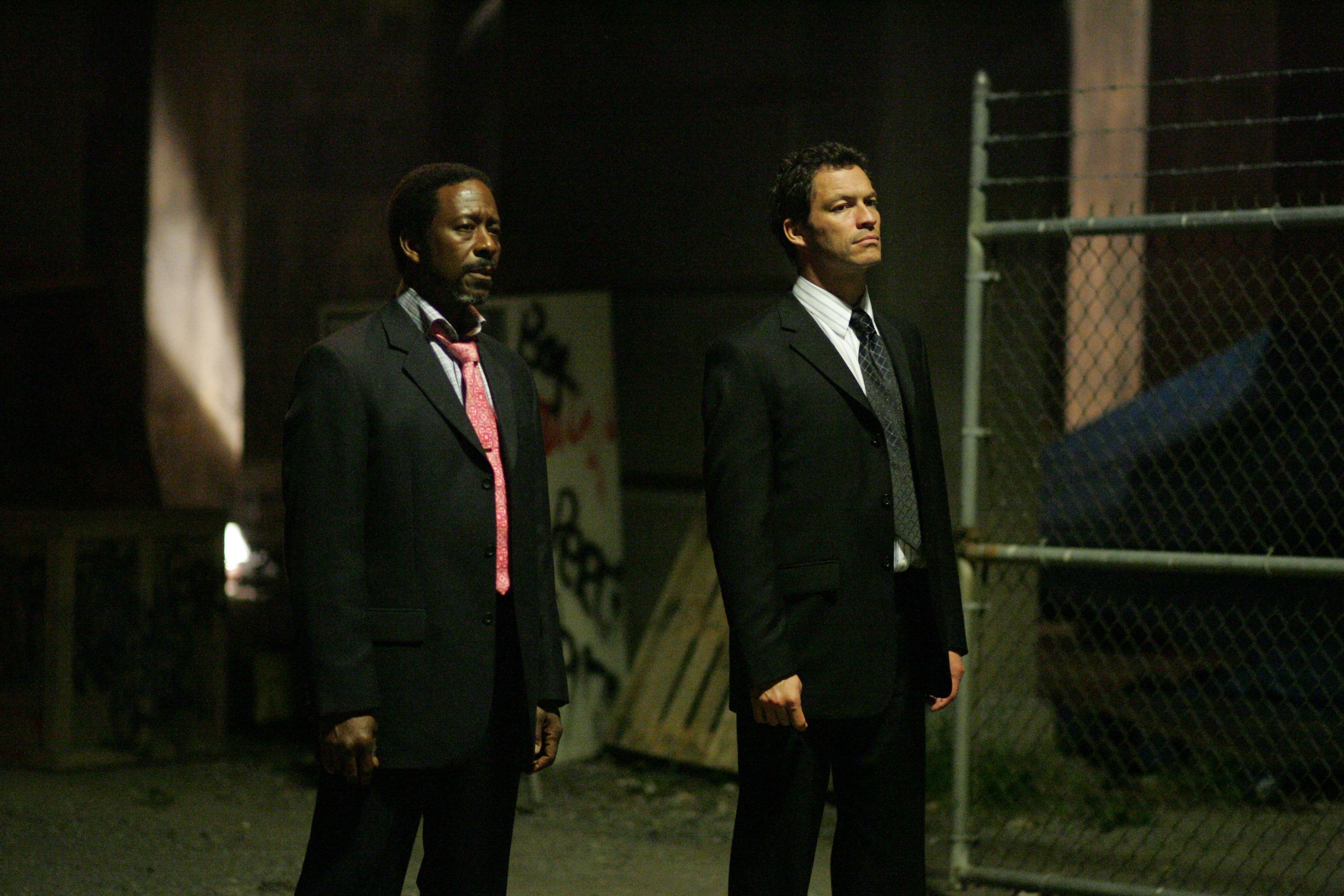
This excellent television show started out as a cop show but it is beginning to broaden into a critical look at the power structures of contemporary America. It warrants critical engagement as this is no ordinary television ( such as CSI and Law and Order). It is a visual realist "novel" about race and class in the city of Baltimore in Maryland, USA.
My initial experience of the early episodes was that it was like a jigsaw puzzle due to the lack of a unified vision, the tacit narrative spread of a season, the refusal to grant closure and disciplinary power determining the existence of everyone. The show’s creator, David Simon has pointed out that The Wire is:
really about the American city, and about how we live together. It’s about how institutions have an effect on individuals, and how … whether you’re a cop, a longshoreman, a drug dealer, a politician, a judge [or] lawyer, you are ultimately compromised and must contend with whatever institution you’ve committed to.
The Wire presents us with a tangled web of bureaucracy and confusion with personal rivalries and hierarchies, budgetary issues and questions of protocol preventing different departments from working together effectively.
August 29, 2009
the tourist gaze
Mining tourism signifies Broken Hill in NSW, Cooper Pedy in SA, Kalgoorlie in WA and Queenstown in Tasmania. Tourism in Australia today is big business. Mining tourism generates jobs and investment.
The focus is on the heritage of the industry, landscape and the way of life, not the environmental damage caused by economic progress and the desire for prosperity in regional Australia. Heritage in this context, refers to history processed through mythology, ideology, nationalism, local pride, romantic ideas or just plain marketing, into a commodity'.
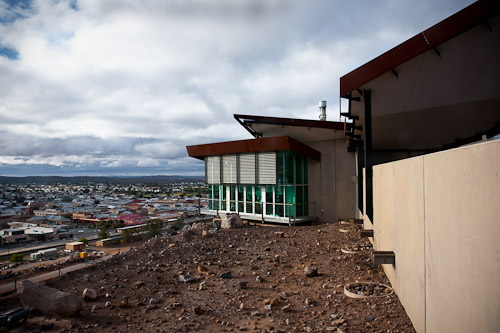 Gary Sauer-Thompson, Broken Earth Restaurant, Broken Hill, 2009
Tourism is about pleasure, travelling, holidays, strange places, desire, leisure, play, consuming goods and services and being modern. Part of the tourist experience of moving through space is gazing upon a scene, landscape or urbanscape; a gazing upon that is socially constructed in diverse ways in different historical periods---eg., 'timeless romantic Paris'; real olde England, the authentic Outback etc. Hence the tourist gaze.
On the one hand, we have the professional dynamics and changing forms of media that produce such public representations.Today this tourist gaze is constructed, and reinforced, by film, TV, literature, magazines, photography and videos, often in terms of travellers (elite) and tourists (mass), of experiencing the real life of others from tourist spaces such as platforms, sites, cafes etc. which are reconstructed for visual consumption.
On the other hand, photography also plays a central role in the creation of a tourist experience, by framing the tourist gaze and 'fixing' an ephemeral view that is then shared with others.
August 28, 2009
Adelaide: an innovation city?
Cities are recognized as major economic drivers. Innovation is the answer to finding a way out of a financial & broader crisis (and it is recognized by most economists [alongside productivity] as the only true source of sustained economic growth). Cities that innovate now tend to outperform economically later.
Is Adelaide an innovation city ? Does it support innovation? Does it have a culture for start-ups --a Silicon Alley or Beach as it were?
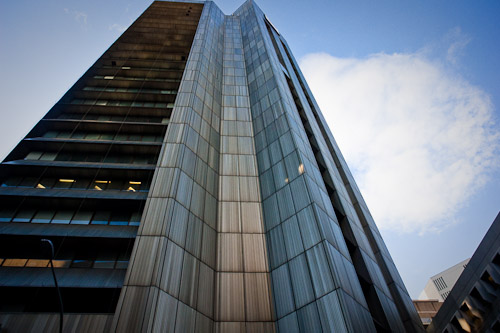 Gary Sauer-Thompson, Telstra, Adelaide, 2009
An example of innovation from here. In order to meet the energy reduction targets that are set as countries or as cities, as states and counties in any of the schemes that are put in place, then web need to address the building sector. In the urban areas, we see as much as 60%, 70%, 80% of the energy consumption in the building sector as opposed to the other two sectors, which would be transportation and the industrial sector.
Adelaide ranks lowly.
August 27, 2009
new visual grammars?
Newspapers and print magazines are doing it tough with discussions about the end of newspapers frequently revolving around whether newspapers can be sustained and the potential and possibilities of new media forms. What then happens to visual narrative?
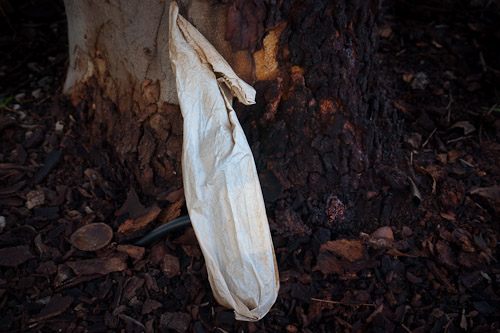 Gary Sauer-Thompson,bottle, Adelaide parklands, 2009
In The End of Newspapers: Reality and Information at the Foto8 blog it is observed:
Over the last fifteen years or so we have witnessed the emergence of new kinds of visual story-telling. Digital photography gave us instantaneous feedback; camera phones gave us ubiquitous photography; picture-sharing sites gave us a developing social milieu in which these instant and ubiquitous pictures could be shared. None of these factors were specifically reasons that contributed to the transformations of the print news industries, but they are part of a larger technological shift that – if not the cause of the end of newspapers- establishes the setting where mass visual communication will find its new parameters, take shape, evolve, and resolve, and, inevitably, continue to transform.
As a result, it is said, we have new formal models for presenting visual information.
In online video: first person address has specific implications in terms of validity; short videos as posted online make their case in ways very different than documentaries have traditionally. There is more documentary feature production than ever before. Still images are organized as slideshows, browse-and-enlarge albums, or in an irregular temporal flow. How does the short form slideshow speak differently than a flat magazine spread?We not have a linear display of images. Consequently, these new formal properties will redefine visual grammars and inform how and of what photographers make pictures, but they will also be subject to the new contexts and frameworks that will continue to emerge.
August 26, 2009
a reflective moment #1
Coffee and loneliness In becoming thrown into loneliness within the city, we become reflective about what has been ruined and our fragility for goodness.
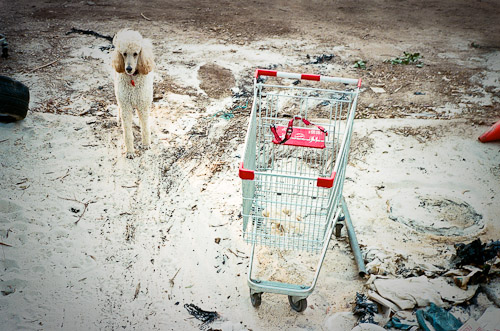 Gary Sauer-Thompson, Adelaide Parklands, 2008
The ruins and fragments of the past live on into the present but the stories that they provide us with are never wholly consistent. Ruins invite competing and contradictory narratives about time and identity. More broadly, the ruin places under question the notion of history as a sequential narrative, whilst at the same time insisting on its own historicity.
The ruins of the industrial capitalism encapsulate a lament for worldly failing, a regret for the passing of time and an anxiety about being hurt, feeling vulnerable within the becoming digital world.
alleyway life
Unlike Adelaide's alleyways I've always found Melbourne's alleyway's fascinating spaces to explore as a rich and colourful art can be found in the multitude of alleyways. This street art is in contrast to the random urban violence.
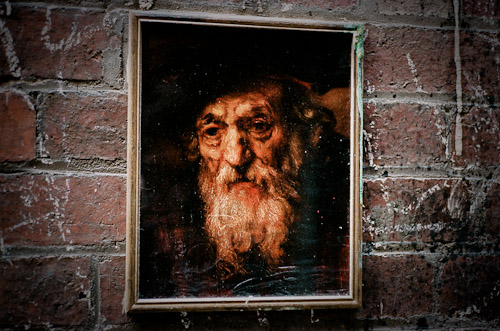 Gary Sauer-Thompson, near Brock Place, Melbourne CBD, 2008
This public art is supported by the Melbourne City Council that is able to distinguish between graffiti and street art -as indicated by its policy of laneway commissions. It realizes that this kind of public art situates Melbourne in the tourist market as an interesting, vital and culturally alive city. In Adelaide a lot of interesting work is scrubbed out by the Adelaide City Council.
As a result of the Council's policy of keeping the city graffiti free, Adelaide's street art is hidden away in odd places in the CBD:
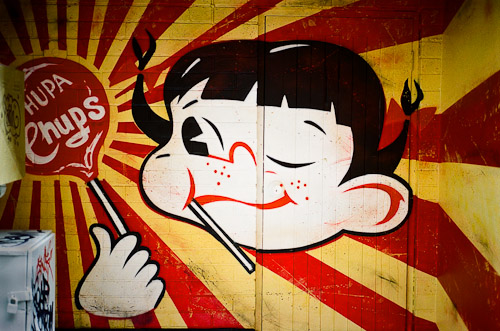 Gary Sauer-Thompson, near Currie Street, Adelaide CBD, 2008, Adelaide, 2008
They have community paint out days in family friendly Adelaide--its fun, so bring the kids. The Council's policy is that:
All graffiti is illegal and as such various avenues are available for taking legal action if the culprits can be apprehended.The graffiti culture consists of an orchestrated effort by a core group of people, aswell as spontaneous acts that are motivated by the desire to vandalise property. Graffiti and vandalism are related and the act should be referred to as “graffiti vandalism”.
The “graffiti artist” is not recognised under this policy as traditional artists seek permission from property owners before they start work on a project.
August 24, 2009
sign of the times
Photojournalism means the photographers can tell the story themselves in pictures, and a couple of decades ago there were places where they could publish those photos. In the print world, many, if not most, of those places have since disappeared. So how is visual storytelling taking place in a digital world?
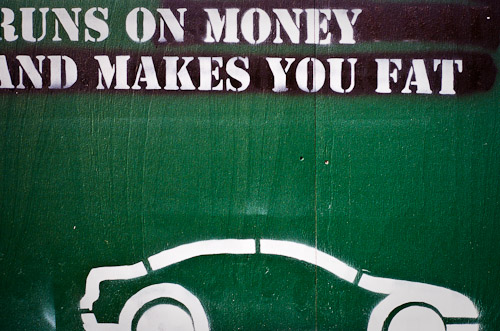 Gary Sauer-Thompson, street art, Adelaide CBD, 2009
David Jolly in the New York Times says:
Newspapers and magazines are cutting back sharply on picture budgets or going out of business altogether, and television stations have cut back on news coverage in favor of less-costly fare. Pictures and video snapped by amateurs on cellphones are posted to Web sites minutes after events have occurred. Photographers trying to make a living from shooting the news call it a crisis.
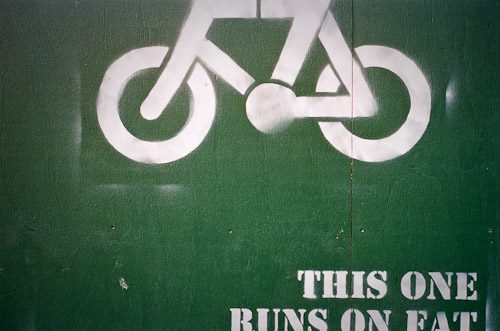
The great benefit of not using pictures is that you don't need photographers! Do we need visual story telling?
 Gary Sauer-Thompson, street art, Adelaide CBD, 2009
Jolly adds that both Getty Images and Corbis--the two major stock photo companies--recently:
rose to prominence by buying up hundreds of image archives and making them available for sale online. While they do continue to sponsor photojournalism — Getty Images employs 130 photographers around the world — the companies are, in effect, services for managing digital property rights.
In effect photographers need to create their own stories in a digital world. What then, after they have been published on the web--on Fickr or a weblog?
August 23, 2009
Romanticism: mirror versus lamp
The Romantics, many hold, understood morality as they understood art--as the means by which the artist does not imitate nature but rather creates a world of his own. But was this the Romantic aesthetic?
Did Romantic art really seek to reject (as M. H. Abrams argued in a famous study ) art as the mirror (as invoked by older, mimetic theories) to become a lamp, shining by its own unreflected light---the light of the writer's inner (the dynamic unconscious) poetic soul spilled out to illuminate the world.
There was a shift from the mimetic to the expressive----Romanticism was the rebellious child of modernity---and no doubt there are cases that fit this dualistic mirror/lamp model, but surely the opposition between mirror and lamp is too schematic? The lamp (the artist's gaze) shines on something, does it not, even if an expressive art is grounded in affective memory?

Is not European romanticism concerned with a dead nature caused by industrial capitalism as well as the return into ourselves? Is not European romanticism also concerned with the dualism of the subject object split in the modern philosophy of the Enlightenment? With organic form in opposition to that of the machine? With the value of belonging to a community?
The romantics did not abandon Aristotle--they reinterpreted him as an organicist rather than a mechanist--- as they placed an emphasis on creativity and imagination in their turn away from the classical standard of unity. What we have inherited from the Romantics is the idea that art expresses our experience of the world, even as its forms of expression extend our experience beyond what the world simply gives us.
August 21, 2009
from grid to network
Mark C. Taylor, The Moment of Complexity: Emerging Network Culture explores the well known shift from the ‘grid’ to the ‘network’ that has being taking place since the 1960s.
He says that the grid is the figure of modernism and it finds its most cogent early expression in the ideas of Le Corbusier, whose attachment to the rectilinear, the straight and the machine-like was exemplary of the rationalizing, formalizing and standardizing drive of industrial Modernism, as evinced by the scientific management principles of Frederick Winslow Taylor and the production methods of Henry Ford. For Taylor, Mies van der Rohe is the greatest architectural devotee of the grid. His work for the Illinois Institute of Technology (IIT) eschews ornament and is so pristine and simple that it is the expression of the analytic simplicity and rational organisation of modern industrial society.
His interpretation of Robert Venturi, Denise Scott Brown and Steven Izenour 's Learning from Las Vegas, a text that is popularly supposed to have defined and initiated architectural postmodernism that engaged with the complexities of a world dominated by mass media and a concomitant endless play of signs, stood for embellishing standard Modernist rectangular boxes with eclectic significatory elements. The apogee of this approach is Philip Johnson’s famous AT&Tbuilding, which is a Modernist block surmounted by the shape of a
Chippendale highboy.
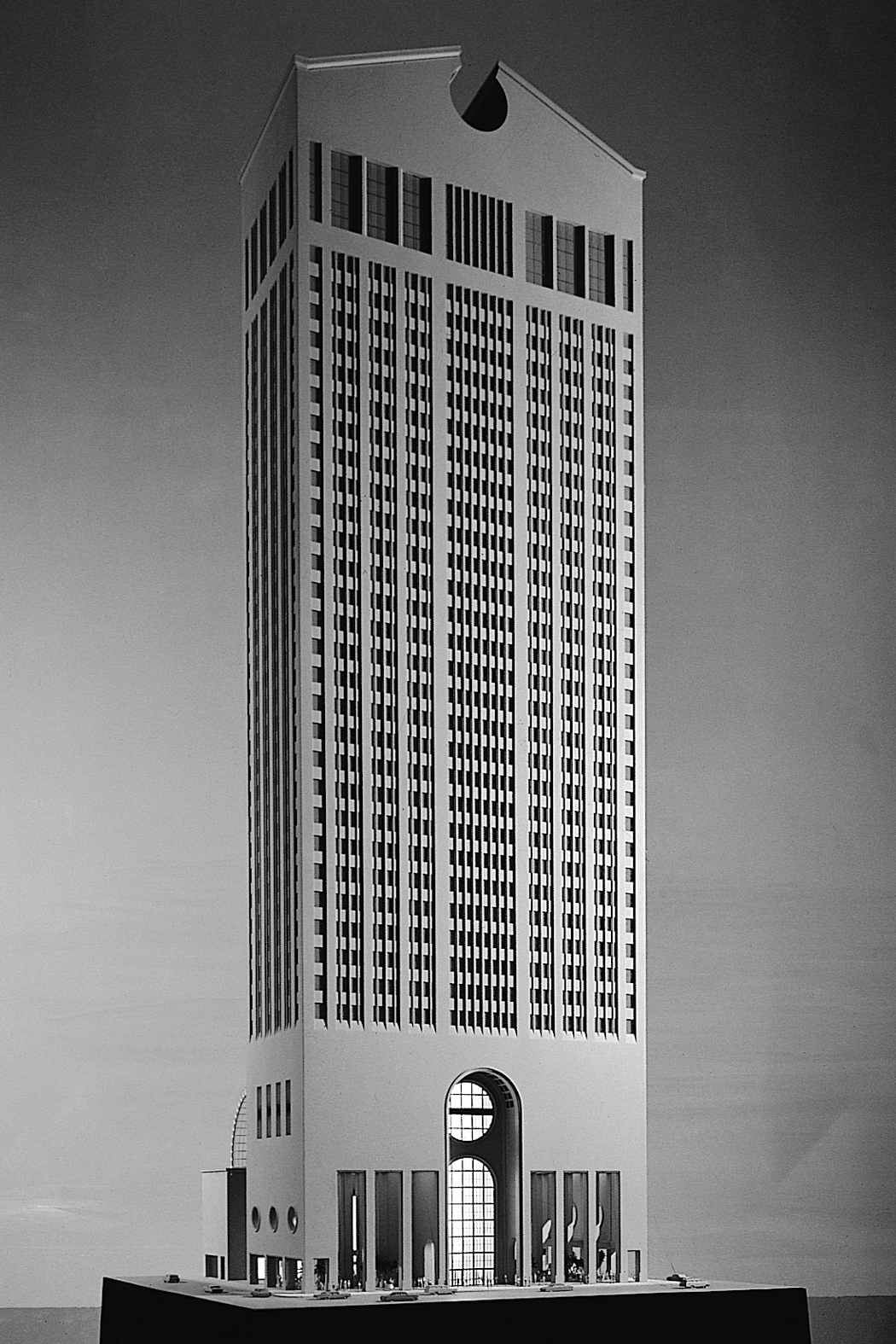
Postmodernism looks back to Modernism by embellishing modern blocks and boxes and so falls short of being able truly to express the emerging world of information communications technologies.
Taylor puts it thus:
The failure of classical postmodern architects to develop alternative forms and structures reflects a society that is no longer industrial, but not yet postindustrial. By creating an architecture around the automobile, Venturi, Johnson, and others remain stuck along the industrial highway and do not venture into the world created by the information superhighway. Their complexities are not complex enough. In network culture, not only surfaces but structures that once seemed simple become irreducibly complex. (p. 40 emphasis in original)
Taylor's text is structured in terms of a move from the grids of modernism to the networks of complexity via the critical perturbations of postmodernism.
August 20, 2009
Russian Constructivism
The Tate Modern has an exhibition on Russian Constructivism--- they were part of the Russian avant garde in the early 20th century that rejected all ideas of illusory representation.
Constructivist art is committed to complete abstraction with a devotion to modernity, where themes are often geometric, experimental and rarely emotional. Rodchenko focused on the physical qualities of the painting: the use of different paints and different textures, and how these related to other elements such as the painting surface, or the choice of colour.
 Alexander Rodchenko, Composition no 61, (from the series 'Concentration of Colour'), 1918
Artists like Rodchenko did not believe in abstract ideas per se; rather they tried to link art with concrete and tangible ideas. Early modern movements around WWI were idealistic, seeking a new order in art and architecture that dealt with social and economic problems. They wanted to renew the idea that the apex of artwork does not revolve around "fine art", but rather emphasized that artwork can often be discovered in the nuances of "practical art" and through portraying man and mechanization into one aesthetic program.
Rodchenko rejected ideas of 'Composition' – a subjective approach to art that expressed the personality of the artist, guided by ideas of taste and emotions – in favour of 'Construction', a more impersonal method dictated by the materials at hand and stripped of anything decorative or unnecessary. The painting is presented as a single physical object, with raw colour as its essential material:
 Alexander Rodchenko, Pure Yellow Colour, 1921
This is pretty much the Russian version of modernism. The principles of constructivism theory were derived from three main movements that evolved in the early part of the 20th century: Suprematism in Russia, De Stijl (Neo Plasticism) in Holland and the Bauhaus in Germany.
August 19, 2009
a 'remix' culture
In Open Content Licensing: Cultivating the Creative Commons edited by Brian Fitzgerald brings together papers on a conference on the internet, law and the importance of open content licensing in the digital age. It can be accessed here on the creative commons and offers insight into what is emerging through blogging and Flickr.
One of the papers ---The Vision for the Creative Commons: What are We and Where are We Headed? Free Culture is given by Lawrence Lessig, says that we have just ended 80 years where culture is broadcast to us. Our experience of it is that we consume it. This culture is made somewhere else, and we passively consume it. The good in culture on this model is more channels.
In a digital economy, by contrast, there is the emergence of a cut and paste culture---an active process of remaking and remixing culture, for that is what we doing with our digital technology. Lessig says:
In the context of music, the Beatles created this amazing album The White Album, which of course inspired Jay-Z to create this album, The Black Album, which then in the expression of what remix is today, inspired this guy, DJ Danger Mouse, to create The Grey Album, which synthesises tracks from The White Album and The Black Album together to produce something different.
This is quite different from piracy, which has given rise to the barbed wire fence of intellectual property protections that protect copyrighted work but in the process kill this potential for remix. He says:
You cannot take a film class and invite the children to take the work of George Lucas and mix it together with Hitchcock and produce a demonstration of how the work of these two film makers worked and interacted. You cannot do that because that is called piracy under the regime of understanding that exists in intellectual property law today. We cannot begin to teach this literacy in our schools, so the capacity, the potential, is destroyed because we call it illegal. That is the critical point.
Digital rights management technology is being mandated by the law to be incorporated in every feature of this network, so that the permission to engage in these acts of creative remixing needs to be sought from the content owner, and guess what? Their permission will not be granted.
The settlement is that we have strong digital rights management through all of our content, but a liberal quote ‘fair use policy’, where by fair use we mean we get to make 3 or 4 free copies.If you buy this content, you get to make whatever number of free copies but those copies live only within the home. What remix culture needs is not the freedom to remix within your home; that is not what you need; you need the freedom to remix and to express it to others – the freedom which our tradition guaranteed to us when it came to text.
We need to find a way to use IP to enable free culture. That is the aim of creative commons – to find a simple way to mark content with the freedoms that the author intends the content to carry, so that when you encounter such free content, you know what you are allowed to do consistent with the law.We need to find a way to make the freedoms understandable, unchallengeable and usable in a digital age – understandable by ordinary people, unchallengeable by lawyers, and usable by computers.
The aim is to bring IP into the 21st century, to make remixing writing, image making and music etc legal in the 21st century. Technologists have given us a way to write. The lawyers have told us that way is illegal today. Hence the idea of the creative commons.
August 18, 2009
Michael Keena: Ratcliffe Power Station
I mentioned that I'd photographing down and around the new development along the Port River estuary in the previous post. So I have been looking for photographers who approach the subject differently to me. One is Michael Keena's series on the coal-fired Ratcliffe Power Station that dominates the sky in Nottinghamshire, England.
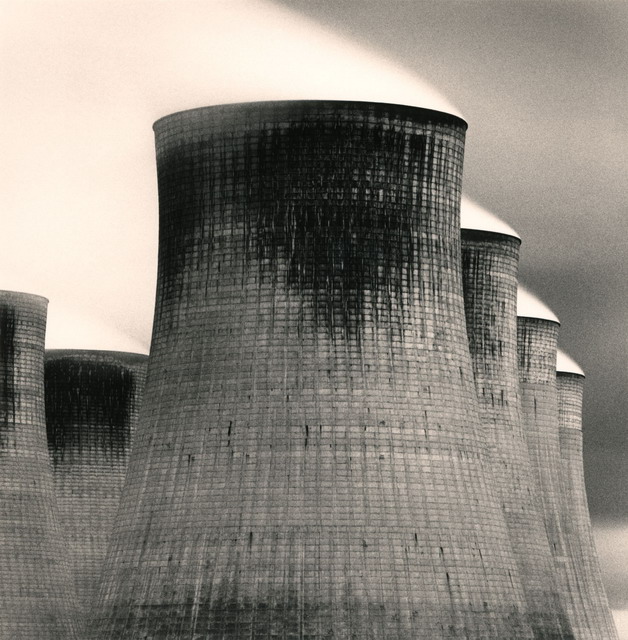 Micael Keena, Ratcliffe Power Station, Study 55, Nottinghamshire, England, 2000
Kenna first began photographing the power station in the early 1980s, and over the past several years he has visited the site many times. The work is characteristic by strong form, long exposures and night imagery.
He says in an interview in Double Exposure that he is interested in the relationship and juxtaposition between the landscape and the structures that we humans leave behind. I look for traces of the past, atmospheres and stories that are left for us to decipher and decode.
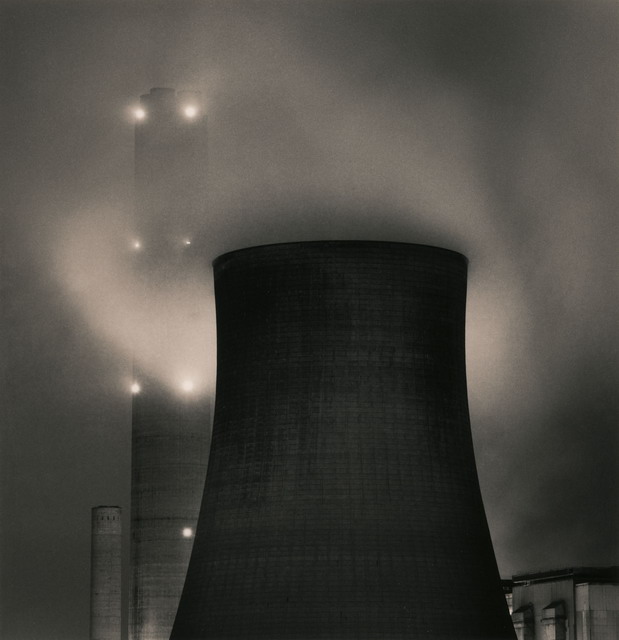 Michael Keena, Ratcliffe Power Station, Study 63, Nottinghamshire, England, 1989
He says that he prefers:
suggestion over description. I like to use the analogy of haiku poetry where just a few elements act as catalysts for one's imagination. Often I make long time exposures so that detailed water becomes floating mist, clouds in the sky become blurred masses of tonality and a populated scene becomes empty. The world is pretty chaotic, seemingly always speeding up and getting louder and more visually dense.
His black and white images transform familiar locations into places of ambiguous intrigue. The words "ghost-like presence” and phrase an "ominous beauty a little bit fraught with danger” suggest the approach. What is avoided is the direct, the explicit and the confrontational.
Rolling Stones: Foret Nationale Concert, 1973
I returned to exploring Wolfgang's Vault last night after a photographic excursion down and around the new development along the Port River estuary. I was feeling nostalgic.
This time I checked out the Rolling Stones archive---- the only concert is the Foret Nationale Concert (Brussels, Belgium) from their 1973 European tour.

This was after Exile on Main St. and Goat Head's Soup ---ie., the Mick Taylor era of the Rolling Stones. The band is energetic, on top of their game, the sound is good. Surprisingly there is the conventional delineation between rhythm (Richards) and lead guitar (Taylor) parts.
This period of '69-'74 is the musical highpoint of the Rolling Stones as a live band--- as opposed to image and celebrity. This Foret Nationale concert is better than Get Your Ya Ya's Out of 1970. It has been a popular bootleg amongst fans ( it is known as "Brussels Affair" and/or Bedspring Symphony) is in superb stereo sound, and is often considered a 'lost classic'.
Taylor left the band after It's Only Rock 'n' Roll, and the group recorded their next album as they auditioned new lead guitarists before settling on Ron Wood. The music was never as good as then:
The Stones were a guitar driven band but Richard's classic riffs need a lead counter-point and Mick Taylor was it.
August 17, 2009
Sante Fe: Steve Fitch
Through the Lens: Creating Santa Fe is a visual history of Santa Fe, New Mexico — as it celebrates its 400th anniversary as the oldest capital city in North America. This is a city that one that has actively promoted its image as a leading arts destination and the exhibition tells the visual history of place and of the medium that contributed so much to its public invention.
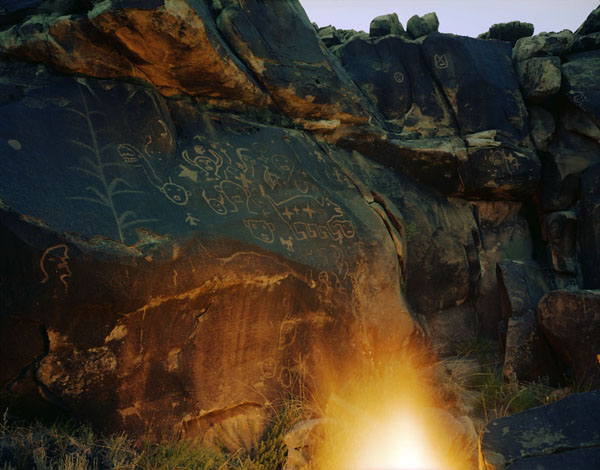
Steve Fitch, A Fire And Petroglyphs at Dusk Near San Cristobal Ruin, New Mexico, July 28, 1983 Type C Print
Fitch's night photography in the 1980s was part of the N.E.A. photographic survey project, Marks in Place. This project which was initiated in 1982 gave five photographers the opportunity to photograph petroglyphs and cave paintings in the American deserts.
Fitch turned to color and the 8X10 camera to record this ancient graffiti by fire light. Fitch was concerned with showing the context of the artwork, he wanted to show a sense of place. Photographing the petroglyhs by fire light enhanced the sense of timelessness and put them in context, as well as conveying the mystery that surrounds this phenomena.
August 16, 2009
Mutton Cove Conservation Reserve
Under industrial capitalism nature is treated as a resource to be exploited for capital accumulation and ecological life forms and wetlands are discarded as of little worth. Often, as Mutton Cove Conservation Reserve on the Lefevre Peninsula illustrates, they are treated as a wasteland and rubbish dump--in this case motor vehicle wrecks and ships.
The Lefevre Peninsula is seen by the state government as an important industrial region that has the potential to generate substantial further economic development benefits for South Australia.
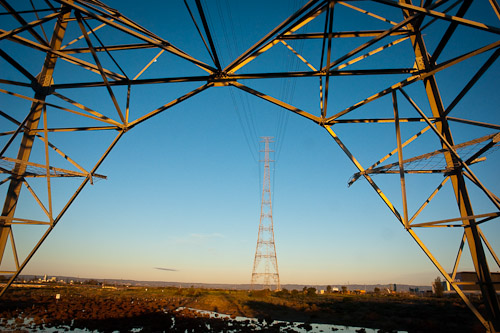 Gary Sauer-Thompson, Electricity pylons, Mutton Cover Conservation Park, 2009
Heavy industry has overrun the Port, and the polluting consequences has been extensive. The ‘reclaimed’ areas around the nearby Pelican Point consist variously of areas of dredge spoil, caustic waste materials from the ICI Soda Ash Plant at Osborne, fly ash and cinders from the Osborne Power Station and pyritic wastes from the Acid Plant at Taperoo.
Industry in the area is hostile to maintaining open space for future expansion along the Port River estuary. The only open space at the moment is the very degraded salt marsh of Mutton Cove --the last remaining biodiverse area of samphire and mangrove woodland on the Le Fevre Peninsula. The cove itself is characterised by tidal restriction caused by a sea wall along the Port River, which impacts adversely on the saltmarsh.
There are promises to enrich, restore and conserve the saltmarsh wetland and to link it to an area called Biodiversity Park. ----It refers to an area of Crown Land (State) located near Pelican Point on the LefevrePeninsula and is approximately 82 hectares in area. What was once a desolate area of reclaimed land used as an unofficial local dump is becoming a landscaped peninsula.
However, I cannot find any public access to this open space around the Pelican Point Power Station. Biodiversity Park is not protected by legislation and policy to ensure the the site is an ecological open space.
August 15, 2009
magic in the plastic
Don Brice's story about become friends with a Diana camera. Brice is a commercial/architectural/professional photographer in Adelaide:
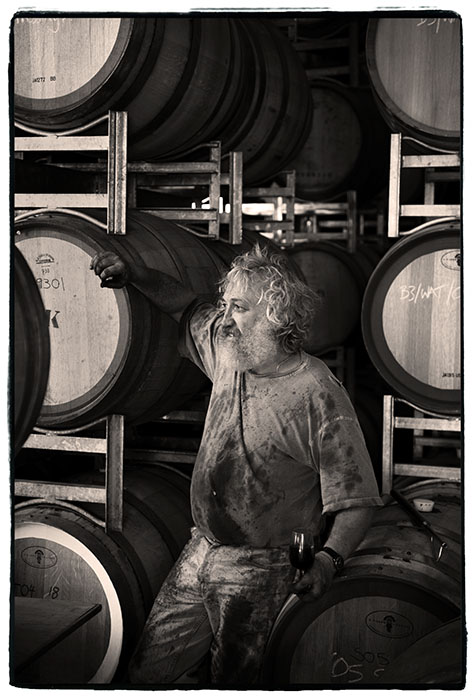 Don Brice, Dave, Skillogalee Winery, Clare Valley, South Australia, circa 2006
Brice also runs an interesting photoblog entitled Blurry Thinking, which explores the magic in the plastic camera.
For Brice a blurry photograph signifies that the image represents more than a simple depiction of the things in the frame as it represents complex issues such as human emotion, memory and dreams. Some of this blurry work was shown at the The World Through a Plastic Lens exhibition at the Blender Gallery in Sydney:
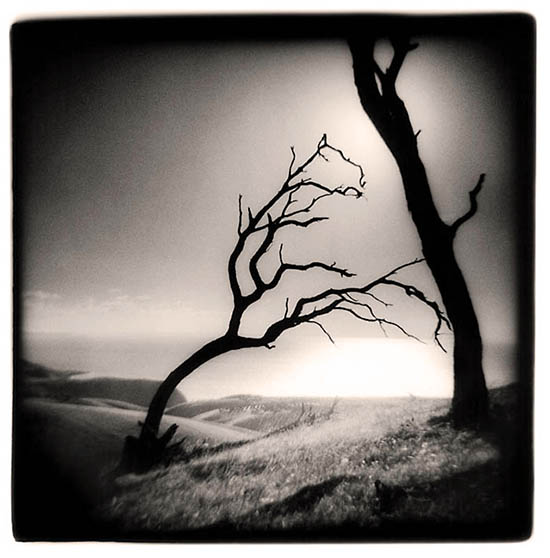 Don Brice, two trees, circa 2007
My favourite series is the signs of life one from Honiara in the Solomon Islands.
August 14, 2009
Music: then + now
It's is 40 years since Woodstock Festival and people are waxing lyrical. Nostalgia is everywhere. As are the myths. The names are ghosts of the musical past. A hallowed memory for many. I did endeavour to relive the music from the Festival by I recently listening to Jimi Hendrix at Woodstock with the newly formed expanded version of ‘A "Band Of’ Gypsies". But I got bored--real bored. Musically nothing much happened.
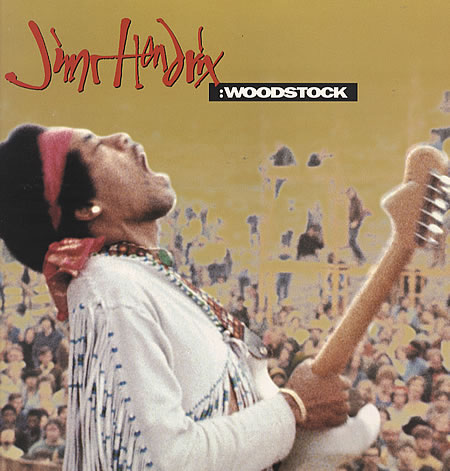
Even the iconic version of his highly-regarded rendition of The Star-Spangled Banner failed to save the tedium of the set The band couldn't match the rhythm section of Mitch Mitchell and Noel Redding of the Experience (which had broken up a mid-1969), and so the more jam-like and experimental pieces were dull. Mostly Hendrix on guitar.
Still, the Woodstock festival began an era. And now?
Courtesy of Tim Dunlop's music blog Johnny's in the Basement I come across a reference to Wolfgang's Music Vault, which I did not know about. It's an interesting site--- a very large collection of concert recordings for free streaming that comes from the folks at Wolfgang's Vault digitizing the huge collection of classic rock concerts he obtained in buying rock promoter Bill Graham's archives. The site’s library was growing larger as they bought the sound archives from the Newport Jazz and Newport Folk Festival.
And the streaming works. I'm testing it by listening to a streaming audio of a short Grateful Dead concert from 1991 at Golden Gate Park (San Franscisco, California) in honour of Bill Graham. That farewell marked the end of an era.
August 13, 2009
economy of appearances
In her Sight Unseen Anne Marie Willis, from Team Des, refers to the rise of the sign-driven economy with its creation of desire through the look, the image, style, brand identity; here too is the dominance of the televisual, of spectacle, of the hyper-real.

This economy of appearances she says:
is vast and diverse, ranging from the mass appeal of techno-realism (such as computer games and cinema special effects) through to the more subtle imagery and precious objects that capture the appreciative gaze of the art critic or connoisseur. ....the economy of appearances is not limited to visual representations of things, it also includes manufanuctured products, materials, buildings and whole environments as they are designed to appeal to the eye.The contemporary environments of dwelling are increasingly becoming worlds of appearance.
In a certain way, she says, we live within the televisual and the computer screen as they are designed (and as they design)according to ever-changing and ever-more nuanced genres of style:
It is more and more possible to think it possible to dwell entirely within the domain of appearances, in which things of the world (clothing, food, furnishings, apartments, cars, appliances, holiday destinations, etc) come to presence primarily as image and style, with their materiality and the relations that constitute that materiality, rendered obscure. The recent evolution of car design (technically and as imaged), exemplifies this well ... as their various functions have increasingly become powered by electronic control systems, the possibility of the car owner ‘tinkering about’ to learn how the car works, is less viable. At the same time cars are increasingly marketed as pure image and ambience, with style and comfort foregrounded....
August 12, 2009
the flâneur
Takaaki Chikamori in a review of The Media City: Media, Architecture and Urban Space by Scott McQuire in Media Culture and Society (July 2009, Volume 26, No. 4) says that while Benjamin’s prominent figure of the flâneur has been mentioned in many literatures on urban modernity, the understanding of the figure seems to have been relatively limited.
This is important as I have adopted the figure of the flâneur as a model for my urban photography.
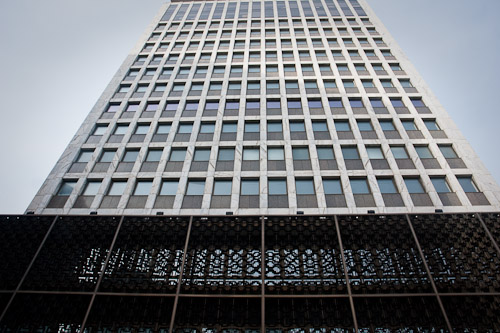 Gary Sauer-Thompson, State Administration, Adelaide, 2009
Chikamori says:
Gary Sauer-Thompson, State Administration, Adelaide, 2009
Chikamori says:
Usually, the flâneur is described as an aimless stroller who enjoys a panoramic view of urban space, or as a detective who holds behind his apparently indifferent attitude a keen attention to the details of people on the street. In each case, a certain position seems to be assigned to the flâneur: a position as a privileged observer who is somewhat detached from the bustling street life. However, when considering Benjamin’s original urban writings, the flâneur sometimes appears as the one who falls out of this assumed detached position. Instead of being aloof on the street, the flâneur can get lost, intoxicated like a hashish-eater, seized by some kind of attractive object and dragged around for a long time almost unconsciously.The practice of flânerie can, then, be seen as a unique technique for getting lost in the city, which is how I understand it.
Chikamori says that the important thing here is that to lose oneself in the city, in the case of flânerie, does not simply mean a situation such as one’s sense of direction getting temporarily confused, or the configuration of streets being too complicated to comprehend. It rather refers to a situation in which one’s system of perception, or the whole system of subjectivity, undergoes a radical transformation. The faculty of mimesis, in which the world is perceived as full of similarities, correspondences and analogies, enables this transformation.
The practice of flânerie is not just about the visual experience, but about the transformation of the whole perception system which is the very condition of the visual experience. Instead of standing as a self-confident subject opposing things and people in urban settings as objective reality, the flâneur begins to lose his distinctive
contours and dissolves into the other kind of reality of the city. Urban memory traces cannot be read by a detached observer, but for an intoxicated flâneur, with his recovered mimetic faculty, the traces can be read as meaningful indexes of the past.
August 11, 2009
Hiroshi Sugimoto, time, Deleuze
Mirjam Wittman in Time, extended: Hiroshi Sugimoto with Gilles Deleuze” in Image and Narrative is concerned with time in photography. There is an earlier post on Hiroshi Sugimoto in which brief mention was made about photography and time. There mention was made of how photography is traditionally attached to the moment of time at which the image came into existence.
In 1980 Sugimoto began working on an ongoing series of photographs of the sea and its horizon in locations all over the world, using an old-fashioned large-format camera to make exposures of varying duration. These seascapes are often interpreted as being as much about the nature of photography as nature itself; and that in negating the horizon, Sugimoto’s photographs reassert or perserve it all the same.
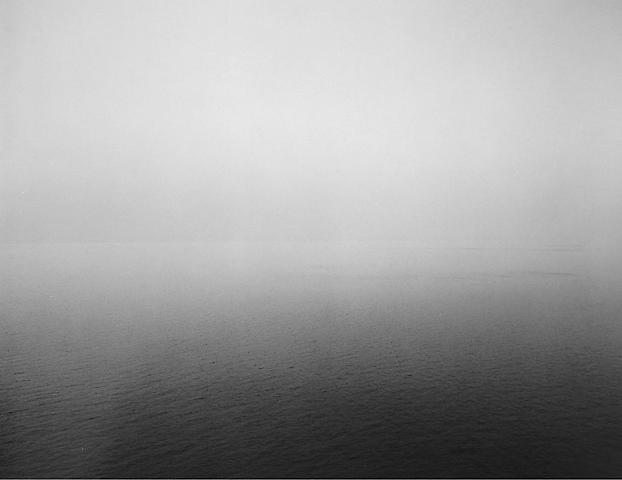 Hiroshi Sugimoto, 'Ionian Sea Santa Cesarea' (1990)
They fall into several basic types: clear dayscapes with crisp, absolute horizons dividing bright, blank skies from dark water; foggy dayscapes where sky and sea merge atmospherically; nightscapes, in which sky, water, waves, and horizon register as so many degrees of black; and dawnscapes shot deliberately out of focus, where sunpaths spill from misty horizons, rendering the candor of photographic vision as pure impressionism.
Wittman is more concerned with time as becoming or growing time and Deleuze's idea of an image of time in his film thinking as a series of simultaneous paths of bifurcations between the “actual” and the “virtual”. Deleuze calls this time-image-one that fluctuates constantly between actual and virtual and records memory-- or a crystal-image. The terms expresses his idea of an image outside of traditional verbal denotation. Does Deleuze’s ‘crystal-image’ of time have much in common with Benjamin’s ‘dialectical image’ of historical time as ‘petrified unrest’?
Wittman interprets Sugimoto's seascapes as time floating around, moving both in a linear timeline, through the moments captured in each single frame, and horizontally, across different images- until the series as a whole could be read as a movie in which all events registered simultaneously.
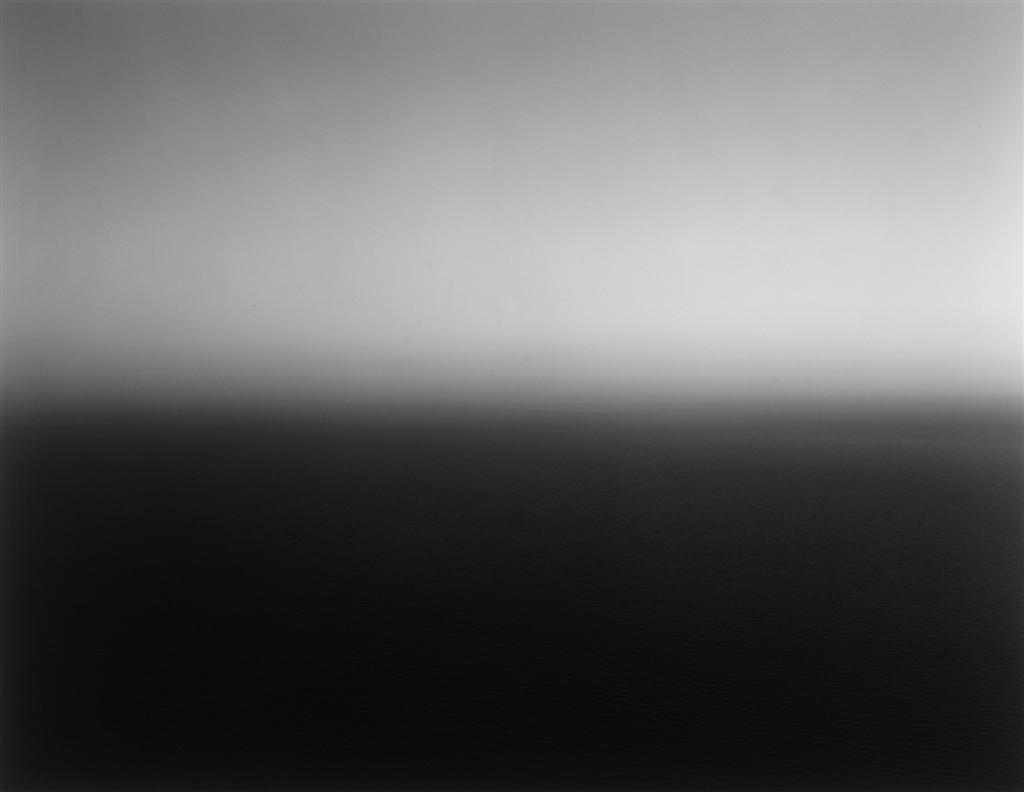 Hiroshi Sugimoto, Mediterranean sea, circa 1990
Hiroshi Sugimoto evokes a sense of time that is floating constantly between reception and production and provokes an understanding of time as event, thereby undermining the notion of the photograph as a frozen moment of time. Although a photograph captures a single moment of time and fixes it on paper, Sugimoto reinforces time as duration and and makes you feel as if time stands still and moves on at the same time.
August 10, 2009
Thierry Urbain
Since 1985 Thierry Urbain (France) has been working on a series on architecture, archaeology and landscapes, particularly the architecture of the Middle East and ancient Mesopotamia.
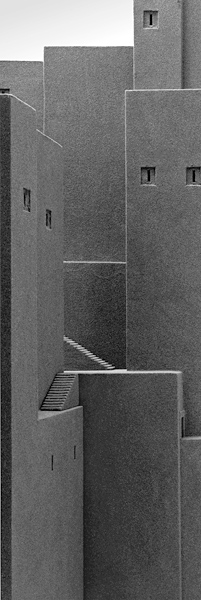 An example is this image from the series Babylon: the Observatories. From what I can gather Urbain's work in this series of work is one in which he imagines, constructs and photographs an ancient observatory in Babylon. Unfortunately, there is little about Urbain on the internet.
What is notable about this work is that it is in the public domain, which is increasingly becoming enclosed by a variety of technologies utilized by corporations to limit fair use in the commons.
It's a fencing off of images through the strengthening of intellectual property rights with digital fences--digital barbed wire. The expansion of property rights is a new kind of property regime. The more property rights the better say the economists. They appear to be dead against the productive power of the commons.
The enclosure of the commons is needed to ensure, or fuel, progress.
A digital text or image, unlike a plot of land, can be used by countless people simultaneously without mutual interference or destruction of the shared resource.
In Fencing Off Ideas: Enclosure and the Disappearance of the Public Domain" James Boyle argues that the logic of enclosure works for the commons of the mind as
well as it did for the arable commons, taking into account the effects of an information society and a global Internet.
Enclosure means increases in the level of rights: protecting new subject matter for longer periods of time, criminalizing certain technologies, making it illegal to cut through digital fences even if they have the effect of foreclosing previously lawful uses.
He adds that we are rushing to fence in ever-larger stretches of the commons of the mind (texts, images) without convincing economic evidence that enclosure will help either productivity or innovation - and with very good reason to believe it may actually hurt them.
Despite this we are witnessing a scramble among the powerful corporations to grab valuable pieces of intellectual property.
Jon Marshall in Internet Politics in an Information Economy in Fibre Culture says:
In the information economy "creativity" becomes a magical term used to carve out property from social and collaborative (or mixed) processes so as to justify ownership. It is usually not the creator who owns but their employer, replicating the capitalist appropriation of labour generally.....Such an extension of copyright also clashes with creativity in general as "information products" are often based on fragments of other information products ....Any information product is embedded in some kind of history and system of other products and schemas.
An example of a countermovement---fostering the commons is Wikimedia Australia organising a Galleries, Libraries, Archives and Museums conference in Canberra (August 2009) and the Powerhouse Museum putting the Tyrrell Collection of glass plate negatives online at Flickr.
August 9, 2009
narrative + pictures
This sample copy of The Journal of Aesthetics and Art Criticism is concerned with narrative. I am interested in narrative because some of my photographic projects --eg., Murray River and Port Adelaide--assume a kind of narrative. They are visual narratives in that a number of the photos as representations are connected in some way.
But what sort of narrative? Stories through images? Narrative is usually meant to refer to telling a story about a series of events connected in a certain way. This story involves a character in some sort of goal-directed action. But my photos are not about events nor do they involve the action of a character. Nor are they a memory around which I construct and reconstruct a life story.
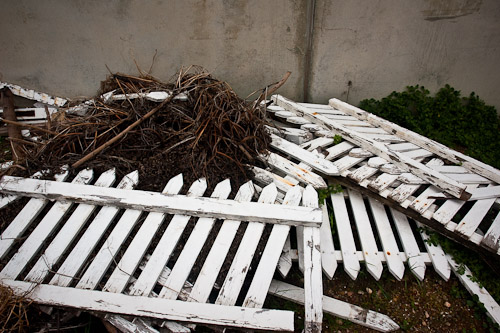 Gary Sauer-Thompson, rubbish, Port Adelaide, 2009
These pictures are more representations of states of affairs than anything else. Can the articles in the Journal of Aesthetics and Art Criticism help to explore what is meant by visual narratives?
In the Introduction to the issue Noel Carroll says that:
as the use of and the discussion of narrative become more common in the culture at large, philosophers are more apt to take notice of it and to start to analyze it, since one of philosophy's charges is to examine the conceptual network of our ideas and categories. Therefore, as the concept of narrative looms larger in our practices, we should expect philosophers to become occupied with it more... one route to the presently awakened philosophical concern with narrative has to do with a renewed interest in aesthetics with particular art forms, specifically narrative ones.
Specifically narrative ones refers to literary narratives and this standardly does not pay too much attention to nonliterary narratives. The assumption is for a narrative, we need at least two events, connected in a certain way.
In Narrative Pictures Bence Nanay argues that:
A naive conception of narrative would be a text or picture where something happens. And something happening usually takes the form of someone doing something. Further, narrative pictures very often, maybe even almost always, represent actions. ...If we want to build an account of narrative around the notion of action, a simple, and not very convincing, way of drawing the distinction between narrative and nonnarrative pictures would be to say that a nonnarrative picture, such as a still life or a portrait, usually represents a state of affairs, whereas narrative paintings represent actions.
Nanay adds that this way of drawing the distinction will not do, as there are portraits that represent the sitter as performing an action. There are narrative paintings where no one performs any action. David's The Death of Marat (1793) is a narrative painting, but Marat does not perform any action in it, as he is represented as dead.
August 7, 2009
Contemporary Aesthetics
I've just stumbled upon Contemporary Aesthetics--an online peer-reviewed journal that began in 2003. it can be seen as a development of Steven Harnard's argument for the need for online self-archiving, free for all, of refereed, published research papers in the on-line PostGutenberg era.
Maybe it is an indication of a renewed interest in aesthetics that is sensitive to the objects of art without either returning to the modernist idea of the autonomous aesthetic of unique works of art that neglected neglecting the historical dimension; or collapsing aesthetics into art history. One that accepts that art and reason are always linked with systems of power (which produce and sustain them) and to effects of power (which they bring into existence).
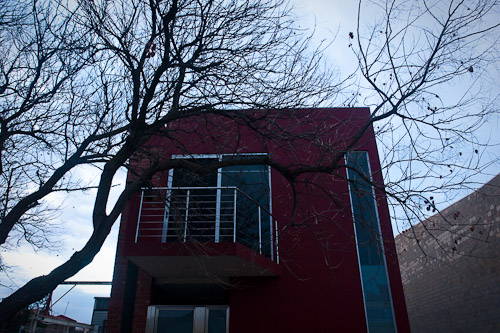 Gary Sauer-Thompson, Gilbert Street, Adelaide, 2009
Will it involve a rethinking of the relations between philosophy, art history and art criticism, be 'a mode of relating to contemporary reality' and locate art within contemporary visual culture. This is a questioning of the autonomous status and distinctive position of art and shifts to define its subject as a history of images rather than art works.
It thus is a rupture from traditional aesthetics in the sense of the philosophical reflection on art that is mainly a legitimization of art's distinctive status in terms of universal and intrinsic qualities such as beauty and the spectator immerse herself comfortably in the images and deriving a narcissistic satisfaction from the experience
August 6, 2009
career shift
So I've made the career shift to photography and blogging ---becoming what could be called an independent intellectual worker rather than an independent scholar. If I'm just a photographer who blogs, then I'm still tentatively feeling my way in this new space, and I'm somewhat unsteady on my feet.
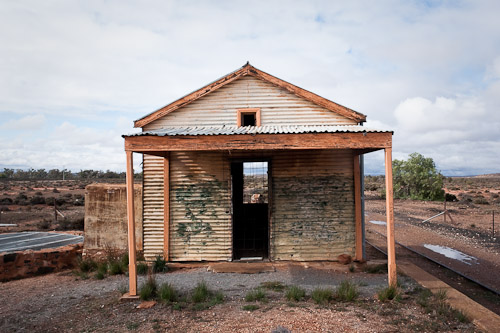 Gary Sauer-Thompson, railway station, Silverton, NSW, 2009
Jeff Ward of This Public Address has said that the time has come for himto make a career shift. He has given up university teaching as a poorly paid “professional writing instructor” in Minnesota (he taught rhetoric for seven years) to become an independent scholar and photographer.
In that post he says:
What next? I suspect that my sidebar for this Public Address 5.0 will change from “rhetorician/photographer” to “photographer/rhetorician”—because photography is always what I have loved the most. I’ve just been away from it for a long time. It’s a large move, physically, from Minnesota to New York. But it’s a small move linguistically.
Like myself and Phil Bebbington whom I mentioned in this post Ward is a blogger and photographer; and so someone who publishes fragments that endeavour to say something that is both creative and interesting. Unlike Jeff I do not have free access to research databases, good university libraries and so I'm dependent on open access.
August 5, 2009
photographs as propositions
Can visual images or photographs be seen as propositions? Yes, if we think of a proposition along with Bertrand Russell as a structured entity with objects and properties as constituents.
The way the photographs are presented on Rhizomes1 as stand alone images indicate a propositional understanding of a photograph. they are isolated self-contained entites. The propositional nature of images in the modernist art institution is simply assumed, and the endless interpretations by curators and critics are spun from these isolated images conventionally defined as propositions.
However, the photography that I did at Broken Hill was interconnected in that some were different images of a single mining structure---The Junction Mine.

These images would then be collected into a collection on Flickr entitled Broken Hill or, as I have done, into a project entitled natural history implying some form of intervisuality.
The poststructuralist notion of intertextuality problematizes the idea of a visual image having strict boundaries, and it questions the dichotomy of 'inside' and 'outside': where does an image 'begin' and 'end'?As Daniel Chandler points out in his Semiotics for Beginners that:
One of the weaknesses of structuralist semiotics is the tendency to treat individual texts/images as discrete, closed-off entities and to focus exclusively on internal structures. Even where texts are studied as a 'corpus' (a unified collection), the overall generic structures tend themselves to be treated as strictly bounded.
Codes transcend structures. Signs are not meaningful in isolation, but only when they are interpreted in relation to each other. Since the meaning of a sign depends on the code within which it is situated, codes provide a framework within which signs make sense. Indeed, we cannot grant something the status of a sign if it does not function within a code. David Chandler says:
Even an indexical and iconic sign such as a photograph involves a translation from three dimensions into two, and anthropologists have often reported the initial difficulties experienced by people in primal tribes in making sense of photographs and films, whilst historians note that even in recent times the first instant snapshots confounded Western viewers because they were not accustomed to arrested images of transient movements and needed to go through a process of cultural habituation or training.
As Elizabeth Chaplin puts it, 'photography introduced a new way of seeing which had to be learned before it was rendered invisible'. What human beings see does not resemble a sequence of rectangular frames, and camerawork and editing conventions are not direct replications of the way in which we see the everyday world. When we look at things around us in everyday life we gain a sense of depth from our binocular vision, by rotating our head or by moving in relation to what we are looking at. To get a clearer view we can adjust the focus of our eyes. But for making sense of depth when we look at a photograph none of this helps. We have to decode the cues.
So much for the modernist idea of photographs as propositions.
August 4, 2009
photography and rhetoric
If rhetoric is not stylistic ornamentation but persuasive discourse, then rhetorical forms are deeply and unavoidably involved in the interpretation of realities by visual media.
 Andrew Wyeth, Christina's World, 1948, Tempera
The painting shows a woman named Christina Olson, who had an undiagnosed muscular deterioration that paralyzed her lower body, dragging herself across the ground to pick flowers from her garden.
Photographs can also be seen as subtle rhetorical constructions, and ultimately rhetoric and photography are intellectual twins.
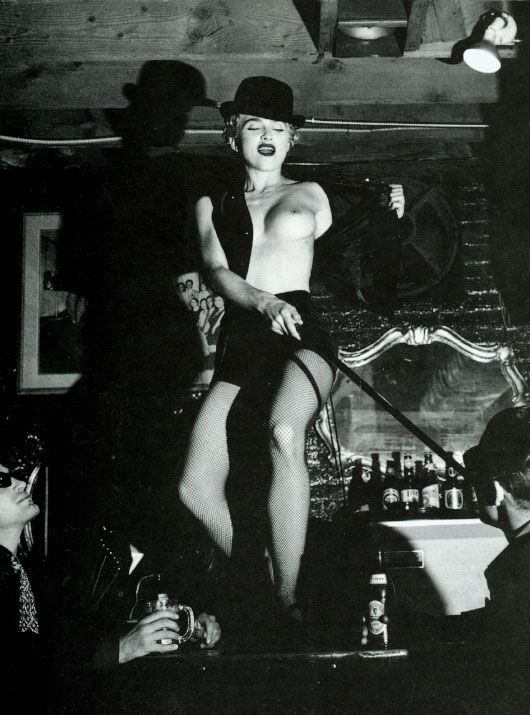 Helmut Newton, Madonna Dancing on Bar with Bottle, Hollywood, 1990
So we have the idea of visual rhetoric, which refers to the ways that visual images communicate meaning. Visual rhetoric is broader than the specific concepts of design or aesthetic theory as it describes how images reflect, communicate, and even shape cultural meaning. Visual literacy involves all the processes of knowing and responding to visual images as well as the ideas that inform the construction or manipulation of cultural images.
August 3, 2009
photography + semiotics
Photography basically aligned itself with positivism in the 19th and early 20th century. Hence the idea of it's likeness or resemblance to what it represents, photography being a mirror of reality; representing truth; photography as objective recording of the facts; photography as realistically rendering what it represents. And so.
This view of photography is deeply held in our culture, in spite of the acknowledgment or recognition that a photograph is an interpretation of what is due to the person using a machine to take the photograph. We become so used to such conventions in our use of various media that they seem 'natural', and when we take these relationships for granted we treat the signified as unmediated or 'transparent', as when we interpret television or photography as 'a window on the world'.
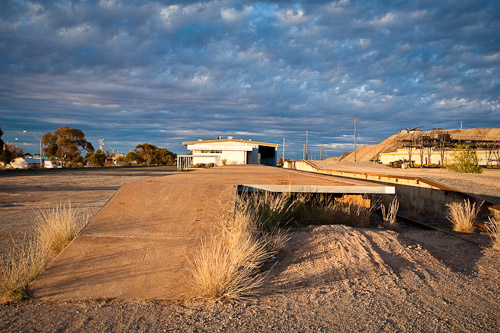 Gary Sauer-Thompson, Enterprise Development Centre, Broken Hill, 2009
A growing consensus is that though analogical photography is a fine technology, it is often deemed to have failed: it has failed to give us the world. Our expectations of it are so loaded it has no choice but to let us down in terms of truth. Thus we become aware of how signs are related to their signifieds by social conventions.
The critique of photography as reportage, photojournalism and documentary, which are founded on a positivist understanding of photography has centred on this resemblance claim. It highlights photography's semiotic or coded structure to our culture as well as its indexical relationship to the object. The image or sign refers to other other images and signs as well as to the real buildings and urbanscape. We are dealing with signs, not with an unmediated objective reality, and sign systems are involved in the construction of meaning.
The rhetoric of a photograph-- eg., a tourist image of Broken Hill that seduces us to visit the silver city---requires the semiotic reference to other images (intertextuality) as well as the "I have been there", and this opens up the different interpretations of a photograph by viewers depending on the context. Meaning is not passively absorbed but arises only in the active process of interpretation. Our systems of signs speak to us as much as we speak in and through them.
Those who control the sign systems (eg., the mass media) control the construction of reality.
Waterhouse Prize 2009
The Waterhouse Prize for natural history art has just concluded. The categories are paintings, works on paper sculpture and objects and youth art prize.
The overall winner is was Matilda Mitchell's (NSW) painting Fish. My favourite was:
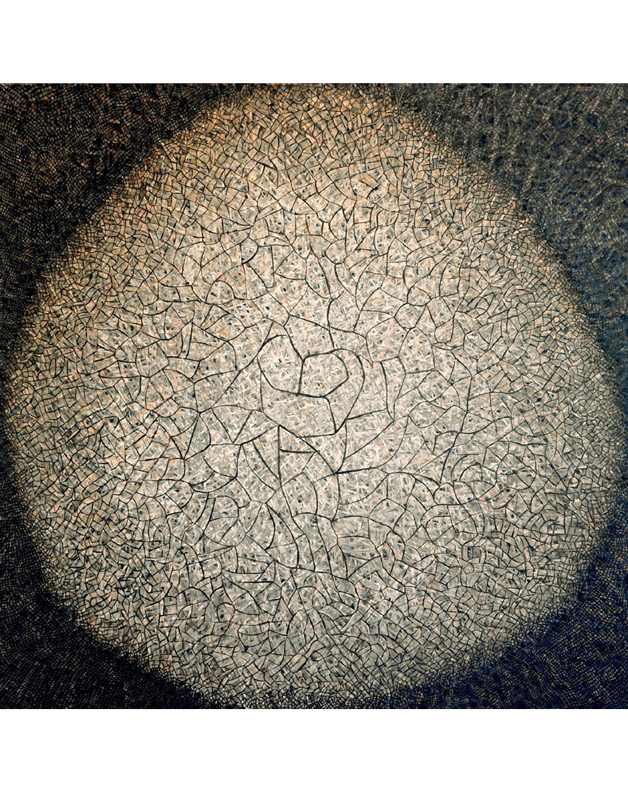 Loreta Devjak (NSW), Egg, Acrylic and oil on canvas
I was disappointed that the works on paper did not include photography--isn't a photograph a work on paper? The exclusion of photography from natural history art strikes me as unwarranted.
August 2, 2009
Broken Hill's "brownfields"
The old mining infrastructure dominates the city of Broken Hill, and it is increasingly becoming disused as the mining winds down due the mines being mined out. The question then arises: --what do you do with the outmoded mining infrastructure that dominates the cityscape?
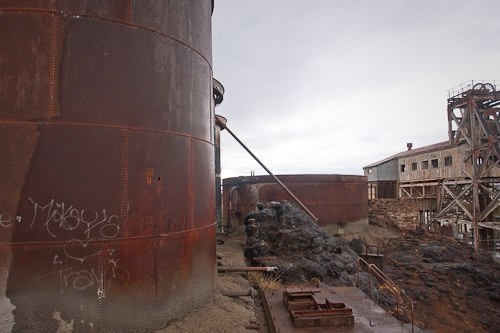 Gary Sauer-Thompson, Junction Mine, Broken Hill, 2009
This is a pressing question for the silver city since it is, by necessity, in the process of reinventing itself as a heritage/tourist destination for domestic tourists. As this submission to the Productivity Commission Inquiry into the Conservation of Australia’s Historic Heritage Places says:
Heritage and cultural tourism have become an integral part of Broken Hill’s future. The fixed life of the mining industry has led the city to focus on sustainable cultural tourism as an important area of growth with heritage as its major selling point.
How do you, for instance, turn the Junction Mine space or site into a new kind of public recreation space?
Should you turn a discarded industrial wasteland into a civic amenity? Martin Filler in Up in the Park in the New York Review of Books offers some insight. He says, in reference to the US, that:
Many architectural preservationists were slow to concede the historical merit of utilitarian landmarks until the 1960s and 1970s. An unusual reclamation project from that period looms larger in hindsight: the land-scape architect Richard Haag's Gas Works Park of 1970–1975 in Seattle, which recycled a defunct gasification plant into a new kind of public recreation space. Haag perceived the raw beauty of the lakeside site's abandoned mechanical components—monolithic tanks, totemic gauges, Mondrianesque pipelines—and incorporated them into his scheme as found objects. Haag's novel idea outraged traditionalists (not least the park's principal benefactors, who refused to have it named after them), but to others the concept seemed reasonable at a time when artists like Mark di Suvero and Alexander Liberman were appropriating I-beams and drainage culverts for their monumental outdoor sculptures.
Another example mentioned by Filler is in New York City: a linear park superimposed on the eponymous long- defunct cargo railroad trestle that wends through nearly a mile and a half of Manhattan's West Side from midtown to Greenwich Village ---known as the High Line.
Though there are a couple of heritage trails or walks in Broken Hill, at the moment Junction Mine is an old industrial infrastructure with a wire fence around it for safety. There is a space for cars and the site favoured by locals for a quite moment sitting in their cars. They just dump their junk food (MacDonalds etc) litter on the ground and drive off. It's all rather sad and derelict.
August 1, 2009
making photography central
I've been trying to gain a picture of what devoting more time to photography so that it becomes more central in my life would mean. What change of lifestyle is required to achieve this? What needs to shift? What needs to be put into place? What sort of things are involved? How does one establish a presence as an art photographer after the digital turn?
The core answer is that the first step needs to be one ion which paid work ispushed into the background so that photography becomes the centre of one's life. That effectively means a reduced income and a far more simplified lifestyle. And that means a retirement from paid work, and it is this shift that gives the time that is needed to do photography.
One example of this approach is Phil Bebbington who runs a photoblog and is known as terrorkittten on Flickr. Phil is retired and works part time doing this and that to supplement his income.
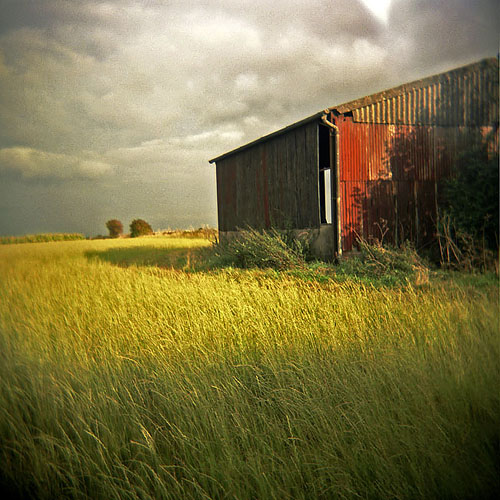 Phil Bebbington, Red Barn Marshfield Gloucestershire, 2006
His hometown is Bath, England, and he spends a large amount of his time photographing on Crete. I particularly admire Cretan interiors work, shot with a Hasselblad SWC. This has a fixed 38mm Zeiss Biogon lens, and is a camera designed 50 years ago.
So there you have it. In order to gain the time to develop photography I need to cut back on paid work and accept living a life on a low income. What next? Produce a body of work, and then establish a big presence on the internet as a photographer.
Big steps
Light Journeys
Light Journeys features monthly solo online exhibition of selected Australian women working in photography. The curator Lee Grant says:
In Australia, photography is still in the process of finding its feet, but in recent years Australian photographers have emerged to stand alongside internationally acknowledged artists. Although Australian photography throughout its history retains the hallmarks of originality and innovation, there have not always been the opportunities to show this work. For many women this has been compounded by familial responsibilities and the competitive endeavour that comes with being an artist.
Online presence in diverse forms changes that frustrating situation---an example is Oculi.com.au that features documentary style photographers in Australia.
One of the members of Oculi.com.au and the first exhibitor at Light Journeys was Tamara Dean, a Sydney based photographer who works for the Sydney Morning Herald as a staff photographer:
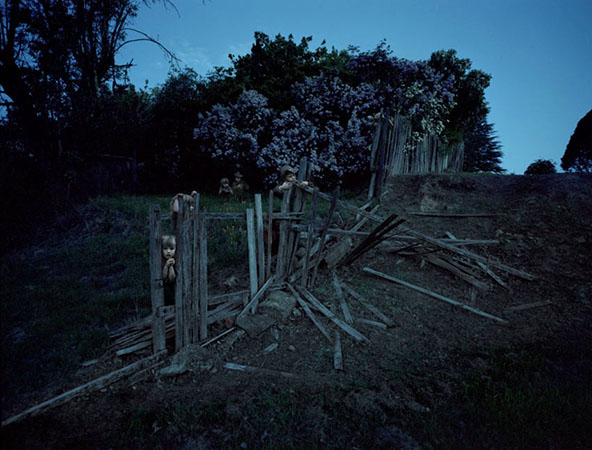 Tamara Dean, from the Ritualism series
Ritual is about the meaning of human actions in everyday life. It interprets selected moments of life, marks them and embodies them with cultural meaning.