|
August 16, 2009
Under industrial capitalism nature is treated as a resource to be exploited for capital accumulation and ecological life forms and wetlands are discarded as of little worth. Often, as Mutton Cove Conservation Reserve on the Lefevre Peninsula illustrates, they are treated as a wasteland and rubbish dump--in this case motor vehicle wrecks and ships.
The Lefevre Peninsula is seen by the state government as an important industrial region that has the potential to generate substantial further economic development benefits for South Australia.
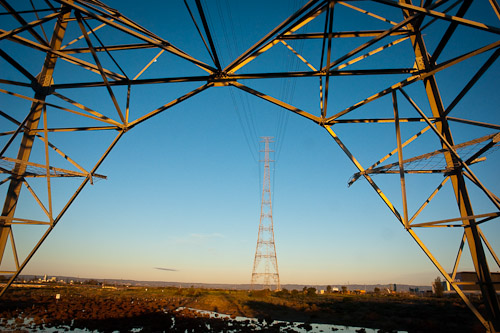 Gary Sauer-Thompson, Electricity pylons, Mutton Cover Conservation Park, 2009
Heavy industry has overrun the Port, and the polluting consequences has been extensive. The ‘reclaimed’ areas around the nearby Pelican Point consist variously of areas of dredge spoil, caustic waste materials from the ICI Soda Ash Plant at Osborne, fly ash and cinders from the Osborne Power Station and pyritic wastes from the Acid Plant at Taperoo.
Industry in the area is hostile to maintaining open space for future expansion along the Port River estuary. The only open space at the moment is the very degraded salt marsh of Mutton Cove --the last remaining biodiverse area of samphire and mangrove woodland on the Le Fevre Peninsula. The cove itself is characterised by tidal restriction caused by a sea wall along the Port River, which impacts adversely on the saltmarsh.
There are promises to enrich, restore and conserve the saltmarsh wetland and to link it to an area called Biodiversity Park. ----It refers to an area of Crown Land (State) located near Pelican Point on the LefevrePeninsula and is approximately 82 hectares in area. What was once a desolate area of reclaimed land used as an unofficial local dump is becoming a landscaped peninsula.
However, I cannot find any public access to this open space around the Pelican Point Power Station. Biodiversity Park is not protected by legislation and policy to ensure the the site is an ecological open space.
|


Since the 1960’s there have been proposals for the development of the tip of the LeFevre Peninsula. The proposals were for the region to be fully filled, with Port activities covering all the land fronting the water. Mutton Cove was to be an area of
warehouses.
A considerable quantity of both fill and seawalls would be needed to realise this industrial development. An immediate start was made on raising the land surface to a level that would enable the development to occur. Until the 1990s it was a still wasteland. Then everything changed about five years ago.