September 30, 2006
looking onto a barren land
In the western part of NSW in the Murray-Darling Basin the winter rains haven't come. The rivers have stopped flowing. The underground (bore) water has gone. Life is very tough. People are leaving.
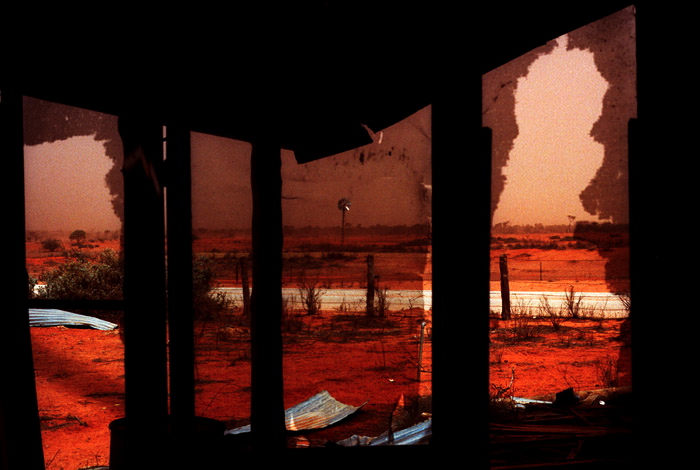
Nick Moir, Oculi, Dust storm, 2002, AgenecVU
September 29, 2006
snapshots as lyric poetics
In his landmark exhibition The Photographer's Eye (MoMA, 1962), John Szarkowski argued that snapshot photography and other vernacular genres form an integral part of the history of the medium and its aesthetic possibilities. But what constitutes a snapshot? It was different from glossy surface of fine art photography.Fine art photographers defined their project against the professional mode of journalism and resisted the narrative legibility and compositional resolution of journalistic work
Was the ubiquitious genre of "unstudied" and "spontaneous" imagery really as straightforward as it seems? Szarkowski's answer was primarily in terms of photographic formalism and the self-referential art object.
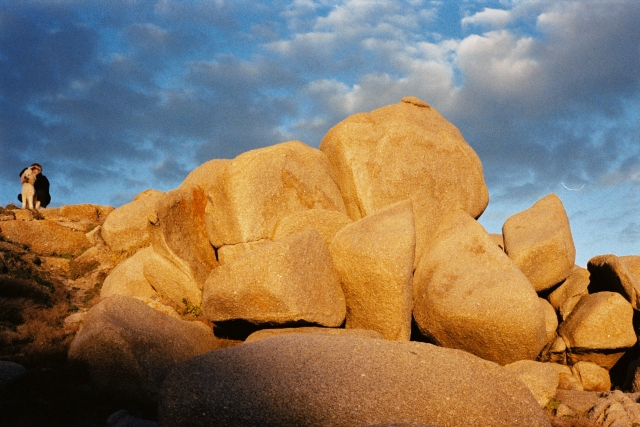
Gary Sauer-Thompson, Port Elliot: figures, Coorong series
Szarkowski then generated a transliteration of Greenberg's formalist aesthetics into photographic terms. He embraced the notion of medium specificity but rejected Greenberg's emphasis on the indexical essence (transparency) of photography. Szarkowski legitimated a form of photographic modernism, complete with autonomous artworks, inspired authors, and a configuration of shapes in space.
Can a snapshot photographer be a lyric poet of the everyday?
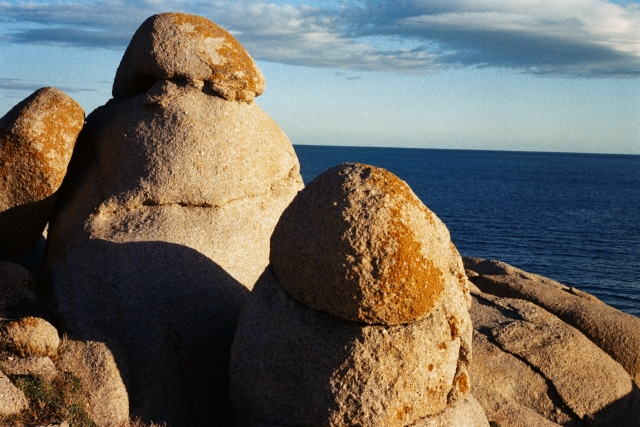
Gary Sauer-Thompson, Port Elliot: rocks Coorong series, 2005
Clement Greenberg's view was that photography's transparent relationship to the world undermines any attempts on the part of photographers to make autonomous works of art. A photograph that respects the obligations of its own medium would be anecdotal and literary. So Greenberg exiles realism from painting yet requires it in photography.
For many artists in the 1960s photography was only useful or interesting to them insofar as it was instrumental in conveying or recording their ideas. Time and again artists describe the photographs themselves as either brute information or uninflected documentation. For many years curators, critics and historians have corroborated this reductive understanding of the role of photography, because it provides a way to free artists from painterly signifiers.
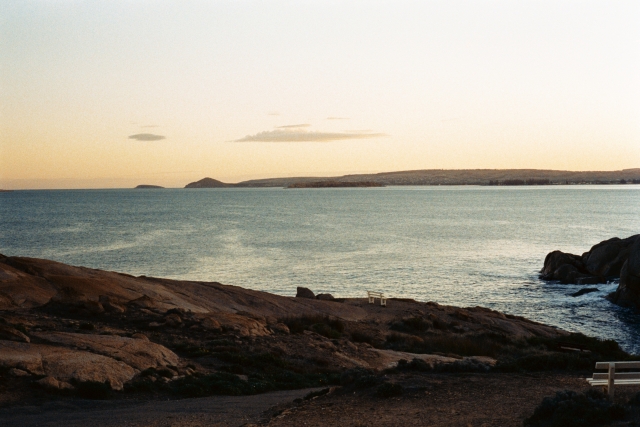
Gary Sauer-Thompson, Port Elliot: twilight, Coorong 2005
What of photographers? Presumably snapshot photography lacks the aesthetic sensibility and technical expertise necessary to qualify as art, unless one embraces modernism. Can one engage the vernacular tradition of photography and establish a dialogue with both the function and aesthetics of the snapshot?
September 28, 2006
walking backwards to digital TV
I mentioned in an earlier post that I'm increasingly turning off the television and turning to watching DVD's. Many are spending their leisure time going gambling---pokies and casinos. Those who are looking forward to digital radio--5 years ago it was just around the corner--- are still waiting for something to happen.
Jock Given, the author of Turning off the Television: Broadcasting's Uncertain Future, writing in The Age usefully asks: Is television dead or alive? Are the social and cultural experiences and business models of free-to-air TV becoming historical?

Given says that free-to-air television is clearly:
...very much alive, if you count the roughly three hours a day the average Australian spends watching it. But if you look at the take-up of Alston's new kind of TV, you might think [it was] closer to dead. In March, five years after its introduction, fewer than one in five Australian households had bought a set-top box to receive free-to-air digital TV, although there are many models now available for under $200.
Given says that many households are interested in using their TV's this way:
Three-quarters of households have DVD players, also readily available for less than $200, and happily spend more money buying or renting discs. That's the kind of take-up rate needed for digital TV if the Government is to meet its original timetable for shutting down the analogue TV transmissions we've been watching for 50 years.
What went wrong?
Market protection of the entrenched free-to-air media companies has ensured that:
Free-to-air digital TV, Australian-style, has been a turkey. A bit of high-definition programming, though rarely in sport; an extra TV channel each from the ABC and SBS, put together on shoestrings; some radio-on-your-TV; limited interactivity.
The bills before Parliament do not change this, despite introducing some changes are designed to get to air two wholly new services. One new service is datacasting" and "narrowcasting" services to households; the other will transmit mobile TV to people, though new handsets will be required to receive the new content. Given says:
There is still not enough in this that allows the potential of digital TV to be fully explored. No more broadcast TV to households, just datacast and narrowcast. No major live sport on the new multi-channels...The Government is too radical on ownership but too cautious on digital TV.
September 27, 2006
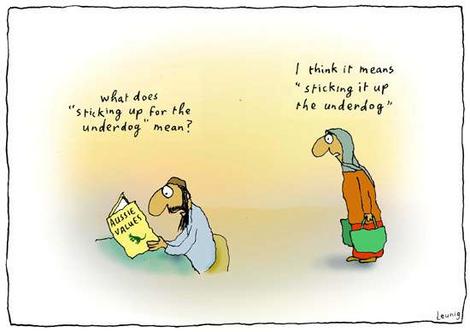
Australian values
So many people are being deemed unAustralian these days as the nationalism of the 1980s becomes an 'us and them' nationalism.
Leunig
Australia has become a harder and meaner place as the shift the market as a mode of life deepens.
September 26, 2006
from weekender to beachhouse
Have you noticed how the old weekender has become the beach house?
The culture of the weekender was castoffs from the house in town. The beach shack was affordable, simple and primitive. It was about getting away, holidays, space, sun, sand, family and barbecues. It signified a relaxed lifestyle leisure time the promise of democratic egalitarianism and the Australian way of life.
The culture of the beach house is architecturally designed, manicured lawns and has its own art and furnishings:
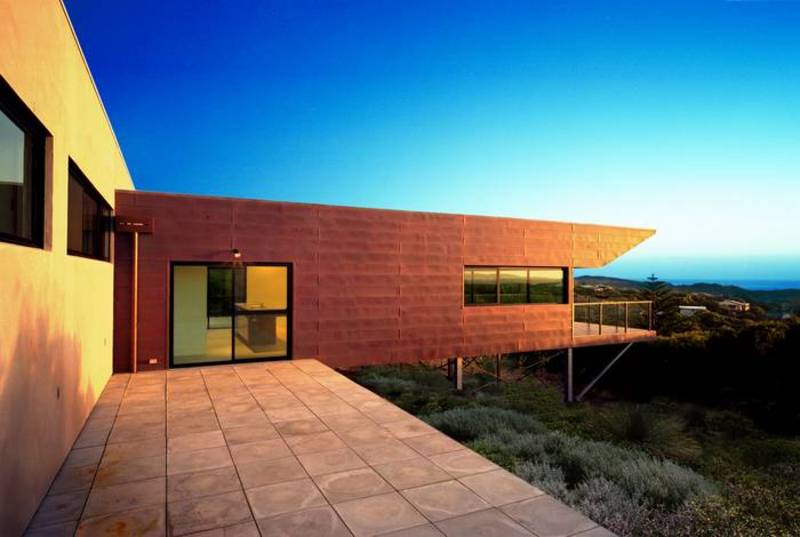
It stands for wealth, exclusivity and class. It is expensive. Many stand empty most of the year.
The context is the urban shift to our coastal regions that threatens to continue the worst aspects of urban
sprawl and development in the coastal towns, beach resorts, and fishing villages based on an ad hoc carve up of land and speculative project building. The local councils planning controls of the last twenty years has sought to
control this development but they have failed.The typical outcome of the development cycle goes along the lines of:
More subdivision=more housing=big footprints= less landscape = less habitat =less diversity=more sprawl= more congestion = more roads=more cars=more commercial big box type development = more community anger and frustration.
September 25, 2006
a tourist photographic aesthetic
Is this an example of the visual language of tourism?

Martin Parr, Small World,
The images of Parr's Small World are drawn from photographs made on assignment for magazines and it is about global tourism.
This article about Parr's work suggests that the visual language of mass tourism is flash-lit and brightly coloured postcards, brochures and snapshots about the ordinariness of everyday life. It uses photography subjectively to snap landmarks and everyday moments of a nation's cultural and social life from a personal perspective and, as it expresses the language of consumerism, it connects with our dreams, our desires to be better people than we feel we are, and to be more glamorous, sophisticated and tasteful.
September 24, 2006
North-west Tasmania: three 'tourist' snaps
Tasmania is an island of contrasts: wilderness & heritage sit along side the gingho exploitation of resources. This consists of daming the wild rivers to generate electricity, logging the old growth native forests for woodchip, the mining of minerals for export and farming. It's impossible not to notice the contradictions even when one is there just a tourist visiting landmarks and seeing the 'sights'.
The conventions of wilderness photography are irrelevant to tourists quickly moving through the landscape in a car. After leaving Tunbridge in the Tasmanian Midlands we travelled along the Heritage Highway to Launceston, looked around the town, had a quick dinner in Devonport, then stayed the night on the north coast near Port Sorrell. The dog friendly place was in Hawley Beach.
In the morning we went for a walk with the dogs along the beach that opened onto the wild waters of Bass Strait. As we were due to have lunch with Suzanne's relatives in Penguin, west of Devonport, that morning we only had time for an early morning walk. The nomadic photography is done on the run.You see something, snap, then move on, ever mindful of being just a tourist caught up in the iamges of a tourist industry that strips out the authenticity (and the meaning) of a place with skillful regularity and determination:

Gary Sauer-Thompson, Rocks, Tasmania series, 2006
David Stephenson points out that in wilderness photography, nature as wilderness is 'aestheticised and depicted within rigid codes of representation as orderly, benevolent, and beautiful. Wilderness is traditionally defined as land devoid of human impact... In Tasmania wilderness photography links views of untouched wilderness with conservation aims.'
The iconic photographs of the wilderness have a strong resonance in Tasmania as the imagery is now being used to market the 'natural' landscape for the national and international tourism industry. A tourist perspective sees things more mundanely:

Gary Sauer-Thompson, rocks and sand, Tasmania series, 2006
Is there a tourist photographic aesthetic? One conception of tourist photographic aesthetic is the representation of nature being based on the typical visitor/tourist experience of wilderness and the landscape. It is postmodern in that it is taking pictures that represent ourselves as a part of nature, not as standing outslde it looking at it. So it also breaks with the conventions of documentary photography.
After lunch we travelled west along the north coast, raced through the ugly industrial town of Burnie and ended up staying in a pet friendly caravan park just west of Rocky Cape National Park. It was called Crayfish Creek, and just up the road was a pelletizing plant at Port Latta:

Gary Sauer-Thompson, beach near Port Latta, from Tasmania series, 2006
As black dust was everywhere the local crayfish were off the evening menu. Apparently the iron concentrate for the pettising plant is produced at a mill in Savage River and is pumped as a slurry through an 80km pipeline to Port Latta, where it is converted into pellets ready for shipment overseas.
This is old Tasmania, a resource based economy that sits uncomfortably with the historic tourist places, such as Stanley just up the road. In old Tasmania the "minerals industry is the cornerstone of Tasmania's economy. The economic cornerstone of the new Tasmania is tourism. Stanley is heritage tourism:---the whole town is under the protection of the National Trust and the tasteful heritage colours of the cottages reflect the work of heritage designers. Stanley, even more than Ross on the Heritage Highway, is a fascinating illustration of the tourist industry and the manufacture of 'heritage'.
It was at Stanley that I understood that the cultural significance of photography's influence on tourism from the nineteenth century onwards. Photography and tourism go hand in hand. Sadly, I've lost the roll of film I shot of heritage in Stanley.
September 23, 2006
melting glaciers
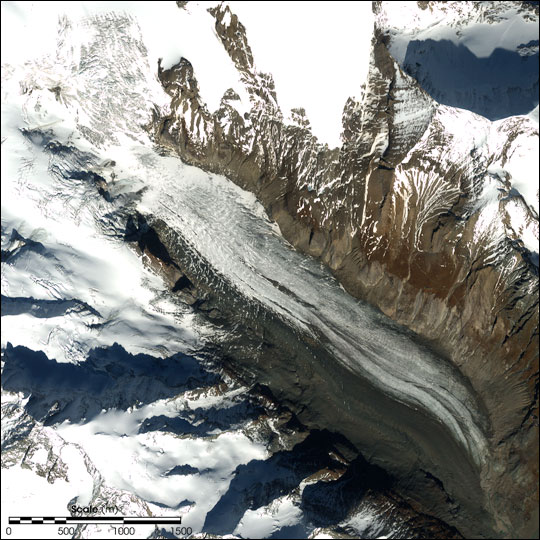
The Pasterze Glacier in Austria, shown here in 1875 and 2004, is one of many around the world that have been retreating, exposing rock that has not seen daylight for thousands of years.

The image does more than illustrate the glacial retreat that is an effect of global warming. The retreat of glaciers in mountain regions is one of the most visually compelling examples of recent climate change.
The planet's many thousands of glaciers have been stable or in slow retreat for more than 100 years but since around 1980 they have mostly been retreating drastically. The fastest decline is in the Himalayas, the Arctic, the Alps, the Rockies and the tropics.
Robert Simmon, NASA's Earth Observatory, The Pasterze Glacier in western Austria
My guess is that though people heard the warnings and read newspaper columns about the reports most of it has yet to really sink in. Big Oil is out in the public domain casting doubt over climate change in a similar fashion to the way m Big Tobacco did over the dangers of smoking. What will convince them: an ice-free Arctic? Well, this story says that European scientists had viewed pictures which showed Arctic ice cover had disappeared so much last month that a ship could sail unhindered from Europe's most northerly outpost to the North Pole.
September 22, 2006
a moment in Tunbridge, Tasmania
This snap from the side of the road of the Midlands highway was taken near Tunbridge, in the Tasmanian Midlands in February this year. We were in Tasmania on holidays.

Gary Sauer-Thompson, Midlands, Tasmania series, 2006
This is farming/pastoral country along the Heritage (Midlands) Highway that connects Hobart to Launceston. The Midlands region is characteristed by a lack of trees and it is very familar to the South Australian landscape. The landscape is in need of some old-fashioned landcare.
Can we talk in terms of the tourist eye? We do have the phenomenon of the work of international visual artists responding to their experience of traveling and living within various cultures. I don't know what the tourist eye would be.
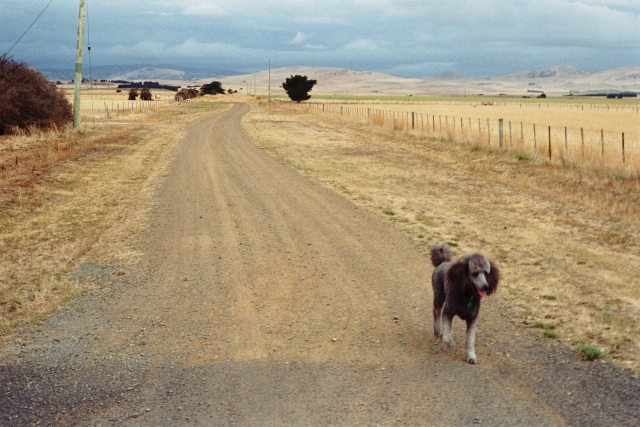
This image has its roots in the edgy reworking of the 35mm black and white film documentary aesthetic (based on the Leica rangefinder with Tri-X film) by street photographers such as Robert Frank and Garry Winogrand; a reworking which incorporates the subjectivity of the photographer and embraces a more expressive aesthetic:
Gary Sauer-Thompson, Agtet, Tasmania series, 2006
The street photography kind of image making presuposes the patient, solitary prowling of one's own society that has its roots in Atget.
Suzanne, dogs and myself stayed a day or so with Suzanne's sister and husband--- Barbara Heath and Malcolm Enright---- who own, and are renovating, a Georgian store in Tunbridge. I was much taken by the shed in the backyard of the store:
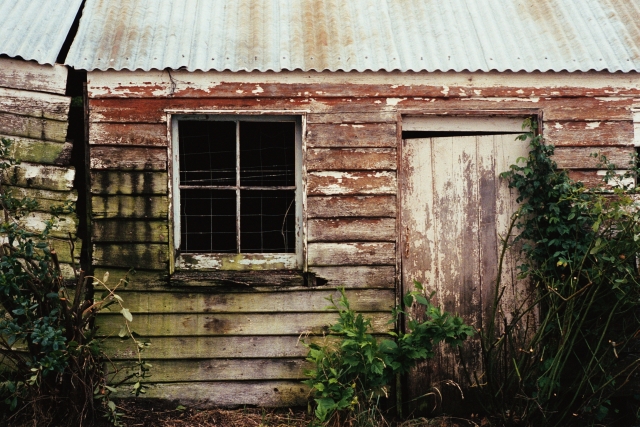
Gary Sauer-Thompson, shed door, Tasmania series, 2006
We drove up to Tunbridge after flying into Hobart from Adelaide. We sat in the backporch of the store and chatted over drinks and nibbles. It was very hot for that time of the year:---a hot north wind was blowing across the plains, and it felt just like a South Australian summer. That was the very situation we were in Tasmania to take a break from. The locals said the hot weather was usual--but unusual weather is normal these days.
The style of the photography is prior to John Szarkowski's publishing William Eggleston's Guide, a book of photographs in the colour negative medium that on first glance appeared to be about nothing much at all, but which highlighted Eggleston as a lyric poet of the everyday. This was anti-street photography that rejected the reliance on an enigmatic visual drama, a central, essential event or "punctum," as Roland Barthes would say.
Three snaps in the Murraylands
Much to my sorrow I don't have much opportunity to take photographs these days. At the moment I mostly take them on my holidays---hence they are snaps.
This image was taken in the river bed near the Mannum Falls about six kilometres from Mannum on the Murray Bridge Road. We were returning to Adelaide from spending a few days of our July holidays in the Clare Valley this year.
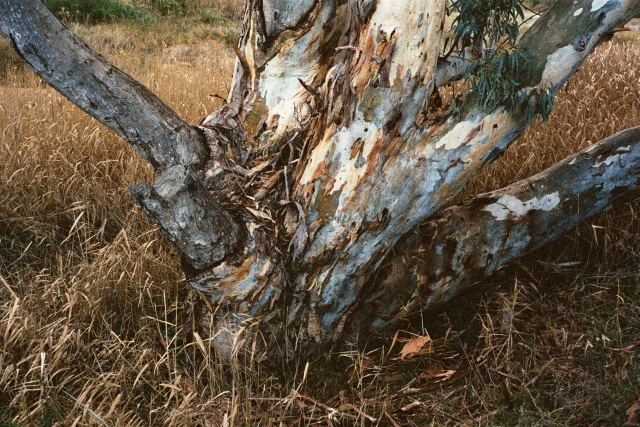
Gary SauerThompson, Redgum, from Murray series, 2006
It was towards the end of he day. We walked up the river valley---it was the dogs evening walk. The little river was still flowing from the hills into the River Murray.This is unusual, as most of the Murray's tributaries in this area have dried up because all runoff water is taken by farmers and winemakers. Environmental flows is a big issue in is this region of the Murray-Darling Basin.
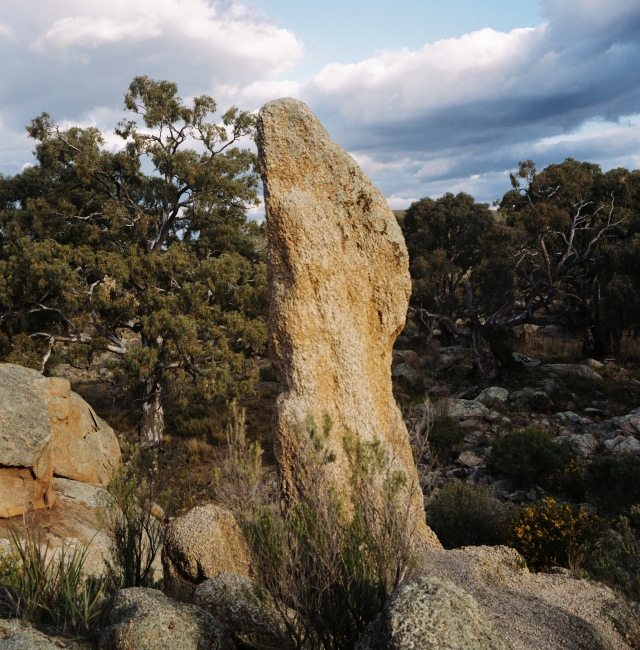
Gary Sauer-Thompson, Mannum Falls, Murray Series, 2006
The sun was going. Dusk would soon fall. There was no time to use tripods and view cameras.
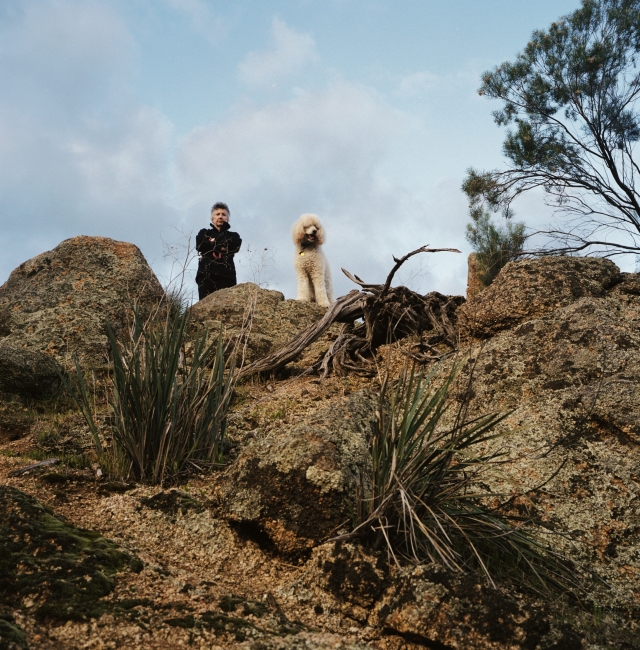
Gary Sauer-Thompson, Suzanne & Ari, Murray River series, 2006
We drove along the Murray River to Murray Bridge then scooted back to Adelaide on the freeway.
September 20, 2006
an eye for an eye?
I notice that an editorial in the Brisbane Courier Mail says that in making his remarks about Islam being evil and inhumane Pope Benedict XV1:
....was merely quoting a 14th-century emperor in a long, scholarly paper; and to apologise for doing so would be caving in to a new dark age of fear and bullying in which useful debate and dialogue are silenced for fear of overreactions and violence.
Wow. They've bought into the clash of civilizations between Muslims and the West narrative, without realizing that Al-Qaeda wants Muslims to embrace Islam as the core of their identities, and to believe that Islam is locked in mortal combat with an aggressive, hostile West.
This strikes me as a suitable response:

Or this. Sure a point can be made about the Muslim street's reaction to the Pope sundering faith and reason. But little is being said about moderate or liberal Muslims by Catholic conservatives (eg., Cardinal Pell in Australia) who both condemn terrorism and say that the Islamists distort Islam. The conservatives are quite content to quote passages out of the Koran that justify violence against the infidel and remain silent about passages in the Bible, or the fundamentalists in their own religion.
That would provide the basis for dialogue they say they want, wouldn't it? And there's grounds for a dialogue as many Muslims believe that faith should be integral to reason and knowing. Moreover, they believe that ethics and morality should include both faith and science as a frame of reference. Doen't this overlap with the pope's criticism of the separation of faith and reason brought about by the Reformation with its rejection of reason and the Enlightenment with its rejection of faith. Isn't that grounds for dialogue?
Instead the conservative civilizational warriors continue to strengthen the central al-Qaeda narrative of a Crusader war against Islam with their strategy to keep the fires raging, rather than driving a wedge between al-Qaeda and the jihadist fringe and mainstream Muslims.
September 19, 2006
deep space
A brief post as I'm road to northern NSW. I'm going to have to rely on the Qantas Lounge to post.
This image is from the Astronomy picture of the day website.

Now that is deep space.
September 18, 2006
from TV to YouTube
I explored YouTube yesterday.There is massive amounts of content but I mostly watched the diverse musical videos. There was a lot of trash but I was taken by the quality of the Bruce Springteen ones-----they gave me an idea of the music on his more recent work, such as The Rising, (2002), Devils & Dust (2005) and the energetic tribute to the songs of Pete Seeger titled We Shall Overcome: The Seeger Sessions (2006). Presumably many of these clips were ripped off from the traditional media.
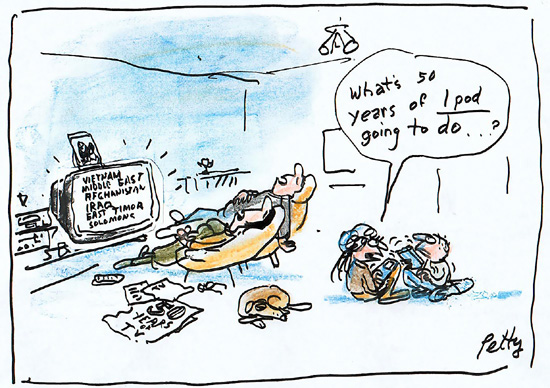
YouTube, as a free video hosting web site which allows users to upload, view, and share video clips, is a way to get round the dominance of free-to-air television. I can see why YouTube has grown quickly and received so much attention.
Bruce Petty
Occasionally I tune in to a mas production show like "CSI" but I tune out about the second round of commercials. I can tolerate 2 or 3 ads, but not 7-10. In contrast we have "Broadcast Yourself" a popular clearinghouse for homemade video. Despite the junk this opens up a world of internet video and a publishing platform for amateur filmmakers and is far more innovative than the closed corporate world of i-pod. Is YouTube a viable business model given the enormous bandwith required---I noticed the carefully placed and mostly unobtrusive ads.
YouTube opens up a new world of users created content--one which will develop into free video stuff and then the better quality content that costs money (subscription) to view. Despite being packed with unauthorized material (promotional musical clips) the traditional media companies, who are destroying fair use, are beginning to work with YouTube, rather than try and close it down.
The marketers could build their own video channels on YouTube whilst the studios can make content available so people can access it.
It is the community and user-created content that has made YouTube so popular and which places it in opposition to broadcast-style business of the entertainment industry. Their lawyers must be circling YouTube.
September 17, 2006
from my apartment
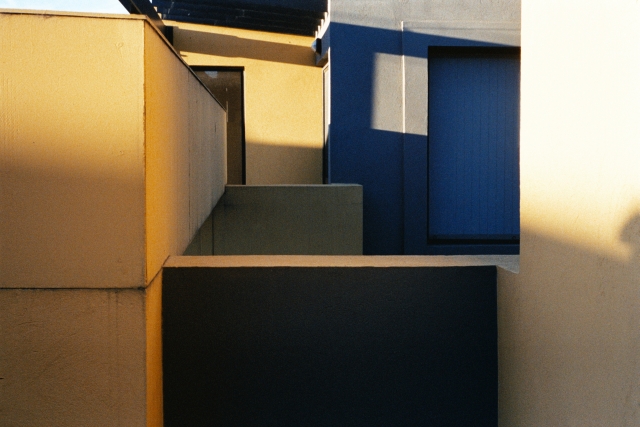
Though the increasingly digitalised city pad is small we spend a lot of time on the balcony in the morning and the evening. This was the view of the northern end of the balcony from my office:
Gary Sauer-Thompson, abstraction 1, 1995
Many of the inner city apartments in Adelaide have no liveable outdoor area at all. One lives within the airconditioned glass interior looking out on the city, if you have views. In many of them you cannot even open the window to feel the cool breeze on the skin. I'd go crazy at such a complete insulation from nature.
September 16, 2006
television: consumers may yet rule
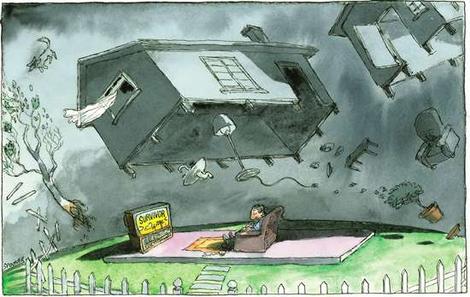
I see that the heavily protected free-to-air television industry in Australia is celebrating 50 years---celebrating its glory days of yesteryear from what I can judge. The modern model of free-to-air was three commercail channels and the ABC and SBS, putting ads in the shows, and consumers watching TV on the terms laid down by the corporate media companies.
John Spooner
Today it is cheaper to buy US product off the shelf ---to buy an American series than make an Australian one. Because of the protection a licence to run a commercial television network is, in effect, a licence to print money. The obligation to give something back to the culture was delivered in sport, news and comedy.
In postmodernity an internet-powered future may very well--hopefully--- sideline the need for television networks to distribute moving pictures to a mass audience. With full-time digital streaming of any kind of programming on demand via the internet we will be able to download programmes to our computers and portable media players and use software to strip any advertising out of the recorded programs.
September 15, 2006
returning to Fairport Convention
I picked up a couple of remastered old Fairport Convention CD's in Canberra ---Leige and Leif (1969) and Full House (1970) the other day. This music is prior to the disconnect between good music and the corporate music industry becoming a chasm, and the rise of the independent, or "indy" scene. The latter is where good music is now happening, as the corporate major labels are now releasing bad, overpriced music that has little appeal. Openness to new music by the corporate music industry is at an all time low.
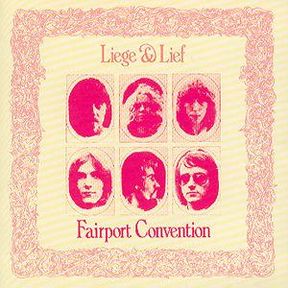 This a landmark CD as it marks the English version of fusing traditional and electric music: from Fairport Convention being a rock band that used folk music as an influence on their sound----transforming from a Byrds-style folk-rock band into a electrified band that specialised in reinterpreting traditional English music. This was the period that saw the band forging new music by drawing on a rich British heritage in much the same way that the Band (and the Bryds, Gram Parsons and Grateful Dead) were doing in America.
Both the Byrds and Fairport Convention started their careers by covering modern folk artists (Bob Dylan, Joni Mitchell) and proceeded to extend and refine the folk genre bringing in a beat to move the music along. Both also eventually fell back on older forms as they explored the edges of folk-rock: The Byrds to country and Fairport to the jigs/reels/etc.
Leige and Lief is traditional English folk ballads with electric instruments (eg., the tracks Matty Groves and Tam Lin). Undeniably it's a great folk album, but a poor rock album. Moreover, there were only two original number on Leige and Leif--- the soaring 'Come All Ye', and 'Crazy Man Michael.'
The rest were adaptations of old English folk songs. Sandy Denny and Ashley Hutchings then left to begin independent careers (Fotheringay and Steeleye Span) . Hutchings carried on the most traditional face of British folk-rock with Steeleye Span, the Albion Band, and the Etchingham Steam Band.
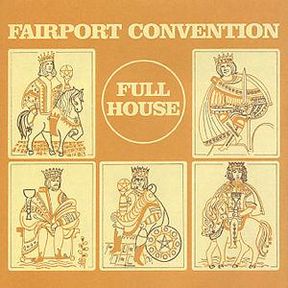 Full House places a greater emphasis on writing their own music and so breaks new ground and so is similar to the way that Gram Parsons broke new ground in the US.
Full House emphases the rock side of folk rock. It is centred around the contributions of, and the duelling between, Dave Swarbrick the fiddler and Richard Thompson the guitarist in particular. There is much more punch and energy in the music, but it lacks diversity and it does sound a bit monotonous at times.
Thompson left to pursue a solo career after 'Full House' as the material Thompson was writing at the time was not suitable for the band. The sound of Fairport Convention today is the electrified British folk style that had been mapped out on Liege and Lief---in the form of a English pub band playing pub music. It was Thompson who was the most innovative of this group of musicians ---the classic 'I Want to See the Bright Lights Tonight' (1974) and 'Shoot Out the Lights' (1982) with Linda Thompson realized Fairport Convention's rock/folk fusion promise of good original popular music with its roots in British folk music.
I'm not sure about Richard Thompson's work in the 1980s and 1990s. He shifted to Los Angeles and the production became more 'Americanized. ' I have only listened to bits of the music of this period.
September 14, 2006
The Bradshaw Paintings
Below are some photographs of the rock paintings in the Kimberley's (one of the the last great wilderness in north eastern Australia) known as The Bradshaw Paintings. These images are 5000 years old, though some say they are at least 18,000-20,000 years old, if not more. The figures are known as the 'Bradshaw figures' because they were first discovered in European terms by Joseph Bradshaw, a pastoralist from Victoria in 1891 when he became lost searching for the million-acre lease he had been granted.

Group of Bradshaw figures
Though it is unclear who painted these images, these rock paintings can be interpreted as among the first 'written' documents of human culture in Australia.

Zebra Figures
The vast majority of Bradshaw panels are concentrated around seven major river systems. This region is characterised by rugged sandstone and basalt terrain. The few roads that exist are only accessible during the short dry season (June-October). Sandstone escarpments with reliefs of c. 150-250 m, flank major river systems.
In the Times Literary SupplementRobin Hanbury-Tenison says that these 'are pictures of people who had clearly reached a high level of culture. They appear to be wearing clothes, or at least to decorate their bodies with hanging tassels, sashes and arm bands. Many have elaborate headdresses.'
These are elegantly drawn images, visually sophistiscated and having a distinctive style:

cupid figures
This is the work of talented and well-practised artisans in a hunter and gather civilization. Artistically, the Bradshaws are unusually advanced in both technique, breadth and diversity of style. These elaborate and highly decorative images should be preserved and protected, as they are unarguably some of the best and oldest representations of human beings yet discovered on planet Earth.


There is a controversy about the significance of these paintings. When the first settlers occupied the area, the local Aborigines told them that the Bradshaw Paintings were "before their time".
Ian Wilson argues that Australia's Kimberley was the cultural hub of the Ice Age world; and that today, it holds within its bounds the world's largest collection of Ice Age figurative art, giving us vital clues to the origins of other cultures and civilisations right across the world.
Graham Walsh, who has spent half a life time trying to establish the origin of the paintings and to decipher what he believes is a hidden language, argues that these paintings are not of Aboriginal origin, but are more likely linked to another race of people from Indonesia or New Guinea.
Others argue that no archaeological evidence exists to suggest an earlier pre-Aboriginal people lived in Australia. The most ancient known human remains in Australia, the 40---45,000-year-old Lake Mungo burials of western New South Wales, are Aboriginal in morphology.
The Bradshaw rock paintings are known as Gwion Gwion to the Aboriginal traditional owners. Further research will indicate whether these image are actually late Pleistocene rock paintings. At the moment the controversy over the origins of the 'Bradshaw' or Gwion paintings is taking place in the context of the struggle over land, Indigenous Australian economic interests, and the representations of Aborigines in the media, the academy and the fledgling cultural tourism industry in the northwest of Western Australia.

These paintings are an important part of Australia's cultural heritage and the living culture of indigenous Australians, and they deserve a prominent position in any global history of rock painting.
September 13, 2006
a myth is born
The remains of the World Trade Centre are the birth place of the war on terror in which a range of separate contemporary conflicts (Afdghanistan, Iraq, Palestine, Iran, Lebanon, Indonesia) become aspects of a "global struggle against terrorism".
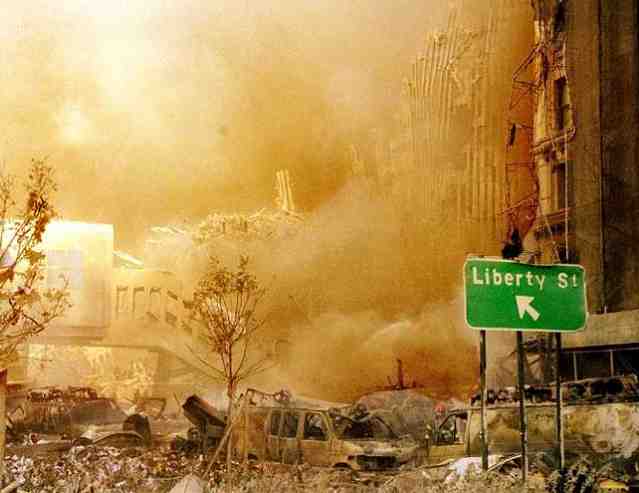
Corbis Sygma - Alan S. Chin
What we have is less a metaphor than a myth: the "war on terror" implies that the West faces a common unified enemy out to destrroy the West.
September 12, 2006
Alec Soth #2
The painterly image below is an example of fine art photography that is based on the craft of old fashioned view camera. It is from Alec Soth's Lothlorien series commissioned by the Madison Museum of Contemporary Art for its 2006 grand re-opening, and as part of the major opening exhibition--- Between the Lakes: Artists Respond to Madison. In this exhibition seven artists explored the layers of history, memory, and cultural meaning that have shaped the city of Madison and Dane County.

Soth focused on the Lothlorien cooperative which occupies a Tudor-style house on the southern shore of Lake Mendota. Soth's photographs are taken with a 8 x 10 format camera. These take often take a long time to produce as the artist makes endless adjustments looking at a ground glass under a black cloth. Alec has a blog
This kind of craft is very different from the image making that uses photoshops photographs or uses photos as raw materials to create montages or layered images.
September 11, 2006
9/11
There is a lot of commentary about the fifth anniversary of 9/11, especially the politics of it. Less is best when the jarring images of the day ---smoke billowing from the towers, New Yorkers crying in the streets, debris falling from the darkened sky---dominated US television and newspapers.

As always it is the personal tragedies that need to be remembered. Silence is a powerful way to remember.
Sound walking
What a lovely idea.
'When was the last time you went somewhere just to hear the sounds?' asks Melbourne-based sound artist Anthony Magen. The sound walk is a simple exercise. It is free! It requires no additional paraphernalia other than your ears and some walking shoes. There is only one rule: no communication within the group. Talking or otherwise. This helps to allow the sounds to become the focus. Magen is the facilitator of our sound walk. A chance to walk through the streets of Sydney and experience the diverse sounds it has to offer.
I do it without realizing what I'm doing. Though not with a group. I do it when I'm walking the dogs in the Adelaide Parklands.
The quote is from an article in Cyclic Defrost, issue 14 July 2006:
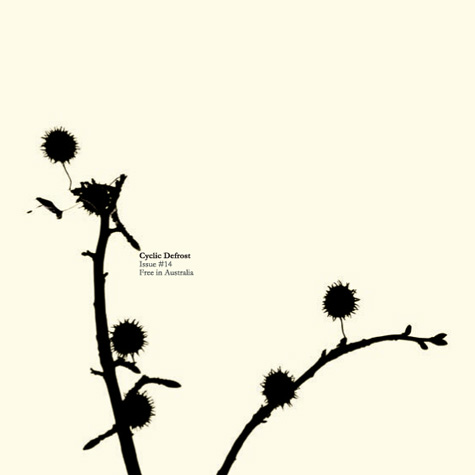
cover design Traianos Pakioufakis
The design is based a photograph taken by Pakioufakis on Murray Street in Perth in winter last year.
September 9, 2006
Crikey: Why all the fuss about Steve Irwin?
I'm amazed at the media reaction to Steve Irwin's death. He sure has media pulling power given the outpouring of grief from an adoring public. The media, it appears, just keeps on feeding on itself even though Irwin's TV series never attracted big ratings in Australia.
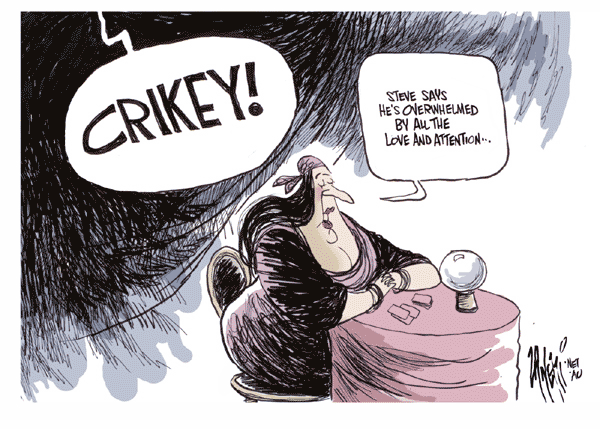
Paul Zanetti
The man, whose star power was based on the Animal Planet pay TV channel, is being turned into a secular saint in Australia---the only one saving endangered species. Is it just a media beatup? I'm turning off the media commentary. It's become obsessive way over and above the spin by Animal Planet.
The media commentary is not really about Irwin though is it? Irwin is a placeholder for another conversation about national identity that has been linked to wildlife conservation. This article in The Age says that a lot of the media commentary is about perpetuating the conservative mythology built around the resolute outdoor type.
Irwin did seem to personify much of the spirit that is usually thought to have its antecedents in the travails of the early explorers, the men and women on the goldfields, the testing of mettle at Gallipoli, the Country Women's Association --- perhaps even Bodyline. Historian Geoffrey Blainey says modern Australia has not entirely dismissed its outback heritage as no longer relevant, even though a character like Steve Irwin seems increasingly remote from the cosmopolitan nature of city life."When we talk about the quintessential Australian, we still largely think outside the cities, to our history on the land----we retain that memory of adventure," he says.
Not all Australian's understand their identity in terms of being a crocodile hunter, do they? This kind of cultural criticism misses the business angle of turning the Australia Zoo (a multimillion wildlife tourist attraction) that is becoming Australia's answer to Disneyland; and the conservation angle of Wildlife Warriors, which buys land to counter the way that farmers and developers knock down trees, flatten the landscape and kill lots of wildlife in the process.
September 8, 2006
meandering down the Mississippi
From the series 'Sleeping by the Mississippi:'
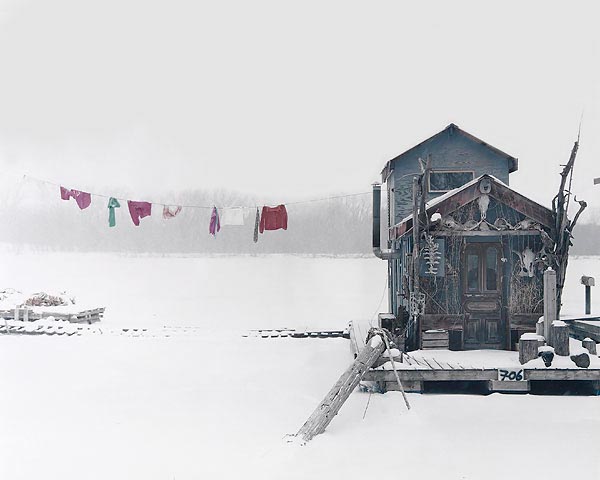
Alec Soth, Peter's Houseboat, Winona, Minnesota, 2002
It is an old-fashioned kind of imagemaking and a very poetic one---a fusion of documentary and poetic styles of photography---about the US's most storied river.
September 7, 2006
FourPlay: Now To The Future
One of the good things about Radio National's great Breakfast with Fran Kelly is the album of the week. It is presented by Tim Ritchie, from Sound Quality and it is an excellent way to introduce interesting and diverse contemporary music.
This week the latest album being introduced by Ritchie is the latest work by an electric string quartet FourPlay who are based in Sydney. The album is entitled 'Now To The Future.' The music, produced by violin, two violas and a cello plus vocals, sounded really interesting and innovative.

According to their website Fourplay started life as a classical string quartet, originally made up of friends from the Australian Youth Orchestra. Inspired by the Kronos, Balanescu and Brodsky Quartets' blurring of the boundaries between classical and rock music, they began playing rock covers for friends, then in the mid-1990s, they transformed themselves into an electric string quartet and started to warp the conventions of classical music.
FourPlay's repertoire includes covers of diverse artists such as the Beastie Boys, Jeff Buckley, Depeche Mode, Charles Mingus, Radiohead and The Strokes, and their own originals, inspired by wide array of diverse music such as rock, dub, folk, gypsy, klezmer, electronica, post-rock, jazz and improv. Sounds good doesn't it?
I haven't heard the new album, nor any of their previous music before. Apparently, the album captures the energy of their live performances and the breadth of their sound So I'm going to buy Now to the Future based on what I've heard. I see that they will play a gig at The Gov in Adelaide late October. Isee that Peter Hollo (cello & vocals) has weblog Stumblings in the Dark runs a music program called Utility Frog (it has a blogonline playlist ) on Sydney's fbi radiostation and writes occassionally for Cyclic Defrost, a thrice-a-year Australian specialist electronic music magazine.
romantic landscapes & the sublime
Sight is a privileged epistemological tool and our way of seeing and thinking about the world around us has been informed by the camera. These machines define the position of the interiorized observer to the outside world and they have been influential in representing our travelling experiences.
Travel has always served as a material basis for landscape aesthetics in art. Recall Claude Lorrain's sketches in Italy which inspired his classical landscape manner and artists for centuries; Edmund Burke's concept of the sublime was deeply associated with the sea and the Alps; Gilpin defined the picturesque on the basis of walking tours of England; and excursions in Italy underlay the Neoclassicism and historical landscapes of Valenciennes and his followers who established the tradition of plein-air painting. The three most valued aesthetic norms were often nationalised: Italy (the beautiful, associated with classicism); Switzerland (the sublime); and England (the picturesque).
The visual picturesque distinguished true travelers from mere tourists, the former experiencing authentic culture and the latter simply reproducing the false representations scripted by guidebooks The physical experience of moving through a sequence of prospects into a cultural experience, an experience that would enhance one's understanding of human life and human history.
The traveller of yesterday is the tourist of today. In romanticism aesthetics the travelling through a landscape is changed, as the emphasis is placed on the subjectivity of the gazing (middle class) traveller:
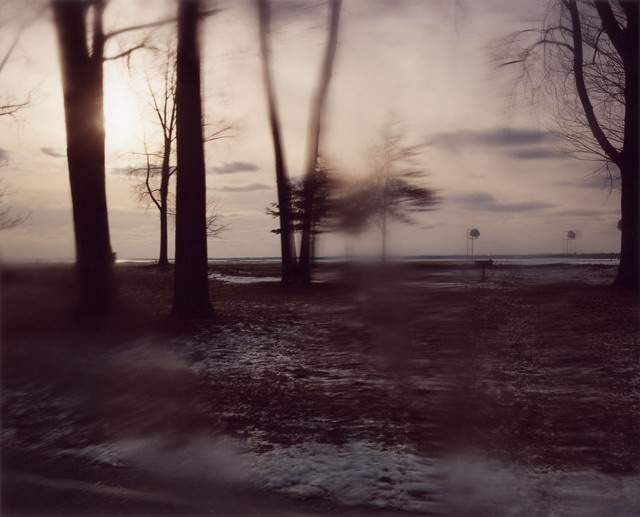

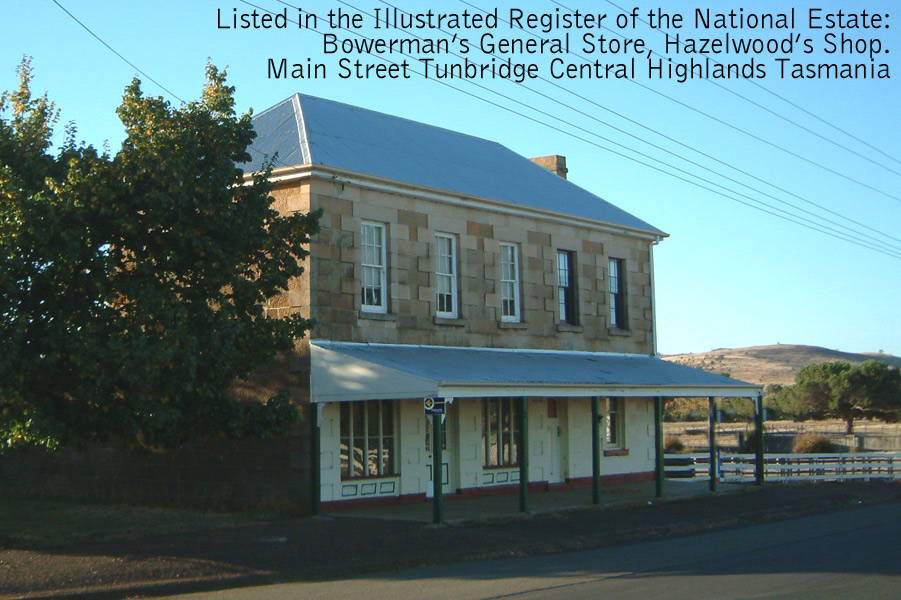
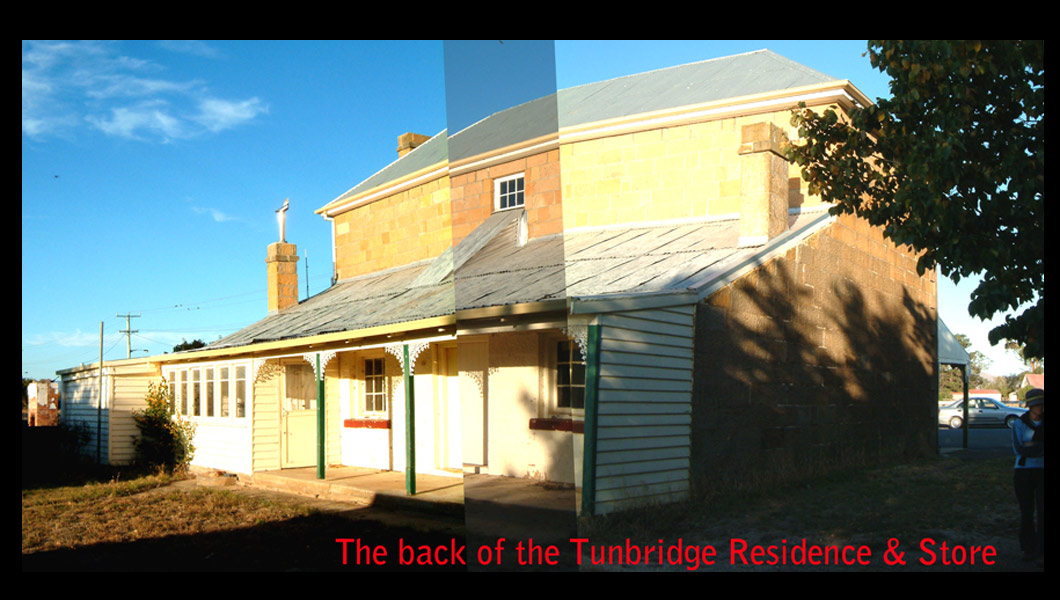
With romanticism the landscape becomes a hybrid of the place, history, myth and illusion. Romantic art is generally characterized by a highly imaginative and subjective approach, emotional intensity, and a dream-like or visionary quality. Romantic art characteristically strives to express by suggestion states of feeling too intense, mystical, or elusive to be clearly defined.
Another part of romantic aesthetics is disclosed by the notion of the romantic sublime in that strand of Romantic European landscape painting that emphasised vast panoramic scenes, depict light breaking through storm laden clouds, endless skies and mist shrouded lakes.
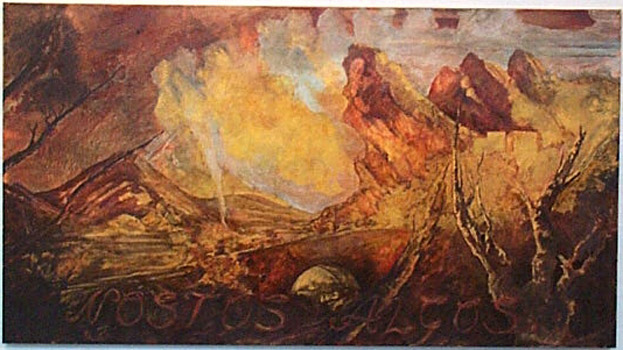
Mandy Martin, Nostos Algos, 2003, Oil, ochre, pigment on linen
The Romantic sublime is often nterpreted in Australia as the moment of inspiration when someone sees beauty in what many see as a hostile landscape. This tamed understanding of the sublime is more akin to a conception of the picturesque, which is what is transgressed in this kind of work:
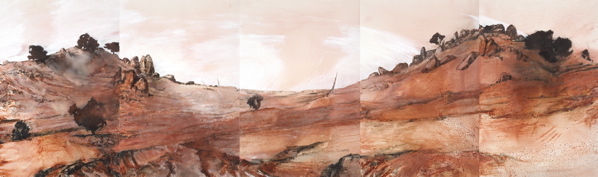
Mandy Martin, Haunted 3, 2005, Oil, ochre, pigment on linen,
I would want to return to Edmund Burke's understanding of the sublime, where 'terror is... the ruling principle of the sublime". He equated the sublime with astonishment, fear, pain, roughness, and obscurity. The sublime horrors appeal to our desires for self-preservation.
September 6, 2006
Lake Alexandrina snaps
The mouth of the River Murray in South Australia is esturine and composed of the Corrong and two large shallow lakes--Albert and Alexandrina. I stayed at Poltalloch Station on Lake Alexandrina just before Xmas 2004 for a work do. I managed to take a few snaps with the Leica when the storrmy/rainy weather permitted:
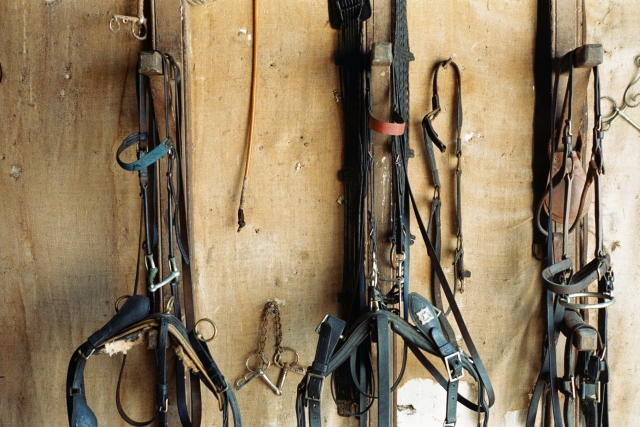
Gary Sauer-Thompson, Bridles, Lake Alexandrina , 2004
The image below is on a hill just back from, and looking towards, the lake. The area around the Lake on all sides has been denuded--stripped bare of trees. That is the effect of 19th century pastoralism based on sheep. There is little replanting going on to bring back the trees.
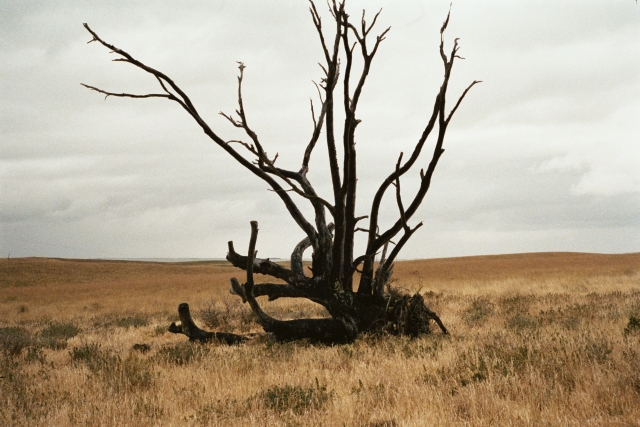
Gary Sauer-Thompson, Hilltop, Lake Alexandrina , 2004
This kind of environmental concern breaks with the founding assumptions of modernist aesthtices: the universalized subject of aesthetic appreciation; disinterested contemplation, or the paradigm of reception that strips the subject's relation to the aesthetic object of any practical stake in that object's existence; and the autonomy of the aesthetic domain from moral, political, or utilitarian concerns and activities.
The bare landscape around Lake Alexandrina has been produced into something quite different to what it had once been 200 years ago.This then is a politically informed aesthetic--an ecological one.
Another denuded hill near the narrow passage between Lake Alexandrina and Lake Albert.
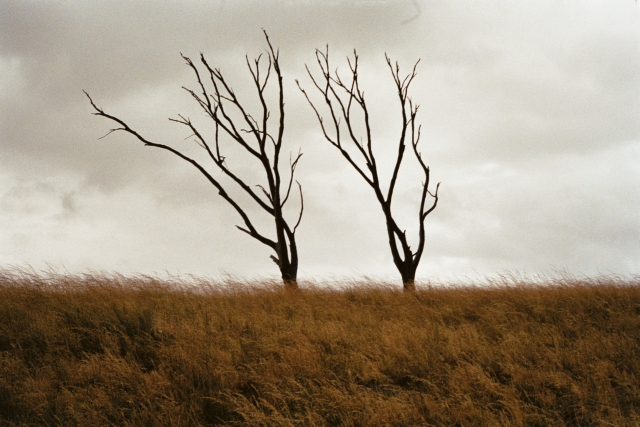
Gary Sauer-Thompson, Hilltop, Lake Alexandrina , 2004
These images are not romantic ones. They are more within the snapshot tradition---one that is marked by small, handheld, 35mm cameras, that produced grainy, blurred images characterized by tilted horizons and erratic framing which aptly expressd the speed and chaos of modern life. It has been adapted to a travelling around the landcscape looking at the effects of the heavy human footprint on the landscape.
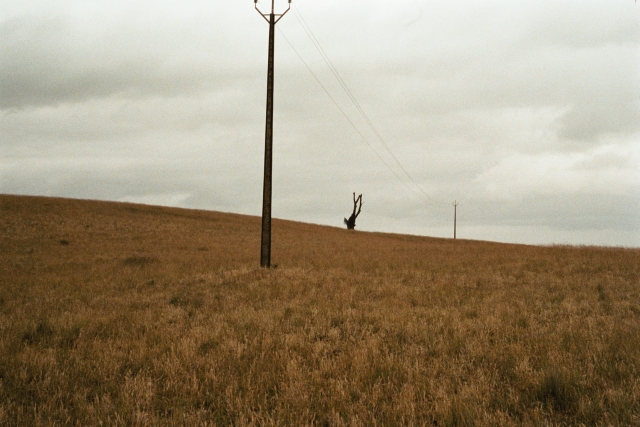
Gary Sauer-Thompson, Electricity Line, Lake Alexandrina , 2004
Though this series deploys the trope of 'the tour through a landscape', it's snapshot mode links back to the topographical aesthetic of Gustave Courbet, which places value on actual, ordinary, regional and self-consciously contemporary experience. This has a new, self-reflexive way of constructing cultural meaning from lived experience.
The denuding of the landscape by the pastoralists, who were trying to create an English village based around the landed gentry, means that we are just left with the grasses:
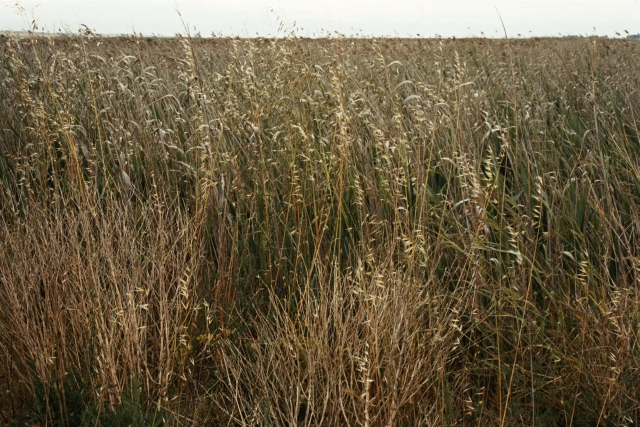
Gary Sauer-Thompson, native grasses , Lake Alexandrina , 2004
This topographical aesthetic has affinities with the "New Topographics, in which the landscape is depicted complete with the alterations by humans. This movement is often interpreted as a reaction against natural landscape photography that depicts only wilderness. The photographers of the New Topographics show landscapes that include roads, housing projects, bridges etc that have been built through suburban development. The style is within a tradition of documentary --and so is in opposition to formalist photography.
Though the object is the idea of 'social landscape'--how human beings have affected the natural environment in an industrial culture-- the topographical aesthetic need not exclude beauty. It is downplayed into being just an aspect of the altered landscape:
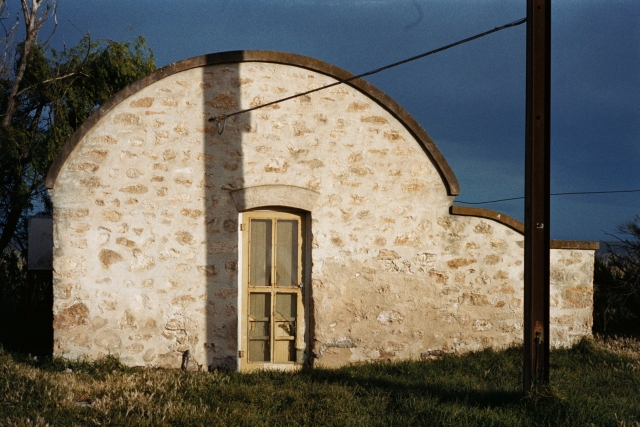
Gary Sauer-Thompson, Boatshed, Lake Alexandrina , 2004
The New Topographics attempt to expunge individual style (the death of the author?) so that one is left with just the text or image. This meant that viewer's reception of what the photographer has seen becomes all important. We can modify this aesthetic by recovering the romantic concern with the sublime:
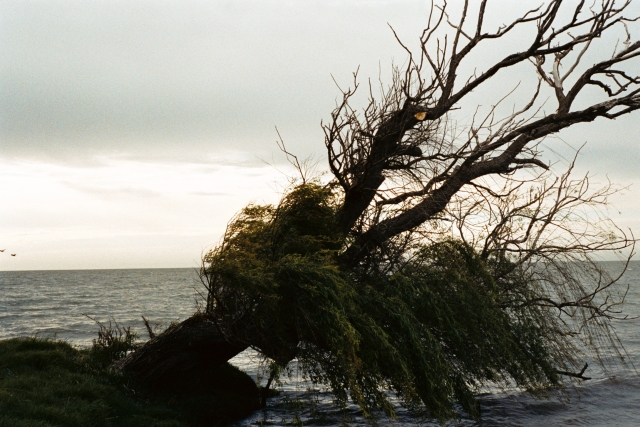
Gary Sauer-Thompson, Battered tree, Lake Alexandrina , 2004
The sublime in this case is not the towering alps of Europe--it is the wild storms that sweep across Lake Alexandrina from the southern ocean; a wildness that causes horror and a concern for one's self-preservation.
art criticism #3
It is fair to say that the commercial enterprise of art---market, lobbyists, public relations, people, art institutions etc has a lot of influence over art criticism and reviewing in general. You cannot bite the hand that feeds you too much. What then is the state of play in art criticism in Australia?
Bad, says Luke Morgan, in his excellent article, Australian Art Criticism and Its Discontents" published in the Australian Book Review. He gives a very bleak account of the current state of play in art criticism and reviewing in Australia:
In the end, then, we are left with a field that might be described as follows. Over there is a group of strait-laced conformists, assiduously bowing and scraping before the big art institutions ---the 'museo-academic ziggurat'--- until they are finally admitted into the coveted inner sanctums. Elsewhere is another group, easily identifiable and eagerly initiating and maintaining conversations with anyone who will listen. Then there are the artist-critics, whom some of the others show signs of admiring, but who usually live in the US. In the foreground, a group of policemen can be spotted, waving their truncheons and barking out their verdicts. Further back, a few figures can just be made out behind a wall, too absorbed in their private affairs to pay attention to the policemen or anyone else for that matter, except perhaps the artist-critics. If you look hard enough, you can sometimes see a handful of stragglers, who periodically venture out, drink in hand, to fool around with darts, some of which hit their mark. Comparatively thick on the ground are the shady proxies of the market in their silvery suits, all of whom keep portraits of themselves in locked rooms that they are careful never to enter. Far less in evidence are the indigenous critics. Finally, best dressed and most glamorous of all, presiding over the terrain as a whole, even during their regular absences overseas, are the curators of contemporary art.
He acknowledges this is a caricature, cartoon-like almost, and adds that the art critic today has nothing like the has been relegated to the sidelines of the middle class based art world. It is the curator who is centre stage in the art institution.
Morgan asks: 'are there any signs of are any signs at all of health in Australian art criticism today?
He draws attention to two relatively new ventures that may suggest more effective models for criticism as a less compromised pursuit ---the Sydney based the art life and the Melbourne based unMagazine Since the latter has closed after three years of toil and become an archive, that leaves us with the art life as an effective model of art criticism. It breaks new ground with its 'informal mixture of criticism, reviews, news, gossip and commentary on what it might describe as the ‘antics’ of art world figures, including some of the critics canvassed for this essay, all in a self-deprecating, witty and ironic style.'
September 5, 2006
Tasmanian snaps
These photos were taken on the long drive from Queenstown in the southeast corner of Tasmania to Tumbridge in the Midlands, whilst I was on a two week holiday in Tasmania earlier this year.

Gary Sauer-Thompson, Queenstown, 2006
We stopped at a place where we could walk along, and around, the Franklin River in the Franklin-Gordon Wild Rivers National Park.
This is the wild river that was going to be damned by the Tasmanian Government in the 1980s to produce electricity.
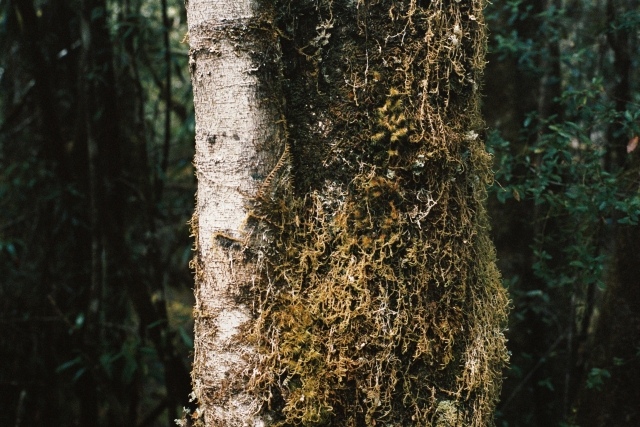
Gary Sauer-Thompson, Moss on tree trunk, Franklin-Gordon Wild Rivers National Park, Tasmania, 2006
This snap is a very different kind of image to the conventional wilderness photography or those photos that are produced to brand Tasmania-as-wilderness for the tourist industry.
This idealization of wild nature is largely indebted to the aesthetic of the sublime popularized by European Romanticism The habits of thinking that flow from this complex cultural construction called wilderness" are influential. William Cronon, in an essay entitled "The Trouble with Wilderness," suggests that in the sublime tradition:
nature comes to represent an enticing flight from history: the false hope of an escape from responsibility, the illusion that we can somehow wipe clean the slate of our past and return to the tabula rasa that supposedly existed before we began to leave our marks on the world. The dream of an unworked natural landscape is very much the fantasy of people who have never themselves had to work the land to make a living.The fundamental problem with the concept of sublime wilderness is that it depends on and reinscribes the notion of nature's otherness, of the separation between the human and nonhuman realms.
Alas, nobody in our party was interested in exploring the rain forest or staying there for several hours. Their's was clock time. Home in the Midlands was calling them, and we were due to fly back to Adelaide the next day. So I only had time to wander around with the Leica and take a few quick snaps. It was all a bit of a rush as the other people and dogs were waiting in the cars for me.

Gary Sauer-Thompson, Moss & tree trunks, Franklin-Gordon Wild Rivers National Park, Tasmania, 2006
I wish I could have stayed. The forest as an experience of the sublime in Romantic aesthetics---that "awful shadow"--- was the antithesis of this urban kind of experience in modernity:
Amid the deafening traffic of the town
Tall, slender, in deep mourning, with majesty,
A woman passed, raising, with dignity
In her posed hand, the flounces of her gown;
Graceful, noble, with a statue's form.
And I drank, trembling as a madman thrills,
From her eyes, ashen sky where brooded storm,
The softness that fascinates, the pleasure that kills.
A flash . . . then night! -- O lovely fugitive,
I am suddenly reborn from your swift glance;
Shall I never see you till eternity?
. . .
-- excerpt from "To a Passer-by," Les Fleurs du mal, Charles Baudelaire
September 4, 2006
art criticism #2
In this earlier post I mentioned the common distinction between art criticism and art reviewing. This enable us to make a break from just talking about critics.
There's an implied hierarchy here, which would have criticism as the more complex and specialised activity and reviewing the more day-to-day. Criticism is done in when writing an essay for an art magazine or a book, whereas reviews are written for the (mostly broadsheet) newspapers. How is the distinction understood?
Luke Morgan in his Australian Art Criticism and Its Discontents" in the Australian Book Review says that we usually encounter:
diametrically opposed, if equally trenchantly expressed, viewpoints. On the one hand, we have an image of the newspaper art critic as a buttoned-up, perhaps elaborately moustachioed and truncheon-wielding policeman-pundit, laying down the law wherever he goes. On the other, there is the academic critic, whom we encounter behind a wall somewhere, probably a sandstone one, emitting a steady stream of baffling dissertations.
It is different voices for different publications because the same people can, and do, write art criticism and art reviews. Thus art critics for the Sydney Morning Herald, The Age, the Canberra Times and The Australian are often academic. Morgan makes no mention of blogs---presumably, we bloggers would be seen as amateurs---at this point. They come up latter under hopeful possibilities.
Victor Harbor snaps
I mentioned here that I often walk along the cliff tops with the dogs on the weekends when I'm down at Victor Harbor. This is a typical view that we see all the time. It is 'seen' as 'scenery appreciation' within an aesthetic appreciation of nature as beauty, sublime or the picturesque.

Gary Sauer-Thompson, Looking to Kings Head, Victor Harbor, 2003
This is late afternoon in the winter sunshine. In the summer the green goes and the earth becomes the light brown of dried grass.
Our aesthetic experience of nature still has sits roots in eighteenth-century landscape aesthetics which concentrated primarily on sublime and picturesque scenery based on continental travel writing---the tradition of picturesque tours.
How long before this landscape is covered in houses through seachange is any body guess. That concern takes us to the edge of environmental aesthetics as an area that considers aesthetic appreciation of things other than works of art. How then do we to understand aesthetic appreciation of non-art?

Gary Sauer-Thompson, Ari on clifftop walk, Victor Harbor, 2004
The concern for the state of the environment is not simply one of preserving natural scenery and returning to romantic naturalism, as we probably need to interrogate assumptions about the self and nature which Romantic writing helped to naturalize. These assumptions suggest that seeking an aesthetic appreciation of nature is a solitary pursuit constituted by a spectatorship, which begins and ends with the individual self, and signals a separation from the world.

Gary Sauer-Thompson, Atget on clifftop walk near the Bluff, Victor Harbor, 2004
We need to move away from self-centered conceptions of Romantic aesthetics of nature and toward greater environmental aesthetic that assumes we are a part of, and within, nature.
art criticism
The consensus is that Australian art criticism is in poor shape. So argues Luke Morgan Australian in an essay entitled Art Criticism and Its Discontents'. Morgan says that:
Some of the issues at stake here may be familiar, even tired, or at least always present in one form or another. What seems different is the palpable tone of resignation. In the past, polemical pieces about the crisis of criticism have often served as prolegomena to some new critical programme, often driven by a defined theoretical position or dissatisfaction with the ex cathedra pronouncements of the established critics. In Australia today, however, few critics seem interested in reforming criticism (not, of course, that they necessarily should be): some duly note the problems as if they were necessary evils to be kept at arm's length as much as possible, while others flatly deny any interest in criticism or, to be more precise, what they describe rather disdainfully as 'reviewing', preferring to think of themselves as practising other forms of art writing altogether.
Art criticism performed by the academic critic----as distinct from art reviewing performed by the newspaper critic--is in poor shape, its condition critical, as it were.
September 3, 2006
first steps to a gallery
Though - net.art, which refects the cultural, social and political issues of the users who inhabit this domain, is well and truely established, I'm only just getting the hang of translating images shot on old film cameras (Linhof and Leica) onto the weblog. 'Just' is the key word at the moment.
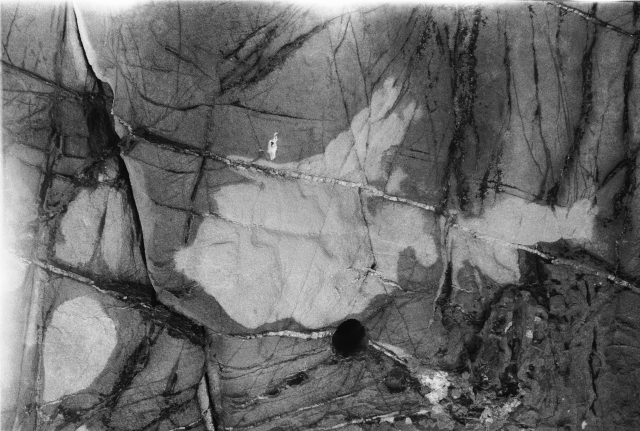
Gary Sauer-Thompson, Rocks Mallacoota, 2003
This is an old image from a holiday on the east coast near the NSW Victoria border. It is an example of how an existing art form (photography) has moved onto the internet.
I'm finding it a step learning curve, however. I do not really know the differences between the different digital formats--bmp & jpeg--let alone how to modify the image digitally. I'll just stick with jpeg for the moment. I can see why artists are drawn to the net---it promises aesthetic control over the embedding graphics and sound into pages of easily navigated text.
This technology allows for an easy mix of image and text that can be grounded in the local and personally, as the work of Tom Moody, a visual artist based in New York, shows. However, they still can't earn any money with their art.
Me, I just take the humble snapshot aesthetic using the conventions of beach culture. The old (modernist) hierarchy in photography went from high-art photographs at the top, to documentary photographs (working photojournalism) in the middle, to snapshots (for us amateurs) at the bottom. But those hierarchies don't exist anymore.
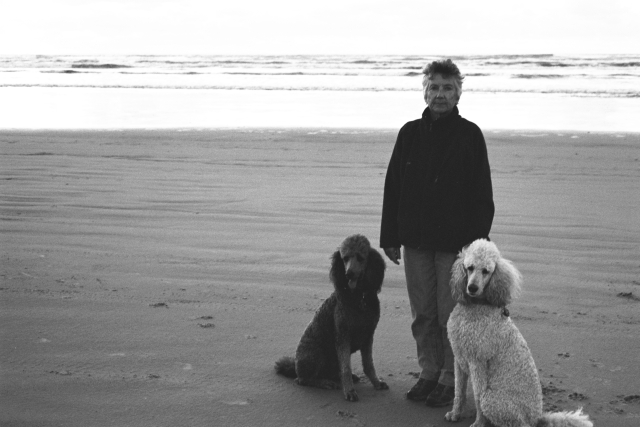
Gary Sauer-Thompson, Suzanne and Dogs, Victor Harbor, 2004
Though it could be a beach anywhere, it is actually our backyard when we are holidaying at Victor Habor---part of the cliff top top walk west of Petrel Cove. The negative gives no indication where the beach is. I'm just guessing. I more or less stopped shooting in black and white when the old Leica M3 fell to the ground in Brisbane and the range finder broke. It still has not been repaired.
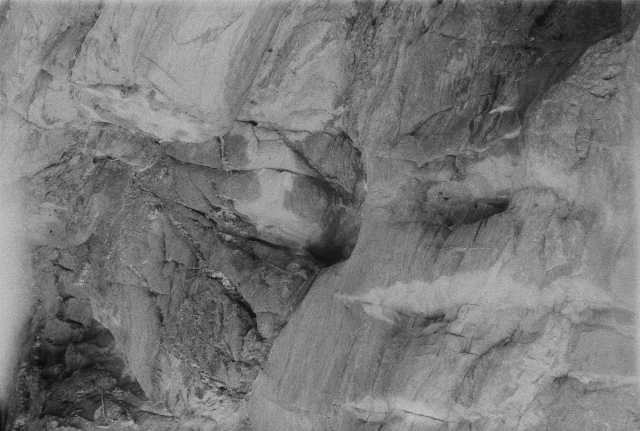
Gary Sauer-Thompson, Rocks Mallaccota, 2003.
The image needs darkening to bring out the blacks. That's the next step isn't it--modifying the image. So what we have is a toehold in digital space for the discussion of media, networked arts and cultural practice as it happens.The critical reflections upon this can be found at empyre What we have is a different kind of textuality.
September 2, 2006
my country
Nyayuku Ngurra (My Country) is now showing at the Helen Maxwell Gallery in Canberra. The work is by Central Desert artist Marie Shilling.

Marie Shilling, WaterHole: Birds and emus are going to drink at the waterhole", 2006
It is a naive work and very decorative and captures the colours of the desert landscape west of Alice Springs.
September 1, 2006
The falling man
The photo below depicts a man falling from Manhattan's World Trade Center during the September 11, 2001 attacks in New York City. The unknown subject was one of the people (dubbed "jumpers" by the press) trapped on the upper floors of the building who apparently chose to jump to certain death, rather than die from the heat, fire and smoke. They did so until the tower collapsed.
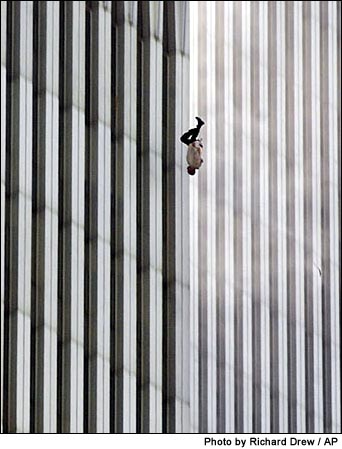
Richard Drew, The Falling Man, 2001
The image is controversial, especially in the US. The media's self-censorsed the photograph, preferring instead to print photos of acts of heroism and sacrifice. The picture appeared all over newspapers on September 12, but never appeared again. The image was deemed to be too confronting and it was derided as disrespectful, voyeuristic and exploitative of the tragedy that tore at the heart of the US.
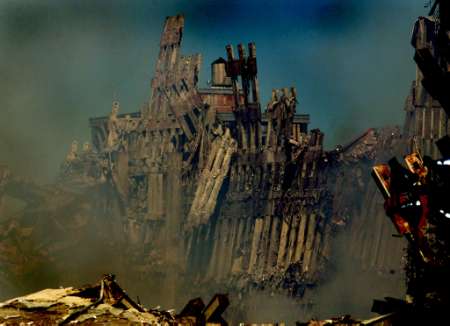
Shaun Best, 2001
The media were seen by the American public as being irresponsible and immoral. They exposed children to a brutal and honest truth? What truth is that? What is being exposed?
Update: 5 September
Kim Huynh provides an answer in an op ed. in the Canbera Times. He says that the violent reaction is in part explained by the falling man's defiance of two of the great narratives of our times:
The story of the modern forward-looking individual tells us that we must strive until the very end, if only because this is as good as it gets. From this perspective, each of us exists at the centre of the universe and, with enough will, can overcome any obstacle.The Christian story also urges us to carry on in the face of hardship because you never know when God will bestow his miracles. Even more compelling is the knowledge that there is only one sin that the Almighty cannot forgive - suicide. These grand stories are woven together to form the very core of what it means to be American today.
That makes sense.