October 31, 2006
painting dementia
When he learned in 1995 that he had Alzheimer's disease, William Utermohlen, an American artist in London, responded in characteristic fashion. He began to try to understand it by painting himself. His self-portraits reveal his descent into dememtia over the span of nearly four decades.
Below, a self-portrait from 1967.
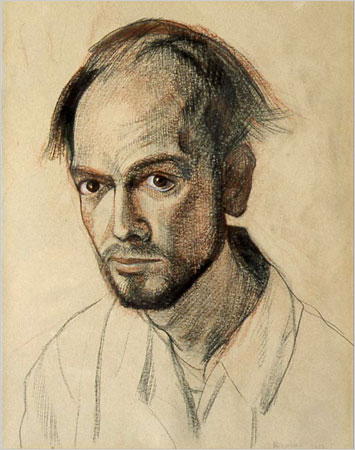
A self-portrait from 1996:
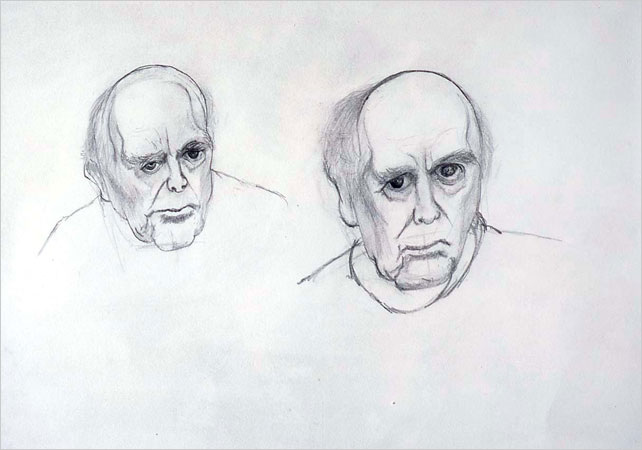
Mr. Utermohlen, 73, is now in a nursing home. He no longer paints.
October 30, 2006
Representing the Fleurieu Peninsula
From the Fleurieu Peninsula Biennale. An entry in the The Fleurieu Peninsula Vistas Prize
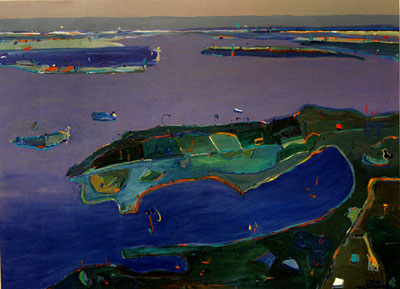
Clair Cooper, Lake Alexandrina and the Tolderol National Park, 2006, Acrylic on Canvas
religious conservatism
I guess Sheik Taj Din al-Hilali's words express the widely shared views and sentiments among the first-generation Muslim immigrants in Australia. What Hilali says is consistent with a strict, conservative interpretation of Islam, and so highlights the fundamental difficulty with Islam's attempts to integrate with modernity.
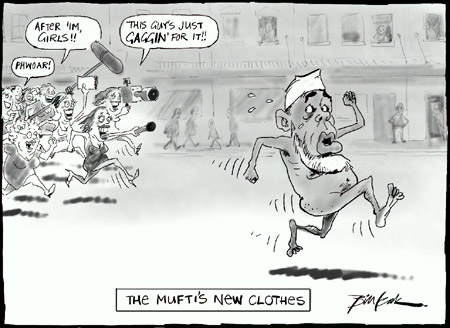
Bill Leak
The old era of immigrants see moral corruption endemic in Australian secular society, the kind they believe has led to a breakdown in families. Their views overlap with Australian social conservatives in general [eg., those who cluster around in The Australian and Quadrant], who see human freedoms, especially with regard to sexuality, as having gone too far.
The Islamic and Christian religious conservatives see their religious texts (the Koran and Bible respectively) as the literal word of God, and not as a product of history. Consequently, only a strict interpretation of the text is appropriate.
October 29, 2006
Fleurieu Peninsula Biennale
We are off to the Lake Breeze Winery on the banks of the Bremer River in the premium red wine district of Langhorne Creek region of the Fleurieu Peninsula for lunch. It's a picnic of wine, food and music.
From pre-European settlement to the present day art has played a distinctive role in defining a sense of relationship with this geographical region. This relationship continues today. The Fleurieu Peninsula Art Prize is the nation's richest landscape art prize. It is the flagship of a number of art prizes, that form the Fleurieu Peninsula Biennale. What attracts me is The Fleurieu Peninsula Water Prize and this is one of the entrants:
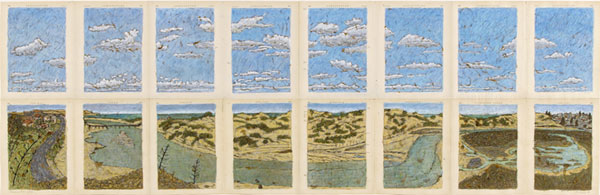
Ken Orchard, Onkaparinga Estuary SA, Ink, Shellac and Pastel on Paper, 2006
It is one of the few images of water in the region. From pre-European settlement to the present day art has played a distinctive role in defining a sense of relationship with this geographical region.
Art means painting ---not drawing, prints, photography or digital imagery---and therein lies the conservatism.
October 28, 2006
blaming the victim
The cartoon refers to Muslim women not wearing traditional dress in Australia been compared with trays of meat by Sheik Taj Din al-Hilali---an Australian Muslim leader---and being defined as temptress. What was stated was "equating women who do not wear the hijab with 'meat' to be devoured by sex-crazed men". So he promotes the damaging myth that rape is about sexual temptation.

Tandberg
Sheik al-Hilali is blaming young women for the soulless celebration and glorification of the sex industry, and for a raunch culture's understanding of sex, sexuality and their attitudes to women. It's a classic case of blaming the victim and quite at odds with one of Australia's fundamental values-- the idea that men and women are equal. Consequently, what Sheik al-Hilali should be doing is voicing concerns over the way the fashion and advertising industries' sexualise women and girls.
October 27, 2006
about photography
In his influential essay "Little History of Photography," originally published in 1931, Walter Benjamin quotes Bertold Brecht on photography:
Less than ever does the mere reflection of reality reveal anything about reality. A photograph of the Krupp works or the AEG the massive German armaments and electric companies, respectively--- tells us next to nothing about these institutions.
As Susie Linfield commentsin Boston Review:
...on one level, there is no doubt that Brecht was right. Photographs don't explain the way the world works; they don't offer reasons or causes; they don't tell us stories with a coherent, or even discernible, beginning, middle, and end. Photographs live on the surface: they can't burrow within to reveal the inner dynamics of historic events. And though it's true that photographs document the specific, they tend, also, to blur---dangerously blur---political and historic distinctions: a photograph of a bombed-out apartment building in Berlin, circa 1945, looks much like a photograph of a bombed-out apartment building in Hanoi, circa 1969, which looks awfully similar to a photograph of a bombed-out apartment building in Baghdad from last week.
Wy should photography explain the the way the world works? That is the task of natural and social sciences, not photography.
Linfield says that:
what photographs succeed in doing, which is to offer an immediate, emotional connection to the world. People don't look at photographs to understand the inner contradictions of monopoly capitalism or the reasons for the genocide in Rwanda. They---we---turn to photographs for other things: for a glimpse of what cruelty, or strangeness, or beauty, or suffering, or love, or disease, or natural wonder, or artistic creation, or depraved violence, looks like. And we turn to photographs, also, to find out what our intuitive reactions to such otherness might be.
October 26, 2006
civilization
Is this the interface between nature and civilization? It looks like it.

Gary Sauer-Thompson, Lake Alexandrina, 2004
Not quite. Though the lake is a part of the estuary of the River Murray where the river enters the sea--the Murray Mouth--- the lake is protected by barrages to keep the sea out. It is fresh water lake, nay a storage pond, for the irrigators and farmers. There are a series of locks, built in the 1940s, that prevent the mixing of sea and fresh water.
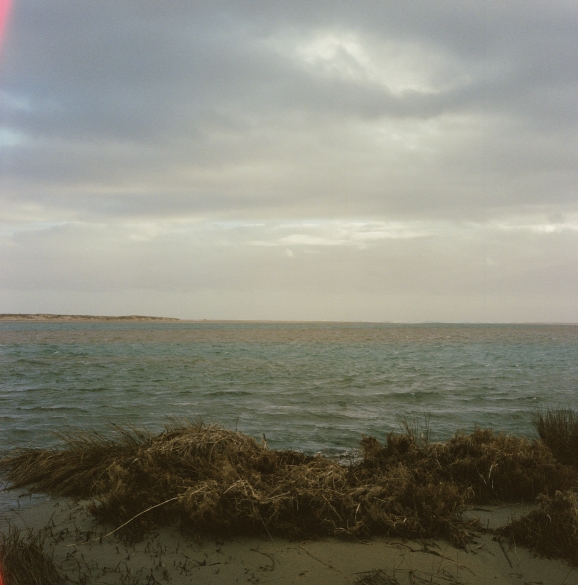
Gary Sauer-Thompson, Murray Mouth, 2003
The mouth of the River Murray is only kept open by dredging 24 hours a day, 352 days a year.
October 25, 2006
work-station anxieties
The roots of our idea of technology do indeed lie in our historical period of study, the era of the Romantics and the Luddites, but in ways much more complicated than either ahistoricist neo-Luddism or ahistoricist technoculture have seemed able or willing to explore. C. P. Snow was wrong. Literary intellectuals and humanities scholars are not natural Luddites.
Work-station anxieties refers to way that the humanities academics and intellectuals are themselves being turned into what the high-tech business world is calling "knowledge workers." Humanities scholars need to engage the knowledge-work culture of postindustrial capital if they are not to be redefined as easily-redundant, mere knowledge workers.
The resistance in the new era must be to educate the incipient resistance to the ahistoricist hegemony of that business culture.The postindustrial worldview holds that there is no real difference between the past and present that is not technical, so there is no real need for historical understanding per se.
October 24, 2006
returning to Russell Drysdale
When the poodles and I went for our evening walk in the Adelaide parklands today I noticed that a cluster of gum trees had died. The ground was so dry---dirt and dust with tufts of dead grass The landscape I was in reminded me of the paintings of Russell Drysdale:
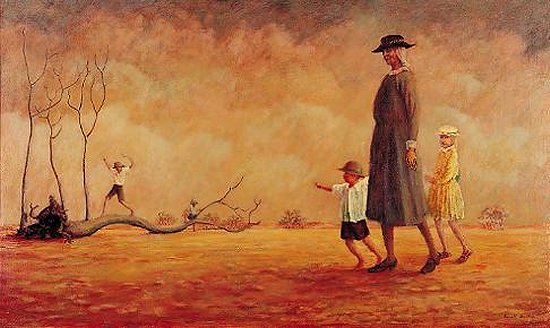
Russell Drysdale, Grandma's Sunday Walk, 1972
Drysdale is very unfashionable these days. He was killed of by an abstract modernism. I remembered some of the images of a series of paintings of drought-ravaged western New South Wales in the 1940s.
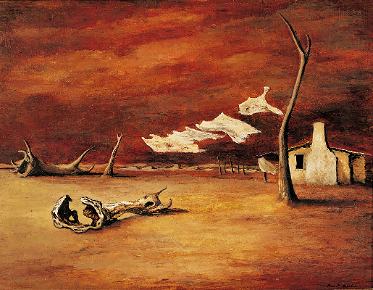
Russell Drysdale, Red Landscape, 1945
An excerpt from (Keith Newman, 'An artist's journey into Australia's "lost world"', Sydney Morning Herald, 16 December 1944, p. 5)
To drive into this country in a dust storm...is like driving into a lost world. The dust-laden air plays eerie tricks with light. The sky appears leaden, like a snow sky in Europe, or is crossed by great bands of black, red and grey... The sun is entirely obscured, or shows like a wan full moon. Dead trees, a tragic number, loom through the hot murk in a variety of fantastic shapes as though they died in agony beneath the axe or tortured by thirst as the wind blew the soil from their roots... Worse than the skeletons of animals and trees are the skeletons of homes.
This is rural Australia today, thanks to global warming.
rage against the machines
The association of Romanticism with the Luddites and, in turn, with the Luddites' presumed anti-technology philosophy is now widespread in popular culture. Romanticism is understood as essentially an anti-technological philosophy whilst the ecotopian project is to return us to nature--- to a pre-capitalist way of life. The image of the anti-technological/neo-Luddite fusion of "machinery" being smashed---televisions or plastic computers in the 1990s ---- is a reminder of the smashing of machines (stocking frames) two hundred years.

Between now and then lie fields of carnage and desolation, with various cultural possibilities, but these are all glossed and collapsed into the 'rage against the machines.' The conflation of Romantic literature and Luddism often assumed that the poets are able to express what the workers could only do.
The above understanding implies that Romanticists would not be found on the Internet, since a digital romanticism--ie., a romanticism on the net was a contradiction in terms. So what happens to those romantics who have gone digitial? They embrace the machine--their work stations--not smashrthem. We humanities' intellectuals use them to write about technology pervading every aspect of life---nanotech, biotech, genetic engineering, genetically modified crops etc ---leaving us no place of refuge and the way this enframing threatens dominion over our bodies and our subjectivies.
a political moment
Says it all really:
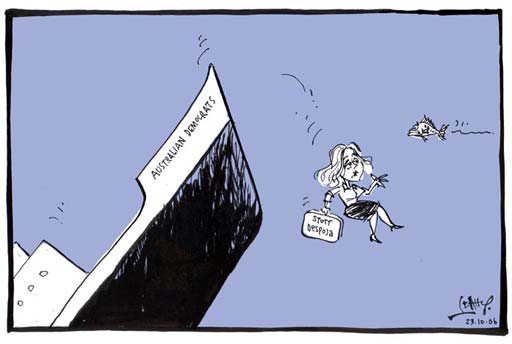
Sean Leahy
Sad in a way. The Democrats held the balance of power in the senate by 1980 and retained or shared that position for 25 years. A period of significant political history has ended. The centre has factured into right (Family First) and left (Greens).
October 23, 2006
Frank Zappa: Baby Snakes
I've got a DVD of an early Frank Zappa film called Baby Snakes from Quickflix, which I'll watch next weekend on the home theatrette and evaluate it as multimedia. I'm not a diehard Zappa fan, not even a fan, as I've hardly heard any of the jazz-rock fusion music on the Hot Rats, Burnt Weeny Sandwich and Weasels Ripped My Flesh albums.
The film is structured around a late-'70s (1979?) Halloween stand in New York City with digressions throughout the first half for backstage antics, band interviews, and some outlandish clay animation from Bruce Bickford. Zappa is in transition from being a social commentator in a satirical mode to an act that veered between jazzy music concrete and scatalogical Dadaism.
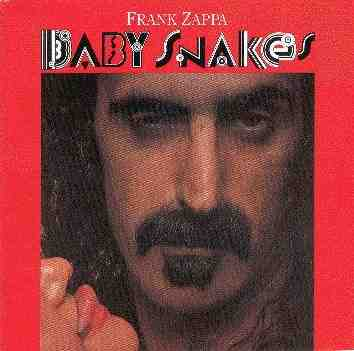
My understanding is that Baby Snakes is a collection of concert footage, dressing-room slapstick, and clay-figure animation. The concert runs almost uninterrupted from the midway point of the DVD to the end, with many of the played in the set coming from the Sheik Yerbouti. album.
I've had a brief look at the DVD and I guess that many would see the stream of conscious blend of music and imagery as a shapeless, inexcusably long concert film full of particular blend of avant-garde pretension.
from my backyard
a snap from the rocks at the foot of the cliffs of the southern Fleurieu Peninsula where I often walk the dogs on the weekends.
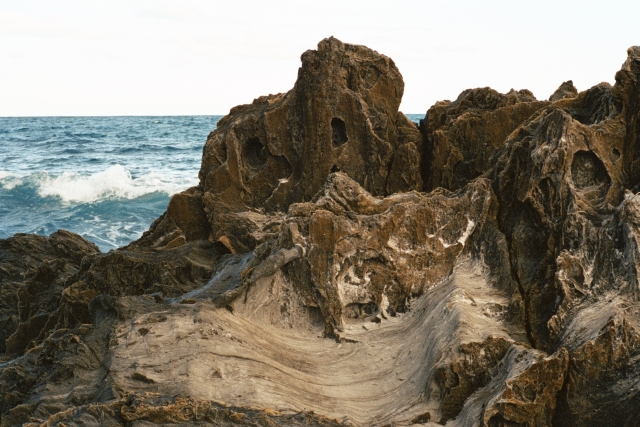
Gary Sauer-Thompson, Rocks, Victor Harbor, 2004
October 22, 2006
visual history of blues music
Along with jazz music, blues is the other quintessentially American art form. This makes sense of course as blues and jazz music are structurally, culturally, and historically related. So I decided to explore this with Rhino's Blues Masters ---- The Essential History of the Blues Vol. 1& 2.
The blues is America's roots music as it is music that it is strongly grounded sense of place -- specifically, the Deep South:
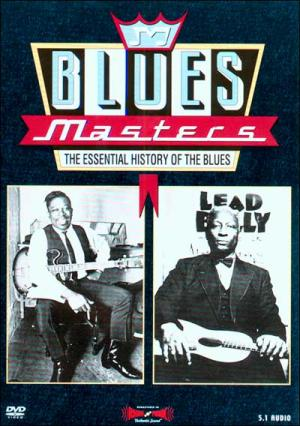
This is an "essential history" of blues music using rare performance and historical clips. The blues legends shown performing include Son House Leadbelly, Bessie Smith on Volume I, and Muddy Waters, Billie Holiday, Buddy Guy, and B.B. King on Volume 2. Though it rejected the idea that the simple and popular music of the black masses the history lacked any genuine musical substance.
It was trash in terms of both exploring musical development (no Robert Johnson, Skip James or Elmore James or Willie Dixon) and aesthetics (reflection theory). It was more about the rare performances of the early masters captured on film rare and archival footage . It is a visual, not a musical history of blues music, and one that discusses the blues in terms of its reflection of the social significance of the black movement overcoming racism and segregation.
The visual history gestured towards a blues aesthetic but never explored it in terms of the voice and guitar.
I wanted to deepen my understanding of the shift from the country blues to the urban blues then the post 1945 electric Chicago blues. The former was recorded in the mid-1920s by a single male singer, self-accompanied on the guitar or piano, with perhaps an accompanying harmonica or simple percussion. (eg., Charley Patton, Blind Lemon Jefferson, Blind Boy Fuller, and Robert Johnson) .Urban blues represents the incorpration of popular music and jazz in the 1930s with combos incorporating piano, guitar, and percussion being developed by Tampa Red, Big Bill Broonzy, Little Brother Mongomery, Leon Carr and Scrapper Blackwell, Lonnie Johnson, and Memphis Minnie.
It was during the 1940s that some blues bands incorporated saxophones amplified harmonicas, with Chicago becoming a predominant center of blues recording in the 1950s. for Muddy Waters, Little Walter, Elmore James, Howlin’ Wolf, T-Bone Walker, and B. B. King. So what was the connection between country and urban Chicago blues-- is it the Mississippi blues style just because many performers had migrated from the Mississippi region?Nor did it explore the how the blues influenced mainstream American popular music through musicians like Bo Diddley and Chuck Berry, in which Diddley and Berry's approach to performance was one of the factors that influenced the transition from the blues to rock 'n' roll.
October 21, 2006
drought, wetlands and climate change
Don't be deceived by the water. It's just a pool in the Chowilla wetland of the River Murray that hasn't seen a flood for ten years or more due to the overallocation of its water. Floodplains, which are the vast majority of a river, are not seen as part of a river. The River Murray has changed in that decade from being a working river to an irrigation channel. Consequently, many of the redgums in Chowilla are just hanging on.
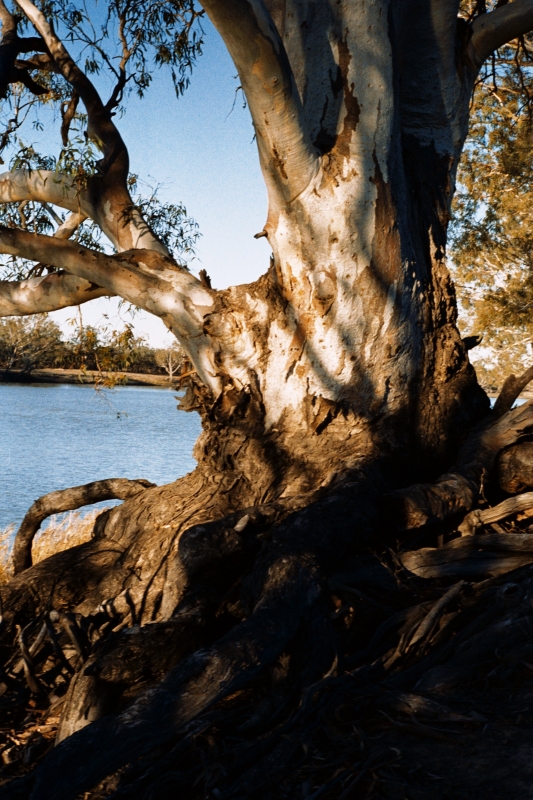
Gary Sauer-Thompson, Chowilla Rivergum, 2004, from the River Murray series
The director of CSIRO's Climate Program, Bryson Bates, appeared before the Senate Inquiry into Water Policy Initiatives earlier this week. Bates told the inquiry the Murray River was experiencing its driest five-year period, and that climate change was expected to decrease run-off in the Murray-Darling basin by up to 25 per cent by 2050. That means a reduction of annual river flow of around 15%.
It is in the wetlands of the River Murray, such as Chowilla, that you can see the how basin is drying out. Water trading as a response to the issues of reduced supply, increasing demand, and competition between a range of urban, rural and industrial users will not help an overallocated river with a future of reduced flow. It is the very survival of the river that is increasingly at stake.
October 20, 2006
River Murray
We are arguing about water a lot these days as we inceasingly adapt to living with the effects of climate change. In my neck of the woods that means decreasing rainfall and a country that is drying out. In calling that drought we imply its only temporary, presuppose the rains will return, and deny that the dryness has the human finger print all over it. The scientific evidence increasingly undercuts that hope even though the big picture is still fuzzy from a lack of data. That lack is due to university research funding being cut by the Howard Government since 1996.

Gary Sauer-Thompson, Cliffs, 2004, River Murray series
The outlook is gloomy especiaily for those of us in Adelaide ,who are living downstream at the bottom of the Murray-Darling Basin and are still reliant on the waters of the River Murray for our drinking water.

Gary Sauer-thomspon, Reeds, 2004, from River Murray series
If the rains fall less, the runoff is less, the river's flow is less and the water supplies are depleted. Yet the population continues to increase, and along with it the demand for water.

Gary Sauer-Thompson, riverbank, 2004, from River Murray Series
Few have thought through the long term consequencesof climate change for southern Australia How many have considered that the electricity generators that now power Australian society may not have the large amounts of fresh water they require for their cooling towers?
October 19, 2006
fire scares
Courtesy of Jeffrey J. Hemphill

Great Sandy Desert fire scars, Australia, Landsat
It looks like an abstract expressionist painting from the 1950s, doesn't it? It looks different from an on the ground perspective.
And very different from indigenous representationsof the desert --painting country:

Jock Mosquito, Canning Stock Route, Ochre on canvas,
black humour

Leunig
I guess the conservatives will not smile. They wil see it as defaming the military who should be honoured.
October 18, 2006
Victoria's rivers are dying
This article in The Age makes for sobering reading. It says that global warming means rainfall levels in Victoria may never return to "normal" when the drought ends. So the state's main rivers may never get back to pre-drought levels. .
New figures show that flows in many key rivers have already fallen to below those recently forecast by the CSIRO for 2055, assuming global warming. Flows in the Yarra have fallen by 29 per cent over the past 10 years, whereas the CSIRO had previously forecast they would drop by 23 per cent by 2055.In the same period, the Maribyrnong's flow has fallen by 41 per cent. The forecast was a 32 per cent drop by 2055.Geelong's main water source, the Barwon, has fallen by 34 per cent. Its forecast was a 28 per cent drop. Likewise Ballarat's main source, the Moorabool, has fallen 60 per cent. Its forecast fall by 2055 was 32 per cent.
Bendigo is biting the bullet. It is building a water recycling plant.The recycled water will be piped to nearby farms, parks and the Campaspe River, rather than being added directly to drinking supplies.
October 17, 2006
Sex pistols: the music
I had always understood the Sex Pistols in terms of being a threat to the social order and the monarch rather than the music. Though I haven't seen Malcom McLaren's 'The Great Rock 'n' Roll Swindle', I did not accept his mastermind thesis that the band were his living, breathing sculptures to build a punk aesthetic---all mean, subversive and anti-social --that was used to swindle the masses to make lots of money for the promoter through creating chaos. I presume that McLaren had delusions of being an Andy Warhol? I 've always understood punk as a genuine social movement struggling to create a truly participatory culture in in Thatcher's England.
But I never really listened to the music. So I watched a DVD of 'Never Mind the Bollocks, Here's the Sex Pistols' in the classic albums series on Sunday night. This 1977 album made by the Jones/Cook/Matlock/Rotten line-up of the English punk band, Sex Pistols. Sid Vicious comes across as a drug-addled and pretty vacant with questionable bass skills and a violent streak who contributed little to Never Mind the Bollocks. Yet he and his self-inflicted tragedy is the ghost that haunts the Pistols.

This was the only album they recorded (it's basically a singles collection), and it is now regarded as a classic and influential rock and roll album--- the defining album of punk. The album was an attack on the safe and bloated progressive rock (Yes, Emerson, Lake and Palmer, Pink Floyd?), the manufactured pop music of the mid-1970s and the prevailing fashion of long hair and flared jeans. It became a style that was commodified. Hence the DVD explores the album as signifying a critical moment in pop culture (a happening) as well as the unmaking of a band that mattered.
I was suprised how much the music on the album was overlaid ---it was not the raw, primitive sound that I thought it was. The lead guitar is minimalist and tight. if they could only play three chords they were serious about their music. The album sounds as fresh and hard as when it first came out in 1977.

Punk eventually became a fashion statement. Anarchy became less about overcoming political oppression of the working class in Thatcher's England, and more about wearing torn pants and leather jackets and obtaining free sex and drugs in a society of the spectacle.
The story on the classic album was hard to follow---I have yet to see the more personalised story of The Filth and the Fury film with the band themselves telling their own story.
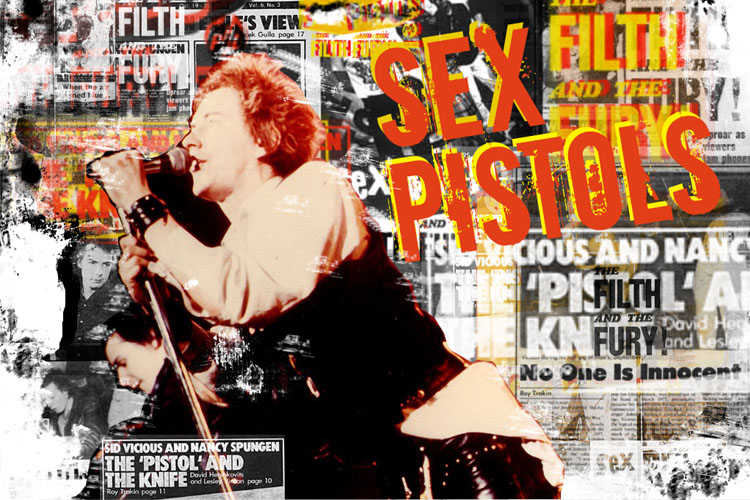
I guess we are still waiting for a film about punk as a movement instead of a rockumentary about a particular band. The Alex Cox film, Sid and Nancy, which released in 1986, is not that film.
Wassily Kandinsky

Wassily Kandinsky, Lyrical. 1911. Oil on canvas. 94 x 130 cm. Museum Boymans-van Beuningen, Rotterdam, Netherlands.
October 16, 2006
Muslim veil ban
In Australia the veil is seen by conservatives as a political statement (part of its "aggressive" role). What is overlooked is the lack of job opportunities, racism in the employment market, the chronic shortage of affordable housing and what increasingly looks like institutionalised racism in the provision of the most basic council/state government services.
The cartoon below refers to the row over religious dress and the integration of communities in the UK arising from remarks by Jack Straw, who sparked a debate when he urged Muslim women to abandon the veil because it hampered community relations since one could not talk face to face. Straw's comments referred specifically to the veil that covers the whole of the face except the eyes (niqab), or even hides the eyes (burka), not to the many variants of the headscarf which are the more usual version of hijab in Britain.
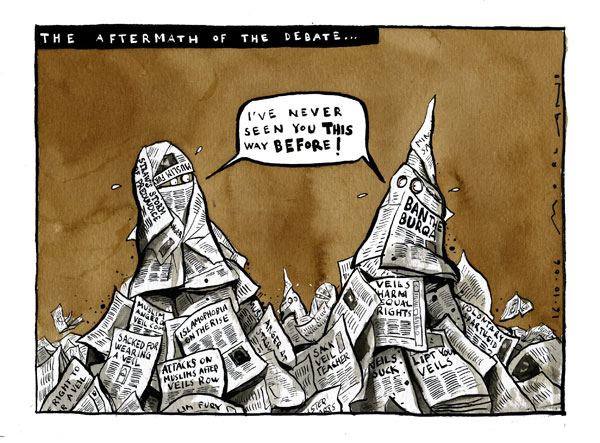
The Times
The Muslim veil is not seen an issue of personal choice. The universities are moving to "uncomfortable" or "threatened". Veiled Muslim women are caricatured as oppressed victims who need rescuing from their controlling men, while at the same time accused of being threatening creatures who really should stop intimidating the (overly tolerant) majority.
October 15, 2006
imaging the Earth from above
I suspect this is a representation of Uluru:
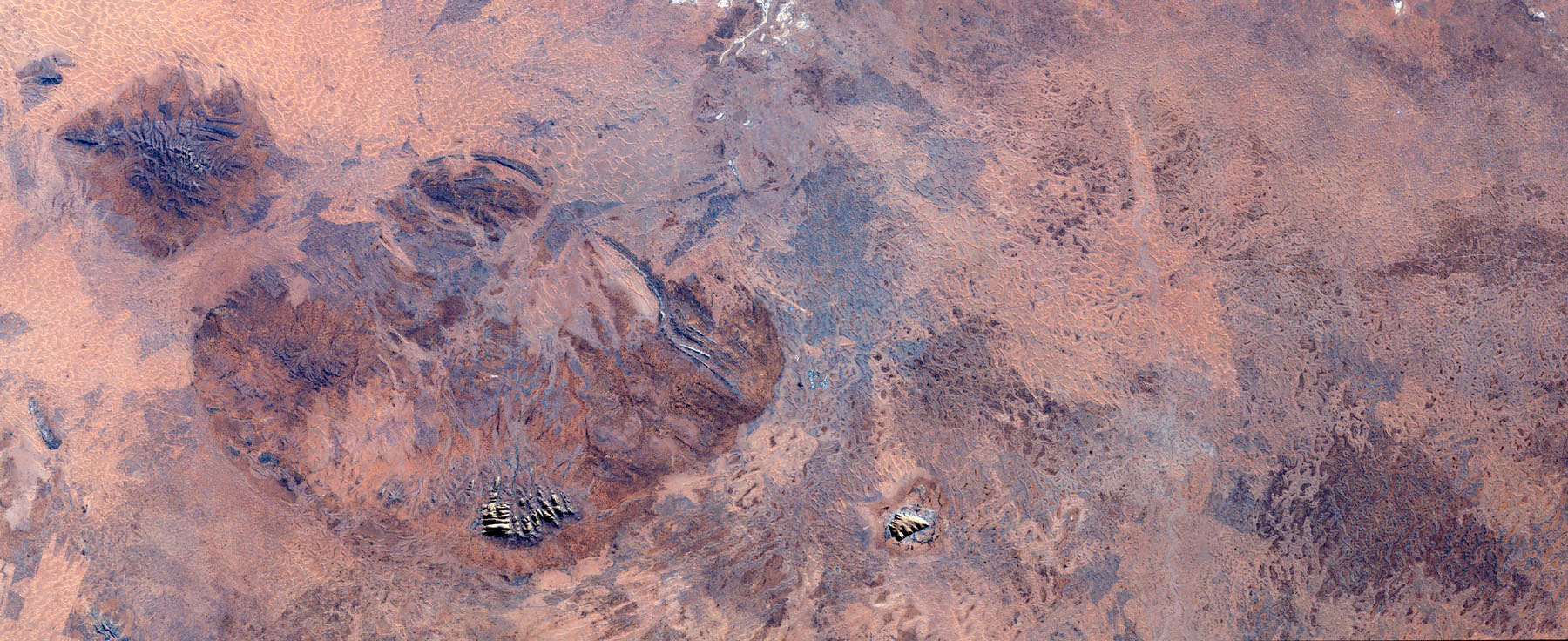
Stephen Young, Australia from Space
It is a sample image from an exhibitionit is close to an abstraction.
it's getting hotter and drier
When I came down to Victor Harbor for the weekend I was shocked at how dry the landscape is. It is just mid-spring and it looks like mid-summer (February). The hot temperatures and north winds have dried out the little moisture that was left in the land after a winter with hardly any rain. I spent a large part of the weekend bucketing water to keep going the young trees in the reserve that I planted several months ago.
As the 'drought' worsens, the weather conditions become ever drier, the heat from the hundreds of bushfires blazing around the country grows more intense, and the ever tightening water restrictions become normal. Climate change is all around us.

Matt Golding
The scorching October weather has left many of us in southern Australia feeling suffocated before summer and feeling rather anxious about the future. Those people existing on water tanks in the Fleurieu Peninsula do not have enough water to get them through summer.
This is the new world of climate change: the warming across Australia has been accompanied by declines in regional rainfall. That is not all. Rising temperatures mean melting icecaps and rising sea levels. Sea levels are already rising (lready risen 20cm and are expected to rise a further half-metre over the next century. Adelaide will be among the worst-hit of Australia's coast-hugging cities and Adelaide's low-lying suburbs face increasing flood risk from stronger winds and storm surges coming off higher sea levels.

Stephen Young, digital elevation model of Australia with the sea level raised 100m, 2006
It's 100metres if Greenland goes the sea levels will rise by 7m.If Antarctica went as well the sea would rise by 80m. Adelaide, faces a double whammy, because areas where we have been pumping out groundwater are now sinking at a rate similar to the rise of sea levels. So hard decisions will need to be made about whether to spend money to protect the coast with things like breakwaters, or sacrifice land and let the coast recede backwards naturally.
October 14, 2006
digital television
I've just had a home entertainment centre set up. I couldn't set it up myself I was obliged to rely on audio and television technicians to get it up and running.

Well its more a home theatre system that is supposedly equipped to control all the requirements that I might need for my movie and music experience. It wasn't very impressive watching He Ping's Red Firecracker Green Firecracker (1995) ---the surround sound was limited and the picture quality was poor despite the excellent visuals of a feudal way of life. This is a pity because the fim was about a fiercely puritanical society living on land; a repressive order threatened by sexual impropriety; and fireworks as a metaphor for sexual ecstasy.
It may be the case that digital transmission will eventually replace analog transmission for all broadcast delivery--its around 202. Imagine my disappointment when I discovered that digital television in Australia was really no different to analogue TV in terms of the content being offered. So what has happened to the promise of diversity by Senator Helen Coonan, the Communications Minister? media reforms are really about changes to the media ownership to allow greater concentration. The promise of diversity clearly remains undelivered, as there are no new places to go with the media reforms. All that Coonan's recently passed media legislation achieved is consumers being able to watch 'Dancing with the Stars' on a mobile phone. Big deal.
It is clear that digital television isn't going to be introduced overnight as the free-to-air commercial television of digital data-casting ---extra news, weather, sport and shopping channels and useful community services are being broadcast. You can check out still shots of notorious traffic areas and surf-cam shots of the major beaches to let you see what surf conditions are like. Great. Very innovative.
October 13, 2006
Bat out of Hell
I watched Bat Out of Hell as a DVD in the classic albums series last night after returning from Melbourne. This combination of theatre and rock on an album that combined the talents of Meat Loaf, Jim Steinman and Todd Rundgren ( cinematic production) was released at the time when punk rock was shaking up the music world. They produced music (seven songs) pulsating with energy that is recognized as a milestone of '70s pop culture.
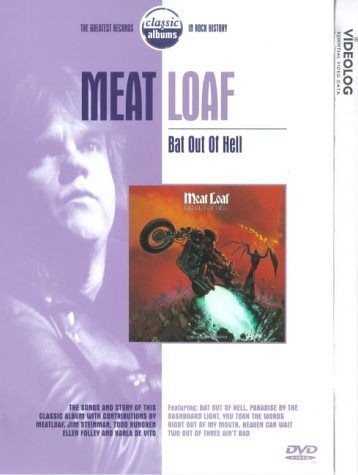
Bat Out of Hell was entirely written and composed by Jim Steinman. Steinman's classical background accounts for the albums sweeping arrangements, but much of the bombastic music has its roots in the classic girl group sound of Phil Spector and in Broadway theatre. The music depends on the pover the top performance by Meatloaf.
October 12, 2006
wall rose
I'm off to Melbourne for the day so I've only time for a photo
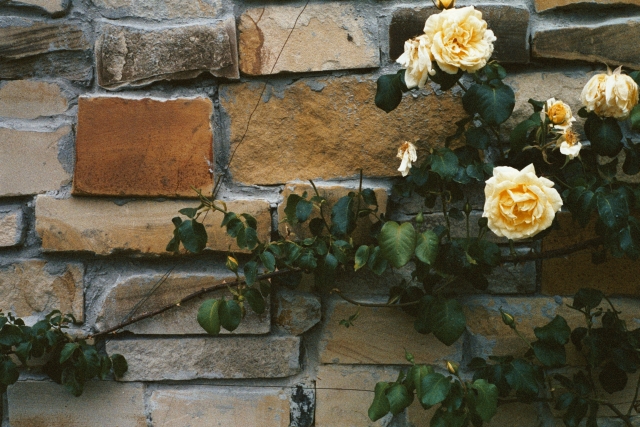
Gary Sauer-Thompson, wallrose, 2006, from Tasmania series
October 11, 2006
'Corporate paedophilia'
The argument by Emma Ruse and Andrea La Nauze from the Australia Institute is that corporate Australia is engaged in the sexualization of children to move product:

Fred Bare Hula Girl, 2006
It is less a happy snap of kids and more posed sexuality to sell product. Ruse and La Nauze call this form of the sexualization of children corporate paedophilia. They say:
Images of sexualised children are becoming increasingly common in advertising and marketing material. Children who appear aged 12 years and under, particularly girls, are dressed, posed and made up in the same way as sexy adult models. 'Corporate paedophilia' is a metaphor used to describe advertising and marketing that sexualises children in these ways. The metaphor encapsulates the idea that such advertising and marketing is an abuse both of children and of public morality.
Major department stories, such as David Jones and Myer, are posing children like adults, presenting them with hips thrust out and lips wet with gloss and slightly parted. So they are constructed as sexual beings by photographers before the kid models reached puberty.

Frangipani Rose, Denim shorts, 2006
That's a porn style shot isn't it. My guess is that the trend towards increasing sexualisation of children by advertisers and marketers is likely to continue. Ruse says that the idea behind corporate paedophilia is that normal paedophilia is adults exploiting children for their own sexual gratification without the children's consent. Children are not able to consent to sex. The same thing is happening with corporate paedophilia in that the Department stores are sexualising children, again without children's consent.
October 10, 2006
Rijks Musem
This is from the Rijks Museum
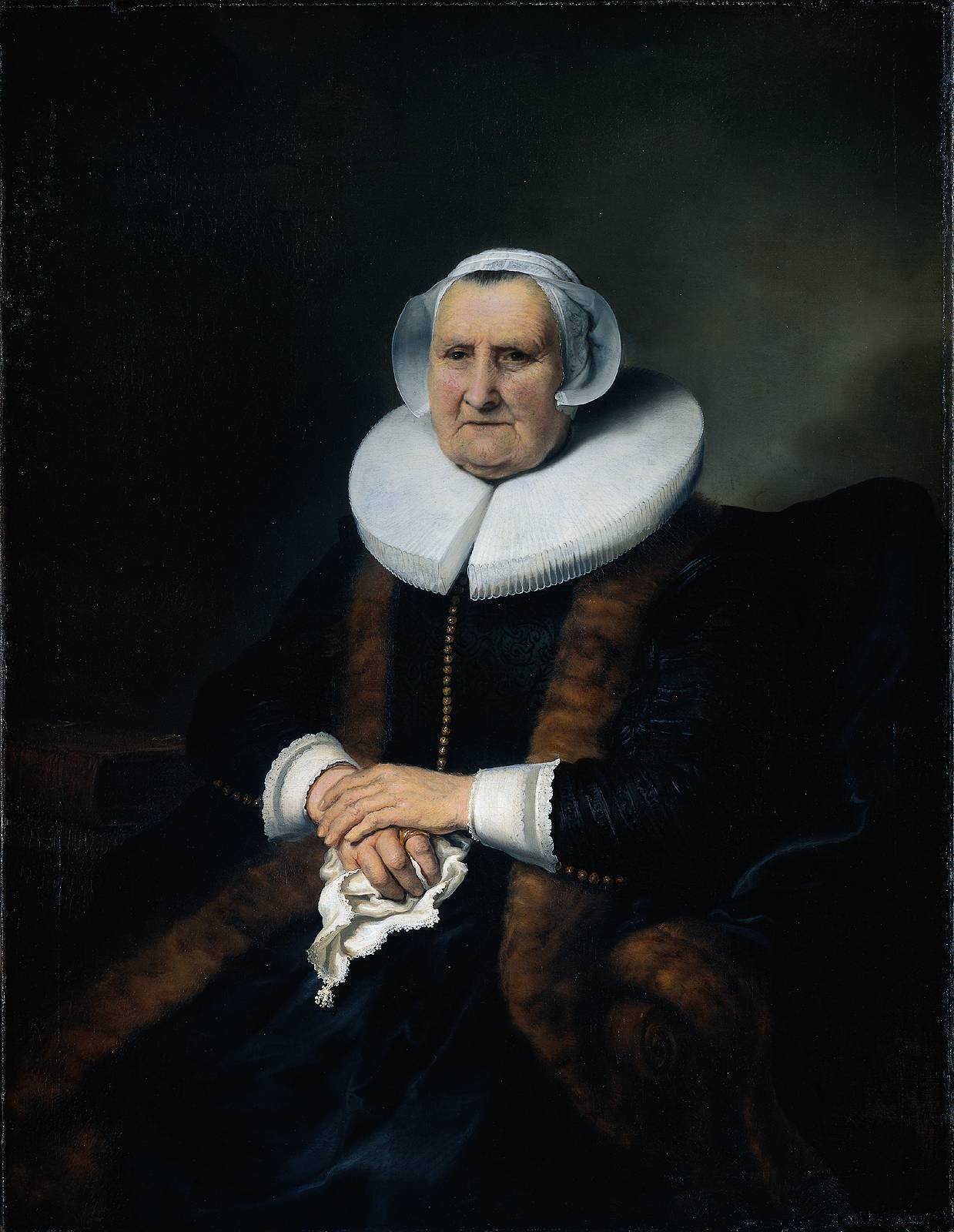
Ferdinand Bol, Elisabeth Jacobsdr, 1640
It is part of an exhibition of paintings that were originally attributed to Rembrandt and were bought as such by the Rijksmuseum, but about which doubts have arisen over the years.Bol worked for a period at the studio of Rembrandts in Amsterdam, before setting up as an independent artist in 1642.
October 9, 2006
photographic traces
Some argue that philosophical idealism is implicit within photography. I do not even understand that claim--I presume it has something to do with mind (of the photographer) and romanticism. Does that give us a romanticizing idealism? Photographs of plants and nature, which reflect the lingering undercurrent of Romanticism, are not inherently urbane or modern, and so their organicism is at odds with technological modernity.
This photo was taken when I was in Tasmania on holidays earlier this year. It was part of a series taken in and around Queenstown.

Gary Sauer-Thompson, Queenstown, 2006
In the 1980s Australian photographers basically decamped from street photography (understood as reportage)as mimesis) to studio tableaux and artifice. That leaves out a photography that is concerned with the nature/ human intervention relationship; one bearing the traces of the old Romantic notion of the antagonism between city and countryside.

Gary Sauer-Thompson, Rockface, Queenstown, 2006
One concerned with the traces of the human in nature.
October 8, 2006
Roy Orbison & friends
I flew back to Adelaide from Brisbane around dinner time and watched a DVD of Roy Orbison. Originally produced as a television special for Showtime, it shows that Orbison's music is not hackneyed as many have thought.

Black and White Night is a live show at Los Angeles' Coconut Grove and it features Roy Orbison making music with friends and colleagues including Jackson Browne, Bruce Springsteen, Bonnie Raitt, Elvis Costello, James Burton and Tom Waits joined Orbison in order to collaborate with, and pay tribute to, a rock and roll talent. It's full of warm vibes.
The music is more than the big ballads of lost love and dark sunglasses--there is a lot of good rockabilly played that highlights Orbison's musical roots in 1950s rockabill and shows the forward links to Bruce Springsteen.
However, as the Poemhunter.com site says:
Orbison finally found his voice with Monument Records, scoring a number-two hit in 1960 with "Only the Lonely." This established the Roy Orbison persona for good: a brooding rockaballad of failed love with a sweet, haunting melody, enhanced by his Caruso-like vocal trills at the song's emotional climax. These and his subsequent Monument hits also boasted innovative, quasi-symphonic production, with Roy's voice and guitar backed by surging strings, ominous drum rolls, and heavenly choirs of backup vocalists.
The Black and White show discloses how that dark glasses persona is misleading.
October 5, 2006
a satelite eye
A satellite image courtesy of Jeff J Hemphill at UCSB Department of Geography, Santa Barbara, California:
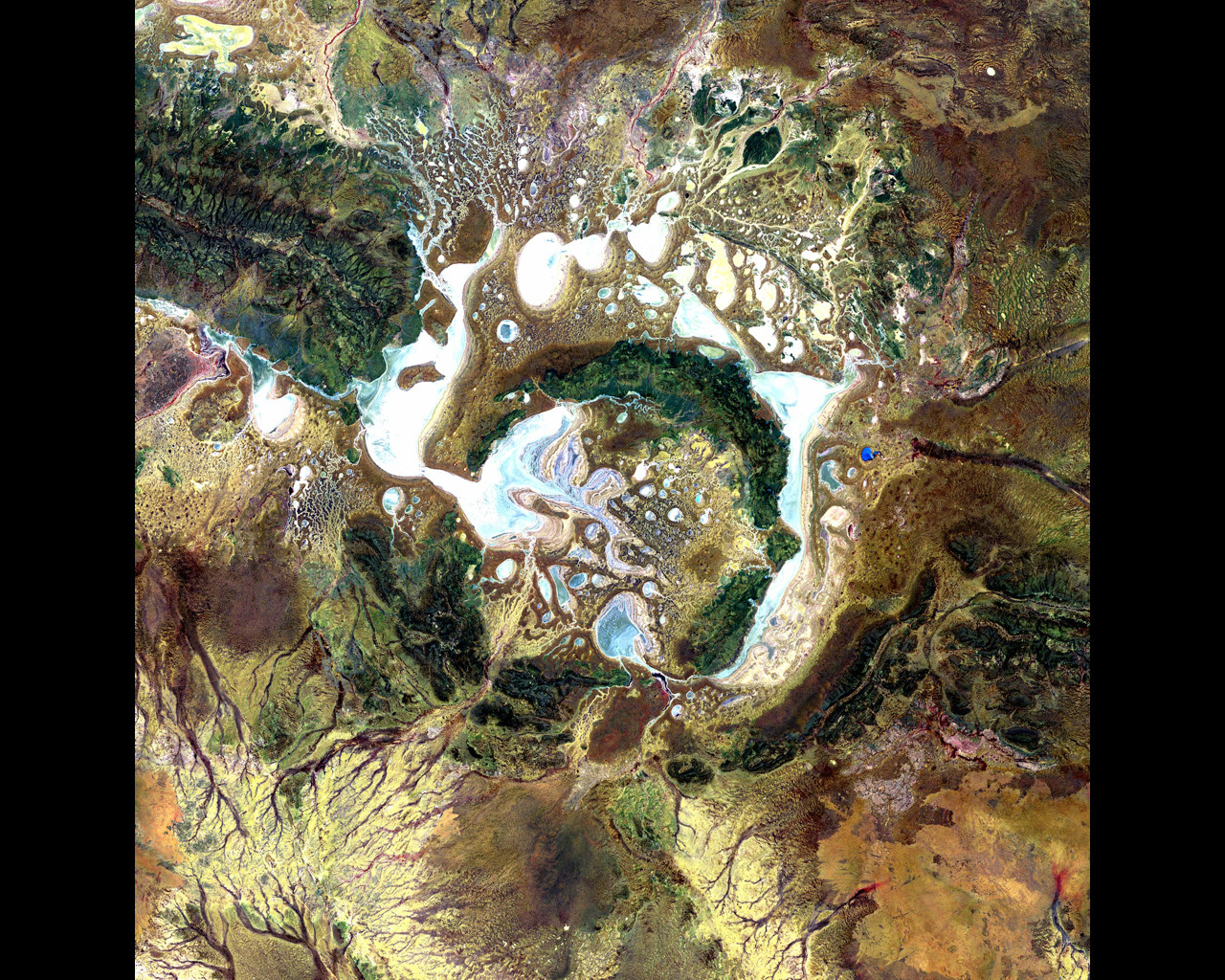
australia shoemaker impact structure 30 km across seasonal salt lakes nov 2000
The Shoemaker impact structure lies in the arid, central part of Western Australia near Wiluna. The crater is about 30 kilometers (18 miles) in diameter and contains seasonal lakes that produce salt deposits as they evaporate. It is approximately 1.7 billion years old and is regarded as the oldest known Australian impact structure to date. A dark, crescent-shaped inner ring surrounds the core, which consists of uplifted granitic rocks. The outer ring is composed of Precambrian sedimentary rocks. The crater, formerly known as Teague, was renamed the Shoemaker impact structure in honor of the late geologist Eugene M. Shoemaker, one of the founding fathers of impact research, who was tragically killed in a car accident in northern Australia.
coastal development
I'm due to go to Brisbane this weekend for work. It is an attractive city, but another capitol city where the car is dominant and the emphasis is on building freeways to improve traffic flows.
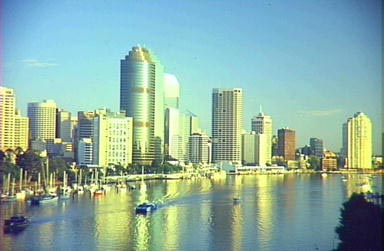
This is a state when a variety of State Governments have been seduced all along by the mantra of development and growth above everything else and their regional plans are all about helping to make this happen.
It is in south-east Queensland where the coastal landscape has been aggressively developed and little green space has been retained. So what we have developing is a 200 kilometre city. In this urban world the signs point to the challenge of rapid population growth with an updateding of the infrastructure plan: its all about roads and more roads, more electricity infrastructure, a new hospital for the Gold Coast, a couple of small dams, and nothing at all to preserve the environment. If South-east Queensland is growing even faster than many demographers predict, then it is also running out of water.
Tamborine Mountain has long been a battleground between developers and conservationists. It is where developers continued to gain approval for their subdivision applications in what should be a National Park.
October 4, 2006
Snaps: hogging the coloured centre
An formalist modernist aesthetics holds that the photographic medium has gradually been coming to an historical consciousness of itself as a form of picture making, or snapshot-aesthetic pictures of Gary Winogrand, which celebrate ordinary events, and transforms them with precise timing and framing into astute visual commentaries on modern life.
So this looks very old fashioned as it pays little attention to what is not centred:
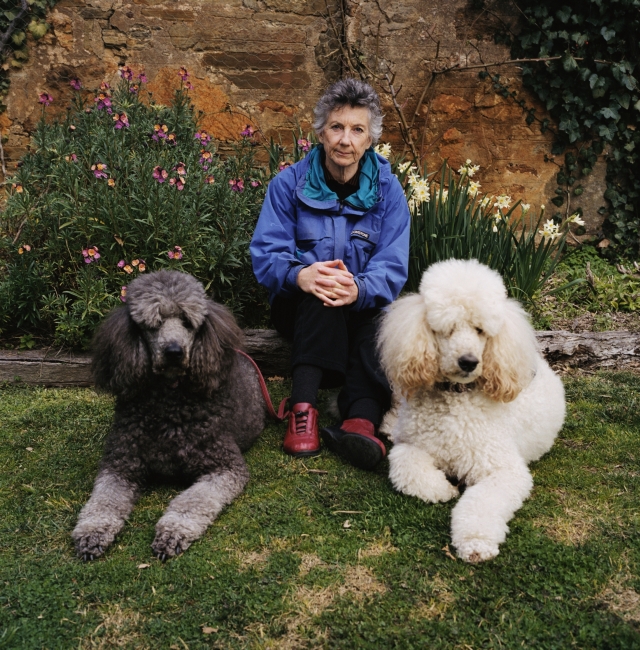
Gary Sauer-Thompson, Agtet, Suzanne, Ari, Clare 2006
In contrast, Gary Winogrand's images do not place his main figures in the foreground of a tautly arranged setting. In Winogrand's pictorial convention the main figure is sliced by the edges of the frame, or surrounded by acres of unexceptional space, or perched in the middle distance while some quizzical extra hoggs the center of the picture.
Portraits are seen as conservative genre of art. They are a long way from the work contained in William Eggleston's Guide, in which every detail matters and the picture is based on the expressive possibilities of the colour and the detail.
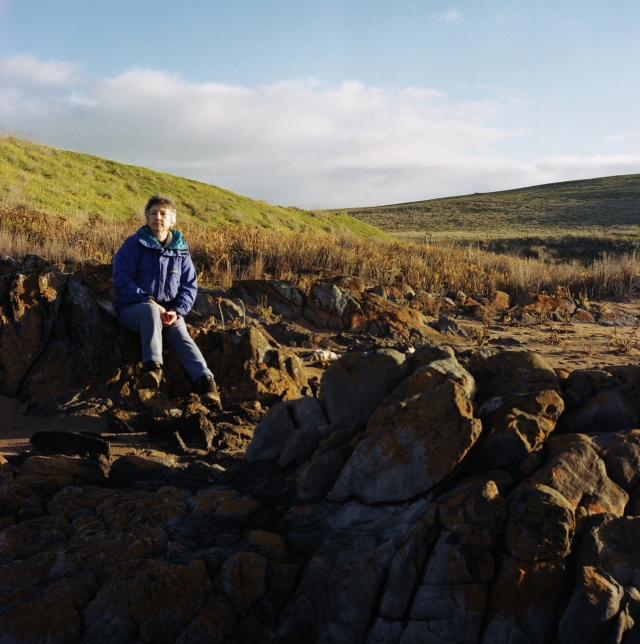
Gary Sauer-Thompson, Suzanne, 2005
These portraits have allegiances to more traditional forms of picture making. People are comfortable with portraits--or rather a picture with a figure or an object in the middle of the frame. People want something obvious from photography and protraits gives them that. They don't care all that much about composition, space, colour, line.
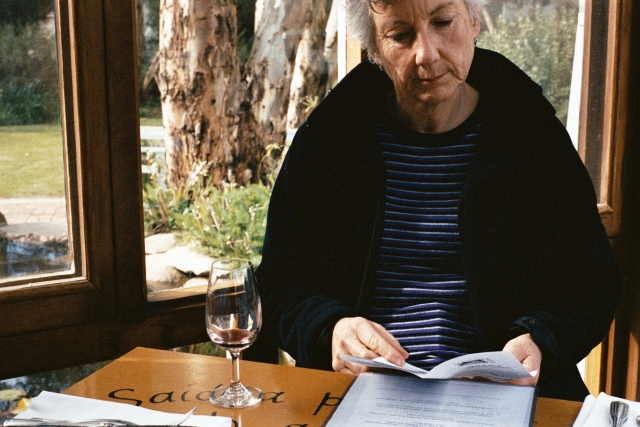
Gary Sauer-Thompson, Suzanne, 2005
Some formalists say that the photograph has nothing to do with the content. The pictures are about content (they mean something as pictures) and also simultaneously about photography, for the two issues are not supplementary but coextensive.
In his Introduction to William Eggleston's Guide John Szarkowski says that:
Most color photography, in short, has been either formless or pretty. In the first case the meanings of color have been ignored; in the second they have been considered at the expense of allusive meanings. While editing directly from life, photographers have found it too difficult to see simultaneously both the blue and the sky.
a note on media markets
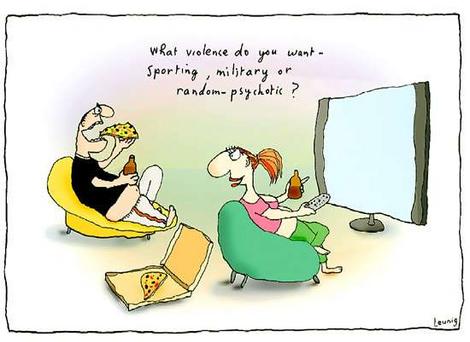
I read somewhere that the marketing and media executives are trying to reach --herd was the word used---youth who refuse to sit in an armchair and passively consume their daily media diet. TV is not their medium. Radio is background noise. They read newspaers online.
Leunig
Apparently--and old Rupert Murdoch has cottoned onto MySpace---hanging out together in some new place online --YouTube---where they make their own news and entertainment. Their websites---Flickr--- mainly consist of content created by their own users for themselves. They control the digital media they consume.
That puts paid to the mass market audience doesn't it.
October 3, 2006
William Eggleston's snapshot aesthetics
Szarkowski, as a curator tried to establish a new style of photography, based on an aesthetic of spontaneity, contingency, intimacy, and autobiography. Robert Frank was the progenitor of this kind of work and Gary Winogrand was the heir apparent. William Eggleston's show at MoMA in 1976 is widely acknowledged as the "breakthrough of color" in art photography.
'Breakthrough' means that Eggleston facilitated the entry of colour photography into art galleries---color was no longer 'vulgar' as It had become a legitimate mode of photographic expression, transcending its previous purely commercial application. The effect was to open up a distinction between "art photography" and "artists with cameras" (eg., the conceptual photography of a Richard Prince or a Cindy Sherman).
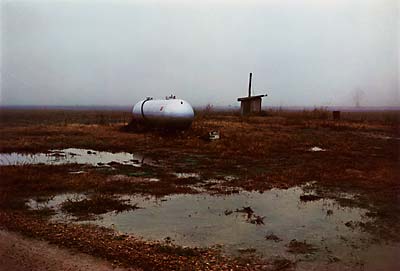
In its original concept, William Egglestone's Los Alamos images would be shown only as a group, with no commentary, titles, or representational hierarchy, essentially imitating for the viewer the artist's own visual experience of the world.
William Eggleston, from the Los Alamos Project
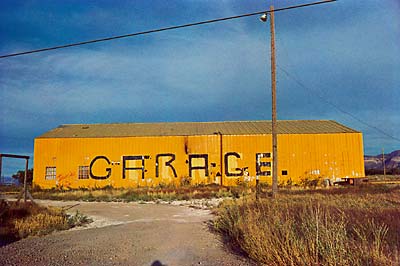
Modernist curators say that the images of this project 'seem almost incidental, yet there is an exact composition that uses power lines crisscrossing the sky or a stretch of fence as a formal device to divide the picture plane, or aligns the angled front wheel of a parked car with the high oval window of a building in the background.'
William Eggleston, from the Los Alamos Project
Szarkowski argues that the color in Eggleston's pictures is part the tint of the unexpected in his work:
These pictures are fascinating partly because they contradict our expectations. We have been told so often of the bland, synthetic smoothness of exemplary American life ... that we have come half to believe it, and thus are startled and perhaps exhilarated to see these pictures of prototypically normal types on their familiar ground ... who seem to live surrounded by spirits, not all of them benign.
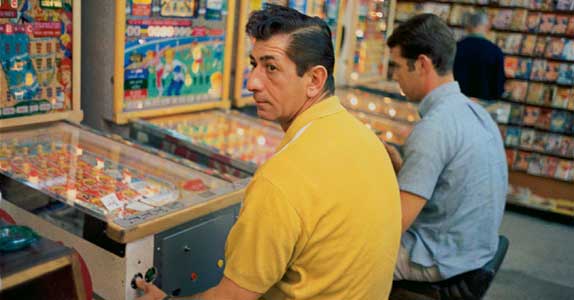
William Eagleston, from the Los Alamos Project
But we can reinterpret these images in terms of the social landscape can we not? I find the distinction between art photography and artists using cameras to be unhelpful. It is historical. Photography is much more diverse than this.
I grant that this image is different ---the photographer as a colour field artist deploying ironic formal and colour juxtapositions. It's the photography that is important not the subject matter:
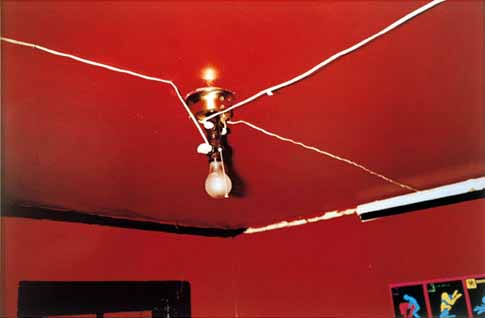
William Eagleston, Untitled (Greenwood, Mississippi) (Red Ceiling), 1973, from William Eggleston's Guide.
Eggleston's exhibition of "banal colour" photographs at the Museum of Modern Art in 1976 did turn the art photographers' world upside down. The MoMA show included such images as a dog drinking from a mud puddle, shoes under a bed, a child's tricycle, a tile shower and a kitchen oven. It did so because it undercut the hierarchy between the well-established black-and-white genre in fine art photography that worked to aestheticise subjects and colour photography, which was the domain of family snapshots and commercial work. Eggleston used colour to capture the immediacy of his subjects, unpolished and intimate and his choice of vantage point demonstrated a desire to express unconventional points of view, both literally and conceptually.
I do not know Eggleston's The Democratic Forest (1989) or his Faulkner's Mississippi (1990).
Can we not use the camera as a diary?
October 2, 2006
photographic snaps as memory
This snap is from a holiday in Mallacoota back in 2003. It stands in opposition to the work of those straddling the boundary between commercial and fine art photography, such as Andreas Gursky and the Dusseldorf-based Becher school.
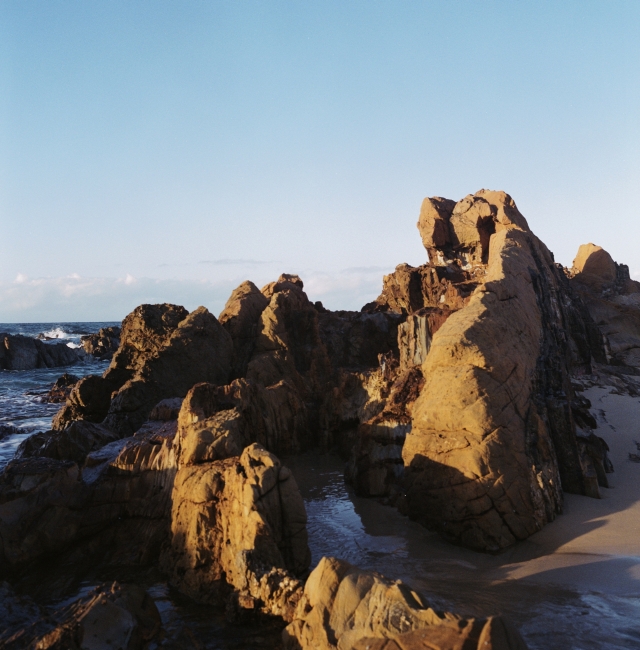
Gary Sauer-Thompson, Mallacoota Rocks, 2003
The images are a form of visual diary, or more accurately a photographic diary that is visual memory of a specific, previously unknown place and a tourist holiday experience that is often forgotten.
This is not a shift from scene-itself to the photographer's experience-of-it to generate a self-conscious style of art photography:
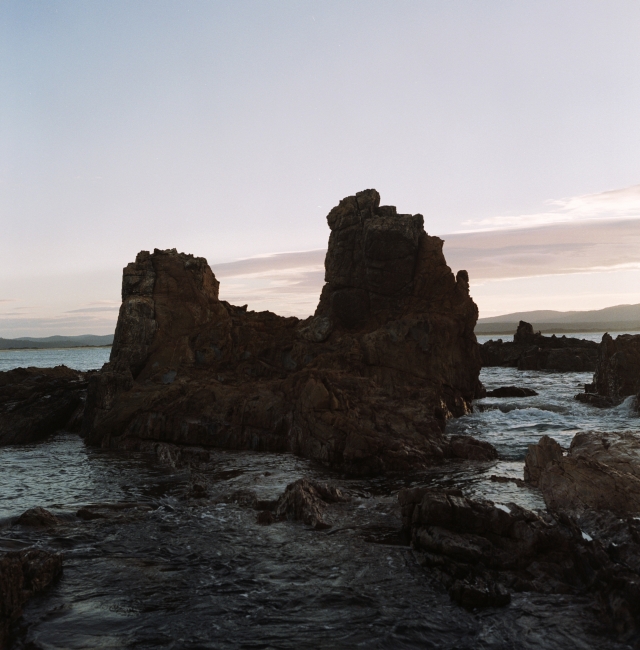
Gary Sauer-Thompson, Mallacoota, 2003
What is created is a world anchored in reality but one predicated on a memory of a tourist rather than fantasy or a document of a trip across the country that evokes the nostalgia for the road as in artist X went looking for Australia and couldn't find it anywhere. What is foregotten is the journey across the country. What is remembered is a specific place, namely Mallacoota:
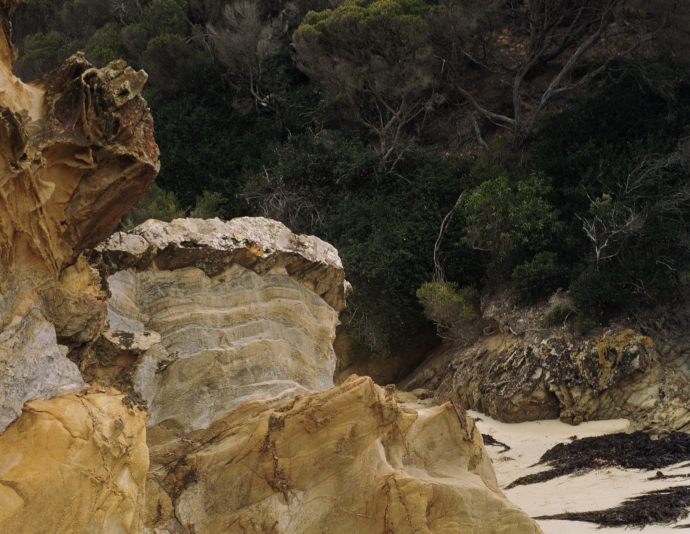
Gary Sauer-Thompson, Secret Beach Mallacoota, 2003
Can we then talk of the tourist's photographic eye in terms of Jacques Derrida's "logic of the supplement"? The point of this is to question the central assumption of the universality of vision (the "intelligent eye" of the photographer, the "appreciative eye" of the audience), as it seeks out the essence of the medium. For Derrida a supplement is something that, allegedly secondarily, comes to serve as an aid to something 'original' or 'natural'. The fact that a thing can be added-to to make it even more "present" or "whole" means that there is a hole or gap (which Derrida called an originary lack) and the supplement can fill that hole.
The Wikepedia entry on Deconstruction states:
From this perspective, the supplement does not enhance something's presence, but rather underscores its absence.Thus, what really happens during supplementation is that something appears from one perspective to be whole, complete, and self-sufficient, with the supplement acting as an external appendage. However, from another perspective, the supplement also fills a hole within the interior of the original "something". Thus, the supplement represents an indeterminacy between externality and interiority.
The tourist eye as supplement brings us back to the everyday and our own mundane concerns of places that we seek to protect and care for because they are special for us in the context of the rampant coastal development associated with seachange.
October 1, 2006
Heidegger+desert paintings
I've been exploring the links between Heidegger and aboriginal art around Puritjarra over at philosophical conversations.

Mandy Martin and Mike Smith, Palimpsest, Found local and sourced pigment, sand, rock shelter floor matter, ochres and acrylic on Arches paper, 2004
According to Wikepedia a palimpsest is a manuscript page, scroll, or book that has been written on, scraped off, and used again. If it is a basic tenet in rock-art that images tend to accumulate at selected sites and also at specific rock panels, then the rock face would be the 'manuscript' at Puritjarra and it can be interpreted as having usually diverse layers or aspects apparent beneath the surface.