November 30, 2006
Emily Kame Kngwarreye + colour
Emily Kame Kngwarreye (c.1910-1996), who is one of Australia's leading painters, is from the Utopia community north east of Alice Springs, even though she started painting in the public arena when she was in her eighties. That painting was founded on decades of making art for private purposes, of drawing in the soft earth, of painting on people's bodies in ritual or, in the late 1970s, of painting on the bodies of the Utopia women.

Emily Kame Kngwarreye, Merne (Everything) (Australia, 1996)
The work can be placed within 20th century abstract art, and within this perspective her vibrant compositions are often interpreted as abstract colour-field paintings. What is offered here are explosive, yet ordered, rhythms energetically worked her canvas with fluid dots or blobs of colour that form pulsing layers over the 'mapped-out' underpinnings. She is seen as a contemporary artist, rather than an aboriginal one.
Wouldn't it be better if she is seen as an an innovator within the aboriginal tradition---one who produces work that is very expressive in a cultural rather than a personal a sense ?
melting ice caps
The regular reader of Science and Nature is treated to an almost weekly load of data, virtually all of it showing results at the very upper end of the ranges predicted by climate models, or beyond them altogether. Compared with the original models of a few years ago, ice is melting faster; forest soils are giving up more carbon as they warm; storms are increasing much more quickly in number and size; and droughts are becoming worse.
Arctic sea ice is melting fast, the tundra of Siberia, permafrost has begun to melt rapidly,whilst the melting of the southern icecaps is happening a lot faster than was expected. I watched a report on Lateline last night about the melting of the Antartica icecap.

Pine island Antartica. Dec 2000, aster
The process we are now seeing is the breaking up of the ice shelves, the melting of the glaciers behind them, water flowing into the oceans and rising sea levels. And as the ice sheet discharges more icebergs into the ocean and loses mass, its surface sinks to a lower level where the temperature is warmer, causing it to melt faster.
We need to think in terms of the earth as a self-regulating system become significantly hotter. We need to reverse the flow of carbon into the atmosphere before we cross a threshold and create a "different planet." In this article in the New York Times Jim Hansen talks in terms of two scenarios:
In the business-as-usual scenario, annual emissions of CO2 continue to increase at the current rate for at least fifty years, as do non-CO2 warming agents including methane, ozone, and black soot. In the alternative scenario, CO2 emissions level off this decade, slowly decline for a few decades, and by mid-century decrease rapidly, aided by new technologies.The business-as-usual scenario yields an increase of about five degrees Fahrenheit of global warming during this century, while the alternative scenario yields an increase of less than two degrees Fahrenheit during the same period...The business-as-usual scenario, with five degrees Fahrenheit global warming and ten degrees Fahrenheit at the ice sheets, certainly would cause the disintegration of ice sheets. The only question is when the collapse of these sheets would begin.
November 29, 2006
Canberra's political culture
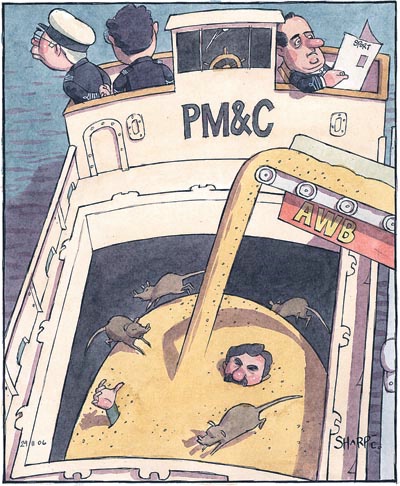
The background is here and here
Sharpe
Sharpe depicts our political culture. It is hard to get a picture of it because it is obscured. Yet we know that all is not well within it. It's the smell isn't it.
November 28, 2006
strange happenings
The English, by all acounts, had a bad time of it in Brisbane, when they began their defence of the Ashes.
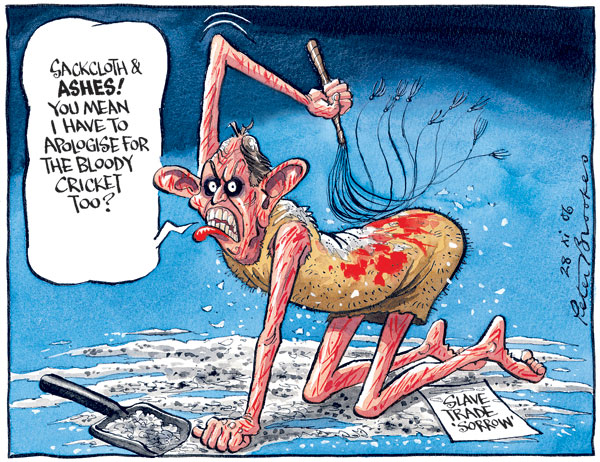
Martin Samuel, writing in The Times, says
The ridiculously overbearing security presence around the Gabba were nicknamed the fun police. They would not let supporters take rucksacks with drinks or sandwiches into the ground, but instead made them remove their rations and place them in a plastic bag. The rucksack could then be carried in, but only if it was in a plastic bag. This raised the bar for global stupidity, but do not expect the new standard to last long.
Samuel adds that everywhere you looked 'baseball-capped security men, many armed, eyeballed the paying customers suspiciously. They were on guard for offensive items. Beach balls, cool boxes, home-made sandwiches, trumpets, you know the sort of thing. All banned. Welcome to Western democracy, 2006.'
Jerry Shore: images of New York
I do not know anything about this photographer who worked the streets of New York in the 1980s and took photographs of driveways, back lots, industrial buildings, houses sheathed in paper brick in the New York City area. At this stage I only know what I have read in an article in the New Yorker entitled 'Jerry Shore's New York, and ours' by Adam Gopnik.

Jerry Shore, New York,
That's a pretty vibrant bright red. It's made vibrant by the strong silent. Yet, though a part of pop culture, it is an anti-picturesque image made without pop irony.

Jerry Shore, New York,
Gopnik says:
Shore's photography is, to use the ever-reductive language of art criticism, an attempt to reconcile the subject matter of the New York school of black-and-white street photography of the fifties---the love of the overlooked, the stray, the strange, the gutter, and the slum---with the high finish and compositional poise of the Meyerowitz-Eggleston school of color photography. His own ambitions for his photographs seem to have been almost purely formal and even abstract: though he was always on the streets, he never saw himself as a documentary street photographer, in the familiar Eugene Richards sense. His attention was devoted to space and color and form. And, to be sure, it is the organization of the pictures that first strikes one---what was called, in formalism's rosier days, their interpenetrating planes and surprising deep space.
I reckon these images go beyond formalism--to a concern about place---to Shore's urban neighbhood which he loved.

Gopnik talks in terms of Shore's will to memorialize the commonplace mirrors our own sense of how things we love get lost, and can be recalled only in pictures.There are no people in these images.
November 27, 2006
Robe: a holiday snap
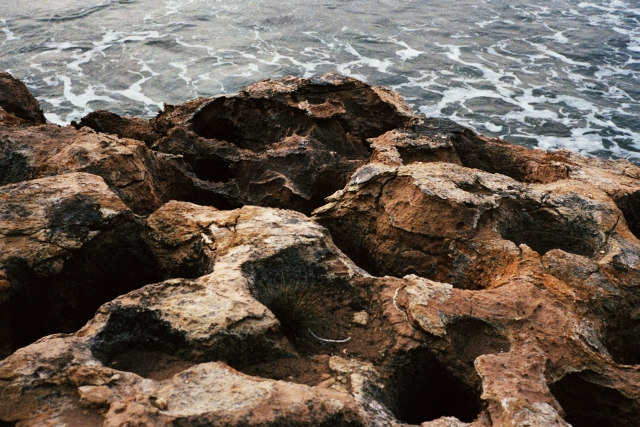
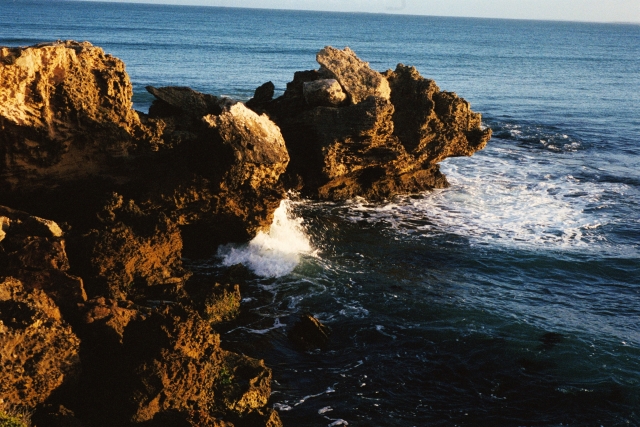
On my holiday in Robe earlier this year I walked along the clifftops in the morning and evening from our holiday shack to the town centre with the poodles. So I could walk the dogs and take some snaps with a 35-mm. camera, "sketching" possible scenes for a latter visit.
The pictures are less still-lifes and more landscapes, less studies of things rather than impressions of place.
Gary Sauer-Thompson, cliffs, Robe, 2006
We photographers are often seen by the art world as being out there in the world making pictures naive to the workings of the art world and its aesthetic concerns. We are 'naive' in the sense that we don't know art history, the art styles favoured by the art institution, and the pictorial conventions (beauty, sublime, picturesque etc).
Gary Sauer-Thompson, cliffs, Robe, 2006
Art photographers are an exception to this naivety. Art Photographers were a product of the art school and embraced formalism in the 1970s and 1980s, and so were concerned with space and color and form, modes of representation, the original eye and the organization of the picture.
'Naive' in the sense of being amateurs who did not know the work of a de Kooning and or a Kline. They only know photography and its craft.
November 26, 2006
Queenie McKenzie
I mentioned Queenie McKenzie in this post. She had a relatively short artistic career as she did not begin to paint until the late 1980's after encouragement from her friend, Rover Thomas
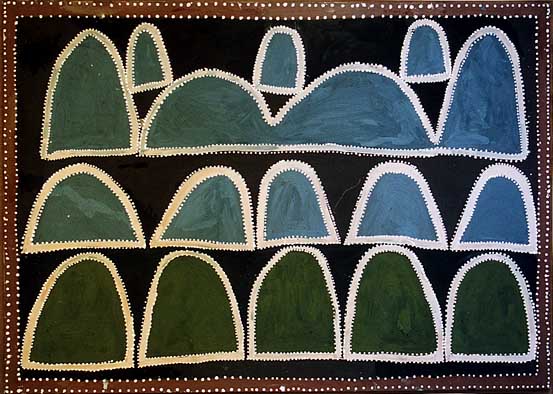
Queenie McKenzie,Turkey Creek, Ludan - Fish Hole, 1998
Her painting followed Rover Thomas' style, mapping country in natural ochers, blending landscape with witnessed or remembered events, family anecdotes and mythological information. Her landscapes are very distinctive, particularly her rendition of the Kimberleys. She used dots to delineate her simple forms and as a link to the traditional work of the Turkey Creek movement.
In her compositions, she usually placed images of geographic features in rows against monochrome grounds:
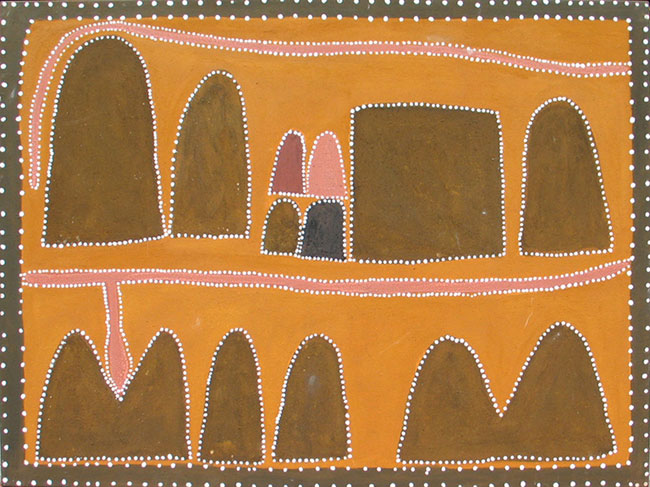
Queenie McKenzie, Balinji Tabletop, 1997, 120x91 cm ochre on canvas
Queenie McKenzie is now dead. She was a devout Catholic who, as an artist, tried to preserve both the style of Kimberley art and the traditional stories.
This kind of work takes us beyond the culture Wars, which suggests that there are two sides implacably opposed to one another, and that their goal is total victory by whatever means. To speak of culture wars, too, ennobles the warrior, and suggests aparity between the representatives of different positions. Culture wars are about power, and not about truth, as it suggests pit bulls that can intimidate and maul your enemies.
Culture, in contrast, suggests a pattern of relationships that include sharp differences about goals and about ways to live. These differences are best resolved in conversation, based on reasoned and appropriately complex argument about the issues at stake. This conversation has its standards, and you are entitled to a hearing only if you meet those standards.
Balzac and the Little Chinese Seamstress
Last night I watched Balzac and the Little Chinese Seamstress (2002)--- a Dai Sijiei film set in China 1971.This was when Mao's Cultural Revolution swept over China, shutting down universities and banishing "reactionary intellectuals" from the cities to work with the "revolutionary peasants" in the countryside as part of their "re-education". The young men and women are taught Chinese propaganda which they must then spread to nearby villagers in the mountains.
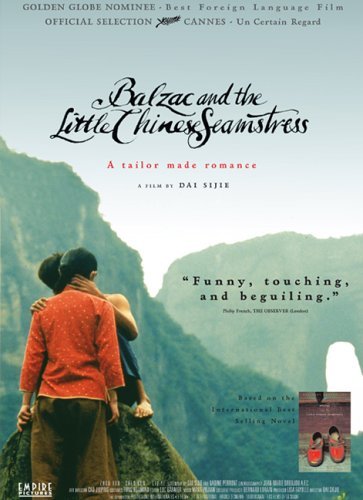 The cultural revolution was seen as a good thing in lefty academic circles in Australia in the 1980s---but it would be the equivalent of going to work in a rural, anti-intellectual Australia and being re-educated in deeply conservative values because green values were seen as bourgeois and opposed to the values of the regional working Australian people.
The film explores two young men being in love with a beautiful Chinese seamstress. The narrative is simple.
The boys discover a fellow student possess European literature, they seize the forbidden 19th-century literature and begin reading Balzac to the seamstress. They end up falling in love with her.
This reading gives the seamstress the keys to her own freedom and she leaves the village for the city.
This simple romantic narrative is well photographed in the way that it depicts a mountainous landscape in terms of its rich, vibrant tones.
Can we talk in terms of a Chinese national cinema and the re-imagining of Chinese history, when Chinese cinema is fundamentally disperse, and the globalization of film production, distribution, and consumption calls into question the notion of "national cinema" ? Some discussion can be found here.
November 25, 2006
John Prine: story telling in an ahistorical world
I watched this DVD the other night to learn more about John Prine, whom I only knew from the odd song and video. Prine is acknowledged to be a fine American singer and a great songwriter, and many of his songs have gained critical approval. Can the songwriters step into the gap left by the poets?
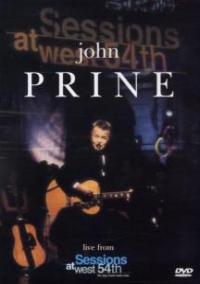 I was interested in hearing the stories told by a songwriter in an urban world of gas stations, traffic noise, neon lights, beggars and street kids, myths, glittering commodities in consumer dream worlds and wars.
The show----part of the Sessions at West 54th TV series--- was a mixture of Prine's great songs from his then current CD In Spite of Ourselves. It was all very human with pithy and humorous observations on the state of life and personal experience of regional America.
It was all very downhome, warm and friendly. The band was good in an understated way. We are invited to read the traces of living history in the stories that Prine tells, rather than decoding the surfaces of old commodities.
It is in the individual stories of songs like "Sam Stone," and "Hello in There" that we find a critique of both the big-city glitter of modernity that offers material proof of progress, and an expression of the withering of experience in a world of late capitalism that becomes alienated from its history as it celebrates progress.
It was much more interesting than watching The Corrs DVD Live at Landsdowne Road (2004). What a disappointment. Where was the musical innovation?The Corrs music was more light pop than traditional Celtic sounds. It was a long way behind the groundbreaking fusion achieved by Fairport Convention 30 years ago.
An earlier DVD, The Corrs Live at the Royal Albert Hall, (2000) indicated that they are within the pop mainstream both musically (a transatlantic sound) and their magazine-friendly looks. The concert was musically better:
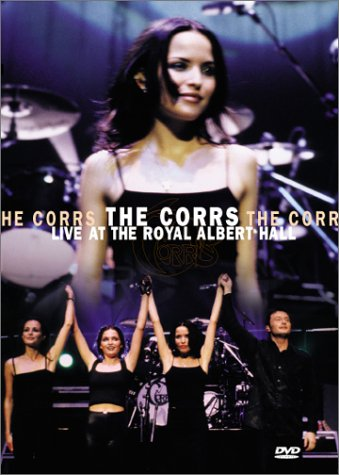
Still a lot of the songs sounded the same and the lead singer(Andrea Corr) had limited vocal expression and range. Again the claim about 'the innovative blend of pop music and traditional Celtic sound' was not evident. Instead of achieving a genuine synthesis of traditional folk and contemporary pop, The Corrs offered accessible and charming modern pop built on Fleetwood Mac, the Carpenters, Simon and Garfunkel etc that is mixed in with some Irish jigs, reels and melancholy airs.
November 24, 2006
photographer as flaneur
With the advent of the hand-held Leica camera in the mid-1920s, photographers acquired the capacity to go out into the world---updating the 19th-century flaneur, eg., Baudelaire--to try to capture that instant when visible reality itself seemed to yield an artistic result. Often the street was represented by many of the more poetic photographers as pretty, or a making beautiful. Beauty remained the core aesthetic value.
Not so here with this wandering through the city streets of modernity by Lee Friedlander:
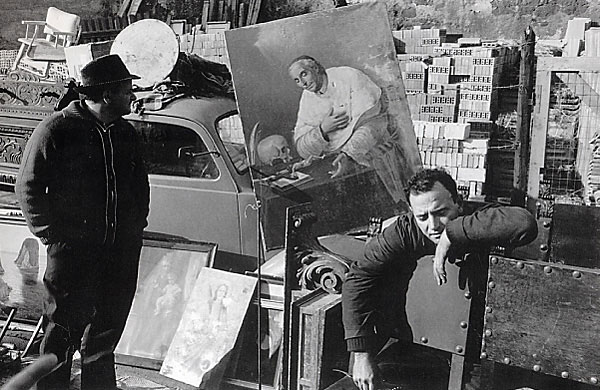
Lee Friedlander, Rome, Italy, 1964
The isolated photographer goes into the seductive marketplace full of bewitching commodities to have a look at it, but also to find a buyer for his product.
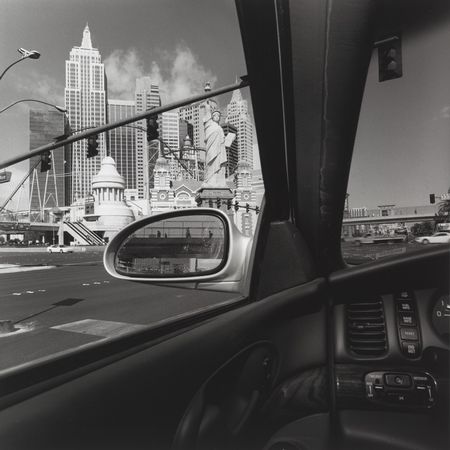
What is offered by Friedlander are moments of existence, which enter the memory as disconnected sequences of images of the diverse meanings, that are associated with the daily shocks and conflicts of late modernity.
Often in modernist American accounts of the history of photography we have the group of Dianne Arbus, Robert Frank, Garry Winogrand, Lee Friedlander and William Eggleston as the formal/content core. Then its decline: --photography lost something back in the '70s somewhere, somehow. Maybe we need an alternative way of reading of the photographic tradition than the old modernist one?
An alternative that is a critique of visual culture, but is alert to the power of images for good and evil and is capable of discriminating the variety and historical specificity of their uses.
November 23, 2006
Warnum art & Rover Thomas
I've mentioned before how much I admire the work of over East Kimberley artists such as Rover Thomas, Paddy Jaminji, George Mung Mung, Queenie McKenzie, Jack Britten, Freddie Timms and their contemporaries, Hector Jandany, Rusty Peters, Madigan Thomas and Paddy Bedford. These are the driving force of this distinctive Australian (Warmun) art movement that had its origins in Turkey Creek and crystalize out of the recent history of the eastern Kimberleys.
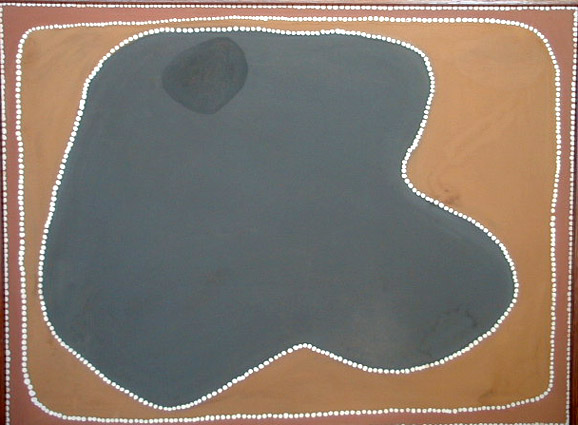
Rover Thomas, Nungarra, date unknown
The areas of solid colour and graphic forms contrast sharply with Western Desert acrylics or Eastern Arnheim land paintings, even though all explore the relationships between mythology, people, land and history.
Art at Warmun evolved in the late 1970s from the painted boards used in the Gija people's Krill Krill song-dance cycle performed by the Warmun community. This ceremony included the carrying of painted boards by dancers. These boards initially were painted by Thomas's uncle Paddy Jaminji, under Rover Thomas' instructions, and only several years later did Rover Thomas take up painting independently himself.
November 22, 2006
celebrity culture
Like Bono in U2 Ian Thorpe is a key player in a celebrity culture. Unlike the girly news readers of tabloid television Thorpe's status was gained from winning more Olympic gold medals, world championships and world records than any other Australian.
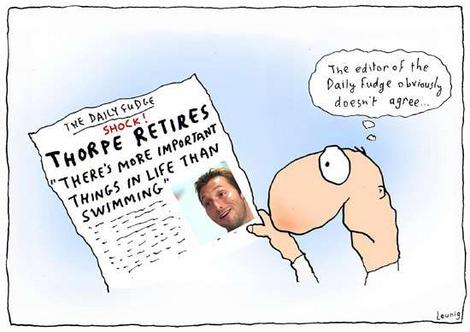
Leunig
The rise of celebrity culture is associated with the erosion of authority of traditional forms of authority---monarchy, church, parliament, which are often treated with disrespect, if not derision. If we no longer trust politicians we have faith in the pronouncements of celebrities. It strikes me that a celebrity culture is our new culture of deference. The new cultural authority is based on personality.
November 20, 2006
Lee Friedlander
Lee Friedlander is widely regarded as one of the innovators in photography in the 1970s. This is an innovation that has its roots in the work of Robert Frank, Walker Evans, Eugene Atget and works the tension in the history of the tension between the painterly photograph and the snapshot.
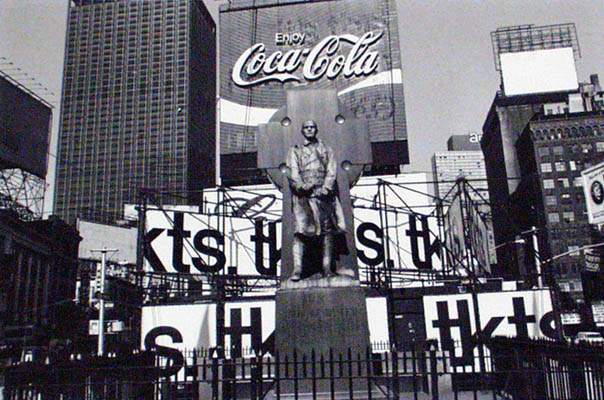
Lee Friedlander, New York City, 1974 , Gelatin-silver print
Friedlander accepted the modern street in the city as it was, with its clutter and wires and explored the way it fragmented our vision. In Friedlander's images, surfaces are frequently broken, disrupted, or complicated; objects jut forward, obscuring others. Mirrors and windows reflect and refract events already in flux.
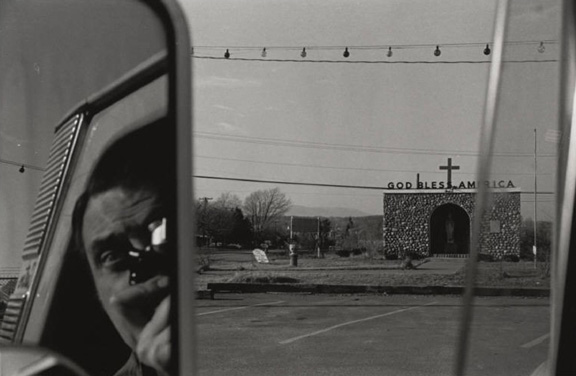
Lee Friedlander, Self portrait, Route 9W, New York, 1969.
In his series on TV images he represents only a moment of the action but it is enough to set the mood.
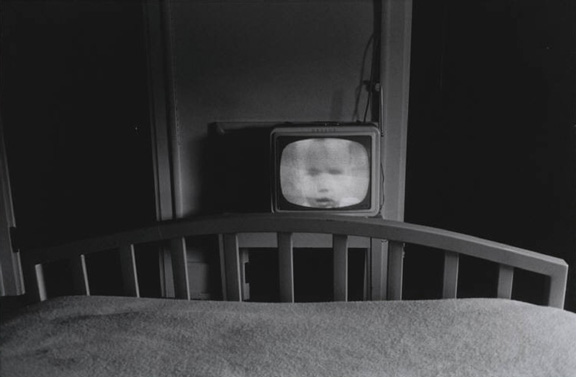
Lee Friedlander, Galax, Virginia, 1962, Gelatin-silver print
It is a bleak, lonely mood. People are absent. We are by ourselves in motel room.
November 19, 2006
being edgy
I've been concerned of late that junk for code has begun to look flabby. It has lost the harder edge it once had when it explored the pornographic in our cultural unconscious. It has become too nice with the more personal posts on art and music and cartoons that appeal. In becoming nice it has lost its edgy cultural criticism that scraps our skin like sandpaper.
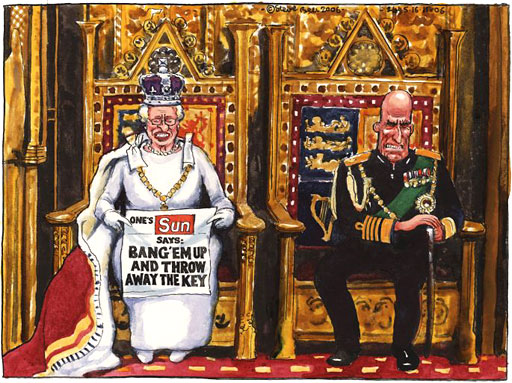
So we have a return to the violence in the unconscious of our now very conservative, patriarchal Anglo-American culture, which talks about family values, law and order, constraints on sexual freedom and antagonism towards Islam in a religious Christian mode.
After all it is the conservatives who go on and on about the cultural wars and a flabby postmodern liberalism that is the road to nowhere. What is needed to stop the liberal rot, they say, is a reassuring truth of a single narrative. It is the security blanket that provides us comfort in a world of chaos and flux. The comfort is supposedly given by a Judaic-Christianity, which functions as the foundation of the values of our culture.
Hasn't that foundation decayed and withered, as Nietzsche famously argued?
November 18, 2006
Fleurieu Peninsula Biennale
I've been doing my bit for regionalism in a global world by previously mentioning the Fleurieu Peninsula Biennale, which is a small peninsula of land at the bottom of our great southern continent. I've been posting some of the entrants for Fleurieu Peninsula Art Prize and some entrants in the different sections, namely The Fleurieu Peninsula Vistas Prize and the Fleurieu Peninsula Water Prize.
This is a national visual arts festival for landscape painting, which is coupled to an extensive set of events. So one way of judging the winners is to see if the landscape artists are beginning to juggle with the complexities of global warming, and if so then how.
The winner of the Fleurieu Peninsula Art Prize is:
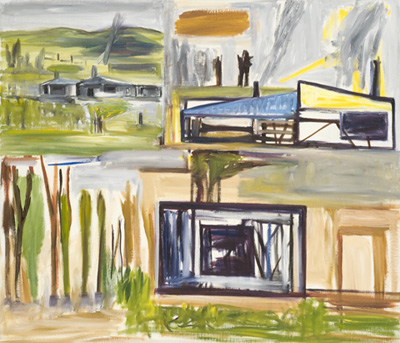
Ken Whisson, Time Is, 2006
There is not much indication of climate change in this work, despite the reference to time and the opportunities opened up by the collage structure. It's just all too green isn't it. Pastoral almost. All's right in the rural world these days.
Yet it's not. The autumn rains have failed seven years in a row in the Murray-Darling Basin. There are no signs that this weather pattern is abating and there are signs that this is more than a drought. Our continent is getting hotter.
So the work is more about rural hopes and dreams than realities or a portrait of what once was.
The winner of the Fleurieu Peninsula Vista Prize is
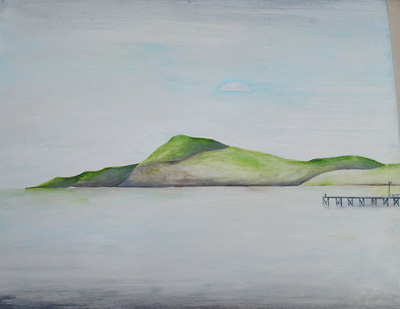
Noel McKenna, Jetty, Second Valley, 2006
That's a very tranquil and peaceful image. It says that there is no need to worry or feel anxious. Yet this weekend the hot north winds are sweeping across the landscape of the Fleurieu Peninsula, the earth is parched, and the bushes and trees continue to die from lack of rain. It is not a green world anymore. It was once. Not any more.
The winner of the Fleurieu Peninsula Water prize is:
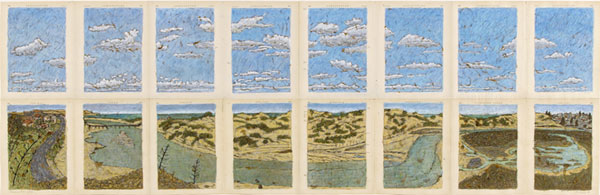
Ken Orchard, Onkaparinga Estuary, 2006
There is nothing here to suggest that we are becoming more aware of our own passage through time, or that we are facing something new wrought by climate change, or that our landscape is changing. It's a series of snapshots of a particular moment in time.
The sense of catastrophic events and climatic devastation is evoked in the winner of the Fleurieu Peninsula Youth Scholarship
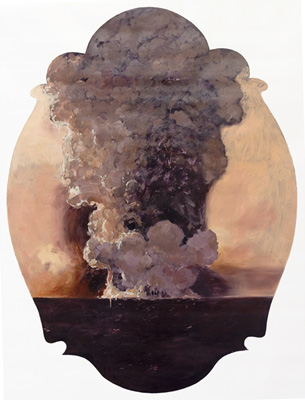
Morgan Allender, When the Earth Moves: Eruption, 2006
This is a representation of a changing nature in the sense of the earth moving and its surfaces shifting from underground pressures. What is highlighted is the violence ---a tropical cyclone.
November 17, 2006
limits of photography
This is a view I often see when I stay in hotels and I look through the window.I notice the greate view then I realize that I am in an airconditioned room with no windows or balconys. I cannot go outside to feel the air on my body.
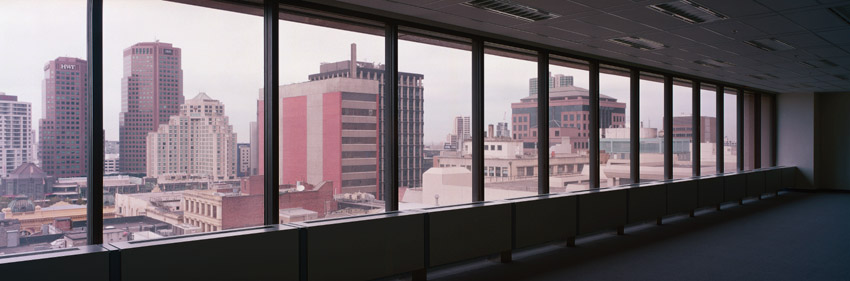
Paul Knight, interior as portrait ("he went on to tell me..."), 2002
This is the urban world I live in I tell myself. It's not very green nor it is very sustainable in the way it uses its water or energy. It is not obvious from the photo portrait that most of the energy powering the city is being generated by coal-fired power stations.
November 16, 2006
conservative kitsch
An interesting image--the jagged edge of kitsch:
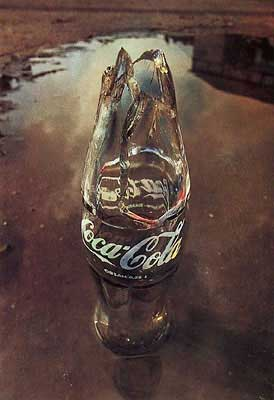
Jan Saudek, Coca-Cola, 1971
It reminds me of the kitschy Republican talking heads I saw on the talk-show media- (Fox News) (the low end of the culture industry),during the congressional elections. I was taken back by both their snappy, cutting attacks on the "cut 'n' run " liberals and the authoritarianism.
Over at Democracy Now Sidney Blumenthal sketches the cultural background of conservative kitsch:
The conservative kitsch cultural industry is centred in Washington, where Republican political power has protected philistinism from the ravages of cosmopolitanism, unlike in New York, Los Angeles or Chicago....Unlike the kitsch before and during the Reagan era, the Bush warriors' kitsch lies beyond unintentional camp. Their kitsch lacks more than irony or self-consciousness. It is deliberately sarcastic, mean-spirited, fearsome and fearful. Their unbridled bullying reveals their deep fears within. Their personal disintegrations expose what they fear most about themselves.
That sarcasm and cruelty was what I noticed watching the Murdoch's kitschy Fox News.
November 15, 2006
the now
a personal moment:
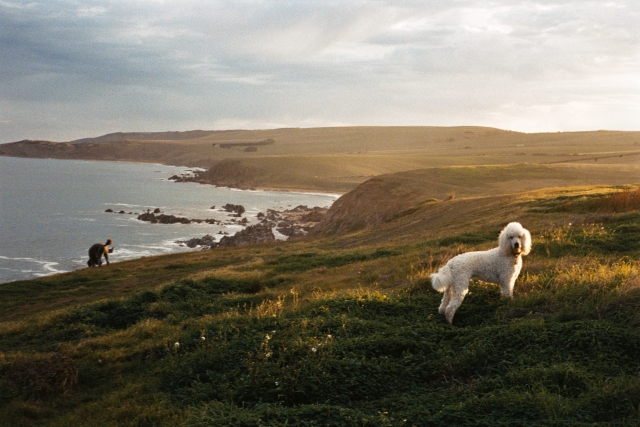
Gary Sauer-Thompson, evening walk, Fleurieu Peninsula, 2005
The moment is a stepping outside of the cyborg networks that we are a part of in a postmodern society and living in the 'here and now.' Then we re-discover, and reaffirm, that our body is the very ground for our interactions with the world. The figure of the cyborg misses out on our embodied subjectivity.
November 14, 2006
cyborg
"Cyborg" is short for cybernetic organism, or what cyborg theorists call the melding of the organic and the mechanic.

Donna Haraway's paper entitled "A manifesto for cyborgs: Science, technology, and socialist-feminism in the 1980s" (1985) ushered in the academic discourse on cyborgs, which she understood as hybrid creatures who blur the boundaries between the various boundary projects of modernity, including human/machine, human/animal, male/female, and so on. For Haraway, the postmodern "self" is no longer characterized by a singular, unified identity, but an assortment of politicized and fractured cyborg "selves."
nice work
This is a good work. Strong formally, tonally sophtisticated, beautiful and has a touch of a reaching beyond the everyday to the religious.
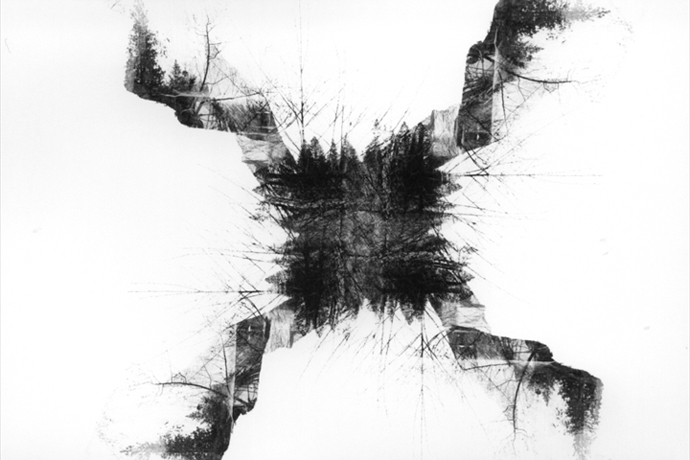
Adi Da Samraj, Untitled
Yeah, I know that's an aesthetic judgement. Few make them anymore. It's too modernist or elitist or something. Well, there ought to be more photography like this.
November 13, 2006
vortices
The image below is from the EROS image gallery--earth as art:
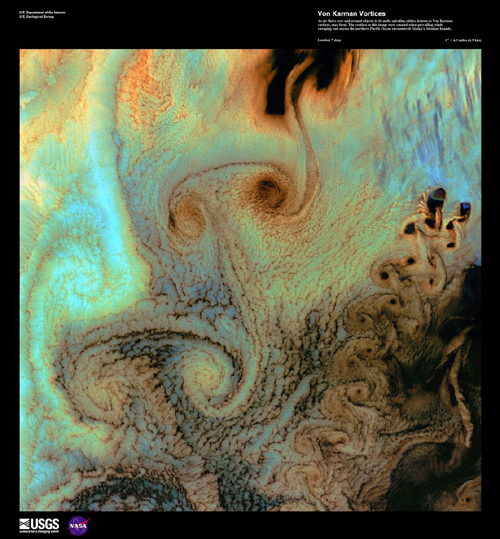
Von Karman Vortices, July 4, 2002, Landsat 7
As air flows over and around objects in its path, spiraling eddies, known as Von Karman vortices, may form. The vortices in this image were created when prevailing winds sweeping east across the northern Pacific Ocean encountered Alaska's Aleutian Islands.
It's very reminiscent of an abstract expressionist painting isn't it.
digital media
I've been puzzling about the term digital media If an e-book, ie., an electronic (or digital) equivalent of a conventional printed book, is considered to be an example of digital media, then so is an "e-photograph." What we here is an individual work in a digital format do we not?
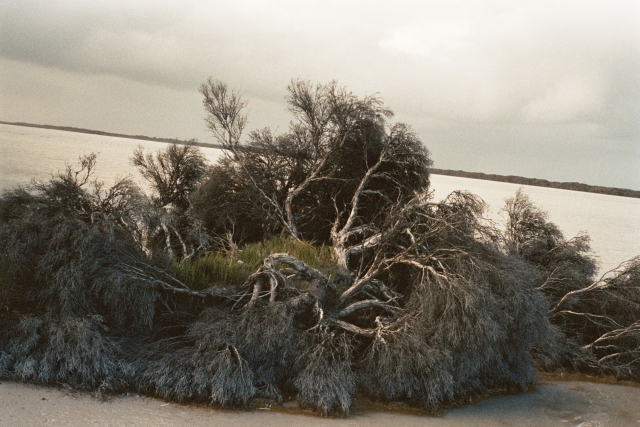
Gary Sauer-Thompson, Melaleuca, Coorong, 2004
This involves a shift from film to digital does it not? The next stage is to process the photographs using Adobe Camera Raw; employing Photoshop techniques to correct, retouch, and manipulate the images etc. The next stage is to stay creative in an increasingly complicated postmodern world.
November 12, 2006
Josef Sudek & romanticism
This image by Josef Sudek makes a change--it takes us back to the poetic sensibility of the European romantic past:
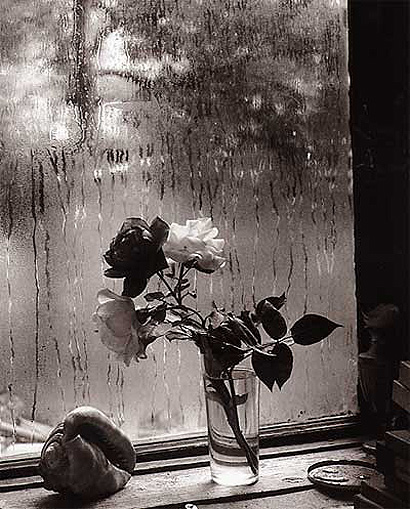
This is the world of 5 x 7 contact prints and European romanticism.
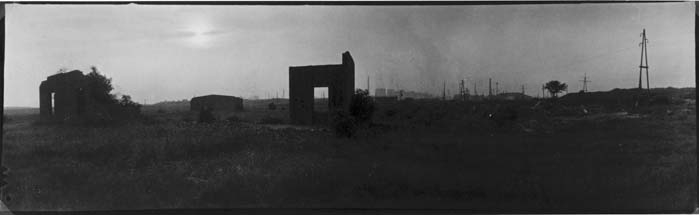
The landscape tradition, as we understand it today, has its roots in British and European Romanticism, with its underlying Kantian notions of the beautiful and the sublime and, ultimately, of an imprint of divinity, which would serve to underwrite human beings aesthetic adventure in the great wilderness of creation. The European romantic landscape harked back to the Biblical Eden.
European romanticism is different from Australian romanticism. Australia inhabited the European Romantic imagination as the dystopia (penal colony) to North America's utopia (Jerusalem). This dystopian geographical unconscious, which is arises from the Western encounters with the Australian landscape, consistently found it to be aberrant, repellent, dystopic; the underside of the world, the Antipodes--- it was a traumatic encounter.
This trauma was contained through the aberrant earth and its species being normalized through utility in the service of advancing civilisation and sustaining economic progress.The connection between this utilitarianism and the dominant aesthetic is mediated by the pastoral tradition that translates and the land as earth into land-scape. Yet there is a resistance to this translation in terms of an element of the unassimilable, which is signifiin the romantic tradition as 'wilderness.'
Springsteen live---in Barcelona
I was in Melbourne yesterday for an all day workshop. I flew over on the first plane from Adelaide and then caught the last plane back from Melbourne. I relaxed at home late in the evening with this DVD of a live show from Bruce Springsteen's The Rising tour:
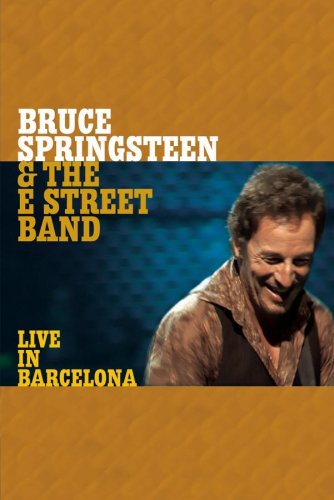 I'd been listening to The Essential Bruce Springsteen---it shows Springsteen to be a skilled melodist. So I was interested in hearing late Springsteen live.
Many hold that rock music is transcendent because it was primitive, not because it could be avant-garde, and for many fans Springsteen stands for rock authenticity. Jon Landau's words capture this:
Last Thursday, at the Harvard Square theatre, I saw my rock'n'roll past flash before my eyes. And I saw something else: I saw rock and roll future and its name is Bruce Springsteen. And on a night when I needed to feel young, he made me feel like I was hearing music for the very first time.
So what are we make it if it now? It is 2004 not 1984 but the E Street Band has been bought back. Does the dream have substance or is it a shadow?
This is the first time a Springsteen concert has been released in its entirety. It is a big loud rock and roll concert that is full of energy. The DVD designed to be watched on large screen,with the DVD player wired through the stereo, full surround sound and the volume turned up. It's a rock concert. The enthusiastic crowd gives a live feel to the DVD and they are comfortable with the "Boss" persona of white, working-class authenticity and the Americana of the blue-collar, rock 'n' roll naif.
Though the concert is impressively energetic, enthusiastic, big and loud, musically speaking, it disappoints. The mix was often poor on the commercially accessible rock material, the band sounded murky in the early stages, and the big songs---the tight, guitar-driven intro-verse-chorus-verse-bridge-chorus songs--- often sounded inferior to the originals and much the same. The appropriation of Phil Spector's production values into epic rock surroundings becomes bombastic arena rock. The sound was much crisper on the more somber folk-oriented works. The Rising tour is more shadow than substance. It just isn’t 1984 any more.
Springsteen has yet to release an official live album that is worthy of his place in rock history and one that is equivalent to Live Dead, The Who Live at Leeds or The Allman Brothers Live at Fillimore East Kevin Cherry says that the best documents of his career continue to be the tapes of the many radio broadcasts on the 1978 tour. I'm going back to listen to Born to Run from 1975.
November 11, 2006
Coorong snaps
Two different faces of the Coorong, which is part of the Murray mouth. It is a tidal estuary depending on the intermixing of salt and fresh water.
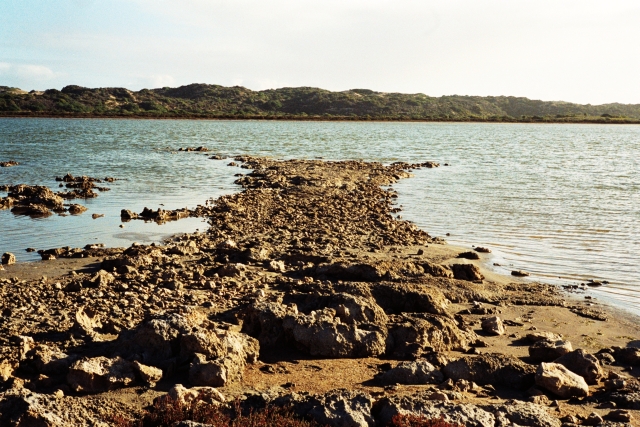
Gary Sauer-Thompson, Coorong, 2006
It is a tidal estuary that is suffering from a lack of fresh river flows coming down the River Murray.
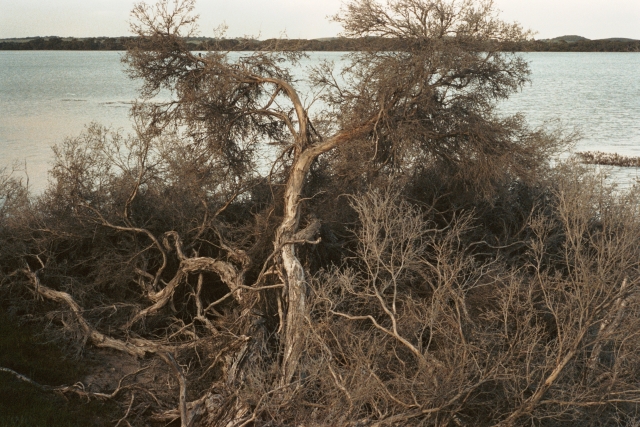
Gary Sauer-Thompson, Coorong, 2004
The predominant medium size vegetation is salt tolerant malaleuca.
November 9, 2006
the politics of climate change #2
Since I am in Canberra I may as well continue with a political theme. The Greenhouse plan is build a nuclear power industry in Australia.
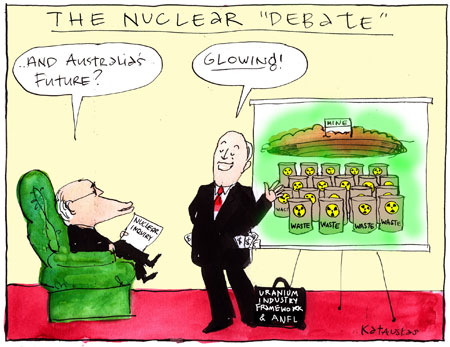
According to Julie Macken in New Matilda the proposed plan involves an industry to facilitate and manage the enrichment, fabrication, leasing, transport and storage of 15 to 20 per cent of the world's nuclear fuel needs. Why is Australia providing this service to the Americans and others? Because it has the most stable geology in the world.
November 8, 2006
the politics of climate change
With the Stern Report the economic combines with the natural sciences and ethics to generate political change. Gee, even Rupert Murdoch is beginning to get worried.The Stern Report argues for a moving beyond 'business as usual' on environmental policy.
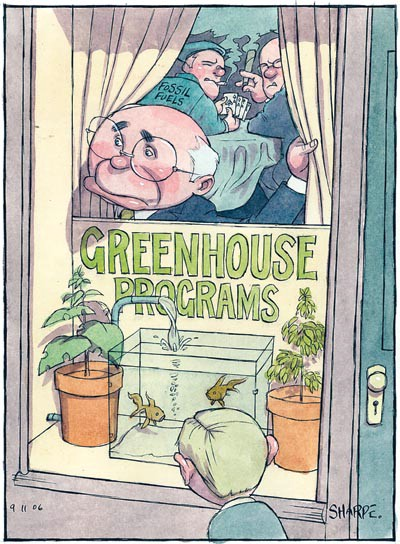
Sharpe
Business-as-usual increasingly looks like a defence of the coal industry by the Howard Government. That defence is become more naked as the pressure mounts. The sceptics have a new talking point: a global warming anxiety is taking hold amongst the population. Why the anxiety? It's human nature--hard wired into our genes apparently.
November 7, 2006
Kid A --Radiohead
Curtis White in an article entitled Kid Adorno in Context No 6. examines Radiohead from the perspective of Horkheimer and Adorno's Dialectic of Enlightenment. This promises to be more insightful than my initial attempts to make sense of Radiohead White says:
Radiohead's political bete noire is what Adorno called "instrumental rationality." A techno-totalized world. Its artistic quandary is not how to prosper within this totalized context (as their well-wisher Nick Hornby encourages) but how to respond to it in a way that is adequate to what the artist wants: the feel of the authentic, the spontaneity of autonomy, even a tiny gap between itself and the universal other, the Corporate Life World.
Looks promising doesn't it. It never occured to me to link Radiohead's music to Adorno's concept of an administered society which promises the freedom of individuality while simultaneously prohibiting it.

It's difficult music for sure.
White then says the following about Radiohead's Kid A:
Call it a self-indulgent refusal of their job description (why, "there's no room for anything approaching conventional pop music," Hornby whines), but this is the obligation or the duty, if you will, that art itself feels it owes to the social. It's as if art's primary function is simply to remind us that there is a difference between freedom and repression, that change is real and the possible is possible.
Radiohead's aesthetic strategy is not to avoid the enemy but to inhabit it and reorient its energies
What really bugs critics like Nick Hornby is that as Radiohead's albums have progressed, this strategy has been taken up less through an explicit "message" in the lyrics while the music remains more-or-less standard pop rock (even if very good pop-rock) and gets taken up more integrally in the textures of the music itself. This is what sends Kid A "beyond the pale." In fact, I would argue that Radiohead's intuition that its politics are best made not explicitly in their lyrics but integrally with the music is a very good indication of the artistic and political health of the band.
America's dark side
The New York Times has opened its pages to free access for one week. This article by Dinitia Smith on photographs taken by Dorothea Lange of the internment of Japanese citizens by the US state.
In the winter of 1942 the United States government ordered tens of thousands of people of Japanese ancestry, two-thirds of them American citizens, to report to assembly centers throughout the West for transfer to permanent internment camps.
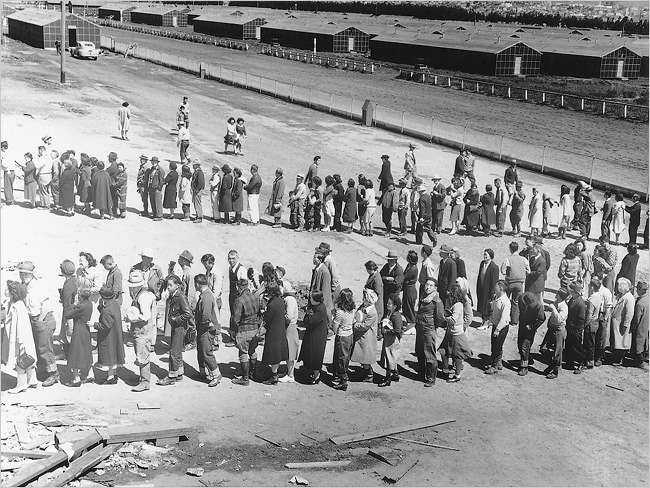
Dorothea Lange, People of Japanese ancestry arriving at Tanforan Assembly Center, 1942
Smith's article is a review of the Linda Gordon and Gary Y. Okihiro (ed) This internment involved about 110,000 people were moved with their families, sometimes at gunpoint, into horse stalls and tar-paper shacks where they endured brutal heat and bitter cold, filth, dust and open sewers.
The conditions in the camps were much worse than was shown by the photographs taken by Ansel Adams:

Ansel Adams, Mrs. Naguchi and two children, Manzanar War Relocation Center in California, 1943.
Adam's photos bordered on publicity and deception.
There are disturbing parallels between the treatment of Japanese Americans in 1942 and that of Muslims and other American citizens since the attacks of 9/11.
November 6, 2006
Melbourne cup
The time for excess---in Bataille's sense not the self-gratification --- has come around again. All that surplus wealth from the boom needs to be expanded. What better way than for the wealthy to celebrate the wealthy at a national festival.
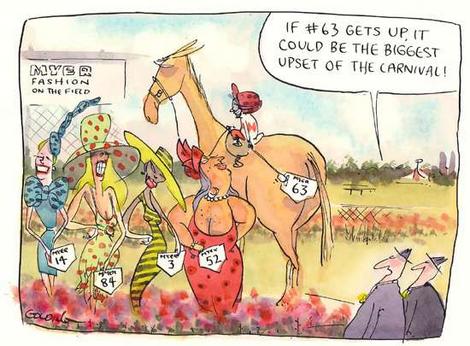
Matt Golding
I understand that two of the race-course marquees at Flemington,will be tricked out with the splendours of Marie Antoinette's 18th century French court in mind. It is all part of the spectacle.
Sally Gare takes the self-gratification airhead approach in this extract from her book The Triumph of the Airheads – and the Retreat from Commonsense in The Australian:
In this age of the free market, the pursuit and acquisition of money at all costs is now considered more important than knowledge, values and commonsense. This is also the post-postmodern world, which apparently means there are no such things as objective knowledge, values and commonsense. How lucky is that? Short-term thinking has triumphed, so has greed, and the unstoppable driving force of our times is the belief that it's all about me. (Which so very often devolves to: it's all about me and what I can stuff into my pockets and bank accounts.) It's amazing how fast a world can change when enough people learn to approach life like this.
Hence the unease with the signs of conspicuous consumption: the clinking of the champagne glasses, the splendour of the frocks and hats, the easy tolerance of debt and general licentiousness associated with the Melbourne Cup festival.
November 5, 2006
top 50 live albums
I think that the art of the live album is much under appreciated these days of the ipod songlists. The live rock album conjurs up guitar wankery--- in the classically show-offy god sense---and the terribly unsavory business of "jamming". It was what turned me off The Who's Live at Leeds in its initial truncated appearance. Yet authenticity in rock has a lot to do with live performance, ability and talent. Music should be for the people and by the people---it can be anything so long as it grabs you, shakes you, and resonates with you. Isn't that what punk said about authenticity?
So I was interested to see that Stylus Magazine has an article on the top top 50 live albums. It's a very diverse and wide ranging list, and I only know a few of them.
I don't care about the best bit---I'm interested in what people consider to be good live albums and why they are are judged to be good. The existence of these albums undercuts the cultural; conservative tradition that says rock & roll is dead. I'm thinking of the nostalgic baby boomer rock critics who say that r ock'n'roll is the essential soundtrack of who we are and have been over the past 50 years, and then add that classical rock is the touchstone for everything else.
Currrently----ie.,when I'm in Adelaide as I have no music here in Canberra---I'm listening to Bob Dylan's - Live 1975 Rolling Thunder Revue and The Allman Brothers' - Live at Fillmore East. The latter is classic southern rock played in a vigorous jam style.
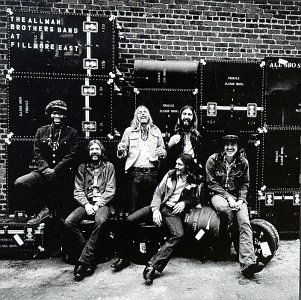 Big Star rang me the other and said that my copy of Bob Dylan - Bootleg Series, Vol. 4: Live 1966, "Royal Albert Hall" Concert had arrived. I've only heard bits of it but I was impressed by the raw energy and the intense emotion. This is a defining moment of rock music history----rock's most famous concert.
I would have included the Grateful Dead's Live Dead, rather than their sprawling Europe '72 in the top 50 albums. I am still considering whether or not to buy Miles Davis' Live Evil.
It's noticeworthy that there is no live album by the Rolling Stones on the list. This is understandable because this bands approach to a live album is along the lines of a sloppy greatest hits production, rather than as an artistic statement. It's showbiz. Not everyone believes that 60s/70s rock = real rock = the way music is supposed to be. This sshows that rock needs to get over its delusions of grandeur and stop its rigid, recycled ways.Otherwise it really will be a permanent retro show.
What is a suprise is the appearance of Johnny Cash twice---Johnny Cash - At San Quentin and Johnny Cash - At Folsom Prison--- and near the top of the list. What has happened is that rock has become threatened as the dominant youth culture by hip-hop. Rock has become hamstrung by authenticity issues ---putting ethos before music--- at a time when people's listening habits are changing.
More people are listening to one song at a time or downloading music. The rise of file-sharing and mp3s has increased our listening to music- one song at a time- and created an emphasis on the single. People now view albums as malleable, collections of songs that can be skipped or deleted from burned copies of a disc.
ipod and us
An excellent article on ipods by Charlie Bertsch at Alternet. It is entitled, 'The iPod's Moment in History', and it expresses what I've been struggling with about this "lifestyle" product that is now everywhere.

I have noticed that the existence of traditional audiophiles is under threat--the shops that sell high quality equipment have all closed down in Adelaide. The mourning owners say that it is due to digital music and the MP3 format. However, it is the way we use the ipod in public spaces in Sydney that causes my unease.
My unease about an ipod world is not because this MP3 player does not increase participation in the public sphere , so as to enable citizens of a democratic state to contribute actively to the formation of critical public opinion and so influence the state's actions.
Bertsch, a writer over at Bad Subjects and co-editor of Bad Subjects: Political Education for Everyday Life anthology, rightly says:
It is impossible to make sense of the contemporary culture industry without putting the iPod center stage. Even those music lovers who have no interest in using one, either because they are unsatisfied with its limited fidelity or because they aren't interested in mobility, must confront the fact that the choices available to them are constrained by the iPod's influence on the market. Indeed, the very existence of traditional audiophiles is threatened, since the criteria they use for rating both equipment and recording are no longer a high priority for most listeners. Frequency response, the accuracy of microphones, the virtuosity of musicians -- the bread and butter of "serious" music magazines from the late 1940s until the popularization of the MP3 format -- have become secondary or tertiary considerations in a context where the most important thing is not how good the music sounds, but how readily it is available to you.
It is all about mobility isn't it. Being at home with oneself whilst living a nomadic existence in public spaces. Music is our identity.
Bertsch, says that if the iPod is often used to protect us in public, then the use of iPods also minimizes the possibility for social interaction with others:
As cultural critics are fond of pointing out, the German title of Sigmund Freud's famous essay on the uncanny, Das Unheimliche, translates literally as "the un-home-like." That's an apt description of the eerie feeling we get watching people who sit for hours staring blankly into space, ears plugged with music of their choosing, looking like they've lost the passage back to the place they were before. They are out in public, to be sure, but primarily to act out their desire for privacy. Maybe what these listeners want is to be seen wanting both company and solitude.
It's the beginnings of a phenomenology of everyday life in postmodernity isn't it; one that links backs to Adorno's Minima Moralia.
November 4, 2006
Cloud Lichens
An entry in the Fleurieu Peninsula Biennale.
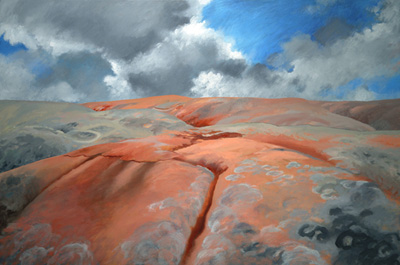
Winnie Pelz, Cloud Lichens, Gawler Ranges, 2006 Oil on Canvas,
The Gawler Ranges National Park is located in South Australia's southern Gawler Ranges, approximately six hours drive north-west from Adelaide.
November 3, 2006
in Canberra
I'm "stuck" in Canberra this weekend. As I only know the Kingston, Manauka and Parliament part of Canberra, I plan to do the tourist bit and visit the National Gallery of Australia on Sunday. I've gone online to see what is being shown with respect to indigneous art. Suprisingly not much. How disappointing. But I came across:
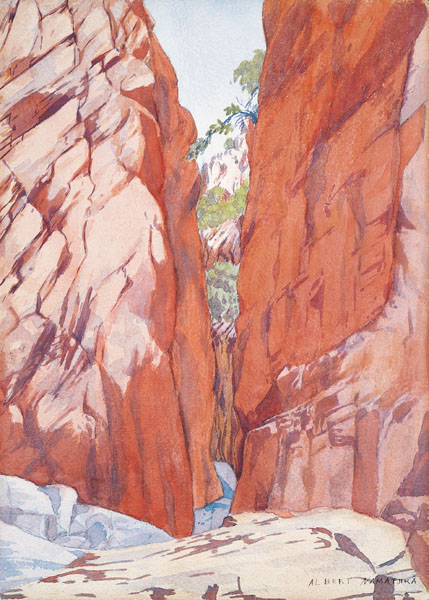
Albert Namatjira, Standley Chasm c.1942-49 watercolour and gouache over pencil on paper
His picturesque landscape paintings are iconic images synonymous with the central Australia. Namitjirta's kinda been pushed into the background. I respect the colour--he opened my eyes to the colour in what Anglo-Australians once called the "dead heart".
November 2, 2006
the other
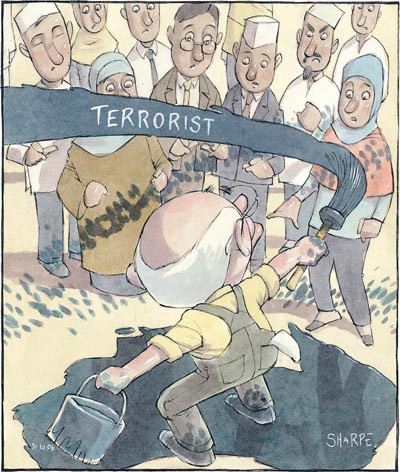
The politics of fear is mentioned, and briefly explored, here. The politics involves an appeal to Australian values that are counterposed to Islamophobia and to disrespect, intolerance and exclusion of islam and Muslim-Australians.
Sharpe
Postmodernism and its critique of Eurocentrrism often gets rapped over the knuckles by conservatives for talking about the other, but its value can be seen in this cartoon. In his Orientalism (1978), which was about the power relations between the coloniser and the colonised, Edward Said argued that the Occident both fears and fantasises about possessing the exotic East.
In the post 9/11 war on terror, and based on this new logic, the West now fantasises that the Middle East is evil.---the enemy who is jealous of our values. What are these? They are universal values ---tolerance, inclusion, freedom, fraternity (mateship) ---that are given an Australian colouring (mateship for fraternity). Equality is rarely mentioned.
November 1, 2006
ugly Sydney
In a speech to his Local Government Association Paul Keating criticised the shoddiness of NSW planning, the shadiness of ALP politicians, the rapaciousness of its developers, the shabbiness of its architecture and, underpinning it all, the mediocrity of modernism. This argument resonates. Sydney from a plane window coming into land acros the harbour is beautiful. On the ground, looking through the window of the taxi on the way to a hotel Sydney is ugly.
Keating's question is essentially the same as Alain de Botton's, namely: why is the modern world so ugly? Keating asks: why is modernism so inept when it comes to making streets, buildings, precincts and cities in which people feel good?
Elizabeth Farrelly in the Sydney Morning Herald gives an answer. She says:
The answers, of course, are complex. At root, they're about how an essentially humanistic and socialistic movement like modernism was talent-spotted by capitalism and captured as a means of getting the cheap and nasty through the front door..... primary difference between Keating's beloved old-world cities, and our new, soulless ones "like Tokyo", is our lost willingness to spend unnecessary time and money making buildings beautiful. Time and money appear in buildings as extra space, real materials, craftsmanship, detail and decoration. What modernism calls waste, tradition knew as comfort and delight.
Cheap and nasty captures the egg crate apartment buildings doesn't it. But not the wasteland that are the streets upon which the buildings sit.
Leunig: female sexuality
As we know conservatives argue that the culture industry's use of sexual imagery exploits and degrades women. On the other hand, we have pro-porn feminists who argue porn with positive female images is empowering. And the debate swings between the two extremes.
Is this image empowering?

Leunig
Strikes me this is the character of the dumb blonde--all body no brains. She causes the sexual trouble but is unaware of role in it. Not a very flattering representation is it.? But it is a deepseated (unconscious) image in our patriarchal society.