|
September 27, 2004
Joe Carducci put forth a particular view about rock music in his 1994 book, "Rock and the Pop Narcotic." He says that:
"The essence of quality in rock's musical terms is to be found in the musical interaction of the players of a guitar, a bass and a drum kit. Its special musical value is that it is a folk form which exhibits a small-band instrumental language as in jazz, rather than mere accompaniment to a vocalist as in pop."
Carducci's class-based text is directed at the taste of the so-called established '60s “rock press and the puppet model of Motown or Phil Spector or Dick Clark. The latter are just producers who get a song and they are not real artists in the rock sense. Pop is a narcotic. Pop versus rock is debated here at ausculture. It's good.
Presumably Carducci's definition of rock music would include The Rolling Stones' Sticky Fingers It would include most punk bands, since Carducci's text is a defense of ’80s post-punk bands that were mostly ignored by mainstream rock critics until Nirvana came along.
But Carducci's definition would exclude other kinds of music, such as Brian Wilson's Smile, because that album is the work of a composer and arranger, not players in a band. It would similarly exclude work that straddles the intersection where musical styles, and thus some of the work of Radiohead.
 I started listening to Radiohead's OK Computer yesterday for the first time. It was music of the 1990s and so different from Brian Wilson's Smile from the mid 1960s, the Grateful Dead's Stepping Out from the early 1970s, or the Rolling Stones Exile on Main Street from the same period. I started listening to Radiohead's OK Computer yesterday for the first time. It was music of the 1990s and so different from Brian Wilson's Smile from the mid 1960s, the Grateful Dead's Stepping Out from the early 1970s, or the Rolling Stones Exile on Main Street from the same period.
I do not know Radiohead's earlier work---Pablo Honey and The Bends---nor the latter albums, such as Kid A, Amnesiac and Hail to the Thief. On OK Computer we have a rock band moving into the world of techno/electronica without sacrificing their guitars and bass and drums, whilst adding synthesizer and sound effect samples. I recoiled from the harsh swirling guitars of the opening track, found some of the music inaccessible and tortured, and noted the quieter acoustic sections and sound effects of a musical landscape.
I never really got round to sorting out the individual tracks. Nor did it actually matter as it was the overall 'atmopherics that come to the fore ---as in Exile on Main Street, Smile, or Live/Dead.
What I heard was very industrial, electronic and droned in a world weary way. We are living in a bleak industrial, technocratic and corporate world devoid of human emotion. We are depressed, with lots of fears, paranoia, and trying to cope with a general sickness---I guess we can use a Heideggerian term postmodern technological dread or anxiety that leaves us with a sense of emptiness.
It was a world away from The Kinks 1968 Village Green Preservation Society
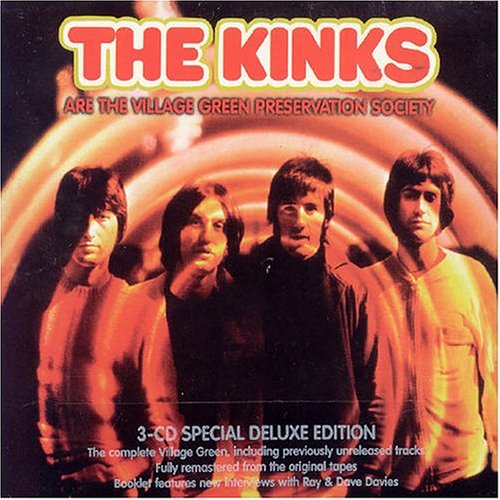
Another world from the quiet world of the English village green.
The music on OK Computer is pushing towards being an expression of what it is to live within this technocratic territory---it is explored more fully in the more experimental Kid A, where the material often transgresses the song format.
 And Amnesiac apparently. In these albums Radiohead shift more fully into the world of electronic music. And Amnesiac apparently. In these albums Radiohead shift more fully into the world of electronic music.
The music on OK Computer left me with a sense of emptiness and emotional bleakness.
My impression is that repeated listens would reveal all sorts of intersecting themes, repeated motifs, and shared themes--just as we find in the work of Brian Wilson in Pet Sounds and Smile. All sorts of things in the mix will contribute to the atmosphere of the album, little things, many of which I could not explain how it was done.
So a great deal of this albums power is due to the production.
|


