January 31, 2007
David Hume: mapping the riddles of Woomera
I've often wondered how contemporary white artists respond to the innovative work of indigenous painters. An example of a response is this work by a South Australian painter we have come across before in considerations of regionalism in a global world,
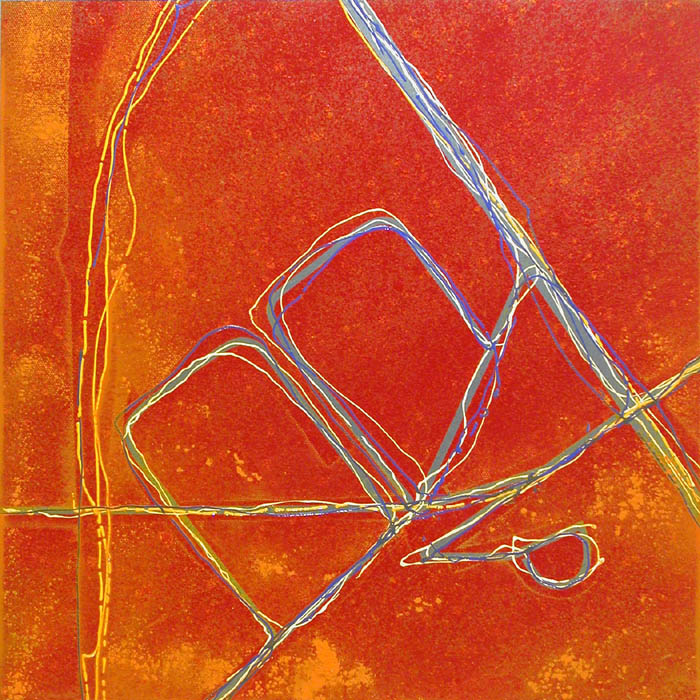
David Hume, Woomera #2, Acrylic on Galvanised Steel, 2005
The linkages and responses are a touchy subject because of the long tradition of white artists ripping off , and exploiting, black artists. But the way the latter paint the landscape in terms of maps of their country is an important innovation in the Australian landscape tradition; so innovative that it cannot but have an impact on other visual artists. What these contemporay indigenous works express is what Adorno calls riddles.
In Aesthetic Theory Adorno says:
What has irritated the theory of art on end is the fact that all art works are riddles; indeed, art as a whole is a riddle. Another way of putting this is to say that art expresses something while at the same time hiding it. The enigmatic quality grimaces like a clown...Trying to wrestle with the riddle of art is one thing. Understanding specific artistic products is quite another. Verstehen of particular art objects is the objective reproduction or re-enactment of a work by experience where experience operates on the inside of the work ....The enigmatic quality renders the very notion of Verstehen problematic...I am using the term 'enigma' not in a loose sense, denoting some general ambiguity, but in the precise sense of a riddle or puzzle...Now art works are puzzles in this sense...vexing the viewer whose defeat is a foregone conclusion.
Like myself, David Hume has visited Woomera on trips to Andamooka. I found Woomera a strange town, one deeply haunted by its past. Firstly, as a site for the Anglo-Australian Joint Project in the mid-twentieth century to test British rockets to carry nuclear warheads to counter the threat posed by the Soviet Union. Secondly, when I visited Woomera the town was known for it's detention centre for aslyum seekers and refugees. It was a hostile town to strangers. That time too has past. It's future may well be a nuclear dump site. Hauntology is everywhere in Woomera.
David Hume sees Woomera as a mythic place, rather than in terms of hauntology.
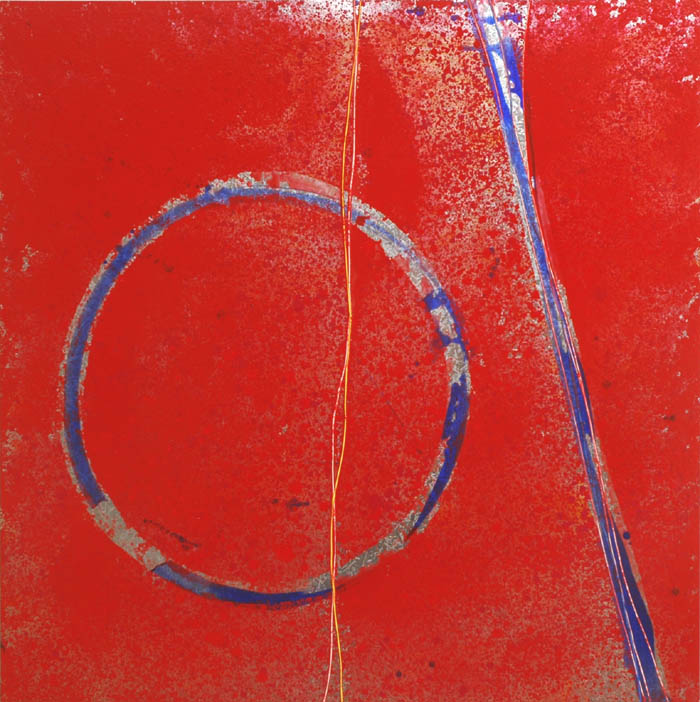
David Hume, Woomera #9, Acrylic on Galvanised Steel, 2005
Hume says thatmaps:
...are tremendously dense ways of storing and transmitting information, they not only show the land, but give tantalising vignettes of the stories that go with it. Dog Fence, for example, is a prosaic term, but I’m sure there are whole lives bound up in it; and the Prohibited Area – an exclusion zone for rocket testing – is particularly rich in history.
He's right about the cultural meanings. The Prohibited Area, for instance, was the site of the Maralinga nuclear tests by the British around 1957. Despite a cleanup it is still a contaminated wasteland.The spectre that haunts this space is the deaths of indigenous Australia from the tests conducted by a declining imperial power.
Hume, to his credit, goes on to confront the key issue---the relationship to indiigenous Australians. He says:
The journeys I seek to mark in this work belong to indigenous Australians as well as non-indigenous. Because similarities between my work and Aboriginal work have been remarked, I have been particular in explaining, in a very Western way, the origins of what I have done. Perhaps because I grew up in the time of the Papunya Tula paintings of the 1980s and 1990s, I felt it important to be sure that my work did not misappropriate items that should be the exclusive domain of Aboriginal culture. I think that now we should be able to advance, with caution, beyond that time.
Woomera is where indigenous and white history overlap and are overlaid in a complex way.
January 30, 2007
Eugene Von Guerard: 'weird' landscapes
As I've been searching for images to construct the South Australian regional album in my gallery I found myself keep exploring the 19th century colonial painters. I couldn't help but notice the way these visual artists ignored Aborigines in their colonial landscapes of settler Australia.
When they painted Aborigines it was to place the indigenous people in a time before history: their colonial discourse says this is the timeless land: out there in the centre beyond the water it's the timeless land in the sense of the land of the dreamtime. So the Aborigines have no history, as theirs is a culture that was changeless and timeless. A new world order has arrived with settler Australia, a world of history and of change; one that can tame the strange and weird land to build a civilisation through farming and building dams.
I kept coming back to and to the romantic work of von Guerard: less the picturesque images and more those that refer back to Caspar David Friedrich. These are the sublime wilderness ones, with their trace of longing, or nostalgia, for the absent landscapes of Europe.
An example that links the two themes is this romantic painting in which a small group of Aborigines are camped by large, dark rocks in the red/gold glow of sunset:
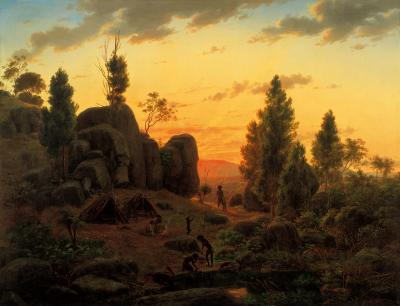
Eugene Von Guerard, Stoney Rises, Lake Corangamite, 1857.
It is strange, melancholy, foreboding, with a hint of terror. Though the aboriginal people are depicted as happily living their natural life in a timeless land, there are few of them. Do they represent a little pocket of survival. Is there a sense of doom? A sense that their world will be invaded and destroyed by the British?
The classic statement of the weird landscape is Marcus Clarke's:
"In Australia alone is to be found the grotesque, the weird, the strange scribblings of nature learning how to write. Some see no beauty in our trees without shade, our flowers without perfume, our birds who cannot fly. But the dweller in the wilderness acknowledges the subtle charm of this fantastic land of monstrosities. He becomes familiar with the beauty of loneliness, whispered to by the myriad tongues of the wilderness he learns the language of the barren and the uncouth."
An example of the weirdness is:
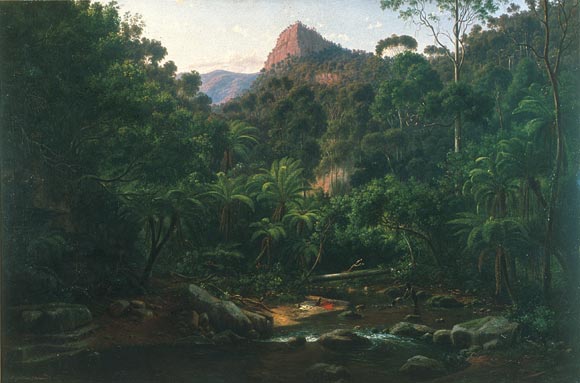
Eugene Von Guérard, Fern Tree Gully, Cape Otway Ranges, c 1879.
The weirdness and romantic melancholy turns to the wildness of the sublime, as expressed in this weather-beaten, desolate and bleak image:
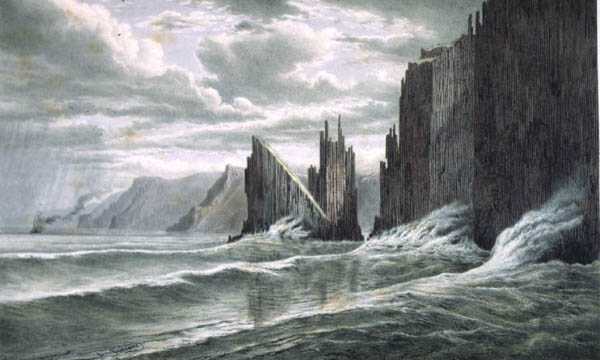
Eugene Von Guérard, South end of Tasman's Island, 1967, lithograph colour
What is oftern called 'that certain weird melancholy' is the awesomeness of the horrors: the sweeping, out of control bushfires, raging floods and apocalyptic dust storms which are a part of the untameable land that is Australia.
January 29, 2007
Quarry Australia
I heard on the radio this morning that the resources boom is going to go on and one. It's all about India and China needing Australia's resources.
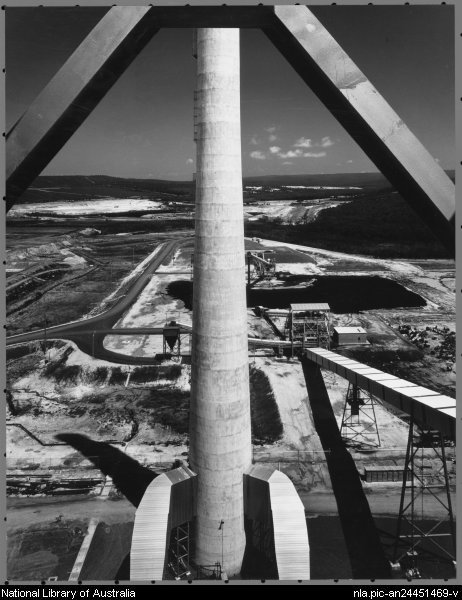
Wolfgang Sievers, Alcoa chimney at brown coal mine, Anglesea, Victoria, 1969.
The stockmarket is going gangbusters. It's all about the resources boom. This is no time for the Greens to be asking us to make many sacrifices in material well being and economic growth, which will have adverse impacts on the poorest in our communities and in the world. Money is to be made from coal. Global warming from greenhouse gases cannot be allowed to get in the way of making money can it?
So it is technology to the rescue. The technology would block sunlight to halt global warming. Techniques ,such as giant mirrors in space or reflective dust pumped into the atmosphere, would be important insurance"against rising greenhouse emissions.
January 28, 2007
tattered desires
I 've often looked at torn posters on urban walls in terms of faded dreams and desires; or rather the attempts by advertisers to represent our desires and dreams so that we identify with what they want us to buy. In this lacerated poster the desire is about romantic love in an instrumentalized world:

Mimmo Rotella, Casablanca, 1963-1983
Rotella calls the image a 'torn poster' decollages which he made from torn advertising posters. His décollages, which drew heavily on film imagery from the 1950s and 60s, were made by tearing layers of film posters stuck on canvas to recreate the appearance of peeling billboards.
He says:
I went through a period of crisis [1953] and then,in the middle of it, I was impressed by the walls covered with torn handbills. I was literally fascinated because I thought then that painting was finished and that is was necessary to find something new, lively, and to the point. And so that evening I began to tear these handbills down, rip them down from the walls, and take them back to my studio where I would put them back together and leave them just as they were, just as i saw them.This was décollages were born".
The film imagery meant that Rotella is interpreted as a pioneer of European Pop art.
The walls of our cities cvan be interpreted as an open book where one can ‘read’ the images of a continuously evolving history.
January 27, 2007
James Natchwey
If the twentieth century saw a paradigmal shift in our culture it is probably in the shift from the word to the image. The available technology (satellite communications, digital cameras) allows a fast distribution of coloured images, almost in real time—and we find ourselves immersed in sea of constantly moving images.
What then is the role of concerned still photography as a black and white craft?
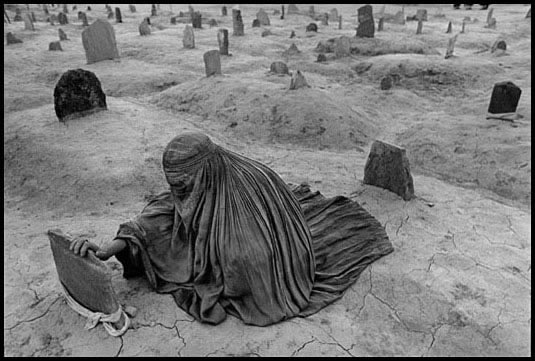
James Natchwey, Afghanistan, 1996 - Mourning a brother killed by a Taliban rocket.
In his receiving speech at Tel Aviv University in 2003, when he shared the Dan David Prize ($1,000,000) in the “Present” category with documentary film-maker Frederick Wiseman, James Natchwey talked in terms of war photography as witness.
He said:
Even in the age of television, still photography maintains a unique ability to grasp a moment out of the chaos of history and to preserve it and hold it up to the light. It puts a human face on events that might otherwise become clouded in political abstractions and statistics. It gives a voice to people who otherwise would not have one. If journalism is the first draft of history, then photography is all the more difficult, because in capturing a moment you don’t get a second chance.
Natchwey went on to say:
Hundreds of years from now, when our descendents are trying to understand the time in which we are living, photography will be a crucial part of the record. In the present tense, photography is critical in helping create an atmosphere in which change is possible, not only possible but inevitable. It does this by making an appeal to people’s best instincts: generosity, the ability to distinguish between right and wrong, the willingness to identify with others, the refusal to accept the unacceptable. In the long run, photography enters our collective consciousness, and more important, our collective conscience. It becomes an archive of visual memory, so that we learn from the past and apply its lessons to the future."
January 26, 2007
Australia Day
It's Australia day and the Australian flag is everywhere: on handbags, arms, lunch tables, cars, flapoles. It's the new style. People are even wearing it. After doing the shopping at Woolworths and the fruit shops I walked along the beach at Victor Harbor with the dogs. I stayed in a space between the playing crowds and I remembered taking this photo I'd taken a year or so ago.
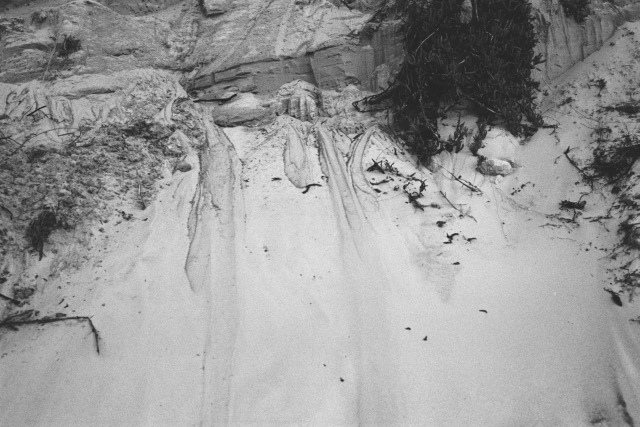
Gary Sauer-Thompson, sand dunes, Victor Harbor 2004
Australian nationality has gone conservative with its reconnection with the unconscious fear of the Other, distrust of multiculturalism, the celebration of the diggers as the national character, all the talk about our values and Islam versus the West.
I used to be a nationalist . Now I'm not so sure. I find myself thinking more about the fragile ecology of the coastline in the context of global warming. i could not help thinking that what this photo represents may not exist in a decade or so, due to rising sea levels and big storms resulting from global warming caused by greenhouse emissions.
So I decided to work on a visual expression of the landscape I belonged to, and was a part of. This is my country; one that is becoming warmer and generally drier as the westerly storm belts that bring winter rain to the southern parts of the country are going to south and so less effective. We need to start forcing industries and businesses to lower their greenhouse emissions.
January 25, 2007
Building a digital gallery
I've been playing around with Google's Picasa 2, a photo-sharing web application, in the small hours of the morning. It is usually compared to programs like Flickr and Zooomr, neither of which I have tried to use. I'm just feeling my way on photo editing and organizing software.
I find Picasa2 to be a basic, user friendly piece of software. It is quite useful in begining the process of modifying my photographs taken with a fim camera so they can take on a published digital form. What I like about Picasa2 is that it is a one-click web upload directly from the modified images on my computer (modified with the basic tools of Picasa2) and then uploaded to my gallery.
I've started a Gallery of some of the photos that I've been uploading onto junk for code. The first album is entitled Robe; the second album is entitled Coorong; the third album is entitled Fleurieu Peninsula. Other albums will come online as I sort though my photos.
Picasa2 is free software. It also allows users with accounts at Google to store and share 250 MB of photos for free. It's enough to get me started. I'm impressed, even though I appreciate that it lacks the advanced-editing features included with the big photo-editing software applications like Photoshop.
After working with Picasa2 for a while I desire to be able to do a lot more close touch-up work and adjust specific color levels, similar to what one can with software such as Photoshop. Picasa2 pretty much sticks to beginner-level editing and it is not the digital equivalent of the old darkroom, since it only offers very basic editing -- and a way to organize all of the photos on the hard drives.
I've also decided to have a regionalism album ---representations of South Australia as a particular place ---to counterbalance a global culture and the idea of a global village.
January 24, 2007
natural beauty
Aesthetics has been ambivalent to the beauty in nature. Natural beauty dropped off the agenda and was repressed. Wholly human made, the autonomous work of art is radically opposed to nature. It is artefact versus nature.
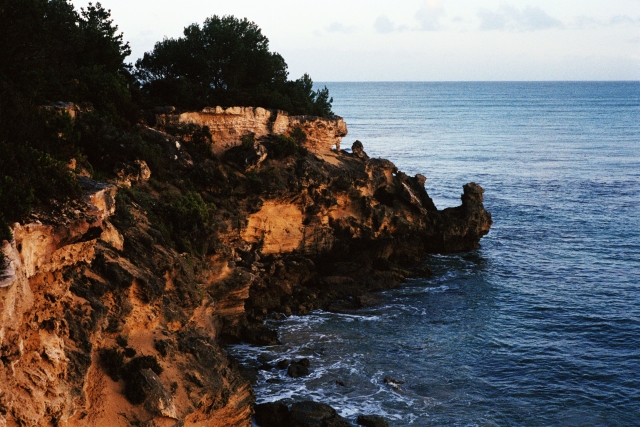
Gary Sauer-Thompson, Robe, 2006
Natural beauty had nothing to do with the freedom of the autonomous subject; the lone subject in an instrumentalized and mutilated world ravished by utilitarian pseudo-progress. So we have the subject seeking solace as a tourist in stone walls, old buildings, and ruins, lamenting what is passed, forgetting the suffering in constructing the walls and buildings, and viewing nature through a prism of fear.
And yet the aesthetic appreciation of nature continued. Nature was beautiful. What was elided from this appreciation was the domination of nature to ensure progress, and the subject's instrumental sway over nature. The destruction of nature was buried in our historical memory as nature was increasingly commodified from being cultivated by human beings for pastoralism, farming and irrigated agriculture.
January 23, 2007
an apocalyptic culture?
John Kay's claim about environmentalism as an Apocalypse myth was badly stated, but it does open into a consideration of whether we are living in an apocalypse culture.
 Such a culture expresses itself as 'our world is doomed and it has no future. The end is nigh.'
It does appear that apocalyptic dread is alive and well in popular culture; the discourse around bush fires, viruses, Avian flu, terrorists, global warming has apocalyptic themes with its fears and hopes. With respect to global warming we await the consequences.
Fatalism rules in an apocalypse culture, which has arisen from the collapse of the grand systems of thought that once dominated Western intellectual culture.
Mervyn F. Bendle argues that popular culture is awash with images and narratives of the apocalypse in various forms.
These range from war and acts of terrorism involving “Weapons of Mass Destruction,” to religious, science-fiction, horror and fantasy representations of the “End Times,” depicted in a wide range of media including novels, comics, film, television and video games.
Bendle's argument is that we are are living a move away from a basically liberal optimistic outlook that complemented secular faith in human progress based on reason, science, technology and social amelioration, towards a far more pessimistic view that distrusts these values, and instead sees the near future in terms of social disintegration, violence, war and ultimate catastrophe, before a final deliverance brought by divine power. It is this dark vision that now shapes the contemporary apocalyptic imagination in both its religious and secular forms.
Dominic over at Poetix argues that:
We should acknowledge that our world is doomed, that it has no future; but also that it is not the only possible world, that other worlds have been and will be. The world that is to come is not the future of our world; it is not the world we intended for our children, who arrive, as all children must, at the edge of the void. Barbarism, yes: the present barbarism, the barbarism of the ages, limitlessly cunning and polymorphous and yet always ultimately the servant of the same intransigent stupidity and imaginative incapacity. Barbarism and then socialism? It remains to be seen.
K-Punk disagrees. We live in a post-apocalyptic culture in that apocalyptic dread has receded from the popular unconscious:
In many ways, however, we have ceased to imagine the end of the world just as surely as we have lost our ability to imagine the end of capitalism. Oddly, apocalyptic dread - so omnipresent during the Cold War - seems to have been extirpated from the popular unconscious. The possibility of environmental catastrophe may well be entertained as a rational hypothesis, but it does not dominate our collective dreams in the way that the threat of nuclear annihilation once did...t's worth pausing here to reflect that, in the debates over climate change, it is no longer the apocalyptic potential of current trends that is disputed; what is doubted is whether any effective action could be taken to deal with it.
It is increasingly difficult to imagine alternatives to capitalism:---the world goes on, but nothing new can ever happen. What remains is cloning and recombination of capitalism. Is that the only option? How about the self- destruction of capitalism due to the economy's laying waste to its ecological life support, and its inablity to resolve this contradiction?
January 22, 2007
hacking and gift economy
The last text that I'd read of McKenzie Warks was Celebrities, Culture and Cyberspace, (1999). I wasn't much impressed. A Hacker's Manifesto looks more interesting.
It is centred around the concept of intellectual property in a world of digital technology and the enclosure of the commons. Wark argues that this has created a class division between "hackers" -- producers of information, be they academics, creative artists, or others -- and a"new ruling class" that has seized ownership of this property via patents, copyrights, and trademarks. This privatizing of information in the new emerging neo-liberal world order demands by drug and media companies for protection of their patents and copyrights is counterposed to an abstract-gift economy, which includes the free-software movement, for example, and the rise of listservs, and the file-sharing movement and the pervasive popular culture of file sharing and pirating. This is really a social movement in all but name that is creating pressure for change embodied in a movement around sharing information as a gift.
'Hackers ' can be misleading here, given the existence of hackers as spammers as producers of information. Obviously the word “hacker” itself has since been distorted and debased, and Wark is thinking in terms of digital resistance that creates new things aaand, as a movement, ththreatens to undermine the enforcement of valuable patents and copyrights. Wark says:
Whatever code we hack, be it programming language, poetic language, math or music, curves or colourings, we create the possibility of new things entering the world. Not always great things, or even good things, but new things. In art, in science, in philosophy and culture, in any production of knowledge where data can be gathered, where information can be extracted from it, and where in that information new possibilities for the world are produced, there are hackers hacking the new out of the old. While hackers create these new worlds, we do not possess them. That which we create is mortgaged to others, and to the interests of others, to states and corporations who control the means for making worlds we alone discover. We do not own what we produce - it owns us.
This 'we'--intellectuals on my interpretation -- is confused:
And yet we don't quite know who we are. While we recognise our distinctive existence as a group, as programmers, as artists or writers or scientists or musicians, we rarely see these ways of representing ourselves as mere fragments of a class experience that is still struggling to express itself as itself, as expressions of the process of producing abstraction in the world. Geeks and freaks become what they are negatively, through their exclusion by others. Hackers are a class, but an abstract class, a class as yet to hack itself into manifest existence as itself.
Well it's time for academics to go digital: move the monograph into a truly electronic mode of publishing and start thinking in terms of a debate involving multiple voices.
January 21, 2007
Snaps: Coorong
This is the bottom end of the Murray-Darling Basin: a complex estuarine system that is a mixture of fresh and salt water at the River Murray's mouth and is home to migrating birds from Asia.
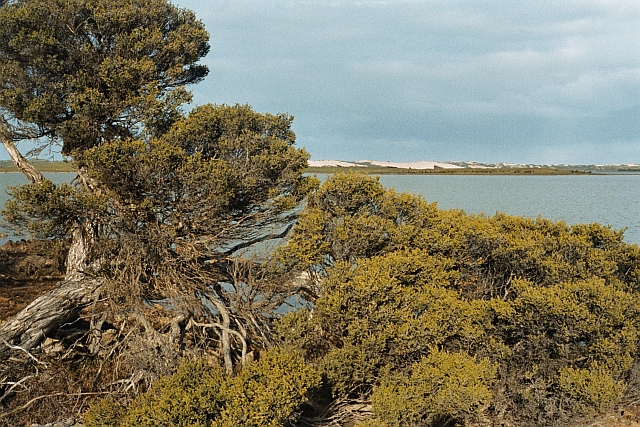
Gary Sauer-Thompson, Coorong, 2004
Only there is no fresh water flow and the Murray Mouth is closed. So the Coorong stagnates. The bird numbers have dropped off.
January 20, 2007
Pet Sounds Live in London
I watched a DVD of Brian Wilson playing Pet Sounds in London ---four sold-out shows at London's Royal Festival Hall---the other night. That series of concerts with the Wondermints was back in 2002. The DVD of Wilson's first solo tour of Europe and England, does not have the first half of the show --the Beach Boy hits and Wilson's songs.
At the time it was unclear whether Wilson was capable of pulling off a live re-creation of the Beach Boys' 1966 album, 'Pet Sounds', which had been mainly written by himself and Tony Asher. Pet Sounds is probably the first pop-rock record to be wholly conceived as a complete experience, a self-contained album that broke away from the hits-plus-filler affairs that characterized most of the rock albums up to that time. The "pocket symphonies," were inspired by the production style of Phil Spector (Ronettes, Crystals, etc.), and used some of Spector's "Wall of Sound" crew to infuse pop music with a naked emotional content.richly symphonic sound. Conventional keyboards and guitars were combined with exotic touches of orchestrated strings, bicycle bells, buzzing organs, harpsichords, flutes, theremin, Hawaiian-sounding string instruments, Coca-Cola cans, barking dogs, and more.
So the concert was a very emotional occasion--B'rian is back.' Would it be disappointment -the familar response to all of the Beach Boys’ recordings after Pet Sounds? Would Wilson's shattered confidence be overcome? Would Wilson deliver?
 This was not an aging veteran revisiting his glory years in a live setting. It was touch and go with the early songs---Wouldn't It Be Nice , You Still Believe in Me , That's Not Me. This was not the Beach Boys revisited, and though Wilson's voice had dipped a couple of octaves, they began to breathing new life into "Let's Go Away for Awhile", "Sloop John B", "God Only Knows and "Caroline, No" with waves of affection and applause greeting each song. It was a most moving live event, and I presume , a lot of tears were shed, unashamedly.
The concert did not sound like listening to a newly remastered version of the real thing--a perfect note for note rendition of the original record. Wilson's songs were (for the most part) structurally very simple , but were overlaid with extremely complex and often highly chromatic vocal and instrumental arrangements. Pet Sounds, which can be interpreted to be Brian Wilson's first solo album , had been a commercial disappointment but it was also critically lauded and embraced within the musical community.
This is no trip down memory lane. Ihe music sounded energised, vital, current. The melancholy at the heart of Pet Sounds came to the fore and it was impossible not to listen to the songs and not relate the themes of love, loneliness, abandonment and creative frustration to Wilson's long dark night:---his mental deterioration, eventual breakdown, and his long years of schizophrenia or bipolar affective disorder. The songs still retain their magic--- in fact the rendition of the Pet Sounds instrumental track was better than the original--with a whole a new depth of sensitivity.
Even all these years later, Pet Sounds sounds fresh and dynamic. It challenges the way we now experience culture as disposable music, or the customized consumption of goods and services with which we are already familiar or the average spoon-fed nostalgia fest.
January 19, 2007
water for sale
It's been lightly raining off and on in Adelaide for most of the day. It is very welcome after the long period of dryness, though it is not enough to green the parklands or bring the dead trees back to life. It's just an interlude in a very dry spell.
I've recently noticed that all the public taps no longer exist. Water is no longer a public good with state governments having a constitutional responsibility to manage it for the public interest or the common good. Water, especially in rural Australia, is now a commodity and state governments use the water market to sell water to those with the deepest pockets during a drought.
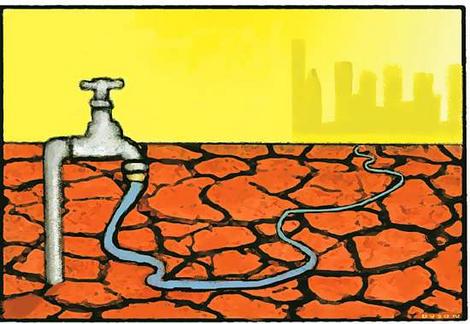
Dyson
Water markets are meant to ensure the efficient allocation of scarce resources, as water use shifts to the highest value user. The scarce water resources are supposedly due to the drought, it is constantly said. Yet the history of water politics indicates that in the 20th century water was once given away to irrigators by state governments to foster economic development and prosperity. Water development was variously called drought proofing the region or making deserts bloom.
Today government ministers rarely say that rising global temperatures cause less rain and that rising temperatures are increasingly caused greenhouse emissions. It's the drought.
The 'Drought' explanation implies that the rains are on the way. It implies that it is just a matter of when the wet cycle replaces the dry cycle and that its all a matter of natural cycle. So, the government authorities say, we just have to make do with less water in the cities those with deep pockets (businesses) excepted of course. And we need to build more and more dams for the next wet cycle. That is gonna be a big one. I can feel it in my bones. Can't you? In fact it's just around the corner, isn't it.
That kind of approach to the water crisis represents a denial of global warming and its effects on our capital cities.
January 18, 2007
beauty & embodied meaning
Beauty and photography means fashion and glamour doesn't it. Beauty used to be the supreme purpose of art in the nineteenth century, now it has been dethroned to the extent that there is almost a critical taboo against beauty.
There is a simple reason for the dethronment of beauty: good art need/may not be beautiful. Beauty is now associated with skincare and/or plastic and cosmetic surgery.

Gary Sauer-Thompson, Beachport, 2006
Maybe we should giove more consideration to the "embodied meanings" of art works and images? Isn't there a role for the critic of trying to say what a given work means, and how that meaning is embodied in the material object which carries it?
Justin Goode over at Design Observer has a post on beauty, where it is said:
The modernist way to account for the objective basis of beauty — to the extent that it has any objectivity — is the design philosophy of functionalism. "Form follows function" means beauty is a quality that indicates a utility or efficiency of the form as a means to an end. Functionality is enhanced by maximizing efficiency. That is why the enemy of functionalism is ornamentation. Functionalism is the aesthetic of the tool and of the machine.
January 17, 2007
the need for aesthetics
In Appendix 111 to Aesthetic Theory Adorno writes about the need for aesthetics. This issue surfaced in the comments on this earlier post. I 'd argued that there is a need to rework the old categories of traditional aesthetics. An example would be 'beauty':
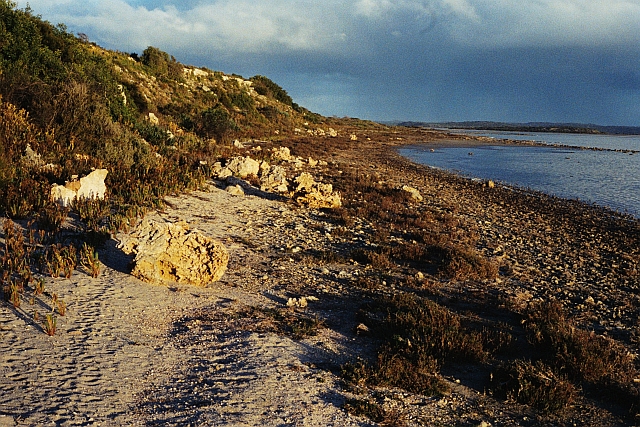
Gary Sauer-Thompson, Coorong, 2006
Many people in Australia still operate with a European understanding of natural beauty, and they do not see the bush or the Australian landscape as beautiful, by which they mean that it is messy, lacks colour and form and is all the same.
In Appendix 111 Adorno says:
In view of what has been said so far, aesthetics is not only obsolete but also timely and necessary. Art has no use for an aesthetics which prescribes norms so that art might feel less unsettled, more secure. What art does need is an aesthetics that is able to generate the kind of reflection that art is unable to marshall by itself. Terms like 'material', 'form', 'creation' are readily used by modern artists. Unfortunately they are mere cliches, and one of the functions aesthetics ought to perform is to disabuse artists of these hackneyed words. (p.468)
Adorno goes on to say that at a deeper level aesthetics has to be a reponse to the open endedness of works of art.
He states that since works of art:
are not timeless and self-same but in constant motion and development, they call for mental exercises such as commentary and critique. These are art's medium of becoming. Such shapes of spirit, however, remain weak and sickly unless they discover the truth content of art works. To accomplish this they must pass from commentary to aesthetics. Only philosophy can find that truth content and it is here that art and aesthetics converge. On its way to this point philosophy is engaged not in some external application of philosophical tenets, but in the immanent reflection of works of art. (p.468)
The situating of art in society involves mediating between the impliict truth content of art and the explicit truth claims of philosophy.
January 15, 2007
just an image
Art speaks for itself some people say. There is no need for commentary, theory, critique, or aesthetics. We intuit or feel the effects of the image, and we are happy to respond to works of art in terms of the joys experienced by the wine or food appreciation of sophisticated consumers.
Of course, what is not acknowledge is that category that underpins the 'joys experienced by wine appreciation ' is the judgement of taste, and that this carries a subjective bias. Beauty, as it were, is in the eyes of the beholder, and this is deemed to be a foundational truth; so foundational that it is beyond critique. Why then has 'form' replaced the 'judgement of taste ' as the criteria to evaluate what constitutes a good work of art in the modernist art institution?
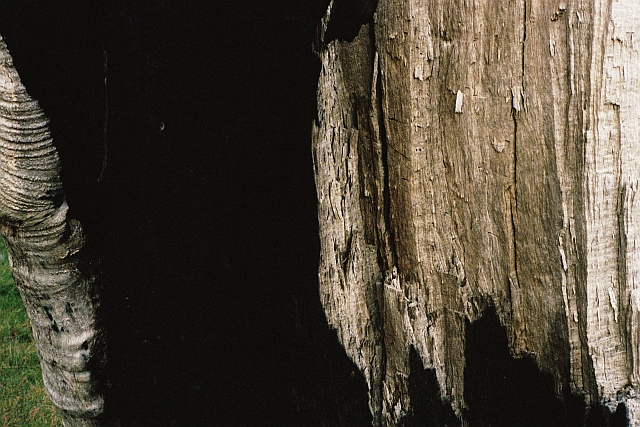
Gary Sauer-Thompson, tree trunk, Clare, 2005
What is often pointed to is a conflict between art and traditional aesthetics. There is a distrust of philosophical aesthetics, a hostility to 'Theory' that is deemed to be of an academic nature and a rejection of critical reflection on art works, institutions and aesthetic categories. Theory--the name for aesthetics in postmodernity--- is deemed to be alien--it is seen to hover over art works like some ferocious bird of prey.
Do we not have a particular kind of aesthetics tacitly presupposed in aethetic appreciation based on responding to, and experiencing works of art, in terms of the judgement of taste of sophisticated consumers? Isn't this a particular way to talk about works of art? An empiricist one, which presupposes that aesthetic judgments about beauty and harmony are perceptual and take their authority from a sense that is common to all who make them; and that this sense is called a ‘sense’ because it involves no intellectual element or category, no reflection on principles and causes.
Why should we tacitly accept or presuppose an empiricist aesthetics, as opposed to one that recognizes we use categories in making aesthetic judgements, whilst denouncing the relevance of aesthetics to contemporary art? Isn't this contradiction a reason for critical reflection? Doesn't art itself embody reflection?
January 14, 2007
sports circus
The summer carnival continues. First it was the cricket now it is the tennis. It is spectacle is it not?
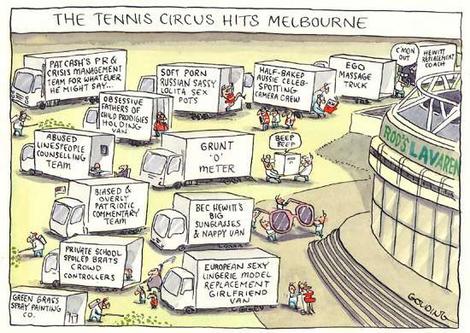
Matt Golding
I caught a few moments something called 20/20 cricket a week or so ago on free -to air television. It was sport as entertainment with the fireworks and all.
January 13, 2007
a changing nature
The dry conditions and lack of run off into the Murray-Darling river system in 2006 has meant that many of the wetlands along the River Murray are disconnected from the River Murray and been left to dry out.
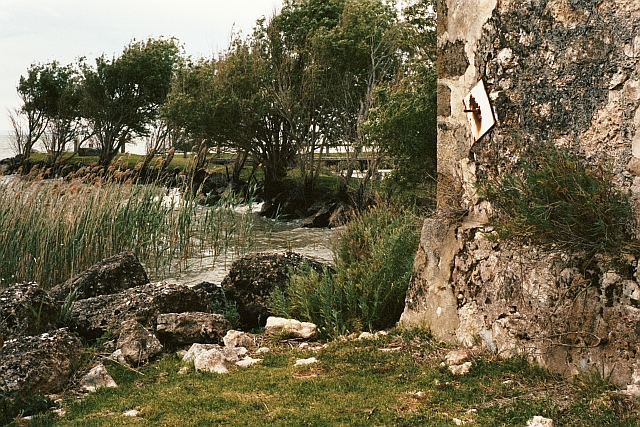
Gary Sauer-Thompson, Boatshed, Lake Alexandrina, 2004
There is an emergency plan to build a weir between Wellington and Talem Bend to protect Adelaide's drinking water from the River Murray. probably means that Lake Alexandrina will slowly dry up.
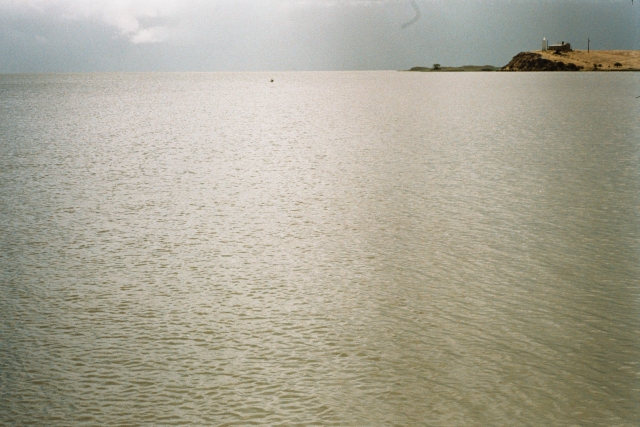
Gary Sauer-Thompson, Lake Alexandrina, 2004
The lake is very shallow and suffers from a lot of evaporation during the summer. Still it was an artificial fresh water lake with barriers on the Murray Mouth side to protect the influx of sea water. The fresh water was a water supply for irrigators (wineries) and dairy farmers.
January 12, 2007
representing space
This is the astonomy picture of the day: I didn't know that there were clouds in space. They're called "nebulae", and are generally composed of gas and dust many light years across.

The Eagle Nebula in Infrared
The image is of an open cluster of stars being formed was taken by the robotic orbiting Spitzer Space Telescope. Stars in the Eagle Nebula are born in clouds of cold hydrogen gas that reside in chaotic neighborhoods, where energy from young stars sculpts fantasy-like landscapes in the gas.
January 11, 2007
downsizing the creator
I've always been an advocate of the poststructuralist thesis of the 'death of the author' as it downplays the individualism of the heroic/genius artist that is so pronounced in modernism and abstract expressionism.
On Roland Barthes' account in the "Death of the Author" (1967) the argument is against incorporating the intentions and biographical context of an author in an interpretation of text. Writing and creator are disconnected in order to undermine the traditional view, which holds the experiences and biases of the author serve as the basis for definitive interpretation of the text. For Barthes, to give a text an Author and assign a single, corresponding interpretation to it is to impose a limit on that text.
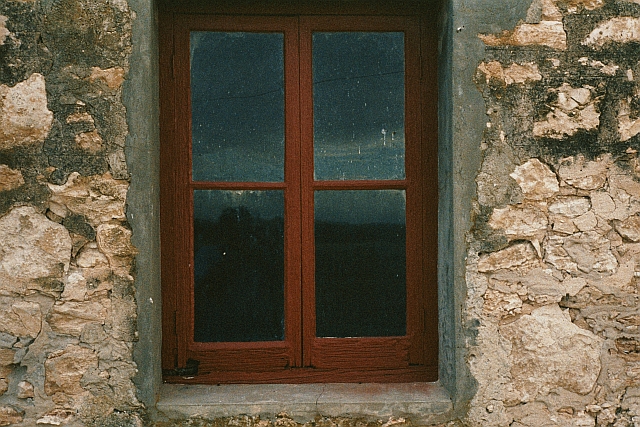
Gary Sauer-Thompson, self-portrait, 2004
Each piece of writing or image making writing contains multiple layers and meanings, especially when the text or image is contextualized and seen as part of a system of language. The emphasis shifts to focus upon the disjointed nature of texts or images, their fissures of meaning and their incongruities, interruptions, and breaks.
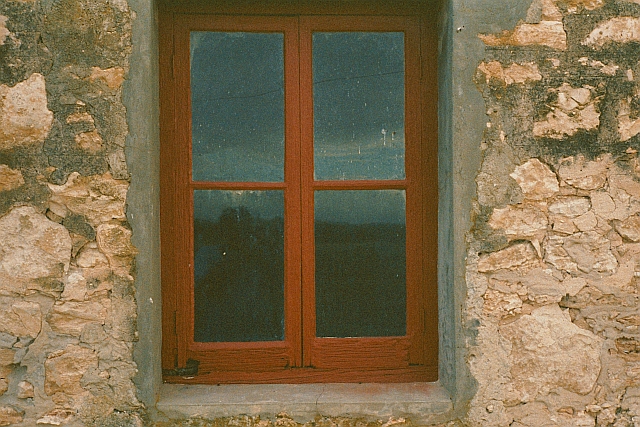
Gary Sauer-Thompson, self-portrait, 2004
So the creator of the photo becomes part of the blur of the shadow/darkness. It signifies a shift from an anthropological standpoint based on a priori concepts of the nature of the human subject to focus on the role of discursive practices in constituting subjectivity.
January 10, 2007
photoblogging
The Geert Lovink article on blogging in Eurozine, which I mentioned here has been picked up at Larvatus Prodeo in two posts here by Glen Fuller and here by Mark Bahnisch. The latter post is concerned with photoblogging the personal in the form of "documenting stuff in my life and that I happen across".
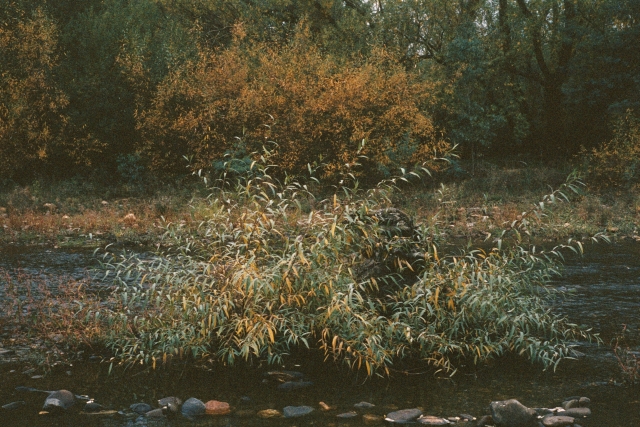
Gary Sauer-Thompson, Currency Creek, Fleurieu Peninsula, 2004
Mark picks up on comments by Glen Fuller, namely:
For some reason many media theorists seem to think it is bad that ‘little people’ produce media that is organised around their shared interests rather than the old situation of having their interests dictated or at least cultivated in the broadcast model of media.
Examples of 'shared interests' are cat blogging and food blogging using digital cameras.
I'm puzzled by the remarks. Is the personal really a problem? Haven't those on the left accept the intertwining of the personal and the political since the 1970s/1080s? So why the problem with the personal?
Haven't photographers being expresssing 'the personal' and the 'here and now' for ages? Aren't there blogs that mix the domestic, the trivial, the political, the personal and the professional---as Pavlov's Cat puts it? This response by this kind of blogging to something happens--ie., an event--- is one that does not take its bearings from the constructed news in the media or from media theoriests; it may come from attending a music event or a walk:
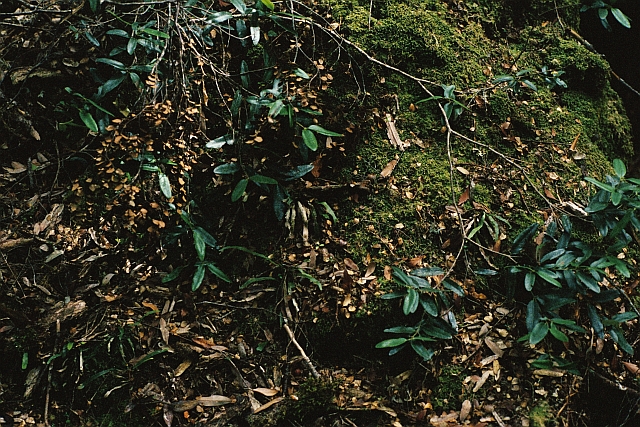
Gary Sauer-Thompson, forest floor Tasmania 2006
Isn't it more a case of digital technology now enabling people to start taking snaps of what they find of interest in their everyday lives with far greater ease than film cameras of yesteryear and then distributing it on weblogs, galleries or Flickr? Or that Larvatus Prodeo is a part of a literary culture that has a marginal connection to the visual?
Update:12 Jan.
If we come back to Lovink's concern with the relationship between blogging cynicism and nihilism, then is the implied argument that photoblogging of our everyday lives is a counter movement to cyncial reason's response to nihilism? A critical response that takes the form of not believing in what we are doing anymore because our highest values values have been devalued as Nietzsceh argued. If so, does that mean creativity is what we still believe in? That it is the pathway out of the debilitating condition of cynical reason? Is this the argument?
Paris Hilton: celeb-trash-princess?
Celebrity is an odd isn't. A postmodern popular culture now requires an exhibitionist and Paris Hilton is making a lot of money from her television and movie roles and television, movies, modeling, and personal appearances. Media attention is a commodity.
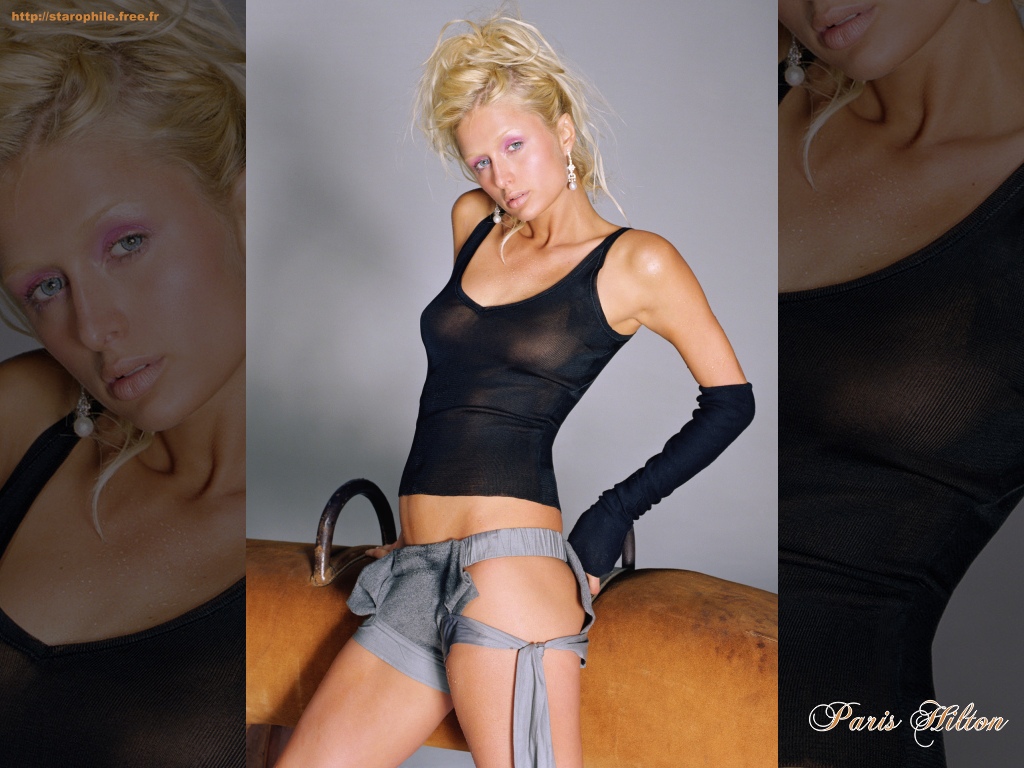
Paris Hilton
She is everywhere. She creates fame and fortune just by being Paris Hilton (the persona is Paris the Heiress) and by turning herself into a tabloid princess. Her sex video on the internet in 2003 was her launching pad. In the tabloid world the worse Paris Hilton behaves, the more famous she becomes and the more money she makes. She uses media attention to sell product, and is a walking billboard.
Our popular culture has gone way past conspicuous consumption to a 24-7 rubbing our noses in the wealth of the super rich. Paris Hilton is not just about celebrity, fans and cameras or celebrities misbehaving, as Hilton is also intensely disliked or hated. Kay S. Hymowitz, points out in City Journal that:
...rather than being an alpha female, as theorists of celebrity would have it, Paris is America’s national cartoon heroine, a caricature who allows us to mock the undeserving and decadent rich we have scorned since the time of Tom Paine. We follow the Perils of Paris the Heiress in new episodes [on her Fox series The Simple Life] that seem to come almost weekly, snickering at her vapidity, her coarseness, her libertinism, and her outrageous assumption of entitlement
I reckon Channel 9 ought to acquire the show, since they've goone down market in a cost cutting exercise. Or has Channel 10 cornered that market? If we think in terms of Paris Hilton as a signifier in pop culture, then, as Hymowitz states, Paris Hilton:
...has become a synonym for American materialism, bad manners, greed, "like" and "whatever" Valley Girl inarticulateness, parochialism, arrogance, promiscuity, antifeminism, exposed roots and navels, entitlement, cell-phone addiction, anorexia and bulimia, predilection for gas-guzzling private transportation, pornified womanhood, exhibitionism, narcissism — you name it.
So why not tax her? Aaah, this is Republican America remember.
With her record the celeb-trash-princess is transforming herself into chic pop star
January 9, 2007
crisis of culture
Okay, I've taken the quote below from Terry Eagleton's The Crisis of Contemporary Culture; his inaugural lecture as Thomas Warton Professor of English Literature delivered in Oxford back in 1992. It's relevant to what is happening now--what many call the culture wars --in a background way.
If you recall, traditionally culture was the preserve of the elite (ruling class to use an old Marxist term) whilst vocationalism (often without jobs) was the preserve of the people, and more particularly the working class. The concept of culture functioned as harmonization of our various squabbles and conflicts, including those of class; it was the terrain on which our differences could be reconciled in a transcendent unity. Culture was the very antithesis of power and the liberal university was free from the tainted discourse of politics and ideology. This traditional cultural formation is what has being undermined since the late 1960s, with the humanities in the West providing the arena of intensive political contestation.
This contestation is often interpreted as the crisis of culture which tradtionalists, as custodians of the good old days, who frame it in terms of the erosion of cultural standards, which they usually blame on the liberal-left, who have adopted deconstruction and postmodernism, rejected the “correspondence theory of truth”, politicized the univerity, and embraced nihilism as their basic philosophy.
Isn' the university meant to be an argument culture as Gerald Graf argued? Aren't students taught to argue about the issues of culture? Don't relations of power exist in a university? Shouldn't students debate the sharp conceptual division between politics and culture held by the cultural conservatives? The questions about culture cannot be abstracted from questions regarding economics and politics.
What then causes the upheaval in culture and the humanities that we have been experiencing? Eagleton's answer is different from that given by the cultural conservatives.
Eagleton says:
What is subverting traditional culture, however, is not the Left but the Right----not the critics of the system, but the custodians of it. As Bertolt Brecht once remarked, it is capitalism that is radical, not communism. Revolution, his colleague Walter Benjamin added, is not a runaway train but the application of the emergency brake. It is capitalism which pitches every value into question, dissolves familiar life forms, melts all that is solid into air or soap opera; but it cannot easily withstand the human anxiety, nostalgia and deracination which such perpetual revolution brings in its wake, and has need of something called culture, which it has just been busy undermining, to take care of it. It is in the logic of late capitalism to breed a more fragmentary, eclectic, demotic, cosmopolitan culture.
Advanced liberal capitalist system has come steadily to undermine its own metaphysical rationales that were grounded on its Arnoldian premises of a national culture based on Australianness. Eagleton adds:
So it is that the intellectuals of the New Right, having actively colluded with forms of politics which drain purpose and value from social life, then turn their horror-stricken countenances on the very devastated social landscape they themselves have helped to create, and mourn the loss of absolute value.
Since then we have had the conservative attack on culture as a site of pedagogical and political struggle by traditionalists (Harold Bloom and Lynn Cheney in the US, Keith Windshuttle in Australia) pointing the gun at the language of power, politics, and multiculturalism. They say that literary criticism has been replaced in the academy by cultural politics and the result is nothing less than the renunciation of the search for truth and beauty that once defined universalistic and impartial scholarship. The decline of standards and cultural collapse, the cultural conservatives say, is seen in the way that literature that has been marginalized in the university by the degrading forms of popular culture.
These cultural conservatives have no time contempt for the cultural politics of an education that fosters a new cultural "literacy" through teaching students to be critical of dominant forms of authority both within and outside of the university; and crirtical of the authority of those cultural tradtions that sanction what counts as theory, legitimate knowledge and public memory.
January 8, 2007
blogging, cynicism, criticism
Media theorist and Internet activist Geert Lovink has an interesting article on blogging in Eurozine, which connects blogging to cynicism and nihilism. I'll pick up on the cynicism point here as I've discussed the nihilism bit at philosophical conversations.
Lovink, who was recently in Australia, says on the cynicism point that:
It would be ridiculous to collectively denounce bloggers as cynics. Cynicism, in this context, is not a character trait but a techno-social condition. The argument is not that bloggers are predominantly cynics in nature, or vulgar exhibitionists who lack understatement. It is important to note the Zeitgeist into which blogging as a mass practice emerged. Net cynicism is a cultural spin-off from blogging software, hardwired in a specific era and resulting from procedures such as login, link, edit, create, browse, read, submit, tag, and reply. Some would judge the mere use of the term cynicism as blog bashing. So be it. Again, we're not talking about an attitude here, let alone a shared life style.
Cynicism, techno-social condition, is connected to the "chronic instability of forms of life and linguistic games" which are destitute of all seriousness and obviousness and have having become nothing more than a place for immediate self-affirmation.
Let's grant Lovink this account of the postmodern condition. What then?
Lovink asks: 'How is cynical reason-----enlightened false consciousness"--- connected to criticism? Is cynical media culture a critical practice?' His answer is an interesting one:
So far it has not proven useful to interpret blogs as a new form of literary criticism. Such an undertaking is bound to fail. The "crisis of criticism" has been announced time and again and blog culture has simply ignored this dead-end street. There is no need for a "new-media" clone of Terry Eagleton. We live long after the Fall of Theory. Criticism has become a conservative and affirmative activity, in which the critic alternates between losses of value while celebrating the spectacle of the marketplace. It would be interesting to investigate why criticism has not become popular, and aligned itself with such new-media practices as blogging, as cultural studies popularized everything except theory. Let's not blame the Blogging Other for the moral bankruptcy of the postmodern critic.
And yet junk for code, like many other blogs, does continue a form of cultural criticism in providing commentary on different forms of art and popular culture, whilst trying to deal with the contradictions of liberal capitalism---the gap between fact and value, rhetoric and reality, what we actually do and what we say that we do. Lovink's response is that it is:
easy to judge the rise of comments as regressive compared to the clear-cut authority of the critic. Insularity and provincialism have taken their toll. The panic and obsession around the professional status of the critic has been such that the created void has now been filled by passionate amateur bloggers. One thing is sure: blogs do not shut down thought....Blogs express personal fear, insecurity, and disillusionment, anxieties looking for partners in crime. We seldom find passion (except for the act of blogging itself). Often blogs unveil doubt and insecurity about what to feel, what to think, believe, and like. ....Their emotional scope is much wider than other media due to the informal atmosphere of blogs. Mixing public and private is essential here. What blogs play with is the emotional register, varying from hate to boredom, passionate engagement, sexual outrage, and back to everyday boredom
This is very true---it is the personal voice that is introduced by blogs and whichg diffrentiates them from the professional critic writes for the corporate newspapers and, who more often than not, provide a consumer guide and so quietly continue to fulfil culture's classical role of reconciliation to liberal capitalism.
January 7, 2007
Tasmanian snaps
Queenstown was an odd place. It was much more visual than I'd thought.

Gary Sauer-Thompson, Cottage, Queenstown, 2006
A mining town, which was becoming a tourist town, was full of architectural history that signified how the built environment as attempt to create a small territory within the elemental chaos of nature.
January 6, 2007
art as bodily excess
As I mentioned in an earlier post Julie Copeland interviews the Australian feminist philosopher Elizabeth Grosz on the ABC's Sunday Morning programme about the creative process.In summing up Grosz says:
The thing is that art is, in part, an excess of the body’s capacities and productions. Art is that which the body does in excess of need, and every body, I think, to some extent performs art, it’s just not publicly recognised as art or publicly valued, and indeed nor should it be in most cases. I think everything living has this artistic impulse to excess and to the revelry and the pleasure of that excess. It’s only some of us who have the rigour and the discipline to impose form on that sensation to give it life.
Copeland then mentions that Grosz has been influenced very much by the ideas of Gilles Deleuze.
She says that art, according to Deleuze, doesn’t produce concepts, though it does problems and provocations…that’s where this idea of art producing sensations and feeling comes from, from Deleuze. Grosz responds:
Yes, it does, and he has a very wonderful book on art called The Logic of Sensation which is a reading of Francis Bacon. Francis Bacon, of course, lends himself very well to be discussed in terms of sensation. But in reading that book it struck me that one could actually extract from Deleuze a much more general theory that didn’t apply to 20th century art or to abstract expressionism but to art in general. He had the resources there. The idea of sexual seduction is not particularly there in Deleuze, and I owe a debt, of course, to French feminism and to French theorists in general for making the sexual element of art really clear. But Deleuze is very brilliant on this question.
Do we actually need a general theory of art?
January 5, 2007
the value of biodiversity
In an interview mentioned in an earlier post Liz Groz speculates that art is the revelry in the excess of nature and that we artists:
take our cue from the animal world. So what is it that appeals to us? It’s the striking beauty of flowers, it’s the amazing colour of birds, it’s the songs of birds. In a way, it’s that excess which, I think, is linked to sexuality rather than to creation or production directly.
Here's some insect beauty that can be found in in the Brisbane area, Queensland, Australia. The tissue between the veins of the butterflies' wings looks like glass:
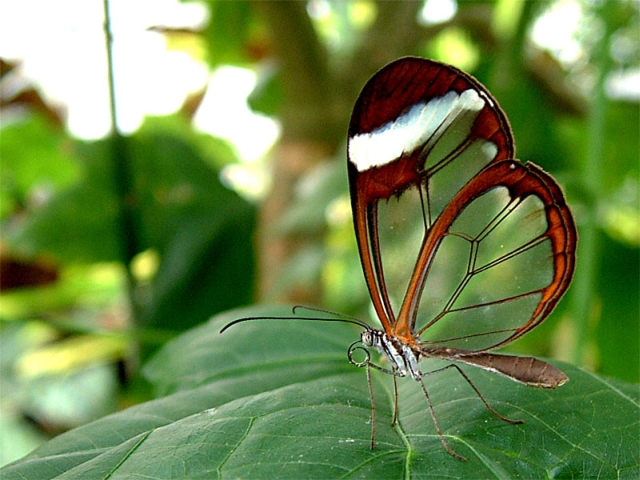
Glasswing butterfly (Acraea andromacha)
It is an example of the loss of biodiversity when the forests are cleared. It's what we try to introduce when we green bare landscapes that have been stripped for grazing. Often the landscape is barren because of overgrazing and unsustainable farming, which can permanently degrade fertile land.
January 4, 2007
Snaps: Robe
This was taken down Beachport way. It was a squally day and very very windy. Every now and again, after the squalls passed, the sun would come out.
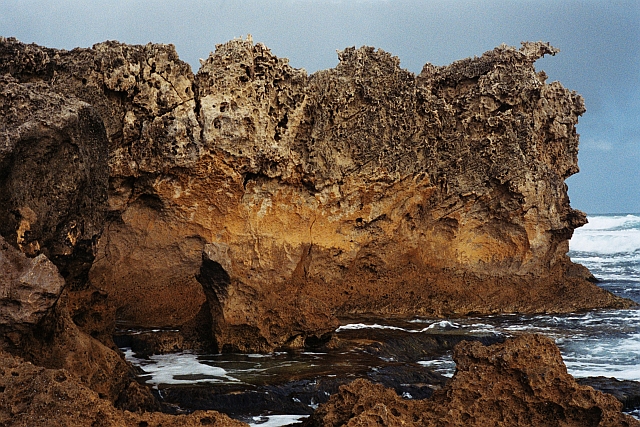
Gary Sauer-Thompson, Beachport SA, 2006
I was taken by the texture of the rocks.
January 3, 2007
March of the Penguins
I watched March of the Penguins last night. Despite the Disney-like musical score it is one the finest nature film I have watched in terms of its grasp of the activities of the emperor penguins and the landscape photography. Surpsingly, in the US it is a controversial> film.
The documentary depicts the yearly journeys of the emperor penguins of Antarctica in autumn, in which all the penguins of breeding age (five years old and over) leave the ocean, their normal habitat, to walk inland to their ancestral breeding grounds.
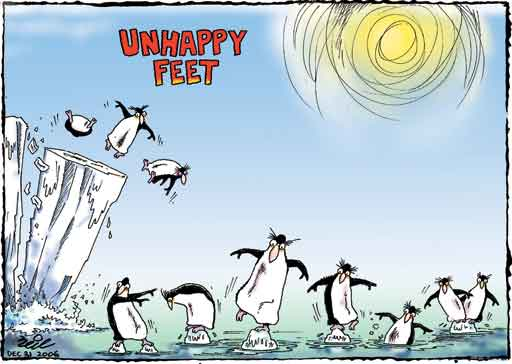
One of the DVD's extra's---Of Penguins and Men--explored the impact of climate change on the yearly journey of the emperor penguins --the melting of the iceshelf creates giant icebergs from the iceshelf that then crashed into the land near one of the colonies, creating impassible terrain and wipping the colony out.
January 2, 2007
Snaps: Victor Harbor
I've been playing around with changing a photograph to a digital image. I played with colour, contrast, saturation and gamma correction. In the end the image has been primarily sharpened.
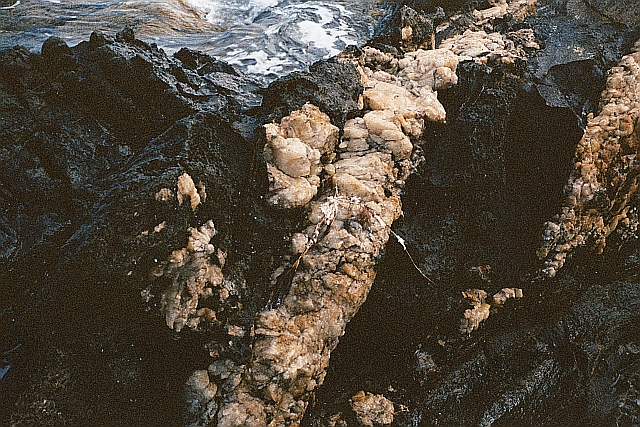
Gary Sauer-Thompson, seashore, Victor Harbor, 2004
I'm not sure that the image has been improved.This is the original image:

Gary Sauer-Thompson, seashore, Victor Harbor, 2004
However, it does look different--even though the changes to the image have been minimal
Grosz on art
Julie Copeland interviews the Australian feminist philosopher Elizabeth Grosz on the ABC's Sunday Morning programme.The interview is partly about the creative process. In it Grosz introduces some Bataiille when she says:
....there’s something about art that is an abundance of excess. Art is the revelry in the excess of nature, but also a revelry in the excess of the energy in our bodies. So we’re not the first artists and we’re perhaps not even the greatest artists, we humans; we take our cue from the animal world. So what is it that appeals to us? It’s the striking beauty of flowers, it’s the amazing colour of birds, it’s the songs of birds. In a way, it’s that excess which, I think, is linked to sexuality rather than to creation or production directly.
Is it? I love to listen and watch birds at Victor Harbor but I don't connect it to my photography. Grosz goes to explain what she means:
Darwin talks about two fundamental processes that regulate all of life; one is natural selection and the other is sexual selection. Natural selection is about survival, and sexual selection, for him, is largely about reproduction or about sexual seduction. And what I think is the origin of art, basically, is that impulse to seduction. So I take it that all forms of art are a kind of excessive affection of the body, or an intensification of the body of the kind which is also generated in sexuality. So it’s something really fundamentally sexual about art, about all of the arts, even though they’re very sublimated. What art is about is about the constriction of the materials, so the materials then become aestheticised or pleasurable. The pleasure of those materials has to do with the intensification of the body. So this impulse to art is to not make oneself seductive but to make oneself intense, and in the process to circulate some of that eros that would otherwise go into sexuality.
Gee and here was me thinking that it was Freud who held that art sublimates sexuality, not Darwin.
Grpsz goes on to say that the fundamental goal of art is to produce sensations--and the reception of art is about feeling something intensely. Now that's Deleuze.
January 1, 2007
Cream + New Years Eve
We watched the Cream reunion concert at the Royal Albert Hall in May 2005 on ABC last night, after the Melbourne leg of the Eagles Farewell tour. The latter was boring ---a corporate rock act taken to the road by slick businessmen who knew exactly what the public wanted to consume, and they provided it to them for millions. It was a slick performance that was low on sincerity or creativity.
The Cream concert was in complete contrast. A musical suprise.

Jill Furmanovsky, Cream Reunion, London, 2005
My memory of Cream was that they were at the forefront of free-improvisation during 1966-1968---around the time that the Grateful Dead were coming into their own--Fillmore West, 1969 --- whilst Coltrane and Ornette Coleman were at the forefront of the free-improvisation movement in jazz.
Baker, Clapton and Bruce hadn't played together for 35 years but they sure sounded pretty good in the reunion concert, and they created some good music more for the head and less for the body. The music took precedence over personality, notwithstanding the history of the band. Were they making new music as opposed to simply recapitulating the old?
Snaps: Mt Lofty Ranges
The Mt Lofty Ranges, which are to the east of Adelaide, separate the regoinal city from the flat country west of the River Murray as it winds down to the mouth of the Murray-Darling Basin. The ranges are stark as they have been stripped bare for sheep grazing. Nothing by way of biodiversity there.
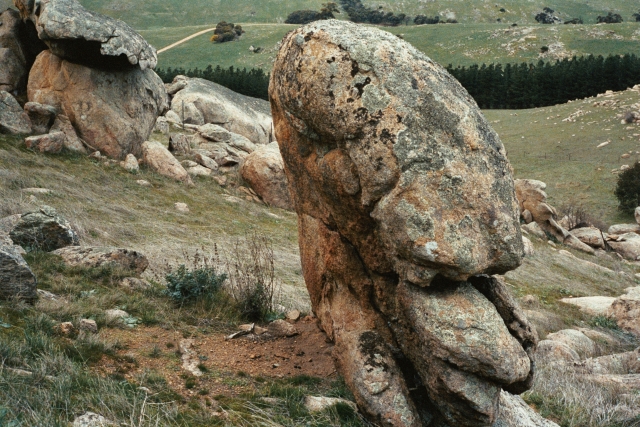
Gary Sauer-Thompson, Rocks, Mt Lofty Ranges, 2005
We were driving back from the river and I stopped the car and took some snaps. It was winter time. It was bitterly cold and very windy. The radio was playing an old Cream song and it bought back memories of driving a Kombi with an old view camera, taking photos and listening to Cream.