December 31, 2006
Snaps: Tasmania
The photograph doesn't work, but it is kind of interesting, though I am not sure why.
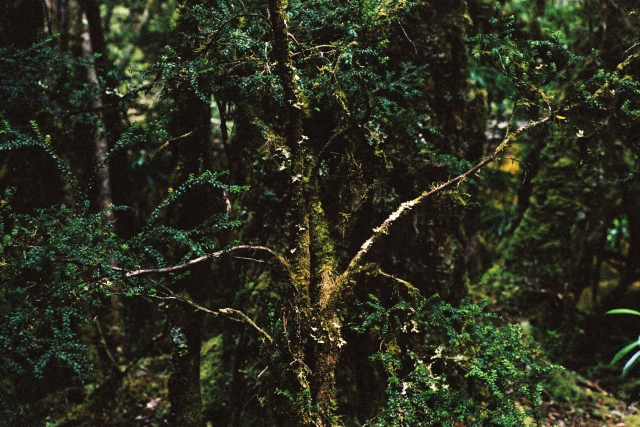
Gary Sauer-Thompson, native forest, Tasmania, 2006
I can never do forests very well. I've always been defeated by them. Too much chaos and busyness. This sketch/snap was trying something different when I was touristing in the Franklin/Gordon National Park.
December 30, 2006
food culture
An interview with Gay Bilson, formerly with Berowra Waters Inn & Bennelong Restaurant at Sydney Opera House - was at the top of Sydney's food scene for a long time.
Her name is synonymous with the revolution in Australian cooking and restaurant life that began in the 1970s. Berowra Waters Inn, one of Australia's most influential and acclaimed restaurants, was situated thirty kilometres north of Sydney, devoted patrons made the pilgrimage to it until it closed in 1995.
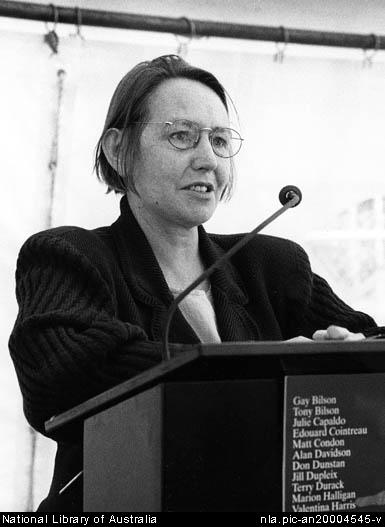
Michal Kluvanek, Gay Bilson, NLA, Australian Food and Wine Writers' Festival, 1997
Gay Bilson's book, Plenty: digressions on food, won the 2005 The Age Book of the Year Award and the 2005 Kibble Award for women writers. Gay Bilson has written much about food and gastronomy, contributing articles and columns to major newspapers such as The Australian and The Sydney Morning Herald, and to magazines as diverse as Artlink and Divine.
In recent years she has also collaborated on meals at public venues, incorporating ideas of theatre and performance and community, for the Adelaide Festival of the Arts, the Melbourne Food and Wine Festival and The Performance Space in Sydney.
I interpret the 'revolution in Australian cooking and restaurant life that began in the 1970s' as a turn to European food ---particularly French and Italian. I was never very fond of that style of cooking.I found the shift to regional foods and the new Australian cusine with its more Asian influence far more attractive and suitable to our climate.
December 29, 2006
Holiday joy
It's called trying to unwind. Many cannot sleep when on holiday as they are too wound up.
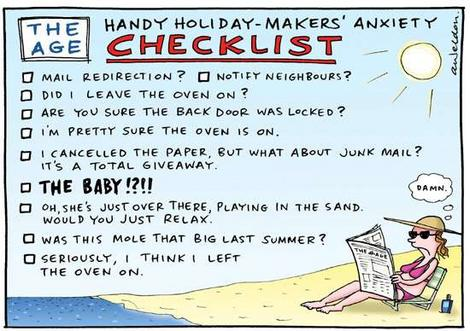
Andrew Weldon
The old Xmas thing of taking a huge bunch of time off over Xmas and January is changing isn't it, now that are a part of the global economy.
December 28, 2006
Neil Young: Heart of Gold
More holiday viewing. Neil Young teams with Jonathan Demme for Heart of Gold. It's basically a film of a concert of Young and his band, dressed-up in specialyt designed period costumes by music couturier Manuel, singing and playing some songs in Nashville's Ryman Auditorium (which used to be the home of the Grand Ole Opry).
Young and his band did two gigs in August 2005. The first half consists of songs from Prairie Wind, the album Young recorded in 2005 after a brain aneurysm threatened to take him out before he hit sixty.
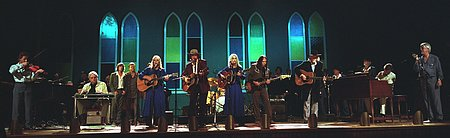
Young lets his new songs of living on the Canadian plains flow into a second gig of the classics he wrote for Harvest and Harvest Moon.Prairie Wind completes the trilogy begun by Harvest and continued with Harvest Moon. Some of the newer material is dull and bland. It disappoints.
In Heart of Gold Young identifies deeply with Hank Williams, and the musical ghosts of the Ryman, expresses the comforts of home and family, confronts mortality, and appreciates traditional values. We are given Young's imagining of Nashville's past and the concert represents a tradition (old Nashville) Young means to preserve.
The film ends with Young on stage after the concert is over, in a beautiful closing credits sequence, playing "The Old Laughing Lady" to an empty house. Simple clarity.
December 27, 2006
Prime Suspect: A Final Act
I watched a DVD of Prime Suspect's seventh series the Final Act, last night as part of our holiday viewing. This series is Det. Supt. Jane Tennison confronting her demons, battling alcoholism, and struggling with repressed rage and loneliness. Woman alone is the price of career. Lynda La Plante, who initially created the character of a female police inspector in a predominantly male world who wanted to one of the boys, parted company with ITV after the third series.
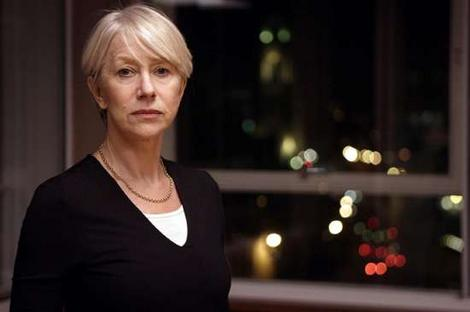
It was four hours of very good television, which is divided into two-parts, written by Frank Deasy.The DVD was copied by a friend of Suzanne's when it was shown on Channel Seven early this month. The adverts had not been edited out and they made for frustrating television. You become aware of just how much free-to-air television destroys good quality drama by chopping up the drama with its blocks of ads. 'Tis time to give free-to air the flick. They use good drama to generate cash flow from selling adverts to audiences.
As K-Punk points out the first three series were structured around career versus domesticity (very La Plantean/ Thatcherite). In an earlier post he says:
One line on her face is more expressive than most thesps' whole careers. A look, a faint change of expression is enough to carry the unbearable weight of Prime Suspect 7's great theme, mortality. Mortality threatens Mirren's Jane Tennison in many forms: her age (at one point, she sees herself in the mirror and seems unable recognise herself, an increasingly common experience as one gets older), doubts about wrong choices (the reproaches of empty hallways, address books full of names that she cannot call when in need of succour), the death of her father (the scenes with Frank Finlay, also excellent, imply a lifetime of evasions, frustrations and inadequately handled affections). There were at least three moments that provoked tears, and not cheaply.
A Final Act is equally about the character Det. Supt. Jane Tennison,and her problems with drink, depression and the impending death of her screen father andsolving a murder. She is facing retirement, has little to look forward to as she has been marrried to the job, and has few friends in her hour of need. The whodunit is secondary to Tennison's disintegration as a person.
December 26, 2006
Russian Ark + history
I watched Alexander Sokurov's interesting Rusian Ark (2002) last night. We return to the 18th century to explore the corridors and salons of the Baroque Winter Palace (now the Russian State Hermitage Museum) in St. Petersburg (Russia's window to Europe) with a French Marquis diplomat from the 19th century and a modern filmmaker.
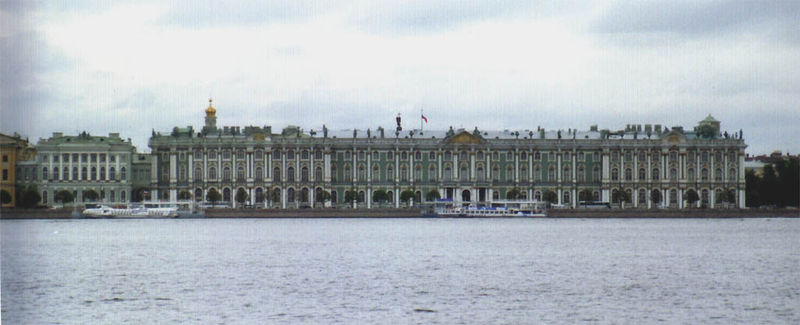
Winter Palace Neva River side, designed by Francesco Bartolomeo Rastre in 1754-62
The Hermitage Museum is the largest art gallery in Russia and is among the largest and most respected art museums in the world. It's collection has been digitalized.
The form of Russian Ark is Russia as a theater and its people are actors. We, as spectators, witness scenes from the Tsarist Empire: Peter the Great thrashes his general with a whip; during rehearsals of her own play, Catherine the Great rushes around looking for a place to relieve herself; the family of the last Tsar dine together, oblivious to the impending revolution; and hundreds of dancers waltz at the last Great Royal Ball of 1913 with Valery Gergiev conducting. The camera moves in and out of different time periods, assessing canvases and sculptures, glimpsing small vignettes and vast scenes.
This voyage through time unfolds in a single, uncut steadicam shot ---- a 96-minute-long, continuous tracking one---whilst the Marquis and the filmmaker as the camera engage in a passionate and ironic dispute criticisms against and defences for the narrator's native Russian culture. The Marquis clearly has a Western love-hate relationship with Russia. He mocks Russian civilization as a thin veneer of Europe on an Asiatic soul. The modern filmmaker questions his country’s uneasy connection to its past and to Europe today.
Henry Sheehan says that Russian Ark is interlinked with V.I. Pudovkin's 1927 Bolshevik classic The End of St. Petersburg, a story of the communist revolution:
As dedicated to expressive editing as Sokurov is to long, long takes, Pudovkin ended his film on the same grand staircase as does Sokurov. But Pudovkin used montage to ascend the stairs and focused on an individual, a revolutionary woman searching for her husband. Sokurov’s long, unbroken shot with a huge group of aristocrats is a riposte to Pudovkin’s. Additionally, Sokurov’s movie ends the same year Pudovkin’s begins.
I'm going to have the Russain Ark again--so I can move beyond the overpowering strangeness of its one-take structure and begin assess artistic implications. Matt Zoller Seit, writing in the New York Press, says that the super-long takes purely is esthetically significant:
It represents one extreme of an old, still-unresolved argument in film theory, namely: Does the essence of cinema lie in camera movement, composition and the arrangement of objects before the lens, or in the editing room? Thanks to the technical limitations of film cameras and the academic triumph of montage theory---exemplified by D.W. Griffith, Sergei Eisenstein and other editing room pioneers---the long take never had much chance at winning the argument. Editing allows one to expand, contract and otherwise manipulate and master time. The long take makes one more aware of time---the immutability of time, the continuous, merciless flow of time. Editing, by its very nature, chases immortality and omniscience; the unbroken long take acknowledges mortality; it also suggests a limited, subjective experience. There are no cuts in real life; ergo, when a movie scene unfolds without cutting, even when the onscreen action is absurd, it still feels more urgent, more real somehow, than a scene that’s edited---almost tactile.
Russian Ark is a meditation on how the past (history) continues to affect (even inhabit) and shape the present from the perspective of our subjective, continuous experience being guided through Russian history.
:
belonging, place, landscape
One of our Xmas guests at Victor Harbor--Suzanne's sister--- received an Xmas present in the form of a book entitled Earthwalking Sky Dancers edited by Leslie Castle. The text is about women's pilgrimages to sacred places. It has a chapter by Lynne Wood entitled 'A Gailleach in the Antipodes'. Wood says that she writes as a fourth generation Australian who is strongly aware of her Celtic origins and who feels a sense of isolation within the Australian landscape. She says:
My own unease at writing this piece comes from feeling Celtic and living in a land with which I have no ancestral bonds. Australian Aboriginal people have taught me much about their relationship with this country, and I feel an understanding of their bond in terms of my own connection with lands of my ancestral culture in Britain. My experiences of sacred sites in Australia is as a Celt with ancestral memories of my own traditional country. What I speak of experiencing the land in Australia is an an outsider with a parallel experience, which can never adequately express the personal experience that an Aboriginal woman has in this land. However, I was born here, as were my parents and their parents. When I am in Britain, I still feel connected to Australia, while in Australia I have a powerful sense of not belonging, a yearning for my ancestral home, that sense of longing embodied in the Welsh word Hiraeth, a chronic Celtic condition.
I choked on 'not belonging' and 'experiencing the land as an outsider'. This struck me as mythmaking in a postcolonial society.
I do not have this experience of being alienated from the Australian landscape --eg., the Coorong or Flinders Ranges---even though I immigrated here from New Zealand. Nor do I try to identify with the country in the same way as the indigenous people as Wood endeavoured to do ---in order to find my ancestral cultural roots. Isn't belonging to a place different from one's ancestral roots?
Nor do I have a sense of belonging to two places and being torn between them. I was born elsewhere but Australia is my home and I have a sense of being a part of the landscape in the river country around the Fleurieu Peninsula. Moreover, I can, as a white person have my own sacred places--eg., the headwater or mouth of the Murray river---and so I do not need to try to find my roots in my Anglo-Saxon origins in England (father) or in the black forest of Germany (mother).
This is the old white settler Austrlaia is a dead heart' meme transformed into sacred places. There are no sacred places for whites in Australia as it has no history.
December 25, 2006
Xmas
And so it is Xmas:
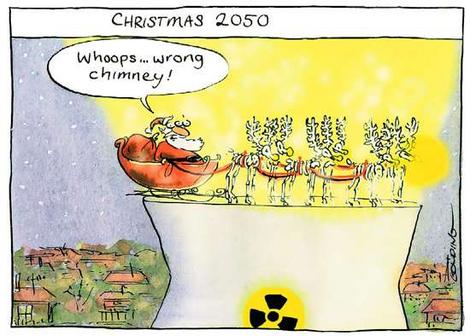
Matt Golding
So let us celebrate the value of family friendships and bonds. Some say that the stories of Christmas take us out of the private world of family and friends into the public — it makes shepherds, unwanted kings, angels and innkeepers part of our domestic scene. Do we not live in a liberal society in whioch the private and the public has been separated?
December 24, 2006
Snaps: bare life
Another snap from Queenstown, Tasmania. Some regeneration is beginning to take place in the moonscape.
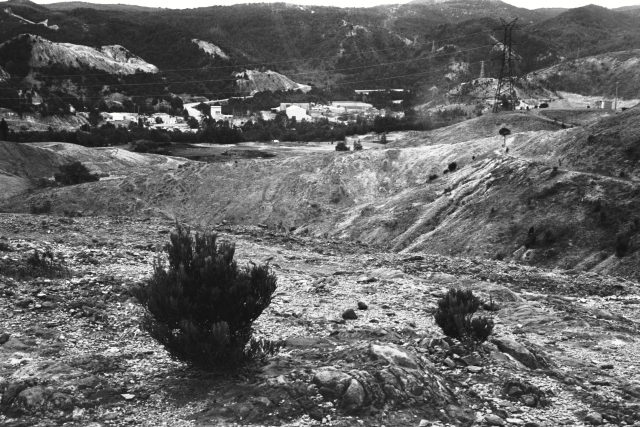
Gary Sauer-Thompson, Queenstown landscape, 2006
It is still pretty bleak though in terms of biodiversity. When I went up higher up I did experience lots of March Flies that really stung.They drove the poodles crazy and ended all tripod/darkcloth style photography.
December 23, 2006
Snaps: Queenstown, Tasmania
Queenstown Tasmania. Bare hills from the sulphur used in mining the copper.

Gary Sauer-Thompson, Ari in Queenstown, Tasmania, 2006
Parts of the hills around Queenstown look like a moonscape. Some locals want to keep it that way to attract the tourists. They are proud of what they have achieved in creating civilization out of a rugged wilderness. Their discourse is about the pioneering spirit conquering nature.
December 22, 2006
virtual worlds
Second Life, a virtual graphical world, has its own nasties --virtual vandals known as griefers.

Anshe Chung (right) before the griefing attack. Insets: The attack and two of the suspected griefers.
An interview with Anshe Chung--the in-world identity of Chinese businesswoman Aillin Graef conducted by CNet, which has established its own bureau or building in Second Life.
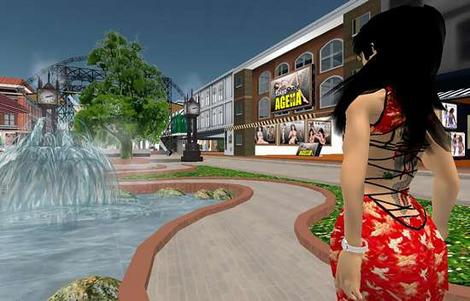
Anshe Chung with one of her virtual developments
Snaps: lichen
It was a gray overcast morning in northern Tasmania.The spell of hot weather that had never been experienced before in Tasmania had just broken. We went for a walk along the beach
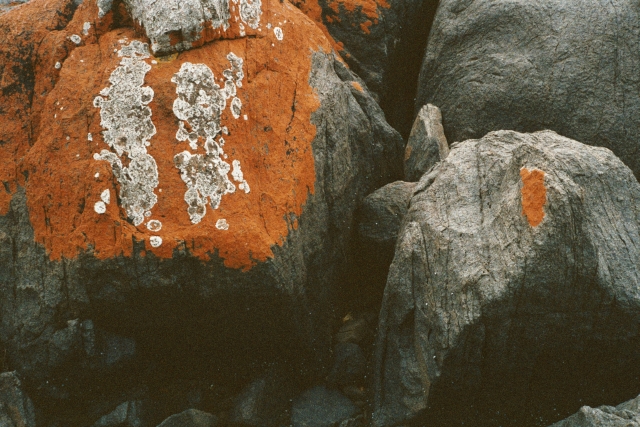
Gary Sauer-Thompson, lichen, Tasmania, 2006
The colour caught my eye on a misty morning.
December 21, 2006
Snaps: near Marne River
We have an electrical storm moving across Adelaide now. The server is up and down all the time. Posting is difficult--it's very hit and miss at the moment. This snap was taken on the backroads in the EdenValley heading to the Marne River, which is a tributory of the River Murray.
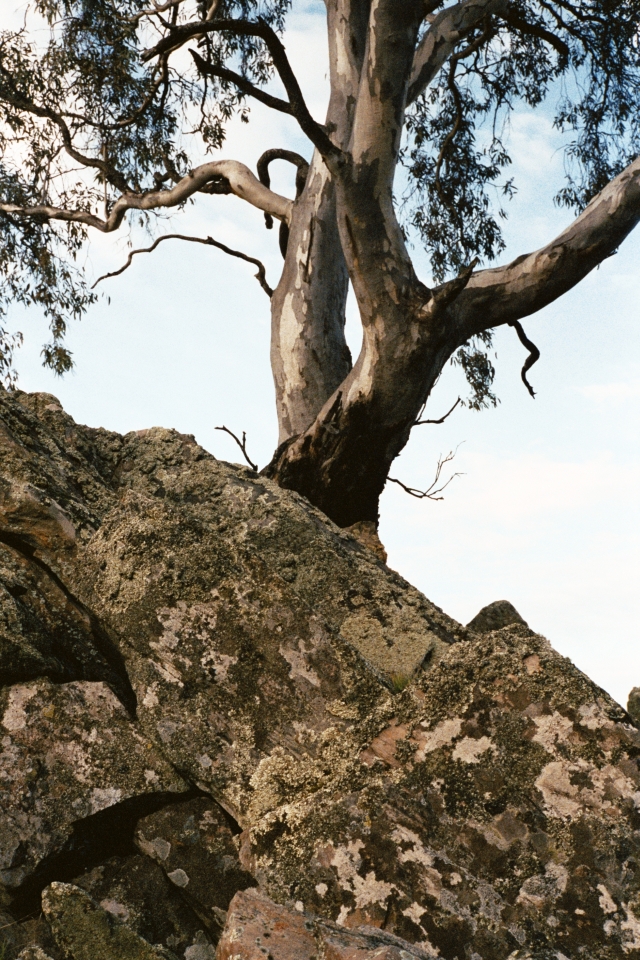
Gary Sauer-Thompson, rock and tree, Eden Hills, 2005
This image is from a time when I was travelling around looking at how vineyards (mis) used water. The Marne River had dried up as a result of too much run off in the hills being trapped by the vineyards. Consequently, the river had liitle runoff flowing into it.
Therein lies the problem with the rivers in Australia. Too much is taken out of them.
December 20, 2006
Games as virtual worlds--Second Life
Second Life is a graphical 3D virtual world. This life in the virtual world---often seen as new explorers on the electronic frontier ----has its own Herald and a monthly magazine, Slatenight, which celebrates the arts, culture, education, lifestyles and all forms of entertainment in the virtual world of Second Life. This virtual world is one in which you can leave all the labels and identities of the real world behind and create your own. You can be, and act out, whatever you want to be in Second Life.

This is excellent work in a new media form. Though it is software some represent Second Life less as a game in and more a world. issues about reality and identity. Anya Ixchel aka Angela Thomas (who blogs at i-Anya) says that the virtual world of Second Life:
is populated with educators involved in e-Learning, artists creating new media, filmmakers who are creating animated movies or machinima, fashion designers creating clothes, skins, hairdos, shoes and jewelry for people's avatars, and many other people who bring their real life work into the world. But at the same time, Second Life is populated with people who have created fantasy characters for themselves, people who are engaged in role-playing, creating digital fictional, playing games, and exploring fantastical worlds.
I guess you could have photographers/visual artists creating images.That raises all sorts of questions about identity, including gender identity. Or appearance and reality, for that matter in that image and simulacra exert tremendous power upon culture; or with a fashion designer or jeweller marketing their product in the simulated world of Second Life. It has a different ethos to Worlds of War.
How long before Murdoch moves in to buy it to make money? Or more likely, Wired? When this happens the real world/fictional world distinction is placed into question. Things would then become even more fuzzy than they are now. Well, not for the techno-futurists, who think we’re going virtual.
Update:
I presume Second Life is financially viable because you need to buy an account. and then pay for mantaining the account active. That means you--as a gamer---become a person who pays to play the game. It is the account that allows you to enter the world to visit or to play the game. Thus corporations (or schools) could buy 100 accounts at once to be used by all their staff (and students). So the viabilty of Second Life depends on the numbers and the type of accounts. Hence Second Life is a digital business. It provides for paying users a freeform place to play and it allows many transactions to occur in it. So the owners (Linden Labs) can take a percentage and make a profit.
where's the water
This is a major storage dam in the Murray-Darling Basin--a major piece of infrastructure for the irrigation industry. No rains no water. That is the effect of drought overlaid with climate change. It produces a drier and hotter Australia.
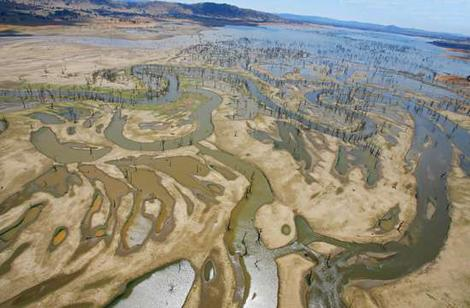
Simon Dallinger, aerial shot over Lake Hume, near Huon, 2006
Some argue that the way to address the water shortages faced by the cities is to build more dams. What's the point if there is no rain? Shouldn't we be recycling what we currently have?
Some reckon it is going to rain tomorrow, all will be okay because this is the natural order of things. For them nature has no history. It's just a question of endlessly repeating cycles.
December 19, 2006
a photographer of ruins
This post is from an interview at BLDGBLOG with Simon Norfolk, which I came across from a link at South Seas Republic. The photographs fit right into the ruins/baroque aesthetics meme of the last few posts and open the meme into the landscape.
European art has a strong tradition for ruin and desolation that has no parallel in other cultures. Since the Renaissance, artists such as Claude Lorraine and Caspar David Friedrich have painted destroyed classical palaces and gothic churches, bathed in a fading golden twilight. These motifs symbolised that the greatest creations of civilisation--the Empires of Rome and Greece or the Catholic Church--even these have no permanence. Eventually, they too would crumble; vanquished by "barbarians" and vanishing into nature.

Simon Norfolk, A government building, from Afghanistan: chronotopia, 2001
Afghanistan is a place that displays the 'layeredness' of time---what Mikhail Bakhtin called a 'chronotope'. Simon says:
Afghanistan is unlike Sarajevo or Kigali or any other war-ravaged landscape I have ever photographed. In Kabul in particular, the devastation has a bizarre layering; the different destructive eras lying on top of each other. I was reminded of the story of Schliemann's discovery of the remains of the classical city of Troy in the 1870s; digging down, he found 9 cities layered upon each other, each one in its turn rebuilt and destroyed. Walking a Kabul street can be like walking through a Museum of the Archaeology of War--different moments of destruction lie like sediment on top of each other.
The war in Afghanistan is now in its 24th year.

Simon Norfolk,Bullet scarred apartment building and shops, Kabul, from Afghanistan: chronotopia, 2001
Norfolk photographs with an old-fashioned 4 x 5” format field camera with slow shutter speeds.
December 18, 2006
death, ruin, catastrophe
I'm reading about Walter Benjamin and his exploration of Baroque aesthetics (of the 17th century), the way the signs of death in its visual culture was used, and the distinction between allegory and symbol. The term "baroque" as an adjective is often understood to refer to what is over-ornamented, unnecessarily complex, or obscure in language. It is an art of decadence, and as a style, the baroque turns harmony into a dissonance by using imperfect proportions. Baroque also designates a civilization that can be associated with the period of absolute monarchy, with an alliance of church and state to maintain the hierarchical structure of society, and even with economic mercantilism.
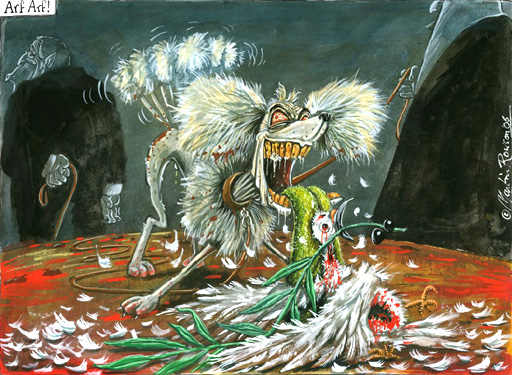
Martin Rowson, The Poodle and the Dove, 2006
In allegory history appears as nature in decay or ruins and pre-modern Baroque aesthetics took the form of melancholy reflections (or contemplation) of the inevitability of decay and distintegration. A transitory nature is an allegory for human history understood as death, ruin, catastrophe. Benjamin argued that Baroque allegory was a mode of expression that is peculiar to social disruption and war when human suffering and material ruin are the core of historical experience.
Allegory is a form of cultural and artistic expression. It looks like this form is being used by Martin Rowson as a response to the horrifying destructiveness of the UK invasion of Iraq.
December 17, 2006
death digs deeply
Poligoths by Tanja Stark, a Brisbane-based visual artist. The link is courtesy of the excellent Sarsaparilla. Poligoth is noted along with some brief comments by Ken Parish over at the literary-orientated Club Troppo.
Poligoth is an excellent example of a classy and biting visual humor and satire about our federal politicians in a gothic mode. This visual mode of expression of a gothic subculture indicates that this offshoot of the post-punk genre is alive and well in Australia. This pre-modern cultural form expresses a darkness that is the other side of the sunny Enlightenment delivering progress and material abundance; a darkness that is about death, blood life and horror. It stands in marked contrast to the Christian preoccupation with sin and evil.
Though this Rowson cartoon is not gothic-- it is all about death and decay associated with political violence --the face becomes the skull of the makeup artist, who represents death.
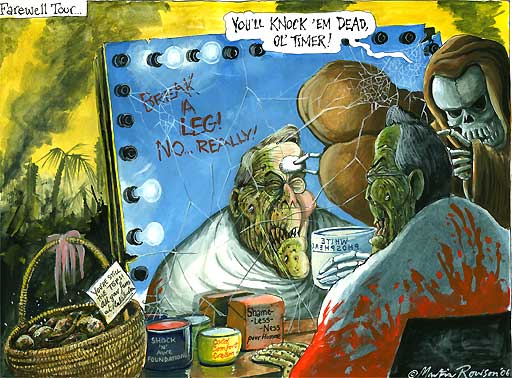
Martin Rowson, Rummy's Farewell Visit to Iraq, 2006
The skull suggests the transitoriness and distintegration of earthly power.The Iraq war reinforces the idea of ruins and fragility of empire---it is the place of skulls. The transitory US empire crumbles amidst, horror blood and death. For Christians this means a descent into Hell. That means the Americans in Iraq plummet downward into ruin.The debris of their western civilization will be covered over by the shifting sands.
What we have is a reaching back into, and appropriating the signs of, a pre-modern visual culture to express our current historical experience around war; a baroque culture that stands for excesses, illusion, artifices, decorations, trompe l'oeils and multiplied images. What Rowson's neo-Baroque aesthetic produces is a representation of a world made of images. The images do not hide the truth or adorn emptiness, they are the many layered, multiple faceted truth. This is the baroque of fullness, the baroque of the fold, the baroque of Leibniz and Deleuze.
December 16, 2006
Dylan: Scorsese's No Direction, Home
I have been watching the two disc DVD of No Direction Home by Martin Scorsese, which focuses on Dylan's life and music from 1961-66. It is a portrait of an musician as a young man in his cultural/musical context of opular culture in postwar America and musical tradition--a Bildungsroman. It is chronological, using archival footage intercut with recent interviews interwoven with exploring art's self-reliance versus its social responsibilities.
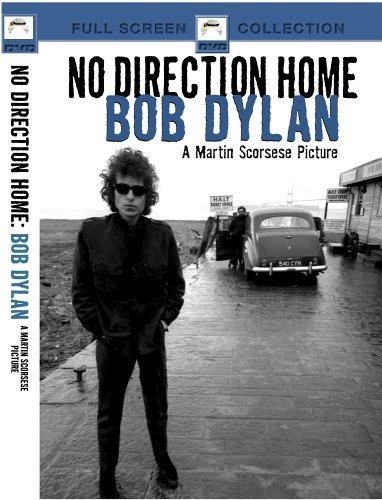
No Direction Home is long but it is very very good. Disc one starts with home recordings made in 1956, and charts the transformation from juvenile blues copyist to fully-fledged folkie strumming of the people's poet who makes contemporary music by reworking the old music; then his retreat from the leftist role of protest singer as 'a voice of a generation' ---advocated by Joan Baez or Pete Seeger-- and his transformation into a modern rock musician who played around with volume (noise) and dazzlingly surrealist wordplay. This disc is also a homage to Scorsese’s New York City.
Disc two traces Dylans' rejection of folk music at Newport with a performance of "Maggie's Farm," backed by the Paul Butterfield Blues Band -at the 1965 Newport Folk Festival, the rock work with Mike Bloomfield and Al Kooper, and the shift from literary surrealism into the hard rock music of the 1966 English tour with the Hawks, who later became The Band. There is extensive coverage of the famous 1966 Manchester concert--edited from the footage that DA Pennebaker shot on that tour. It ends in 1966 with Dylan's motorcycle accident.
It's an excellent film of that era--easily the best I've seen---and up there, as a film with Scorsese's The Last Waltz. That needs to be qualified as "No Direction Home" is an in-house project from Bob Dylan's management team, conceived as a way to frame Dylan's legacy. Scorsese edited the material--- there is heaps of raw material--- to show the historical significance of the music Dylan created during that turbulent decade.It highlights the emphasis Dylanb placed on image manipulation and mystique maintenance and "No Direction Home" can be interpreted as another addition to Dylan's hall of mirrors.
December 15, 2006
a warmed up life
It's been the year of the environment hasn't it. Global warming is definitely centre stage in our awareness and even in our politics. We know that climate change leads to arid Australian regions being more prone to drought while wetter regions become more prone to flooding.
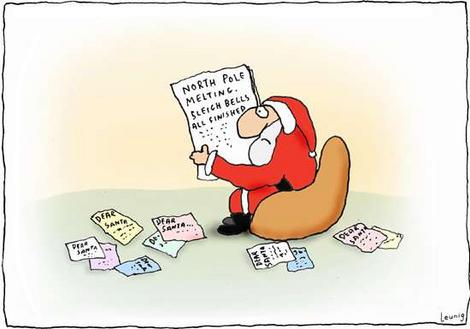
Leunig
The polar ice caps are melting at a faster rate than expected. We know that if emissions of carbon dioxide and other greenhouse gases were to slow, the likelihood of rapid ice loss would decrease. Not much likelihood of that as Australia's environmental policies have been guided by John Howard's "gut" and the influence of his fossil fuel industry patrons. Remarkably, the gut and the fossil fuel interests coincide.
I now find myself keep on imagining the effect of a meter rise in sea levels as I stroll around the beaches in Adelaide and Victor Harbor. It doesn't look good. Yet little is being said about it. It just doesn't cut through, even though all seaside property is not going to be protected. Higher food prices because of less agricultural production due to lack of water might. I've noticed that the drought is hitting food prices across the board. Higher food prices exacerbated by climate change may cut through politically, particularly since polls suggest that more than 80 per cent of Australians believe the Howard Government is not doing enough to tackle the issue.
December 14, 2006
Melbourne Docklands & urban renewal
I was in Melbourne on the weekend for work, and I stayed at the Radisson on Flagstaff, which had one broadband connection in the one desk business centre. The hotels continue to charge exorbitant rates for internet access. It was far too hot to walk around the city taking photos as I had planned, but I was able to take a tram to St Kilda on Saturday night, and I did a quick explore of the Docklands----Australia's largest urban renewal project---as the taxi took me to the airport to catch a flight to Canberra early Monday morning.
What initially struck me was the high rise apartment architecture. This great photo by Dutch photographer Frank van der Salm, courtesy of Conscientious, represents what I saw:
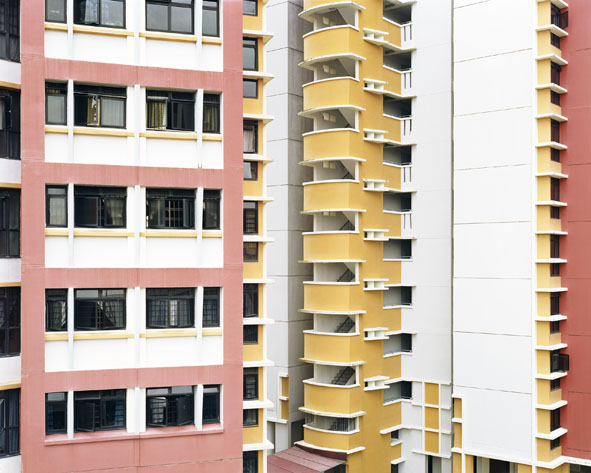
Frank van der Salm, Regime , 2005
The Melbourne Docklands stands for urban renewal of Melbourne's derelict waterfront. What I saw from the city end were high modernist apartment towers with splashes of colour. The towers were standing in wind swept public spaces that did not appear to be very people friendly. Does it give the city a heart? Does it enable the shift from doughnut city to cafe society?
Some say Docklands lacks 'soul'. The section I saw certainly hasn't put Melbourne in the vanguard of urban renewal and design. Was this part of the Docklands, or is it something adjoining?
The 15 year Docklands urban renewal project (progressive completion until 2015) is adding a total of 200 hectares to the western edge of Melbourne's central city area. It is is marketed as luxury waterfront living, cafes, restaurants, a state of the art stadium, a high technology park etc. It is to be a showpiece of design and renewal as indicated in this project vision:
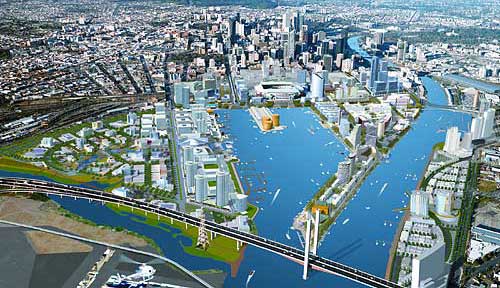
Docklands, Melbourne
Presumably, the urban development around the water edge is more attractive, visual and people friendly than the back end or the Spencer Street end. So we have piecemeal development and variable architecture in 7 different precincts with different developers.
Telstra Dome looked brutal. A 20th century A monster. Where were the flowing organic lines and the post modern shapes?

It is an urban transformation that goes way beyond anything in Adelaide. It is one firmly within increasing global integration, the shift from a manufacturing to a services economy, and the agglomeration of key functions into an area adjoining the central business district (CBD) of Melbourne. It says that Melbourne is part of the new international economy. Adelaide is not. In Adelaide the concerns of the urban policy debate still revolve around the 1980s consolidation--urban sprawl question with the policy outcomes falling on the side of urban consolidation--- eg. the local policy frameworks of Adelaide 21.
December 13, 2006
Clare: a personal snap
This photo was taken when we were on holidays in the Clare Valley in South Australia early this year. We were having lunch in a restaurant called Skillogalee, and there was a moment between the main course and desert when 'the time was right' to take a photo in the cottage garden around the restaurant.
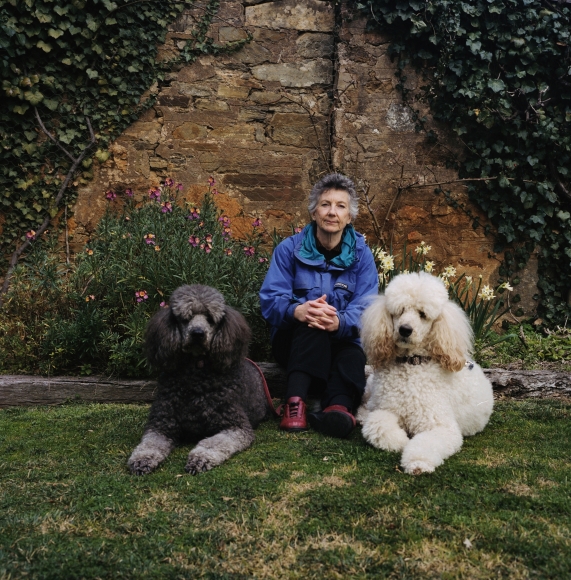
Gary Sauer-Thompson, Agtet, Suzanne, Ari, 2006
The image is a portrait as a snap within the tourist flow of everyday life of the urban middle class holidaying in the tourist world that is the Clare Valley. It's what people do isn't it on holidays? Take snaps of themselves as tourists?
The Skillogalee restaurant sits amidst the vineyards in the rolling hills that shape the region and valley. We stayed in a wooden cabin in the bush covered hills for a couple of days, and so I had some time to take a few photos:
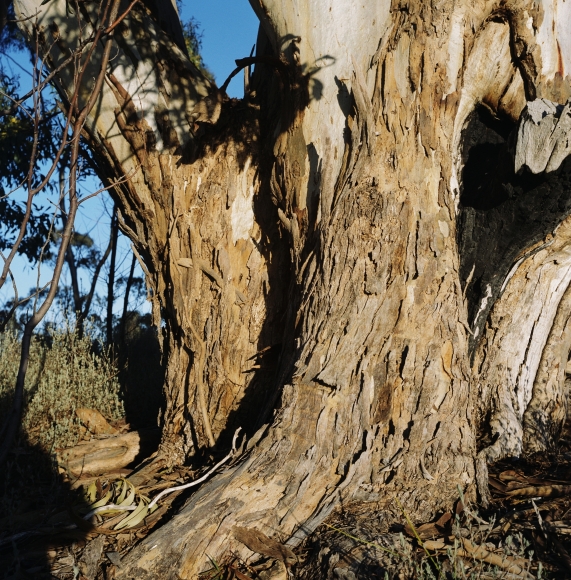
Gary Sauer-Thompson, Tree Trunk, Clare, 2006
Nature is seen as what is.--as wildeness. Yet the whole valley had been shaped and transformed into a wine area. In reality there were only isolated pockets of wilderness that had not been deeply scarred by grazing and farming.
Lipstick traces
I bought a copy of Greil Marcus' Lipstick Traces when I was in Canberra last week. The text's account of the history of the 20th century starts from the challenge to pop culture of punk from the Sex Pistols. Marcus describes about this disruption:
The Sex Pistols made a breach in the pop milieu, in the sceen of received cultural assumptions governing what one expected to hear and how one expected to respond. Because received cultural assumptions are hegemonic propositions about the way the world is supposed to work--ideological constructs preceived and experienced as natural facts---the breach in pop milieu opened into the realm of everyday life: the milieu where, commuting to work, doing one's job in the home of the factory or the ofice or the mall, going to the movies, buying groceries, buying records, watching television, making love, having conversations, not having conversations, or making lists of what to do next, people actually lived
Marcus saays that judged accordign to its demands a Sex Pistol's record had to connect a person's act to every act, and then call the enterprise as a whole into question. Thus the record changes the world.
December 12, 2006
Snaps: Mallacoota
A couple of years ago I travelled through the north eastern Victoria alpine where the bush fires are now raging to have a little holiday on the east coast near the Victorian/NSW border. The current bushfires activated the memories of the trip and I remembered this image:
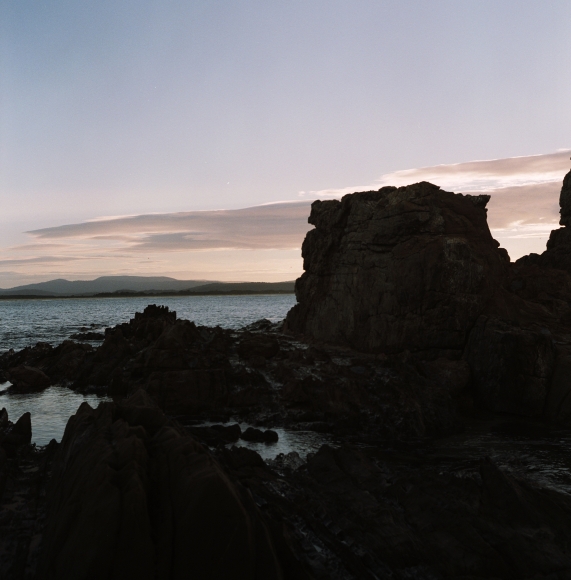
Gary Sauer-Thompson, Mallacoota, 2004
There had been bush fires in the alpine country that summer. We drove through burnt out landscapes in autumn. I lost the film. Pity.
top 10 favourite Australian albums
I see that we have a poll of the top ten favourite Australian albums of all time, courtesy of the ABC. Suprisingly, the top 3 albums are:
Pink Floyd --- Dark Side Of The Moon
Jeff Buckley ----Grace
Radiohead ----Ok Computer
Even more suprisingly, the Rolling Stones only come in at no 95 with Sticky Fingers.
Cheryl Lawrie, commenting in The Age, says that 'the fact a relatively obscure album such as Grace came in at number two seemed to give the poll a certain authenticity.Nonetheless, it was surprising. Jeff Buckley's music was always critically acclaimed, but he's never been mainstream.'
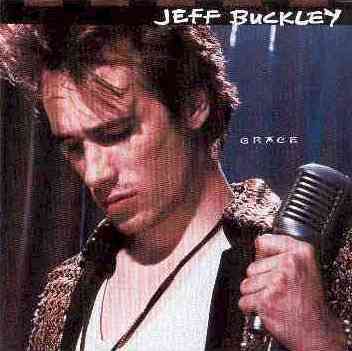
Lawrie goes on to say that what is intriguing about this album is the depth of naked spirituality in the album. It might even be better described as religious:
This is a collection of psalms for the non-religious, putting its faith in a redemption it has serious doubts about. I'm not sure we knew we were like this. It surprises us when other people feel so deeply and ask these kind of questions. But Grace asks them with a rawness and beauty that it doesn't seem we have to sell our souls to listen to. This...is best expressed through music and Grace is one of those albums that does it exquisitely.
Se adds that we might not want to ask these questions or acknowledge this pain, but since we do we may as well have the voice of an angel singing them for us.
Lawrie then makes an comment I find puzzling:
Our favourite records are the ones in which we find ourselves. And we do find ourselves in these songs ----a complicated, raw and spiritual version of ourselves that's too confronting to look at often. But we need it to be there, even if we're sceptical of it. We are, after all, quite comfortable with dismissing organised religion with the heartfelt passion and anger of Eternal Life, and then being converted in the next breath with the anthemic, addictive Hallelujah. We're not really sure what it is we're being converted to, but that's not the point. There's something deep within us that finds its mirror here. We really mean it, even if just for the six minutes of the song.
I'm not sure that Grace made it to number two because it holds a mirror to our lives in that somehow we find ourselves in it; or that it defines us and we recognise ourselves in the song of another.
Who is this 'us'? The people who voted in the poll? Australians as a people? The music loving public? The cultural elite? Do we immerse ourselves in music? Or is that only one mode of reception?
December 11, 2006
reworking mass culture imagery
Pretty nifty image making huh:
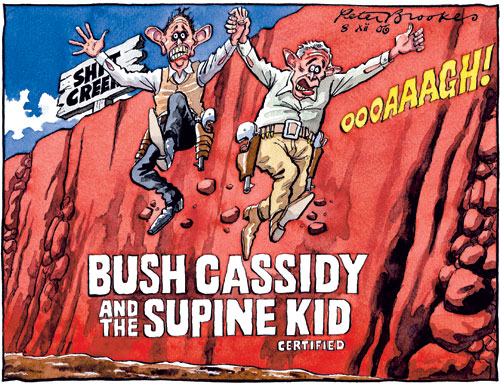
Peter Brookes
I love the way that Brookes plays with, and reworks, the Hollywood images, which are such an integral part of the visual landscape of mass culture, to make a political point. All that is missiing is the figure of John Howard --another true believer in good versus evil way of understanding the Middle East.
December 8, 2006
cartoon excellence in the UK
Steve Bell of the Guardian was selected as Political Cartoonist of the Year. Morten Morland, The Times cartoonist had his cartoon, 'Mind the Gap', selected as the winner in the Political Cartoon of the Year 2005 in the UK.

Moreland
The cartoon comments on the suspicion among London Tube users of innocent Muslims.The same suspicion is prevalent in Australia and it has been stirred along by conservatives opposed to a multicultural society. They, and the Howard government, are using code to say that Muslems are different and that they don't fit into the Australian community. What we then have is a growing fear and resentment of Muslims in the Australian nation.
Australian conservatives talk in terms of “integration” and say that people should stop talking about multi-culturalism and concentrate on common Australian values. Common Australian values give us social cohesion. Islam gives us division.
gum trees as petrified nature
Photography both encourages amateurs and challenges the way we historically view images and the landscape.
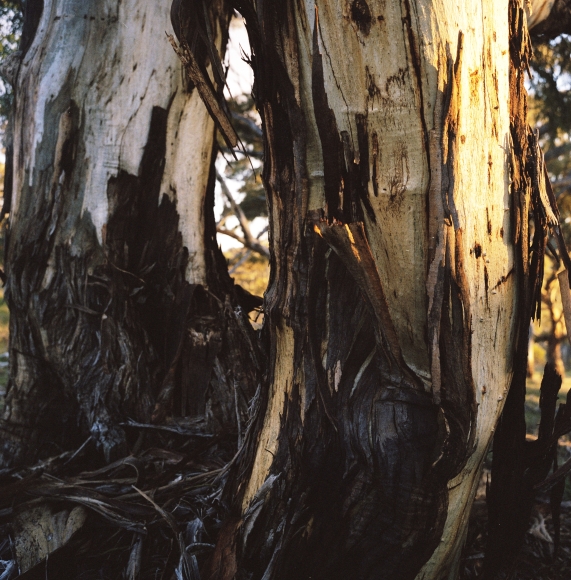
Gary Sauer-Thompson, tree trunks, Clare 2006
If photography is an integral part of popular and mass culture, it can used to question the way our culture dominates nature. Gum trees are seen as petrified nature---a reified world of fixed and hollow forms and conventions.
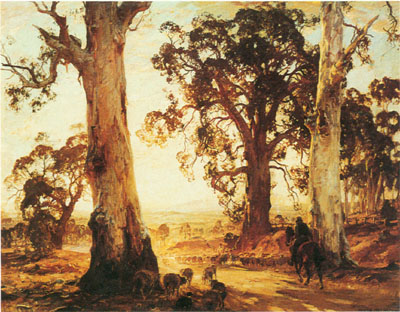
Hans Heysen, Moving into the Light,
December 7, 2006
Clifford Possum Tjapaltjarri +Assimilation
Clifford Possum Tjapaltjarri is regarded as one of the most famous of the Western Desert Aboriginal artists, and one the first Aboriginal painter to be critically acclaimed by in Europe and North America. He is acknowledged to be one of the most innovative and accomplished of the Western Desert artists. Possum, who worked at Papunya in the dot-painting tradition, blended the trails of his ancestors, certain figurative elements, and Aboriginal iconography.
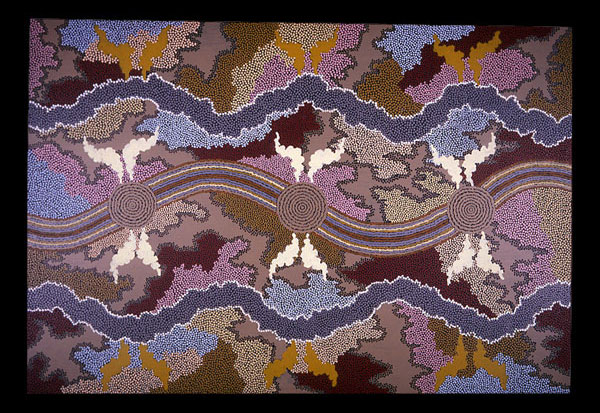
Clifford Possum Tjapaltjarri, Corkwood Dreaming, 1991, acrylic on canvas
The "community" at Papunya was set up in 1959 as an official government settlement 250 miles west of Alice Springs, in central Australia, bringing together nomadic desert people with the aim of assimilation to western living. Many different language groups were brought together away from their traditional lands and faced inappropriate social and cultural structures with the diversity of groups living in such close proximity. They were stationed at Papunya for their supposed advancement, but this settlement was a very unhappy time, a time of wrenching social turmoil; a place with a high morbidity rate, riots and despair.
The restrictions and pressure which arose, also due for example to the forceful prevention of leaving the reservation except with the permission of the whites, as well as the realisation by the elders of the communities that their culture was suffering untold damage, made it essential to seek a way out.
The assimilation process was a tragedy for nomadic peoples who understood their role to be keeping the country. The painting demonstrates the continuing link with their country and the rights and responsibilities they have to it. The paintings are positioned in concerted opposition to white officialdom (Northern Territory) at a settlement built to silence their language and stifle their culture, since by revealing the ancestral designs that invoke power in ritual contexts, they asserted the importance of their culture to the colonisers and controllers of their destiny.
Assimilation held that the training, education and regulation would impact on the manner of living of Aboriginal people in order to encourage (or coerce) Aboriginal people to live like 'other Australians'; 'other Australians' was a term, which essentially meant white people. Ultimately the policy sought to result in a national community, or the unity of a single community.
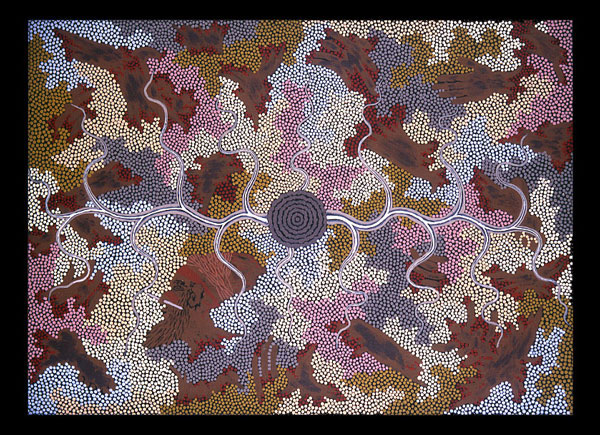
Clifford Possum Tjapaltjarri, The Law, 1991, acrylic on canvas
Central Desert acrylic painting began as a form of political activism produced by male elders experiencing a profound sense of diaspora. Ultimately, it became an art form that has earned its place as important contemporary art in a mainstream context.
December 6, 2006
guns versus butter
The cartoon highlights the priorities of the national security state--defence over health
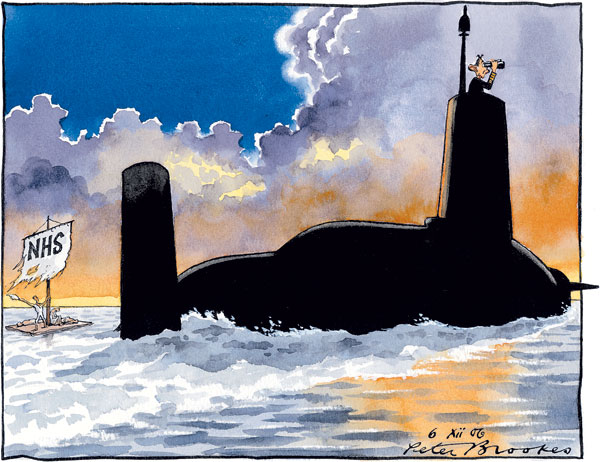

Both political parties inoculate themselves against the perception of weakness on defence and security during a time when the war on terror frames the way we think of national defence.
December 4, 2006
nomadic life in modernity
I'm reading Robyn Davidson's Quarterly essay No Fixed Address: Nomads and the Fate of the Planet She says that traditional nomadic ways are under enormous pressure, and, with few exceptions, will disappear. She is sad about that as some valuable non-western nomadic ways of thinking about nature and culture will be lost.
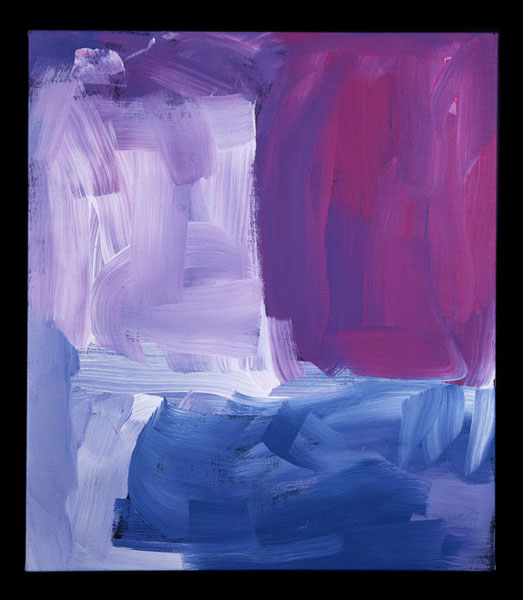
Emily Kame Kngwarreye, Last series,1996
In the conclusion to No Fixed Address Davidson says:
There can be no return to previous modes of living, no retreat to the traditional as a way of shoring up identity, or denying rationality and the benefits of science. Such retrogression only lands us in kitsch. But there might be ways into previous kinds of thinking, prilgrimages, let's say, to newly imagined territories where, instead of arrogantly dismissing the traditional as useless to modernity, the best of each might be integrated.
Is not the work of Emily Kame Kngwarreye an example of that kind of integration?
December 2, 2006
a dried up Canberra?
I'm in Canberra this weekend. It's been very hot all this week. It is unusual for this time of the year the locals say. Maybe the weather is changing? Canberra is usually seen as a cold place.
My understanding from working in Canberra is that the capital city sees itself as the garden city. The city is actually a planned parkland. The national institutions are surrounded by vast lawns and landscaped gardens, roads are divided by nature strips, the suburbs have lots of lawns and the satellite cities are linked via forest and bushland. It is an attractive city.
Canberra was designed as a garden city. Walter Burley Griffin was influenced by the City Beautiful and Garden City movements, which influenced town planning during the late 19th and early 20th centuries. Canberra has evolved from formal English-styled gardens and landscapes to the bushland settings for the new suburbs.
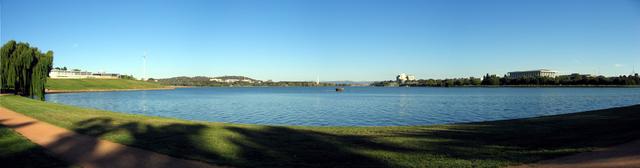
Andrew Baumann, Panorama of the lake and surrounds, 2005
So what happens to the garden city on indefinite water restrictions requiring a 35% reduction in water consumption? Will Canberra become a dry inland place?
What suprises me is that there is still little water reuse in the suburbs, no subsidies for homeowners to install rainwater or gray watertanks, or no incentivess to convert gardens to become more water efficient. Canberra is only just beginning to come to grips with the realities of gliobal warming.
December 1, 2006
a pictorial language
In abstract expressionism the "act" of painting becomes the "content" of the painting. Through gestural movements the artist is attempting to unleash their raw emotions, not paint pretty pictures.
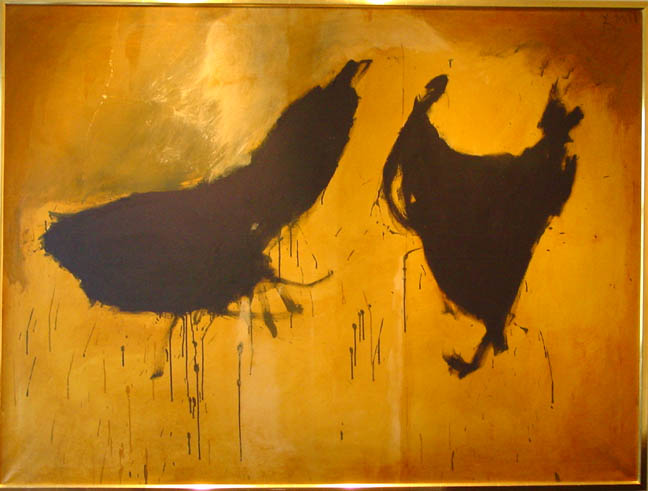
Robert Motherwell, 2 Figures, 1958, oil on canvas
Well, if I didn't know that bit of art history then I would read the image as a pretty picture. Well not quite. What we have is a basic pictorial language.
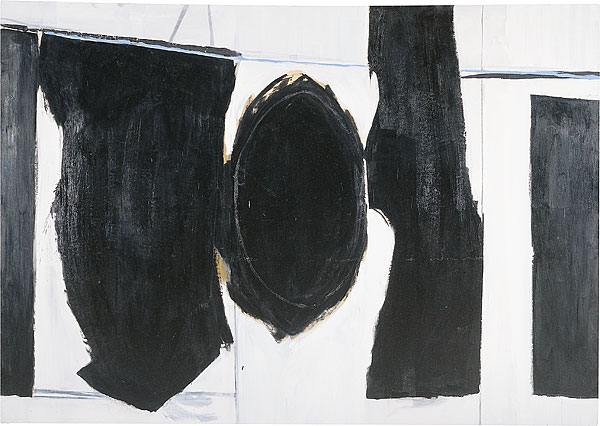
Robert Motherwell, Elegy to the Spanish Republic, 1958 synthetic polymer paint on canvas
An elegy is a short funeral song or lament--slow, meditative, and mournful. Motherwell painted more than one hundred works in the series "Elegy to the Spanish Republic", refers to the Spanish Civil War, which lasted from 1936 to 1939. They express his feelings about what happened to the people who lost. So the image conveys a particular mood. the large, black forms of the painting. The use of these black forms to cover up the colors behind would express death
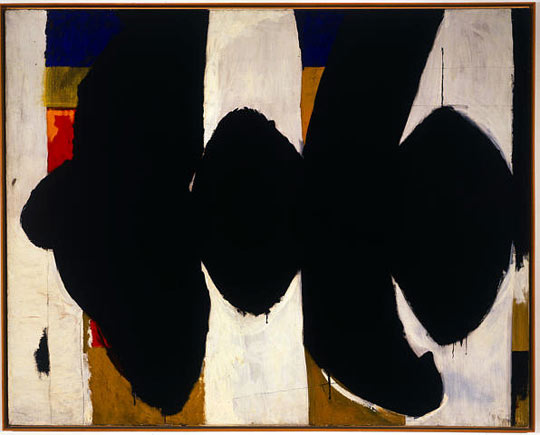
Robert Motherwell, Elegy to the Spanish Republic #34, 1953-4
Each image in the series contains black, vertically oriented elements alternating with colour forms. The colors of the Spanish Republic's flag can be seen behind the large, black forms of the painting.
Walkely Awards
The Walkley Awards are Australia's most prestigious journalism's awards.The 2006 winner in the artwork category was:
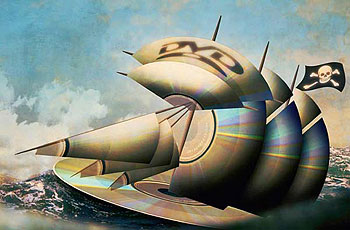
Karl Hilzinger, The Australian Financial Review, “DVD Piracy”
Hilzinger's illustration of "DVD Piracy" was a montage of photographic elements. By transforming DVDs into a pirate ship sailing on the high seas, he conveyed the theme of the story. As the judges say, this work is:
Imaginative and well executed, this exceptional piece of artwork is a powerful image that demonstrates Hilzinger's artistic ability. His wonderful high-tech ship brings together video piracy and good old-fashioned high seas drama. The idea is very clever and the work conveys a real sense of threat and danger.
However, the real entertainment was this event.