|
October 02, 2006
This snap is from a holiday in Mallacoota back in 2003. It stands in opposition to the work of those straddling the boundary between commercial and fine art photography, such as Andreas Gursky and the Dusseldorf-based Becher school.
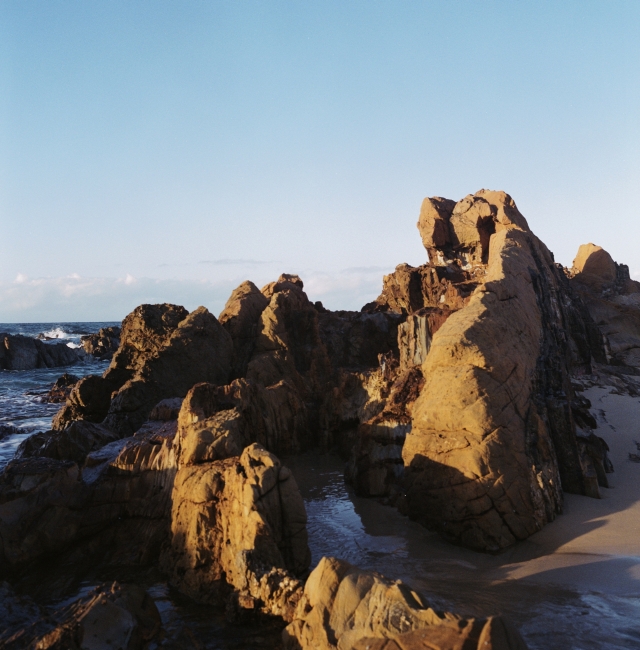
Gary Sauer-Thompson, Mallacoota Rocks, 2003
The images are a form of visual diary, or more accurately a photographic diary that is visual memory of a specific, previously unknown place and a tourist holiday experience that is often forgotten.
This is not a shift from scene-itself to the photographer's experience-of-it to generate a self-conscious style of art photography:
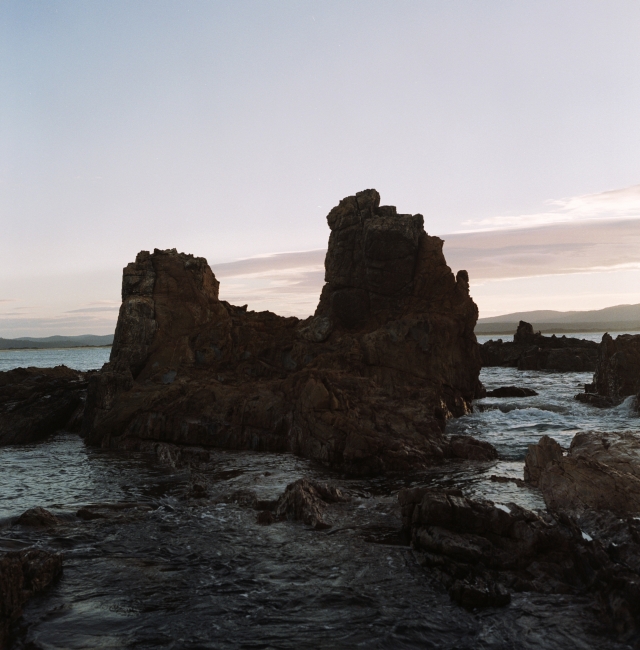
Gary Sauer-Thompson, Mallacoota, 2003
What is created is a world anchored in reality but one predicated on a memory of a tourist rather than fantasy or a document of a trip across the country that evokes the nostalgia for the road as in artist X went looking for Australia and couldn't find it anywhere. What is foregotten is the journey across the country. What is remembered is a specific place, namely Mallacoota:
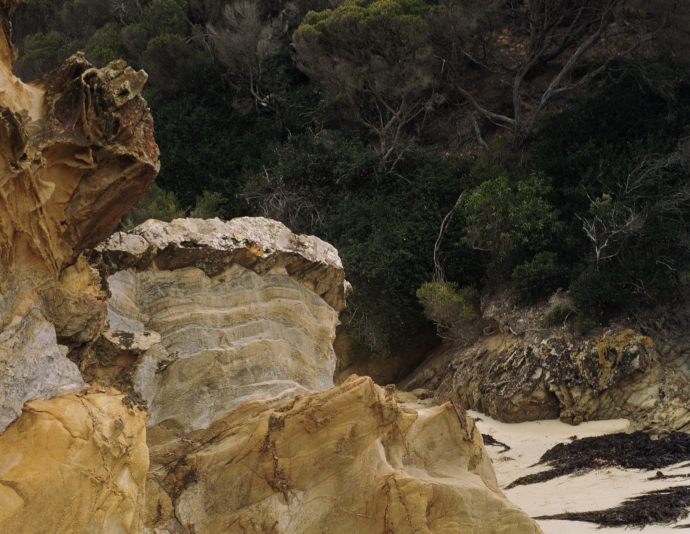
Gary Sauer-Thompson, Secret Beach Mallacoota, 2003
Can we then talk of the tourist's photographic eye in terms of Jacques Derrida's "logic of the supplement"? The point of this is to question the central assumption of the universality of vision (the "intelligent eye" of the photographer, the "appreciative eye" of the audience), as it seeks out the essence of the medium. For Derrida a supplement is something that, allegedly secondarily, comes to serve as an aid to something 'original' or 'natural'. The fact that a thing can be added-to to make it even more "present" or "whole" means that there is a hole or gap (which Derrida called an originary lack) and the supplement can fill that hole.
The Wikepedia entry on Deconstruction states:
From this perspective, the supplement does not enhance something's presence, but rather underscores its absence.Thus, what really happens during supplementation is that something appears from one perspective to be whole, complete, and self-sufficient, with the supplement acting as an external appendage. However, from another perspective, the supplement also fills a hole within the interior of the original "something". Thus, the supplement represents an indeterminacy between externality and interiority.
The tourist eye as supplement brings us back to the everyday and our own mundane concerns of places that we seek to protect and care for because they are special for us in the context of the rampant coastal development associated with seachange.
|


