|
October 03, 2006
Szarkowski, as a curator tried to establish a new style of photography, based on an aesthetic of spontaneity, contingency, intimacy, and autobiography. Robert Frank was the progenitor of this kind of work and Gary Winogrand was the heir apparent. William Eggleston's show at MoMA in 1976 is widely acknowledged as the "breakthrough of color" in art photography.
'Breakthrough' means that Eggleston facilitated the entry of colour photography into art galleries---color was no longer 'vulgar' as It had become a legitimate mode of photographic expression, transcending its previous purely commercial application. The effect was to open up a distinction between "art photography" and "artists with cameras" (eg., the conceptual photography of a Richard Prince or a Cindy Sherman).
In its original concept, William Egglestone's Los Alamos images would be shown only as a group, with no commentary, titles, or representational hierarchy, essentially imitating for the viewer the artist's own visual experience of the world.
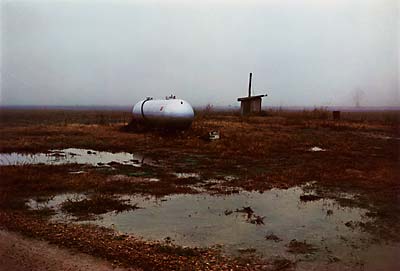
William Eggleston, from the Los Alamos Project
Modernist curators say that the images of this project 'seem almost incidental, yet there is an exact composition that uses power lines crisscrossing the sky or a stretch of fence as a formal device to divide the picture plane, or aligns the angled front wheel of a parked car with the high oval window of a building in the background.'
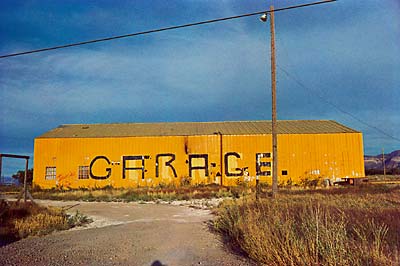
William Eggleston, from the Los Alamos Project
Szarkowski argues that the color in Eggleston's pictures is part the tint of the unexpected in his work:
These pictures are fascinating partly because they contradict our expectations. We have been told so often of the bland, synthetic smoothness of exemplary American life ... that we have come half to believe it, and thus are startled and perhaps exhilarated to see these pictures of prototypically normal types on their familiar ground ... who seem to live surrounded by spirits, not all of them benign.
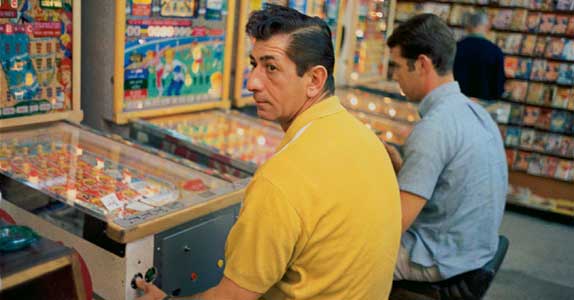
William Eagleston, from the Los Alamos Project
But we can reinterpret these images in terms of the social landscape can we not? I find the distinction between art photography and artists using cameras to be unhelpful. It is historical. Photography is much more diverse than this.
I grant that this image is different ---the photographer as a colour field artist deploying ironic formal and colour juxtapositions. It's the photography that is important not the subject matter:
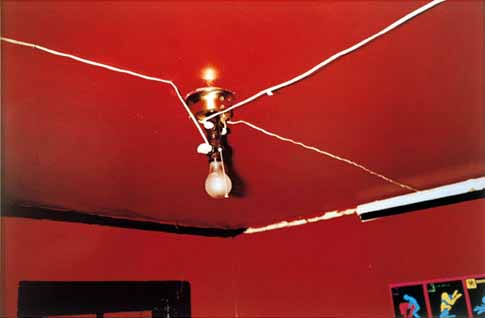
William Eagleston, Untitled (Greenwood, Mississippi) (Red Ceiling), 1973, from William Eggleston's Guide.
Eggleston's exhibition of "banal colour" photographs at the Museum of Modern Art in 1976 did turn the art photographers' world upside down. The MoMA show included such images as a dog drinking from a mud puddle, shoes under a bed, a child's tricycle, a tile shower and a kitchen oven. It did so because it undercut the hierarchy between the well-established black-and-white genre in fine art photography that worked to aestheticise subjects and colour photography, which was the domain of family snapshots and commercial work. Eggleston used colour to capture the immediacy of his subjects, unpolished and intimate and his choice of vantage point demonstrated a desire to express unconventional points of view, both literally and conceptually.
I do not know Eggleston's The Democratic Forest (1989) or his Faulkner's Mississippi (1990).
Can we not use the camera as a diary?
|


