June 30, 2004
patriotism
Patriotism is a difficult emotion.We are ambivalent about it, despite the Anzac tradition.

Cathy Wilcox
We are uncomfortable with the way our governments talk it up and use it.
Have you noticed the undertone of patriotism or even nationalism to national Australian news.
You would have noticed the whipped up jingoism by the sports commentators that turns the stomach and makes you feel sick.
Some turn to postnationalism in a global world and go cosmopolitan.
June 29, 2004
visual knowledge?
Many critics see photography from the perspective of a literary culture. Susan Sontag is one such figure. With them the word triumphs over the image. The assumption is that it is only narrative that enables us to understand.
That was the assumption of A Japanese Story. Hence its aesthetic conservatism.
Why not start with the visual?

Robert Rauschenberg, Pledge, 1968
The images are assembled in a loose, poetic manner, creating an impression of visual flux that allows the viewer to free-associate. Is this not a mode of knowing in the metropolis?
Is there not something called visual knowledge?
June 28, 2004
Japanese Story
We live in the cities but we create a visual language of nationality in terms of images of Anzacs in the outback.

We have yet to escape the narrative and horizons of settler Australia
June 27, 2004
Australian cinema: an urban language
I saw this film last night---Japanese Story. It juxtapositioned the city with the landscape. In terms of the visual language the urban was downplayed in favour of the landscape.
I had been hoping for a postmodern link back to this kind of work:

Robert Rauschenberg,Estate, 1963
But it was not to be. The emphasis was on the stunning desert landscape of the Pilbara in Western Australia. It plays a familar theme: the familiar Australian landscapes (remote, desert, outback) and character types (brash, laconic, independent) as the bedrock of an Australian identity based on white settler masculinity. Only this time the bearer of the core of Australian identity is a woman geologist.
Do Australians have a urban visual language? We live in cities not the desert.
June 26, 2004
a visual language
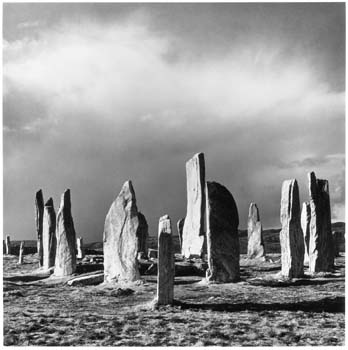
I've just got back from doing some work in Canberra. The hours were very long and I had little time to post. All I could manage to post was the odd image, mostly from the street work of Harry Callahan, which I juxtaposed with the English landscape work of Fay Goodwin.
The point of posting Callahan's street work was to highlight the way that a visual langauge was formed based on the commonplace during the mid-20th century.
Around this time Robert Rauschenberg was working:

Robert Rauschenberg, Rebus, 1955
What he found significant about photography was not the art photography in the gallery, but the actual phenomenon of photography: the snapshot, the advertsiing photography, the news photograph. These were the folk images----the habitual idiom--- of contemporary consumer culture.
Rauschenberg incorporated them into his work:

Robert Rauschenberg, Untitled, 1963
Many of these photographs had been reduced by multiple reproduction to the status of a commodity in industrial society. Rauschenberg incorporated such “found” materials as advertisements into loose, abstract compositions:

Robert Rauschenberg, Brace, 1962
In the process he created a visual urban language.
June 25, 2004
Harry Callahan#4
It is almost cubist isn't it?

Harry Callahan, Skyscrapers, New York, 1978
This photograph is part of the visual language that was developed from the 1950s that was tied to personal experience and American experience:
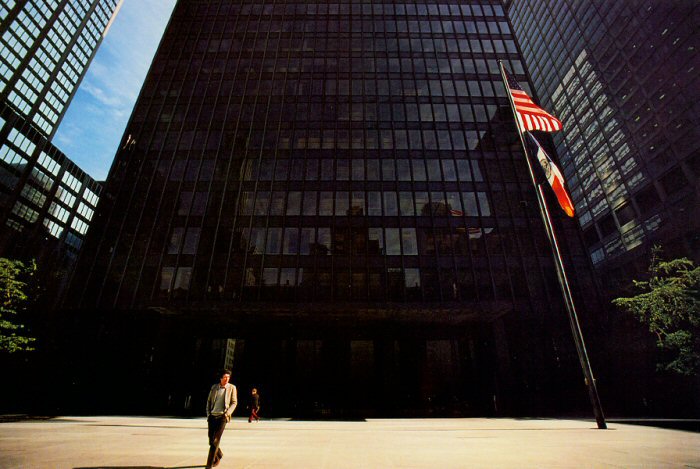
Harry Callahan, Skyscraper with Person and Flagpole, New York, 197
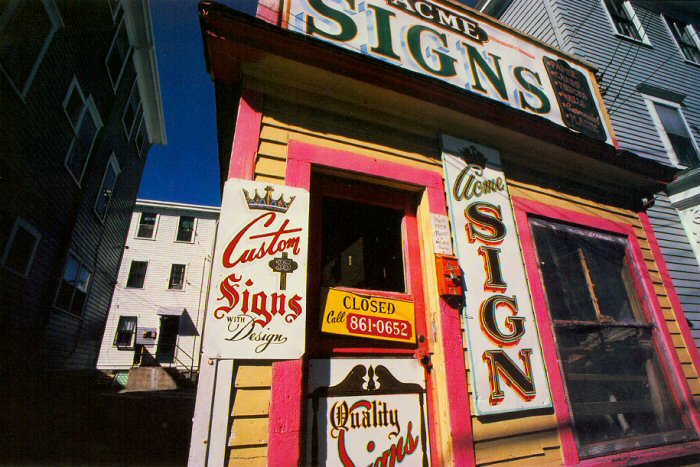
This visual language was based on looking squarely at the commonplace in urban life and the images of the public visual world. In some ways it was akin to placing a frame around what already existed.
The language being created is one of commonplace content and sophisticated visual form.
June 23, 2004
June 22, 2004
June 21, 2004
Harry Callahan#2
I'm very busy. So another image from a well known American photographer:

Harry Callahan, Couple Walking Down Street, Venice, 1957
June 20, 2004
Harry Callahan
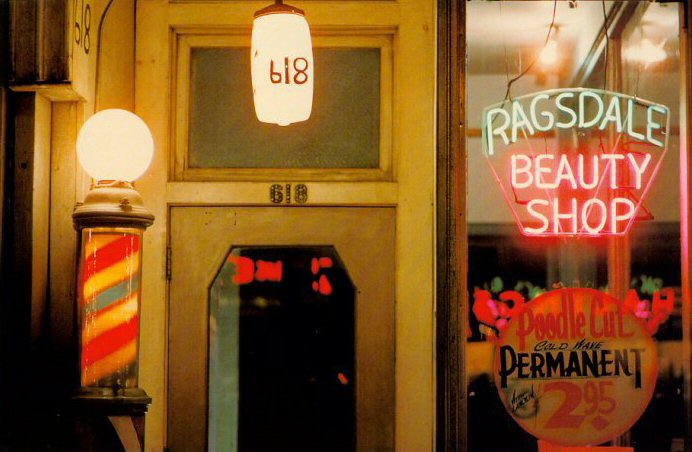
Harry Callahan, Ragsdale Beauty Shop/Poodle Cut, Detroit, 1951
It is what you see everyday in the city isn't it. The commonplace. Most pass by the images such as these in our public visual culture
The image has a a touch of the surreal yet it is grounded in reality in a way that surrealism never was.
Is this prioritizing reality over illusion and visual fact over the symbol the overccoming of surrealism in the visual arts?
It certainly is an overcoming of photography's traditional reportial function and a reconstruction of photography.
June 19, 2004
This image, taken by the Stardust spacecraft, shows the surface of "Comet Wild 2" pocked by craters:

June 18, 2004
June 17, 2004
June 16, 2004
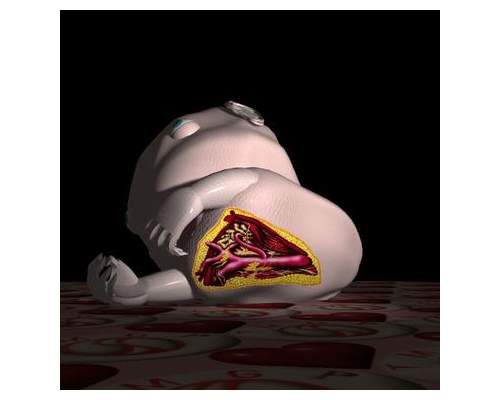
Selling biotech
Patricia Piccone says that according to any of the reputable biotechnology companies:
"...selling medicine is like selling anything else. Therefore I decided that LUMP must have a spokesperson to sell it. That person doesn't really need to have anything to do with the product or any real expertise, they just have to be famous. To this end, I contacted Sophie Lee‚ AustralianTV personality ‚ who agreed to endorse LUMP in a series of images titled 'Your Time Starts Now'."
Patricia Piccinni, Felicity, Your Time Starts Now, 1996

Patricia says that this series:
"presents Sophie and LUMP together, the absolute epitome nurturing care. There is a bond between mother and child that is deeper than the emulsion on the photograph. The LUMP is not real and neither is the woman; she is Sophie Lee the personality not Sophie Lee the person. Her fame‚ her celebrity‚ is as artificially constructed as the LUMP, and her image‚ made up, photographed, retouched, enhanced‚ as plastic."
June 15, 2004
June 14, 2004
A creative archive
This is something the ABC in Australia should be moving towards.
Most of its material is locked away in vaults. It should be in the public domain. The ABC should be moving to allow people to download clips of ABC factual programmes from abc.net for non-commercial use, keep them on their PCs, manipulate and share them, so making the ABC's archives more accessible to Australian citizens.
June 13, 2004
love the clone
We should stop worrying about biotech and learn to love the clone. The new reproductive technology has become a scapegoat for all we fear about uncontrollable, unnecessary and unethical science. We are told that scientists are on the verge of creating the first human clone. Soon a human will be cloned.
At the moment we hear about the promises of therapeutic cloning - the process that produces stem cells and which may one day offer cures for terrible diseases. The great promise of cloning in terms of human welfare lies in the use of the bio-techniques – not for reproduction – but for therapeutic purposes. Stem cell research as having the 'potential to revolutionise' the practice of medicine.
Can we accept IVF yet reject therapeutic cloning?

Patricia Piccinni, Trophy, The Mutant Genome Project, 1995
However, the regenerative properties of stem cells, which make them so attractive as a possible therapeutic tool, also means that the distinction between therapy and enhancement will inevitably be further eroded.
So many people recoil from this kind of scientific experiment in assisted reproduction. Human cloning evokes the fervid, largely fiction-induced images of doom: cloning means Brave New World, Hitler, Nazi science Frankenstein, Jurassic Park and designer babies.
June 12, 2004
Landscape#2
More black and white landscape photography

Gordon Stevenson, Myall Lakes Paperbarks New South Wales, 2004
Gordon Stevenson, who lives in Sydney, works as a Research Assistant in Molecular Biology at the University of Sydney. He has pursued photography seriously over the past four years.
June 11, 2004
Landscape: B&W photography
A classic black and white landscape photographic tradition exsits in Australia:

Gordon Stevenson, Driftwood, Cooloola National Park Queensland, 2004
June 10, 2004
Tasmania: wilderness#4
Below is a classic Australian photo that helped to save a wild river in Tasmania:

Peter Dombrovski, Rock Island Bend
As Tim Bonyhady says:
"Dombrovskis' most famous photograph, Rock Island Bend, was the iconic image of the campaign to stop Tasmania's Hydro-Electric Commission damming the Franklin River. When it appeared as a full-page advertisement in the Herald just before the 1983 federal election, the caption was "Would you vote for a party that would destroy this?"
The Franklin River was saved with federal intervention.This was not just a political photo. it was also a good photo. As Tim says:
"He was the finest landscape photographer in Tasmania, a master of his large format camera which recorded the environment in remarkable detail. The others typically were bushwalker photographers short on skill and experience.The work of the bushwalker photographers was often poorly composed, short of detail, devoid of any particular stamp of authority or individuality. Dombrovskis's photographs were superbly composed, wonderfully detailed and always immediately identifiable as his. They were, at simplest, much more beautiful - providing much stronger reason to support the campaign and vote on that basis at the federal election."
Tim then mentions what junk for code has noted. There are no good photographs being produced of the clear felling of Tasmania's old growth forests:
"One of the oddest features of the campaign to safeguard the Styx is the poverty of the photographs that have gained the greatest dissemination. It is as if the Wilderness Society and the Greens senator Bob Brown, who have been central to the campaign, have forgotten the lessons of the Franklin: that it takes the best photographers to produce images that galvanise the public. Instead they have relied on their own, generally very ordinary photographs. They have made no attempt to find a new Dombrovskis."
Some seem to be capturing the beauty of wilderness rather than the destruction of the forests.
June 9, 2004
Biotech: rethinking feminism
The social and political implications of the emergence of thenew world opened up by the new reproductive technologies (in vitro fertilization and other test tube techniques) are important. They indicate a new form of biopower.
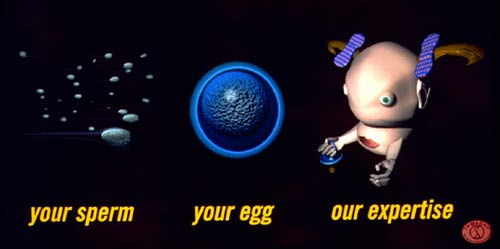
Patricia Piccinni, Your Sperm Your Egg Our Expertise,The Mutant Genome Project, 1995
Why biopower? The context is the histories of reproductive technologies that we are familar with.The conventional medical one describes:
"...the development of modern obstetrics as a process wherein childbirth was removed from a female realm of ignorance and superstition to the enlightened realm of male physicians with the scientific knowledge and technical skills needed to rescue women from the risks and pain of childbirth. Traditional medical scholars focus on the history of the growth of scientific and clinical knowledge with little emphasis on the practice of medicine. In contrast, feminists describe the "medicalization" of childbirth as the transformation of pregnancy into a disease and the takeover of a female-centered natural process attended by skilled and caring midwives by a group of male physicians interested in establishing and expanding their practices, their occupational status and authority, and their control over women."
The radical feminist account, for instance, argues that women's bodies are reduced to medically manipulable objects, to the living laboratories of male "technodocs" bent on appropriating the last source of power left to women-the procreative power of motherhood. This kind of analysis has a tendency to demonize the technologies and the men who design and implement them; focuses almost exclusively on the dominant discourses and practices governing reproduction and pays insufficient attention to the resistance and struggle that is already taking place in the context of reproductive politics; slides over into an anti-technology stance with an utopian romantic appeals to a pre-modern era; and tends to call a halt to further development and use of in vitro techniques.
In a biotech world we need new ways of looking at reproductive technologies. Another pathway is opened up by Foucault's concept of biopower as an apparently benevolent, but peculiarly invasive and effective form of social control. Foucault argues that biopower has evolved in two basic and inter-related forms. One form is:
"....disciplinary power, [which] is a knowledge of and power over the individual body-its capacities, gestures, movements, location, and behaviors. Disciplinary practices represent the body as a machine. They aim to render the individual both more powerful, productive, useful and docile. They are located within institutions such as hospitals, schools, and prisons, but also at the microlevel of society in the everyday activities and habits of individuals. They secure their hold not through the threat of violence or force, but rather by creating desires, attaching individuals to specific identities, and establishing norms against which individuals and their behaviors and bodies are judged and against which they police themselves.The other form of biopower is a regulatory power inscribed in policies and interventions governing the population. This so-called "biopolitics of the population" is focused on the "species body," the body that serves as the basis of biological processes affecting birth, death, the level of health and longevity. It is the target of state interventions and the object of study in demography, public health agencies, health economics and so forth."
Maybe this pathway can provide us with a tool box that enables us to make sense of social and political implications of biotech.
start previous next
June 8, 2004
Biotech: giving nature a helping hand
The new world of biotech in which reproduction is being "enterprised up." In this world "the control, enhancement, and harnessing of reproductive and genetic processes are the basis for the emergent industry of biotechnology"
Medical Industry is now shaping the politics of fertility by giving nature a helping hand.
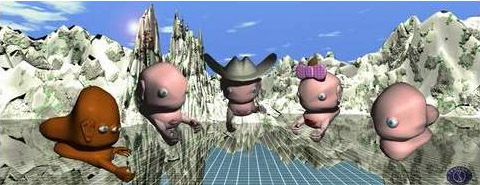
Patricia Piccinni, Lumpland, The Mutant Genome Project, 1995.
Hence we have the idea of cooperation between technology and nature to assist the traditional family.
Well, that is what people me who have experienced the world of lumpland and assisted nature tell me.
Reproductive intervention costs them heaps ($30,000 upwards) but they are happy.They have a family.
June 7, 2004
Biotech: fetal images
We have entered the world of reproductive politics from a strange pathway.
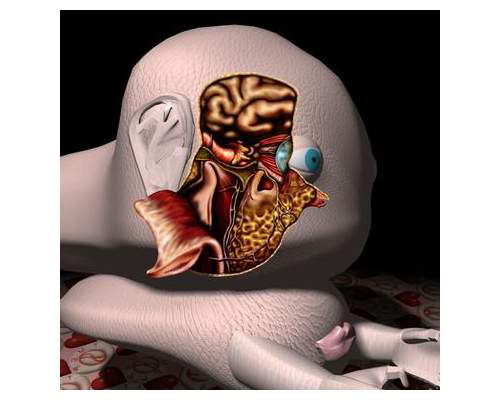
Patricia Piccinni, I Love You Baby, Love Me My Lump, 1995.
The meaning of reproductive politics has expanded and diversified. Fetal images have now become key sites of struggle over the meanings through which reproductive politics are currently being defined.
However, the old ways of thinking about this politics---those grounded on notions of rights and choice---no longer seem appropriate anymore.
June 6, 2004
biotech: reproductive technologies
Biotech is a rapidly evolving world through providing possibilities for infertile people to have children:
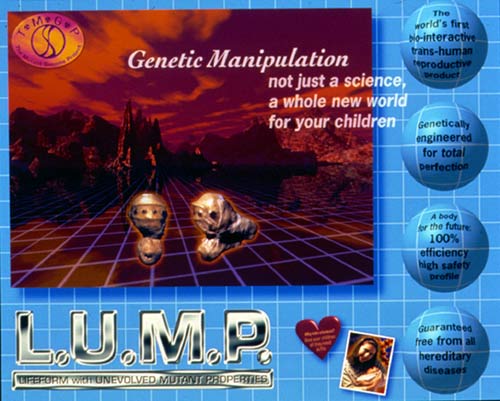
Patricia Piccinni, The Mutant Genome Project, 1995
Reproductive technologies are an example of the changes we are living. Consider this account. First we have a description of reproductive technologies:
"Reproductive technologies are the medical capability to remove human eggs and sperm from one set of bodies, perform operations on them, and return them to the same female body, place them in another female body, or cryopreserve them. In addition to removing fertilization from the interior of women's bodies and transferring it to the laboratory, reproductive technologies also remove male ejaculation from it's endpoint in the female body, reducing it to masturbation in clinic bathrooms."
Then an account of the significance of these technologies:
"All reproductive technologies separate reproduction from heterosexual sex and marriage. Potentially, that separation makes reproduction possible for those outside of the tradition heterosexual couple, offering new democratic family and parenting options. Not only are new individuals conceived as a result of technology, but so are new family, kinship, and parenting practices."
Reproductive technologies trouble and divide people as well as assist them.
June 5, 2004
rape
junk for code is being deluged with advertisements for nasty rape sites at the moment. I'll have to up grade Moveable Type and install the right plugin.
This is what I'd like to do to them:

Artemisia Gentileschi Judith Beheading Holofernes, 1620, Oil on canvas
A website devoted to the works of Artemisia Gentileschi.
June 4, 2004
Biotech: mutants
This is the biotech industry.
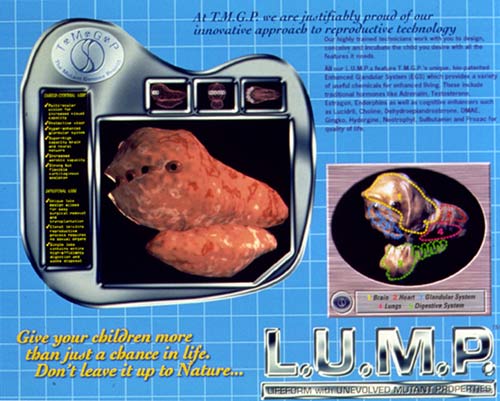
Patricia Piccinni, The Mutant Genome Project, 1995
Technoscience can now shape human nature. That is a big shift.
Science and technology shaped the landscape in the second half of the 20th Century through big enginneering works such as the Snowy Mountains Hydro Electricity Scheme. Those modernist guys are still dreaming about big dam and engineering projects to bring water down from the northern part of Australia to the southern part.
In the first part of the 21st century corporate technoscience began shaping human nature to produce human beings who are not human beings.
How do we start making sense of that paradox?
June 2, 2004
a sacred place
I'm tired from struggling with energy policy at work all day.
I wish I were here:
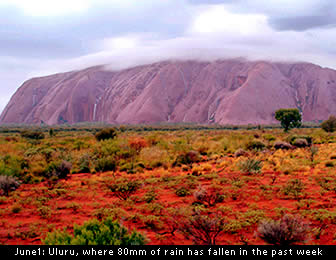
Uluru
This Sandstone monolith Uluru (formerly known as Ayers Rock) in Central Australia is a sacred place in Australia.
June 1, 2004
Living in a biotech world#2
In the biotech science lab:
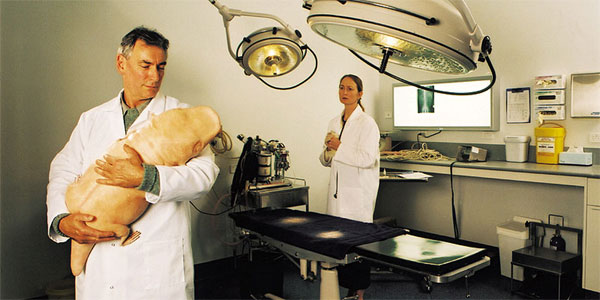
Patricia Piccinni, Science Story, 2002
Life is a becoming. Life is not composed of pre-given forms that simply evolve to become what they are. There are different lines or tendencies of becoming due to encounters that produce new kinds of becoming.
Mutants are a new kind of becoming.