|
June 9, 2004
The social and political implications of the emergence of thenew world opened up by the new reproductive technologies (in vitro fertilization and other test tube techniques) are important. They indicate a new form of biopower.
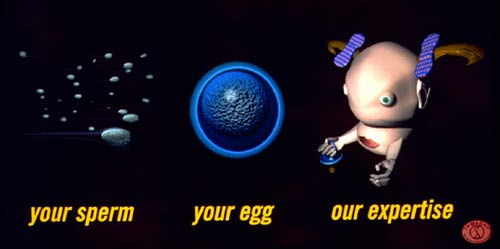
Patricia Piccinni, Your Sperm Your Egg Our Expertise,The Mutant Genome Project, 1995
Why biopower? The context is the histories of reproductive technologies that we are familar with.The conventional medical one describes:
"...the development of modern obstetrics as a process wherein childbirth was removed from a female realm of ignorance and superstition to the enlightened realm of male physicians with the scientific knowledge and technical skills needed to rescue women from the risks and pain of childbirth. Traditional medical scholars focus on the history of the growth of scientific and clinical knowledge with little emphasis on the practice of medicine. In contrast, feminists describe the "medicalization" of childbirth as the transformation of pregnancy into a disease and the takeover of a female-centered natural process attended by skilled and caring midwives by a group of male physicians interested in establishing and expanding their practices, their occupational status and authority, and their control over women."
The radical feminist account, for instance, argues that women's bodies are reduced to medically manipulable objects, to the living laboratories of male "technodocs" bent on appropriating the last source of power left to women-the procreative power of motherhood. This kind of analysis has a tendency to demonize the technologies and the men who design and implement them; focuses almost exclusively on the dominant discourses and practices governing reproduction and pays insufficient attention to the resistance and struggle that is already taking place in the context of reproductive politics; slides over into an anti-technology stance with an utopian romantic appeals to a pre-modern era; and tends to call a halt to further development and use of in vitro techniques.
In a biotech world we need new ways of looking at reproductive technologies. Another pathway is opened up by Foucault's concept of biopower as an apparently benevolent, but peculiarly invasive and effective form of social control. Foucault argues that biopower has evolved in two basic and inter-related forms. One form is:
"....disciplinary power, [which] is a knowledge of and power over the individual body-its capacities, gestures, movements, location, and behaviors. Disciplinary practices represent the body as a machine. They aim to render the individual both more powerful, productive, useful and docile. They are located within institutions such as hospitals, schools, and prisons, but also at the microlevel of society in the everyday activities and habits of individuals. They secure their hold not through the threat of violence or force, but rather by creating desires, attaching individuals to specific identities, and establishing norms against which individuals and their behaviors and bodies are judged and against which they police themselves.
The other form of biopower is a regulatory power inscribed in policies and interventions governing the population. This so-called "biopolitics of the population" is focused on the "species body," the body that serves as the basis of biological processes affecting birth, death, the level of health and longevity. It is the target of state interventions and the object of study in demography, public health agencies, health economics and so forth."
Maybe this pathway can provide us with a tool box that enables us to make sense of social and political implications of biotech.
start previous next
|


