September 29, 2011
a ‘regional Australian culture’
The reading of the Australian land as a vast and empty space is a settler reading of this landscape has been the traditional one. Even after discarding the notion of terra nullius (with its undertones of tabula rasa) as an official characteristic of this land, the fact that we still live around the edges of the country continues to determine how we read the ontology of our dwelling here. The settler reading of the landscape as ‘vast and empty’, waiting for the settler ‘imprint’, has been a constant in Australian history.
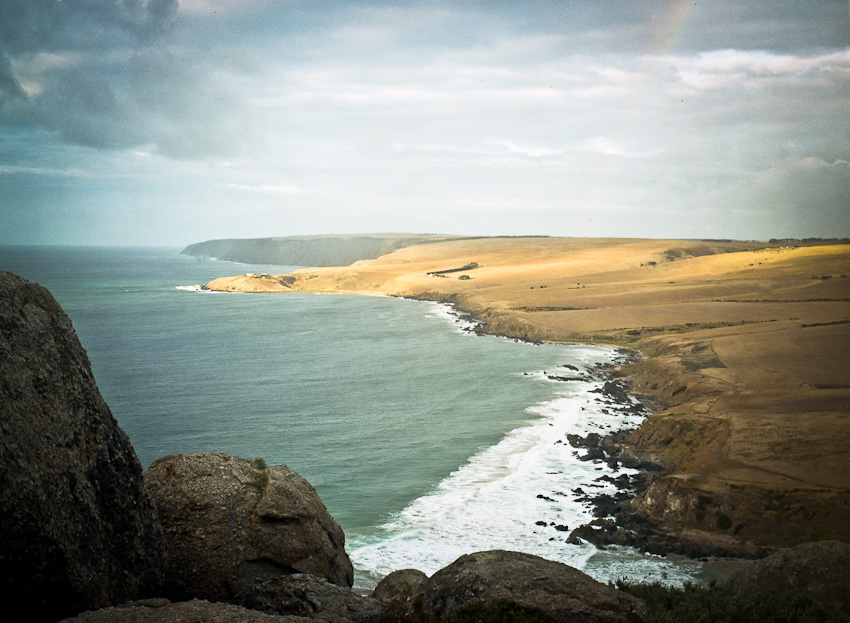 Gary Sauer-Thompson, Petrel Cove: morning, 2002
According to Helen Ennis, the quintessential ‘Australian landscapes’ are those of the bush and the beach: strong light features prominently in this tradition as a marker of ‘man’s’ subordination to nature and a means of illuminating the real and perpetual struggle between the European inhabitant and the rugged landscape.
The implication is that our buildings are situated in the vast, open space giving the impression that they have been constructed elsewhere and placed, almost at random, in this otherwise empty terrain. These buildings seem to have neither a context that grounds them nor the infrastructure or history to justify their presence.
Hence the idea of Australia as lacking----it lacks a visible ‘culture’; an absence that is interpreted as a failure on the part of Australia, as the new locality, to establish itself as a distinct cultural entity. It is seen as provincial. The model is one of centre versus periphery and it functions to marginalise the periphery. The colonial settler heritage that generated in settler artists’ sense of subordinated status, unoriginality and an underlying inadequacy. This constructed Australian art history within a framework of dependency on English, European and American art.
The reaction to this centre/periphery model is the post modern conception of Australia as palimpsest--there is no ‘real’ Australia, just images and representations. Australia is uniquely unoriginal and inauthentic because of the circumstances of its definition by others. Australia is a a simulacrum of the Great Southern Land---less a construct from of geography and origins, and more a construct of texts and textuality.
This was a theoretical framework that supported an art practice in a postmodern, globalised art world that absorbed and processed existing images, producing new but unoriginal works. This is to say, in a fashion, that appropriation artists ate images, in particular those of the North Atlantic canon. The argument that Australian art was uniquely unoriginal was predicated around a centre/periphery model that was marginalized by globalization and swept aside by the meta-culture of globalising biennales.
September 28, 2011
9/11: a decade on
The Schrank cartoon says a lot about the decade we have lived through. The US today is in a sad state.

Not from the 9/11 attacks though.
It's Wall Street that has bought the US empire to its economic knees. US dominance of the world is slowly drifting away in an Asian cewntury; the economy is not working for the middle class; the numbers of working poor living below the poverty line is increasing;
September 27, 2011
being gazed at
It is becoming ever more difficult to take photos of people in public spaces without their consent. It is not just that this kind of street based work is increasingly targeted by security guards defending corporate property and power.
It also raises issues of personal privacy. Privacy is increasingly seen to be under siege in a digital world where the digital camera is everywhere and almost and almost everyone is a photographer.
 Gary Sauer-Thompson, Footscray Station, 2011
Our culture, as a result, has become increasingly preoccupied by surveillance, distrust, hysteria over child sexuality, and growing political tensions. The artist photographers right to shoot, display and sell street photographs without the permission of anonymous subjects is being rolled back. People don't like being watched unawares.
It's not just the photographic gaze of the street photographer: there is also the relentless logistics of data gathering of surveillance technologies of Google and Facebook; digital CCTV cameras, Facial Recognition Software, directional microphones and 3D body scanning.
The street photographer represent visually the individual moving through space; or rather in-between spaces, between home and work--- laneways, walkways, tunnels, underground walkways, train stations, and bus routes. Often these areas of normality and banality allow little, to no human interaction.
The Docklands in Melbourne is an example. Even though you can wander along the river this development is basically the privatisation of the waterfront. Medibank's managing director George Savvides observes:
Since our move to Docklands, the district has become a highly concentrated commercial hub for business, sport and high-rise residents. But I just don't get the lack of design and creativity in the streetscape, where 50,000 people walk, exercise, commute, eat and socialise - or try to. No trees, no birds, no grass, a lack of community but a plethora of structures.
The emphasis has been on the corporate, commercial buildings at the expense of people who live in the apartments. The open spaces are more akin to a concrete jungle and there are no spaces for kids to kick a football, no tennis courts, and a complete lack of infrastructure apart from minimal public transport.
September 26, 2011
British Photography: John Blakemore
John Blakemore is a British photographer and printer who has been practicing his art since 1956. He was Emeritus Professor of Photography at the University of Derby, where he taught from 1970 to 2001. He is renowned for his richly detailed and nuanced landscapes and still-lives, predominantly in black and white.
 John Blakemore, untitled, date unknown
Blakemore is recognized as one of England's leading landscape photographers and he has published several books, the first of which, John Blakemore, British Image No. 3, was published in 1977.
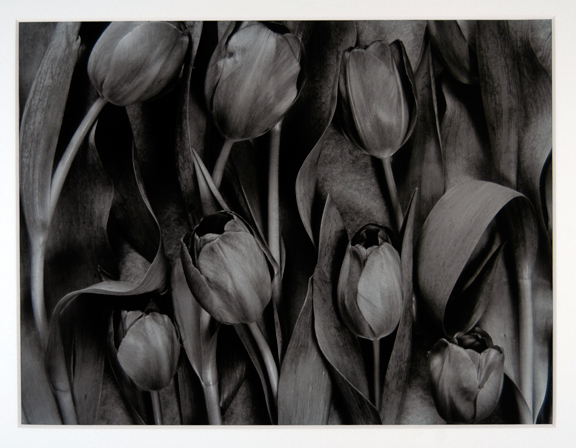 John Blakemore, tulip, date unknown.
Blakemore refers to his tulip journey by which he means his picture making:
when i made the first simple photographs of a vase of tulips on my kitchen table i could not have made, could not have imagined the later series, the variety of images that i would finally make. They became possible only through the extended visual enquiry that i allowed myself.The activity of picture making also made it necessary to extend my use of the photographic process as i imagined different photographs, different print tonalities, and had to discover the means to realise them.
His tulip journey was ultimately a visual journey: an investigation and discovery of visual possibilities. The tulip became an object of attention, of fascination, became both text and pretext for an activity of picture making. The photographs are not finally, or not primarily, about tulips, they contain tulips.
September 25, 2011
Facebook is changing yet again. It is the dominant social media in that it has a hold on the public’s online attention (800 million users). Facebook says that it helps people to “tell the story of their life” to their "friends"--- social media is one core of the internet. Facebook, according to its spin, has become an online destination where people can record their own history.
Facebook is the world's largest Internet social network, and it is increasingly challenging established online companies like Google Inc for consumers' time online and for advertising dollars. According to the company, people that use Facebook on mobile devices are twice as active on the service than users on PCs.
I'm only edging my way into Facebook, as I'm not sure how to effectively use it, given Facebook's form about privacy issues.
 Gary Sauer-Thompson, Ballarat Railway Yards, 2011
The muted changes indicate that Facebook is seeking to more effectively monetise users' social interactions. It is increasing access to advertisers by providing even more information of value to advertisers wanting to understand consumers, how they interact and how those interactions have changed over time.
Social media is a core strand of the internet. If companies become increasingly reliant on Facebook to drive their sales, then Facebook is in a better position to demand that they should be compensated for providing them with a marketing platform. That means it is driven to track every move we make online.
I have noticed some minor modifications to Facebook already, such as the changes to the layout of its live fee --on the upper right of the page. It looks okay to me. But more changes are planned in a bid to transform this social network into a key entertainment hub, so that Facebook becomes the centre of our web experience--ie., friends will direct other friends to online content.
Facebook looks more and more like the future. Currently, it is where the attention, the traffic and the conversations are. Facebook will cement this by teaming up with companies that distribute music, movies, information and games in positioning itself to become the conduit where news and entertainment is found and consumed Its new partners include Netflix and Hulu for video, Spotify for music, The Washington Post and Yahoo for news, Ticketmaster for concert tickets and a host of food, travel and consumer brands.
Since Netflix and Spotify are not available in Australia, then the changes are not that significant to me re the online content. However, as Adrian Short points out with respect to the world of independent blogs:
Facebook and Twitter now wield enormous power over the web by giving their members ways to find and share information using tools that work in a social context. There’s no obvious way to replicate this power out on the open web of independent websites tied together loosely by links and search engine results.....You can turn your back on the social networks that matter in your field and be free and independent running your own site on your own domain. But increasingly that freedom is just the freedom to be ignored, the freedom to starve.
He says that we give more power to Big Web companies with every tweet and page we post to their networks while hoping to get a bit of traffic and attention back for ourselves. The open web of free and independent websites has never looked so weak.
September 23, 2011
NZ Photography: Richard Maloney
I've just stumbled upon Richard Maloney's work at Photoforum His project aims to document rural and industrial decay in New Zealand, and the emphasis is on representing the changing interior and exterior of early buildings and structures. He says:
Our country is changing. The old is falling, passing. The new, almost here, taking form, replacing. There is an urgency, a pressing, futile need to grasp. Without details, our memory will fail, and we will become groundless.
I was attracted to his studies of decay in the rural town of Ashburton, as this is the town in the South Island where I was born:
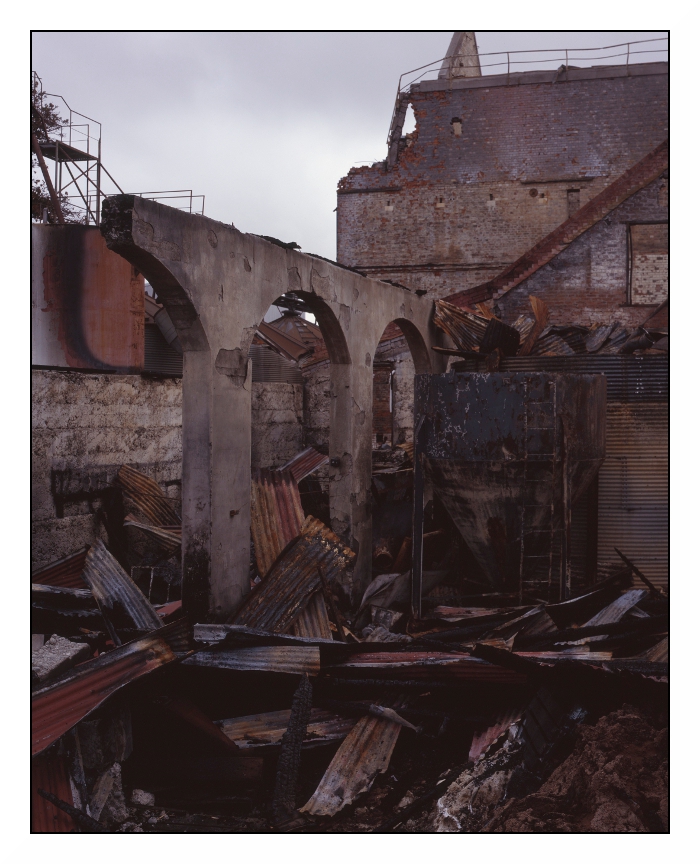 Richard Maloney,The Two Paths – The Second Path (diptych, right), Ashburton, New Zealand, Autumn 2011
He is working similarly to me: He uses a Cambo Legend 4" x 5" Monorail View Camera and Fujichrome Astia 100F, does his rough proofs and web scans with an Epson V700 and makes preliminary studies of his subject.
September 21, 2011
Melbourne: development
I've spent several days walking the CBD of Melbourne and I'm amazed at how much development that has taken place in in the last couple of years. There are office buildings and apartment towers going up everywhere, especially in the area around the Docklands area of South Wharf.
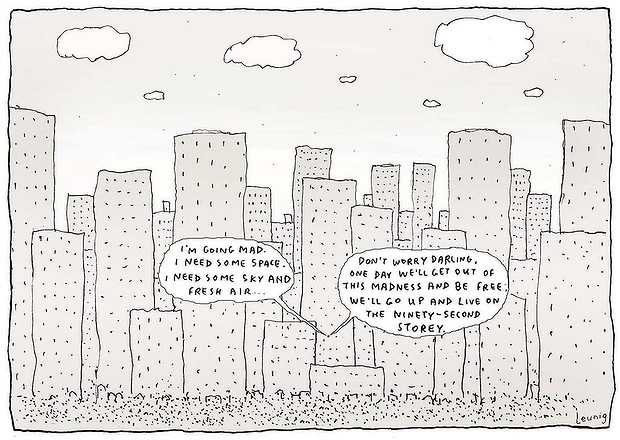
Every little empty space is being utilized. Old buildings are being demolished. Promises of cosmopolitan urban living in high rise towers are all along the city streets. The signs say consume, consume, shop, shop, shop.
I spent 7 hours a day walking the streets and the public spaces where one could relax and escape the noise and traffic of the city were few and far between. This lack was notable in the Docklands area where the car has been rolled and people can walk. But they have created no genuine public places where people can sit and gather.
September 20, 2011
Australian photography: Les Horvat
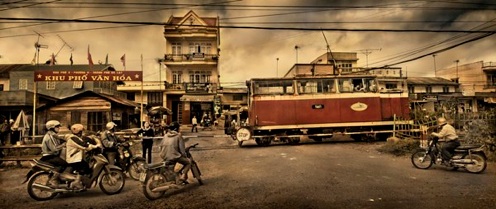
One of the exhibitions in the core programme of the Ballarat International Foto Biennale I did see when I was in Ballarat on the week end was Les Horvat's Momentum of the River’s Flow’: An Australian’s View of Vietnam’s Long Journey.
 Les Horvat, untitled, from Momentum of the River’s Flow’
The emphasis of this work is on digital imaging to interpret or make sense of a landscape that is set up in opposition to thge ‘rhetoric of photographic documentation’. Horvat says of this body of work:
These images are photographic outcomes derived from a series of multiple visits to Vietnam over the past three years. They are however, not simply photographically captured moments in time but are often constructions of visual encounters, repositioned within the frame of the still image. Post-production techniques and manipulations, along with a contextual re-interpretation of the view seen through the camera's lens, are used to express narratives and perceptions, observed over time and framed by place
The post production is quite extensive.
The issues that concern him are: Firstly, what is the role of memory in our understandings of landscape and through the landscape our understandings of lived experience? And second, how can a photographic interpretation of the landscape further that understanding? His argument is that photography has an important role to play in bringing meaning to cultural history, not only by recording place as an historical marker, but through the interpretation of memory, and its relationship to landscape.
September 15, 2011
on the road
As I will be travelling to Ballarat and Melbourne in Victoria in the next few days. Posting will be light as I will be dependent on free wif fi hotspots in Ballarat over the weekend, and, as they are few and far between from what I can see, I'm not all that hopeful.
I'm going to mind the gallery at the Woolshed Clothing Store for Melbourne Silver Mine's group set show on the Saturday, have a look at some of the exhibitions in the Biennale on Sunday, then pick up my prints and return to Melbourne that night.
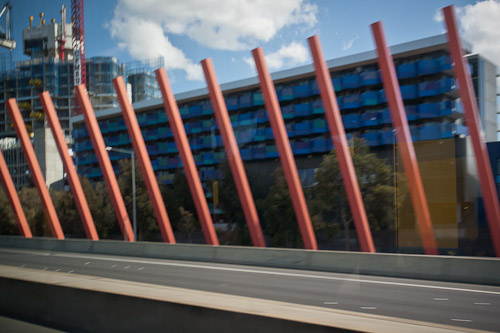 Gary Sauer-Thompson, Tullamarine Freeway, Melbourne, 2011
Things will pick up re internet access when I'm in Melbourne (Safety Beach on the Mornington Peninsula) on Monday--hopefully.
Update
Alas the internet was not working at Safety Beach. Karen's newly installed security system was blocking access to the internet. It's taken a couple of days to get that sorted.I can finally post.
September 13, 2011
Australian photography: Katrin Koenning
Another Australian photographer who is featured in the first issue of the online timemachine entitled home is Katrin Koenning, is a German born documentary photographer now living in Melbourne.
The work that is featured is Near, which explores family identity: – it is an ongoing portrait of her family:
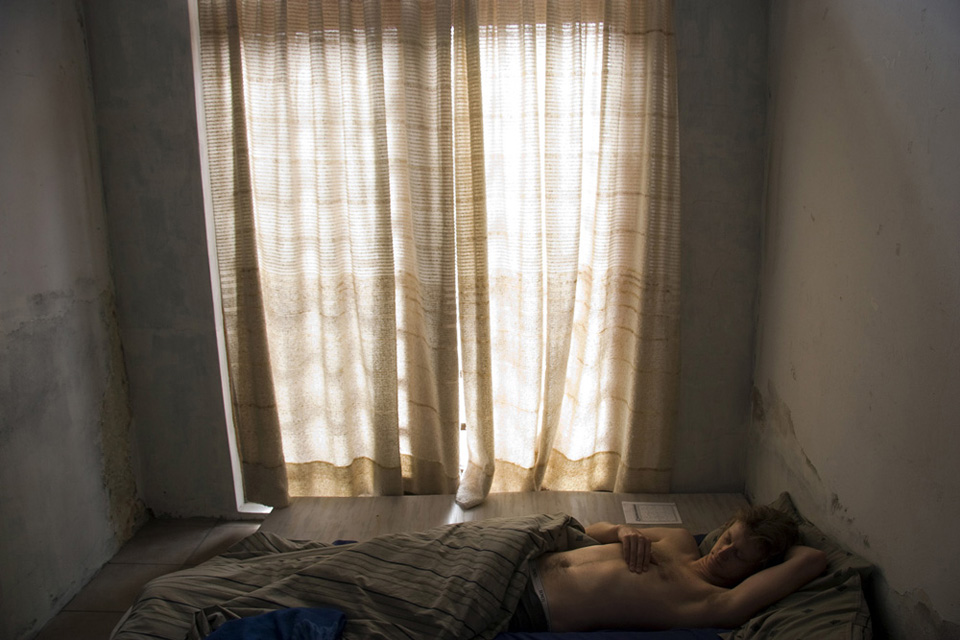 Katrina Koenning, untitled, from the Near series
Koenning is associated with the Centre of Documentary Practice, which is based at the Queensland College of Art, Griffith University, and publishes a magazine called The PhotoJournalist. It provides an alternative photojournalism and story telling to that of the mainstream media; one that includes the work of Edward Burtynsky, Alec Soth, and Jim Goldeberg.
Much of Koenning's work investigates and challenges the ordinary and everyday. An example is Pacific Straight Ahead, which documents Australia’s urban seaside. This series avoids the traditional beach images of Australia – crazy and fun-packed and humorous – is favour of images that are much more quiet and contemplative.
She says:
The visual language for the series is very simple and condensed – which means, ironically, it's very hard to get the right elements in place. Everything has to be perfect. It has to be overcast, not blue sky. There needs to be a good amount of cloud, but it can't be too dark. It's vital that the wind is absolutely still, so the ocean is dead calm, like a mirror. In this way, the image becomes more abstract...
These are quiet moments of everyday life at a suburban beach in Melbourne--St Kilda.
September 12, 2011
Paolo Ventura
Paolo Ventura, an artist and photographer, is a creator of sophisticated sets that he then photographs in ways that are haunting. In this video he talks about Winter Stories. He's an image-maker before he is a photographer.
His dioramas, which evoke a strange and often imaginary past, are conceived and created on two very ordinary tables at his Brooklyn studio. He starts with notes or rough sketches of a particular scenario he has imagined. Once the concept is established, he then builds the set.
The detail is extraordinary, from the folds in the clothes of the little figures, to the artfully arranged props, to the precise way the light and shadow play out in his pictures. He uses foam board, cardboard, plastic, and wood — basically, anything that he can get hold of.
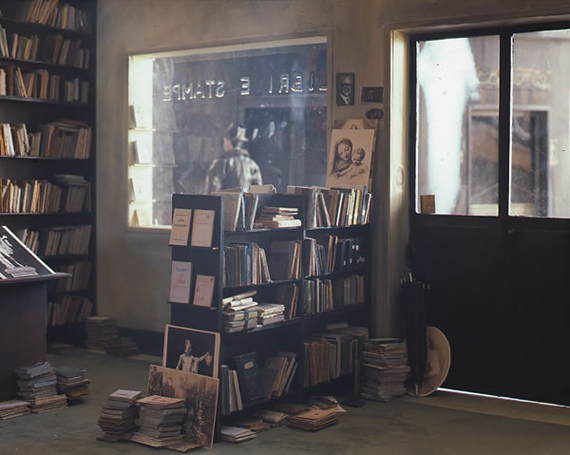 Paolo Ventura, untitled, Winter Stories
Once the set is completed, Ventura takes Polaroids to use as a reference for minor adjustments. He then shoots with a Pentax 6x7 camera from a fixed position, using only natural daylight, preferring to capture the scene on slightly overcast days
Ventura's narratives are set in a small fictional Tuscan village in the early 1950’s. He invents an imaginative series of photographs depicting scenes from the memory banks of an old circus performer as he looks back on his life. What the performer revisits are not moments of great drama, but rather fleetingly recalled glimpses of an everyday life, "images that he had thought to have never seen, quick moments he unknowingly observed as he raised his eyes to the clock hung at the corner of the block.
September 10, 2011
Jane Campion: Portrait of a Lady
I started watching the DVD of Jane Campion's 1996 film Portrait of a Lad but gave up. I realize that Campion is Australasia’s leading auteur director---acclaimed her ‘compelling stylistic innovation’--- but I found the visuals slow moving and the narrative tedious, in spite of Campion's concern with concerned with ambiguity or what is unseen or unsaid.
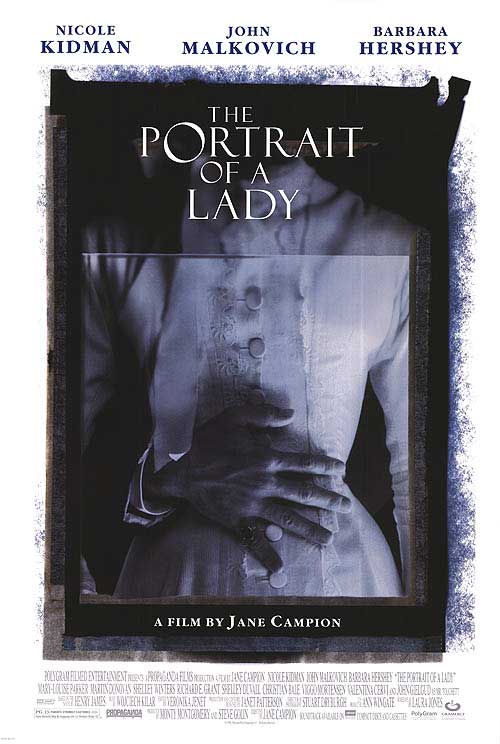
I sympathized with the way that Campion was presenting Isabelle Archer she might have appeared in her time and place---a different aesthetic of the female body than that of ideal or mask of beauty of the feminine ideal in classical narrative cinema--and her quest for subjectivity and the self-defined expression of desire in an oppressive patriarchical world. Its a re-reading of the Henry James novel from a woman’s point of view.
Though I appreciate that the film is concerned with Isabel’s journey from stubborn independence, to entrapment in a loveless marriage through to self-awareness-- the quest narrative is about repressed female desire and the dangers of desire ( a disastrous, unhappy marriage)--- I found the film boring, stilted and kind of sleepwalking.
It is a chilling film and much more than a period costume drama but its entrapped in the stereotype of a freethinking American girl being seduced and crushed by a blasé, corrupt Europe--- a tragic history of modern feminine desire. It is a dark Gothic romance that is leached of life.
September 9, 2011
timemachine: an Australian foto magazine
Timemachine is a collaborative project by fellow photographers Lee Grant and Tom Williams. It is Canberra/Sydney based project and it publishes contemporary photography from Australia and elsewhere in the world. The blurb says:
The emphasis is on showing new work and longer term projects; and bringing the concerns of photographers and their colleagues to wider attention. It assumes that countries or cultures have different ways of thinking and seeing and that Timemachine is a place to look at new Australian image making alongside a selection of what’s emerging from around the globe.
Graham Miller has a portfolio. Another Australian featured is Louis Porter, an English photographer who has been based in Melbourne since 2001, and who explores the outer suburbs of Melbourne:
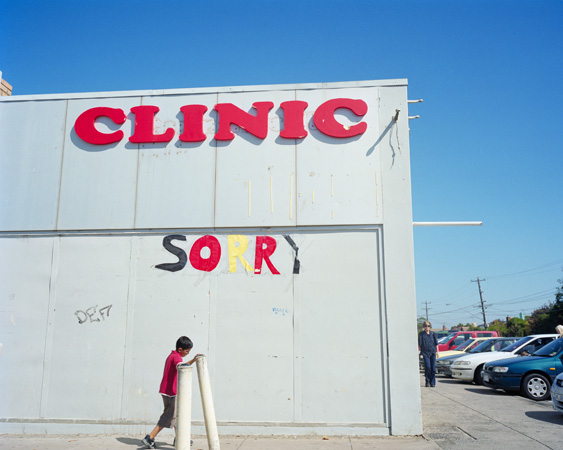 Louis Porter, untitled, from the Unknown Land project
Often Porter's work of Melbourne's suburban spaces becomes an archive of grunge and grot, of found objects and premises, which suggest these suburbs looking as if they are in decay.
September 8, 2011
American photography: Jerome Liebling
Jerome Liebling roots were in the Photo League, a co-operative of amateur and professional photographers committed to social documentary photography in the 1940s. He became a teacher to earn money and a documentary film maker. His work was motivated "to go figure out where the pain was, to show things that people wouldn’t see unless I was showing them.”
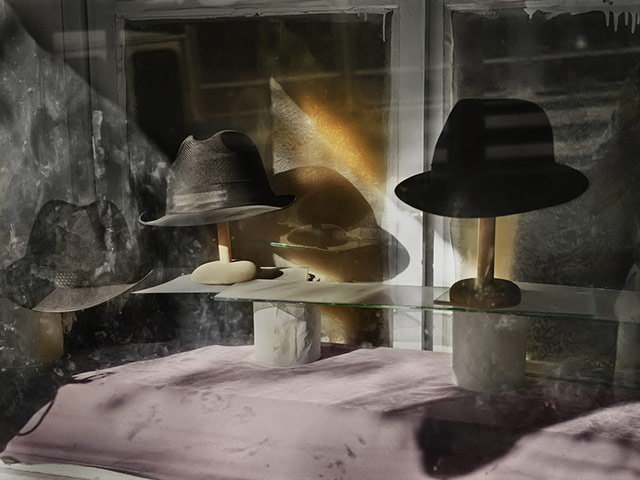 Jerome Liebling, Men's Hat Shop, Jerusalem, 1983.
His subject matter was often dark and uncompromisingly noncommercial: the blood-drenched workers at a Minnesota slaughterhouse; mental patients in a state hospital; cadavers used by New York medical students. Throughout his working life, he used a Rolleiflex film camera and did not make the switch to digital photography.
Throughout his working life, he used a Rolleiflex film camera and did not make the switch to digital photography.
September 7, 2011
Australian photography: Sally McInerney
Sally McInerney is the daughter of Olive Cotton. The latter worked from studios in central Sydney, was briefly married to Max Dupain, but in 1946 she moved to Cowra in NSW and immersed herself in motherhood, farming, rural life and ran a rural photographic studio.
I know little of Sally McInerney's work and there is little on the internet. There was an exhibition this year in Sydney entitled "Uncivilised Scenes: 40 Photographs", but none of the images are online. Presumably some of these were from The Lost Track of Time project, which consists of images taken over the last six years on McInerney's various roundabout car trips between city and country homelands:
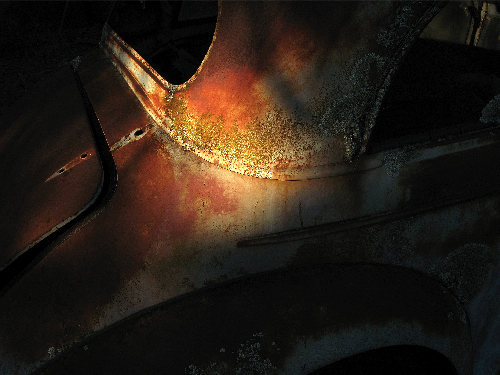 Sally McInerney, AWY 087
It's the poetics of decay.
It is a close-up of an everyday object in terminal decay - a discarded car steadily oxidising into a relic of primitive automotive technology.
September 6, 2011
Wolfgang Sievers + architectural photography
I have mentioned Wolfgang Sievers in an earlier post. One of his strengths was architectural photography --modernist architecture done in a modernist style. He is part of the early canon of architectural photography in Australia---- Max Dupain, David Moore, Wolfgang Sievers, Richard Stringer and Fritz Kos-- that established the standards for the photography of Australian architecture for the 1960s and beyond.
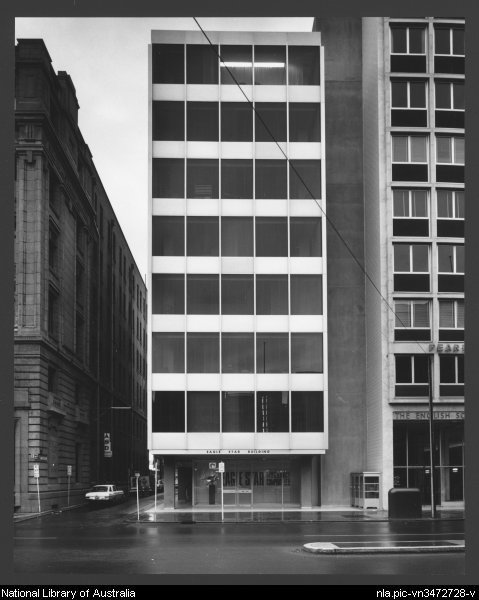 \Wolfgang Sievers, Eagle Star Insurance Building, Adelaide, 1969, architect Yuncken Freeman. NLA
Siever's industrial and architectural photographs ranged from from mining, office buildings, scientific processes, light and heavy industries, Olympic stadia and schools. On the surface he was hired by the Australian Government and private companies to help change the image of Australia from rural and agricultural, to industrial and manufacturing nation.
The modernist approach generally focused on the meticulously staged full facade shots where people, cars and other uncontrollable objects are excluded.They showed buildings as a series of isolated monuments as distinct from recreating the experience of a building. What the modernist architectural photographers ignored were the beaten-up buildings of early Australia that endure as a nineteenth-century version of Critical Regionalism.
September 4, 2011
the image as data in flux
Digitalization and manipulation of still photographs is now taken for granted in the visual media as well as the need to think in terms of photographic information, rather than the photograph as raw evidence. The “document” is in reality a text or an argument now that the image is basically data in flux.
In her Image Simulations, Computer Manipulations: Some Considerations essay in Decoys and disruptions: selected writings, 1975-2001 Martha Rosler says that:
art photography perpetually defines itself by stressing its distance from the recording apparatus; it often does so by relying on arcane theories of vision and on manipulation of the print, more recently on conceptual or critical-theoretical grounding. In the eyes of professional photographers, this no doubt makes them skill-less charlatans, loose cannons who get rich by fleecing the public. Such professional photographers, fixing their horizon at the level of copyright, are in no position to see that artists’ motivations for appropriating photojournalistic and other workaday photographic images are not so far from their own fears of manipulation; the difference, of course, is that the artists see commercial photography and photojournalism as deeply implicated in the processes of social manipulation while the producers of the images are more likely to see themselves as at the mercy of those who control the process. Autonomy for each is the underlying theme.
While professional photographers stop at the level of ownership of the image, the future lies with the conversion of the image to “information,” making photographers, no matter how souped up, chip-laden, automated, and expensive their still cameras are, look like little ol’ craftsmen or cowboys, cranky remnants of the old petite bourgeoisie.
Lee Friedlander: spatial compression
As is well known, Lee Friedlander's photographs broke with the dominant formal canons of the visual arts and those of photography, such as transparency and breaking our experience of the moment photographed.
Transparency or literalness of the photo is very strong in a positivist culture. Though Friedlander uses the techniques and images of naive photography his formalist modernism utilizes the strategies of juxtaposition and collage of the various elements whilst alluding to the document.
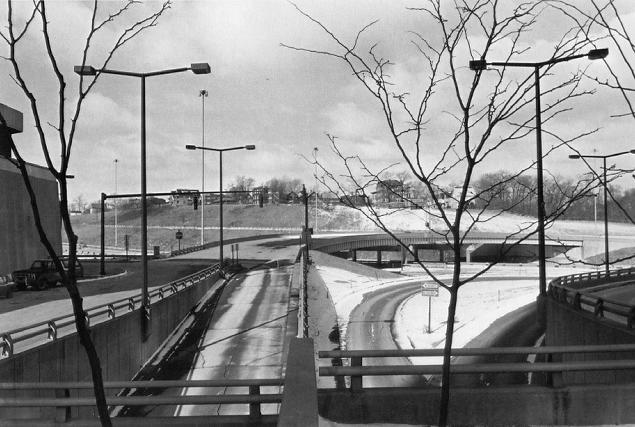 Lee Friedlander, Akron, OH, Plate 13 from "Factory Valleys", 1980
Friedlander is a formalist, concerned with how he divides the rectangle of the photograph, how light and shadow divide space, and how foreground and background relate and merge. Many of his landscapes have strong verticals, horizontals, and diagonals, which Friedlander uses to create additional frames for smaller stories within the frame of the photograph.
In her "Lee Friedlander's Guarded Strategies" essay (originally published in Artforum, April 1975) ---in her Decoys and disruptions: selected writings, 1975-2001 Martha Rosler says that:
The compression of foreground and background is fairly common in Lee Friedlander's photos. It violates the tacit rule that a representational photo should suggest space as we perceive it in the world, with any deformations being easily decodable. Friedlander's deformations are rarely result from the optics of lenses, which we have learned to cope with. Rather, he arrays the pictorial elements so that they may connect as conceptual units, against our learned habit of decoding the flat image into rationalized space.
Though spatial compression is a possibility peculiarly inherent to photography, where such junctures can happen accidentally, Friedlander makes it a conscious technique.
Rosler adds that:
Once you accept that photography need not rest on the history of painting (where, before the heavy influx of photographic influence, at least, there had been no concept of chance imagery, only accident and or better or worse decisions about intentional juxtaposition), you can accept as the outcome of conscious and artistic control photos that have the look of utter accident.
Friedlander’s work may make us think of naive photos that incorporate unwanted elements until we inspect a body of his work, when his habitual choice becomes evident, and chance and accident can be seen to diverge.
September 2, 2011
photography: a language or discipline?
In Seduction and Flirations in Photographies (vol.1 Issue 2, 2008) Patrizia Di Bello says:
Photography theory, particularly as thought through structuralist and post‐structuralist models, has tended to think about photographs as dematerialized images, loci of meanings rather than objects in themselves – materiality being the province of connoisseurs and old‐style curators hung up about vintage printing techniques and desperate to re‐invest photographs with the aura of a work of art to give status to themselves and the objects in their archives. However, as Michael Hatt and Charlotte Klonk argue in their survey of the discipline [in Art History: A Critical Introduction to Its Methods], art history has not only moved on from exclusive concerns with great artists and canonical works, but has been always potentially open to eclectic approaches, freely borrowing from a range of disciplines, and in many cases setting the boundaries of its own in ways elastic and porous enough to be productive rather than constrictive .... If an interest in language‐based semiotics made the photograph's materiality secondary, as a carrier of meaning generated elsewhere; and if a visual turn emphasized the often disembodied gaze of the viewer/photographer; then the recent interest in materiality and the senses focuses on how both of these aspects might interact with the body of the photograph and its various beholders.
They argue that as writers on photography don't have a language or discipline of our own; rather than be seduced by theory, perhaps we should learn to flirt with it, to crystallize the indecisiveness of photographic meaning into positive action.
September 1, 2011
Harold E. "Doc" Edgerton
In the late 1920's Harold "Doc" Edgerton studied at the Massachusetts Institute of Technology. Here he used a stroboscope to make a cyclically moving object appear to be slow-moving, or stationary. Edgerton was a pioneer in strobe photography. He used the technique to make images of milk drops (1937). athletes competing (1938), hummingbirds hovering (1953), bullets bursting balloons (1959), and blood coursing through capillaries (1964).
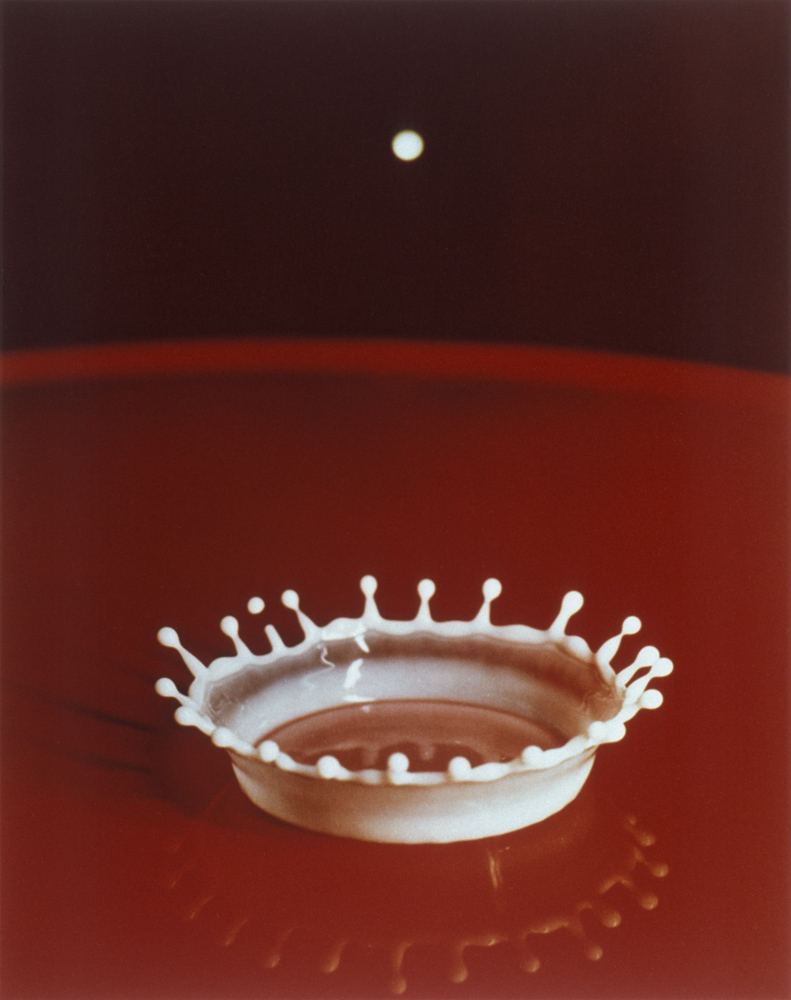 Harold Edgerton, Milk Drop Coronet, 1957.
The single idea of his photography was making the invisible visible. Edgerton succeeded in photographing phenomena that were too bright or too dim or moved too quickly or too slowly to be captured with traditional photography.
The milk-drop coronet image, formed by the splash of a drop of milk, not only introduced the poetry of physics into popular culture, but forever altered the visual vocabulary of photography and science.