|
August 25, 2011
Terry Lane reviews books of photographs by Wolfgang Sievers by Helen Ennis and the Melbourne-based Many Australian Photographers (MAP) group's Beyond Reasonable Drought.
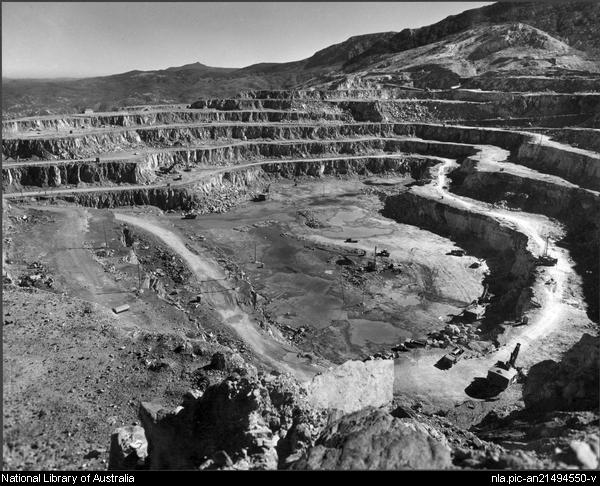 Wolfgang Sievers, Abandoned copper mine at Mt. Lyall {i.e. Lyell}, Western Tasmania, 1959, gelatin silver, NLA
Lane highlights the differences in technologies--- Siever's black and white images produced by a view camera and darkroom and the colour images produced by modern DSLR's and then links these technologies to different photographic aesthetics.
He then says:
Every photo in Beyond Reasonable Drought is a story to be “read” – quite different from the work of Wolfgang Sievers, who has done all the reading for us. And if we presume to read Sievers’ pictures we are likely to be deceived because they are artful arrangements intended to astonish, rather than reveal the truth.
Not all of Sievers' work can be read as a modernist celebration of industry and its architecture that are designed to astonish. Some are classic examples of Australian photographic modernism:
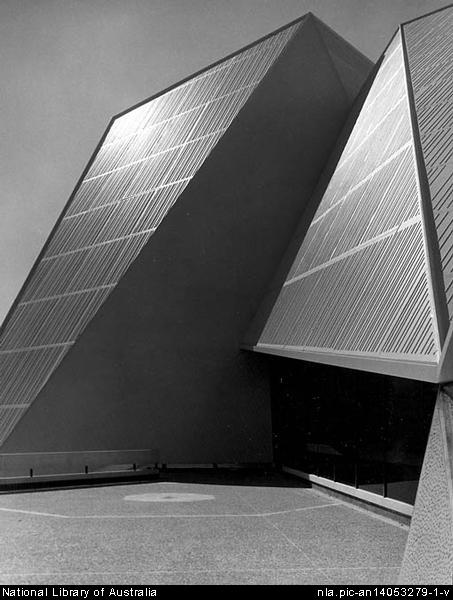
Wolfgang, Sievers, Adelaide Festival Centre, 1973 gelatin silver, NLA
This is an iconic modernist image as it's primary concern is with form, tone and texture; is an example of the self-contained and self-sufficient art form; and forms part of the canon of Australian modernist art photography.
Newhall's illustrated histories of photography, published by the Museum of Modern Art in 1937 and 1938, were seen by art historians as groundbreaking works shaped the canon for photography in the fine arts tradition. In choosing illustrations—most prominently from the work of 'straight' photographers Alfred Stieglitz, Ansel Adams, Edward Weston, and Walker Evans—Newhall embraced the vision of Museum of Modern Art director Alfred Barr, whose aesthetic theory privileged cubism, straight photography, and the Bauhaus notion of the camera as a machine.
The Australian National Gallery followed the lines of the established modernist aesthetics that had been laid down by MOMA when it constructed the Australia canon in the 1970s in spite of the emergence of Conceptual art in the 1960s, which highlighted modernist art’s loss of critical ability due to it representing a corporate enterprise compliant with official institutions.
|


