August 29, 2012
reviving Polaroid 8x10
Impossible has now announced it will release a batch of 1000 boxes of 8x10 large format instant black and white film retailing at $189 for a box of 10 photos. The film will work with all 8x10 cameras equipped with the original Polaroid 8x10 Film Holder and Processor. The early experiments in 2011 with Maurizio Galimberti photographing can be seen celebrities such as Patti Smith, John C. Reilly, Monica Belucci and Willem Dafoe.
Impossible presents an exhibition of the "very first photos taken on test film" by up-and-coming photographers Chloe Aftel, Penny Felts-Nannini, Adam Goldberg, Thom Jackson, Tim Mantoani, Alan Marcheselli, Melodie McDaniel, Stefan Milev, Nicholas Misciagna, Rommel Pecson, Bill Phelps and Neal Winter at its Project Space in New York.
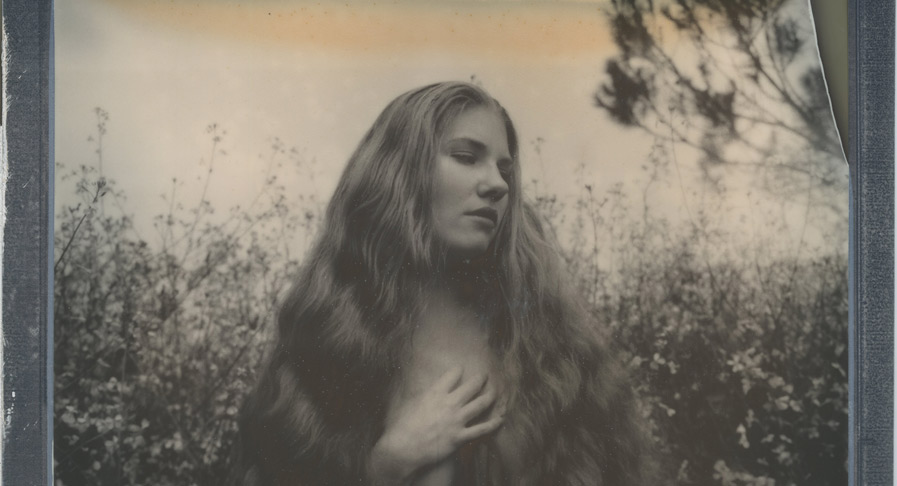 Chloe Aftel, from 8X10 Impossible
Is there something rebellious aspect to the adoption of The Impossible Project's instant film — a push back against the digital photography world as today’s innovators look into the past to make something new again.
August 27, 2012
iPhoneography
The L.A. Mobile Arts Festival 2012 in Santa Monica is in a converted airplane hangar that is divided into a variety of themed rooms. All of the 600 images on display were originally taken using an iPhone and then edited using a variety of mobile apps and computer software techniques.
 Helen Breznick, Lilie Lotus
This exhibit of art created with mobile devices really puts into perspective how photography has changed over the years thanks to apps that are easier to use and much less expensive to use. Even though iPhoneography uses the latest technology, the results often have a low-tech feel. Images created with these state-of-the-art devices can look like something from a lomo, a holga, a diana, or maybe even a homemade pin-hole camera. One of the most popular artistic effects used by the photographers was layering — combining multiple images into one.
August 26, 2012
imperfect photography
There is an online discourse on photography in the form of a blog entitled Still Searching that is hosted by Fotomuseum Wintherthur. The blog was launched in January 2012 and its blurb states that it:
aims to be a continually developing, growing and decidedly interactive Internet discourse on the medium of photography that features a multitude of participants; it is conceived as an online debate on forms of photographic production, techniques, applications, distribution strategies, contexts, theoretical foundations, ontology and perspectives on the medium. It explores photography’s role as a seminal visual medium of our time—as art, as a communication and information tool in the context of social media or photojournalism, and as a form of scientific or legal evidence.
In the first post entitled Imperfection the German photo historian and theorist Bernd Stiegler notes that contemporary photography eschews and renounces the perfection of technology.
 Gary Sauer-Thompson, The Bluff, Victor Harbor
Imperfections abound in contemporary photography:---it used to be known as snapshot photography associated with photographers such as William Klein and Nan Goldin. It has since broadened into lo-fi cool, and become very extensive in the form of an “anti-aesthetic”. Is this a reaction against realism? Or a reaction against the standardized (pre-programmed) perfection of DSLR digital photography in the name of individual creative expression?
Steiger notes that in:
contemporary exhibitions as well as photographs as they are used in everyday aesthetic applications, one notices that imperfection plays a key role. Far removed from the ideals of the Group f/64, New Objectivity, or even the Bechers and their school, to name a few positions, photographs that consciously employ technical errors have become common sense in photography. There are photographers who use deficient cameras; Lomography aficionados sell their photographs along with this type of camera in stores in major cities; snapshots are in demand, and blurriness is the aesthetic rule. Imperfection is the new ideal of contemporary photography, even if celebrated, staged, and represented in a kind of perfection.
We can distinquish between the imperfections created with mobile phones with built-in cameras and pocket-size digital cameras and a photographic imperfection that is nostalgic in that it is expressed in the form of analogue cameras and techniques, such as Hipstamatic or Instagram. These are so popular that imperfection is a visual grammar.
August 24, 2012
post-photography?
It used to be the case up to the 1960s that art photography was measured according to the conventions and aesthetic values of the painted image . This was the position of American formalist modernism, in its Greenbergian form.
But that has changed now, as in the late 20th century the strict modernist boundaries between photography and other media like sculpture, painting or performance became increasingly porous--ie., with postmodernism.
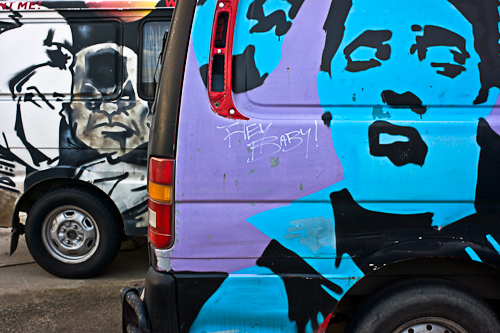 Gary Sauer-Thompson, vans, Adelaide, 2012
There has been a bleeding of photography to other media and a shift in the art world that views photography as a realist system of representation (ie., resemblance to reality) as a fading memory from yesteryear. Or as a fossil from a previous age when the relationship between the real and its representation, and truth and falsehood, defined the identity of photography.
That identity rested on the uniqueness of photography's indexical relation to world it represented, a relation that was regarded fundamental to its operation as a system of representations. On the positivist account of photography, a photograph of something (a person) was held to be a proof of that person's existence, and it was held that photography was inscribed by the things it represented.
In a digital world of the 21st century computer visualization means that photographic-style images can be made in which there is no direct referent to the world of objects and events. These digital images are less signs of reality than they are signs of signs. For many that means photography made with a camera as an image making instrument is in a state of a crisis and that we can now talk about the death of photography or post-photography.
Why? Because digital imaging or digitization has dealt traditional photography a death blow.
August 15, 2012
Hijacked III: Michael Ziebarth
Hijacked III: Contemporary Photography from Australia and the UK.It was curated by Louise Clements, Mark McPherson and Leigh Robb and it was presented as part of the Perth International Arts Festival and FotoFreo.
One Australian photographer is Michael Ziebarth whose current series is part of an on-going collection focusing on trees in suburbia taken in various parts of Western Australia, South Australia and Victoria are part of a collection loosely titled Waiting.
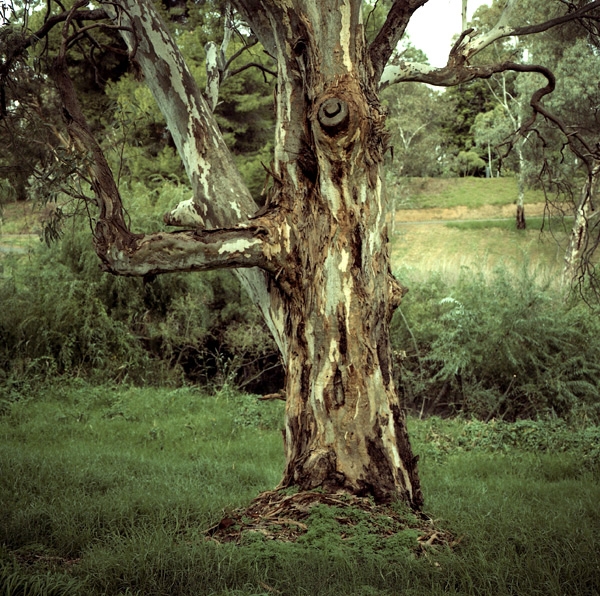 Michael Ziebarth, untitled, from Parkland series.
The landscape is not featured very strongly in Hijacked III which concentrates more on portraits.
August 13, 2012
Australian photography: Debra Phillips
Whilst I was working on this post I came across the work of Debra Phillips in Blair French and Daniel Palmer's text, Twelve Australian Photo Artists.
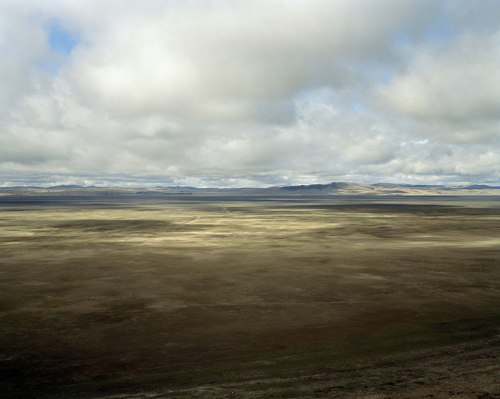 Debra Phillips, Untitled 7 (view from model plane launch area)’, 2001, From the series ‘The world as puzzle’
The series shows a subtle change of cloud formation and light falling across the lake bed as the camera is angled slightly differently from the same location.
August 11, 2012
conceptual photography
Light Years: Conceptual Art and the Photograph, 1964-1977 was an exhibition put on by the Art Institute of Chicago in March 2012. It was assembled by Matthew S. Witkovsky, the museum's curator of photography,
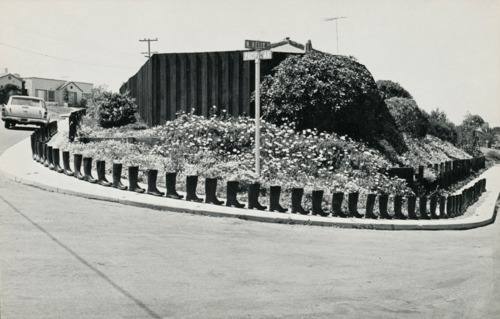 Eleanor Antin, 100 Boots,
In 1971 Antin devised 100 Boots, a conceptual work that bypassed the traditional gallery system by using the US postal service as a means of distribution. For this piece, Antin literally placed 100 boots in different Southern California settings and had the boots photographed in each scene. The photographs were printed as postcards and the individual postcards were mailed to approximately one thousand artists, writers, dancers, critics, libraries and art institutions at irregular intervals.
August 10, 2012
Robert Hughes: RIP
Robert Hughes, who died on Monday at Calvary Hospital in the Bronx, will probably remembered more for his educational "The Shock of the New,” his eight-part documentary about the development of modernism from the Impressionists through Warhol, than his three decades for Time magazine as chief art critic. His emphasis is on judging individual works of art rather than artistic movements or even individual artists.
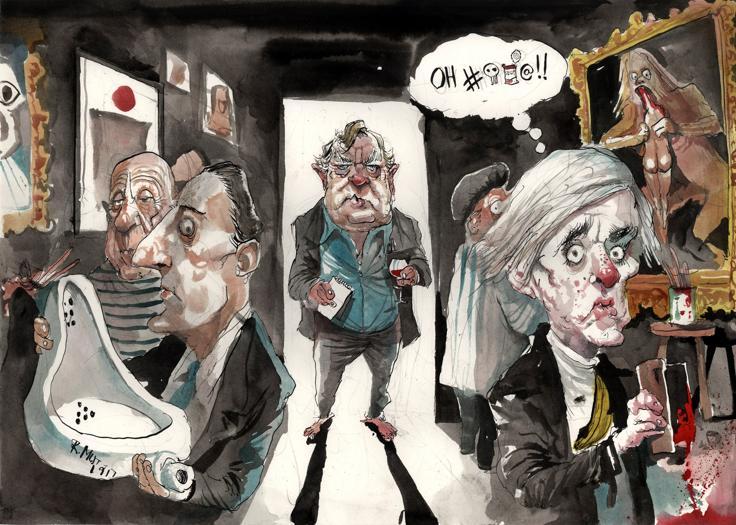 David Rowe
It stopped at modernism because Hughes was out of joint with postmodernism --he saw the movement as little more than image-scavengers and recyclers who infest the wretchedly stylish woods of an already decayed, pulped-out postmodernism. On the other hand, Hughes was critical of both the art market's impact on art (the art market became the art world at large) and those artists, such as Warhol, who cling to the market.
August 8, 2012
modernism + the blur
American photographic modernists--eg., Edward Weston and John Szarkowski--- held that sharp focus was a part of the ontology of a photograph. It was a core characteristic of the medium specificity of photography, rather than an aspect of a certain kind or style of photograph.
This medium specificity approach was part of a strategy to define the photographic medium's ontology differently from painting and other visual media. By outlining the medium specific characteristics of their field they assumed that they could define the ontology of photography.
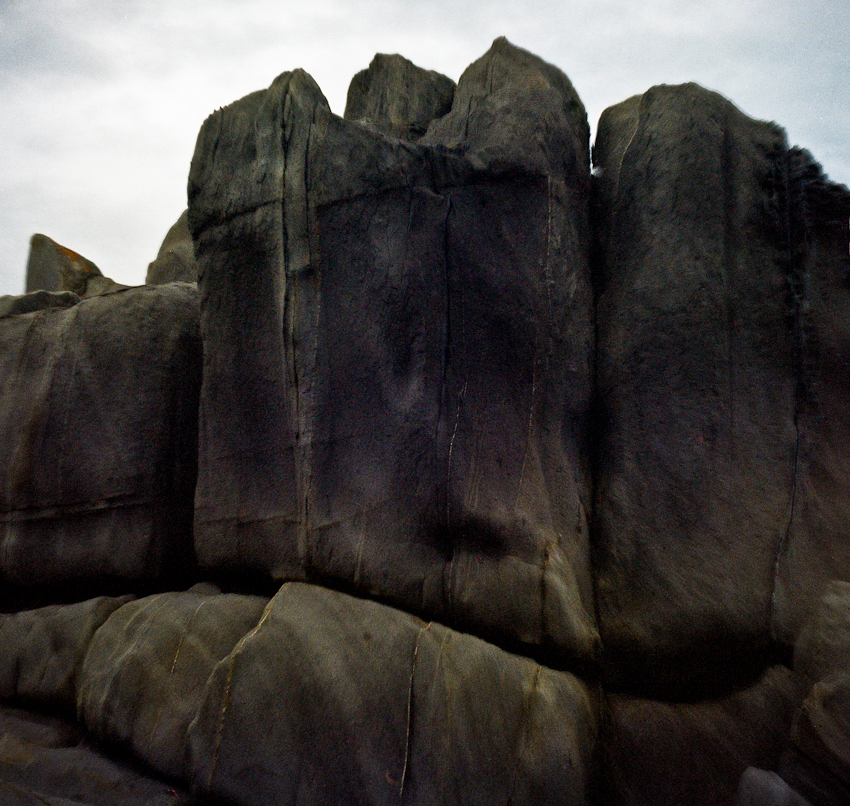 Gary Sauer-Thompson, rockface, Kings Beach, Victor Harbor, 2011
Why not think otherwise---why can't photography not share or exchange characteristics with painting? Why cannot we have blurred photographs in which the indexical quality of the photograph is weakened? If we can, then the identity of photography is one of flux and mutability as it changes over time.
In their Representation in Photography The Competition with Painting chapter in Photography Theory Historical Perspective text Hilde Van Gelder and Helen W. Westgeest say that:
The debate in the nineteenth century among photographers and theorists on whether a photograph should be as sharply focused as possible or be partly blurred was strongly related to the discussion about the relationship between photography and painting. The late pictorialist photographers, such as Peter Henry Emerson, preferred a painterly blurredness in photographs. As argued in the first section of this chapter, these photographers were accused of being pseudo-painters. The blurred photographs looked like impressionist paintings, which were perceived as unfinished paintings that had to be completed by the spectator in the very act of observation and interpretation.
The American modernists, as we have noted, were at pains to differentiate photography from painting in order to establish the autonomy of photography as a fine art.
Today, after postmodernism, we have the ncreasing popularity of blurred photographs in contemporary art.
August 7, 2012
Australian photography: Steven Tester
Steve Tester is an Australian large format (4x5 and 8x10) landscape photographer who lives in Castlemaine, Victoria.
 Steve Tester, Red Gum + Pines, platinium print
His landscape photography is about the quiet mood of the place. he says:
Making photographs is both an emotional and tactile experience for me. Some emotional connection between the scene and me must exist to initiate the image in my mind; the real life situation first captures me in a sense. I then strive to produce photographs that convey the emotion and sense of place of the original image to those who view the finished work.
He uses traditional darkroom methods to develop the prints on fibre based paper and each print is individually made.
 Steve Tester, Grass Tree, Platinum Palladium
Grass Trees are very hard to represent. I have numerous failures.
August 4, 2012
SALA: Mark Kimber
If Mark Kimber’s exhibition, The Pale Mirror, at Greenaway Gallery blurs the lines between make believe and reality, then it can be located in the terrain of remembrance. The mirror as a memory fuses the present with the past.
Kimber’s ethereal photographs of diorama-like sets, shot in film, feature city high-risesand seascapes are constructed with polystyrene, cardboard, masking tape and odds and ends scrounged from train modelling shops. These small dioramas – they measure no more than 40cm square – are light with appropriately tiny LED lights. Finally, he photographs them – on film – with an apparatus he has fashioned himself by combining a pinhole camera with a plastic Diana one.
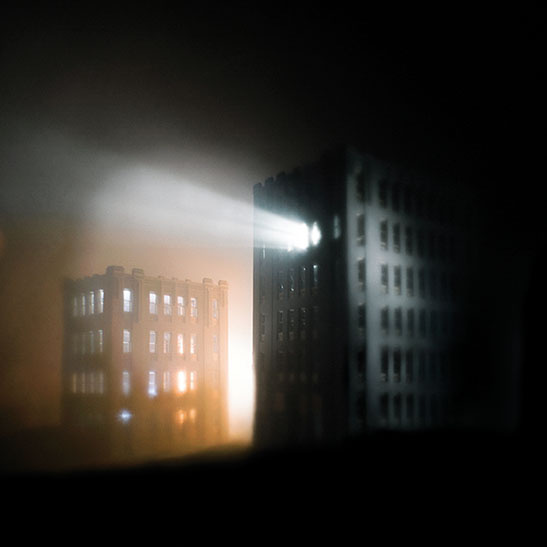 Mark Kimber, Through the Windows of the Night, 40 x 40 cm, giclee print, 2012.
These photographs are an adult attempt to go back to that level of play. Kimber says that:
Most are journeys back to childhood memories – the Hindenburg disaster on TV, the Bates Motel in Psycho, more personal ones too. As I get older I see the relationship between the way I viewed the world as a child and the way I have gone on to view it over my life. These scenes are an attempt to recreate those childhood imagined landscapes and make new ones.
These hazy, indistinct images are about play--childhood play and creativity. Kimber says that when he was a kid he would come home from seeing a movie and try to build a replica of it in the backyard.
If our society is now marked by televisual spectacle and immediacy, then our sense of history fades. Photography becomes a material form of memory that counters the way instrumental reason's continuous history and technological progress leaves the past behind to create a new instant present. Kimber's photography counters the anachronism of the past and historical loss caused by the digital technological transformation.
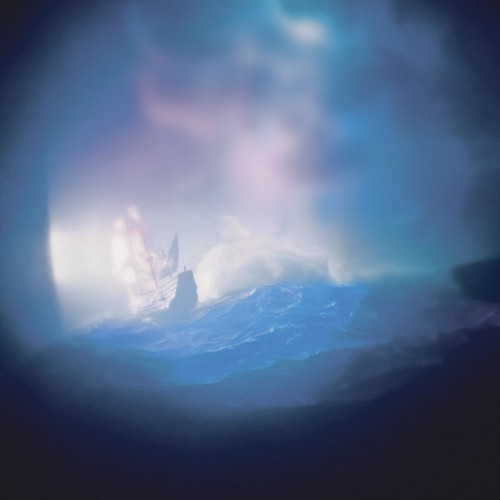 Mark Kimber, Into seas without a shore, 40 x 40 cm, giclee print, 2012.
So we photograph in order to remember in a world increasingly marked by the shrinking of historical understanding. The instantaneous time of the 24 hours news media is a mechanism for our historical amnesia.
August 3, 2012
Australian photography: Bruno Bernini
An interesting article on Melbourne photography in the 1950s and 1970s in The Age. This includes Angus O'Callaghan, who has previously appeared on junk for code.
Another photographer mentioned is the Australian fashion photographer Bruno Benini, who had an exhibition at the Sydney Powerhouse Museum in 2011. It was entitled Creating the Look: Benini and fashion photography. The Powerhouse Museum acquired Benini's fashion photography archive in 2009. This was part of building strong graphic design and fashion photography holdings as part of a wider Visual Communication design and photography collection focus within the Design and Society curatorial department.
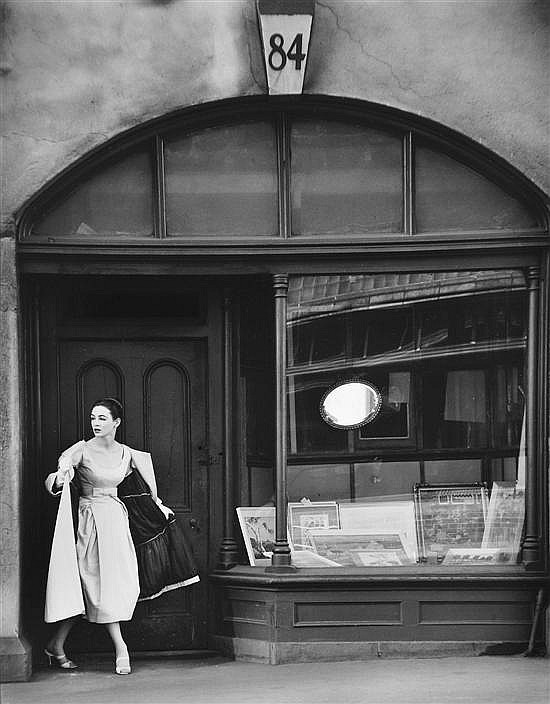 Bruno Bernini, Helen Homeward Wearing a Phillipa Gowns Cocktail Dress, Eastern Market, 1956,
Silver gelatin photograph
Bruno Bernini, Helen Homeward Wearing a Phillipa Gowns Cocktail Dress, Eastern Market, 1956,
Silver gelatin photograph
Benini an Italian-born, Melbourne-based fashion photographer, became one of a group of influential émigré commercial photographers working in post-war Australia. While Max Dupain is recognized as a genius of 20th century Australian architectural photography and Wolfgang Sievers the master of industrial photography, Bruno Benini can be regarded as one of Australia’s most elegant and refined mid-20th century fashion photographers.
August 2, 2012
photography: “indexical” and “iconic”
In the last section of Representation in Photography The Competition with Painting in Hilde Van Gelder and Helen W. Westgeest's Photography Theory Historical Perspective text --it was mentioned in this post ---Van Gelder and Westgeest explore the “index” and “icon” (or “indexical” and “iconic”) opposition.
This duality is often used to define the relationship between the photograph and reality and the difference between photography and figurative painting. Photography’s indexicality is deemed to constitute the basis for proposing ontological distinctions between painting and photography.
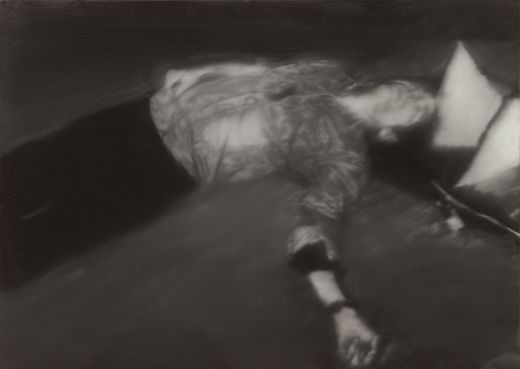 Gerhard Richter, Erschossener 1, Man Shot Down 1, 1988, Oil on canvas
Erschossener1 has been hand-painted from photo- graphs that appeared in German newspapers and it comes out as black-and-white, blurred photograph.
Van Gelder and Westgeest say that some theorists define index and icon as two different forms of representation, with – sometimes – an overlap in formal relationship. Susan Sontag, for instance, argued in On Photography (1977) that style cannot exist in photographs because it is automatically installed due to the image’s indexical nature. Photography supposedly lacks an iconic and is “condemned” as it was to indexicality. Figurative painting, in contrast, has most often been accorded higher valued than photography on the scale of art due to its presumed purely iconic nature.
A photo is a physical trace or index of that reality. Gelder and Westgeest say that:
Many theorists...have basically used index and trace as synonyms, privileging the term index and emphasizing the causal relationship to the detriment of the formal or iconic aspects. The reason for this conflation seems to be that causality can be linked to photography’s assumed relationship of veracity to the reality it represents. Photography’s indexicality thus constituted the basis for proposing ontological distinctions between painting and photography. Indexicality, understood in sheer terms of a cause–effect relationship, would be the hallmark of photography. Iconicity, which in this logic does not possess such causal capacity, is left for painting, as being its own specific characteristic of a stylized resemblance.
My own view of this is that the resemblance between a realistic depiction and the reality it refers to, be it a figurative painting or a photograph, is always ultimately based on a cultural/aesthetic convention, shared by many persons. In Sontag's terms style exits in photography.
Photography and figurative painting share a common characteristic in the sense that they both are a mode of representation in which the picture can be perceived as resembling the object it depicts. They can, therefore, both be defined as iconic. Even an photographic image that is strongly indexical--eg., analogical photograph considered to be a witness, stressing the singularity of a moment--- becomes interesting photograph to look at in different ways when we do not know and do not bother anymore about the who or where.