|
August 24, 2012
It used to be the case up to the 1960s that art photography was measured according to the conventions and aesthetic values of the painted image . This was the position of American formalist modernism, in its Greenbergian form.
But that has changed now, as in the late 20th century the strict modernist boundaries between photography and other media like sculpture, painting or performance became increasingly porous--ie., with postmodernism.
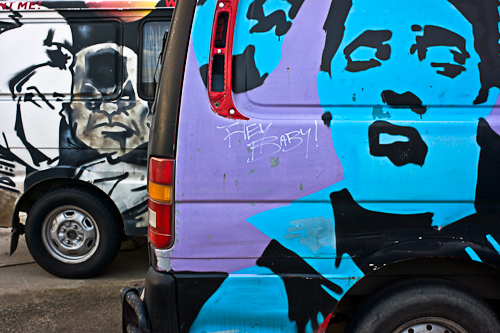 Gary Sauer-Thompson, vans, Adelaide, 2012
There has been a bleeding of photography to other media and a shift in the art world that views photography as a realist system of representation (ie., resemblance to reality) as a fading memory from yesteryear. Or as a fossil from a previous age when the relationship between the real and its representation, and truth and falsehood, defined the identity of photography.
That identity rested on the uniqueness of photography's indexical relation to world it represented, a relation that was regarded fundamental to its operation as a system of representations. On the positivist account of photography, a photograph of something (a person) was held to be a proof of that person's existence, and it was held that photography was inscribed by the things it represented.
In a digital world of the 21st century computer visualization means that photographic-style images can be made in which there is no direct referent to the world of objects and events. These digital images are less signs of reality than they are signs of signs. For many that means photography made with a camera as an image making instrument is in a state of a crisis and that we can now talk about the death of photography or post-photography.
Why? Because digital imaging or digitization has dealt traditional photography a death blow.
|


