December 30, 2008
beauty, photography
Tony Frouse is an Ottawa based photographer who has a blog called Drool. He has a post on beauty at Slightly Lucid that caught my eye.
Referring to the work of James Nachtwey and Simon Norfolk that picks up on a remark Norfolk made about beauty being a tactic. Frouse comments:
The idea of turning war photos (or any photos of human suffering) into beautiful commodities raises all kinds of issues. But this one phrase, “beauty is a tactic”, neatly tips the discussion into more positive territory.I believe that beauty reaches farther into the human psyche than almost anything else. I also believe that these photographers photographs have a certain quality that elevates them, that makes them worth, somehow, more than standard press photos of carnage, mayhem and horror; press photos that get consumed in one sitting and are thrown out with the garbage the next day.In order to get people to look and to react to the state of the world these days new tactics must be employed. Beauty is one of them.
I find this puzzling. beauty, as an aesthetic category, has been understood by modernists to be part of the object, in the sense of significant form. Form is one aspect of what makes a photograph stand the test of time and what makes it art. From this perspective I cannot see why beauty is problematic in photography--it is an aspect of our aesthetic judgment about a particular photograph. That does not mean that beauty is, or should be, central to art and aesthetics.
The other interpretation of Frouse's comment is that it is a case of photojournalists adding to their aesthetic category---including beauty alongside truth? This is their way of defending their work from criticism that they were beautifying" or "aestheticizing" the suffering caused by war, famine, or forced dislocation. This---images aestheticizing violence--- is more the likely interpretation , given that Susan Sontag wrote and worried, about beautiful suffering.
December 29, 2008
consumerism
At this time of the year there are images of avid shoppers bingeing on bargains after a period of enforced abstinence due to their fear of impact of the global economic crisis on their lives:

The word 'bingeing' suggests that they have little control over their spending or rmaxing out their credit cards. despite the pointy economic heads saying a fragile capitalism requires consumers to spend big. So why the binge?
A quote that gives one possible answer:
....there is something so mischievous and naughty about the prospect of a shopping spree in the midst of a recession that is almost drug-like. Walking into a shop, finding a bargain and then funding it with a credit card fills me with a buzz...Discovering Westfield was like injecting a massive dose into the arm. The day ended with me sitting at a tube station, wide-eyed and filled with guilt, as I tried to squeeze everything into fewer bags in an attempt to look less ostentatious..... The signs in the windows and the sale stickers on the rails have manipulated me perfectly into spending more than I ought to.
That phrase "injecting a massive dose into the arm" indicates that shopping is like an addiction. Or is this the residual cultural force of the age of credit that has, in fact, ended?
Alas photography plays its part in "injecting a massive dose into the arm" of the consumer. So an art photography needs to take an oppostional stance to this visual injection.
December 28, 2008
Graham Miller: Suburban Splendour
Graham Miller is a photographic artist and co-founder of FotoFreo, a biennial international festival of photography based in Freemantle, Western Australia.
 Graham Miller, Alice, from Suburban Splendour
Suburban Splendour refers to the unease beneath the manicured lawns, garden sheds, white picket fences and shimmering facades of middle-class Australia; an unease that is described by Miller in terms of a vague but inconsolable longing, an unnamed enigmatic yearning. This is represented in terms of the “theatricality and artifice” of staged photographs (Miller references the work of Philip-Lorca di Corcia) in which male hookers, addicts and drifters are posed in elaborately staged shots.
Miller says:
Melancholy has always appeared to be just under the skin of the suburban vernacular. Australians are more affluent than ever, and politicians monotonously boast of economic prosperity, but we are no happier now than we were fifty years ago. Life seems a process of replacing one anxiety for another; one desire for another. The elusive dream of happiness is continuously postponed. What if happiness is not a final destination that we plan to arrive at and then stay, but a fragile and fleeting emotion, an intermittent state that evaporates leaving us with a lingering backdrop of what Julia Kristeva calls “a sad voluptuousness, a despondent intoxication”?
Another word for this public mood is suffering in the form of quiet desperation, or what Heidegger called anxiety:
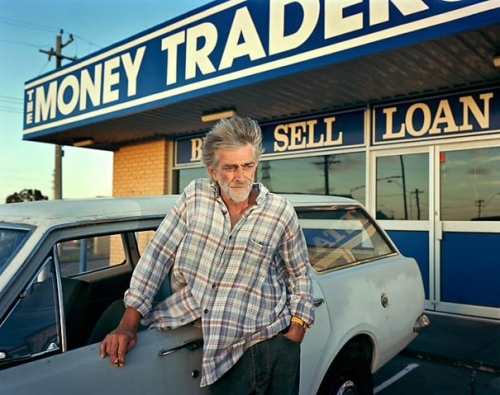
Graham Miller, from Suburban Splendour
December 27, 2008
Xmas and all that
In concluding his Creative and Cultural Industries Justin O'Connor says that culture sets a certain limit on capitalism’s drive to accumulation. He argues thus:
If capitalism is the principle of unlimited accumulation then culture is always going to be critical; as Raymond Wiliams argued, it has an intrinsic value which is distorted when used simply for profit.

He adds that:
‘Critical’ here is not the same as being politically opposed; nor is ‘intrinsic’ about some universal, inherent quality of art. Cultural value is about something other than accumulation of profit and thus sets a limit to it. Though culture has long been caught up in commodity production in the market this does not mean that culture acquiesces to the principle of unlimited accumulation.Shakespeare was an entrepreneur certainly, but that does not mean there is no conflict between the values of culture and the values of profit.
O'Connor adds that traditionally cultural policy has been about de-commodification, identifying certain cultural goods as having public value and thus provided for by state subsidy. The cultural industries agenda made a break with this in trying to pursue a cultural policy through industrial intervention. Over the course of the last 40 years cultural policy has moved beyond a
concern with the arts, just as it is no longer about decommodification.
A cultural industries policy is about providing the space in which content that we value might still be produced -hopefully with a beneficial economic outcome.
December 26, 2008
limits of photography
An interesting post in the Daylight Magazine blog by Matthew Siber that talks about his transition from a technical emphasis to an expressive one. Along the way he touches on the insecurities of photographers vis-a-vis the art institution. Siber says:
It was this shift from a technical emphasis to an expressive one, paired with a couple of classes in Photoshop, that began the loosening of my adherence to the photographic medium. With the expression of ideas first and foremost in my mind, what did it matter what medium I chose for a specific project? Photography is great at some things but terrible at others. Each medium has it's strengths and weaknesses so why not take advantage of the strengths of those mediums that are not photography?
Why not indeed. Because we don't have the desktop skills and are not trained in professional design. Acquiring the desktop skills and becoming familiar with the design software is a step learning curve if not initially trained in it. I personally find the 'do it yourself ' pathway hard going.
Siber adds that
More and more, I have been encouraging my students to learn more programs, to think beyond photography, to watch films, keep up on painting trends and look for work done in new media. This is a controversial issue, as many are reluctant to give up their label as an integral part of their identity as painter, photographer, sculptor, etc.. I have been called pretentious to my face by former photography professors for referring to myself as an artist rather than a photographer.
He goes on to note that technology has been a great equalizer for many artists:
Learning a few creative programs opens up whole worlds of possibilities that were only accessible to highly trained professionals in the field a few decades ago. Many of these programs work with similar formats making learning new programs that much easier. A great many of my friends and colleagues in the photo field also work in video with programs like Final Cut and even iMovie. Graphic design and 3D design has been made more accessible through programs like Illustrator, Sketchup, Rhino and Maya.
And so we have a multimedia digital environment in which we creative folk now work, exploring its possibilities.
December 25, 2008
Merry Xmas
Merry Xmas everyone. My Xmas present.

Thanks for dropping by, commenting and discussing. It's been great. Looking forward to more comments and discussion on photography, visual culture and urban development issues after the Xmas holidays.
December 24, 2008
Leunig on technology
Suddenly GPS popped up everywhere else. Now getting lost is no longer an option, except in technology.
Leunig's quiet, witty, critical dig at technology that shapes our everyday lives. It makes a welcome contrast to the 'all technology is wonderful' school; or the 'must have that' school; or the 'technology as toy' school. It is a critique of the desire for the technological geewhiz symbols of status s
that are embedded in our lives.
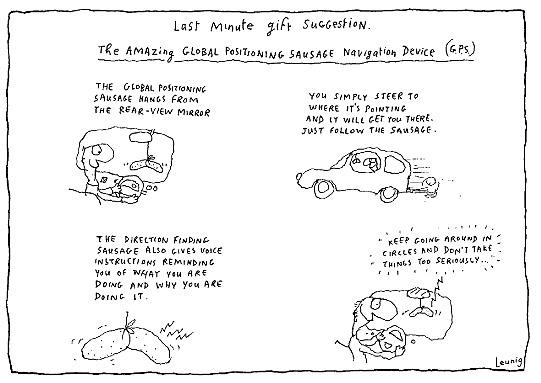
This deflates the glamour that entices our desires for something that we don't actually need; or struggle to make work properly. Plug in and Play sure is a misnomer----judging by my experience of both computers and getting a HD digital receiver to work through an LCD screen that is plugged into a stereo system. Our experience of the latter in Victor Harbor this Xmas is that we have to get people out to make the different components work as a unit.
I also constantly struggle with getting different components to work re both my work office and office of Encounter Studio, even though I try to keep things as simple as possible. I read Wired magazine as technological dreaming.
Leonard Cohen's Hallelujah
A lot of music is about interpretation of a song. Two versions of Leonard Cohen's Hallelujah from the Various Positions album in 1984. I'd lost touch with Cohen's music.
The first interpretation is by Tim Buckley:
I only know the music from the Grace album.
The second is by KD Laing:
I only know the Hymns of the 49th Parallel.
December 23, 2008
the photograph as a physical object
Courtesy of S2art at musings from the photographic memepool [the shallow end]. US photographers like Henry Holmes Smith (1909 -1986) and Frederick Sommer (1905-1999) stood in a tradition of camera-less photography. They gradually shifted their style to the more abstract and personal, to thinking of a photograph as a physical object in its own right, rather than solely as a reflection of the outside world.
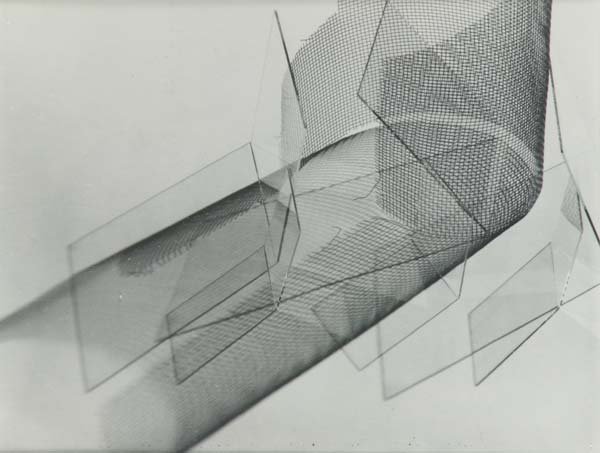 Henry Holmes Smith, Light Abstraction,
This is the tradition of Moholy-Nagy and Man Ray who pioneered the creating of photographic prints without the use of a camera in the 1920s. In the late 1940s Henry Holmes Smith developed a technique of "liquid-and-light" drawing by carefully pouring a layer of thick, viscous corn syrup directly onto a sheet of 19th Century glass, forming the characteristic figurative elements of his clichés-verre.
The negatives were printed in contact on conventional sensitized photographic paper and developed by traditional methods in Smith's photo laboratory. A limited number of prints were thus made before the syrup was eventually scraped off.
December 22, 2008
photography: two faces
From what position do we speak? And in the name of what or whom? These questions apply to photographers in a liberal democracy as well as philosophers and activists, since they operate within an aesthetic regime. Theirs is a contradictory position since the modernist aesthetic regime rejected the representative regime of mimesis in favour of one of the autonomous image that operates outside any system of legitimation, only to find itself captured by the spectacle.
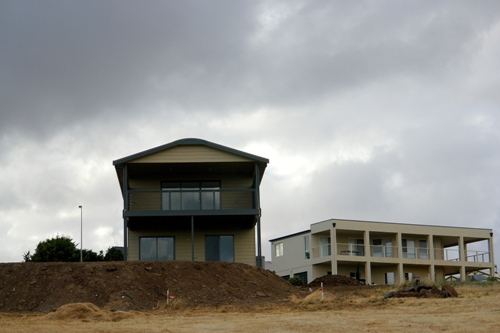 Gary Sauer-Thompson, Beach Houses, Encounter Bay, Victor Harbor, South Australia, 2008
So photography has two faces: mimesis or abstraction. Low and high. Commerce and art. And so we return to the conventional 19th century opposition between pure art and the sordid world of commerce and industry--- a cliché that still animates much talk about contemporary arts and cultural industries policy.
So we have various Arts Councils drawing lines between what should and should not be funded based around the extent of commercialisation. The roots of this are deep, going back to early modernity with its roots in state's role in the twin processes of the civilisation of the masses or the industrial working class and the legitimation of the nation-state in mass democracy.The other face was a fear of the dilution of high culture as it was spread across a semi-literate mass and the fear that the rise of the dangerous classes would produce anarchy.
Underneath culture was the rise of mass education along withgrowing spending power and disposable leisure time combine with a range of technological and business innovations that produced a new wave of cultural production and consumption that included photography that took its bearings from painting.
December 21, 2008
Landsat: Death Valley
It's been a while since I've looked at the archive of Landsat images of Earth from space. From memory I had been exploring the earth as art archive.
This image is of Death Valley, which lies between the Panamint and Amargosa mountain ranges in eastern California. The valley is the lowest, driest and hottest place in the United States.
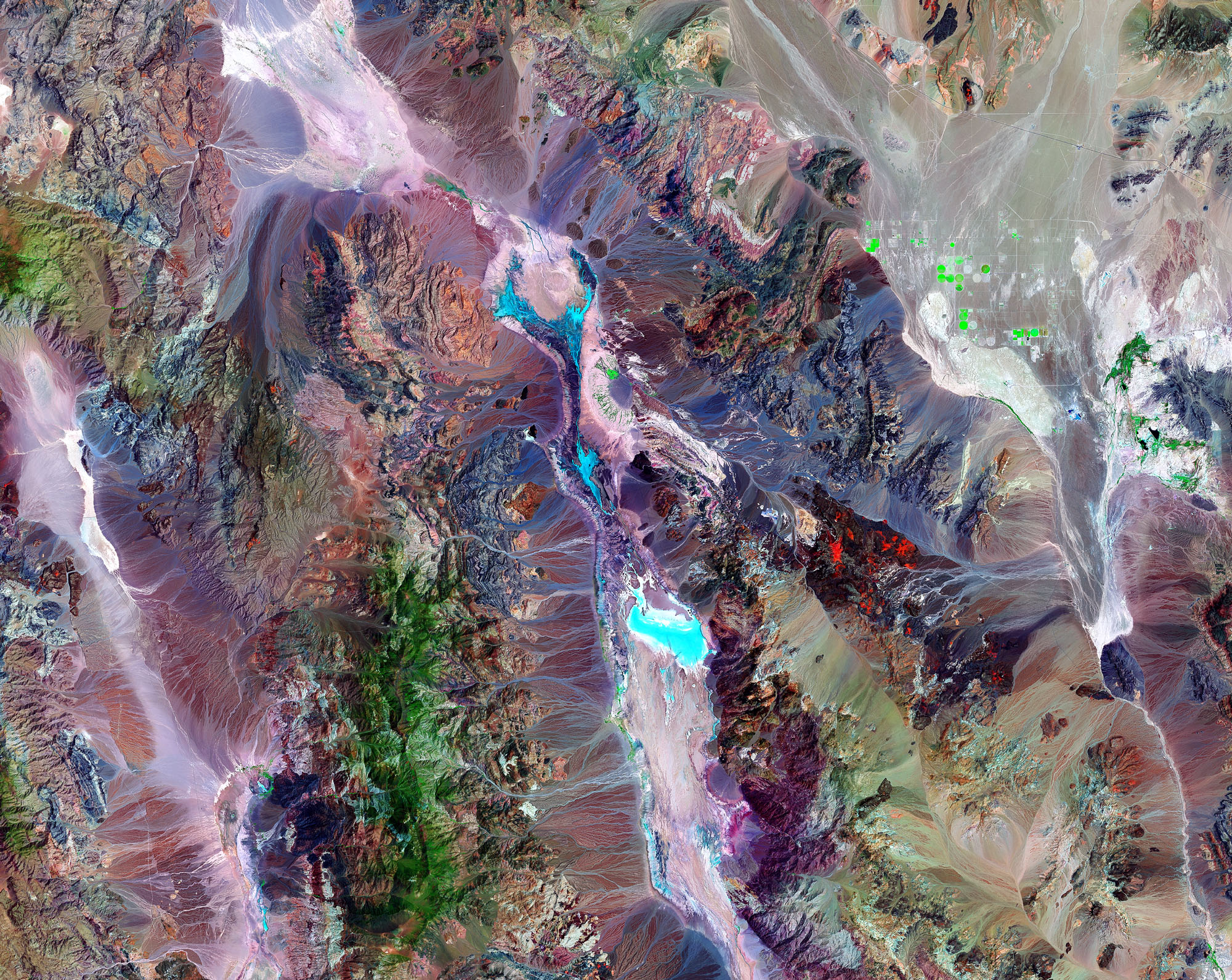 Landsat, Death Valley, California
Landsat reinforces the conventional view that conventional photography is the result of a mechanical process--- as a mechanical eye to be used for the replication of facts---and so the creativity in the work is minimal. In reponse, many photographers reduce aesthetics to technique and craft; whilst others deny that photography has any connection to asethetics despite many Landsat image having 'significiant form' and rely on a lot of computer post processing.
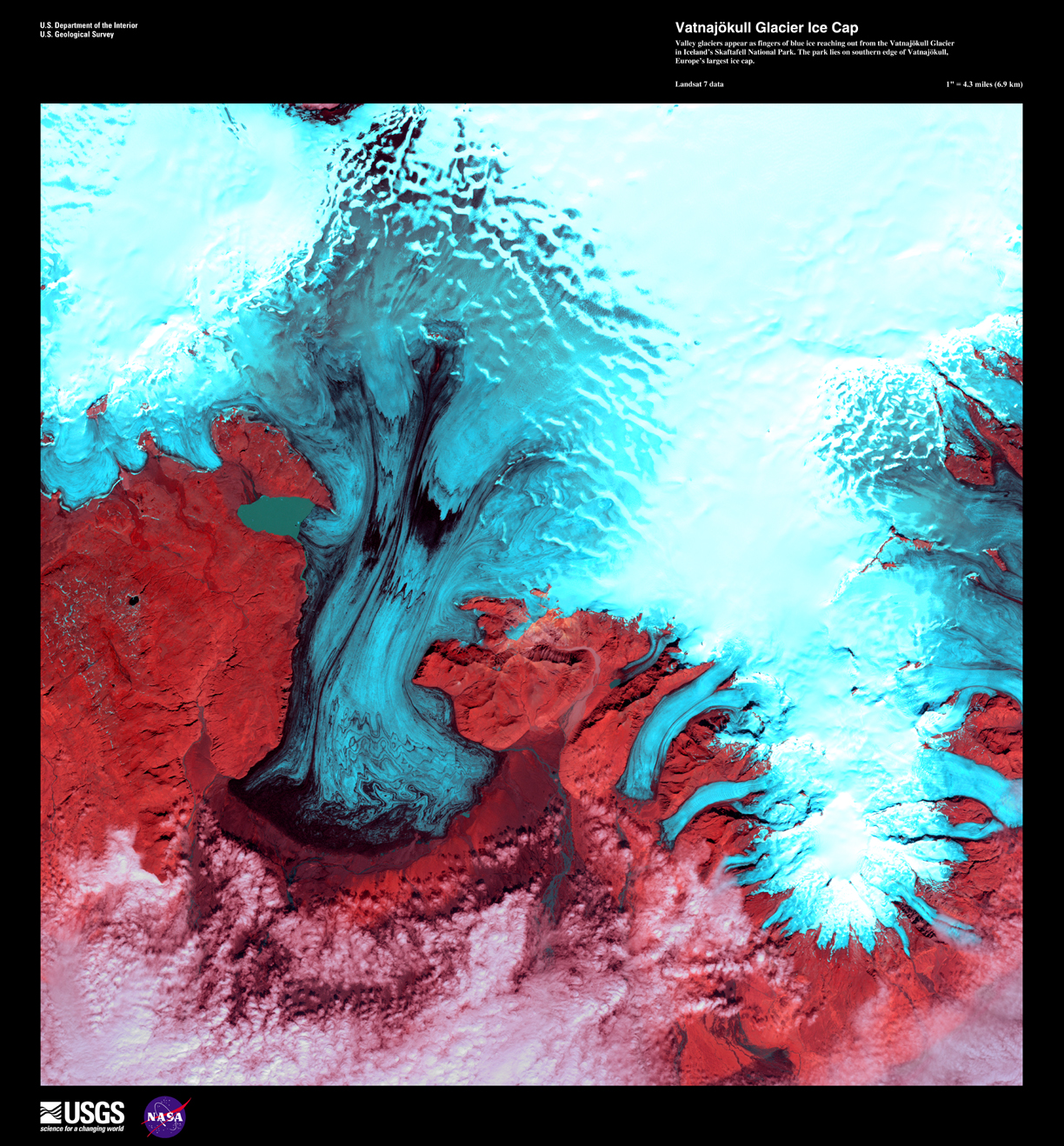 Landsat, Vatnajukull Glacier Ice Cap, Skaftafell National Park, Iceland, 1999
A core issue in this kind of discussion is the idea of science as objective and art as subjective and so on. Tis much better to argue that all images, including scientific images, should be analysied, critiqued, as part of visual culture studies that recognizes recognizes the predominance of visual forms of media, communication, and information in the postmodern world. Our experience of culturally meaningful visual content is that it appears in multiple forms, and visual content and codes migrate from one form to another:
print images and graphic design
TV and cable TV
film and video in all interfaces and playback/display technologies
computer interfaces and software design
Internet/Web as a visual platform
digital multimedia
advertising in all media (a true cross-media institution)
fine art and photography
fashion
architecture, design, and urban design
We learn the codes for each form and code switch among the media and the "high" and "low" culture forms. Our experience of images today mainly through photographic means, or images encoded as photographs. and we erecognize that digital images now dominate production of images in every medium. We ar emoving into an era of "post-photography" photography in which images and film imitate photography and camera-based images, but are entirely digital in composition and viewable output.
December 19, 2008
rocks, photography and surrealism
An interesting article in the Tate Online Research Journal by Ian Walker about the surrealism' of natural form and the tendency to interpret them close anthropomorphically. My interest was attracted by the association of rocks and surrealism.
It is an art history article about Eileen Agar, the rocks of Ploumanac'h in Brittany and English surrealism in the 1930s. I know very little about the English Surrealist Group other than it being marginal and dismissed as foreign rubbish.
Agar interpreted the rocks as heads and faces, bodies and monsters. The unconscious, images chosen from free association and dreams, and the process of automatism. does not seem to have been a part of the configuration. The cultural insights of Freud's dream narrative techniques and his analysis of unconsciousness mental life do not appear play a role in this photography. Hence the term 'natural surrealism' is used for this photography work.
It is unclear why they are surrealist--because they disclose the illogical and the absurd through imaginative juxtaposition---eg., a fur-lined cup?To divorce the art-historical movement known as Surrealism from its Freudian underpinnings is to no longer have Surrealism---surrealism is representations of libidinal repression.
I appreciate that he French surrealists interpreted Atget's images of vanished Paris as the spontaneous visions of an urban primitive—the Henri Rousseau of the camera, and not as the work of a competent professional or a self-conscious artist but as the spontaneous visions of an urban primitive—the Henri Rousseau of the camera. In Atget's photographs of the deserted streets of old Paris and of shop windows haunted by elegant mannequins, the Surrealists recognized their own vision of the city as a "dream capital," an urban labyrinth of memory and desire.
December 18, 2008
Australian Photojournalist
The Australian Photojournalist is news to me. It is an annual journal, published through Griffith University's Queensland College of Art, that seeks to address issues affecting journalists but more specifically photojournalists concerned with visual storytelling.
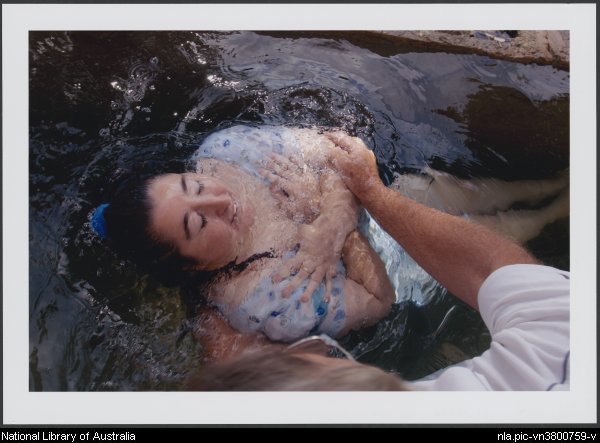 Michael Coyne, Koryn Karner is baptised with a full emersion at the Numurkah Gospel Fellowship Centre, Victoria, from Numurkah Lakes + Roses series 2006
I haven't seen the 192-page full-colour annual hardcopy publication--a preview. The publication has a low profile and is unable to pay for the work submitted from established photojournalists working around the globe.
How do the photojournalists survive financially once they have graduated from Griffith with the requisite media/craft skills when journalism is on the skids as a result of the collapse of the business newspaper model? Who would employ photojournalists in Australia? Which newspaper? Go freelance and sell pictures to the global print magazines? Aspire to become an established photojournalists like Michael Coyne working on assignment for prestigious international magazines with solo and group exhibitions in art galleries based on 19th century collection practices within a modernist regime of the image?
The emphasis on 'the printed book' is surprising given the existence of the digital mediascape that we now live in with its real-time computing. Nowadays most forms of mass media, television, recorded music and film are produced and even distributed digitally; and these media are beginning to converge with digital forms, such as the Internet, the World Wide Web, and video games whose assemblage forms a digital mediascape.
Words without Pictures
The excellent Words without Pictures has closed for the year. We have the archive to dig around in. Christopher Bedford's essay, Qualifying Photography as Art, or, Is Photography All It Can Be?, explores the way curators in the art institution approach photography.
Bedford says that the majority of art critics writing today lack the requisite descriptive vocabulary and technical understanding to account for and evaluate the appearance of a photograph, and to relate those observations to the critical rhetoric of the image. He says that photographers who instrumentalize photography as one component of a broader visual practice have accrued far more critical and commercial traction than photographers who hue more closely to the essentialist, “observe and record” model of photography, simply because their work is more accessible and intelligible to art critics.
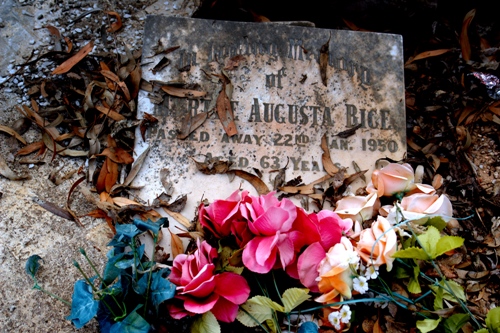 Gary Sauer-Thompson, Gravestone+flowers, 2008
Bedford explores this by way of Michael Fried, and his text on Thomas Demand. The reason is that Fried's art criticism defines the contours of late modernism in the visual arts. He says that Fried argues that the artist’s critical value issues directly from his resistance to the observational, documentary impulse.
The ultimate referent is not the form or content of his images, but the authorial concept:
Fried’s emphasis rests upon intention. For although we as an art critical community no longer use artistic intention—the most outmoded of methodologies—as the infra-logic for interpretation, we do place an implicit premium on intentionality, and we take it for granted that an object arrives in a gallery or museum saddled with some degree of authorial purpose, even if that intention does not figure vitally in the meaning of the work as enumerated by the viewer, critic, or scholar.
Fried's emphasis on the artist's pre-photographic processes leads the reader further and further away from the specific objecthood of the photograph, since the the photograph is not independently productive of meaning but since the photograph is the document that records and implies the extended process behind the image.
However, Bedford says that the absence of the artist’s hand in photography means that the much-
vaunted consonance (or dissonance) of subject and form, so often the lynchpin of successful painting and sculpture, is much harder to bear down on and evaluate in the case of a photograph. Bedford says that:
If photography is to be understood as a medium always and deliberately productive of meaning in the same sense as painting, this will require a rich and thorough understanding of the myriad decisions that precede the production of a photographic image, ranging from the conceptual and obtuse to the mundane and pragmatic. Such technical awareness is the necessary precondition for the production of art critical writing that operates with a full ontological awareness of photography as a unique medium.
Bedford's concern, for medium-specific, self-aware critical discourse will signal photography’s equal passage into the world of contemporary art, when there is a postmodern mixing of different media and the extensive use of Photoshop. Bedford still seems to be working within a late modernist discourse.
December 17, 2008
referencing graffiti
I couldn't resist this Moir cartoon about President Bush, Mt Rushmore and graffiti in the form of a stencil of Bush:
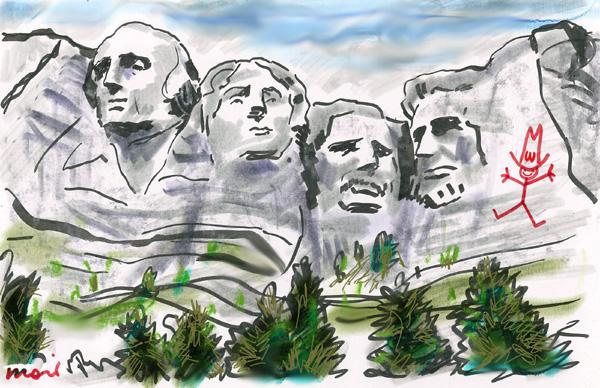
Graffiti--or street art --in public spaces has become part of our visual culture hasn't it--even though cultural conservatives rant and rage about it as a form of vandalism of private property. The latter refuse to acknowledge post-Graffiti, which distinguishes contemporary public-space artwork from territorial graffiti or vandalism. Most street artists in Adelaide see urban space as an untapped format for personal artwork.
December 16, 2008
Torrens Island Power Station
Power stations, especially coal fired ones, are in the news these days because of climate change caused by greenhouse gas emissions produced by the power stations. So is Mr 5%. The coal mining companies and coal based energy companies rule.

This photo of a gas-fired power station near Port Adelaide in South Australia is not about climate change. It is more conventional in that it highlights the negative effects on the environment (degradation of the landscape) due to industrialization from the perspective of Romanticism.
In this form of economic growth the environment is often seen as wasteland, if it lacks resources that can be exploited by industry through technology to make a profit. The only value is that of utlity and nature can be laid to waste if profits can be made and the majority benefit through jobs and increased GDP. Romanticism protests this market utilitarianism and the effects of industrialization on the environment.
The conventional view of Romanticism is this:
Romanticism introduced a new outlook on life that embraced emotion before rationality ..... Romanticism was a reactionary period of history when its seeds became planted in poetry, artwork and literature. The Romantics turned to the poet before the scientist to harbor their convictions (they found that the orderly, mechanistic universe that the Science thrived under was too narrow-minded, systematic and downright heartless in erms of feeling or emotional thought)...since most poets thrived on the emotional and irrational abstract that they were writing about, there was no specific category that this mode of thinking could fall into.
Romanticism, on this account, is seen as standing against the progress of liberal modernity rather than a critique of progress from within modernity. On the latter account the critique is from the perspective of human beings relationship to the natural world at the very time when the natural world was disappearing in Europe. The degradation of the landscape was central to the aesthetic concerns of the era.
Romanticism, on this alternative interpretation, was a response to the growing industrialization of Europe,as well as a reaction against the Neo-Classical style, and a revolt against traditional landed social order. They were critical of "the machine age", the mechanization of all aspects of life in industrial society, the effects of technological development on society and people, and the idea of progress in a liberal-capitalist order. It was held that industrialization separated (alienated) human beings from nature and that art and literature were a mode of expression for the loss of nature (paradise lost) and the yearning for a better relationship to nature than that of naked exploitation.
Romanticism resurfaced in the 1970s with the New Left (self-expressive freedom), the counter culture (return to nature and rejecting urbanization), the philosophical critiques of science (scientism) and technology, the rejection of modernism and environmentalism.
December 15, 2008
political courage
The first steps to a low carbon future are modest. Timid even. It is all about handouts to the polluting industries. So much for political courage.
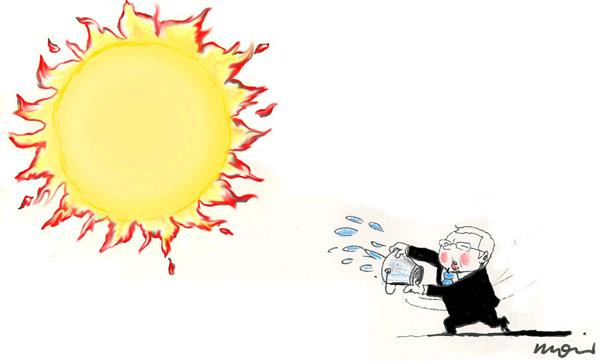
Writing in The Australian George Megalogenis says that:
Kevin Rudd’s carbon pollution reduction scheme is a form of cash-for-sacrifice. The risk in choosing to give households back more in handouts than the higher gas and electricity they will face under carbon trading is that the price signal is dulled beyond all meaning.
The modest targets and lack of investment in alternative energy will mean tougher conditions in the Murray-Darling Basin and kissing goodbye to the Great Barrier Reef. I'm not sure about the effect on the Kakadu wetlands.
Tougher conditions in the Murray Darling Basin means a new dry regime. Monthly inflows for the Murray system have been below average now for the past 37 consecutive months. For every degree centigrade rise in temperature you get a 15% reduction in stream inflows. The inflows are consistently lower than what the Murray-Darling Basin Commission plans for.
That means irrigated agriculture is going to take a massive hit. Do they realize what is coming? Or are they still thinking in drought terms?
December 14, 2008
photography and abstraction
The relations between photography and abstraction are complex and an integral part of its tradition in spite of the commitment to realism and its ontological ties to documentary. This makes it different from the art history conception of modernism as a flawed progress towards ever more purified abstraction and opticality and makes the most figurative and even traditional of photographic black and white languages appear “abstract”.

If abstraction is the removal of one or more aspects to allow the viewer to more closely focus on what you have kept, then in this sense monochrome photography is a form of abstraction: we remove the distraction of color to better concentrate on tone, line and shape.
The modernists assumed that the artist, as someone possessing advanced technical competence in the means of visual production, is, in the service of enlightenment, entrusted with the task of wrenching, tearing or cajoling the beholder's habits of perception out of their ossified, conventionalized, academicized and ultimately falsified norms. This assumption, has been undermined , with the professional definition of 'artist' shaped much less by any convictions about autonomy, special privileges or obligations, and much more by arts interweaving with a multifaceted and all-pervasive media culture, historical amnesia and the commodification of everyday life.
George Baker in Photography and Abstraction in Words and Pictures says that:
We need to rethink the great cliché that modernist art was engaged with the negative, the autonomous, and the abstract while postmodernism has signaled a massive return of popular and representational forms, a return to realism and figuration. Though the question of realism returns with pressing urgency in the moment of the postmodern, its traditional language cannot, no matter the desire of even the most sophisticated of critics to theorize the lineaments of an aesthetic project of "re-figuration" in the wake of modernism's repressions.
We photographers do seem to be stuck in the duality of pictorial abstraction or of documentary representation in a world of flow, overflow, and excess.
December 12, 2008
wheels, cars, cities
Leunig's cartoon about the wheel highlights the way the role of the car in changing our cites into roads, freeways and ring roads. The flow of the car is what has driven urban planning
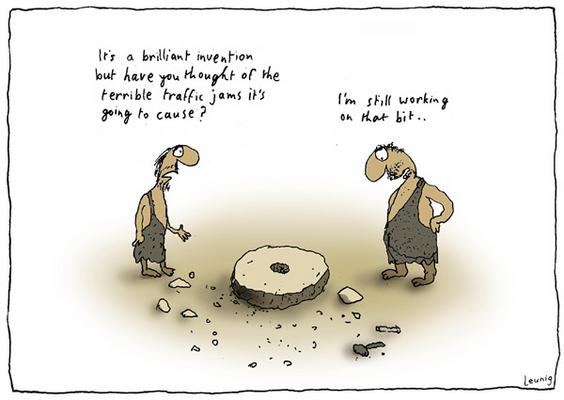
The public transport systems in our capitol cities just don't work well and commuters are becoming fed up with the creaking system. There have been years of under investment in public transport when around 80 to 90 per cent of spending was on roads, despite public transport being seen as a core responsibility of government by citizens. State governments now face a choice between significant public transport and new roads projects —since there is unlikely to be enough money for both.
So far they taken the roads agenda whilst spinning (empty promises) about the lack of priority for public transport despite the majority of low-income constituents, who live mainly in the outer and new growth suburbs, having no choice except to continue to run two or three cars in perpetuity if they want a life. What happens is that the old public transport proposal to the outer suburbs are continually rebadged to show that the state government is a can do government.
In reality developing the suburban rail network doesn't happen. New suburbs are planned without a transport plan. What we have are pretend public transport plans, lots of can do media releases and big advertising campaigns.
December 11, 2008
the temporality of photography
What we have inherited from 20th-Century art, both in its modernist and postmodernist or –if one prefers– in its avant-garde or post-avant-garde paradigms, is a dead weight: an opposition to realism, or at least with the term.
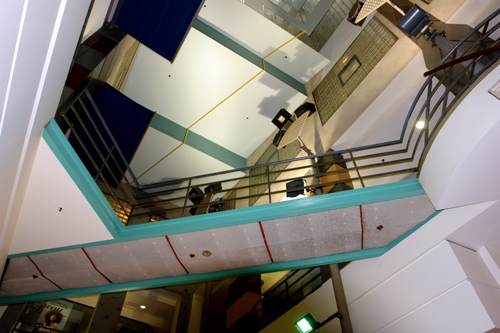 Gary Sauer-Thompson, Centre Way, Melbourne CBD, 2008
This tradition held that realism is incompatible with the basic features of what creative work and thinking in art is supposed to achieve: a distance toward reality itself, which art is not supposed to reproduce but to contest, to transform, and to supersede. Realism appears to go against the grain of a contemporary refusal of the canonical ways of presenting and representing (perspective in painting, narrative in literature, melody in music, and so on).
Art should be a constant challenge to explore the boundaries of the not yet known and realism does not seem to serve this project. Realism, therefore, was often relegated to the museum of –in the eyes of current thinking– pre-modern styles and devices, safely locked in the toolbox of 19th-Century art history. On the other side innovative art tended to be discarded and debunked as fetishistic, anti-social and even anti-democratic.
This aert history tradition is a dead weight because realism stood for a photographic realism’: the 19th-Century model of detail realism as the production of a mechanical replica. instead of one realism, a full-fledged history of variegated and competing meanings, interpretations and assessments of the concept of realism.It is a dead weight because it denied the possibility of innovation and realism; a seeking to understand the social reality by critically ‘making images and notes of it. In this middle ground, there is a multiformity of ways in which the photograph manifests itself in diverse artistic practices today and this has consequences for photography’s critical potential.
n the Introduction to the Time and Photography issues of Image and Narrative it is stated that:
In recent years, the research on the temporal aspects of photography has modified dramatically our conception of photography. At a theoretical level, the idea of photography as being primarily a “slice of time” (snapshot, decisive moment) has been deconstructed and replaced by a more complex vision in which time and space interact. At a practical level, artists, practitioners and scholars have rediscovered the more ‘spatial‘ forms of photographing (panorama photography, photo finish photography, strip photography). More generally speaking, we are now moving away from a vision of photography that is determined by pictorial models, both historically (photography is no longer the little sister of painting) and technically (photography has freed itself from the model of Western perspective).
Photography is finally stepping out of the shadows of art history as a new conception of photography forming that trangresses both modernist art photography (the medium-specificity of photography) and the realism of documentary photography(mimesis).
December 10, 2008
picture anxiety
Via page 291 I stumbled upon 1000 Words, an online photography magazine with its own blog. This increased presence of photography in a digital world is part of the turn to visuality that brings visual culture into the foreground.
From this digital perspective what Deleuze called the object of encounter is the anti-image tradition that set its face so resolutely against the image. The image in this tradition was seen as something so seductive and false that we needed to unmask and turn away from it. The pictures that lie in our language hold us captive. This object of encounter challenges out typical way of being in the world and disrupts our forms of thought.
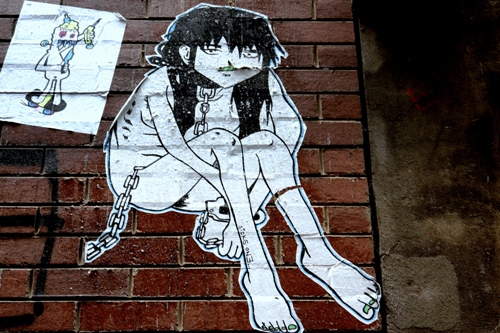 Gary Sauer-Thompson, Hosier Lane, Melbourne, 2008
The different streams in this anti-image tradition---eg., the ideology critique of mass culture; philosophy's antipathy to the image; the cultural dominance of linear writing --- seem to express a fear or anxiety about image that often results in traditional image destruction or the disfiguring of an image. The "pictorial turn" was seen as threatening traditional modes of knowledge, as behavior-threatening, and as an atavistic return to tribalism, irrationality, superstition, illiteracy. This is definitely seeing and thinking the world differently.
A classic example of this expression of anxiety is the 19th century literary and art hostility to the earlier pictorial turn based in photography and mechanical reproduction of images. A similar anxiety is happening with the digital shift and the computer processing of pictures.
There are a lot of prejudices that are built into people’s attitudes about visual culture, imaging, visual experience; as well as images and visuality becoming a specific point of irritation in contemporary theory, an unsolved problem or anomaly. The prejudices and anxiety are associated with being taken in --seduced---by an image.
This object of encounter forces us to think otherwise.
December 9, 2008
towards e-books
I've been considering building two of my embryonic photography projects---on the River Murray and Port Adelaide ---- into electronic books with text and photographs. That requires special software. What sort?
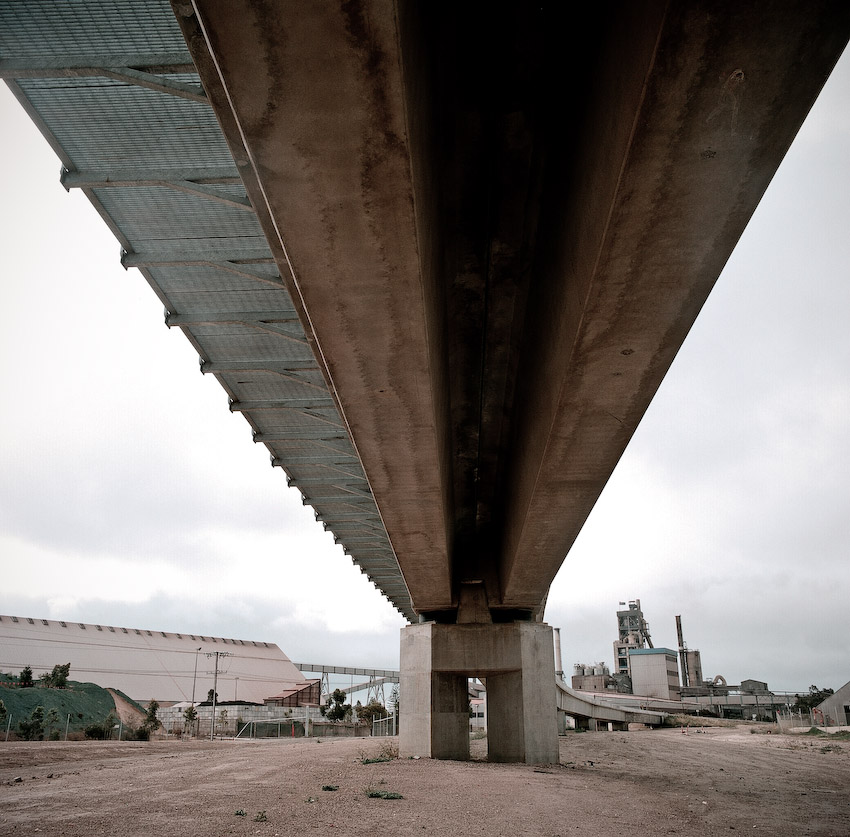 Gary Sauer-Thompson, Port Adelaide, South Australia, 2008
I'm not sure how to go about creating an e-photobook with text. But it is the next step, as I have some text and pictures that explore image-text relations viewed as a site of conflict. It is the conflict that is crucial given the development versus the environment struggle that has been played out in these two projects. So the nexus is where political, institutional, and social antagonisms play themselves out in the materiality of representation.
Theorists, such as W. J. T. Mitchell in Picture Theory: Essays on Visual and Verbal Representation, argue that the postmodern mode of representation is one which represses language and absorbs it into image. According to Mitchell we live in a culture dominated by pictorial image, yet we remain unable to understand the power of the picture, even though the pictures themselves form a point or site of friction and discomfort.
Consequently, we need to avoid the tacit binary theories of the Image/text" relation: the photographers and visual artists who reduce every to image and make the text empty and those in the literary world who see the image as an illustration of the text. Each is a black hole for the other. Thus photographs were once seen to just look like the world: we can see what a picture is of without having to learn any codes---a naïve mimesis, copy or correspondence theories of representation, or a renewed metaphysics of pictorial ‘presence’ in which the picture has the capacity to transport a viewer to a state of being that both precedes and elides language.
If the dominant theory in our culture is a too linguistic interpretation of images that hinders "visual literacy", then we need to begin from the tensions and paradoxes that exist between visual and verbal representations in the mass-circulated global corporate culture in which we now find ourselves.
December 8, 2008
urbanity in Melbourne
Is this cartoon a working definition of Robert Doyle's understanding of urbanity---the urban renaissance model of polished architectures, fine stores and coffee tables in the streets are mostly catering to gentrifiers and tourists, and where a strong surveillance through cameras and police guards is constantly needed to keep the working class in its place? This is what makes Melbourne a "happening" place.
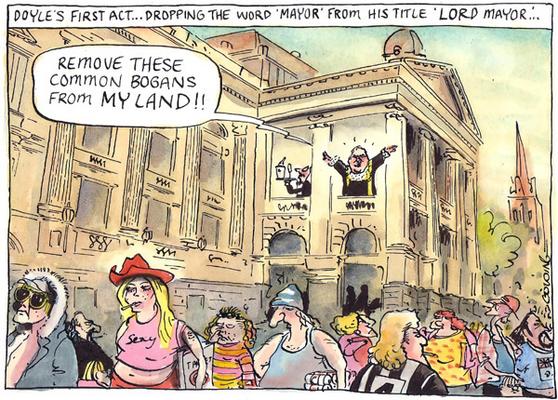 Matt Golding
In bringing back the cars Doyle expresses a contempt for the urbanity of the street. Behind it sits the desire to address weekend alcohol-related violence by restricting alcohol supply, 2am lockouts and providing Hummers for the police.
December 7, 2008
Scorsese's Gangs of New York
I watched a DVD of Martin Scorsese's rather conventional historical Gangs of New York (2002) last night. It is a complex film about about gang warfare and draft riots in the Five Points area of New York's Lower East Side during the Civil War era. The conventional narrative of revenge, the set design, period detail and gang warfare is framed by the violence giving birth to New York city and the American government's violent mistreatment of immigrant citizen. America as a political utopia transformed into a society ruled by violence, fear and corruption.

The era it explores the New York netherworld of 1862-63 – is one I know little about. Nor did I know about the Five Points area or the multifarious gangs – the Forty Thieves, the Dead Rabbits, the Bowery Boys et al – that fought savage street battles for possession of it.
I was reminded me of the work of Jacob Riis, a journalist and photographer of industrial America and a Danish immigrant. who exposed the deplorable conditions of late nineteenth-century urban life in his widely-read book, How the Other Half Lives.
Gangs of New York is not simply about street gang violence in the 1860s or a son's revenge quest. The gang warfare mushroom into a political movement on behalf of Irish immigrants, who turn in full force against their nativist enemies only to be steamrolled by the chaos and carnage of the riots of 1863 when the army and navy fired upon civilians, blacks were lynched from lampposts and the city went up in flames.
Scorsese's romanticized vision of gang warfare as a prelude to melting-pot patriotism is harder to buy, as we are watching a Western with its gestures Leone or Ford even if the film is set in New York. The core is still the archetypal characters of epic melodrama: the martyred father, the avenging son, the charismatic villain, the duplicitous friend, the beautiful and penitent betrayer and the theme of murder, revenge and redemption.
As Chuck Rudolph notes in Slant the end is interesting one. The film ends with a graveyard in the foreground and the skyline of Manhattan in the distance. The latter expands to tower over its surroundings while the graves of the slowly become smaller. As the history of New New York flashes by the past shrinks away. The history of the cinema is shown with computer effects and digital projection technology overwhelming the once-important record of the medium—the old reels of celluloid. So we are left with the memories of those who were lucky enough to catch a glimpse of the past.
December 4, 2008
debris, Yarra River
An image of rubbish or debris floating in Melbourne's iconic river near Swanston Street Bridge:

Terrible we say. It is wrong to throw rubbish into the river as if it were a drain or sewer. There is rubbish or litter everywhere in the city. People should clean it up and take more care or responsibility for their rubbish.
Isn't our consumer society based on excess, disposables and waste? Some argue that we should reduce our consumption. Maybe we need a different way of relating to the waste we produce than moral condemnation that makes people feel guilty?
This review of The Ethics of Waste: How We Relate to Rubbish by Gay Hawkins does this in terms of a micro-politics that illuminates human complex relations with waste and explores the intricacies of our relatedness to waste.
In this piece Hawkins points out that the Productivity Commission has argued that 'Governments and retailers should not proceed with their foreshadowed plan to eliminate plastic bags by the end of 2008 unless its supported by a transparent cost-benefit analysis. The analysis should clarify the problems the ban would seek to address, the response of the community to a ban, and whether or not alternatives - such as tough anti-litter laws and a means for encouraging greater community participation in controlling litter -would achieve better outcomes for the community.'
Though plastic bags weren't really a problem for the Productivity Commission people have made the switch to using green bags and cutting down on the use of plastic bags for shopping. This indicates that a new ethics or set of values about waste is emerging that says economic benefit--profit--isn't the only value.
December 3, 2008
Melbourne: Doyle, urban life, waste
Local council elections took place on the weekend that I was in Melbourne and the new Melbourne mayor is one Robert Doyle, the ex-Victorian Liberal party Leader. His policies to improve Melbourne as a mode of urban life are pretty thin and signify a return to the past.
Doyle wants to reopen Swanston Street to cars, ban bad buskers, stop the city being a bogan magnet, and banning tram super stops that have handed more of the city back to public transport users. I was surprised there was nothing about banning graffiti or photographers taking photos on the city streets from this conservatism.
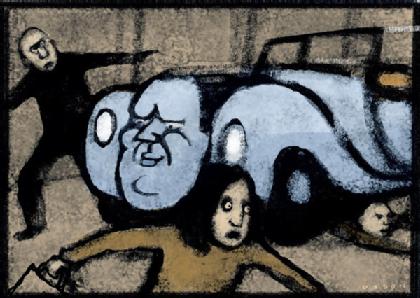 Andrew Dyson
Doyle's model of city life is the modernist American one with its predominant focus on business and financial activities — at the expense of retail, entertainment and residential uses; with transport access primarily by car; and all the people centres dispersed to the suburbs.
As with the Liberal mayor in Adelaide Doyle rejects the European model of urban life based around city centres for people by encouraging people to live, shop and recreate in the city. Access by public transport and bicycle was encouraged and by car discouraged. Pedestrian malls were widely developed and business and financial uses ware required to fit into the urban fabric in a sympathetic way.
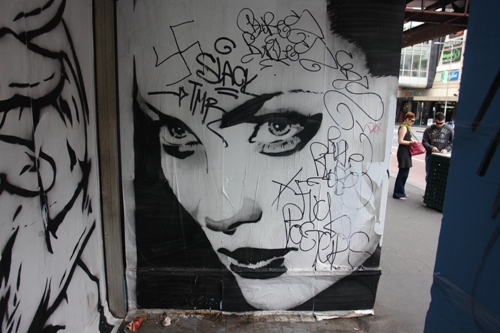 Gary Sauer-Thompson, waste, Lonsdale Street, Melbourne, 2008
What is attractive about Melbourne--the rollback of the car to make the city more people friendly--- is what Doyle is attacking. Amazing. It's the same in Adelaide, despite more people coming to live in the city.
Sadly, under the Brumby Labor Government, Melbourne is retreating from its attempts to contain suburban sprawl on the urban fringe and high-density building in the middle suburbs. The defining principles of its Melbourne 2030 metropolitan plan (2002) were a clear urban growth boundary, development centres with medium to high-density housing dispersed across the metropolitan area and the preservation of green wedges.
The Brumby Labor Government has also appears to have retreated from a greater investment in public transport despite the choked freeways.
December 2, 2008
Mars: glaciers?
it is suggested that this unusual terrain on Mars signifies huge glaciers of buried ice.--These floors of several mid-latitude crater in Hellas Basin on Mars, which appear unusually grooved, flat, and shallow, may indicate the largest volume of water ice outside of the Martian poles.

How the glacier on Mars originally formed remains a mystery. The rocky debris blanket topping the glaciers apparently has protected the ice from vaporizing, which would happen if it were exposed to the atmosphere at these latitudes.
December 1, 2008
Melbourne airport 7am
I spent the weekend in Melbourne, flying in on Saturday morning and returning to Canberra on Monday evening. It was a work and family weekend with a Sunday lunch at a winery on the Mornington Peninsula.

I managed do some photography on Saturday morning before work. On Sunday morning I checked out the lanes ways before taking in the Andreas Gursky exhibition with Barbara Fischer from the Melbourne Flickr group and we shared a coffee afterwards. The time in the Melbourne CBD was all too short.
I only had little chance to do some photography at Safety Beach on the Mornington Peninsula. Melbourne for me is about the street life in the metropolis and the street art in the laneways, and, for some reason, I kept on thinking about Ernest Ludwig Kirchner's expressionist Berlin street paintings. It wasn't as if I was seeing the emerging urban ethos of surfacing repressed desire, primitive figurative form, style (hats, feathers and furs) or the decadence of modernity on the Melbourne streets:
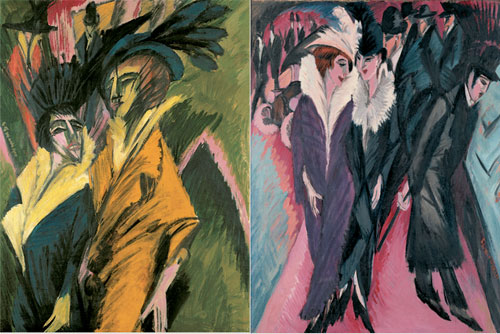 Ernest Ludwig Kirchner, The Berlin Street, circa 1913--1915, Oil on canvas
Kirchner's paintings express the contradictions of the modern European city life in a period of rapid change and development. just before WW1. Nighttime and daytime glamour face loneliness and decadence, with prostitutes (Kokotten) present in many of his works of art. He expresses the raw energy, vitality and eroticism in the Berlin streets, coupled with feelings of alienation, which become a metaphor for the autonomous metropolitan life.
It was the sense of space (receding trriangles) and colours that came back to me---the pinks, greens and yellows and shades of charcoal black.