|
December 18, 2008
The excellent Words without Pictures has closed for the year. We have the archive to dig around in. Christopher Bedford's essay, Qualifying Photography as Art, or, Is Photography All It Can Be?, explores the way curators in the art institution approach photography.
Bedford says that the majority of art critics writing today lack the requisite descriptive vocabulary and technical understanding to account for and evaluate the appearance of a photograph, and to relate those observations to the critical rhetoric of the image. He says that photographers who instrumentalize photography as one component of a broader visual practice have accrued far more critical and commercial traction than photographers who hue more closely to the essentialist, “observe and record” model of photography, simply because their work is more accessible and intelligible to art critics.
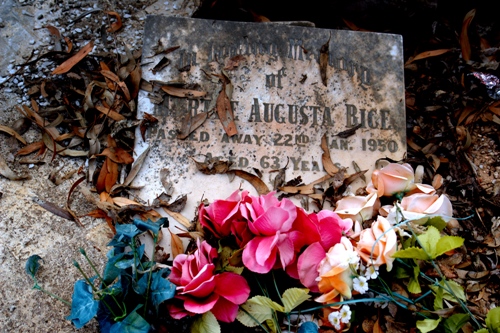 Gary Sauer-Thompson, Gravestone+flowers, 2008
Bedford explores this by way of Michael Fried, and his text on Thomas Demand. The reason is that Fried's art criticism defines the contours of late modernism in the visual arts. He says that Fried argues that the artist’s critical value issues directly from his resistance to the observational, documentary impulse.
The ultimate referent is not the form or content of his images, but the authorial concept:
Fried’s emphasis rests upon intention. For although we as an art critical community no longer use artistic intention—the most outmoded of methodologies—as the infra-logic for interpretation, we do place an implicit premium on intentionality, and we take it for granted that an object arrives in a gallery or museum saddled with some degree of authorial purpose, even if that intention does not figure vitally in the meaning of the work as enumerated by the viewer, critic, or scholar.
Fried's emphasis on the artist's pre-photographic processes leads the reader further and further away from the specific objecthood of the photograph, since the the photograph is not independently productive of meaning but since the photograph is the document that records and implies the extended process behind the image.
However, Bedford says that the absence of the artist’s hand in photography means that the much-
vaunted consonance (or dissonance) of subject and form, so often the lynchpin of successful painting and sculpture, is much harder to bear down on and evaluate in the case of a photograph. Bedford says that:
If photography is to be understood as a medium always and deliberately productive of meaning in the same sense as painting, this will require a rich and thorough understanding of the myriad decisions that precede the production of a photographic image, ranging from the conceptual and obtuse to the mundane and pragmatic. Such technical awareness is the necessary precondition for the production of art critical writing that operates with a full ontological awareness of photography as a unique medium.
Bedford's concern, for medium-specific, self-aware critical discourse will signal photography’s equal passage into the world of contemporary art, when there is a postmodern mixing of different media and the extensive use of Photoshop. Bedford still seems to be working within a late modernist discourse.
|


A lot of analysis from art curators within the art institution sounds conservative. A defence of the old even as it is becoming ever more apparent that we are experiencing the dissolution of an western art historical narrative that has been at the basis of most theories of modern art.
This means not only the end of the traditional dialectic between mass culture and modernism but also of the mantra of the "dissolution" of the border between them.
We are also experiencing the breaking up of the mono-cultures of nation states that previously contained the high-low dialectic, and whose downfalls mark the end of the idea of a unified public space, now mutating into proliferating sub-systems.
The digital culture we now live in was hard to imagine even twenty years ago, when the Internet was hardly used outside science departments, interactive multimedia was just becoming possible, CDs were a novelty, mobile phones unwieldy luxuries and the World Wide Web did not exist. The social and cultural transformations made possible by these technologies are immense and they open up all sorts of spcaces and possibilities.