|
December 18, 2008
The Australian Photojournalist is news to me. It is an annual journal, published through Griffith University's Queensland College of Art, that seeks to address issues affecting journalists but more specifically photojournalists concerned with visual storytelling.
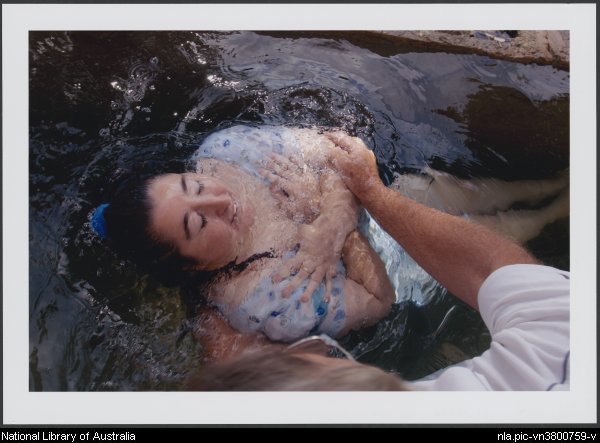 Michael Coyne, Koryn Karner is baptised with a full emersion at the Numurkah Gospel Fellowship Centre, Victoria, from Numurkah Lakes + Roses series 2006
I haven't seen the 192-page full-colour annual hardcopy publication--a preview. The publication has a low profile and is unable to pay for the work submitted from established photojournalists working around the globe.
How do the photojournalists survive financially once they have graduated from Griffith with the requisite media/craft skills when journalism is on the skids as a result of the collapse of the business newspaper model? Who would employ photojournalists in Australia? Which newspaper? Go freelance and sell pictures to the global print magazines? Aspire to become an established photojournalists like Michael Coyne working on assignment for prestigious international magazines with solo and group exhibitions in art galleries based on 19th century collection practices within a modernist regime of the image?
The emphasis on 'the printed book' is surprising given the existence of the digital mediascape that we now live in with its real-time computing. Nowadays most forms of mass media, television, recorded music and film are produced and even distributed digitally; and these media are beginning to converge with digital forms, such as the Internet, the World Wide Web, and video games whose assemblage forms a digital mediascape.
|


Photojournalism exists in a world of its own that has little to do with the art institution. Though it appears in art galleries it is more associated with the mass media, story telling, truth and the photographic image's privileged status as document. The document is placed in opposition to both the romantics emphasis on exploring the subjective space of the imagination and a modernist or formalist artistic practice with its assumption of a self-contained object.
Photojournalism has become isolated through the reception of photography in the art institution. Throughout the 1970s and 1980s, photography in art was aligned with a variety of radical avant-garde practices that sought to disrupt traditional modes of aesthetic appreciation. The more recent generation of photographers, such as Jeff Wall or Thomas Struth, clearly no longer have such anti-aesthetic ends in view. Their work is usually approached through categories that apply more generally to pictorial arts such as painting (style, expression, originality, depiction, intention, and the like).