August 31, 2006
Look both ways
I've just watched Melbourne-based animator Sarah Watt's first film--- Look Both Ways on DVD. It sensitively and wittily explores snippets of the interwoven lives of a number of damaged people over one hot weekend in Adelaide down amongst the decrepit Semaphore/Port Adelaide back streets The sense of local atmosphere, light, dryness and heat haze was recognizable as an Adelaide heatwave---40+ degrees. The fates of the people's messy lives are woven around a single train incident; the film is grounded in familiar detail textured with and lots of meaning.
Though it is saying that confronting cancer death and mortality gives meaning to life through an affirmation of life, the film highlights awkwardnesses surrounding cancer and death, our emotional clumsiness and unease in knowing what or when to express ourselves. Sometimes it came close to saying that it's the silences that speak most strongly.
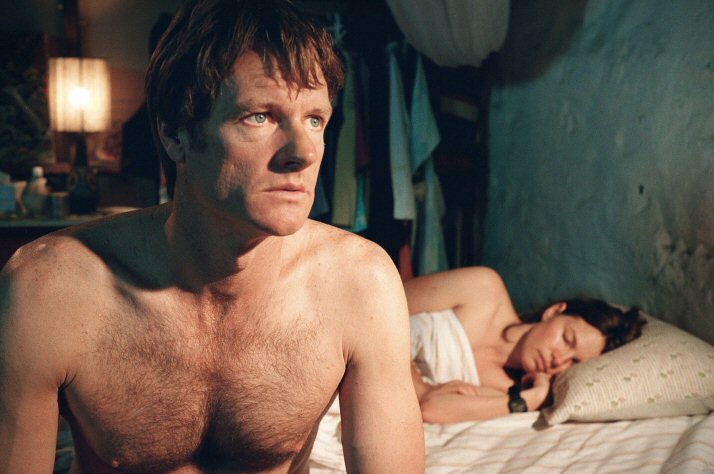
What I loved was the use of animation Meryl and Nick imagine all kinds of disasters and they're visualised in animated form both painterly images of fear and photomontage images of memories. Finally we see people thinking visually in response to events in their everyday lives.
A romantic comedy it is not.
August 30, 2006
"Jihad Jack"
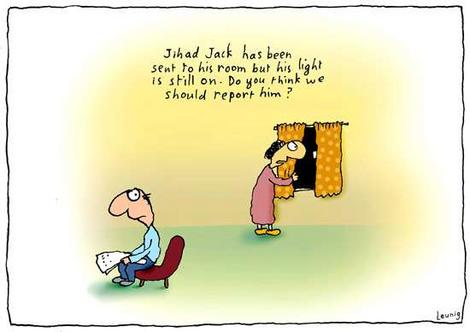
We have the construction of the infamous "Jihad Jack" as some kind of terrorist threat to the national community.
Leunig
Jack Thomas has been judged by the courts not to have been a terrorist. In February, a jury acquitted Thomas of the two main charges of providing support to a terrorist organisation. On August 18, the Court of Appeal ruled unanimously that the interview (in Pakistan) was made involuntarily and should never have been admitted by the trial judge. So the Courts squashed Thomas' convictions and he was made a free man. So he is not "Jihad Jack" the the homegrown terrorist.
But the myth of Jihad Jack , fostered by the tabloid media, has taken hold in the community. The media myth of "Jihad Jack" Thomas as a villain enables us to cope with the fear and anxiety caused by terrorism. e need myths to cope with rawness of the 'war on terror.'
August 29, 2006
(returning to) Brett Whiteley
This painting was awarded the Archibald Prize in 1976, one of several Archibald prizes Brett Whiteley won in the 1970s. There is no doubt that the genre of portraiture-- and the Archibald Prize---make a cosy home for celebrity in its many forms. The art world is now romantically intertwined with celebrity but Whiteley was a celebrity in his own right; on who expressed a rise in affluent lifestyles and upwardly mobile, middle class aspirations of edgy inner city professionals.
Whiteley's 'Self Portrait in Studio ' is one of my favourite portrait paintings---the artist in his world--- and the work makes the case against those who argue for the triumphant mediocrity in Australian culture and those tabloid folk who decry the elitism of high art and celebrate the commercial enterprise of the culture industry.

Brett Whiteley, Self Portrait in Studio, 1976
I have yet to visit the Brett Whiteley Studio in Sydeny. The self-portrait is seemingly reduced to Whiteley's face reflected in a hand mirror within the vast expanse of his studio at Lavender Bay overlooking the harbour (on the top left). The reflection in a mirror is at the bottom of the picture. The painting is primarily a look at his studio and its collection of objects and is painted in deep, bluish tones. I just love the fluidity of the drawing and the virtuosity of the draughtsmanship.
This portrait stands in contrast the mediocrity---or awfulness?---of the Van Gogh series of art and social politics t exploring drugs, visual experience and musical jams:
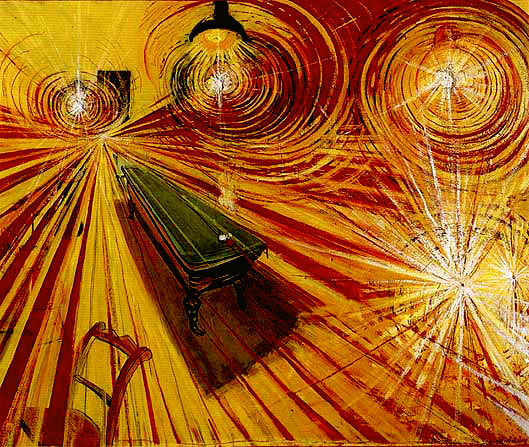
Brett Whiteley, Night Cafe, 1972
Brett Whiteley is the exception to the rule that most late 20th century art is not popular in Australia. Whiteley turned his back on the dominant mode of 20th century art, abstraction and became a key figure in the contemporary Australian canon. As modernism gave way to post modernism in the 1980s, and the explosion of commodification that influenced aspects of everyday life with the individual re-emerging as the ultimate product, Whiteley the 'burned out' artist eventually became commodified. His latter works were judged to be 'tired, overpriced and lazy' rather than a form of culture jamming.
It's a returning to Whiteley by going through the 1990s---- a decade marked by the ascendancy of right-wing
politics, globalisation, free-market trade, the rise of new media technologies and cyber networks and a return to beauty. The decade also witnessed the deregulation of art and the rise of the curator to the sometimes contentious stature of blockbuster or superstar producer in their own right, a status previously unrealised in contemporary art
August 28, 2006
suburban living
Is the postwar suburban home in outer suburbia becoming a historical mode of life? Will the effect of increasing house prices, car dependency, higher petrol prices, higher interest rates, and ever more toll roads be increasing urban consolidation? Is the suburbian dream coming to an end? Will people begin to fall out of love with suburban sprawl and backyards?
Not so say the free market conservatives, such as the IPA. Increasing housing prices, they argue, are primarily due to the failure of state ALP governments to release land. This increases housing prices and causes mortgage pain. The reason for this is that state Labor governments are beholden to urban planners and environmental activists who have contributed to the crisis by making urban sprawl a dirty word. These the latte-sipping, inner-city greenies, living in their renovated terraces, are opposed to urban sprawl ,and they hate the ordinary Australians aspiration to realize the suburban dream. Their urban consolidation interfers with the lives of the asspirational-class, prevents ordinary people from exercising choice, and stops homowners living and working where they like.
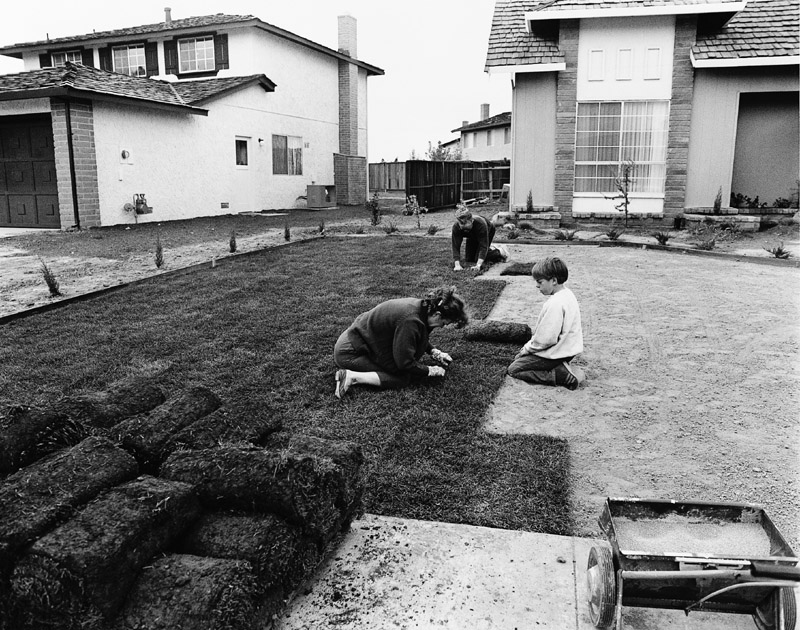
Bill Owen, From the series Suburbia, 1973
The above conservative talking point was what I heard from Wendell Cox on Stateline in Adelaide on Friday night as he attacked those who argue that road congestion can be reduced through improving urban public transport. The limited land release scenario may make sense in Sydney where there has been deliberate land restrictions but not in Adelaide. The cost of land has trebled in Adelaide but land supply has been pretty good. So costly infrastructure on greenfield sites, slow planning and development approval processes, inefficient tax regimes, and poor governance are also aspects of the affordability equation.
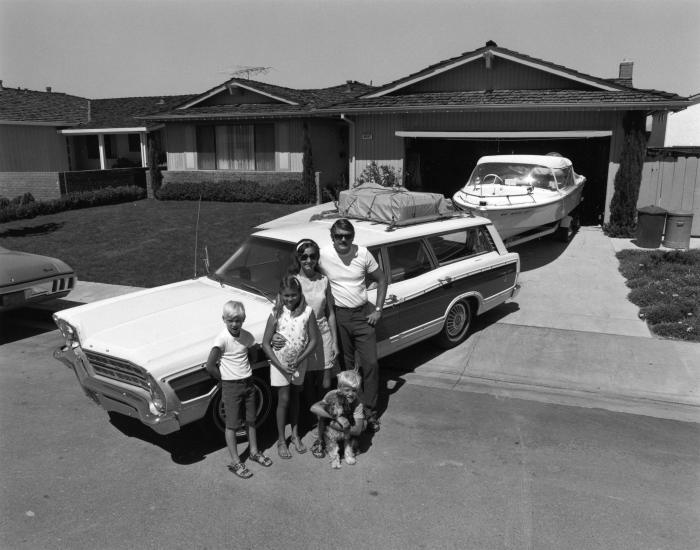
Bill Owen, From the series Suburbia, 1973
Cox came across as an idealogue (a rightwing libertarian) opposed to smart urban growth and the new urbanism He sounded like a hired gun when he argued that modern light rail and commuter rail systems are a profoundly misguided waste of public money.
Adelaide is proposing to extend its tram line through the city and Cox came across as the attack dog for the groups (Liberal Party) opposing this public transportation project. His argument, that urban consolidation is actually bad for the environment, made little sense.
August 27, 2006
Clarence John Laughlin
The two images below are from the work of Clarence John Laughlin, a southern American photographer who lived in the first part of the 20th century.

Clarence John Laughlin, Woman Reflected in a Mirror, 1938
You can see why he is characterised as part of the surrealist movement. But he is more than that. He wrote that "Everything, everything, no matter how commonplace and how ugly, has secret meanings. Everything."
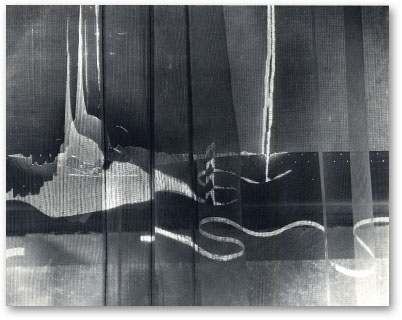
Clarence John Laughlin, The Language of Light, 1952
Laughlin often worked with the juxtaposition of text and images
Fellini's La Dolce Vita
I watched Fellini's La Dolce Vita (1960) last night. It is a welcome break from the diet of movies of the Hollywood publicity machine. Suprisingly, I hadn't seen it, nor the earlier films---La Strada, Il Bidone, Le Notti di Cabiria. I'm not even sure if I have seen 8 1/2 (1963) from the "good old days" of art cinema and reading Sight and Sound. Of the latter fiilms, I've seen Roma, Juliet of the Spirits and Satyricon, but not Amarcord or Casanova.
In La Dolce Vita long, episodic film of loosely connected tableaus or scenes. Fellini turns his critical gaze onto the swinging party postwar lifestyle of Rome's rich and famous---Rome in the 1950's amidst the postwar capitalism boom. Fellini explores what is behind the surface of the glamorous facade of society's respectable elite, and depiction is a decadent society that has become nihilistic. Life has become empty and meaningless. As we drift through life we become less and less human, more disconnected from others, and ever more lonely.

This theme is shot in black and white and is shown in a number of different situations about sex, drugs and alcohol of the celebrity lifestyle, connected by a narrative of decline: a journalist writing gossip (and a frustrated writer) decends into narcissism, self-indulgence and meanness. There is none of Nietzsche's transvaluation of values here.
Though currently out of fashion, Fellini is part of the canon of the high culture of American-European film history, with its assumption of the academic aesthetic opposition of art vs. entertainment. He departs from the neorealism of Italian cinema, with its dictum that is character determined by historical circumstance to a view of the personalized character steered, for better or worse, by his or her subjectivity. He highlighted the fabrication in neo-realism cinema by showing the authorship and the fantastic, and transgresses its realist aesthetic which held that films, like literature, are supposed to depict reality, i.e. represent the life of the common people.
August 25, 2006
dealing with obesity
It's a big issue isn't it?The growing obesity crisis is expected to cause thousands more people to suffer related diseases like cancer, heart disease and type 2 diabetes. We have an epidemic in a junk nation, with an emphasis on banning the advertising of junk food to children. The Minister of Health, a fitness fanatic, resists this proposal, and says that we are responsible for the food we put in our mouths.
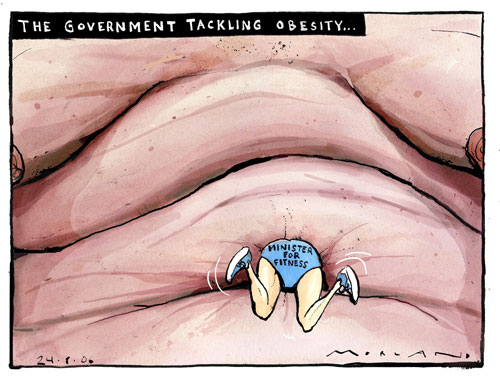
In a neo-liberal society it is all about self-help and self-responsibility. The importance of personal responsibility in the battle against obesity refers to the importance of lifestyle and exercise. The other side of this is that government seems determined not to upset the powerful food industry that engages in the promotion of unhealthy food to kids.
August 24, 2006
about the media
The latest issue of Quadrant has an editorial entitled The New Media and the (Same) Old Media. It says:
The relative strength of the opinion and features pages of the broadsheets which used to be a selling point is also suffering, from on the one hand the proliferation of blogs written by more and more sophisticated and knowledgeable writers which are freely available, and on the other the simple fact of the superior knowledge and intelligence, compared to the journalists, of such writers. Who wants ignorant opinionating from, for example, the Age when far better written, better informed and analytical comment can be found just as easily elsewhere?
Sounds promising, doesn't it.
And there is more:
At the same time DVD releases themselves are under threat from direct downloads of current and archival films. Telstra Bigpond Movies has been offering an excellent library of DVDs by an efficient postal distribution system (we must be thankful that some aspects of Australia Post are still functioning in a reasonable manner). Moreover there are superb backlists of old films on DVD growing on sites like Amazon, such that once-rare jewels of cinematic history can now be added to one’s own library. But Telstra is now offering direct downloads by broadband over the internet, so that for a fee considerably less than the normal cinema seat price one can have many films downloaded to one’s own computer for viewing at leisure. Clearly with the spread of suitable facilities this could begin to compete with traditional first cinema release. Some traditionalists prefer sitting in uncomfortable seats in a cinema amongst other people to enjoy a film. But these are, literally, dying out. More sensible people see the advantages of sitting in one’s own home, alone or with friends, with the ability to take breaks at will.
August 23, 2006
The Bourne Supremacy: ho hum
I used to see the posters for this film on the windows of bus stops as walked the dogs to and from the parklands. I read somwhere that it was generally accepted to be a good film in the thriller/action genre. It was heralded as the new breed of the espionage thriller.
So I ordered it from Quickflix sometime ago, and it turned up this week. I had no idea what to expect, other than it is the second installment of best-selling author Robert Ludlum's series----the first was 2002's The Bourne Identity, which I haven't seen.
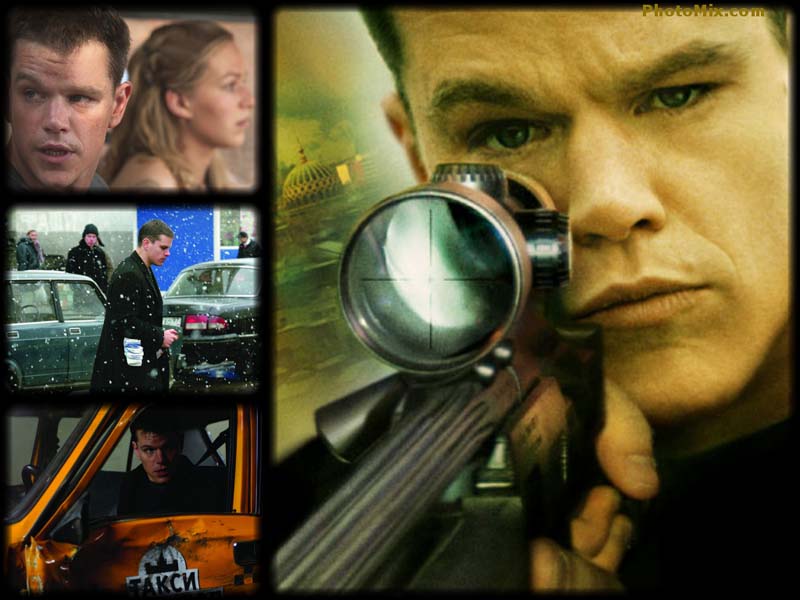
I was bored, despite the exotic worldwide locations and the muscular cinematic edge (fast editing & edgy visuals) I could accept the standard Hollywood narrative of strong man alone fighting a corrupt state in the form of the CIA; a romantic nomadic hero motivated by his sense of privacy and personal relationship. I understand that the appeal of the thriller genre is essentially amoral in that death has no meaning or value. History is about death, a lot of death.
There were too many action/chase scenes for my taste--I guess these chase scenes stand for entertainment. The fistfights, the car chases, the gun battles, the explosions are the 'money scenes'. But in this film the CIA is openly engaged in political assassination. It promises more.
What lurked in the background was an interesting idea. The CIA's and FSB's (Russia's CIA) assassination of a politician opposed to the privatization of oil in Russia and the subsequent corruption of governments by oil tycoons established by the CIA. But this plot about CIA cover-ups, espionage, and a Russian politician was muddled and confusing. We have a Russian Secret Service agent who is on the take from a strange bespectacled man who wants Bourne as dead as the CIA. It was explained away by money--lots of money. Money explains power.
A review at Images Journal
August 22, 2006
airport security humour
Millions of dollars of additional investment have been ploughed into airport security since the 11 September terror attacks.Security officials at airports have little tolerance for passengers joking about "bombs" in their luggage and airlines can refuse to take such travellers on board. 'Tis a matter of grinning and bearing the theatre.
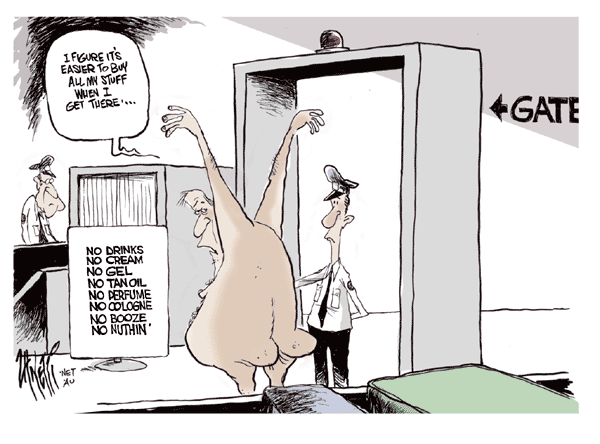
Since all too often the security glitch is human, airport authorities are increasingly turning to electronic surveillance. Biometrics---using the unique features of each human body to identify them--- is the buzzword of the moment.
August 21, 2006
petrol prices
The centrepiece of John Howard's $1 billion energy package, designed to offset the effect of rising petrol prices on motorists, was a subsidy worth up to $2000 for LPG conversions. There was nothing about public transport.
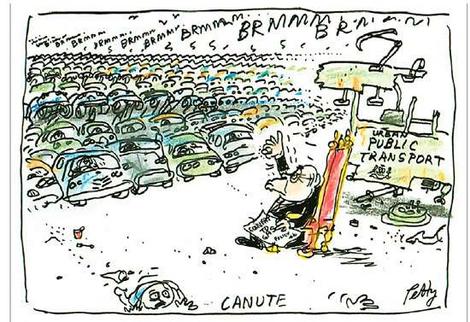
Bruce Petty
The subsidy was to take the political pain out of high petrol prices faced by consumers>it had nothing to do with the environment or greenhouse.
August 20, 2006
Walter Benjamin: Paris Arcades
I've been unpacking the rest of my books, which have been sitting in cartoons for around 10 years, in the store room at the holiday shack in Victor Harbor. I've finally had some bookshelves built for the study rooom--which I've painted inbetween the holiday in Clare and Robe.
One book caught my eye: Susan Buck -Morss's The Dialectics of Seeing: Walter Benjamin and the Arcades Project. This interpretation of the nineteenth century arcades in Paris was Bejmanin's attempt to bridge the gap between everyday experience and traditional academic concerns; an attempt to achieve a phenomenoligocal hermeneutics of the profane world that Heidegger had gestured towards.
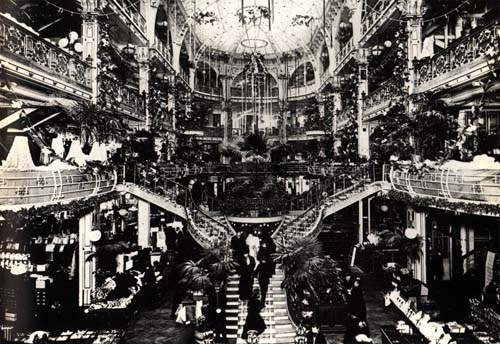
Illustration from Haussmann's Paris Architecture: Interior of the Galeries Lafayette, one of the many new department stores that redefined shopping, consumption and the public sphere for men and women in Haussmann's Paris.
August 18, 2006
saving our wild rivers
The Mitchell River in East Gippsland, Victoria, is one of the few wild rivers the south east corner of Australia. It is going to be protected by legislation from the rural development crowd who desire to dam the river. The water of the Mitchell is icy cold and crystal clear, having trickled down from Victoria's snow-capped peaks, and it drains into into the Gippsland Lakes, which in turn empty into the sea through an artificially maintained opening at Lakes Entrance.
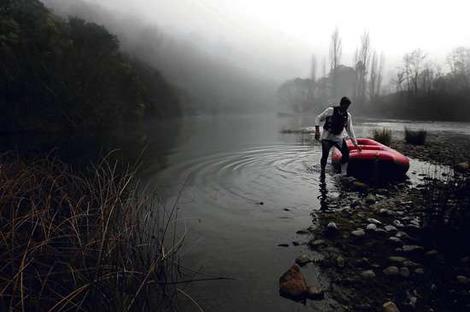
Justin McManus, Mitchell River, East Gippsland, 2006
It carves its way through the steep gorges of the Mitchell River National Park and it has been spared pollution and development by its isolation in the Gippsland high country and its National Park listing.
August 17, 2006
Grateful Dead, free music, video streaming
I've finally given up trying to play free internet music through my stereo system. The two systems are incompatible. Diigitial media is digitial media is digital media. Accepting that the PC is becoming an entertainment source on its own I finally went and bought some of Logitech's small Z-4 speakers. (The Bose Companion 3 multimedia speaker system was expensive, whilst Bang and Olufsen's designy Beolab4 were way outside my budget and not justifiable. I have no idea what their Beoport is).
I guessed these Logitech speakers would give me a reasonable sound when I used the computer to listen to music files on the internet. So now I have okay speakers ), ADSL2+ and speeds of around 16 megabits per second. How does this modest entry into the digital media world stack up?
I tried things out by listening to the House of Representatives online. Though the sound was much improved the image quality was still awful. Dreadful. So how do you improve the image quality of a live video feed? With really fast broadband? Do we need speeds of 50 megabits a second?
I then tried the system out with a drums space jam--the name for the Grateful Dead's exploratory and improvisational pieces---from their Hallowen (October 31) 1991 show at Oakland Colesium. The music file is available on the fabulous nugs. network. The sound on the speakers holds up pretty well for a live concert.

Susana Millman, Grateful Dead, The Greek Theatre, 2005
Suprisingly the music also holds up: that mixture of the tight and the shambolic that rendered the music responsive and interactive is still there. It's a big stadium/arena sound ---very similar to Dozin' at the Knick ---in which the keyboards play a significant role.
I'm not sure who the keyboardist is in the October 31 show at Oakland Colesium, as the band had a reliable propensity for killing off keyboard players in a kind of ritual sacrifice. I think it must have been Bruce Hornsby and/or Vince Welnick, as Brent Mydland, the bluesy organist, died in 1990, whilst Vince Welnick became the lone keyboard player in 1992. I reckon it is Honsby throwing in the quick sharp piano runs whilst Wellnick is providing background coloring.
The show ends with Werewolves of London
August 16, 2006
Schindler's List: grappling with the legacy of the Holocaust
I 've been watching Steven Spielberg's Schindler's List (1993), which was adapted from Thomas Keneally's 1982 biographic novel (Schindler's Ark) by Steven Zaillian. I've only got through disc 1. I'm finding the shots masterfully set up and executed and I'm not reacting to the Hollywood style of the manipulation of emotions.There are no contrived Hollywood scenes so far. I did find the 'no resistance' interpretation of the Warsaw ghetto disturbing. This film isn't the impersonal eye of history looking on unblinking and dispassionate.
I'm finding the film a profoundly shocking epic of the Holocaust. Spielberg's a very skilful filmmaker in the way that he links his Holocaust interpretation to a complicated-yet-simple redemption tale and primordial experiences. It is Janusz Kaminski's startling, rich, evocative black and white cinematography that gives the film its depth. It places the l trauma of the Holocaust into a narrative structure.

This is a way of grappling with the legacy of the Holocaust--but it is more than the Hollywood Version of the Holocaust and it is not entertainment. The film is shot almost entirely in black and white (with a color prologue and epilogue, a red coat in two scenes, and color candle flames in another). It's a Hollywood-style art movie that is understated and enables -us to remember the Holocaust, why we supported the formation of Israel after the war, and indicates the core of Jewish identity.
August 15, 2006
Lunar park
The night-time grille of illuminated scaffolding titled Luna Park in St. KIlda Melbourne by Charles Blackman, a major figure in Australian art of the post-war years.
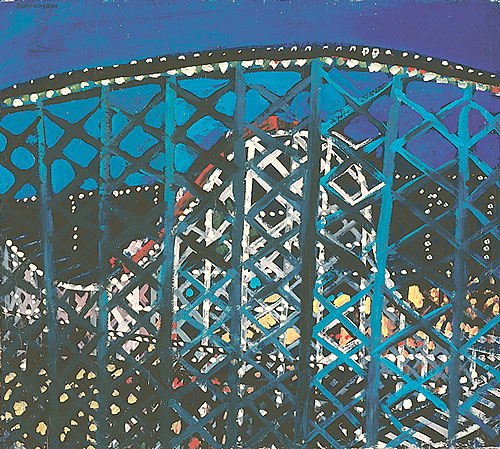
Charles BLACKMAN, Luna Park c.1951-52, 1928, Harbord,
I was reminded of this image of Luna Park when I was in Sydney on the weekend and took a ferry from Circular Quay to Darling Harbour and back. The ferry stopped at Luna Park, one of the most notable landmarks on the Sydney harbour foreshore located next to the Sydney Harbour Bridge. It was very popular.

Luna park is a historical amusement park that was built in the 1930s and restored in the 1990s. The years of neglect has saved the art deco murals, designs, and architecture, and it is now a heritage listed site.

Luna Park is now interpreted by many as a symbol of community concern over harbour foreshore conservation, recreation, high-rise development and the ownership of a public estate.
Lebanese political art
I've been looking for some contemporary work by Lebanese artists. I have found one--the work of Mazen Kerbaj:

Mazen Kerbaj, 2006
20 bombs
in less than one minute
on the southern suburbs
while i am writing
that the war is over
August 14, 2006
on the road
the lack of posting has been because I've been on the road these last couple days without a portable computer (the Toshiba was overheating and its gone back). I did try to find internet cafe's in the CBD of Sydney on the weekend but they were wanting around $6--$10.00 an hour. That is even more expensive than the $25 bucks a day in the Australian hotels I often stay at.

I've selected the cartoon because I struck attitude from the security crowd at Canberra airport this morning. It happens frequently at Canberra, though not the other capital cities. They take pleasure in humiliation. I guess the petty security control over us is only going to get worse.
August 10, 2006
blogging
An Australian text, Uses of Blogs by Axel Bruns and Joanne Jacobs, is the first edited collection of scholarly articles on blogging by experts and practitioners in a wide range of fields. Some commentary can be found byJean Burgess at Creativity Machine and Mark Bahnisch at Larvatus Prodeo.
Uses of Blogs can be counterbalanced to this sceptical account by Leslie Cannold, who says:
Peruse personal websites, blogs and the comment sections offered by mainstream and boutique news sites, and amid the sometimes insightful and occasionally amusing commentary are a significant number of contributions in contention for the totally-missed-the-point, played-the-person-not-the-ball, mono-rail-mind or axe-to-grind awards. On one Australian opinion site, a band of "forum participants" with masculine, often gladiatorial-sounding names, roam from one female-authored article to the next displaying both significant anger management and comprehension issues.
Sure, but there is more to blogging than this.
So what do Bruns and Jacobs say?
They acknolwedge that weblogging is a broad-based movement, not the province of a select few, and say:
While there is some information on who these people are likely to be (male rather than female by a small margin, probably under 30 years of age, relatively well-off, well-educated, and well-connected via broadband), what remains unknown, however, is just how they are using blogs both as readers and as producers of content—only one fact is certain: not all of them will be engaging in news commentary and political discussions.
They then address Cannold's concerns:
Further, and partly because of the mass amateurization of publishing online, blogs have been criticised in some professional sectors as being illegitimate or even dangerously skewed information archives. Yet it is the specific implementation of a blog that determines its value: its operational structures and response mechanisms, as well as the style of writing and method of recording ideas, commentary and institutionally relevant information, all influence the significance, reputation and success of a blog.
August 9, 2006
Schiller's Aesthetic Education
A quote from Frederick Beiser's Schiller as Philosopher: A Re-Examination:
It is generally recognized that one of the most creative periods of aesthetics was that from Baumgarten to Hegel. . . . Among the crowning achievements of this period are Schiller's aesthetic essays, which were written from 1791 to 1795. Schiller's three major essays... ..."On Grace and Dignity"....."On the Aesthetic Education of Man in a Series of Letters"... and "On Naïve and Sentimental Poetry"...have been regarded as classics. Since their publication over two centuries ago, they have been the subject of intensive discussion and commentary. (p.1)
The quote is from this review by Robert Wicks. The only text I know is the Letters on the Aesthetic Education of Man. Wicker say that:
Beiser claims that the Letters is not aestheticist (i.e., it is not escapist) and is instead politically and morally oriented towards actively improving social life. This is because aesthetic education -- one's self-conscious attention to, spiritual absorption of, and consequent behavioral instantiation of beauty -- aims to reinforce and cultivate people's moral awareness in a concrete, and not merely abstracted and contemplative sense. This is for the sake of creating good citizens. Ideally, aesthetic education will produce a set of people who will automatically act morally when they are given their freedom, as opposed to having violent and retributive inclinations, as happened horribly in France during Schiller's time.
My memory is that aesthetic education is the single, essential, permeating, comprehensive and overriding theme of the Letters. It is somthing that has been forgotten.
August 8, 2006
escapism
Its just clicked with me the movie world has turned to the deep space of CGI (computer-generated imagery)-inspired fantasy films. Star Wars, The Lord of the Rings and Harry Potter come to mind. That's quite a wallop--almost a culture phenomemon.
August 7, 2006
harry Potter
Whilst on holidays down at Robe I watched some Harry Potter movies--- Harry Potter and the Philosophers Stone and Harry Potter and the Prisoner of Azkaban. Most of the narrative takes place in Hogwarts School of Witchcraft and Wizardry and it is very reminiscent of 'Tom Brown's Schooldays' .Despite the similarities to 'Star Wars' in terms of a franchise both films were all very English--ye old historical England. These films are based on the popular series of fantasy novels by British writer J. K. Rowling, which have become very successful children's books.
I have not read the books and I'm not a Harry Potter fan. But we sure have a cultural phenomenon---witches and wizards are fashionable even amongst adults.
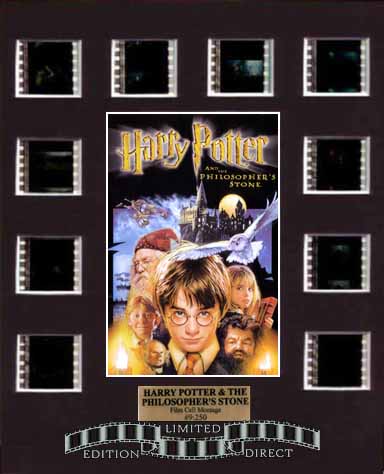
The narrative of 'Harry Potter and the Philosopher's Stone' moved slowly from one special effect to another and I was somewhat bored with the film despite the interesting visuals.
I understand the films are close to the books in terms of narrative and tone. However, the films should --and do-- work on their own terms and they require complex interpretations, analyses and reading abilities.

Harry Potter and the Prisoner of Azkaban was much darker, and its more imaginative visuals were more akin to the Lord of the Rings movies.
August 4, 2006
Robe
My holiday at Robe on the Limestone Coast is drawing to a close.
 Robe is an attractive town; the most attractive and secluded of the seaside ports of Kingston, Port MacDonnell and Beachport. Hence it is popular for tourists and those who desire a holiday house by the sea. It has lovely white sandy beaches, limestone cliffs and vegetation to the shoreline.
It helps to be a part of the Mount Benson wine region---a relatively new, but expanding wine region, situated between the coastal towns of Robe and Kingston in the Limestone Coast region of South Australia. This wine region is becoming renowned for its cool climate Shiraz and Cabernet Sauvignon wines as well as high quality white wines with some excellent Sauvignon Blanc being produced. It is the fertility of the limestone plain that provides the basis for the premium quality wines being produced throughout the Limestone Coast
August 2, 2006
on holidays
I'm on holidays down in the picturesque town of Robe along the Limestone Coast in South Australia.

It is difficult to get internet access. I'm currently working from a public library in the Robe. So I can only work in half hour blocks. Hence the minimal entries.
Robe is marketed as an exclusive getaway for tourists seeking creative and stylish accommodation in beautiful surroundings. Hence its trendy image. But it has an interesting geological history