July 30, 2006
goodbye film hello digital?
This article says it all. Nikon and Canon have stopped making new film SLR cameras.
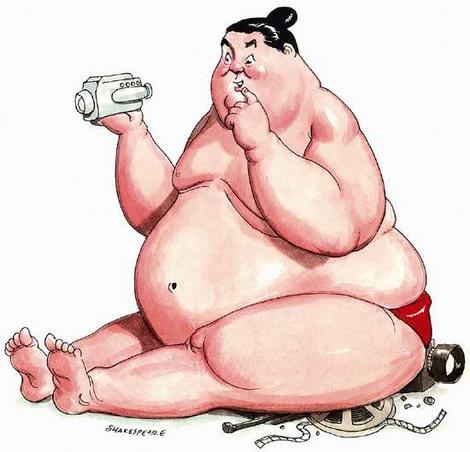
Welcome to the digital era in photography. I'm still shooting film on my holidays.
comment on power
An imbalance of power causes war, as the more powerful side will inevitably seek to impose its will by force.
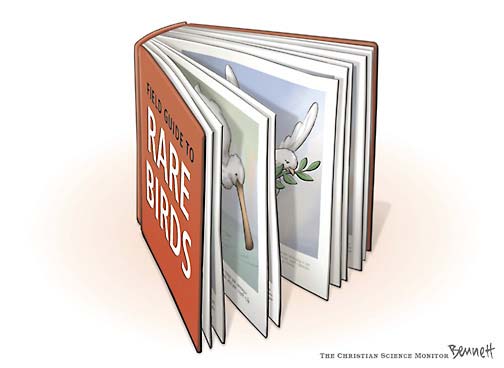
That is the situation in the Middle East. I grieve for the Lebanese civilians.They are bearing the brunt of this conflict.
July 27, 2006
a long way from Cronulla beach
I've managed to gain access to gain access to the internet for a moment.

Paul Zanetti
July 25, 2006
holidays in Clare
I'm on holidays in Clare in South Australia for the next few days. I'm going to having a look at some wineries that specialize in white wines.
This is the tourist image that Clare constructs for the Adelaide middle class:

It's an image of world of romantic getaways, wineries and food that sits at odds with the internet, blogging and personal computers.
July 24, 2006
spilling blood
Some background
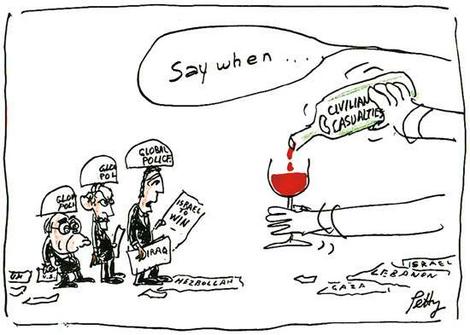
Bruce Petty
It seems that people enjoy unleashing the dogs of war, despite the sobering reality check of Iraq.
Another perspective:
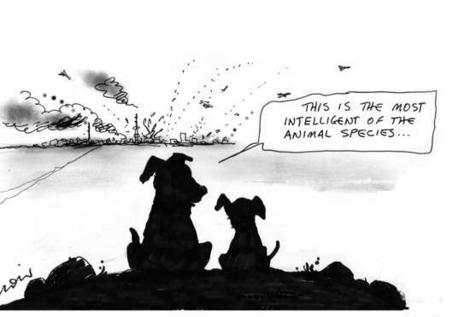
Alan Moir
July 22, 2006
holidays
I'm currently easing into holidays. A two weeks break, starting yesterday. I'm currently down at Victor Harbor for a couple of days painting the study in the holiday shack prior to taking delivery of desks and books shelves built by local craftsman. I'm trying to set up a digital darkroom --so the computer has been upgraded, digital storage acquired, broadband set up.
It is slow and arduous. I've yet to acquire a prosumer digital camera

Finance is the issue.
I cannot afford this kind of equipment:

So the photo lab currently converts my film shots onto digital when they process the fil mand do contact sheets. But it is an expensive way of working.
July 20, 2006
future forward
It's very witty isnt it, the way it captures the effect of the new media?

The political aspect is here
July 19, 2006
Matrix Reloaded
I started watching a DVD of Matrix Reloaded the other night. This is the second instalment of the Matrix series which represents the real world as an elaborate computer simulation. The original Matrix was a box-office hit. Maybe every one liked the idea of reality being a fiction, programmed into the heads of sleeping millions by evil computers. Matrix is a row of green digits. The basic conceit of “The Matrix” is the notion that the material world is a malevolent delusion, designed by the forces of evil with the purpose of keeping people in a state of slavery. The essential Matrixian setup: a bunch of brains in a vat hooked up to a machine that was “programmed to give [them] all a collective hallucination, rather than a number of separate unrelated hallucinations.”
I turned Matrix Reloaded off after the "franchise film" after the scene known as "The Burly Brawl", (Chinese ballet) and before the car chase scene. I mailed the disc back to Quickflix, despite the fight scenes or special effects.The action sequenceswere so over-the-top . I haven't seen the the last film of the trilogy, The Matrix: Revolutions, nor am I likely to.
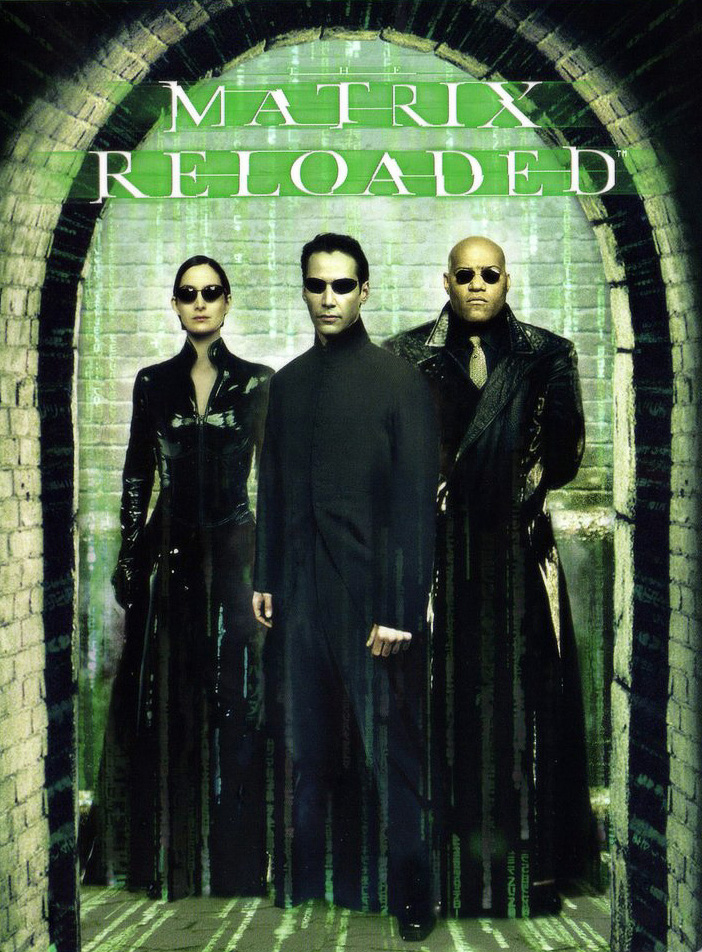
The sequel to The Matrix is more of the choreographed action genre with less of a focus on the plot-- Zion is the last bastion of humanity and one which is under imminent attack from the machines. In order to avert the attack, the humans are going to have to send out an emissary (Neo and his ship) and re-enter The Matrix. Neo is the One—the Messiah figure who will see through the Matrix and help free mankind.
The plot is in the form of hero's journey into the Underworld. The Oracle sends the hero off on his journey, from where he returns with special knowledge.
July 18, 2006
Farah Nosh
Farah Nosh is a Canadian/Iraqi photojournalist and one of the few Western freelance photographers based in Baghdad under the regime of Saddam Hussein,

Her work looks at the casualties of Baghdad and the people who live with the wounds of war. It reminds me of Limbo in Dante's Inferno. Limbo is the first circle of hell, a place where souls persist in desire without hope, living upon the brink of grief's abysmal valley. That's Baghdad today is it not?
July 17, 2006
modern landscapes
It is a familar view isn't it--heavy industry set in a rural hinterland.

John Davis, Agecroft Power Station, 1983,
July 16, 2006
sanitized visual narratives
W.J.T. Mitchell in Picture Theory (1994) says that ' What we need is a critique of visual culture that is alert to the power of images for good and evil and that is capable of discriminating the variety and historical specificity of their uses.
Consider "Superficial Engagement" at the Gladstone Gallery, New York, a walk-in manifesto Thomas Hirschhorn in terms of challenging a sanitized visual narrative of the war against terrorism in the way the US mainstream meedia covers the war.

Thomas Hirschhorn, Concrete Shock, 2006
From a review of the exhibition by Jerry Saltz, entitled Killing Fields in ArtNet:
The exhibition is titled "Superficial Engagement," "because," Hirschhorn writes, "to go deep I must take the surface seriously," although an alternative interpretation is that Americans are only superficially engaged psychologically in the carnage pictured. Overall, it is a jungle or junkyard crossed with a supermarket; a homemade temple of the martyrs and Goya's Disasters of War. Its roots are in punk graphics, surrealism, Joseph Beuys, Kurt Schwitters, Edward Kienholz and Warhol's razzmatazz. Formally, Hirschhorn relies on bright lights, amplification, proliferation and multiplication. His individual objects aren't anything special; he's not a sculptor per se but more of an assemblager. "Superficial" is comprised of four large makeshift platforms. Viewers move between them along narrow corridors; everything is in your face. In addition to the gruesome images, each platform has a number of repeating elements, including quasi-primitive wooden effigies with thousands of nails driven into them, mannequins covered in nails à la acupuncture needles or the pinheads in Clive Barker's Hellraiser, along with facsimiles of the works of the visionary Swiss healer-painter Emma Kunz.
Does this kind of art work critique the visual culture of the mainstream media?
The issue of the sanitized visual narrative is considered here at Jim Johnson's (Notes on) Politics Theory Photography weblog.
visual culture
"What we need is a critique of visual culture that is alert to the power of images for good and evil and that is capable of discriminating the variety and historical specificity of their uses.' - W.J.T. Mitchell. Picture Theory (1994).
Does this kind of photography do this?
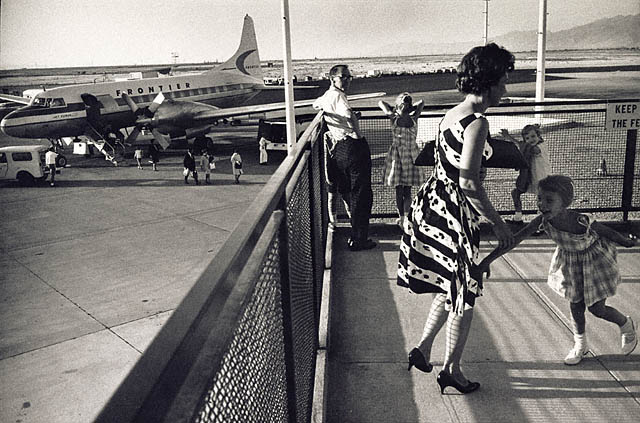
I'm not sure.It's not just because of Wingograd or street photography. What I am sure about is that the visual world is changing, changing rapidly.
Mark Pesce hyperpeople says that video is begining to take off. Its everywhere. He says:
The sheer profusion of devices which can play video – from iPods to desktop and laptop computers to Sony’s Playstation Portable, the Nintendo DS, and nearly all current-generation mobile phones – means that people will be watching more video, in more places, than ever before. You may not want to watch that episode of “Desperate Housewives” on your iPod – unless you happened to be tied up last Monday evening, and forgot to program your VCR. Then you’ll be glad you can. Sure, the picture is small and grainy, the sound’s a bit tinny, and your arms will get tired holding that screen in front of your face for an hour, but these drawbacks mean nothing to a true fan. And the true fans will lead this revolution...Once video is everywhere, once all our favorite television shows are available online for download, we’ll learn something else: there’s a lot more out there than just those shows produced for broadcast.
I'm not sure where I am anymore.
July 14, 2006
Joni Mitchell
I've just bought some CD's of Joni Mitchell---'Court and Spark', 'The Hissing of Summer Lawns' and and 'Hejira'. I'd already bought 'Blue.' I'd always thought that Mitchell was, and continues to be misunderstood and undervalued in terms of her music. Is that because the songs are sung by a woman, played with spare accompaniment, and are largely about love and pain? A woman singer in a then male-dominated rock music industry?

This music is conventionally seen as performed by the solo artist, the vulnerable singer-songwriter, Joni Mitchell: the confessional music poet: signature “Joni Mitchell” is one of a confessor of pain, a ruminator about life and love, a romantic poet with a sad helpless brilliance.
Doesn't 'The Hissing of Summer Lawns' rupture that persona and interpretation of her music? Gone is personal confession to be replaced by social commentary; Joni Mitchell is no longer the folk singer as her music is experimenting with jazz.
Gender is one way that politics and music intersect.
July 13, 2006
Terminator 3
I watched Terminator 3:The Rise of the Machines the other night as a DVD. It was hackneyed, boring and uninteresting--man versus machine with few ideas. So we just have a boys own action thriller with the emphasis on visual effect and sensation. And the ending even allows for a Terminator 4.
How is this different from any other commodity--a vehicle to make a lot of money?

It is not all vacuous as the film has plenty of action sequences, some of which are spectacular---the crane chase---but it's pretty much little more than a road movie. One that allows us to project all our impulses onto the commodity, to g forget ourselves and lose ourselves in the visual effects
This is entertainment rather than than low-brow art, entertaintment that is integrated and administered by the culture industry. If it is seen as low brow than then it's protrusion into culture signifies the failure of culture.
July 12, 2006
Syd Barrett + Pink Floyd
I heard that Syd Barrett had died on the radio this morning along with snippets from 'Shine On You Crazy Diamond' from the 1975 Wish You Were Here album. Barretttook too many drugs, and the LSD, slowly wore him down. Laid low by mental illness he lived as a social recluse for the last 30 years. He looked terrible in a late photo that I saw--very obese.
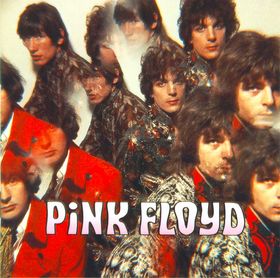 I once owned 'The Piper at the Gates of Dawn', Pink Floyd's debut album, and the only one made under Syd Barrett's leadership.
I remember the melodic instinct and whimsical lyrics and crazy feedback experiments and astral jams; recall the spacey 'Astronomy Domine' and the album pivoting around "Interstellar Overdrive," the 16-minute trip to end all trips. No lyrics, no structure - just one awesome riff and a leap into the unknown with throbbing bass lines, slashing guitars, whirling organ, and pounding percussion. It was nine minutes of loosely structured experimentation and jamming. I do not know Barrett's solo albums, 'The Madcap Laughs' and 'Barrett.'
I haven't heard Piper since. I understand it is now seen as a classic psychedelic album as an expression of Swinging London, very influential (meaning Bowie?) and fondly remembered by Pink Floyd fans. I understand that Barrett became a spiritual pied piper of 80s indie rock and by the 90s his spellbinding music was being referenced by all and sundry.
I'm not a fan of Pink Floyd, even if I enjoyed the 'Live at Pompeii video' on television. I dipped in and out of Pink Lloyd ---'Ummagumma', 'Atom Heart Mother', 'Meddle'--but found that the band were struggling to find their way as progressive" rock, after they sacked Barrett some time around the second album--- 'A Saucerful Of Secrets'. The work was hit and miss. The music became more inflated, bombastic and less interesting ---until 'Dark Side Of The Moon', and that, of course, changed everything. It is the "sound landscape", that makes this a noteworthy album.
I did find 'Wish You Were Here' poignant as it reached back to Barrett in the form of a requiem. I haven't heard 'Animals' (1977), even though it sounds an interesting reworking of Orwell's Animal Farm. I I stopped listening after 'The Wall', as Pink Floyd had became Roger Waters+session men, even if I enjoyed the band's fabulous visual effects of The Wall shows in 1980-81. I have never listened to the Pink Floyd without Roger Gilmour---'The Division Bell' or 'Pulse'--- as the band was not creating something new or original. Their time had passed.
Update: 16 July
I went and bought 3 CD's of Pink Floyd ---'The Piper at the Gates of Dawn', 'Dark Side Of The Moon', and 'Animals' -- today before the cheap priced CD's ($20) disappear and we are back to imports at $40. 'Dark Side Of The Moon', was reconnecting with well known music of a long time ago---I recognize that it was part of the soundscape to my life. 'Animals' is going to take many a listen to hear it properly.
July 10, 2006
political art
Interesting image huh?

Samia Halaby, drawing, "My Pal Palestine,"
In Aesthetic Theory Adorno writes:
What is social about art is not its political stance, but its immanent dynamic in opposition to society. Its historical posture repulses empirical reality, the fact that art works qua things are part of that reality notwithstanding. If any social function can be ascribed to art at all, it is the function to have no function. By being different from the ungodly reality, art negatively embodies an order of things in which empirical being would have its rightful place. The mystery of art is its demystifying power. Its social essence calls for a twofold reflection: on the being-for-itself of art, and on its ties with society. (p.322)
What do you think?
July 9, 2006
pathos
I know its almost over, with only the final to go. I haven't been watching it as the live broadcast is too late, or rather it is in the small hours of the morning form me. AndI'm not that interested in sport per se.
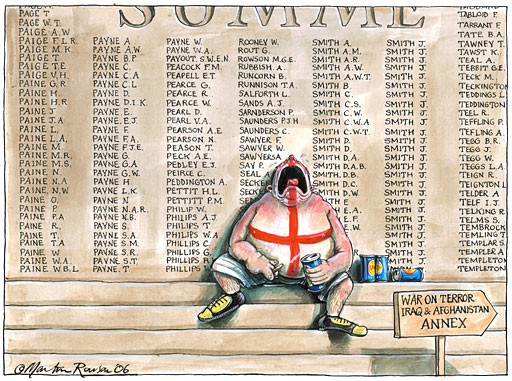
Tis all about national pride isn't it? Another heroic defeat for England. This the way the Australian elimination from the World Cup was represented by the media. Mythology is going to be woven.
It would be even worse for Brazil --- they were defeated by France. They were expected to win the World Cup. A trend or pattern that keeps repeating itself is that South American teams do not usually win in Europe - was confirmed last night when Brazil went out to France. And conversely, as K-Punk points out, European teams have never succeeded in South America.
July 8, 2006
Painted Desert
Courtesy of Blogme

Arkaringa Hills, Painted Desert Australia
The Painted Desert is so named because of the multi-coloured sedimentary layers eroding from escarpments throughout the area. Sediments originally laid down by the ancient inland sea have eroded away over the past 80 million years. This erosion, together with the leaching of minerals from the soil, creates this magical area whose colors change during the day, making it a photographer's delight. Located in the spectacular breakaway country of the Arckaringa Hills, near Cooper Pedy in northern South Australia.
July 6, 2006
a comment on the media
The issues is outlined here. As the book, Jonestown, neared publication, lawyers acting for Jones wrote to the ABC complaining that its contents could be defamatory, and the ABC decided not to publish on the ground that the prospect of legal action made the project commercially irresponsible. Chris Masters, the author, was free to take his manuscript elsewhere, and immediately five commercial publishers began bidding feverishly for it, with Allen & Unwin emerging the winner.
The ABC's argument about commercial irresponsibility was rendered irrelevant, and it has left itself open to the perception, at the least, that it has buckled at the first sign of pressure from Jones.

Nicholson
The ABC buckles under political pressure over a book to be published by one of its own on a conservative shock jock. In 2002 Masters profiled Jones for Four Corners and was t commissioned by ABC Enterprises, the national broadcaster's commercial arm, to extend his work into a full-length book entitled Jonestown.
July 5, 2006
porn spam
The rise of the internet sure is changing things:

Internet porn is everywhere. The Internet allows people to anonymously view imagery that would have required a trip to the seedy side of town, or to a foreign country, a few years ago. A recent Australian Institute survey showed that 84 percent of boys and 60 percent of girls aged 16 and 17 had been exposed to pornography on the Internet.
The solutions to the myriad problems of spam, viruses, phishing and spyware are too great for many. "Put a firewall on. Patch this, download that. These are foreign terms to most people. The fixes may be beyond the skill levels of most consumers.Thankfully, porn spam into my email is blocked by my ISP. This weblog, for instance, is inundated with porn spam disguised as health tablets to get past the porn filters. They are designed to be adverts or referrals on the billboards The spam is automatically sidetracked into junk and disappears after ten days or so. Spammers are abusing comment systems to increase their rank on Google. The spamsters are also trying to drive traffic to a growing number of sites featuring rape, bestiality and incest pornography. Most of the websites are hosted overseas.
July 4, 2006
Brassai
Brassai created many pictures of Parisian life prior to 1945 that were collected into Paris by Night

Brassai, Passion Graffiti,1939
An excerpt from Conversations with Picasso
sex and academia
An interesting article---Academic Whores and Publishing Pimps by Mark John Isola in Bad Subjects. He says:
Anti-sex politics and sex-phobia form the academy's resistance to sex. The former denies the sexual body; the latter denies the sexual act, and their complicity performs a significant act of oppression. In keeping with the function of a discriminating prejudice, this sexism ritualizes a process of abjection (insert Julia Kristeva) by which a larger ideology is justified and upheld. This larger ideology can be detected at the very center of Western Civilization, beginning with Plato's dialectic of existence and being.
Gee that stretches back into the philosophical past, but it can be linked to this:

Brassai, Paris Prostitute, 1933
Isola spells that ideology out:
The academy's refusal of sex upholds the mind/body binary and elevates the mind by subordinating the body. This casts individuals, who make a living with or through their bodies, as other to the academic. The subaltern constituted by this process, the body upon which the academic rests, is the laborer, and the primary archetype for the laboring body is the prostitute. The trope of the prostitute functions to convey, albeit stereotypically, the alienation that lies at the heart of Freudian and Marxist theory, and in this sense, we all fear the prostitute within us.
He then provocatively asks: what does the prostitute tell us, if anything at all, about the academic?A lot is my guess.
The prostitute is not condemned because s/he is necessarily objectified in his/her reality but because the figure of the prostitute reflects the objectification an academic feels in their reality. Indeed, academics are a species of whore, and their pimps are academic journals. Isola says:
Like an archetypal group of whores fighting over a last stash of condoms, academics battle to outdo one another in the publishing prestige game, and the ego games of the conference circuit are well known. Meanwhile, the journal pimps continue to accept submissions with one hand while cashing checks with the other....Let us no longer be academic whores alienated from our labor by publishing pimps. Free the academy; support open source journals.
I concur. Open source journals---Bad Subjects--- have a powerful and productive potential as they promise to empower academics by allowing them to retain rights to the product of their intellectual labor. Open source journals can slash the barrier that bars a person from accessing intellectual work, particularly the intellectual work of the academy, which is locked up in pricey journal subscriptions and inaccessible expensive electronic databases.
Free the academy; support open source journals.
July 3, 2006
Catherine Lumby on Big Brother
Catharine Lumby, Associate Professor of Media and Communications at the University of Sydney, writes in Crikey Daily that once again the Big Brother entertainment program is embroiled in controversy and there are calls to have it taken off air following an incident of sexual misconduct in the house.
The incident happened at the Gold Coast house where the show is filmed that was streamed on the internet but not televised. It showed that John lay down beside Camilla in a bed and held her from behind while a half-dressed Ash knelt over her and put his crotch into her face. Is this their way to seek fame and fortune?

Nicholson, Big Brother Uncut cut ACMA
Lumby, a friend of culture industry, defends Channel Ten by arguing that all is okay with the management of the incident. She says that:
Unfortunately, a lot of the criticisms [of Big Brother] conflate two very different issues. The first kind of criticism, which is frequently levelled at the show, is rooted in socially conservative moral objections to a show in which young people live together, shower together and talk in sexually explicit ways. The second, quite separate, issue is the question of what rules apply in the house and of how the producers manage any incidents of alleged sexual assault, harassment or bullying.
Only two issues? Let's put the first issue to one side--I have no brief for conservative objections to sexuality---and look at how she addresses the second---the theatre.
She says:
As someone who was involved in reviewing the house rules relating to sex, gender and ethics this year and who spent time working with the producers to discuss how they should deal with hypothetical misconduct, I was heartened to see that they acted quickly to remove the two men involved from the house. They also offered the woman full access to confidential counselling and an opportunity to take any action she wanted. Their response was important for two reasons. Firstly, and most obviously, it was critical that the woman involved was given every support. But just as importantly, the producers were telling the viewers that a line had been crossed and that there's never any excuse for uninvited sexual behaviour.
Okay Channel Ten acted properly. The libertarian response is that sexual behaviour by young people stimulates healthy debate as it is only depicting real life. Is the problem that the latest series was too real for some people? Should we say that it is an expression of conservative morality to say that we shouldn't show it on TV?
So why stream the sexual assault on the internet if Channeel Ten says it was wrong cos it broke the rules? Shouldn't a moral finger be pointed at Channel Ten for sanctioning what is wrong? After all, the household's occupants are monitored 24 hours a day. Lumby is silent about this ethical issue as she saying that Channel Ten is doing the right thing in managing the incident.
Lumby then introduces a favourite theme --since young audiences can learn from tabloid television--it cannot be dismissed as trash. She says:
Big Brother has an enormous audience of young men and women who actively debate the rights and wrongs of what goes on in the house. They're exactly the audience to whom we want to be getting the message out about the need to be really sure you have consent in sexual situations. If any good can come out of an incident like this, it's that the Big Brother audience will be contemplating this issue because it's one which directly affects so many of them.
Fine. But it is what else that is missing from Lumby's account that is of concern. Big Brother is run by Channel Ten and they push the edge to create controversy to get ratings. The producers---Endemol Southern Star and Network Ten--- have a track record in manipulatng the publicity for this program. It is how the issue is "contemplated" that is of concern.
Is the current situation being exploited for ratings? Well, what is "getting" an emotional Camilla ---the housemate allegedly sexually assaulted by John and Ashley--- to appear on national television to give a tearful explanation of the situation? The meaning of "getting" is vague because it is unclear to me whether Camille consented to appear on televison to talk about the alleged assault, or that she was coerced to do so. Lumby says nothing about this--or even addresses whether it can be interpreted as a cynical and exploitative way of contemplating the issue to achive ratings. We are dealing with the culture industry after all.
July 2, 2006
signing off
Brian Courtis, the television critic of the The Age, is signing off after many a long year. Given the way that free-to-air television has declined and there is now just so much drivel on, it would now be a tough gig:

In his farewell column he writes that:
Arts criticism in Australia, however, is generally elitist. The smaller an audience, the more precious and generous its print coverage. Thus, comment on literature, the fine arts, opera and dance has flourished. Cinema, haunt of both bug-eyed academics and popcorn masses, is perhaps an exception. But it does produce advertising revenue for print.Television does not do quite so well. It is seen as direct competition and, in critical terms, is rough trade. Now, however, as the landscape changes for the internet, there may be intriguing changes in media attitudes to both mainstream and pay TV.
Well there may be for the rough trade--Big Brother?--- that treated consumers so badly. It may well change the one-way relationship between the viewer and the "broadcaster" now that broadband networks are improving in terms of their speed. That means TV programmes can come down the same line as web data, whenever a viewer wants it. The control of the television experience needs to be placed more in the viewers hands.
Courtis then asks:
So how should print treat TV programs such as Lateline that shatter a newspaper's nightly deadlines with news-breaking stories that can only be reported and examined in print 30 hours later?And there are other questions on drama and the internet. Just how much TV globalisation we can take without losing our own culture, our own way? Do we need to accept from a political leader, who is jumping up and down in his tracksuit watching TV, that sport is all Australians can do well and that this somehow makes us a richer people?These are going to be interesting times for tomorrow's critics.
Do we need to worry about an Australian national culture any more in terms of television?
July 1, 2006
cute
They--Australia lost to a much better team--Italy--didn't they. Australia simply lacked the strike power to take advantage of the possession they managed to win.
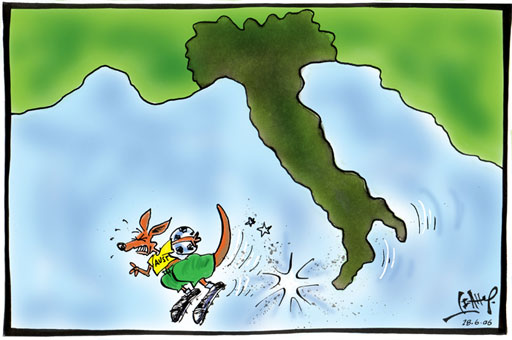
The story behind the FiFA spectacle is not just the "national narrative" that binds fans to their teams qnd which is open to progressive or reactionary appropriation. That is not the game's driving force any more. Soccer, today, is a multibillion-dollar global industry whose power centers are transnational corporations--- it is the money being earned from modern sports promotion, and the sponsorship of the World Cup and its teams stands to make the corporations billions of dollars in revenues. This business of international sport is also the world of international sport.