Thought-Factory.net Philosophical Conversations Public Opinion philosophy.com Junk for code

Mandy Martin, Puritjarra 2, 2005. For further information on MANDY MARTIN, refer here: http://www.mandy-martin.com/
If there are diverse kinds of knowledge and ways of knowing place, then we need to learn to value the different ways each of us sees a single place that is significant, but differently so, for each perspective.
RECENT ENTRIES
SEARCH
ARCHIVES
Library
Thinkers/Critics/etc
WEBLOGS
Australian Weblogs
Critical commentary
Visual blogs
CULTURE
ART
PHOTOGRAPHY
DESIGN/STREET ART
ARCHITECTURE/CITY
Film
MUSIC
Sexuality
FOOD & WiNE
Other
www.thought-factory.net
looking for something firm in a world of chaotic flux

political art « Previous | |Next »
July 10, 2006

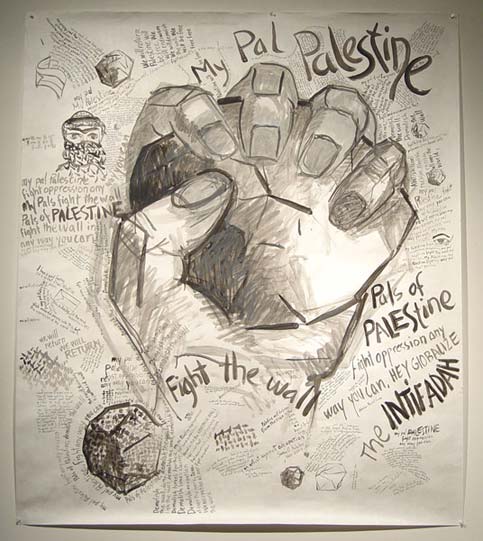
Interesting image huh?

HalabyS.jpg
Samia Halaby, drawing, "My Pal Palestine,"

In Aesthetic Theory Adorno writes:

What is social about art is not its political stance, but its immanent dynamic in opposition to society. Its historical posture repulses empirical reality, the fact that art works qua things are part of that reality notwithstanding. If any social function can be ascribed to art at all, it is the function to have no function. By being different from the ungodly reality, art negatively embodies an order of things in which empirical being would have its rightful place. The mystery of art is its demystifying power. Its social essence calls for a twofold reflection: on the being-for-itself of art, and on its ties with society. (p.322)

What do you think?

| Posted by Gary Sauer-Thompson at 2:34 PM | | Comments (3)
Comments

Comments

If any social function can be ascribed to art at all, it is the function to have no function.

Do you agree with Adorno here? If so, the juxtaposition of the drawing with Adorno's text would seem to demonstrate the political impotence of the former (since it attempts to have a direct social function). Is this your intention?

J.l.
yes. I think that the image stands a critique of Adorno's position. I support Adorno's claim about art's 'twofold reflection: on the being-for-itself of art, and on its ties with society' but not the claim that 'the mystery of art is its demystifying power.'

I find it too modernist and too concerned with high art

I find it too modernist and too concerned with high art

Completely agreed, but then your answer to my question should have been 'no', correct (unless I've misunderstood your response)? I originally thought you were using the authority of Adorno to critique the image, instead of the other way around.

I have heard Adornians argue that high-art critiques society only through its autonomy or separation from so-called 'low culture,' and that any attempt by a work of art to engage social issues directly (i.e., political art) threatens art's autonomy and renders its critique moot.

Of course, if that's what Adorno meant, then why was he so infatuated with Kafka -- whose The Castle was clearly intended to criticize the dehumanizing nature of bureaucracy?