December 31, 2005
high protein diets
The popular CSIRO's Total Wellbeing Diet was written by Manny Noakes and Peter Clifton, from CSIRO's Human Nutrition.
 Despite being funded by the meat and livestock industry, it is certainly been very successful. It has already made the organization more than A$1.5 million (US$1.1 million) in royalties.
The book has sparked arguments between dietitians over its promotion of a high-protein diet at the expense of carbohydrates, the authors' recommendation that a higher protein diet is effective and safe, and the research that supports those recommendations.
Noakes and Clifton advise eating around twice the daily amount of protein in a typical Western diet. The diet recommends around 30 to 35% of a person's daily energy intake should come from protein, compared to 15% in the typical Western diet.
I've switched to it----the receipes are great--- and moved away from the rcommendations that starchy carbohydrates, such as bread cereals, pasta and potatoes, should provide the bulk of each meal, as they help to provide a sense of fullness and at least five portions of fruit and vegetables a day.That sense of fullness for me is an uncomfortable bloated sensation. So I no longer eat bread or pasta. I no longer desire that sense of fullness.
I don't see the switch as a quick fix approach to losing as some are arguing. It is more a major shift in my eating habits. The weight comes off with exercise.
update Jan.8th
The battle over the diets continues. Rosemary Stanton and medico John Tickell say that the CSIRO diet, which recommends high amounts of red meat.contravenes the government's own dietary advice.The government's Australian Guide to Health Eating recommends consumption of 65 to 100 grams of lean red meat three to four times per week, but the new book advocates up to 300 grams of meat daily.
December 30, 2005
barely surviving
Intense heat blanketed southern Australia today with temperatures around 43-47degrees in South Australia. It was still 42 degree at 7pm. As it was impossible to stay in the city apartment with a broken down airconditioner, we went shopping in airconditioned shops and then hung out in an airconditioned local pub in the late afternoon.
We had to hunt for the shops as many airconditioners just did not cope with the heat. At least we not due to experience a heat wave of 2-3 weeks of soaring temperatures (in the high 30s), which is a normal summer for Adelaide.
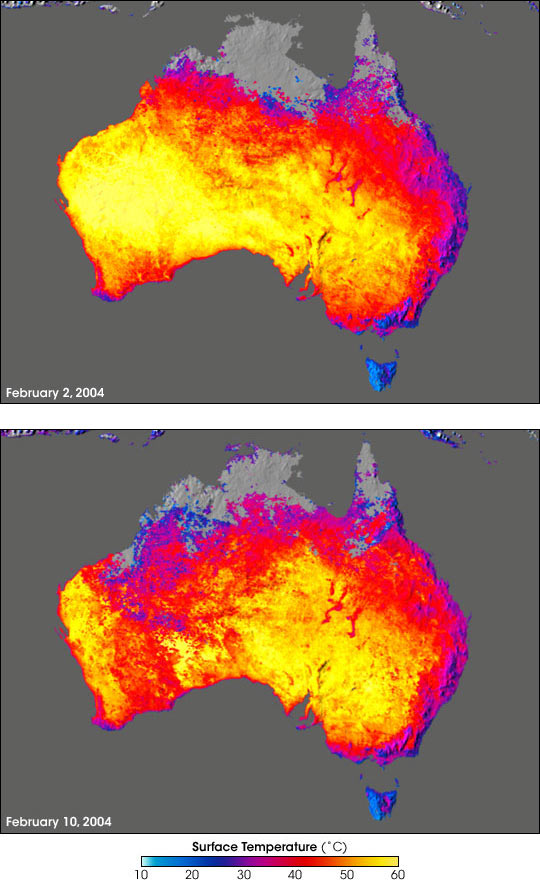
I tried to work in the upstairs office around 6pm in a wet sarong and t-shirt with an icepark around my neck and forehead. I lasted 30 minutes before the heat stress became too much.
Today was living through a searing heat storm as a strong hot north wind blew down from the desert. There will no cool winds blowing in this evening. It is deathly still. I can understand why heatwaves currently kill 1100 people over 65 in Australia each year.
December 29, 2005
a national culture?
Kerry Packer, the Australian media baron, has died. There is masses of commentary in the Australian newspapers. This death marks an end of an era, one in which political patronage (by the Hawke/Keating federal government in the 1980s) built Kerry Packer's fortune, and he emerged the dominant commercial player in the Australian television industry.
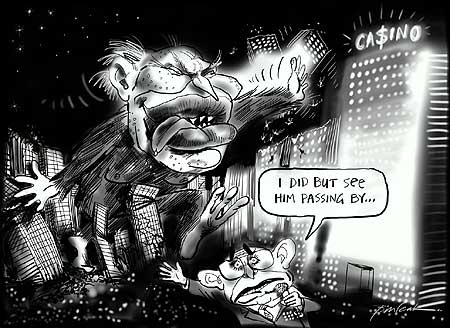
Bill Leak
The background is one whereby the nation-state used the instruments of protection, content regulation and subsidy to foster an infant screen production industry (film and television) to ensure that Australians were able to choose to watch Australian TV shows. The deal was that federal Government would protect free-to-air television and the networks would produce Australian drama. This would contribute to Australia's national culture and so prevent our national culture being dominated by the cultural expression of other countries (the UK and the US).
The argument is well stated by Gillian Armstrong.She says the significance of our national culture is that:
It's our identity as Australians. It's what makes us unique: our language, our idioms, our character, our stories, our humour, our outlook on life. These things are not fixed but are challenged and reaffirmed by our cultural expression. They are reflected by the stories we tell and the images we see.
Thus the nationalist position of the 1970s when confronted by the international attractiveness of American film and television.
The nation is defined as a spontaneous association of humans bound together by shared language, culture, ethnicity and beliefs. Armstrong's nationalism presupposes a normative congruence of political institutions, economic activity and cultural identity and experience. Without such congruence, communities are unstable and their members are denied their patrimony of feeling "at home." Hence the inference: there can be no political sovereignty without cultural sovereignty.
The concept "national culture'', which has been both a central organizing category in the shaping of economic and cultural production, currently fits the reality of television less and less in a globalised world. The internationalization of mass culture threatens national identity and the stability of the political institutions and systems which are assumed to rest on it.
I guess that there will be an increasing decoupling of public policy from culture in the future.
December 28, 2005
The Big Lebowski
Some Joel and Ethan Cohen films finally came in from Homestart over Xmas.They are good independent American filmmakers who avoid the holier than thou ' indie' ethos that rejects the Hollywood studio system and often degenerates into poor craft and self-expression. I watched The Big Lebowski (1998) last night. I have yet to see Arizona and The Hudsucker Proxy.
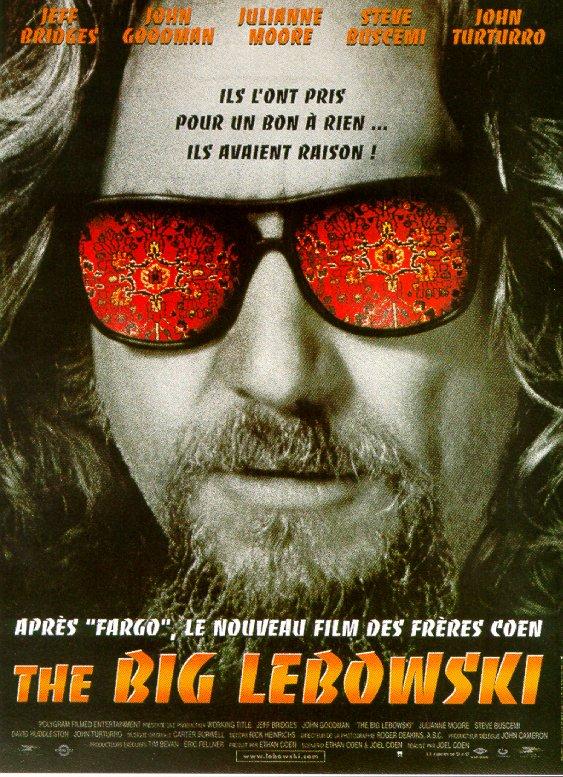
The Big Lebowski is an absurdist comedy based on a particularised, crazy Los Angeles artistic, business and unemployed communities, that is constructed around a stoned slacker with counterculture roots (a '70s throwback), a ruined rug, bowling, nihilists, pornographers, kidnapping, money gone astray, music (Bob Dylan's and Creedence Clearwater Revival) and mistaken identities. Virtually ignored by critics and audiences when it first hit the cinemas in 1998, it has become a cult classic.
Like the brillant Fargo, it also depicts a world of chaos that flows, bleak foolishness, things going wrong--ie., not going to plan---and the offbeat humour amidst disasters. It has a (parody of a) Busby Berkeley-style dream sequence. It--- the narrative doesn't go anywhere-- and yet it somehow hangs together as a story. In this film the narrative is tied together by a voice -over-narrative that reflects on the significance of the events of the central character (the ex-radical pot smoking Dude) drifting along, not part of the life around him. Tis around the 1990s, the time of the first Iraqi war, but the narrative disintegrates into forgetfulness. The events are so chaotic that those living it cannot explain the story to anyone.
Things, events, characters, ocome and go without having a reason to be.
The centre of the film is the bowling alley. The bowling alleys are more than a refuge -- a place where losers, dreamers, and blowhards form a little community and find peace in a competition. They are the centerpiece of the film, with some stunning cinematography (eg., a bowling ball traveling down the lane from inside one of the holes), wth this world of rules and regulations standing in contrast to chaos swirling all around. Bowling maybe life but the big bowling match never eventuates.
December 27, 2005
disrupting corporate music
The resistance to the music corporations is multifaceted. There is the record industry's sour-faced approach to illegal file-sharing and downloading; the deadening routine of Pop Idolatry and over-hype; the stadium rock with their "let them eat cake" and "where are the groupies?" attitudes that have dominated popular music for the past three decades; the empty carefully arranged interview that says nothing; the music by numbers produced by the music factory; the nostalgia or rock radio
The internet has allowed bands to record and promote their own music, and fans to enjoy it, pass it on and share their tastes ----without the aid of major label backing, stylist and towering billboard advertisements associated with the conservative tendencies of a mass art.
This is a grassroots movement based on a strong fan base that is disruptive of the world of corporate music industry; a movement that is more concerned about identity and the expression of emotion than the autonomous musical value and disinterested pleasure of high art.

An earlier version? The early Ramones sought a mass audience, worked within a musical tradition, had a fan base that identified with their punk rebellion and teenage subject matter. The Ramones were the New York personification of punk rock.
December 26, 2005
Japanese duplicity
In the evenings, when I'm relaxing at the shack at Victor Harbor, I walk the standard poodles along the cliff tops of the southern Fleurieu Peninsula, which border the southern ocean. There, during the winter months, I sometimes see the southern right whales as they make their way to Antartica. There are just out to sea as they frolic and play near to the coastline.
I was down there last night, enjpting the space before the holdiday crowds turn up in mass. I now imagine this scene being played out before me from the clifftops:
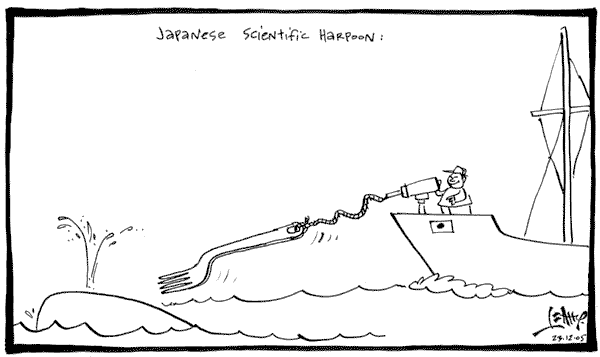
Even the Australian Government is not taken in by the Japanese pressure to commence commercial whaling.
The background to this is that a six-ship Japanese fleet set off from the port of Shimonoseki in western Japan in November. It aims to catch about 850 Minke whales, almost double the previous annual target of 440, and to add 10 Fin whales to what Japan calls its scientific whaling programme.
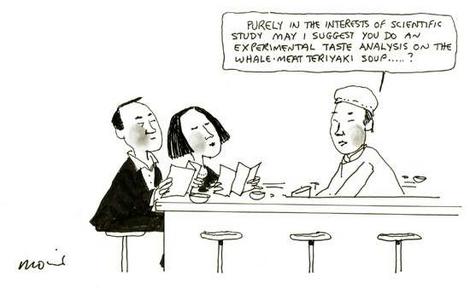
Alan Moir
Although Australia has proclaimed sovereignty over the Australian Antarctic Territory (AAT), it refuses to challenge Japan's invasion of these waters. Japan does not recognise the whale sanctuary.
December 25, 2005
Japanese commercial whaling
Greenpeace in action against the Japanese whalers:

This is commercial whaling by the Japanese. The Japanesea say they are hunting minke whales for scientific research yet most end up the whale meat ends up as high-priced luxury food in Japan.
There was a history of commercial whaling at Victor Harbor in the nineteenth century:

At the base of the Bluff (Rosetta Head) is the site of Victor Harbor's old whaling station. In the early 1870's whaling was a thriving local industry. It has been estimated that around a hundred thousand Southern Right whales used to pass through the waters of Encounter Bay, prior to whaling. Whalers came to the area from Britain, France, America and north-eastern Australia. They hunted the whales almost to extinction.
Although whaling ceased in the 1870s, there are now only an estimated seven thousand Southern Rights in the world. So it's go Greenpeace go
December 24, 2005
a question of time?
I'm down at the shack in Victor Harbor for Xmas.
I've spend two days trying to get broadband connected. I'm still on dialup.We have traced the fault back to Telstra: its either their exchange or line that prevents the modem from accessing the telephone line. Telstra are unwilling to check their system before the 5th of January. Good old Telstra.
Meanwhile, I see that the Japanese whalers are in the news again.
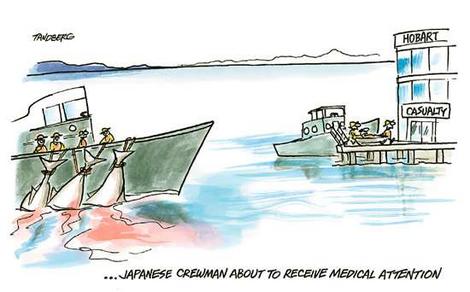
Ron Tanberg
I'm with Greenpeace on this one. The Australian Government needs to toughen its softly softly approach. It si far to conciliatory.
December 21, 2005
Kylie
Kylie: an exhibition, which opens at the Powerhouse Museum on Boxing Day, features 40 of her costumes, designed by the likes of Dolce and Gabanna, Alexander McQueen, Stella McCartney and John Paul Gautier. In addition there are 12 pairs of shoes, 100 photos and 30 of the awards Kylie has picked up along the way to pop stardom.
An example is the gold vintage lurex hot pants ruched at sides for Spinning Around’ from the album Light Years, 2000:
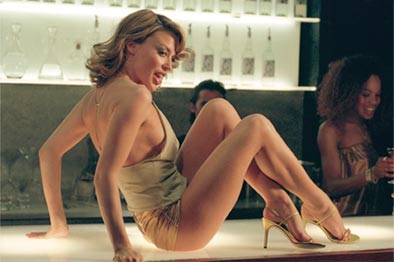
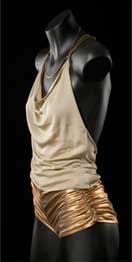
The costume is costume is Gold jersey top with gold chain neck and back straps, Designed by Stella McCartney (UK) for Chloe (France). Video directed by Dawn Shadforth, Performance photograph by Paulo Sutch.
What we have is a collection held at the Arts Centre in Melbourne.
December 20, 2005
about racism
It's been very hot in Adelaide today and I'm very tired from struggling with the searing heat all day.The airconditioner has broken down and needs replacing with something much bigger and more effective.
A cartoon about the old style racism that is based on biology:
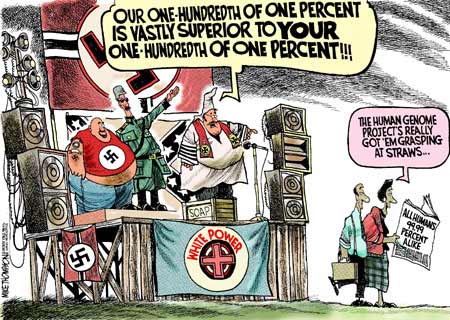
Old style racism is most commonly assciated with apartheid in South Africa, segregation in the American South, and the destruction of aboriginal culture in settler Australia, and links this to core values, social cohesion and the nation.
New style racism in Australia is about the cultural differences of racial groups (eg., Lebanese-Australians)
December 19, 2005
Trent Parke
This image is from a solo exhibition, Minutes to Midnight, which was the result of a two-year road trip around Australia.
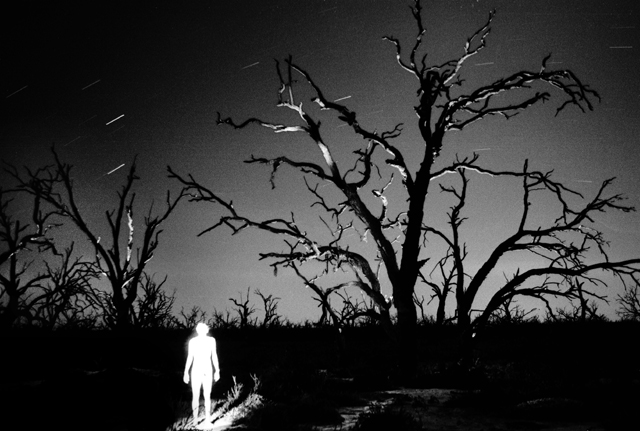
Trent Parke, Midnight, self portrait &endash; Menindee, outback NSW 2003
Great photo. I will post more.
December 18, 2005
East Kimberley art: Rammey Ramsey

Rammey Ramsey, Warlawoon Country Waterholes, 2004
Rammey Ramsey is one of the artists in the East Kimberley exhibition at Parliament House that I have previously mentioned here and here.
He was involved in the earlier Beyond the Frontier exhibition that was held at the Sherman Galleries.
December 17, 2005
East Kimberley Art: Goodie Barrett
Goody Barrett is an Aboriginal artist from the Warmun (Turkey Creek) community in the East Kimberley region of Australia.
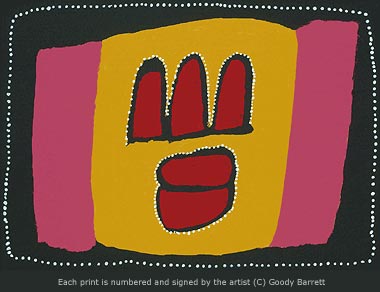
Goody Barrett, Untitled,
She is one of the artists in the East Kimberley exhibition at Parliament House that I have previously mentioned here and here.
This is a work that is bounded by a tradition, rather than being a great work that disrupts a tradition or history; part of a tradition that tells a story about the massacre of Aborigines in the Kimberley in the late 19th and early 20the centuries. This was made explicit in the Exhibition about the Mistake Creek Massacre around 1915- 1930. The exhibition told a story of the slaughter of a large number of Aboriginal women and children of the Kiji people who were shot and burnt in or near a dry creek bed in the Kimberley at the foot of an old boab tree. This art challenges the view that colonial frontier was less violent than many of the historical revisionists have claimed and therefore less destructive of Aboriginal society.
December 16, 2005
Carnival at Cronulla
The cultural conservatives thunder away about the doctrine of multiculturalism being really to blame for the tensions that exploded this week at Cronulla. The tensions were defined into existence by multiculturalist policies and ideas. Multiculturalism has bred ethnic ghettos characterised by high levels of unemployment, welfare dependency, welfare abuse, crime and violence. It's time, they say, to creat a unified nation with a single set of social and cultural values.
Yawn. It just points the finger at exclusively at the problems within a single ethnic community.
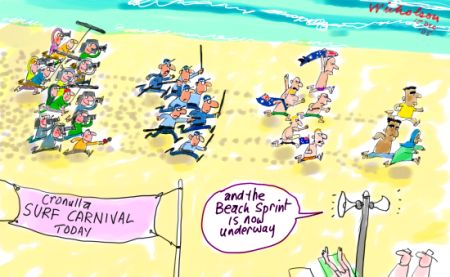
Not that the left liberals are much better. They go on about the deep seated racism of the Australian people, which like sun cancer,just below the skin, bursts into the open due to the reactionary tendences of the mass when fueled by evil politicians and shock jocks.
Yawn.
Both reactions sound like response-by-numbers pieces set to stirring emotional airport music conducted by Christian romantics. The music is entitled the Lucky Country, and its about a golden land of sunshine, surf and soaps, good food, good wine and good living.
December 15, 2005
Cronulla: one face of Australian nationalism
This is the ugly face of Australian nationalism that defended the beach at Cronulla from Lebanese-Australian gangs in the predominantly white enclave of Cronulla.
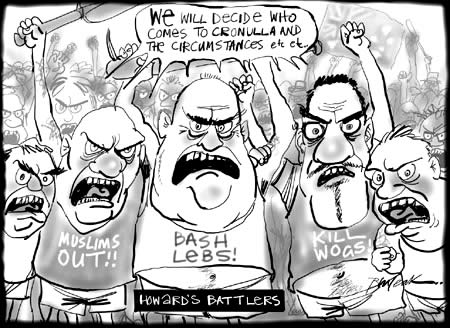
Bill Leak
It is the face of an aggressive and exclusivist nationalism. This nationalism is the anthesis of reason, the rule of law, allegiance to democracy and freedom as embodied in the Enlightenment. It is anti-modern, radical, deeply alienated from the supposed ruling elites and dominant culture, defensive and even paranoid. Through most of Australian history, it has also been deeply racist, not just toward blacks, but toward most minority groups, including Chinese and Aborigines.
The angry and exclusivist outlook of the aggrieved and aggressive right is still cloaked in the 'nationalist' rhetoric of the "Australian ethos " of democracy and freedom, the fair go, and Australian patriotism. The underlying sentiment is one of a permanent state of siege from the war on terrorism, as well as a defensive response to the continuing stresses on the working and lower middle class as they cope with globalization and economic change.
Can we speak of an Australian fascism forming?
December 14, 2005
surfing the undercurrents
It's called dog whistle politics. You talk to the mainstream in a reassuring voice though the tabloid media, whilst making suggestions and gestures to the dark side of the nation the meanings of which are well understood by those on your conservative side of politics.
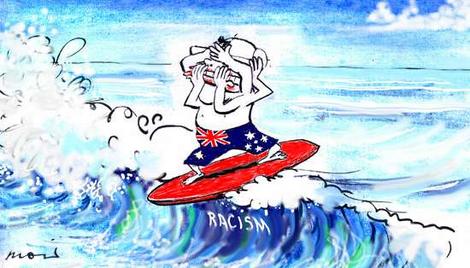
Moir
John Howard, the Australian Prime Minister, is a master of this kind of politics. He plays a cool hand.
The cruder sentiments as critically represented here are left to others on the street or on the media to voice. They have been given permission by the conservative political elites to speak out against political correctness. They then proceed to speak and act out their hostility.
The more sophisticated argue like this.
December 13, 2005
The Quiet American
Philip Noyce produced two films simultaneously: Rabbit Proof Fence and Quiet American. I previously seen Rabbit Proof Fence and I watched The Quiet American last night. It is based on the classic Graham Greene novel that forewarned against US involvement in Vietnam , and is about colonialism and empire as seen through the experiences of a washed out, ageing and jaded English foreign correspondent.
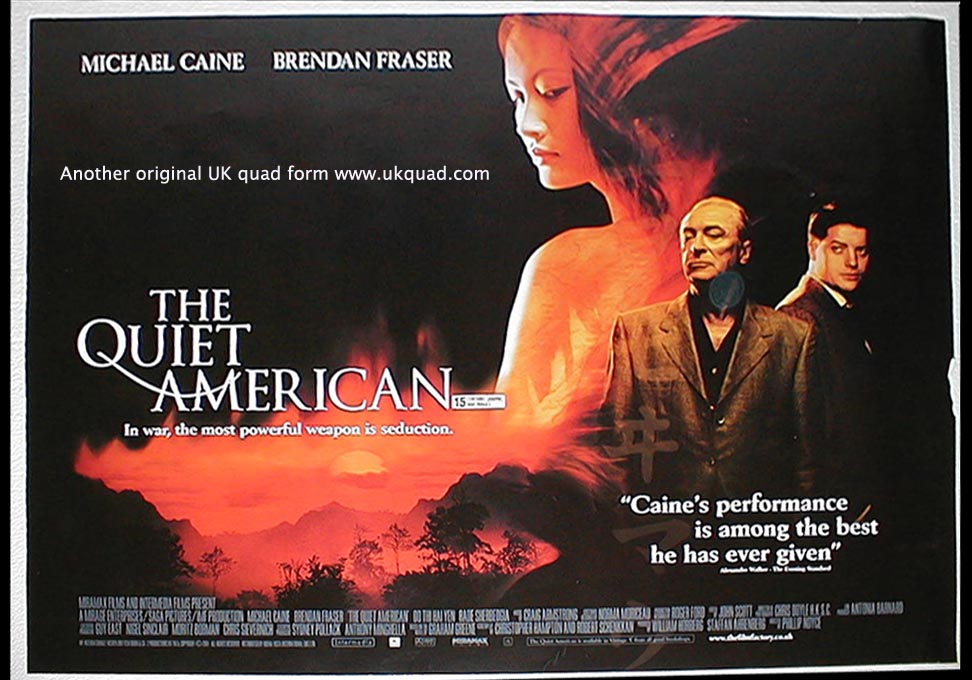
I was disappointed, very disppointed. It looked very good on the surface. There was little historical reflection in the moviearoudn Vietnam. Hell, it is 50 years latter, and we interpret the looming defeat of the France and the entry of the Americans into South Vietnam from where we are now. Yet the film was more about the characters and their relationships---eg., the classic romantic triangle is at the centre of the story--- with the historical context pushed into the background, apart from the Americans attempts at backing a violent "third force," neither colonialist nor communist. We are not given a portrait of the escalating political tensions as the French retreat.
Many people thinks it's a courageous movie, especially after 9/11. That's a very American response.
There was little deconstruction of orientalism. Edward Said had argued that the West had constructed a wrong and often abusive image of the Orient, not because of ignorance but because this was the way the West justified the oppression of the people of the East. This negative image was actually the major tool of subjugation.
December 12, 2005
thinking about Australia's cities
This looks to be interesting. The link is courtesy of Paula Rizzuto's blog
It is the ALP's discussion paper on urban development, housing and local government issues---called Australia's Future Cities.
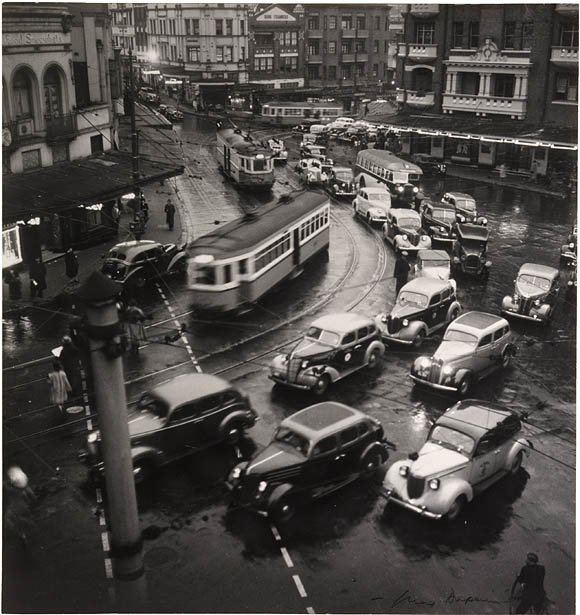
Max Dupain, Rush hour, Kings Cross, 1938
I will come back to Kim Carr's paper as its aim is a good one:
"...to help lift the existing policy debate into the national sphere. These are critical national issues and deserve better than the neglect of the Howard Government. But more fundamentally, the paper is about values. It is about family and lifestyle. It is about the right to a garden, the right to parks, the right to get to work and the right to a fair share of the nation's wealth."
Will Carr address the idea of a sustainable city?
a day of nationalism becomes a racist free-for-all
I appreciate that the image below is off key with this event in Cronulla Sydney on Sunday.
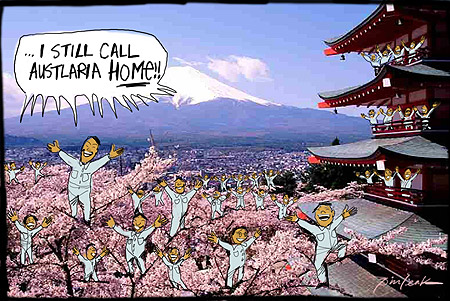
But it was a carnivial atmosphere of reclaiming the beach in the morning before the violence set in during the afternoon and evening and affiriming being an Aussie. There was John Williamson music blaring from car stereos, a sea of Australian flags, Eureka Stockade flags and boxing kangaroos, and a celebration of being a true blue Aussies.
Yet Cronulla transformed into possibly Australia's biggest racist protest since vigilante miners killed two Chinese at Lambing Flat in 1860.
When a day of nationalism becomes a racist free-for-all whilst singing Waltzing Matilda raises questions about Australian nationalism and culture in a globlised world that is caught up in a war on terror.
40 years ago Australia faced the reality that 'Britishness' could not act as a focus for Australian policies and priorities. That left a void in the Australian self-image or identity. Multiculturalism filled the void left by the decay of a once intense white Britishness.
So what becomes of the British heritage in the Australian national experience? If we are a nation of immigrants, so this orthodoxy runs, why give the British heritage pride of place? What is to be done about the nation’s British-centred past as the core national myth that once gave meaning to the Australian people?
The war on terror has punched the wind out of multiculturalism. What returns to fill the void? Cronulla indicated that it is Britishness recoded as Australian nationality. It claims that this tradition has a form of words which explains our nation's history, defines its values, and sets out its aspirations for the generations to come.
December 11, 2005
S & M in politics
This is a tough image.
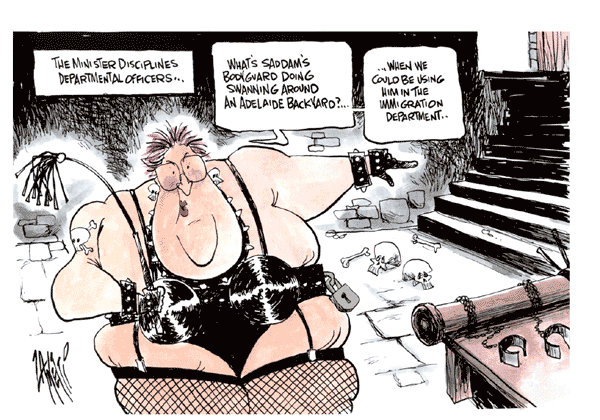
But the pop culture S&M imagery is appropriate, given the bully culture of Minister Vanstones' Immigration Department.
December 10, 2005
National Portrait Gallery
On the way back to Adelaide on Friday morning I noticed this winning design in the Canberra Times for the new home of the National Portrait Gallery of Australia.
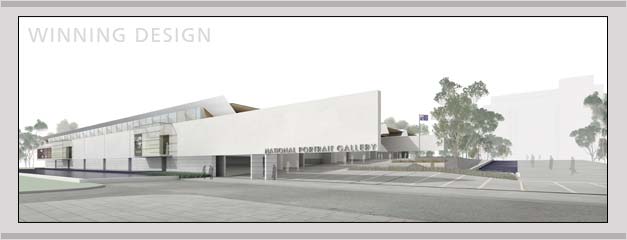
It is currently located in Old Parliament House and in a building in Commonwealth Place.
This is the kind of innovative architecture that is missing in provincal cities like Adelaide. Adelaide lacks the courage to establish a viable regional identity for itself the 21st century.
The National Portrait Gallery is designed by the Sydney architecture firm Johnson Pilton Walker, and it will be located in the Arts and Civic Precinct of the Parliamentary Zone, and so it remains within, and respects, the urban design of Walter Burley Griffin.
Tim Dunlop says that he'd:
"...much prefer it if it [the new National Portrait Gallery] was closer to the City. I hate the way Canberra is designed, with all the national buildings away from the centre of town."
My judgement is that Canberra is one of Australia's great urban achievements, and that Griffin's great urban design of a city embedded in nature provides the city with a design heritage that can be built on over the next 50 years.
Sure, Canberra has its downside. Despite being the nation's capital it lacks a vital cosmpolitan inner city culture, the city centre (CBD) is in need of rejuvenation, and it needs to develop a public transport system that avoids the private and the atrocious taxi industry that would allow people to move around easily.
However, Canberra is a unique city with a special landscape setting. That is what makes Canberra so special. I'm not that confident that the Natonal Capital Authority will protect that heritage. It strikes me they are about selling that heritage to fund development.
a changing musical scene
It is well known that the Grateful Dead failed to penetrate the record charts, the radio playlists and the tv music shows. This allowed the band to escape the creative tradeoffs that have bedevilled those pop musicans whose careers depend on the shifting winds of popular merchandising and musical fashion.
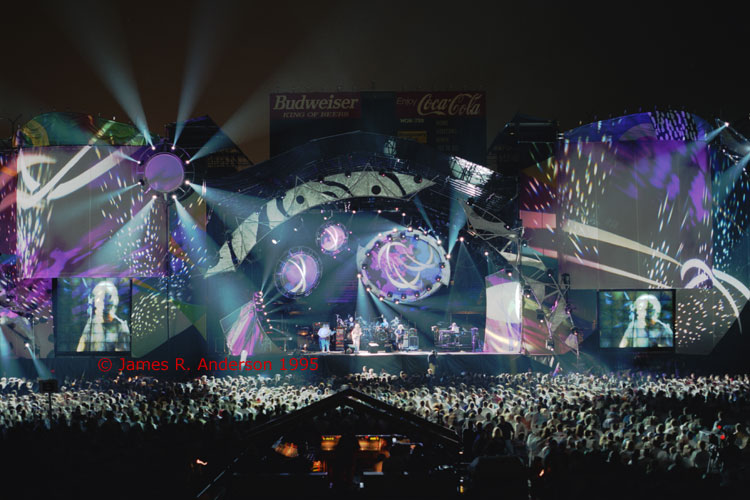
The Grateful Dead's easygoing (libertarian) attitude toward concert recordings had been a cornerstone of its music making. At concerts there was always an authorized "tapers' section"---a mini-forest of high-quality microphones on long poles --and the band never tried to stop fans from trading the recordings, as long as they weren't sold. Over the years some of the fans archived edited and processed the music, and a traders' network grew, which developed from the cassettes by mail of yesterday to the digital downloads of today.
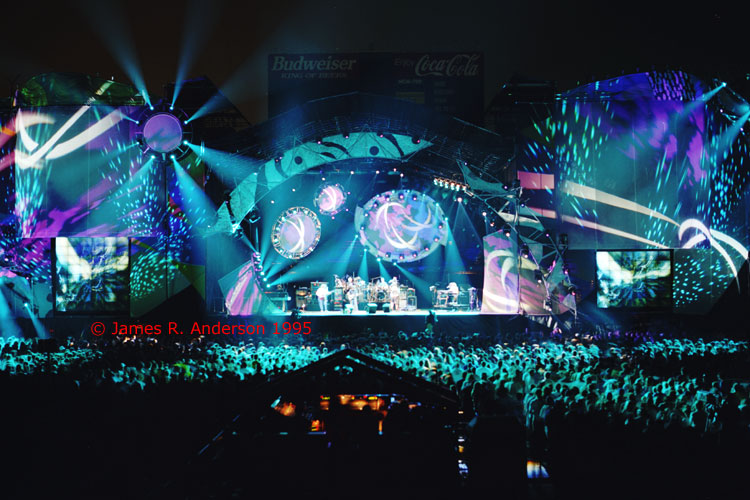
This free archive was quite different from the bands own archive of recordings, which have resulted in a number of CDs over the years in the Dicks Picks (based on stereo master recordings made at shows on reels) and the 'From The Vault' series (made from multi-track material) such as The Knickerbocker Arena, Albany, NY - March 24-26, 1990 which gave rise to the "Dozin' at the Knick" shows.
The relationship between the fans and the bands recordings was based on a model of music as folklore or music belonging to, and a part of, the (Deadhead) community.
What has developed from the fans recordings is a free archive of digital music that exists outside the corporate recording business; an archive that is in competition between to the Grateful Dead's own digital archive.
So in these days of digital copyright and brand value who owns the rights to the live music? Especially when the Grateful Dead as a commercial entity or corporation, as distinct from the band, has been struggling for survival.
The conflict surfaced. Grateful Dead Merchandising asked Live Music just before Thanksgiving Day to pull their substantial catalogs of the band's concert recordings. That angered fans to the point where an online petition was circulated with a threat of boycott of the officially sanctioned Grateful Dead Merchandising releases and Dead concerts. The commercial entity retreated and the shows were reposted for free access.
I'm sure the conflict will resurface.
December 9, 2005
a ship of fools
The idea of 'the ship of fools' is concerned to give a reason for the wayward behavior of human beings in a fallen world. The causes are related to foolishness, wherein foolishness, depending on circumstances, is another word for ungodliness. This lead to the prospect of divine damnation.
The initial moral allegory was by the distinguished humanist Sebastian Brant was published in Latin as Sultifera Navis in 1494 and it contained a number of woodcutsthast are judged to be a early examples of intentionally comic illustration in the printed book.
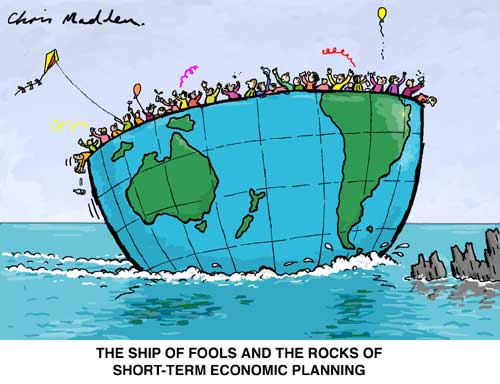
The conception is that the passengers on a ship traveling from X to Y represent society at large in that era. We are voyaging through the seas of time on a ship, a small ship, that is representative of humanity. Sadly, every one of the representatives is a fool. This is how we live--we eat, dring, flirt, cheat, play silly games, pursue unattainable objectives. Meanwhile our ship drifts aimlessly and we never reach the harbour.
Presumably, the new fools are the economists because their obsessive concern with increasing economic growth as the end of government makes them blind to environmental destruction that is caused by that growth. This leads to the tragedy of the commons (eg., the destruction of our rivers), and so we are obliged to live with the wretchedness of economic folly. We are the new fools if we believe the illusions and myths of the economists.
The Grateful Dead have a song a called Ship of Fools on their 1974 'From the Mars Hotel':
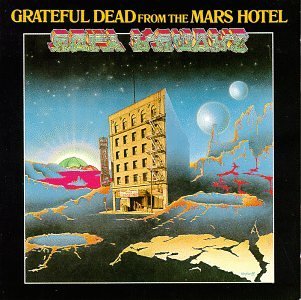 This is the post Ron "Pigpen" McKernan band that had been structured around Pigpen's haunted R&B howls. He had died in 1973 after a long illness. The lyrics of Ship of Fools:
Went to see the captain
strangest I could find
Layed my proposition down
Layed it on the line;
I won't slave for beggar's pay
likewise gold and jewels
but I would slave to learn the way
to sink your ship of fools
The song, by Garcia and Hunter, which works with a sense of self-criticism, includes themselves on the ship of fools.
The bottles stand as empty, as they were filled before.
Time there was and plenty, but from that cup no more.
Though I could not caution all, I still might warn a few:
Don't lend your hand to raise no flag atop no ship of fools.
Ship of fools on a cruel sea, ship of fools sail away from me.
It was later than I thought, when I first believed you,
Now I cannot share your laughter, ship of fools.
December 8, 2005
Paddy Bedford
One of the artists in the East Kimberley exhibition at Parliament House that I mentioned here and here is this one:
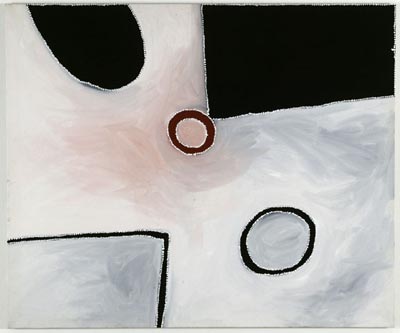
Paddy Bedford, Winperrji, Police Rockhole
Paddy Bedford is one of the driving forces of the East Kimberley art movement.
capital dreaming
A quick image that shows how I feel about toll road companies which are now everywhere in Sydney, courtesy of the Carr Labor Government.

They have no concern about the sustainability of the city. The more cars the merrier. It means more profits for the toll companies.
The Carr Government is reponsible. They are more concerned with the profits of the toll companies and systematically placed the interests of the corporation ahead of the citizens of NSW. Sydney's Cross City Tunnel has become a symbol of political incompetence.
You can read about it here.
December 7, 2005
a pre modern image
A photograph of a pre modern image. It is a long way from the autonomous modern art of modernity and from Plato's explusion of the artists (poets) from the republic that was to be grounded in reason and truth alone.

John Coppi, Aboriginal rock art at Nourlangie Rock, Kakadu National Park in the Northern Territory east of Darwin, 1992
It is an example of why we need to think of the discourse of aesthetics in terms of modernity, especially the modernist conception of art as beauty divorced from truth and morality that was first articulated in Immanual Kant's Critique of Judgement.
In that text we find an understanding of individual judgements of taste as disinterested and the bracketing of knowledge and morality to focus on form. Thus we have the outlines of the modernist understanding of the aesthetic attitude where beauty is equated with formal elegance.
This kind of indigenous rock art in a hunter and gather society enables us to overcome a modernist aesthetics and restore to art its status a form of cognition. It is not great art (as in the sense of some works of Van Gogh or Picasso that disrup the visual tradition). On the contrary thsi image discloses another kind of world, that of a hunter and gather society, and it indicates another way of centring visual representations to the subjectivist one in modernity that places an emphasis on originality and genius.
December 6, 2005
Peggy Patrick
I did manage to eventually see the East Kimberley exhibition at Parliament House, which I mentioned here and here.
I even managed to write down the names of the artists in the show. I plan to introduce the artists over the next month, as I find the work to be extremely important.
Here is one artist:
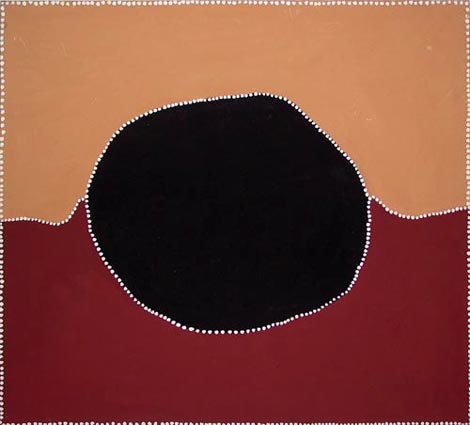
Peggy Patrick, Sink Hole Bow River, ochre on linen
Peggy's work in the Parlaiment House exhibition was entitled Mistake Creek:
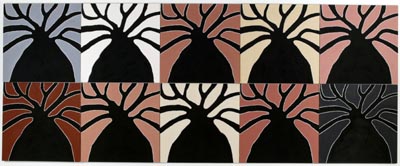
Peggy Patrick, MISTAKE CREEK MASSACRE BOAB, 2004
Peggy Patrick is one of the people who bore witness to the massacre at Mistake Creek in the early 20th century.
I guess this kind so work can be seen as part of a project of giving Australia's Indigenous peoples a voice to express their perspective on Australian history in the form of story telling that cuts against the conservative traditon that justifies and silences the colonial injustices on the colonial frontier.
It stands for a direct challenge to the Kantian aesthetic tradition of a distinterested art divorced from politics and moraliy.
December 4, 2005
stencil grafffiti: Melbourne
There is a difference between graffiti as street art and the ugly tag graffiti done by the alienated street kids

Gabriella Coslovich has a feature in The Age on stencil graffiti as street art in Melbourne. She says:
When it comes to graffiti, it seems the world is divided into those who see it as a menace to society, a sure trigger of escalating crime and falling property values, and those who view it as a vital element of a city's urban fabric and consider the best examples of it as an exciting part of contemporary art practice.
Melbourne City Council, like other capital city councils in Australia, has adopted the menance position as has the Brack's State Labor Government. They want a squeaky clean Melbourne for the Commonwealth Games .Their get tough on graffiti sees street art as an illegal activity. They just do not appreciate inner city cool as they have adoped a zero tolerance approach.
The latter position is that of the designers and visual artists Jake Smallman and Carl Nyman, of Stencil Graffiti Capital: Melbourne:
 celebrates the thought provoking, visually rich stencil graffiti scene. They see this street art as art as an expression of the city's witty, creative and socially aware visual art community, and acknowledge the innovative work of street artists such as Ha-Ha, Psalm, Meggs, DLux, Meek, Vexta, Civilian.
They see the city's walls and spaces as meeting places for visual ideas that propel the art form forward as artists outdo each other with bigger, bolder, madder or simply strange and beautiful stencils.
December 3, 2005
about nuclear power
There has been similar talk in Australia about nuclear power. It is being sold in terms of being the only option to coal-fired power stations that produce greenhouse gases and global warming .


The agenda is for Australia to sell more uranium overseas and to build a nuclear power industry.
December 2, 2005
sedition#3
Is this the effect of John Howard's proposed anti-terrorism measures on writers and artists?

Allan Moir
The application of these laws will be political and discretionary.
Paul Caponigo
Paul Caponigro is one America's best living landscape photographers. I admire the finely composed large format black and white landscapes:

Paul Caponigro, "Rock Wall, West Hartford, Connecticut", 1959, Gelatin Silver Print Photograph
Very cubist is it not?