January 26, 2006
american popular music
Storytelling is a popular form amongst American musicians. So what kind of stories do they tell?

A Ry Cooder quote on American popular music:
'Failure of the American dream is the story.'The story of American pop music is the story of failure. The blues, country music, it's not the story of success. People don't win, they lose.'
That's capitalism, US style, for you.
A classic example is Ry Cooder's Chavez Ravine's story about a world of corruption and greed made from the multicultural melting pot of LA
Inspired by Don Normark’s book Chavez Ravine, 1949: A Los Angeles Story this album recreates various aspects of the poor but vibrant hillside Chicano community, which was bulldozed by developers in the 1950s in the interest of 'progress.' The Dodgers Stadium ultimately was built on the site. It is a story told through the music, and one that recaptures the musical culture of a lost era. Tis a sorry tale of 'urban renewal':

The tale is about political power and prejudice in East Los Angeles during the McCarthy era being used to prevent public housing for the Chicano poor. Chavez Ravine was supposed to be the site of a public housing development by Richard Neutra. This plan never came to pass, as it fell victim to a coordinated attack from land developers who wanted to stop public housing and local McCarthyites who charged proponents of the plan with being “communist agents”.
Tis a story about life being supplanted by sports in a city where life is a shopping mall. This is a world premised on the replacement of real life with virtual life of Disney, McDonalds or Starbucks.
changing musical experiences in a digital world
I've just discovered by Shaun Cronin's Rock'n' Roll Damnation. Through it, via Larvatus Prodeo I came across this: ----Janis Ian's article on the music industry and internet downloads. It is very relevant response to the major labels like Sony-BMG and EMI, who are looking for new ways to make their music less convenient to access by consumers. The music industry is also prosecution of people it perceives as "stealing" music---ordinary consumers are deemwed to be pirates.

Janis states that:
The premise of all this ballyhoo is that the industry (and its artists) are being harmed by free downloading.Nonsense....Free exposure is practically a thing of the past for entertainers. Getting your record played at radio costs more money than most of us dream of ever earning. Free downloading gives a chance to every do-it-yourselfer out there. Every act that can't get signed to a major, for whatever reason, can reach literally millions of new listeners, enticing them to buy the CD and come to the concerts. Where else can a new act, or one that doesn't have a label deal, get that kind of exposure? Please note that I am not advocating indiscriminate downloading without the artist's permission.
Well put. It is what the Grateful Dead utilized to such good effect by allowing the fans to tape their live concerts.
Janis goes on to say that :
I am not saying copyrights are meaningless. I am objecting to the RIAA spin that they are doing this to protect "the artists", and make us more money. I am annoyed that so many records I once owned are out of print, and the only place I could find them was Napster. Most of all, I'd like to see an end to the hysteria that causes a group like RIAA to spend over 45 million dollars in 2001 lobbying "on our behalf", when every record company out there is complaining that they have no money.
There is there is more to music than the music industry.
The everyday musical context is changing rapidly due to digital music. Other musical aspects--discovery, experience, platforms, form--- that are changing due to the explosion of digital music are explored at City of Sounds New Musical Experience post. The argument is that 'though the volume of songs has increased, both in terms of music accessible to the average consumer and in terms of what their devices can hold.....it appears that important aspects of the music experience itself may be diminishing.'
January 24, 2006
modern urban life
The increasing cost of petrol means that the sales of the big touring cars are down in Australia as consumers increasingly make the switch to smaller, more economical cars. Australians still love their cars.

In Australia it is the rising cost of summer airconditioning that hits the family budget, not the winter heating bill. Airconditioning is necessary but expensive. Very necessary in city apartments. As I'm finding out. You live in an airconditioned shoe box and reduce the use of the car is the deal.
The switch to smaller cars does nothing to ease the traffic jams that make urban life so difficult. In Sydney it often takes 1-2 hours to travel to and from work. That's up to 4 hours a day in the car, some of it spent in a crawl. The current solution to traffic congestion crises is to build more e freeways ---Sydney leads the way on this. These tolled freeways defer the crisis but they don't solve the problem: they actually increase the traffic on inner-city roads.
Sydney ploughs on. It is as if traffic congestion is an inevitable by-product of vibrant, successful city. It indicates that Sydney is a car culture—as is most of suburban Australia. Congestion is the inevitable result. Congeston, a dysfunctional transport network, and a city enveloped in fossil fuel emissions is something to live with, despite the social cost. All that you can do, says the Labor state government, is build more freeways that allow people to move more quickly from A-B.
A better solution is to reduce the traffic on the inner city roads. What is not being considered is increasing the proportion of road surface to light rail. The latter reduces car traffic but also increases people flow in a clean, low-noise way. Most Australian cities (Melbourne is the exception) tore up their extensive light rail system in the middle of the 20th century. Few are willing to acknowledge that mistake--least of all Sydney. None are considering returning to light rail.
Sydney has the monorail though. It is little more than a tourist gimmick.
Update: 25 January
There is some good comment on this issue by Andrew West over a the Sydney Morning Herald. He argues that the NSW Labor Government hates public transport. Public transport is for losers. The big car is the sign of winners. Another indication of the refusal to ackowledge the need for cities to become sustainable.
January 22, 2006
living in the regions
I've had connectivity problems at the Victor Harbor weekender in the last few days. Broadband--which took weeks to get going thanks to a faulty Telstra exchange--- dropped out. After lots of checks yesterday the fault has been traced back to Telstra's copperwire infrastructure. Since they will not do any repairs for 48 hours, as they do not work on weekends, I've fallen back on dialup as a backup. But I could not get connected yesterday--the lines were too busy. This is the first connection I've had in 36 hours.
I came down to Victor Harbor to escape the heat wave that has enveloped Adelaide and southern Australia. It was 10 degrees cooler than Adelaide last week, but the heat storm has enveloped Victor Harbor yesterday and continues today. The temperatures are around 40-44 degrees with a gale force north wind blowing down from the desert.

Leunig
Since I've been down here working I've noticed the poor infrastructure of the region. Two examples. We had the usual blackouts due to the electricity overload., and the whole house closes down. Secondly, the sewerage infrastructure cannot cope with the summer overload when the coastal own increases by 3-4 times. So the sewerage is poured into the local rivers that then flow into the popular bathing beaches. The tourist town stinks in high summer.
In the reserve, just across from weekended the sewerage flowed out of the pipes into the reserve. Raw sewerage. It took the the relevant authority 3 days to repair. So for three days raw sewerage was allowed to flow into a popular reserve where people walked and played.
The regular break down of electricity, telecommunications and sewerage infrastructure is a normal feature in the regions.
January 20, 2006
Emily Kame Kngwarreye + abstraction
Emily Kame Kngwarreye is a star amongst indigenous painters, even though her exhibiting career in old age spanned less than a decade, from 1988 until her death at the age of about 86 in 1996. She worked out of Utopia, and in downplaying the storytelling elements in her work, she helped pave the way to a more contemporary indigneous art form:

Emily Kame Kngwarreye, Ochre Body Paint 11, 1995, Earth Pigments and Natural Binder on canvas
The work of modern Aboriginal artists can no longer be dismissed as ethnographica. It is now rightly valued as a great art tradition that can be included as part of the 20th century's modernist abstract art. The abstract painterly quality of Emily Kame Kngwarreye's work has attracted widespread international interest and some of the works can take their place beside those of a Jackson Pollock, Arshile Gorky or Robert Motherwell.
Emily Kame Kngwarreye's work often has a structure of geometric forms that are over painted with lines of dots that overlap the contours of the outlines. Though the modernist art institution often exhibits these works along side of those of 20th century abstract European and American artists, Kngwarreye's works are not just vibrant compositions, exercises in avant garde form, or pleasing patterns and colours on canvas. The paintings are heavily layered or sedimented with indigneous tradition, history and religious ceremony.
Many of the works were produced in an Andy Warhol-like factory assembly line, in which various members of her family assisted in the painting, or painted works under her name which she did not touch. Somehow it was okay for Warhol to do this with his screen prints, but this strand of Kngwarreye's work is seen as fakes.
That is a problem for the investors. What we have are the vibrant works:

Emily Kame Kngwarreye, Alatyite, Acrylic on canvas, 1994
She says:
I did batik at first, and then after doing that I learnt more and more and then I changed over to painting for good … Then it was canvas. I gave up whatsitsname, fabric, to avoid all the boiling to get the wax out. I got a bit lazy, I gave it up because it was too much hard work. I finally got sick of it. I didn't want to continue with the hard work batik required - continually boiling and boiling the fabric, and lighting the fires, and using up soap powder, over and over, that's why I gave it up and changed over to canvas, it was easier. My eyes deteriorated, and because of that I gave up batik on silk - acrylic painting was better for me.
The themes of country and Dreamings remained a constant in her work, throughout the transformations of her style.
My own preference lies with the loose, bold and luscious blocks of monochromatic, linear colour of Emily Kngwarreye's Last Series:

Emily Kame Kngwarreye, "Last Series", acrylic on canvas, 1996
These fields of colour are recognizably an expressionist interpretation of the landscape from the perspective of the traditional indigenous cultural beliefs and customs. Yet, for all their modernist familarity, these works prompt in the viewer a way of perceiving the country and being in the landscape that are initially alien. We sense that we are stepping into a terra incognita of our visual culture.
The art life weblog asks: how do we non-aborigines make sense of this work? (see Thursday, April 15 2004). It's a good question. This post over at Artrift might help. us. Rilke is addressing his relationship to Cezanne:
For Rilke--and this is the heart of the transmittal from Cezanne--"reality" is a habit of the mind, a "tradition" deeper than all the other traditions, neither true nor false, but an anchor by which one holds fast against the new or the troubling.
The Dreaming is an anchor that makes sense of, and helps one hold fast, the chaotic flow of life in postmodernity.
January 19, 2006
River Yarra, Melbourne
Waste and toxic materials in Melbourne's iconic Yarra River have been a source of concern since the 19th century, when the river had been treated as an industrial drain and rubbish dump:

River Yarra circa 1968
The quality of the Yarra River has improved greatly since then, due to a major sewerage expansion program, the removal of septic tanks and the diversion of all industrial waste into the sewerage system.
Today the stormwater from the drainage systems of each of the urban council areas finishes up in the Yarra.it is not safe to swim in because of high bacteria levels that made it unsafe for swiming, rowing and kayaking. There are still thousands of households in outer eastern Melbourne adjacent to the Yarra River and its feeder creeks including Warrandyte, Park Orchards and Donvale still totally reliant on septic tanks discharging into backyards. Human faeces is a significant pollutant in the river.
January 18, 2006

January 17, 2006
natural history

I rarely ever go into Australia's state museums as I have little sympathy with their natural-history focus which separates out natural and human histories.
My problem is the flaw with the conventional natural history approach. This linera history is one that highlights the Australian continent's separation from Gondwanaland; and establishes a historical continuum ranging over 400 million years, with 60,000 years of Indigenous occupation and 225 years of European occupation and ownership.

It also establishes the intellectual rifts between Aboriginals and Europeans and divorces European settlers from nature.
I favour an interpretation of natural history that integrates people with their natural environment ,and so acknowledges that European culture in Australia has been conditioned and influenced by the natural world as well as shaping it.
As well as highlighting the way that colonial Europeans understood themselves to be divorced from nature or the ecology of the continent, ithis interpretation undercuts the way the natural history of the state museums establishes an intellectual rifts between Aboriginals and Europeans. The latter kind of natural history is silent about the colonial wars between aborigines and settlers in colonial Australia.
January 14, 2006
Leunig's wit
It took me a while to get this witty comment.

M. Leunig
The emphasis is on the clean and not the old technology.
January 13, 2006
big energy rules
The six governments responsible for nearly half the world's greenhouse gas emissions will rely on industry to shoulder most of the burden of offsetting global warming. But Big Energy isn't too keen on bearing the burden of the ecological consequences of its reliance on fossil fuels.
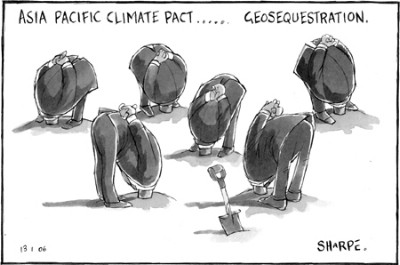
Sharpe
It's a good joke, isn't it.
You cannot address climate change and global warming at the expense of economic growth is the refrain from Big Energy and its government boosters and supporters. That is unacceptable. So is any cut in the use of fossil fuels or emission reduction targets.
January 12, 2006
urban life in postmodernity
The Adelaide City Council is increasing the hight restrictions for the CBD. It wants the provincal city to look modern. New York is the still model of what being modern means.

Being modern in Adelaide means a car dominated city (good for business) and a polite indifference to the needs of people living in the inner city.
Urban life is changing in Australian cities. This report says:
For the cost of putting a baby born in 2006 through private schooling, parents could pay off a mortgage on a two-bedroom suburban Sydney flat....Add a three-year stint at university, totalling $140,000, and the costs blow out to $430,000.
I reckon that's cheap. What if it's a doctors degree? Or an MA? Hell, many people in Sydney cannot afford to own a two-bedroom suburban flat.
January 11, 2006
fields
The collapse of the mechanical world-view,acccording to Einstein gave rise to the emergence of "field" theory
A field describes the behaviour of a dynamic system that is extended in space, through kinetics (interaction in time) and relational order (in space). It is a function of space and time coordinates that assigns a value of the field for each of the coordinates.
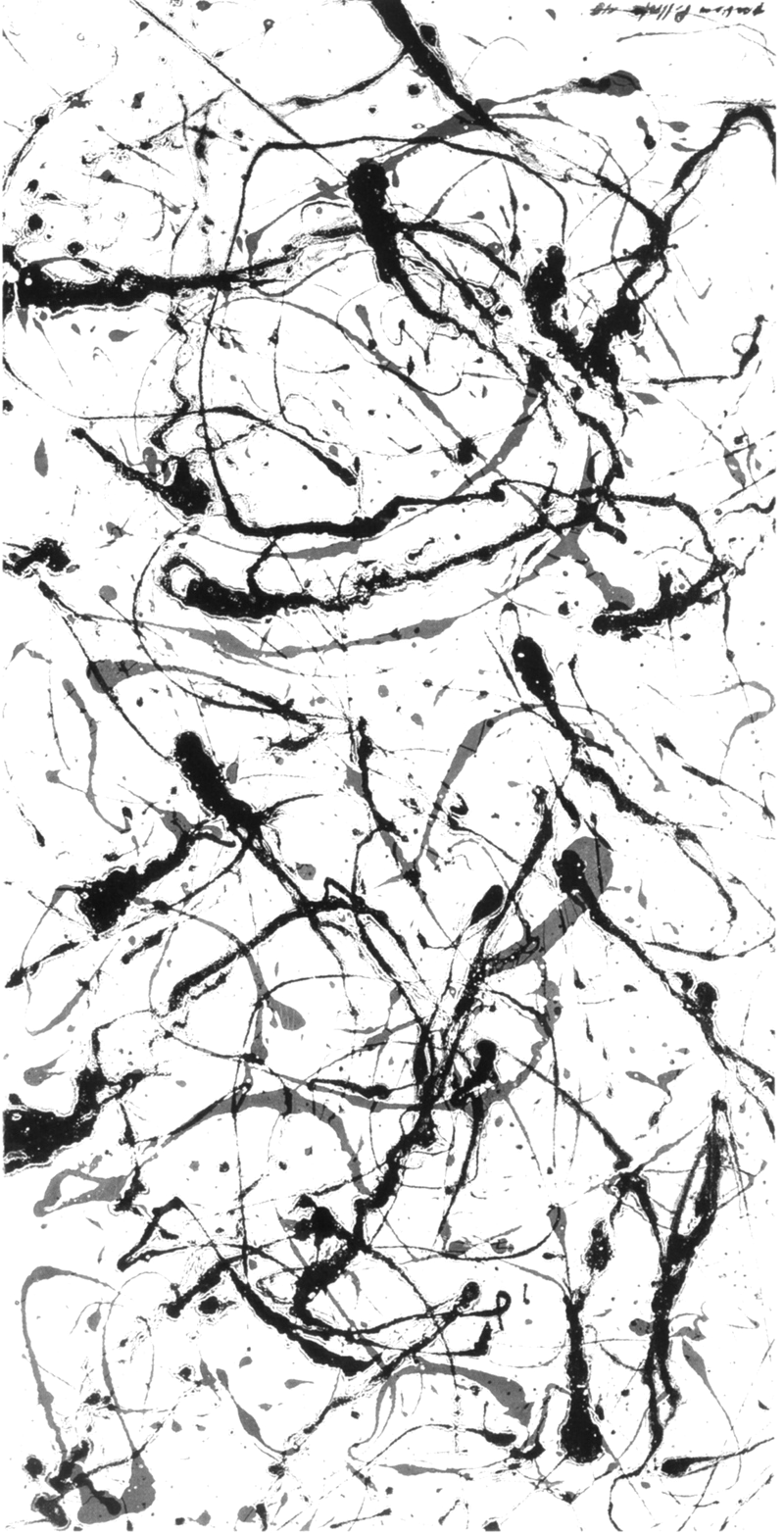
Jackson Pollock, Number IIA, 1948
Fields are not a form of matter. Instead, matter is energy bound within fields.The field is not a thing-concept but a relation-concept; it is not composed of pieces but is a system, a totality of lines of force.
January 10, 2006
political death
It's one hellu'va image about political death at the hands of your own party: on this occassion the Liberal Democrats in the UK.

The Liberal Democrats are a bit like the Australian Democrats in Australia. So it is fitting that Andrew Bartlett has some comments.
whaling battles
Greenpeace continue to annoy the Japanese whaling fleet in the southern oceans:

Paul Taggart, World Picture News
The photo depicts an attempt by the group Sea Shepherd to disable the Japanese factory ship Nisshin Maru after it collided with the Greenpeace ship Arctic Sunrise on Sunday. Sea Shepherd activists in inflatable dinghies tried to foul the propellers of the Nisshin Maru with heavy ropes, the group said yesterday. Driving close under the bow of the Nisshin Maru, the activists from the Sea Shepherd vessel, Farley Mowat, unsuccessfully tried to heave the lines under the hull to entangle its propellers.
Jennifer Maroshy argues that the Greenpeace ship Arctic Sunrise rammed the Nisshin Maru, the factory ship of the whaling fleet, and she takes exception to what she calls the damage to Japanese private property by wrongdoers.
The Greenpeace video is here. Andrews weblog onboard the Esperanza and Shane's weblog from on board Arctic Sunrise
January 9, 2006
Kill Bill
Vol. 1 that is. I have yet to see Vol 2.
But I've finally got around to see the amalgam of low-budget samurai imports, Chinese martial arts films, spaghetti Westerns and exploitation flicks of yesteryear. I found it very stylish, bloody and innovative. It was such
such a simple revenge narrative based on good and evil forces though.
Who cares. It has a great opening scene, it's cartoonish and its very pop artish. I just let it wash over me and savioured the experience of the visual spectacle of the choregraphed violence.

It's a kind of homage to these movies from a cinephile or "film-geek" with lots of ironic, self-reflexive. Tarantino sure has watched a lot of low grade movies.
Is Kill BiIl more than an imitation, revision or reconsideration of Seventies grindhouse and western cinema? Is it more than a sprawling homage or the story of an angry woman's revenge? Maybe there is a hint of redemption in the film? Revenge as the path to redemption? A path involving the massacres of dozens of people and more or less getting away with it.
Maybe we can approach the violence as a kind of visual language? Maybe the way the film approaches the violence says something?
January 8, 2006
John Olsen
The conventional art history account is that John Olsen works within the modernist tradition. I would say that the aerial view, quizzical line, irregular squiggles and dots, and geological mappings presupposes, and expresses the effects of, modern aboriginal art:

John Olsen, Lake Eyre and Still Life, oil on linen.
There is no foreground/ middle ground/ background schema, nor any sign of the traditional European landscape's concern with "human scale."
Olsen himself puts this into question:
"Aboriginal Australians have been artistically interpreting the land for thousands of years of experiencing and looking and being involved, in a hunter-gather kind of way". But though non-indigenous Australians may admire Aboriginal art we can't really identify or understand it in the same way that we have a rapport with a Leonardo or a Rembrandt."How so? Do we not have different kinds of rapport, different points of entry, different interepretational thresholds?
The Australian landscape tradtion is more than the European-Australian one of a Russell Drysdale, Sidney Nolan, Fred Williams and William Robinson. We would now include Clifford Possum Tjapaltjarri and Emily Kame Kngwarreye, and Rover Thomas.

John Olsen, The Murray Running into Lake Alexandria, Oil/Canvas
Australia is a post colonial world and so is the Aboriginal understanding of the landscape.
postmodernism
A nice quote for a lazy Sunday morning to place up against the Kantian paradigm of immanent artistic beauty marked by a-historical universality and disinterestedness--just in case you happen to be reading Kant's Critique of Judgement:
Postmodern theory has taught its practitioners to be wary of origins. In the name of an anti-foundationalist discourse which challenges all nostalgic yearning for an arche, it has helped to foster a critical attitude about the possibility of beginning anew. What has emerged from this critical posture toward beginnings is an awareness about the significance of what I will call "points of entry"--those interpretational thresholds which allow us to enter into a dialogue with a text, a thinker, or a tradition. Points of entry frame the possibilities of all interpretation; they open up pathways for discovery even as they close off other venues and approaches. Entering into a thinker's work from a certain vantage point determines much about how an interpreter will frame her questions and follow her path of inquiry.
The quote is from here.
This anti-foundationalist way of approaching a tradition, text, or image enables us to come into the Australian landscape tradition from a number of entry points or pathways--eg., the European one or the aboriginal one. Or even from a number different aboriginal ones--eg, the rural or the urban. We could for instance start here:
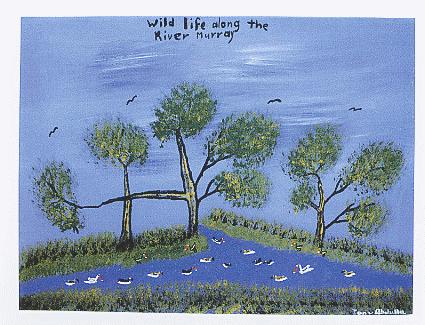
Ian Abdulla, Wildlife along the River Murray - 2002, acrylic on canvas
Ian Abdulla's paintings draw from his childhood experiences of growing up along the River Murray. In his own words:
"In the modern world there's too much modern stuff going on, instead of listening to the old people, sitting down and listening, these days they just play Nintendo and that. My kids were amazed at the lifestyle I had as a boy - my daughter said "If we'd done what you'd done we would never have survived!".
A naive style? A form of history painting of a world along the River Murray that has gone by? 'Naive' would place it within a certain European art historical context--but that is not right way to understand this work. Aboriginal art from the early 1800s - worked with similar styles to Abdulla's - but it was not considered "art" by white Australians of the time. It was seen as "curiosities rather than as the authentic visual expressions of a primitive Aboriginal viewpoint". Abdulla's paintings work from the tradition of Aboriginal art and culture, where story telling an important.
Each of Abdulla's paintings tells a story.
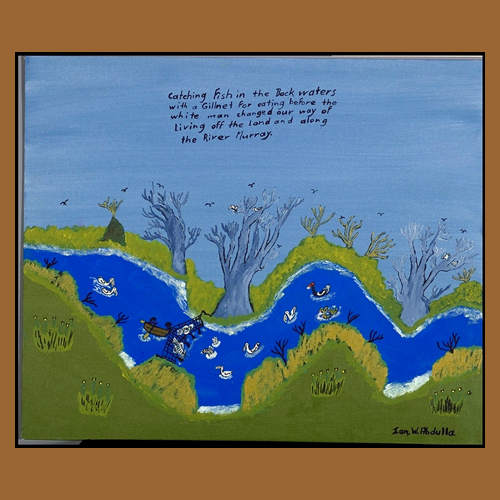
Ian Abdulla, Murray River, 1990, from 'The River Series'
So we need to be wary of orgins do we not? Be aware of the modern conception of the artist: either as a timeless prophet (eg., the Dutch painter Vincent Van Gogh) in which the artistic artefact is the mirror of his unfathomable psyche: art as expression; or the avant-garde artist, the successor of this romantic artist, whose labour of individualisation implies a transgression of the institutional frameworks defining art.
We need to question modernity's aesthetic vocabulary.
January 7, 2006
Clifford Possum Tjapaltjarri
Clifford Possum Tjapaltjarri is the most famous male Central Desert artist. He is one of the first painters in Papunya when the acrylic painting style (known popularly sometimes as 'dot art') was begun. The original vision of the Papunya Tula painters was one of communicating to the world the custodianship of the Western Desert people over their Dreaming narratives and places.”
Clifford Possum Tjapaltjarri is regarded as a forefather, of the contemporary Aboriginal art movement, and is widely held to be the cornerstone of the Central and Western Desert storytelling group of traditional artists. I missed the touring restrospective of his works. Seeing this art of survival is something I deeply regret.
An early work:
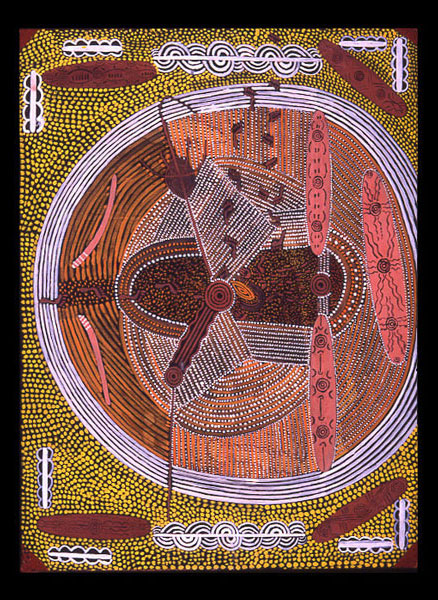
Clifford Possum Tjapaltjarri, Love Story, 1972, Synthetic polymer/paint on board
His concern was to preserve in his early carvings and paintings his native Anmatyerre tribal culture, which was almost lost following the British colonization of Australia. In the process of his visual story telling he became an internationally renowned artist. Justifiably. Consider these epic works:
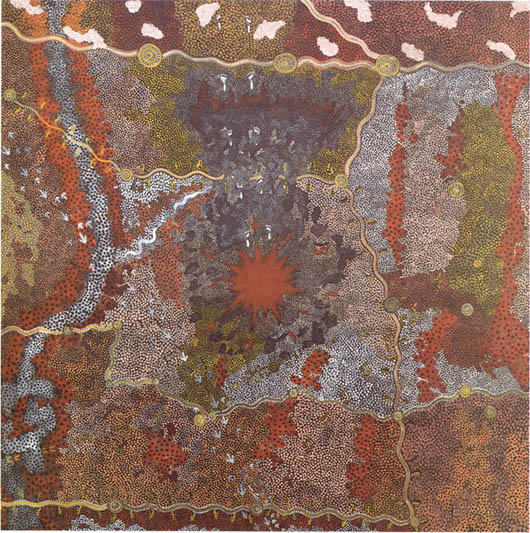
Clifford Possum Tjapaltjarri and Tim Leura Tjapaltjarri, Warlugulong, 1976, synthetic polymer on canvas
The National Gallery of Australia was offered Warlugulong, but rejected it claiming that the then "relatively meagre" price was too prohibitive (with the result that it lay abandoned in a storage warehouse for the next three years "gathering dust").
And:
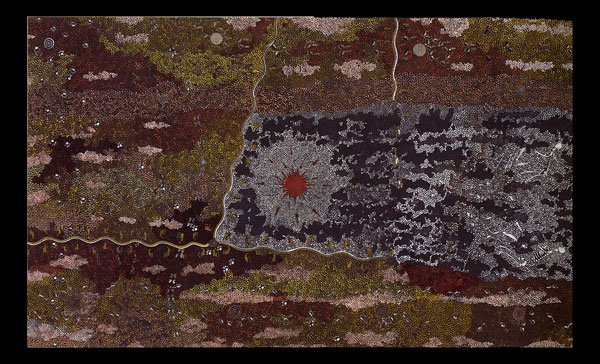
Clifford Possum Tjapaltjarri, Warlugulong 1977, synthetic polymer paint on canvas
Warlugulong is regarded as a key work in terms of narrative complexity. For the first time many different legends were told or mapped on one canvas, each story layered one upon the other. Coinciding with the superimposed stories was a new paint-layering technique and visual imagery.
Possum then began experimenting with colour and subtle modifications of traditional symbols and by drawing on other sources for his work:
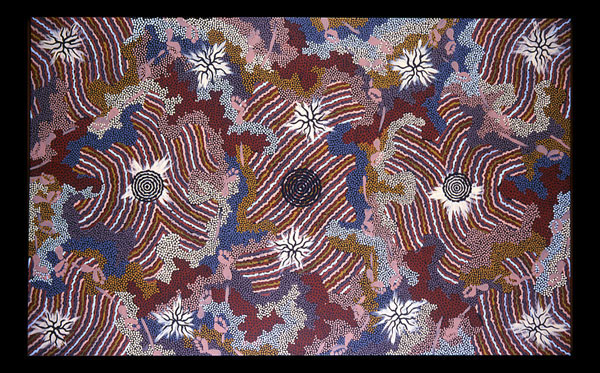
Clifford Possum Tjapaltjarri, Napperby Lakes, 1994, Acrylic on canvas
This is traditional yet innovative work. Germain Greer has her say. She is critical for good reason. Yet the work still stands as art of significance.
January 6, 2006
Cohen Brothers: The Man Who Wasn't There
Thanks to Homescreen I saw the Cohen Brother's The Man Who Wasn't There the other night on DVD:

It is a reworking of film noir that takes place in the period in which the great films noir were both set and produced: the mid-to-late '40s and early '50s. It is shot in gorgeous black-and-white by Richard Deakins, has the hard-boiled, distancing narration of a corrupted town that gestures towards Dashiell Hammett or a James Cain and stylishly reworks the genre of actual 1950s B movie.
Though they drawing on a variety of texts to construct the films they also deconstruct what they draw upon. For instance, The Man Who Wasn't There excludes all emotion from the monotone of Ed, and this central character is dispassionate and detached. What has been eliminated is passion, desire and sexuality. That suggests The Man Who Wasn't undermines the very fim noir genre that frames it.
January 5, 2006
Trent Parke #2
More from the independent eye of Trent Parke, a Sydney-based freelance photographer, and an associate of Magnum Photo Agency:
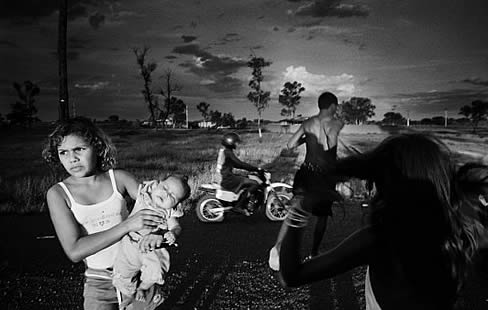
Trent Parke From Minutes to Midnight,
The image below is from the Dream/Life series of 1998-2002, which are photos of urban life in the global city of Sydney:

Trent Parke, Sydney. Summer rain, 1998
January 3, 2006
summertime in Australia
Each year the summer in Adelaide seems to be getting hotter. 2005 was the hottest summer ever in Australia. 2005 was the hottest year for the planet.
Getter hotter means soaring temperatures, and more bush fires across southern Australia.
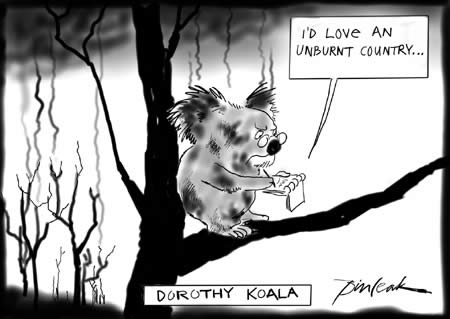
Bill Leak
More accurately, we are expecting a doubling in the number of very hot days in the coming decades and drought conditions to become the norm. Very hot in Adelaide is over 40degrees.
Getting hotter also means less water, more airconditioning in energy inefficient houses, more energy use and more coal-fired stations pumping out greenhouse gases.
If climate change in southern Australia means more heat searing days and more extreme weather conditions, then the relentless growth in carbon pollution from burning fossil fuels in Australia will continue, as little effort is being made by federal and state governments to reduce greenhouse gases emissions from coal-fired power plants. They don't seem to understand that global warming is a big challenge facing Australia; or if they do they are will not do anything that harms our economy.
The coal and oil industry are engaged in the work of disinformation in earnest and we have a few scientists and scientific hangers-on to write Op-Ed pieces and appear on talk shows to provide a "balanced" view to the IPAC consensus in 2001 that the balance of evidence suggests that there most of the warming observed over the last 50 years is attributable to human activities" and its prediction that the planet's average temperature might increase as much as ten degrees Fahrenheit before the century was out.
As for me I've accepted the idea of living in a hotter world.
January 2, 2006
Emily Kame Kngwarreye
Utopia is part of the land of the Anmatyerre and Alyawarre speaking people who now have permanent land title over some 1100 square kilometers of their ancestral country. They have re-established their traditional culture and look after their land through ceremony and ritual just as they have done for thousands of years. The women of Utopia have been making art using the batik technique since the late 1970's. In the summer of 1988-89 these artists began making their designs on canvas, using paint, rather than the batik method.
This painter from the Utopia community, north of Alice Springs, only began to paint her seventies:
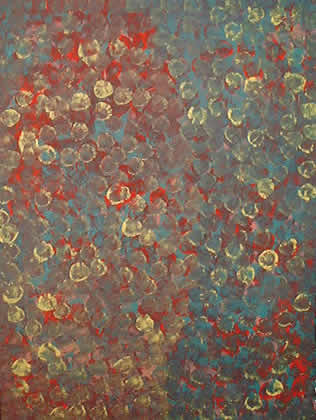
Emily Kame Kngwarreye, Wild Potato, 1995, Acrylic on linen
Her work cannot be categorized as primitive art, which is the tradtional category the 20th century modernist art institution assigned to aboriginal art. This category implied the idea of art being in a state of continuous progression from primitive to the European avant garde of the 2oth century. Primitive art was usually exhibited in terms of its influence on the big names of western art. That meant aboriginal art could only be hung on Europen art pegs---as was the case in the Australian National Gallery circa 1983
Emily Kame Kngwarreye changed her style repeatedly:
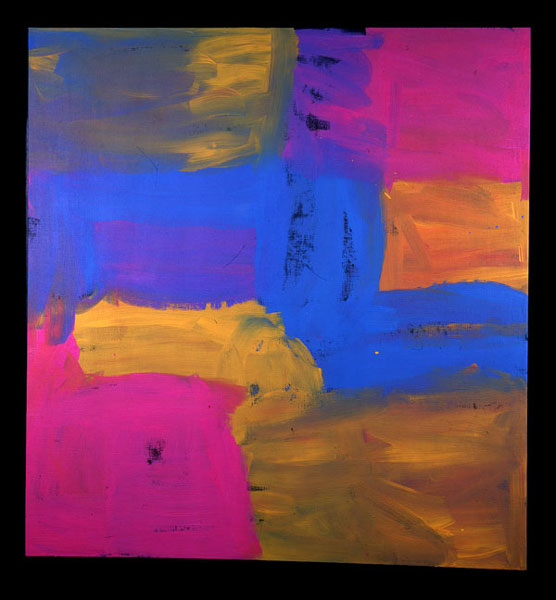
Emily Kame Kngwarreye, Last Series, 1996, acrylic on canvas
Her work fitted into the expectations and criteria of the modernist aesthetic and echo many themes in the recent history of European art.
January 1, 2006
political satire #2
I was reading Evan Jones over at Alert and Alarmed this morning, and I came across a link to Michael Dickinson's satirical collage work, which is made in the old-fashioned way, with paper, scissors and gum.
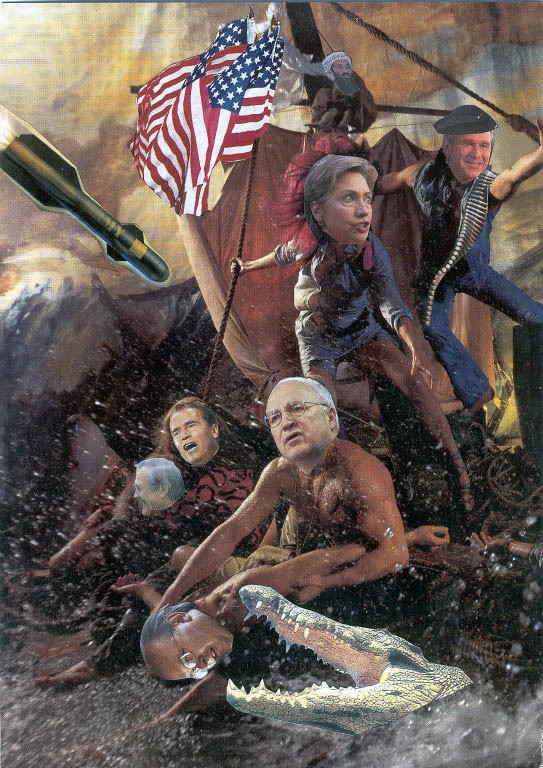
Michael Dickinson, Yabanji, All at Sea, 2005
His Carnival of Chaos website, which was a collection of political satire collages inspired by the violent response of George W Bush to the suicide attacks on the twin towers in New York on September 11th 2001, was banned by Tripod.
Dickinson is part of the Stuckism art movement. An Australian Stuckist. An article. An issue of MungBeing on Stuckism.