|
January 7, 2006
Clifford Possum Tjapaltjarri is the most famous male Central Desert artist. He is one of the first painters in Papunya when the acrylic painting style (known popularly sometimes as 'dot art') was begun. The original vision of the Papunya Tula painters was one of communicating to the world the custodianship of the Western Desert people over their Dreaming narratives and places.”
Clifford Possum Tjapaltjarri is regarded as a forefather, of the contemporary Aboriginal art movement, and is widely held to be the cornerstone of the Central and Western Desert storytelling group of traditional artists. I missed the touring restrospective of his works. Seeing this art of survival is something I deeply regret.
An early work:
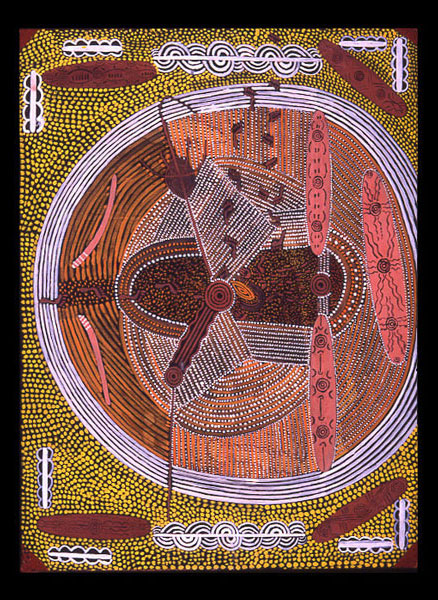
Clifford Possum Tjapaltjarri, Love Story, 1972, Synthetic polymer/paint on board
His concern was to preserve in his early carvings and paintings his native Anmatyerre tribal culture, which was almost lost following the British colonization of Australia. In the process of his visual story telling he became an internationally renowned artist. Justifiably. Consider these epic works:
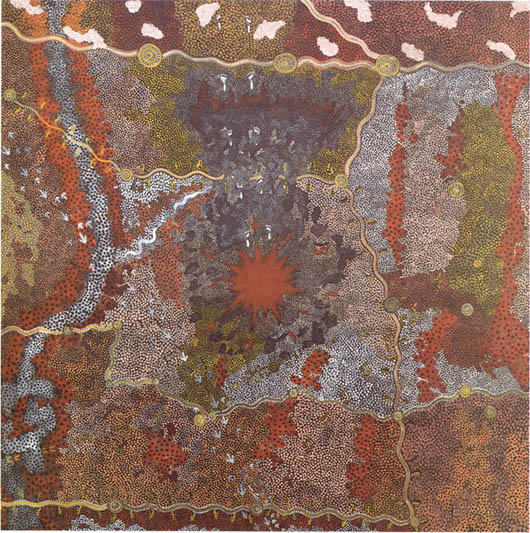
Clifford Possum Tjapaltjarri and Tim Leura Tjapaltjarri, Warlugulong, 1976, synthetic polymer on canvas
The National Gallery of Australia was offered Warlugulong, but rejected it claiming that the then "relatively meagre" price was too prohibitive (with the result that it lay abandoned in a storage warehouse for the next three years "gathering dust").
And:
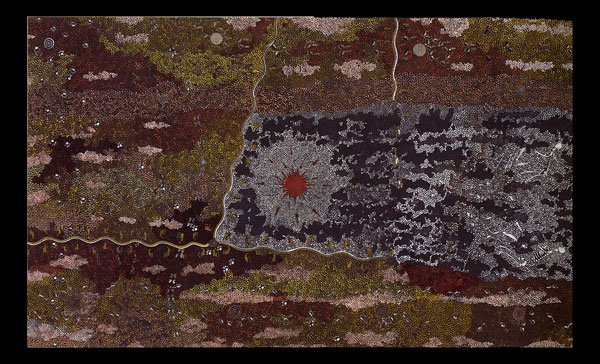
Clifford Possum Tjapaltjarri, Warlugulong 1977, synthetic polymer paint on canvas
Warlugulong is regarded as a key work in terms of narrative complexity. For the first time many different legends were told or mapped on one canvas, each story layered one upon the other. Coinciding with the superimposed stories was a new paint-layering technique and visual imagery.
Possum then began experimenting with colour and subtle modifications of traditional symbols and by drawing on other sources for his work:
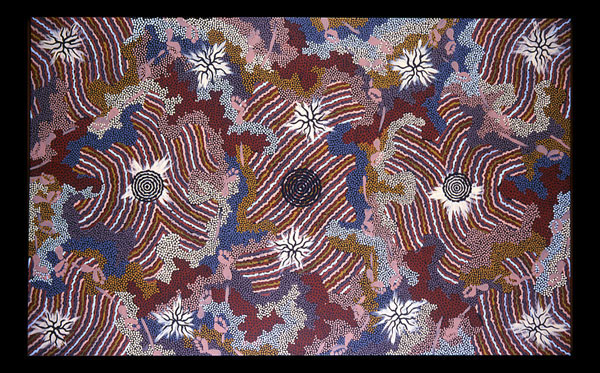
Clifford Possum Tjapaltjarri, Napperby Lakes, 1994, Acrylic on canvas
This is traditional yet innovative work. Germain Greer has her say. She is critical for good reason. Yet the work still stands as art of significance.
previous
|


nice page