|
January 8, 2006
A nice quote for a lazy Sunday morning to place up against the Kantian paradigm of immanent artistic beauty marked by a-historical universality and disinterestedness--just in case you happen to be reading Kant's Critique of Judgement:
Postmodern theory has taught its practitioners to be wary of origins. In the name of an anti-foundationalist discourse which challenges all nostalgic yearning for an arche, it has helped to foster a critical attitude about the possibility of beginning anew. What has emerged from this critical posture toward beginnings is an awareness about the significance of what I will call "points of entry"--those interpretational thresholds which allow us to enter into a dialogue with a text, a thinker, or a tradition. Points of entry frame the possibilities of all interpretation; they open up pathways for discovery even as they close off other venues and approaches. Entering into a thinker's work from a certain vantage point determines much about how an interpreter will frame her questions and follow her path of inquiry.
The quote is from here.
This anti-foundationalist way of approaching a tradition, text, or image enables us to come into the Australian landscape tradition from a number of entry points or pathways--eg., the European one or the aboriginal one. Or even from a number different aboriginal ones--eg, the rural or the urban. We could for instance start here:
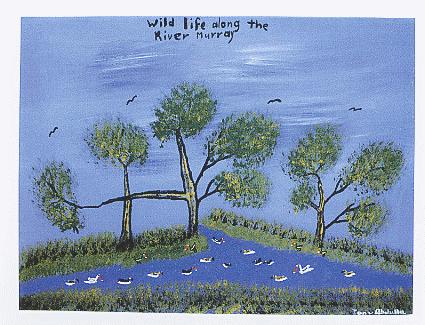
Ian Abdulla, Wildlife along the River Murray - 2002, acrylic on canvas
Ian Abdulla's paintings draw from his childhood experiences of growing up along the River Murray. In his own words:
"In the modern world there's too much modern stuff going on, instead of listening to the old people, sitting down and listening, these days they just play Nintendo and that. My kids were amazed at the lifestyle I had as a boy - my daughter said "If we'd done what you'd done we would never have survived!".
A naive style? A form of history painting of a world along the River Murray that has gone by? 'Naive' would place it within a certain European art historical context--but that is not right way to understand this work. Aboriginal art from the early 1800s - worked with similar styles to Abdulla's - but it was not considered "art" by white Australians of the time. It was seen as "curiosities rather than as the authentic visual expressions of a primitive Aboriginal viewpoint". Abdulla's paintings work from the tradition of Aboriginal art and culture, where story telling an important.
Each of Abdulla's paintings tells a story.
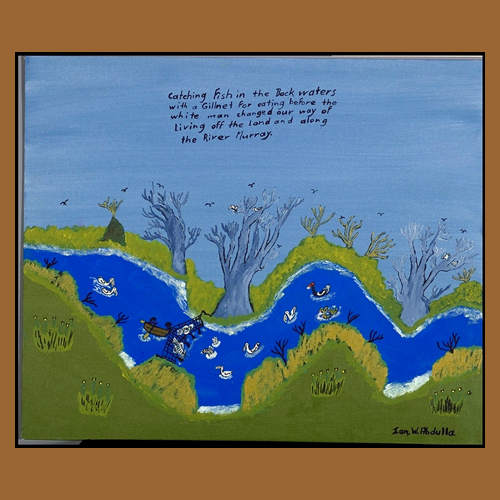
Ian Abdulla, Murray River, 1990, from 'The River Series'
So we need to be wary of orgins do we not? Be aware of the modern conception of the artist: either as a timeless prophet (eg., the Dutch painter Vincent Van Gogh) in which the artistic artefact is the mirror of his unfathomable psyche: art as expression; or the avant-garde artist, the successor of this romantic artist, whose labour of individualisation implies a transgression of the institutional frameworks defining art.
We need to question modernity's aesthetic vocabulary.
|


really good reading with morning coffee.. as you said it "for a lazy Sunday morning" ... just abit of feedback, cheers :-)