December 31, 2011
a post-theoretical viewpoint
Gerry Badger, in his review in Creative Camera of an exhibition of Lee Friedlander's work at the Victoria and Albert Museum entitled Out of the Cool (1991) expresses the backlash against art theory---ie., the semiotic approach to photography--that emerged in the 1970s. He says:
According to much current photographic theory, driven by the imperatives of a teaching and academic art establishment that seeks concrete meaning and positive purpose in a photographer, the somewhat meandering, casually contingent, intimate impulse of the diarist would seem anathema. This is the age of the ‘project’, the conceptually driven rather than perceptually driven body of work. Anything which cannot be predetermined, defined publicly prior to shooting, then explicated publicly in a treatise after shooting, is deemed to be substantively wanting and socially suspect, damned by a retrograde tendency to individualism and the private, atavistic doodlings of modernism. The new breed of photographers, heeding the dictates of this orthodoxy, propose and execute their concept orientated ‘projects’ with a will, the worst of them forgetting that art has visceral as well as cerebral qualities, the best of them soon casting aside the theoretical crutch and continuing to do what photographers have always done – marking their perceptual connections with the world.
I presume Badger is referring to postmodernism---Victor Burgin?---and the tendency of opening out a photograph to an endless chain of meanings (deconstruction) results in the tendency to lose sight of the image itself. Modernist formalist aesthetics, in contrast, fetishes the image, and it fears that the image will be compromised by words.
December 23, 2011
Journal for Artistic Research
The Journal for Artistic Research (JAR) is an inter-national, online, Open Access and peer-reviewed journal for the identification, publication and dissemination of artistic research and its methodologies, from all arts disciplines. The blurb says:
In the context of JAR, artistic research is doubly defined: insofar as it is research, it enhances knowledge and understanding; because it is artistic, however, the mode of presentation is essential. This definition excludes works of art that share modes of presentation with artistic research, but do not enhance understanding. It also excludes research that is not dependant on an artistic mode of presentation. Thus, the development of epistemological as well as artistic criteria for the exposure of artistic research is a key ambition of the Journal; part of JAR's mission is to re-negotiate art's relationship to academia and the role and function of research in artistic practice.
It says that AR's unique presentation of artistic research as 'weaves', instead of 'pages', facilitates multi-modal exposition, thereby meeting the desire of artistic researchers to have their work displayed and documented in a manner that demonstrates a respect for modes of presentation.
What is promising is that rather than imitate the academic boosterism of the natural sciences, the emerging field of artistic research should open itself up to those within the humanities and cultural studies who are in desperate need of allies for the recognition of other types of research output than the classic article in the international peer-reviewed journal.
An exhibition, for instance, should also be recognized and valued as a possible research output. Or a book.
December 22, 2011
Grateful Dead Movie---Part 1
The Grateful Dead Movie DVD contains two discs, the original DVD (1977) that was compiled from their retirement shows at the Winterland Arena in San Francisco between October 16 and 20, 1974 and a second disc of bonus footage. This is the Godchaux version of the band with one drummer.
The film was co-directed by Leon Gast and Jerry Garcia and is a cultural time capsule of deadhead culture. One of the most memorable features of movie is the opening animation sequence by Garry Gutierrez. The extended segment features a Harley-riding skeleton and is a study in the simultaneous use of stop as well as hand-drawn animation.
This feature-length film was shot during the Grateful Dead's so-called "retirement run" of shows at Winterland Arena as the band was to take an extended sabbatical from touring North America.
The Shout Factory has released the original movie on Blue-ray with bonus concert footage on DVD.
The retirement was a hiatus.Blues For Allah (1975) was one of the ways the Grateful Dead spent their retirement. The album has some of the more complex song structures that the Grateful Dead recorded in the studio resulting in one of their strongest studio efforts. When the Dead made "Blues for Allah," the band was at one of its high points, and the music on the recording brings together long-form compositions, complicated harmonies, carefully chosen rhythms and some of the Dead's best melodies.
December 21, 2011
Ennis, Photography + Australia, realism
I've just borrowed Helen Ennis's Photography and Australia from the Adelaide City Council Library and started to read it. A central concern of this regional history is the question: 'What is Australian about Australian photography?' and Ennis envisions her text as contributing to the conversation about photography in Australia.
Photography did not receive any attention in Bernard Smith’s Place, Taste and Tradition: A Study of Australian Art Since 1788 (1945) or Robert Hughes’ The Art of Australia: A Critical Survey (1966). Art photography was mostly confined to a medium specific realm, rarely penetrating the larger art world. A strict hierarchy operated in which the traditional art forms of painting, and to a lesser degree sculpture, were regarded as most important, followed by drawing and printmaking. This view prevailed in Bernard Smith’s Australian Painting 1788-1960 (1962), which considered painting as the primary form of visual art.
Hence the the need for photography specific histories. Prior to Photography and Australia we have had Gael Newton's Shades of Light and Anne-Marie's Picturing Australia. In the introduction to her text Ennis says:
I have not wanted to construct a linear history--assuming such a project was even possible or desirable----which gives a seamless triumphal account of social and technological progress. Nor have I wanted to to be reliant on a single methodology, utilizing instead a variety of approaches to elucidate the meanings of different clusters of photographic works. The chapters were written as self-contained essays that discuss particular themes, issues, styles, and ideas. Overlaps in chronology and history , and thematic interconnections , have been welcomed as a means to creating internal complexity.
She make two points, namely that photography in Australia is tied inextricably to the imperialist and colonialist underpinnings of modernity aligning it in crucial ways with that of other colonized countries such as India, Indonesia and New Zealand, thereby making the interaction between indigenous and settler Australia of prime importance.
Ennis's second point is that:
The one constant in photographic practice in Australia is so striking that it warrants identification at the start--the orientation towards realism. Those using photography in Australia have long been preoccupied with the physical, material aspects of life rather than its metaphysical or spiritual dimensions. Consequently, there is a weightiness to the great majority of Australian photographs--overwhelmingly they are of 'things', including actions and events, which have a concrete reality and a verifiable independent existence. This does mean that the expression of individual subjunctives has not had a place, but rather that subjectivity itself has consistently been framed in terms of a relationship with the external world. For most of the twentieth century inward-looking approaches, whether symbolist, surrealist, abstract, never really took hold.
She adds that even in the late 1960's when conceptual and deconstructionist modes of image making began to appear stimulated by the development of feminist and postmodern theories, realist photography has continued to flourish. Indeed, despite the digital revolution the 21st century has seen a continuous engagement with the 'real'.
December 17, 2011
American photography: Art Sinsabaugh
Art Sinsabaugh trained at Chicago’s Institute of Design and he is best known for his “Midwest Landscapes” of the early 1960s, his “Chicago Landscapes” (1964-66), and his “American Landscapes” (1969-83). Sinsabaugh used a huge 12x20-inch view camera and it is the width that appeals to Sinsabaugh, for he is fascinated by the horizontal sweep of the midwestern landscape and cityscape:
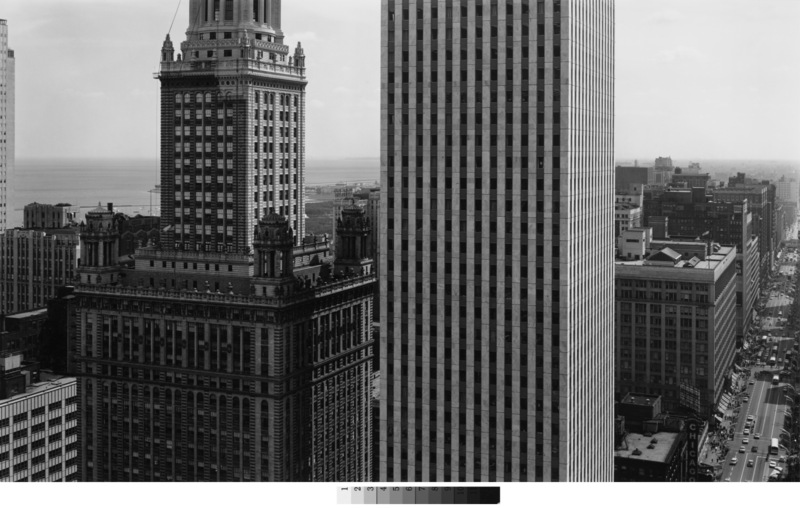 Art Sinsabaugh, Chicago Landscape No. 55 from “Chicago Landscape Group,” 1966, Gelatin silver print.
Sinsabaugh worked in large series in that he sought to create an all-encompassing “census” of the American landscape—the rural midwestern farm (Midwest Landscape Group), the urban cityscapes of Chicago and Baltimore (Chicago and Baltimore Landscape Groups), the mountains and resorts of New England and the barren deserts of the southwest (American Landscape Group).
Rather than focusing on individual people and places, Sinsabaugh captured the rhythms of human life and America's relationship to the land through the formal elements—the buildings, silos, bridges, highways, homes, skyscrapers, trees, and gravestones—that punctuate the horizons of the US.
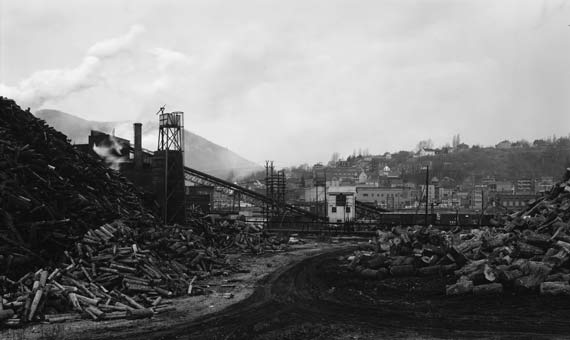 Art Sinsabugh, New Hampshire Landscape #20, 1969
His work is a mixture of the great expansive vision of nineteenth-century landscape photographers with mid-twentieth century formalism. His straightforward, detached viewpoint and inclusion of “ordinary” scenes foreshadowed the environmental concerns of the “New Topographic” photographers of the 1970s.
December 16, 2011
James Cant
James Montgomery Cant was a South Australian modernist and surrealist who painted the local landscape of the Fleurieu Peninsula in the 1950s and 1960s. The Art Gallery of South Australia holds a large number of dried grasses paintings, but these are not online.
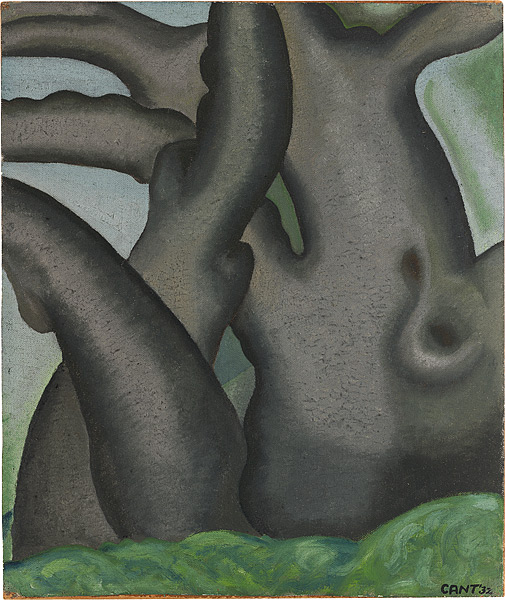 James Cant, The Fig Trees, 1932, oil on canvas on board
I find the dry grasses and scrub series he painted between 1958 and early 1962 around the Willunga and Aldinga area of the Fleurieu Peninsula intriguing.
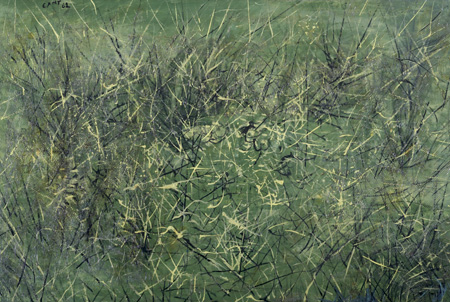 James Cant, wire grass, Oil and encaustic on board, circa 1962
The highly textured paintings of dry grasses, dead branches and brambles are close to abstract expressionism and are full of light; yet they are perceived to be old fashioned and are usually relegated to the storerooms of art galleries.
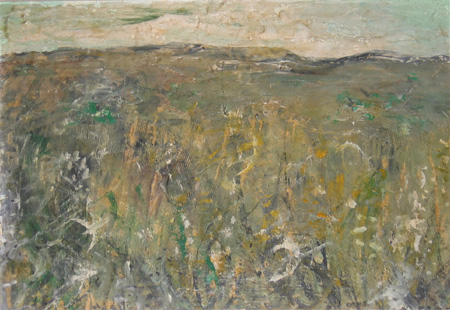 James Can, Landscape, Oil and encaustic on hardboard, circa 1961
The series finished around the mid-1960s when Cant was confined to a wheelchair because of advancing multiple sclerosis and by the 1970s he could no longer paint.
This individual body has influenced my approach to photographing the land in Fleurieu Peninsula.
December 15, 2011
engaging with the landscape after postmodernism
One of the sessions at the Melbourne Festival of Ideas 2011 was entitled Contemporary Vision and Critiques of the landscape that was chaired by Max Delany, the Director of the Monash Museum of Art.
Those involved are artist/photographers in the session who talk about their art practice. The blurb for the session says that there has been a return to the landscape by those working within the art institution:
Following a turn away from the artistic representation of landscape with the advent of post-modernism and post-national discourses, artists have again sought to engage with the landscape, with particular reference to indigenous and colonial histories; to the landscape as a site of ecological significance; and as an opportunity for the experience and attachment to place.
Contemporary art has shifted away the self-conscious relationship to the Australian landscape tradition which is conventionally interpreted as collapsing into nationalism. Yet that landscape embodies our history, and so being in a landscape is also being in our history and in a place.
Australia is seen to be continuing with its struggles to develop a clear sense national identity in a globalized world.
December 12, 2011
Gerhard Richter: townscapes
Between 1968 and 1970 Gerhard Richter produced nearly fifty cityscapes, which were based on photographic source images taken from architecture magazines. The source images were mainly aerial photographs of cities, but also included photographs of architectural models.
 Gerhard Richter, Stadbilt Paris, 1968, oil on canvas.
Though it is difficult at first to decipher the subject matter of this ambiguous image the composition reveals itself to be an overhead perspective of an identifiably Parisian quartier in ruins after a saturation bombardment. This vista is purely fictive.
These photo-paintings recall the aerial photographs of post-war bombed-out cities in Germany
December 11, 2011
attachment to landscape
As is well known the connection or nexus between the changing or dynamic landscape and national identity figures prominently in discussions of Australian experience since the 19th century. Today we are concerned to save the landscape and the best representation of the Australian landscape is contemporary indigenous painting by aboriginal desert dwellers, such as Emily Kame Kngwarreye.
 Emily Kame Kngwarreye, Emu Woman, 1988-89
Emily Kame Kngwarreye is the latest example of visual artists--eg., from Romantics such as Eugene von Guerard--- to Fred Williams shaping our understanding of the Australian landscape. The landscape forms the nation which forms collective or national identity.
In the “Land and Landscape” chapter of her Photography and Australia Helen Ennis states:
And, finally, what of the vexed, interrelated matter of non-Aboriginal Australians’ sense of belonging? While the Australian historian Manning Clark speculated that European settlers were eternal outsiders who could never know ‘heart’s ease in a foreign land, because … there live foreign ancestral spirits’, it now seems plausible that non-Aboriginal Australians are developing their own form of attachment, not to land as such, but to place. Indeed, it has recently been argued that for contemporary non-Aboriginal Australians, belonging may have no connection with land at all. Perhaps this is one of the reasons why art photographs of the natural landscape have lost their currency and are now far outnumbered by photographs of urban and suburban environments - after all, it is ‘here’ that most Australians live and ‘there’ that the tourist industry beckons them to escape.
There is a history of non-Aboriginal Australians experiencing a sense of alienation and exile that is embedded within their colonial experience. Home is elsewhere. The mother country is elsewhere. As exiles, they often remembered an idealised vision of their homeland, a vision of England as a "green and pleasant land".
Australia was a land that constantly failed to equal this vision--- "the Default Country", The settler's language perceived Australia as a "dysfunctional continent", a land that was "incomplete" "unusual" or "defective", a land against which the settler had to struggle, forever trying to subdue the land.
I'm puzzled by the distinction between land and place. Place is where we live and belong and land is an integral part of place. Land, people and place form a nexus. Does this imply that we may belong to a particular place but are not rooted in land? Or does it imply that natural landscape is not of a particular place but cultivated land is?
In settler capitalism the bush or scrub was the enemy of pasture for grain or sheep production, which was held to be the primary form for generating wealth. So the bush--wilderness---had to be cleared. The landscape is exploited for profit rather than sacred as it is for indigenous Australians.
Is this relationship still the way that white Australians relate to the land? Is this still the basis for Australian identity--or Australianness? Didn't a shift begin to take place post 1945 in settler Australia towards the landscape in the sense of visiting the bush --the imagined centre---and conserving the wilderness (wild and other) in the form of national parks. Doesn't this entail a sense of acceptance of the land?
Some of these questions are explored in this session in the Melbourne 2011 Festival of Ideas on Australian Identity: Australian Bio-diversity:
Here the land primarily means natural landscapes and the emphasis is placed on biodiversity. The landscape is a site of ecological significance that needs to be preserved. We are a long way from the traditional role of bush mythology and the popular perception of the outback as the "real heart" of Australia.
December 10, 2011
Helen Ennis: Photography and Australia
Helen Ennis' new text, Photography and Australia (London, 2007), is part of the Exposures series from Reaktion. The texts in this series address the questions of place, time and hegemony in photograph, investigate the cultural mores of significant nationalities, and juxtapose these with parallel studies of how photography became a successful ingredient in the national culture.
You could argue that Australia's national narrative can be told through our visual culture. It is filed under national identity, since the connection between landscape and national identity figures prominently in discussions of Australian experience.
From the start of white settlement, the dense bush and the immense spaces of the land, the intractable wilderness and the repose of the pastoral landscape have brought forth paintings of power and originality. This connection between landscape and national identity is filed under the Australian legend.
Ennis's text is both a history of photography in Australia, and part of the ongoing conversation about the way images have captured Australia as a nation, and the way they reflect our colonial and imperialist roots. Ennis argues that the colonial experience is a central element of these visual testaments, and embedded within this experience are the tumultuous relations between white settlers and Aboriginal peoples.
In the early colonial period the emphasis was on documenting the building of new cities and communities through realist photography and later more picturesque and panoramic vistas of the Australian land as settlers sought comfort in familiar surroundings and a sense of ‘belonging’ to the land (for example day trippers and photographers travelling to the Blue Mountains).
Her analysis explores how the photographs reveal the racial, social and political tensions woven throughout Australian history, ranging from modern works by Aboriginal photographers to archival photographs of desolate mining towns and the peoples who eked out their living from the brutal terrain. Since colonial settlement there has been a rich history of photographing the Australian landscape. In her chapter “Land and Landscape” in Photography and Australia Ennis comments:
… landscape photography has been the practice of settler Australians and the expression of a settler-colonial culture … The viewpoint in landscape photography has therefore been almost exclusively European
This culture has been changing in recent years due to the emergence of Indigenous photographers.
December 6, 2011
American photography: Michael Wolf
Michael Wolf’s recent book The Transparent City is a fascinating book about Chicago. He builds on his previous work in Hong Kong in that he depicts the city abstractly, focusing less on individual well-known structures and more on the contradictions and conflicts between architectural styles when visually flattened together in a photograph.

Michael Wolf, Transparent City #7, from The Transparent City, Chromogenic Print, 2007
It is interesting because Chicago is known for work by innovative architects such as David Adler, Daniel Burnham, Louis H. Sullivan, and Frank Lloyd Wright, and after World War II, it established itself as a world capital of modern architecture influenced by the international style of Mies van der Rohe and home to notable projects by Helmut Jahn, Philip Johnson, and more recently Frank Gehry.
According to this review of The Transparent City in Lens Culture:
Wolf positions himself on rooftops or in the windows of opposing buildings to get the most amazing vantage points for each scene. He waits for perfect light at the time of day when twilight and interior light render the building walls nearly invisible. An incredible large format camera with a 112-megapixel digital back captures and reveals exquisite details.
Wolf's windows open onto a world of people staring into computers or gazing at television sets or napping alone in armchairs. Many individuals seem numbly isolated in sterile, generic boxes of rooms suspended in the sky away from any kind of grounded reality.
 Michael Wolf, Transparent City #78 from The Transparent City, Chromogenic Print, 2007
Wolf spent a year as artist-in-residence for U.S. Equities Realty, a Chicago-based commercial real estate firm. The company helped him gain access to a number of local rooftops. He shot at dusk, when interior lights begin to merge with exterior lights amidst the overlapping building surfaces.
Wolf also digitally enlarged the detail images of the buildings, creating pixelated portraits of the inhabitants inside these buildings.
December 5, 2011
American Photography: Nan Goldin
This New York view is different from Nan Goldin's roots in the post-punk new-wave music scene, along with the city's vibrant, post-Stonewall gay subculture of the late 1970s and early 1980 and the Bowery's hard-drug subculture. These photographs, taken between 1979 and 1986, and based on using her private experiences as art, form her famous work The Ballad of Sexual Dependency.
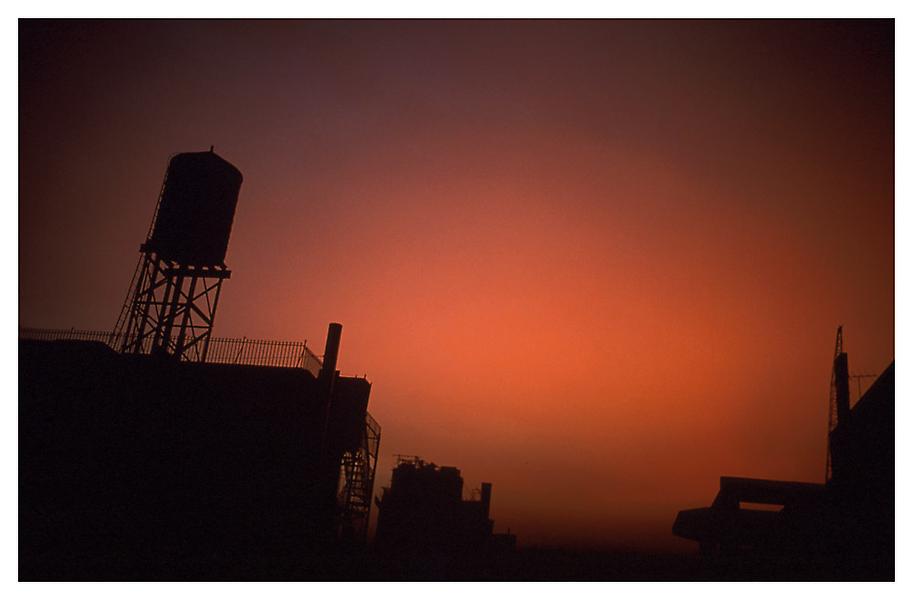
Nan Goldin, Red sky from my window, NYC, 2000 cibachrome
What began in 1979 as slideshows for her friends turned into hundreds and hundreds of photos, a visual diary that is still being written today, 30 years later, as well as a book, first published by Aperture in 1986 and still being printed. The core of The Ballad of Sexual Dependency is the record of the tangled lives of a group of friends and lovers and its a reflection on sexual relationships, domestic violence, substance abuse, so-called alternative lifestyles and male social isolation.
Far from trying to glamourise this underground scene for her own gain, Goldin was herself very much a part of it, and made her own tribe and experiences her intimate subjects at a time such biographical work was relatively radical, unchartered terrain.
December 4, 2011
'Wake in Fright'
I saw a DVD of a remastered and restored of Ted Kotcheff's masterful Wake in Fright over the weekend. It's a convincing representation of the sordid, brutal reality of outback male society amidst the dust and heat in regional Australia had been rejected by Australian audiences in the 1970s.
They were shocked and affronted by the macho, masculine culture of Broken Hill, the hard core drinking, the violence of the kangaroo killing, and the homo-eroticism”. This dystopian representation of white settler Australia was dismissed as unrealistic.
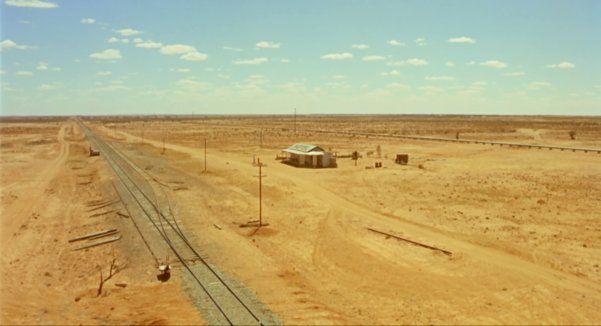
The film had been more or less lost. It is now seen as a classic of Australian cinema--- a seminal film in the renaissance of an Australian film industry and something of a stylistic precursor to the so-called Australian gothic cinema – eg., The Cars that Ate Paris (Peter Weir, 1974), Mad Max (George Miller, 1979). It's Australia as a gothic nightmare, the very opposite of a utilitarian society based on Enlightenment reason and science.
Andy yet Australia had been seen as a dumping ground for Europe's detritus----Bentham's "excemental mass"; a site of purgatory, exile and madness. Australia as a prison colony signifies the ultimate confinement for its failed citizens, outcasts removed to a far-off territory with little chance of return. It was a world for escaped convicts, lawless sailors and whalers, and tough immigrants whose existence depended on their survival skills in a hostile land.
In the 19th century, Australia as the antipodes, had an ambiguous status as penal colony and a land of promise which required the reasoning and rational governance by an elite, cultured, and educated, expert class to control the underclass--- the disordered and feral inhabitants, the criminal, the irrational and the depraved.
The film expresses the geographical unconscious of Western culture. The photographic colours in Wake in Fright was gaudy, saturated, intense hues, and surreal, as these expressed a place of chaos, excess and madness.
This was a strange, hostile landscape and a society that was a living hell with madness and alcohol as the mechanisms of escape--used to anaesthetise the pain of existence. It is the other side to the sunlit world of Enlightenment rationalism and settler hope. Alcohol is the escape from a grindingly harsh existence.
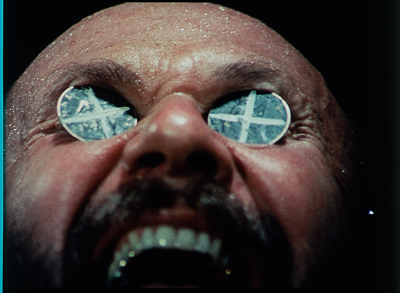
In the film the veneer of the enlightened world of culture and refinement was stripped to the raw underpinning of settler neuroses and anxieties on the rim of western civilization; an aberrant and abnormal white world that is debased, animalistic, bestial and savage in which there is a loss of control and a dissolution of the rational self.
December 2, 2011
Shutterclank!
Shutterclank! is a self-published magazine featuring traditional photographers that is published twice a year. Traditional means film based. In this post Kate says:
at Shutterclank! we celebrate traditional photography, which can be arduous, tedious, and time consuming. and we love it. its so tangible and tactile, and worth the wait for the beauty. but we also use every social media possible to share our photography. we blog, tweet, tumble, do somersaults, facebook, etcetera, ad nauseam
Shutterclank!'s goal is a worthy one: it is to preserve and promote traditional photography in a digital world.
The latest issue is entitled Innocence Lost, a six artist show that explores images of US culture confronted by contemporary America, presented in conjunction with the Brooklyn Artists Gym. Included are Jesse Untracht-Oakner, Joseph Gerhard and Melitte Buchman
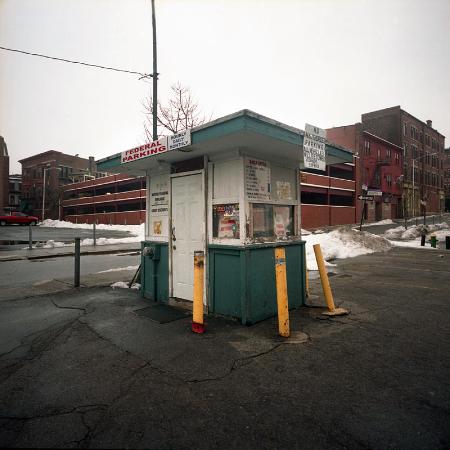 Joseph Gerhard, federal parking (2 of 4), from the Providence series
I know the work of Joseph Gerhard from his Flick stream, his photoblog and his Mill River book.
Joseph Gerhard, federal parking (2 of 4), from the Providence series
I know the work of Joseph Gerhard from his Flick stream, his photoblog and his Mill River book.
Gerhard’s series in Shutterclank! is based around ‘Providence’, an area in Rhode Island in America, that is his hometown. He says that:
No family left there, but my wife and I still go three or four times a year, get a hotel room, roam the streets, check out the museums and eat in the incredible restaurants.
Sounds like a nice thing to do. Gerhard roams the streets early in the morning with his Hasselbald SWC looking for the awkward sections of the town, namely those parts that nobody gives any thought to. It's a sombre series with a dark tonal quality that highlights the minimal life in the town. The shops are empty---as the new downtown mall has taken all the people away.