|
December 17, 2011
Art Sinsabaugh trained at Chicago’s Institute of Design and he is best known for his “Midwest Landscapes” of the early 1960s, his “Chicago Landscapes” (1964-66), and his “American Landscapes” (1969-83). Sinsabaugh used a huge 12x20-inch view camera and it is the width that appeals to Sinsabaugh, for he is fascinated by the horizontal sweep of the midwestern landscape and cityscape:
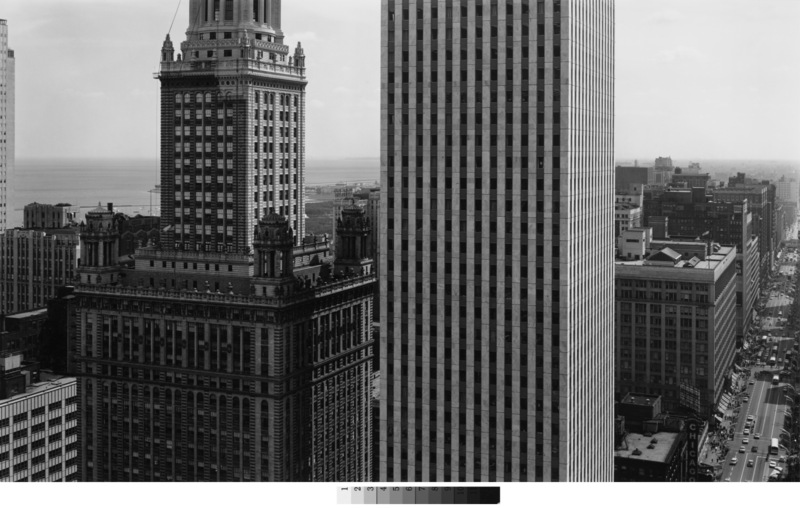 Art Sinsabaugh, Chicago Landscape No. 55 from “Chicago Landscape Group,” 1966, Gelatin silver print.
Sinsabaugh worked in large series in that he sought to create an all-encompassing “census” of the American landscape—the rural midwestern farm (Midwest Landscape Group), the urban cityscapes of Chicago and Baltimore (Chicago and Baltimore Landscape Groups), the mountains and resorts of New England and the barren deserts of the southwest (American Landscape Group).
Rather than focusing on individual people and places, Sinsabaugh captured the rhythms of human life and America's relationship to the land through the formal elements—the buildings, silos, bridges, highways, homes, skyscrapers, trees, and gravestones—that punctuate the horizons of the US.
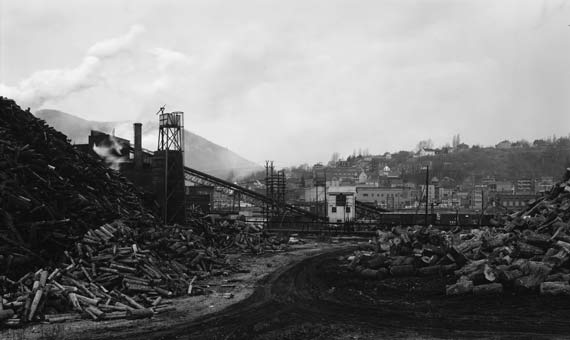 Art Sinsabugh, New Hampshire Landscape #20, 1969
His work is a mixture of the great expansive vision of nineteenth-century landscape photographers with mid-twentieth century formalism. His straightforward, detached viewpoint and inclusion of “ordinary” scenes foreshadowed the environmental concerns of the “New Topographic” photographers of the 1970s.
|


