January 31, 2009
Mondrian: grids, energy flows, jazz
I've always found the grids of modernism rather static and highly ordered. I recoil from the basic kinds of line—that is, straight horizontals and verticals— because there is no sense of flow of energy, or dynamic movement though them. None of the flow of musical jamming if you like. No noise either.
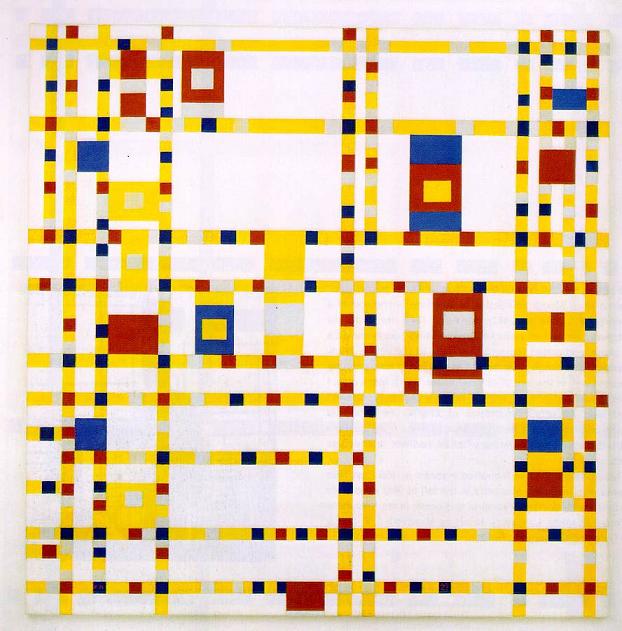 Piet Mondrian, Broadway Boogie Woogie, 1943
This work may be an exception: a subverting of the modernist grid? The title refers to American jazz, with its syncopated beat, irreverent approach to melody, and improvisational aesthetic. The grid lines in Broadway Boogie-Woogie are composed of yellow color planes that are overlaid with blocks of colour laid up against each other. These tiny, blinking blocks of color create a vital and pulsing rhythm.
Despite this movement the overall look of the picture remains homogeneous, rather than freewheeling.
January 30, 2009
heatwave
South eastern Australia is experiencing a heatwave and its a monster. Temperatures in Adelaide are around 43 degrees going down to the low 30s at night. The streets are deserted during the day; airconditioners run non-stop; power is being shut off---load shedding"--- cutting power to homes to save the national grid from collapsing. As the heatwave rolls on and on the deaths mount up.
It is the same in Melbourne. 'There have been rolling blackouts across both states with transformers out and fuses blown. Tis a foreshadowing of life with global warming:
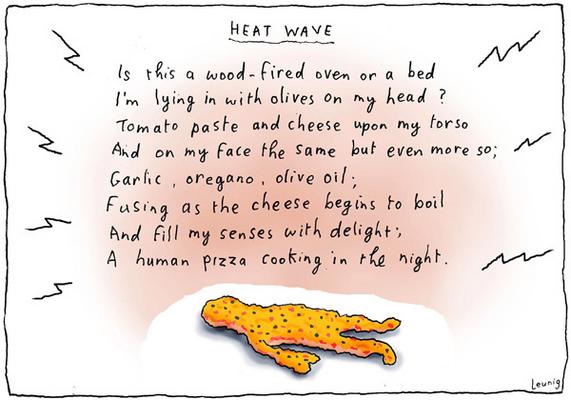
Minister's are saying the heatwave is a one-in-100-year event. Well they said that about the current drought too. Why don't they accept that this is an indication of climate change and acknowledge that they have done little to address the problems such a warmed up world faces.We are using infrastructure built in the 1950s!
January 29, 2009
modernist photography's narrative
The conventional art historical narrative of art photography's passage from Pictorialism to modernism that has been handed down to us is a well known one.
 Florence Henri, Street scene with a woman, 1931, gelatin silver photograph
Two years after the 1913 Armory Show introduced modern French painting and sculpture (including Cubism) to the United States, Paul Strand made a series of close-up photographs that were crisply lit, dynamically composed and superficially abstract. Alfred Stieglitz, then America's arbiter of art photography, renounced the then-prevailing style of gauzy Pictorialism and announced that henceforth photography would be free of the shackles of painting.
Strand's pictures, published in 1917 in the last issue of Stieglitz's magazine Camera Work,' are held to have resulted in a new era in which photographers engaged the medium's unique properties and capabilities. According to Strand, photography's uniqueness rested on its ''absolute unqualified objectivity.'' The new style that emerged - unmanipulated, unsentimental and sharply focused - was given the label ''straight photography,'' and was held to be inherently and essentially photographic. Thus modernist photography was born. The key names are Stieglitz, Strand, Edward Weston, Walker Evans et al (including Paul Outerbridge, Ralph Steiner).
 Florence Henri, Composition with ball and mirror, 1930
This form of modernism was picked up in Australia in the 1930s by Max Dupain with the modernist narrative written by Gael Newton.
Is this the only narrative? Are there others? What of constructivism, cubism, surrealism? What of the unusual vantage points, repetitive designs, abstractions, close-ups and cameraless images characterize this activity, which included such figures as Alexander Rodchenko in Russia and Laszlo Moholy-Nagy, Herbert Bayer and Florence Henri in Germany.
 Florence Henri, Nature morte, 1929, gelatin silver print
Laszlo Moholy-Nagy in his text Photography is a Manipulation of Light emphasized not the objects the medium renders but the play of photography's light-sensitive values. He advocates "tricks," bird's eye and worm's eye views, oblique angles, the use of mirrors and transparent surfaces, cutting, pasting, and superimposition and the collapsed and over-layered imagery of urban life reflected in shop windows with their "superimpositions and penetrations."
January 28, 2009
Grosz, Deleuze, indigenous art
Liz Grosz's Chaos, Territory, Art: Deleuze and the Framing of the Earth tackles contemporary Aborigiinal art in its last last chapter, Sensation.The Earth, a People, Art. Grosz does so by using Gilles Deleuze's ideas about how the artworks created by Kathleen Petyarre and Clifford Possum Tjapaltjarri affect us.
 Kathleen Petyarre, Mountain Devil Lizard Dreaming, sandhill country (after hailstorm) 2004, Acrylic on linen,
Art, Grosz argues, is not primarily conceptual. Instead, it is positioned as the intensification and materialisation of sensation. Concepts are “by-products or effects rather than the very material of art” sensations might inspire a concept or thought, but art does not produce these concepts directly. Art intensifies sensation, and generates new sensation, new excesses. The creation of material forms facilitates our processing of the sensations and stimulations we receive from the world, ordering them into new forms.
Grosz says:
I don't want to deny that artworks have meaning but it may be that in our century-long fascination with language, and with the reduction of all artworks to their linguistic representations, has blunted us to something extra-linguistic that I think even language has: a force or affective resonance that we feel when we experience art directly but that we often or sometimes lose when we over-interpret it. Every work of art, every text, can be interpreted. The question really is: What does that interpretation do to the text or work of art? What does it contain of their force?
She argues, rightly, that contemporary Aboriginal art has come to exist not just on a plane of religious ritual and anthropological knowledge (as many want to suggest), but as art sensations that are now a part of the history of 20th-century art (and beyond), as techniques, forms, images that others can address, incorporate, complicate and transform.However, Aboriginal art Grosz says defies western art history categorisation. Instead of falling into the stylistic schools of either abstraction or expressionism or the 'middle' position of the figural, much of western desert art, seems to occupy all three positions simultaneously.
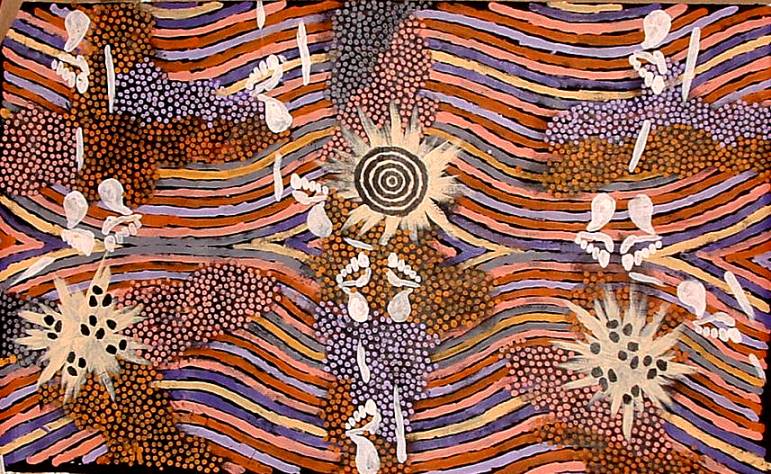 Clifford Possum Tjapaltjarri, Napperby Lakes, 1994, acrylic on canvas
Contemporarry Aboriginal Art has produced an entire field of art and it has changed what art is and how we view it. Grosz adds that:
Art is not about representation. Art is of the body, for it is only art that draws the body into sensations never experienced before, perhaps not capable of being experienced in any other way, the sunflower-sensations that only van Gogh's work conjures, the 'appleyness of the apple' in Cezanne, the Rembrandt-universe of affects or the meat-sensation that underlies the flesh in Bacon.Sensation draws us, living beings of all kinds, into the artwork in a strange becoming, in which the living being empties itself of its interior to be filled with the sensation of that work alone.
Art is less the s the representation of sensation and more the making material of sensation--and the extraction and transformation of intensities.
January 26, 2009
modern times
Modernism, as we know from this exhibition at the Powerhouse Museum impacted on all aspects of Australian culture — from art, design and architecture to advertising, photography, film and fashion.
The curator argued that modernism was a style of big cities and urban life, and for much of the 20th century, it was at odds with Australia's national self-image that was still strongly focused on rural culture, national character and a rural way of life. Through the 1950s and 60s urban Australia aspired to a modern identity, one no longer invested in rural life or in a British colonial heritage. Instead of the flight to the suburbs and the bush modernism celebrated the romance of cities.
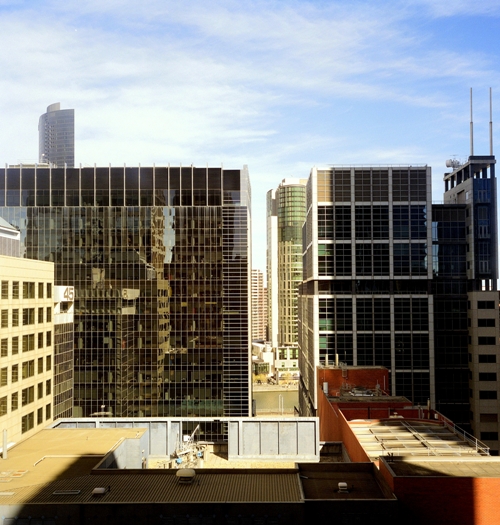 Gary Sauer-Thompson, Melbourne cityscape lower Collins Street, 2008.
Dan Hill at City of Sounds argues that the Powerhouse Museum's Modern Times exhibition emphasizes social and cultural patterns emerging throughout the modern period at the expense of the architecture.Hence the idea of a Google map of Australia modernist architecture. This map shows that Adelaide was barely modern.
Hence the idea of improving on the initial map by utilizing the work from the Modern Times Flickr group, and this has resulted in a new map.
January 25, 2009
Bertolucci: --1900
I watched part one Bertolucci's 1976 film epic 1900 on DVD last night. It was the director's cut of his portrait of the complexities of the social and political history of Italy between 1901 and 1945, specifically in the region twenty miles from Parma. The central themes of this epic film are the local struggle between the peasants and the feudal landowners and, on the national and local levels alike, the rise and fall of Fascism. And sexuality and ideology.
The context of the initial release was an American studio releasing a Communist film at the height of the Cold War and the release was in a truncated form and it has been marked by censorship issues since it was first unveiled 31 years ago.

Bertulocci's aesthetic perspective is that of the realism and totality of Gyorgy Lukacs, the Marxist philosopher. Vittorio Storaro's cinematography constructs magnificent set-pieces with light, especially in the first half of the film when the story is drenched in the golden late afternoon sunshine of eternal childhood summer.
These cinematic images are constructed with a painter's eye, a writing with light , and a lyrical expression, move towards using opposing colors to identify his protagonists and a subtle correspondence between chromatic shades and characters' emotions. It is a cinematography with the historical understanding of a pictorial tradition going back to Piero della Francesca and Caravaggio.
January 24, 2009
animated pictures
W.J.T. Mitchell has long argued that there has been a visual turn, or what he calls a “pictorial turn,” in contemporary culture and theory in which images, pictures and the realm of the visual have been recognized as being as important and worthy of intense scrutiny as the realm of language.
While the “linguistic turn” (Richard Rorty ) in the 1960s called attention to the role of language in culture, theory, and everyday life the notion of a “pictorial turn” signals the importance of pictures and images, and challenges us to be observant and informed critics of visual culture.
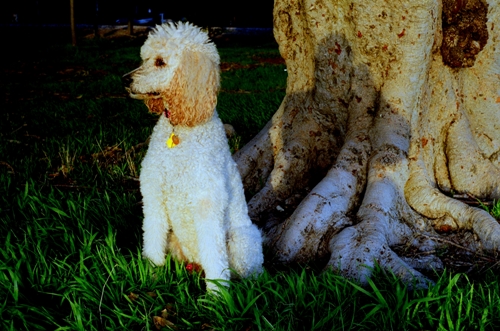 Gary Sauer-Thompson, Ari, Adelaide Parklands, 2008
The title of Mitchell's book, What do Pictures Want?, strikes me as odd. Pictures don't have desires. They are objects that convey meaning not animated beings with desires, needs, appetites, demands, and drives of their own like dogs. Pictured are not alive like dogs. They do not act in the world like dogs. Images are not living creatures.
Mitchell's response is to reformulate this initial question into another set of questions:
'Why is that people have strange attitudes towards images, objects and media? Why do they behave as if pictures were alive, as if works of art had minds of their own, as if images had a power to influence human beings, demanding things from us, persuading seducing, and leading us astray. Even more puzzling, why is it that the very people who express these attitudes and engage in this behaviour will, when questioned, assure us that they know very well that pictures are not alive, that works of art do not have minds of their own, and that images are really quite powerless to do anything without he cooperation of their beholders? How is that, in other words, that people are able to maintain a "double consciousness " towards images, picture, and representations in a variety of media, vacillating between magical beliefs and skeptical doubts, naive animism and hard headed materialism, mystical and critical attitudes
The usual response to this contradiction is to say that they--someone else-- is naive and superstitious whilst we are hardheaded critical and skeptical. Someone else is generally the Other.
January 22, 2009
Bon Iver
From Bon Iver's album For Emma, Forever Ago --a track entitled "The Wolves (Act I and II)":
I knew very little about Bon Iver until I heard them on Radio National Summer Breakfast this morning but I cannot recall which track was played.
For Emma, Forever Ago was received well by critics. It was seen as a hip American indie record.
January 21, 2009
Sugimoto Hiroshi & time
Sugimoto Hiroshi's work ---his series include “Dioramas” (1976-); “Theaters” (1978-); and “Seascapes” (1980-)---- centres on the idea that photography is a time machine, a method of preserving and picturing memory and time.
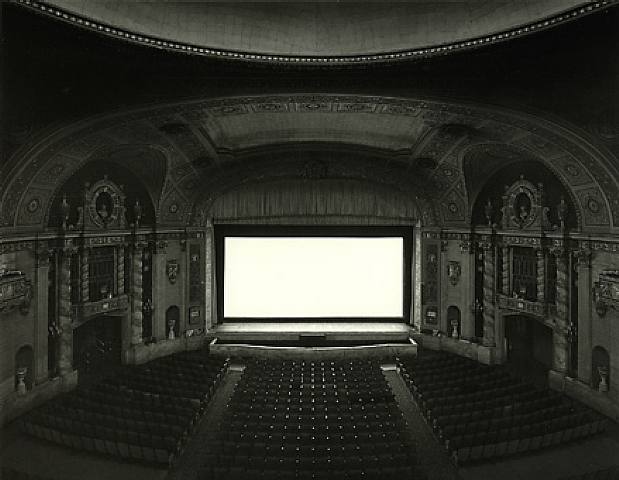 Sugimoto Hiroshi,series
Since the 1970s, Sugimoto has worked on his photo-series entitled «Theaters» in which he photographs auditoriums of American movie theaters, and drive-in movies, during showings. He says:
The question-and-answer session that led up to this vision went something like this: Suppose you shoot a whole movie in a single frame? And the answer: You get a shining screen. Immediately I sprang into action, experimenting toward realizing this vision. Dressed up as a tourist, I walked into a cheap cinema in the East Village with a large-format camera. As soon as the movie started, I fixed the shutter at a wide-open aperture, and two hours later when the movie finished, I clicked the shutter closed. That evening, I developed the film, and the vision exploded behind my eyes.
In most of the theater photographs there is a darkened proscenium arch and decorative architectural details enclose a rectangle of dense, milky light. Often, rows of empty seats are visible in the foreground, just below the glowing movie screen. Except for the viewer, the auditorium is unoccupied.
The Theaters series allude to the camera, to the perceiving spectator or viewer and to time.The work provides a way to think time in the photographic image that is different from the tradition in the history of modern photography in which the photograph has been seen as a static object, a frozen moment of time. A photograph that has been taken in the past, is a brief and short moment of time that is necessarily regarded as one of its decisive characteristics. Film is a series of movement whilst photography is a cut into time.
January 20, 2009
a new day dawning
Barack Obama, the first African-American presidential nominee, is giving his acceptance speech 45 years to the day that Martin Luther King Jr. told the world of his dream.
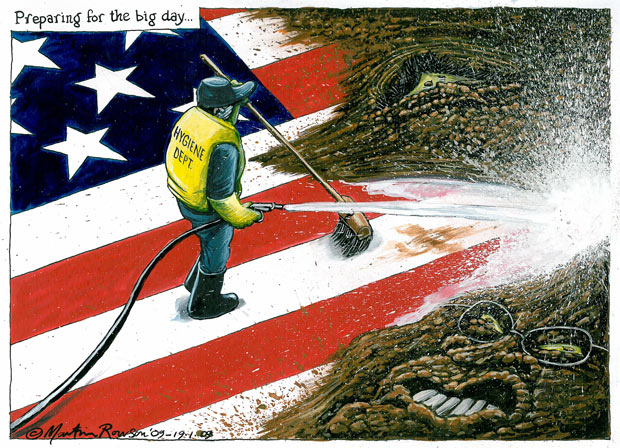 Martin Rowson
Obama's inauguration is seen by many Americans as a cleaning out of the political stables. It's a historic moment.
Seeger + Springsteen
Bruce Springsteen and an 89-year-old Pete Seeger lead the 700,000 celebrants on the National Mall in a stirring rendition of "This Land Is Your Land." It's the old leftie version being sung here in this lead up to Obama's inauguration:
January 19, 2009
Thomas Demand's constructions
Thomas Demand began as a sculptor and took up photography to record his ephemeral paper constructions. In 1993 he began making constructions for the sole purpose of photographing them. Demand begins with a preexisting image culled from the media, usually of a political event, which he translates into a life-size model made of colored paper and cardboard.
His handcrafted facsimiles of architectural spaces and natural environments are built in the image of other images. Once they have been photographed, the models are destroyed.
 Thomas Demand, Poll, 2001
Each of Demand’s photographs is one or more steps removed from reality, creating tension between the fabricated and the real. Demand knowingly uses the traditional role of photography as a faithful transcriber of the world to throw his subject’s artificiality into doubt. This confounding of references is such that the very idea of an original recedes completely.
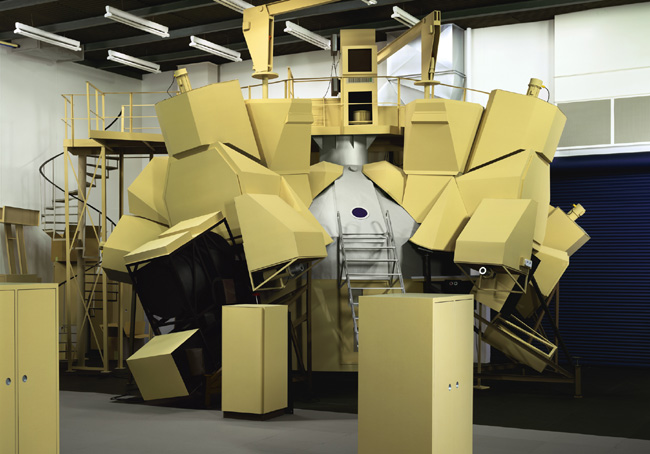 Thomas Demand, Space Simulator, 2003
At first sight, the subjects represented in Demand’s photographs seem commonplace and familiar, but often they relate to scenes of cultural or political relevance, which have come to our attention through the mass media. They range from the archives of German filmmaker and National Socialist propagandist Leni Riefenstahl, Saddam Hussein’s attempt to purchase a concentrated form of uranium called ‘yellowcake’ from Africa and the kitchen in Saddam Hussein’s hideaway in Tikrit, Iraq.
Art curators and critics interpret Demand's work as reconsidering the traditional notion of photography as a faithful record of reality, highlighting the evasiveness of the medium in a world that is saturated with manipulated or mediated images.
January 18, 2009
beholding
Michael Fried's Why Photography Matters as Art as Never Before refers to the “new art photography”, which begins when it takes its full place upon the wall much in the same manner as painting, and now carries the history of painting along with it.The contemporary artists working in photography (include Jeff Wall, Thomas Struth, Thomas Ruff, Rineke Dijkstra, Bernd and Hilla Becher, Thomas Demand, and Hiroshi Sugimoto).
 Rineke Dijkstra, Brighton, England, 1992 from Beach Portraits series
Beach portraits is a series of pictures featuring adolescents posed at the water’s edge. Her subjects are shown standing, facing the camera, against a minimal background. Some of the images have an elemental quality to them: what Barthes called a "punctum" (a subjectively conspicuous detail that takes you out of the frame into some, mostly likely ineffable and personal, truth of life, and establishes a direct connection between you and the subject in the photograph.
Fried argues that this location of art photography immediately compelled photographers to grapple with issues centering on the relationship between the photograph and the viewer standing before it, which until then had been the province only of painting. The central claim of Fried’s book is that in the ’70s and early ’80s, when artists began producing very large photographs for wall display, photography “inherited” the problem of beholding as Fried had described it. For Fried, everything hinges on whether the work of art feels staged or not, and whether that staging is necessary in order to establish the presence of the work in question.
For Fried “art degenerates as it approaches the condition of theatre.” Theatricality in art interferes with presentness, with the potential for a transcendent experience of the work itself. Theatricality refers to a staging that requires and presupposes the presence of an audience in order to have ontological certainty regarding the presence of the work. Dijkstra's portraits are staged in this sense.
Fried's concern is with the problems of beholding and he suggests the problem arises in the division between "theatricality", when a picture looks deliberately outwards and declares itself to an anticipated audience, and "anti-theatricality", when the elements of a picture are constructed without any visible concession being made to an audience; or even to the idea of an audience, and the figures within the image belong to a world of their own – in other words, when the work does not require the audience's participation to make it complete.
Fried's argument is that because the photographic tableau emerges in the wake of Minimalism and of new concerns about voyeurism and the inherently contaminating effects of beholding, it must acknowledge what Fried terms “to-be-seenness” even as it must continue to resist theatricality.
January 17, 2009
history's pages
I'm currently reading a chapter in W.J.T. Mitchell's Picture Theory on abstraction. In it he argues that the modernist account of abstraction is one that highlights that abstract art was a repression of literature, or language, in favour of the pure visuality or painterly form.

Abstract art aimed to place a barrier between itself and literature.Thus Clement Greenberg argued that the abstract artist is a purist who insists on excluding literature and subject matter from art. The primary aim was the erection of a wall between the visual arts and those of literature, whilst the overcoming of representation of content was secondary consideration. Modernism is a rupture of the ut pictura poesis (word + picture) tradition.
The image refers to a palimpsest or manuscript (typically of papyrus or parchment) that has been written on more than once, with the earlier writing incompletely erased and often legible.The picture and text tradition is what Mitchell calls the image/text and it's history has been marked by those who place the emphasis on text at the expense of images, and conversely those who place the emphasis on images at the expense of text.
The historical relation between text and picture is that of inter-action in the form a contest, with modernist painting anxious to shed paintings reliance on literature and turn attention to the problems of its medium. Painting in the form of pictorial abstraction was to be the dominant art of industrial civilization. Kitsch was art that had not announced its reliance on literature (social realism and Hollywood).
Postmodernism represents the explosive breakdown in the barrier between visual image and language maintained by the modernists.
January 16, 2009
David Octavius Hill + Robert Adamson
The partnership of David Octavius Hill and Robert Adamson is unequalled in the history of photography for its sophistication and impact.
Using the Calotype process they produced a wide range of portraits depicting well-known Scottish luminaries of the time and photographed local and Fife landscapes and urban scenes.

Harriet Farnie and Miss Farnie with a Sleeping Puppy, Brownie, originally uploaded by National Galleries of Scotland.
They met in Edinburgh in 1843 after Robert Adamson had set up the first studio in Scotland to work with William Henry Fox Talbot’s ‘calotype’ process. They first met to see if Hill could use photography to aid the painting, but almost immediately discovered the potential excitements of photography. Their partnership produced around 3000 prints, but was cut short after only four years due to the ill health and untimely death of Adamson in 1848.
Mars: Elysium Planitia
This stereo view shows fractured mounds on the southern edge of Elysium Planitia on Mars. The mounds on the southern edge of Elysium Planitia are typically a few kilometers or miles in diameter and about 60 meters (200 feet) tall.Fractures that crisscross their surfaces are extensional in nature, suggesting that the mounds formed by being pushed up from below.
 NASA archives
The entire area is covered by a relatively thin layer of dust and sand.
January 15, 2009
from cartoon to the postmodern
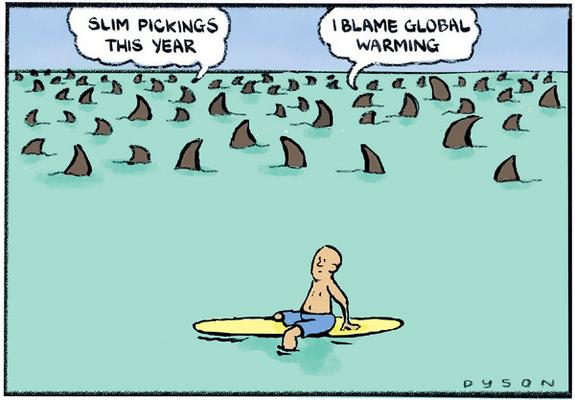
A light moment that refers to the media's current and ongoing anxiety about shark attacks on Australian beaches during the high summer. Reading the media on shark attacks this summer gives me the impression that the media assumes sharks should make way for humans. It's as if sharks have no right to be in the water as predators.
The water around our shorelines belongs to us humans not sharks. Sharks must give way to humans. If they persist in cruising the shore where human have fun, then they ought to be shot. The whole of nature is subservient to human interest and desires.
 Dyson
Dyson
It's only a cartoon but it does ‘overcome a purely formalistic approach to aesthetics and opens the way for a more dynamic interpretation of the relationship between art and life. One way of exploring this is through the notions of decay, the ruin and fragment that engender creativity. That which has succumbed to the ordeals of time also embodies an awareness of the process of time.
These terms suggest the postmodern which is commonly considered to be a period of decay in that in this period (postmodernity) there is a lack of originality, a ‘‘fractured’’ narratives typical of seriality, a corruption of meaning, which it is inferred pose a ‘‘danger to civilization’. The current transformations in narrative form are interpreted as symptoms of a state of cultural degeneration with contemporary media (art and cinema) is viewed as resisting legibility and interpretative depth.
The ruin is a fragment, which is a state of being. The ruin-fragment as it were. Fragment suggests broken off, detached or an incomplete part. Ruins evoke wholes that have passed away and are an historical object. Considered as fragment ruins become detached from their original contexts and are in some sense isolated from the present. Whilst a fragment can refer back to a whole that has passed away it also has a forward looking aspect, as it can be a figure coming into being.
The ruin fragment--a deserted, ruined building in the bush--- is a way of framing history, the past and the nation an suggest decline, decay and disorder, even when they evoke conservative nostalgia. The aesthetics of the sublime is in part an effort to name the confusion that comes over us when faced with the catastrophes of human history.
January 14, 2009
water: old attitudes
Jay Arthur, from the National Museum of Australia, in Tracking Water Through the National Archives of Australia in Altitude talks about Australian responses to living on a dry continent where water and its management has become one of the issues of the twenty-first century.
Tracking Water is a historical look that highlights entrenched attitudes and habits, explored in terms of responses. The first is the variety of schemes that are the many variations:
of the Snowy Scheme and the Ord River Scheme and other major damming, piping and irrigation schemes – an engineering response to the aridity and variable rainfall of Australia. It is almost as if Australia is seen as a badly-plumbed structure and if only the flow can be re-arranged, it will be able to realise its right potential. The persistence of these dreams is the persistence of the belief that human intervention is able to fix perceived environmental problems.
These are dreams of building an imagined country. Technology would provide the means to transform the country--making the desert bloom.
The other main response is:
the idea of water running to ‘waste’ – as large amounts of water ending up in an estuary are seen to be. There is no sense in these plaints of the role that a seasonal flush of fresh water might have in these ecosystems. The imperative is to use the water that would otherwise be wasted by the ‘profligate’ natural system. This sense of the rightness – amounting sometimes to an obligation – of making use of a ‘wasted’ resource is part of a moral thread running through many of these water project proposals, both the realised and the unrealised. Water management is often seen not just as an economic activity but also as a moral one.
There was no ecological understanding of the continent or river systems.
January 13, 2009
Julie Blackmon: family life
One strand of contemporary photography is photographing the everyday life of families at home; homes in me in disarray--Sally Mann. Some of this work makes reference back to 17th century Dutch and Flemish painting ---eg., the work of Jan Steen, as with Julie Blackman:
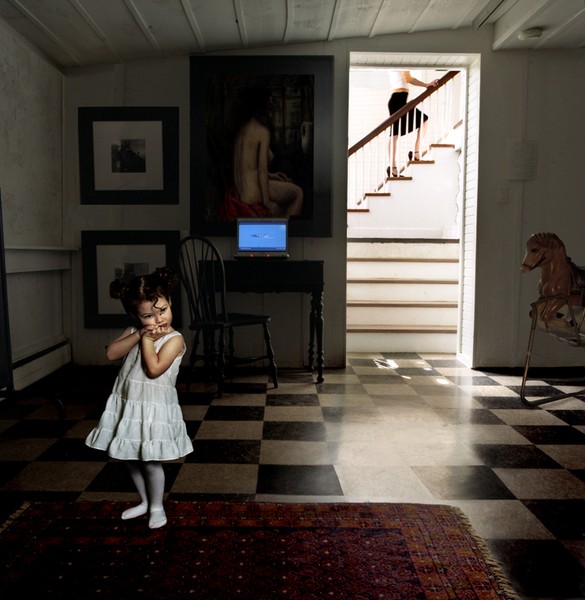 Julie Blackmon, PC, from Domestic Vacations, 2005, Archival Digital Pigment Print
These images are both fictional and auto-biographical, and reflect not only our lives today and as children growing up in a large family, but also move beyond the documentary to explore the fantastic elements of our everyday lives, both imagined and real.The stress, the chaos, and the need to simultaneously escape and connect are issue that I investigate in this body of work. We live in a culture where we are both “child centered” and “self-obsessed.” The struggle between living in the moment versus escaping to another reality is intense since these two opposites strive to dominate. Caught in the swirl of soccer practices, play dates, work, and trying to find our way in our “make-over” culture, we must still create the space to find ourselves. The expectations of family life have never been more at odds with each other. These issues, as well as the relationship between the domestic landscape of the past and present, are issues I have explored in these photographs.
Photographs that often look like paintings in a realist style of houses in disarray, kids not wanting to nap, playing by the pool, jumping on a trampoline - all very common images of suburbia. Blackmon constructed and highly stylized pictures create insightful, eerie and funny artworks from these situations. Sometimes the pictures have been Photoshopped.
In a great many of these images, people are not interacting with each other, but each lives in their own separate world, despite being in the same space----as in Saturday.
Photography becomes liberated as objects are displaced from their original context and digitally placed in a new one.
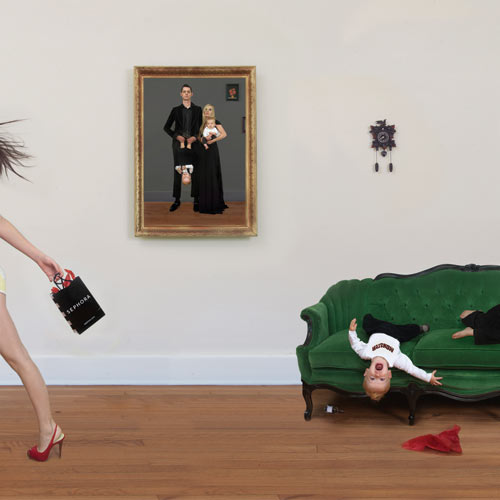 Julie Blackmon, Family Portrait, 2005, from Domestic Vacations, 2005 Archival Digital Pigment Print
January 12, 2009
Dieter Appelt: performance, photography
Dieter Appelt is one of Germany's most influential photographers and videographers. Since 1982, the artist has taught photography, film and video at the Hochschule der Kunst in Berlin. In the late 1970's and 1980's, the artist's work was centered on performance art, and his photography developed out of the documentation of his performance.
Often, the performances took place within constructed nature-based sculptures or sets and dealt with issues related to primal endurance and decay. This was in part because of the experience of returning home from World War II to find the decomposing bodies of soldiers in neighboring fields
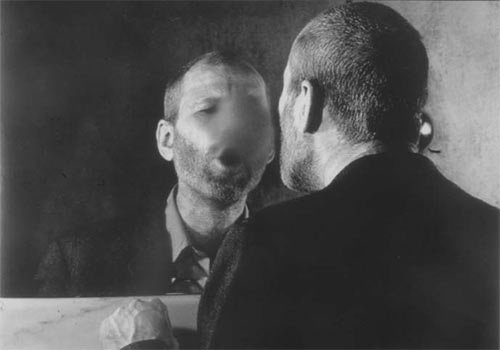 Dieter Appelt, ”Der Fleck auf dem Spiegel,den der Atemhauch schafft”,1977, photography
A latter work is Forth Bridge — Cinema. Metric Space, an exhibition at the Canadian Centre for Architecture; a work informed by, and referring to, the late nineteenth-century Forth Rail Bridge near Edinburgh in Scotland.
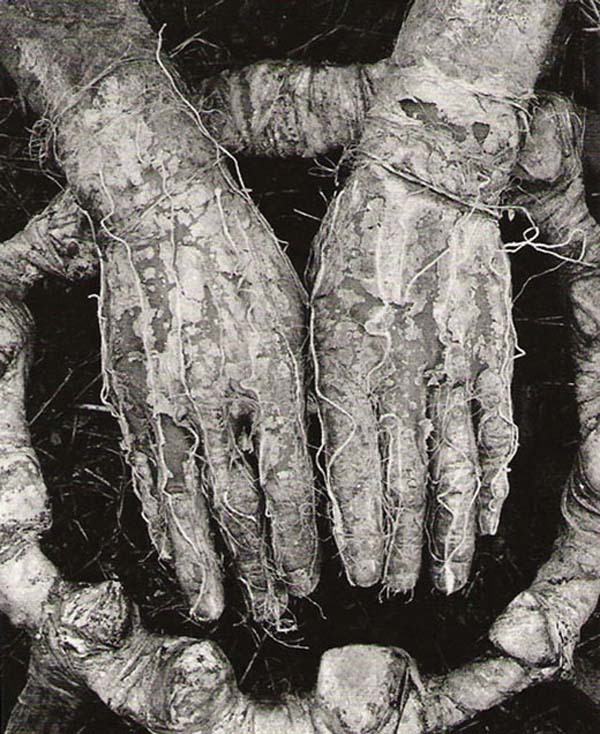 Dieter Appelt, "aus Erinnerungsspur (vergraste Hände), (Weed growth of the hands), 1978-79.
The images is a record of Appelt's performances, the best known documented by "Liberation of the Fingers." In the attempt to purge himself of wartime childhood memories of decaying bodies, Appelt set out to become one himself: he whitened his body with marble dust and wrapped his hands and legs in linen, as if preparing for burial. The artist was not only burying himself alive, as it were, but resurrecting himself, that is, functioning as his own Christ--or shaman, in the tradition of his contemporary Joseph Beuys.
Victor Burgin interviewed
This is a quote from an interview with Victor Burgin in the early 1990s by Laura Cottingham in the Journal of Contemporary Art.
Burgin first came to prominence as an originator of conceptual art in the UK. US77 was one of Burgin’s signature black and white photo text works from the late ‘70s, combining documentary style photographic imagery with texts in the manner of glossy magazines. US77 considers the construction of the subject in a patriarchal and media-dominated society. The show also includes three works from Tales from Freud, a series of five related photo-text works from the early 1980s, which made explicit Burgin’s interest in psychoanalysis and extended Burgin’s ever-widening range of references to include such themes as fetishism and voyeurism.
Burgin is asked: If you were in a position to navigate the course of contemporary Western art, what would you chart for the next thirty years? What would you like to see happening in art- making? Or in art's reception? His reply is:
If you'd asked me that question twenty or more years ago I would have found it much easier to answer. Back then, I wanted to see a dissolution of the hegemony of modernism and an expansion of art-making to include considerations of content that, you may remember, Greenberg defined as "something to be avoided like a plague." I wanted content to be defined not solely in terms of "personal expression" but in terms of critical social and political issues — considerations that Greenbergian modernism defined as improper to art. I wanted an end to the definition of visual art in terms of the traditional media alone. I wanted to see a use of contemporary technologies and forms that would make a link between what was on the gallery walls and what was in the world outside.
And now? Burgin says that today most of that seems to have happened. What didn't happen, or at least didn't happen very widely, was the element of critique.
He says:
What took over was a sort of sixties pop art celebration of the eighties, a period of Reaganomics and junk bonds, when a speculation-fed art market had expanded to the point where it could economically support those "alternative" sorts of activities — but only to the extent that they could be commodified. ....What I would like to see now, though, is going to be much harder to get. I would like to see the creation of a critical and curatorial climate in which long-term critical projects in art can be sustained and flourish. I would like to see novelty and "mediability" displaced from their present positions as paramount aesthetic values. I would like to see just a little less of museums being led by the nose by fashion. This is even more politically important now that being "right on" is becoming chic. I would very much like to see "critique" take forms other than simple accusation.
There is very little in the way of a critical and curatorial climate in which long-term critical projects in art can be sustained and flourish. So how do we create such a climate? Can we do so through the resources provided by the internet?
January 11, 2009
Victor Burgin
I never really connected with the work of Victor Burgin when I was at photography school in Melbourne --it was miles away from straight photography and it was embedded in theory, which I was told by the instructors/lecturers had little to do with photography proper. Anyway photography was about creating original pictures not reworking the pictures of others.
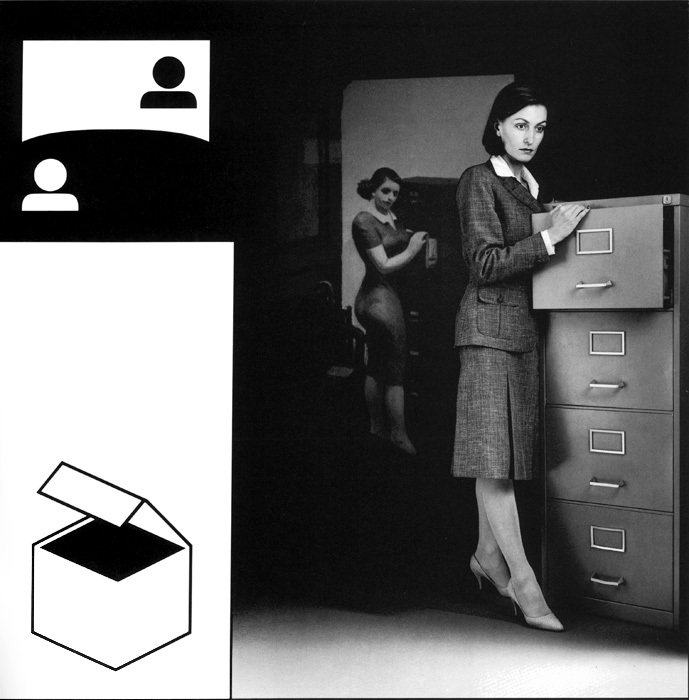 Victor Burgin, Office at Night, 1986
I sensed that Burgin had a knowledge of the art world way in advance of my meagre grasp of 20th century art. In this case Burgin's work is a re-reading of Edward Hopper’s 1940 painting Office at Night; a re-reading was from the perspective of the organization of desire within the law, and the organization of sexuality within a patriarchal capitalism.
 Edward Hopper, Office at Night, 1940
Burgin's Office at Night, which was first shown at the ICA, London, in 1986, was a seven-part photographic installation. Burgin says:
Patriarchy has traditionally consigned women to supportive roles in the running of the economy, subject to the authority of men. The ‘secretary/boss’ couple in Hopper’s painting is at once a picture of a particular, albeit fictional, couple and an emblem, ‘iconogram’, serving to metonymically represent all such couples – all such links in the chains of organization of the (re)production of wealth. Such coupling for reproduction must of course contain its sexual imperative. The family functions to contain, restrain, this imperative in so far as it is directed towards the reproduction of subjects for the workplace. The erotic supplement to the biological imperative cannot however be contained in the family. It spills into the place of work, where it threatens to subvert the orders of rationalized production. [Hopper’s] painting, clearly, may represent such a moment of potential erotic disruption in appealing to such preconstructed meanings, items of the popular pre-conscious, as are filed under, for example, ‘working late at the office’.
Postmodernism was not on the horizon of the photography school in the 1980s. Even if they knew about it the response would have formed part of the strong resistance against a theoretically active art-making process coupled to a gleeful celebration of naivete in photography.
January 10, 2009
subverting modernism
The title of the picture suggests the intention of the maker of the picture. But how can we detect precisely what the photographer intended?

The intentional fallacy in aesthetics questions the assumption often made that the meaning intended by the author of a visual work is of primary importance. It is argued that the meaning of the image does not belong to its producer, but rather, once it is published, it is detached from the picture maker and is beyond their power to control its meaning.
Each picture contains multiple layers and meanings that come into play when the picture resides in a flow of images in the mediascape that constitutes constitutes "a multi-dimensional space. Signifiers in a visualscape or language refer to other signifiers in the same system. (Think of a dictionary, which constantly directs the reader to other signifiers.) This discloses the disjointed nature of pictures, their fissures of meaning and their incongruities, interruptions, and breaks and opens up the way that the process of ‘re-viewing art through a prism of contemporary concerns’
An earlier version of the post can be found on the altfotonet blog.
altfotonet.org
A new Flickr group ---altfotonet.org has been created by S2art and myself. The blurb says:
This is a group, whose aim is to seed images for an an online publication called altfotonet.org.We are currently seeking submissions from creatives/artists/idealouges/ratbags/visonaries, who use lenses and light sensitive materials to make statements, create ideas or explore the notion of 'photography' and what it, 'photography', means in the 21st century.
The Flickr stream, and the concrete canvas stream, provide the flow of images that forms the basis for submissions to an online gallery exhibition.
Why so? What is the rationale? Why the DIY ethos?
In the altfotonet.org blog s2art states:
My interests in photography, are varied, and after several years of hanging around on flickr I realised that the establishment either wasn't taking the idea of online art seriously, or just had no idea what was going on.Meanwhile flickr had long reached critical mass and the gems were getting harder and harder to find amongst the sunsets, babies, kittens and flowers. I wanted to share and get involved in photography and photographers who were interested in more than some preconceived notion of what constituted a good photograph.
The art insttution is not that interested in online art photography. So how do art photographers step beyond their Flickr stream? An online gallery with regular images seems to be the obvious next step. Hence altfotonet.org.
January 8, 2009
eco-postmodernism in Adelaide?
The new VS1 Office Building in Victoria Square, developed by the Catholic Archdiocese of Adelaide, and the HQ of SA Water, is the first building in South Australia to achieve a 6 Star Green Star rating. It is situated in south east corner of Victoria Square next to the iconic Federal Court building, and is a redevelopment of the old tram building/shed.

The building has a strong focus on water conservation and energy reduction and is expected to achieve a reduction of approximately 70 per cent in potable mains water consumption, and a reduction of approximately 50 per cent in greenhouse gas emissions and energy costs compared to a typical office. building. So it is an eco-flagship building in Adelaide.
There some postmodern architecture in Adelaide---an example and some gestures to more sustainable office buildings, but energy efficiency in this city has a very low profile. It has a low priority in Australia despite climate change.
January 7, 2009
punk + photography
s2art's Flickr stream has a set entitled neo-documentary aka... In the notes describing the ethos of this interesting body of work s2art provides a map of the art institution in Australia in the 1980s. He says that:
In the 1980s in the Australian art scene, there was a lot of photo-art that was being made that questioned the documentary nature of photography, one of the techniques used to do this was titles, another to COMPLETELY stage the shot as well.
We can add to this tmap of changes in the art institution by introducing the questioning of high modernism (formalism) in the Australian art scene. Place is a key here, as it signifies a return to everyday life. Photography is an ideal medium in which to examine the importance of place (or the pain of being without place), partly because it works well within a DIY aesthetic.
So how did photography question the hegemony of late modernism?
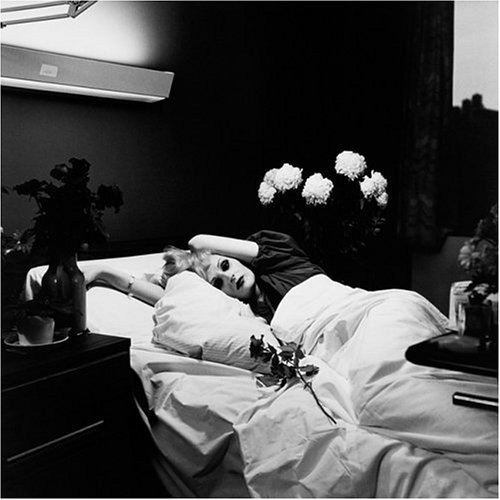 Peter Hujar, Candy Darling on her deathbed,1974. Vintage gelatin silver print.
One way of transgressing modernism was to reject its idea of popular culture as kitsch, spin off from pop art and Warhol, step into popular culture, and question its codes and practices. The critical current in the late 1970s and early 1980s was punk that coincided with serious economic recession, mass unemployment, the tail end of an unpopular Labour government, strikes and industrial disputes, a sense of national decline and a demand for change.
Punk was an explosive movement in popular culture and it was influenced by those alternative currents in modernism----Dadaist, Futurist, Surrealist and Situationist--- that have a minor presence in Australia. It caused in moral outrage and tabloid disgust amongst cultural conservatives. The punk movement is most commonly explained in terms of music (Sex Pistols ) and style (torn jeans and razor blades), but it was also rooted in performance, installation art, photography, graffiti, collage, graphic design and assemblage. It
A visual account of the artwork surrounding the ’70s punk scene is Panic Attack! Art in the Punk Years (curated by Mark Sladen and Ariella Yedgar). The curators say that punk can be interpreted around four central themes:
art with overt political intent that uses the inner city as a symbol of social breakdown; the body as a site to explore transgressive ideas of sexuality, violence and abjection; do-it-yourself aesthetics, collage and appropriation as alternative means of visual communication; and the underground scene as a radical social space and ground for artistic cross-fertilization.
In one of the essays in
the artists broke away from the imperatives of Conceptual and Minimalist art to claim a new ground—the politics of representation—through the redefinition of photography and its potential "uses" for socially engaged, critical intervention. This intervention . . . shifted the terrain of activity for many artists from an "aesthetics of administration" to aesthetic politics as part of a larger shift in the very terms of cultural production itself within the Postmodern condition
The politics of representation—through the redefinition of photography and its potential "uses" for socially engaged, critical intervention still reverberates. Edgy, wilfully controversial, and directly political photography based on resistance from within a deserted urban wasteland that expressed unrest, urban decay, protest, self-reinvention. The imagery of urban decay was often used as a symbol of the public crisis.
January 6, 2009
Stephen Shore: The Nature of Photographs
Stephen Shore's text, The Nature of Photographs, (1998, recently reprinted) can be seen as an extension of a class on photographic seeing he taught at Bard College. This used John Szarkowski's The Photographer's Eye as a central text.
Shore's text is a book about photographs rather than the act of photography and so it is about photographic seeing, the visual grammar of photography, and aesthetics(or the categories we use to interpret images). By photographs Shore means the straight (art) photograph taken with a camera and printed from a negative or a digital file, as opposed to composites and images created through Photoshop or computer generated imagery.
 Stephen Shore, South of Klamath Falls, Oregon, from Uncommon Places
He says:
So how my pictures are seen now, as opposed to the early 70s, I see a tremendous difference. People say my pictures are nostalgic, my pictures aren’t nostalgic, they’re nostalgic! My pictures are just pictures. When they were shown in the early seventies in New York, there was no hint of nostalgia. Some people who didn’t get them said, well, it’s just like looking at the world, why would anyone want to show me this? There was no distance from it, now there’s a distance of time.
However, Shore works very much in the modernist tradition mapped by Szarkowski, as opposed to the poststructuralist or cultural studies perspective that places photos within language or the visual media scape.
It is the latter that would explore the way that pictures are time capsules showing subtle changes in how we interpret images. Shore, is more concerned with the photograph as photograph. In the introduction to the Photographer's EyeSzarkowski said:
This book is an investigation of what photographs look like, and of why they look that way. It is concerned with photographic style and with photographic tradition: with the sense of possibilities that a photographer today takes to his work...in large part the photographer was bereft of the old artistic traditions .... The photographer must find new ways to make his meaning clear.
Shore initially explores the nature of a photograph at the physical level. This level includes the chemical makeup of a print, the photographs flatness, the fact it has edges making it be contained in boundaries (unlike our own vision, which, when combined with the moving of the head, is infinite, compared to the finite view of a photograph, making the photograph seem limited), the texture, and the color (or lack of color) of the print. These are tools to create a meaning, evoke an emotion, and so on. This level is about in making an image using a camera. A photographer stands in front of a subject and makes several decisions: where to stand, what to include, how to utilize focus and finally, how to use time to record the image.
The second level of the nature of a photograph for Shore is explored in terms of how photography differs from any other discipline. This is explored in terms of a photographer analyzing existing reality and then choosing (by vantage point, frame, moment of time, and selecting focus) what he wants to create the structure of his photograph.
So the nature of photograph is about how a photographer can use technical tools to create meaning of a photograph. Nothing new there. So how do we read or interpret a photograph? In the last chapter 'Mental Modelling' Shore says:
Earlier I suggested that you become aware of the space between you and the page in this book. That caused an alteration of your mental model. You can add to this awareness by being mindful, right now, of yourself sitting in your chair, its back pressing against your spine. To this you can add an awareness of the sounds in your room. And all the while, as your awareness is shifting and your mental model is metamorphosing, you are reading this book, seeing these words – these words, which are only ink on paper, the ink depicting a series of funny little symbols whose meaning is conveyed on the mental level. And all the while, as your framework of understanding shifts, you continue to read and to contemplate the nature of photographs.
We are not at the level of language yet as we are still concerned with the photograph as an individual object, as so yet to cross the boundaries between photography and culture.
January 5, 2009
Friedrich Sommer as a surrealist
s2art has a brief post on Friedrich Sommer at musings from the photographic memepool [the shallow end]. I know little about Sommer's work or ideas. I'd vaguely seen him as akin to Minor White.
 Frederick Sommer, Anatomy of a Chicken, 1939
Sommer explored making images with other media, creating masterful drawings, collages, and musical scores. It's the mixture of abstraction and surrealism that I find attractive and appealing. Over the years, Sommer collected scraps of billboard posters, children’s toys, pieces of torn wallpaper and fragments of rusted metal. By 1946 he was making photographs from these found objects which he assembled into Surrealist collages.
He isolated the austere Arizona hillsides and reduced them to abstract patterns. Sommer intentionally created flattened landscapes that lacked a single focal point, calling into question photography’s objectivity and suggesting a new way of seeing.
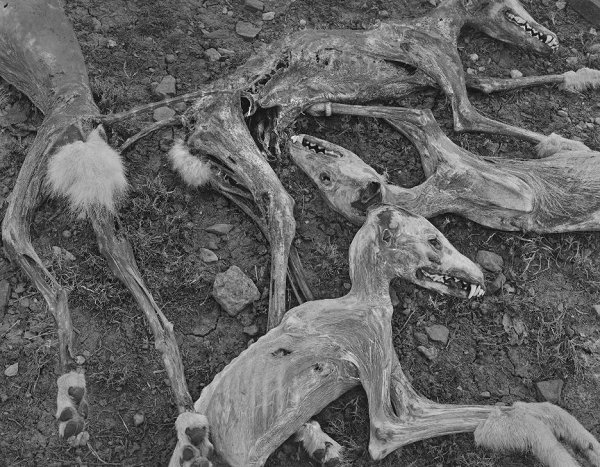 Friedrich Sommer, Coyotes, 1945
These desiccated carcasses of four coyotes, stripped of their pelts still work within finding things to photograph Sommer pushed the boundaries of photography's subject matter by moving from finding things to photograph to creating things for the camera.
In the 1950s Sommer developed a process of painting on glass to create cameraless negatives and began experimenting with a Leica 35 mm camera. Later he experimented with processes such as cliché verre, painting on cellophane and smoke on foil. He would paint in oil or deposit smoke from a candle onto a transparent surface and then place it in an enlarger to create negatives of his abstract compositions.
January 4, 2009
Bruce Springsteen: Storytellers
I watched a DVD of Bruce Springsteen's recent StoryTeller concert the other night.
Made around the time of his Devils & Dust album (2005) Springsteen dissects his songs line by line, explaining how the music fuels, informs, and complements the lyrics. It is low key, informative and interesting.It shows that he is not just a rock performer or a writer of pop songs.
January 3, 2009
Plateform magazine
I stumbled upon Plateform Magazine via exploring Ann Marie Simard's photostream on Flickr and then her WinterGarden weblog.
Plateform is new, is French and based in Paris, has its own photostream on Flickr, and appears to be run by OnoLulu - Laurence Guenoun. It is a magazine to exhibit work and it is based on suggestions in the form of a series of 10
Issue One You can read the diverse body of visualwork by turning the pages. However, the text for the interviews is not readable.
The second issue is out now. The text is in French. An English version is promised.
You can explore the work of photographers selected here. for exhibition. There is lots to explore and it shows how vibrant photography is after the digital revolution.
January 2, 2009
poesis: a note
Photography as poesis. It is one way that an aesthetic rationality can challenge the dominant utilitarian form of instrumental economic rationality in late modernity.

Another example. There are diverse, more developed and better examples of photography as poesis.
Initially --in Plato---poesis refers to the work of art shapes the sensuous particularity of experience into an emotionally coherent totality. The work of art, as it were, interprets through metaphor in contrast to the language of philosophy and mathematics----what Descartes would called physics as science.Plato called into question the value of expressing in metaphorical language our understanding of things. Poesis's concern is with the sensuous particular not knowledge of the truth.
Since Plato alternative views of poesis have taken over from the traditional mimetic interpretation of poesis, with the dominant interpretation highlighting the originality of individual expression of personal emotion with film and television now the main forms of public art in the common culture.That mode of expression often rests on the principle of ut pictura poesis that ties, or allies, the visual arts (historically painting) to literature (historically poetry) as sister arts.
That tradition was ruptured by modernism.
January 1, 2009
an aesthetics of social conduct
Ken Gelder, in responding Peter Craven at the Sydney Writers’ Festival, makes the following remarks in Overland about cultural conservatism in the literary culture:
Peter still believes wholeheartedly in Matthew Arnold’s view of the ‘best’ in civilised culture and Leavis’ view of the canon, both of which he earnestly invoked in his talk at the Sydney Writers’ Festival (along with a few Australian Arnoldians, like Vincent Buckley and Chris Wallace-Crabbe). He believes in the ‘classics’ and is sure they make us better people. Because of this, he is constantly backward-looking, forever hauling up a short list of great writers we should all still be attending to but sadly no longer seem to be. He is what we used to call a ‘vertical’ or monogamous reader: burrowing down through a thin tunnel of great books, invoking them in the reviews he writes, returning to them without respite.
Gelder says that the cultural field these days is horizontal and promiscuous, not vertical and monogamous. It spreads outwards, covering all sorts of things, willy-nilly: literature, popular fiction, cinema, television, all kinds of media, everywhere.
However, this cultural conservatism in the literary culture is pervasive and informs culture in general and so a visual culture. There have been attempts by those working in the Anglo-European modernist tradition to construct a canon of Australian photographers that represent the best in Australian visual culture.
This cultural conservatism can be interpreted as an aesthetics of social conduct, or ‘culture’ that functions as the very unconscious structure of our life that contains the unruly and directs the life of passion and sensation into approved forms of feeling and action. As Brian Musgrove observes in Overland:
The aesthetic reconstructs emotion, redirects it into established forms that seem reasonably right. Crucially too the aesthetic activates the nebulous concepts of sentiment, sympathy and affinity: a sophisticated political etiquette, an ethos of sensibility which attempts to fuse our felt identity with the powers that rule us, regardless of what those powers might actually be doing.
The aesthetic acts to channel passion by finding a consensual form of mediation between the rule of reason and law and raw, everyday life.