|
January 5, 2009
s2art has a brief post on Friedrich Sommer at musings from the photographic memepool [the shallow end]. I know little about Sommer's work or ideas. I'd vaguely seen him as akin to Minor White.
 Frederick Sommer, Anatomy of a Chicken, 1939
Sommer explored making images with other media, creating masterful drawings, collages, and musical scores. It's the mixture of abstraction and surrealism that I find attractive and appealing. Over the years, Sommer collected scraps of billboard posters, children’s toys, pieces of torn wallpaper and fragments of rusted metal. By 1946 he was making photographs from these found objects which he assembled into Surrealist collages.
He isolated the austere Arizona hillsides and reduced them to abstract patterns. Sommer intentionally created flattened landscapes that lacked a single focal point, calling into question photography’s objectivity and suggesting a new way of seeing.
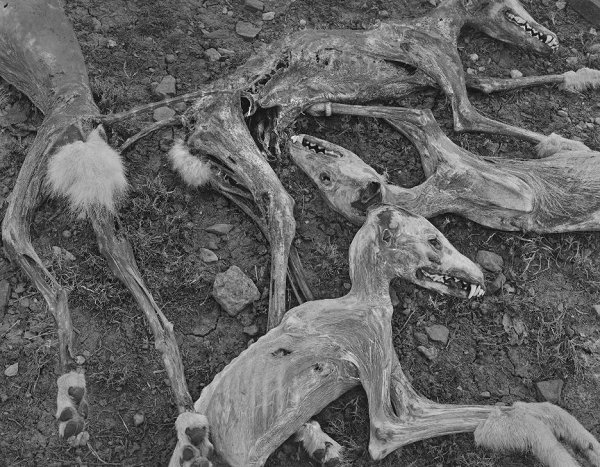 Friedrich Sommer, Coyotes, 1945
These desiccated carcasses of four coyotes, stripped of their pelts still work within finding things to photograph Sommer pushed the boundaries of photography's subject matter by moving from finding things to photograph to creating things for the camera.
In the 1950s Sommer developed a process of painting on glass to create cameraless negatives and began experimenting with a Leica 35 mm camera. Later he experimented with processes such as cliché verre, painting on cellophane and smoke on foil. He would paint in oil or deposit smoke from a candle onto a transparent surface and then place it in an enlarger to create negatives of his abstract compositions.
|


Sommer's early beginnings were heavily influenced by Surrealism, he was close friends with Max Ernst. Legend has it that he bought a bottle of rum, visited Ansel Adams one night and learnt all he needed to begin making fine prints.