December 31, 2009
Happy New Year
There is the common belief in photography that the photograph is natural. The assumption is that the image is a natural sign, a straightforward analogue of its object that is unmediated by language or convention.

In Picturing Ourselves: Photography and Autobiography Linda Haverty Rugg says that while we know on one level that photographs are the products of human consciousness, they also can (have been, are, will) be taken as "natural" signs, the result of a wholly mechanical and objective process, in which the human holding the camera plays an incidental role in recording "truth."
She adds:
Our belief in this aspect of photography allows us to admit photographs as evidence in courts of law and persuades some that the spirits of the dead or heavenly emissaries can be captured on photographic film. In this reading of photographs it is possible to posit the metaphorical "Eye" mentioned above, an eye so close in character to that of the unknown and invisible reader, or the eye of the observing and narrating autobiographer, or the eye of the State or of God, that it achieves a transcendent and disembodied quality.
She says that if, as practicing poststructuralists, we would like to discount photography's evidential power, we should remind ourselves of the small army of photographic selves that verify our status and agency in the world on passports, drivers' licenses, and so on.
However, it is not as straightforward as this either or, since passports and drivers' licenses are part of our visual language and conventions.
December 29, 2009
Xmas Day: Granite Island
Most of our time over the short Xmas break at Victor Harbor was spent cleaning up the weekender so that friends could spend their two week Xmas break there. We are now back in Adelaide amidst the heat, arriving midday Tuesday.
We did, however take the odd break from the cleaning and painting. We spend a couple of hours walking around Granite Island along with lots of Indian and Chinese families for whom Xmas Day had no significance other than as a secular public holiday. We Anglo-Saxons were in a minority that morning, and that highlighted just how much Adelaide had become a multicultural society in the last decade or so.
Despite all the cleaning I managed to find some moments to do a little bit of photography --snaps of the coastal landscape and the beach architecture with my digital camera:
 Gary Sauer-Thompson, beach architecture, Victor Harbor
I even managed to do a little thinking about photography----specifically about Saul Leiter's use of colour as form in photography when I was briefly exploring the possibliites for abstraction in the rock forms along the shoreline.
The backdrop is that I have tossed in my Canberra policy work to devote more time to photography. Though the money I was earning was good it felt more like compensation than pay, despite some modicum of creative output. The experience of satisfaction was minimal as the job became increasingly one of the sausage-factory abstract writer in the knowledge economy.
Over Xmas I wondered about how Edward Hopper's beach work--lighthouses, architecture and landscapes would translate to coastal South Australia. I'm struggling to find a visual language to represent this coast beyond my standard point and shoot whilst walking around.
These consideration have become important as photography is now becoming more into the centre of my life in an effort to address the challenge of creativity
December 28, 2009
Murray Fredericks: Lake Eyre
Murray Fredericks is known for his black and white images of the Tasmanian forests and mountains. Since 2002 he has been exploring Lake Eyre in South Australia in a minimalist and colourist way. He camps on the salt at Lake Eyre and he uses an 8 x 10 Toyo view and slow colour film to represent the intense light and the vast space of this remote region:
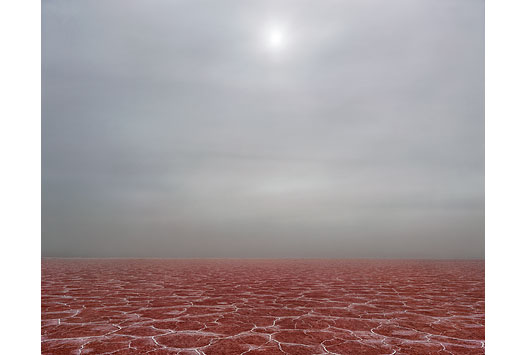 Murray Fredericks, Salt 108, 2007, pigment on cotton rag
These are not representations of a specific wilderness landscape, which has traditionally been represented as the dead heart in Australian culture. Some, no doubt, would interpret these images as representations of nothing--a black hole where nothing lives and even the desert vegetation is dead.
Fredericks says that in this work he is deconstructing the stereotypical images of postcards and calenders:
I was deliberately trying to break the calender aesthetic --which is very place based. I am not about describing Lake Eyre . I don't even want anyone to look and say that it is a nice place to visit. landscape is something that can be used to carry an emotion, all different emotions. It has a connection that goers beyond the conscious minds.
This is a reference back to Stieglitz's Equivalents series --an attempt to free the subject matter from literal interpretation, and, as such, create abstract photographic works of art.
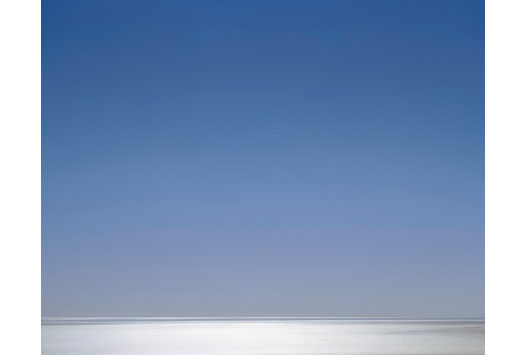 Murray Fredericks, Salt 30, 2007, pigment on cotton rag
Frederick's uses pictures as metaphors to represent feelings about things other than those shown by the pictures in this case his inner journey or subjectivity.
Trouble is, we have no idea of Frederick's emotions when he was camped at Lake Eyre. We just have the photographs. There is no way to know what Fredericks's photos are equivalent to (other than asking him). On the other hand, we can consider them equivalent to something from our own experience, if we so desire. Thus we can say that they are equivalent to pure emptiness or to the emotions of intense solitude.
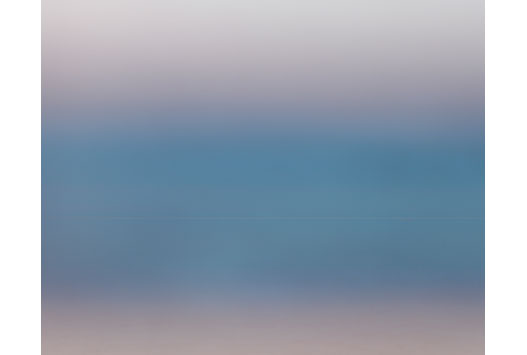 Murray Fredericks, Salt 133, 2007, pigment on cotton rag
Or we can interpret them as painterly abstractions within the modernist art tradition.
December 27, 2009
Gordon Undy
The altfotonet blog has a post on Gordon Undy, the Australian analogue photographer. There is little about Undy on the internet apart from the historical images of regional Queensland held by the National Library of Australia:
 Gordon Undy, Bulk Sugar Terminal, Mackay, 1995
The images in the collection of the National Library of Australia are mostly architectural, street scenes of McKay, Townsville and Rockhampton and mining taken with a large format camera. There are very few landscapes in this series, but I found one:
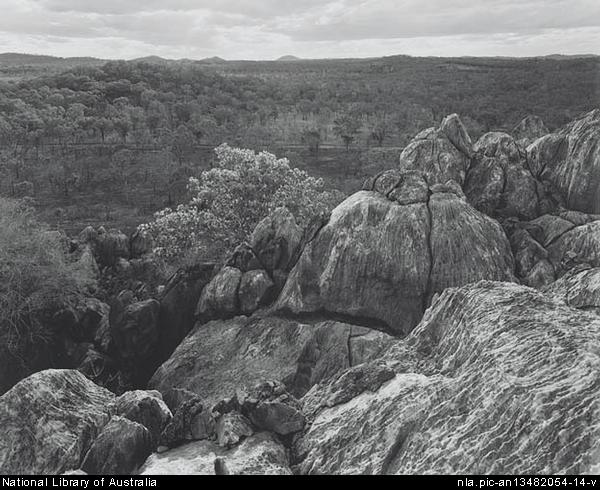 Gordon Undy, West from Chillagoe, 1994-96, silver gelatin
Undy says that his landscape images are within the tradition of fine black and white photography with a lineage of connection through Paul Caponigro Minor White to Edward Weston, Edward Steichen, Harry Callahan. Though he is the author of three books of photographs of the Australian landscape Yet there seems to be very critical commentary about Undy's body of work in Australia. The art institution ignores photographic landscapes?
I am assuming that there is an Australian tradition of this kind of fine art black and white large format photography. But where to look to uncover it?
December 26, 2009
Saul Leiter: colour photography
Some of Saul Leiter's early colour work can be seen at Gallery F 5.6. I 'm surprised because I thought that William Eggleston broke the ground in terms of colour art photography. Well, that is what the art historians say.
Leiter's work is a decade pre-Eggleston and was produced at a time when colour photography inhabited the realm of magazine and advertising, and was seen as low art, vulgar or kitsch understood in Clement Greenberg's terms and photography was viewed in terms of documentation and transcription.
 Saul Leiter, Untitled, New York, circa 960
Leiter's visual language is one of fragmentation, ambiguity, and contingency coupled to subtle, painterly images ithat transpose the formal pictorial language of Abstract Expressionism to the photograph and its inherent qualities such as its realism.
 Saul Leiter, Phone call, 1957, Chromogenic print.
The street-scenes are half-hidden, veiled, fragmented; incorporating muted tones and simple forms whilst the surfaces are obscured with shadows and reflections creating multiple layers. Martin Harrison, editor and author of Saul Leiter Early Color, writes:
Leiter’s sensibility…placed him outside the visceral confrontations with urban anxiety associated with photographers such as Robert Frank or William Klein. Instead, for him the camera provided an alternate way of seeing, of framing events and interpreting reality. He sought out moments of quiet humanity in the Manhattan maelstrom, forging a unique urban pastoral from the most unlikely of circumstances.
Saul Leiter uses the camera as an expressionist brush. To that end he's using the very new, and very unpredictable, color film medium to 'paint' vignettes of the New York that he saw.
December 25, 2009
Xmas Day: white rose
Merry Xmas everyone
 Gary Sauer-Thompson, white Solway peace rose, Encounter Bay, Victor Harbor, 2009
Have a lovely, relaxing break
December 23, 2009
Fotofreo 2010: Eugene Richards
FotoFreo 2010 is month long celebration of photography showcasing the work of internationally renown and emerging photographers from March to April. Like the Ballarat Biennale it consists of core and fringe programmes as well as discussion.
The core programme includes work by photographers previously mentioned on junkfor code: Carrie Levy, and the two Australians Pat Brassington and Narelle Autio.
The American documentary photographer, Eugene Richards, is part of the core programme. The work featured is the colour work of the abandoned and forgotten houses of western America in areas such as the plains of Kansas, Nebraska, New Mexico and the Dakotas.
 Eugene Richards, An abandoned house just outside Corinth on Highway 42 in northwest North Dakota, from The Blue Room
This series consists of pictures of abandoned buildings and the communities that once supported them. They couldn't make a living any more on a small farm.
These regional ghost towns speak of an irreversible decline.Judging from Richard's work They are places that have been emptied out as the family farm gave way to the capitalist enterprise.
 Eugene Richards, empty house+ train, North Dakota, from The Blue Room
North Dakota stands for abandoned houses, empty stores, churches without congregations, community buildings gone dark and closed schools.All that signifies a future of narrowing possibilities.
December 22, 2009
Copenhagen: a fiasco
I don't have much to say about COP15 that I haven't already said at public opinion. Other than I am deeply pessimistic about the future negotiating process to forge a legally binding treaty after Copenhagen.
 Martin Rowson
Lets have more graffiti about reducing greenhouse gas emissions and shifting to running our economy on renewable energy. Our future in southern Australia is now one of sea level rises, reduced food production, less water and a hotter and drier climate. This is especially so in Adelaide.
Artists, including photorpahers, need to speak out about what is happening in terms of how the fossil fuel industries are trying to kill off the shift to a low carbon economy.
December 21, 2009
Sarah Jones: photography + psychoanalysis
Sarah Jones had one of her images included in the seminal "Another Girl, Another Planet," curated by Gregory Crewdson and Jeanne Greenberg Rohatyn, at what was then called the Lawrence Rubin Greenberg Van Doren Fine Art in New York City in 1999. I referred to that exhibition in the post on Annika von Hausswolff's photograph that was provided the context for the exhibition.
This image was part of a series of teenage girls with whom Jones has been working for some time, photographing them in and around their comfortable middle-class homes. The girls inhabit an in-between space that bridges childhood and maturity. In pointing to a haunting narrative beyond the frame--a childhood "uncanny" -- Jones denies her work the genre-portrait status to which it might otherwise be consigned.
Jone's previous series was Consulting Room, 1995, which explored the various codes, signals and conventions associated with the sense of ritual and place. The couch series is ongoing and it now represents couches in the analyst rooms:
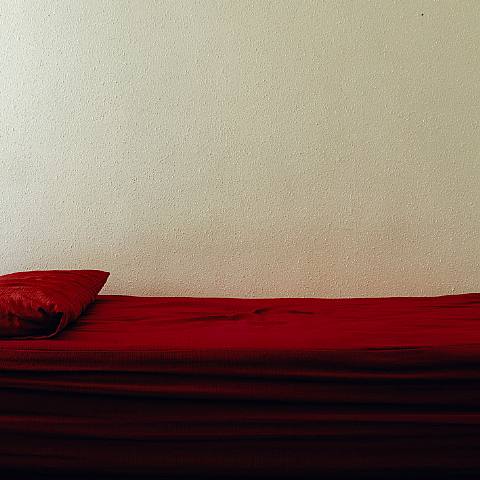 Sarah Jones, Analyst (Couch) (I) circa 1995, Lambda print mounted on aluminium
What is explored is the ‘analytic frame’ that marks off the different kind of reality that is within it from that which is outside it; but a temporal spatial frame also marks off the special kind of reality of a psychoanalytic session. There are many elements of the analytic frame. It is a room — a physical setting. It is a set of conventions about how one behaves. It is a state of mind — a mental space. It is a facilitating environment and a container.
In this interview in Frieze Magazine Jones says that the head of British Institute of Psychoanalysis spoke about:
how patients in the room often imagine the presence of a third person, and he suggested that the camera could be like this third eye; an onlooker, an audience. This then unfolded a whole way of photographing the couches, which developed into photographing the girls and the roses and the trees, and my relationship to photography.
In psychoanalysis it is the existence of the analytic frame that makes possible the full development of that creative illusion that analysts call the transference.
December 20, 2009
The Kinks: Come Dancing
I don't know The Kinks latter albums, such as States of Confusion (1983). But the buoyant nostalgia music hall-tinged pop of 'Come Dancing' reaches back to the post-war world of Arthur and the lament of The Village Green Preservation Society for the passing of old-fashioned English traditions.
The song, which I heard on The Ultimate Collection on the hard drive of my PC is about the effects of urban renewal and losing what was once valued (in this case the Ilford Palais ) in a place we live in. This loss from the forces of progress or development means a part of ourselves dies.
They put a parking lot on a piece of land
Where the supermarket used to stand
Before that they put up a bowling alley
On the site that used to be the local Pally
That's where the big bands used to come and play
My sister went there on a Saturday
The day they knocked down the Pally
My sister stood and cried
The day they knocked down the Pally
Part of my childhood died, just died
Ray Davies has turned the song/video in a theatre musical
old + new
When I am walking the contemporary city as a situationist exploring urban life with a film or digital camera I have a feeling of unease. The city, as both a geographic entity and as a series of criss -cross flows, is too dispersed to grasp as a unity.
I sense that the older images and concepts that we habitually represent the compact bounded city that we have come familiar with have become cliches. I start feeling naked, in spite of the camera.
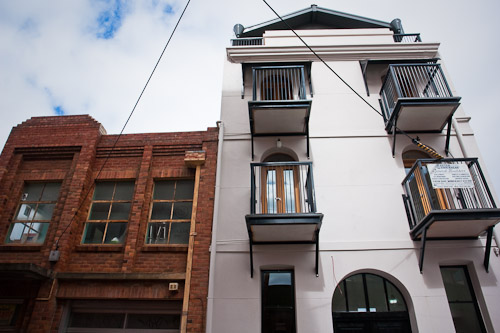 Gary Sauer-Thompson old+ new, Eliza Street, Adelaide CBD, 2009
The conventional distinctions centre/periphery; city/country, inside/outside no longer make much sense of the chaos as the the industrial city of yesteryear is transformed and reinvented by capitalism.
These old dualities belong to a historic discourse that we cling to like an old garment to protect us from the unease of the fragments of an industrial city fragmenting and disappearing before our eyes. The only way that I can deal with this is to grasp in images the changes that are taking place in the urban spaces that we live in--to decipher the trail they leave in space as we make our everyday journeys through these contemporary spaces.
Traces of the past in the present. To either deal…with history through the filter of the present or to focus on a present in which the past actively resonates. Either way history needs to be in the foreground.
December 17, 2009
Art and Copenhagen
The art world has been slow to grasp the significance of climate change. How do you represent global catastrophe? Hasn't visual art's long-held a fascination with apocalypse?
GSK Contemporary, Earth: Art of a changing world sets out to consider the impact of climate change, and our transition to a new world.
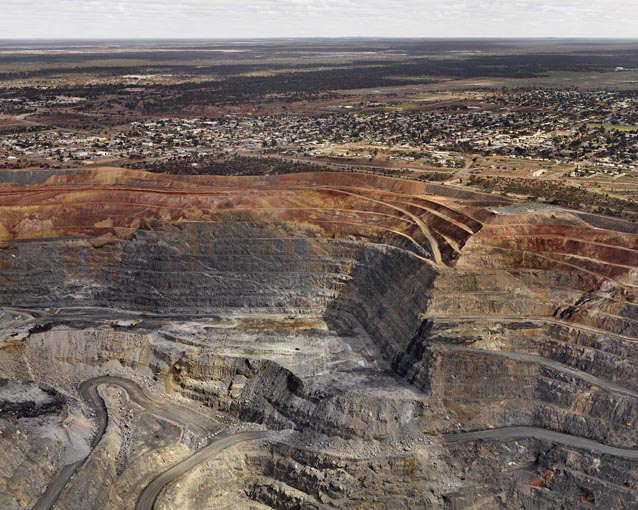 Edward Burtynsky, 'Super Pit #4, Kalgoorlie, Western Australia', 2007
There is a Rethink show in Copenhagen.
December 16, 2009
Conroy's internet censorship
A censorship regime in the form of a mandatory internet filter has been announced by the Rudd Government. It is to be implemented next year. The video---part of the Censordyne campaign---is by Danllc for GetUp:
My fear is that, given the background, Conroy's mandatory ISP filtering plan looks to be the thin edge of a very large, potentially very conservative and encompassing censorship programme. The potential emerges for two reasons.
Firstly, the potential is there because "illegal" or "unwanted" content is currently what is on the ACMA blacklist and what may be put on the blacklist in the future. he definition of what is illegal is dealt with under the Broadcasting Services Act by use of the terms "prohibited content" and "potential prohibited content". Prohibited content is that which has been classified RC (refused classification) or X 18+ by the Classification Board; whilst potential prohibited content is content that has not been classified by the Classification Board but that if it were, there is a substantial likelihood that it would be prohibited content.
Secondly, this movement for censorship is a campaign based on exaggerated claims, that has been run by ChildWise's Bernadette McMenamin, the Australian Family Association and the Australian Christian Lobby. They have a wide understanding of refused classification and potential prohibited content and they are opposed to an open internet. So no photos of naked bodies on the web or photos of teenage sexuality?
The Australian Christian Lobby, which has its base in the evangelical Pentecostal-type churches, is already calling for a review of the mandatory internet filter within three years to expand its scope beyond the ACMA blacklist. Managing director Jim Wallace issued a statement claiming the Enex report had "proven the technological principle [of filtering] can be extended to deal with other harmful X (sexually explicit material) and R-rated material (includes information about, or containing, drug use, nudity, sexual references, adult themes, horror themes, martial arts instruction, graphic images of injuries, medium or high level coarse language, sex education, health education and drug education) on the internet.
What the Australian Christian Lobby, which is a pro-life and anti-biotechnology group, wants blacklisted is content that is legal, but offensive to sections of the community defined by religious fundamentalists within the Christian movement. They work on the basis of moral panic and the politics of fear. They stand for < a href="http://www.rodneycroome.id.au/other_more?id=3068_0_2_0_M18">Christian governance grounded in the objective moral truths contained in the Scriptures, advocate an Posted by Gary Sauer-Thompson at 4:42 PM | Comments (3) | TrackBack
December 15, 2009
Annika von Hausswolff + post modern photography
In von Hausswolff's 1993 color photograph from her 'Back to Nature' series, a naked woman lies face down in a shallow marsh, her pale, body half-submerged. Is it a staged crime scene similar to what we see on free-to--television crime programmes? An artist's model posing as a suicide? Sex and violence? A feminist depiction of rape?
The image is ambiguous in terms of its cultural meaning in spite of its simplicity:
 Annika von Hausswolff, Back to Nature, 1993
What the image signifies is the postmodern turn to staged photography and to narrative, thereby transgressing If the photo carried the image into history (war photos) then the story telling came from captions or text, as in photojournalism.
In Dial "P" for Panties: Narrative Photography in the 1990s Lucy Soutter says that the idea that pictorial work could function as allegory was extremely compelling; linking contemporary photography with the privileged discourses of literature and narrative history painting, the allegorical interpretation of works allowed them a satisfying complexity and multivalence and also created a new kind of viewer.
In the 1990s photography became a central figure in the postmodern art institution. Consequently, as Soutter points out:
unlike the audience of modernist art photography who expected to see a self-sufficient autonomous image the postmodern viewer could be relied upon to recognize oblique critical allusions without introductory explanation. In allegory, the speaker trusts the audience to make the metaphorical connection and to sustain it throughout the discourse. In essence, this metacritical mode allowed artists to maintain links with old-fashioned art values while at the same time maintaining a critical distance from them.
Allegorical readings often drew attention away from the formal aspects of the work, its explicit subject matter and its presentation. She adds that:
the current narrative work stakes its importance on [a] subtle complicity of its relationship with commercial culture. Its hipness is determined by the narrowness of the margin between art and fashion or between art and pornography; it dances on the razor's edge. In the same way that cutting edge fashion items are barely recognizable as apparel and cutting edge fashion photography makes it hard to see what is for sale, cutting edge gallery photography is barely distinguishable as art.
The tension between commercial and artistic applications of photography has always created status anxiety in photographers. In the l980s this anxiety could be seen in the clashing discourses of art and art photography. Cindy Sherman and Jeff Wall are repeatedly referred to as "artists" rather than photographers, even though their work takes exclusively photographic form.
update
von Hausswolff's combination of traditional Nordic landscape painting and scene-of-the-crime in 'Back to Nature' photography refers to the work of Bellmer and Duchamp, where the eroticism of looking is closely linked to the female body and to sadism and voyeurism.
If her photographs expose the inner workings of the much maligned gaze of male desire to dominate and possess, then a good part of their attraction for us derives from her willingness to acknowledge that the sight of naked flesh can be oddly riveting. Her work both attracts and repels.
December 14, 2009
animated images
In Towards A Philosophy of Photography it is argued by Vilém Flusser that there are two interweaving programs in the camera. One of them motivates the camera into taking pictures;the other permits the photographer to play. Beyond these are further programs - that of the photographic industry that programmed the camera; that of the industrial complex that programmed the photographic industry; that of the socio-economic system that programmed the industrial complex; and so on.
In the Introduction Vilém Flusser says that:
If images are to be deciphered, their magical character must be taken into account. It is a mistake to decipher images as if they were "frozen events." On the contrary, they are translations of events into; situations; they substitute scenes for events. Their magical power is due to their surface structure, and their inherent dialectics, their inner contradictions, must be appreciated in light of this magic they have.
Images are meant to render the world accessible and imaginable to man, but, meven as they do so, they interpose themselves between man and the world. They are meant to be maps, and they become screens/ Instead of pre-senting the world to man, they re-present it, put themselves in place of the world.
The world becomes image-like, a context of scenes and situations.We forgets that we produce images in order to find our way in the world; we now try to find our way in images. The purpose of text is explain or decode images and to decipher texts is to find out what images they refer to.
The struggle between texts and images poses the question of the relationship between text and image. In modernity conceptual thinking analyses magical thinking in order to do away with it, magical thinking infiltrates conceptual thinking in order to imagine its m concepts. In the course of this dialectical process, conceptual and magical thinking mutually reinforce themselves: texts become more imaginative, and images become more conceptual.
December 13, 2009
Photography: memories and history
William Christenberry's poetic documentation of the vernacular landscape of the American South is an ongoing series that blends the descriptive with the mythic. It parallels the work of Bernd and Hilla Becher.
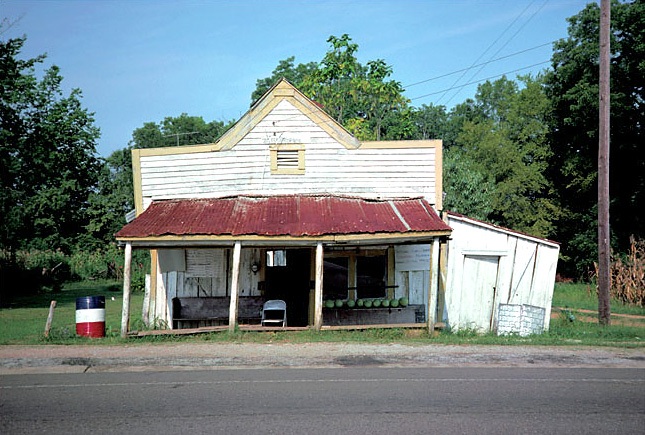 William Christenberry, T.B. Hick’s Store, Newbern, Alabama’, 1976
This kind of work links text and image since the artist’s memories of the Deep South are stepped in rich literary and photographic tradition.
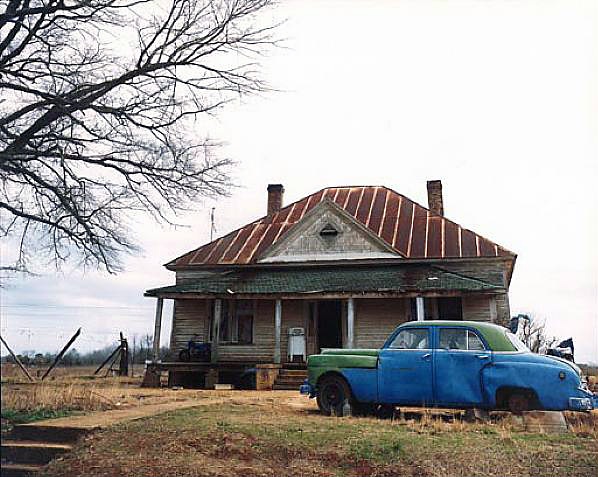 William Christenberry, House and Car, near Akron, Alabama’, 1981
This work is about place, time and memory.In this interview in Afterimage (November 2005) he says:
I don't want my work thought about in terms of nostalgia. It is about place and sense of place. I only make pictures when I go home. I am not looking back longing for the past, but at the beauty of time and the passage of time....I can't wait to get out into that landscape and to go back and see those same places. Sometimes they are still there and sometimes they are completely gone...Returning to the sites allows me to record both the traces of passing time and represent how a subject is transformed by time.
He adds that Walker kept his distance emotionally. His view was objective. My stance is very subjective.
The place is so much a part of me. I can't escape it and have no desire to escape it. I continue to come to grips with it. I don't want my work to be thought of as maudlinor overly sentimental. It's not. It's a love affair--a lifetime of involvement with a place.
He adds that although his work is largely celebratory there is this dark side that permeates the South--eg., the issues of the civil rights period and the terrible evil that manifests itself in the Ku Klux Klan's terrorism and racism.
December 12, 2009
photobooks: possibilities + future
I've been thinking about the possibilities and the future of photobooks.
My starting point is that I no longer buy art photography books because they are too expensive, and that the impeding arrival of Apple's iTablet, or similar innovative platform of communication, shifts the focus from print to online. Technology has lowered the barrier to entry to publishing images bounded in a cover whilst the Internet has changed the distribution model.
This opens the future possibility of photobooks becoming a more experimental means of extending the reach of a cohesive photographic project, body of work, series of photographs or visual storytelling.
 Gary Sauer-Thompson, Coca Cola, Broken Hill, 2009
The reason for my haphazard, exploratory thinking about photobooks is that the bookform is where I want my work to shift to--the next step beyond Flickr steam or the Rhizomes1 photoblog. I'm not that interested in a portfolio, nor the book as an artform per se. 'Tis time for a radical re-think.
Despite the continued existence of the printed book, the future is increasingly online: as a multimedia platform in which you can scroll through the pages, hear audio, click on links, or watch a video. The future is experimental and the nature of the book and publishing is going to broaden and become more diversified.
 Gary Sauer-Thompson, Browns Shaft, Junction Mine, Broken Hill, 2009
The DIY possibility using Blurb or any other on-demand publishing website ---as opposed to a traditional publisher ---- offers a good way to test a book project concept. This could be an artists’ book that would be purchased online as an e-book and viewed through a wireless connection, on a big screen TV monitor. A printed book would be on the coffee table. They would be quite different.
Eyecurious says:
Blurb and co demonstrates that they have some way to go to convince professionals in terms of quality. There is nowhere near enough control afforded to you through these sites to be able to get the same result as you do with a printing house where much more fine-tuning is possible. They provide a great affordable and decent quality alternative to lugging a portfolio around with you or to test a book project concept, but for most fine art photographers, this isn’t enough. Perhaps their most important function is to provide amateur photographers or pro-sumers (whatever the hell they are) with a terrific, inexpensive way of experiencing other aspects of photographic practice, such as sequencing, editing, graphic design and production, which is welcome in an age where millions of images are being produced every second.
The testing the book project provides possibilities to move beyond the conservative form of the photo book, which is basically a gallery exhibition on paper; to move to a form in which the book is more than just a collection of photographs and which explores the possibilities to create more sophisticated visual narratives. This would include a LiveBooks blog-- Resolve---recently posted an interesting open question for everyone to attempt to answer: “What do you think photobooks will look like in 10 years? They are crowd-sourcing a blog post about the future of photobooks and they want everyone to chime in.
The struggle is to avoid the book being reduced to a means to distribute my photographs and to think of the oneline book as a stand alone object.
December 11, 2009
photography and climate change #2
Climate change is our most pressing global problem and Tuvalu, one of the world's most climate-threatened countries, formally proposed at Copenhagen that countries sign up to a new, strengthened and legally binding agreement that would set more ambitious targets than what is presently being proposed.
More than half the world's countries say they are determined not to sign up to any deal that allows temperatures to rise by more than 1.5C - as opposed to 2C, which the major developed economies would prefer.
 Pep Bonet, miner, Poland, 2009, from the Blackfields series in Consequences by Noor
Like Australia Poland has long relied on coal for its energy, and it has been reluctant to force the coal industry to invest billions of dollars to try to clean up smokestack emissions, fearful it would drive up electricity costs to consumers.
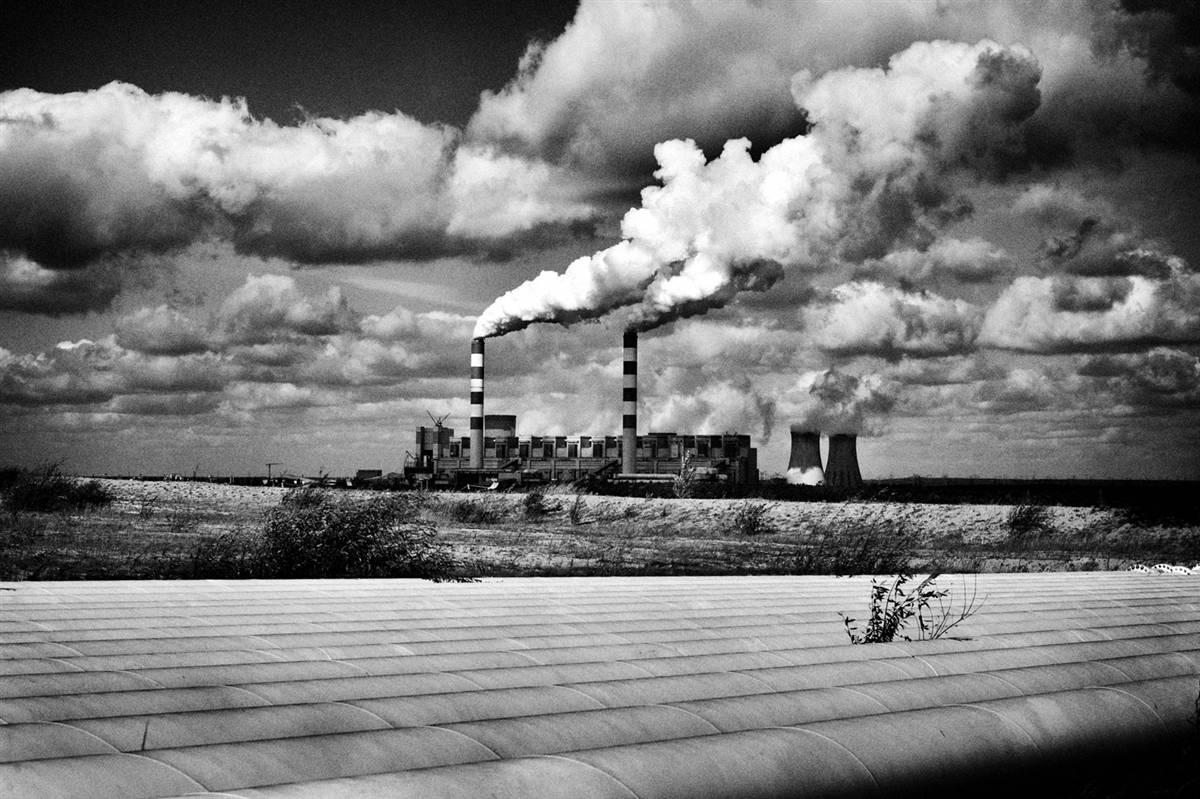 Pep Bonet, Belchatów power plant, Poland, 2009 from the Blackfields series
The Belchatów power plant is the largest in Poland, supplying almost 20 percent of the nation’s energy. Each year its chimneys belch more than 31 million tons of carbon dioxide into the atmosphere.The Australian equivalents are to be found in the high-emitting South Australian station Playford B. T and the Victorian Latrobe Valley generators Yallourn and Hazelwood. Australia hasn't closed a single one for the purpose of reducing greenhouse pollution. We're dusting off old coal-fired power stations and extending their lives instead.
December 9, 2009
photography and climate change
Consequences by Noor features the work of nine photographers from the photo agency Noor who documents the devastating effects of climate change around the globe including the rising sea level in the Maldives, coal mining in Poland and oil sand extraction in Canada.
The goal of the exhibition, which is being shown at Copenhagen where world leaders are crafting a new climate change deal, is to document some of the causes and consequences, from deforestation to changing sea levels, as well as the people whose lives and jobs are part of the carbon culture.
 Francesco Zizola, Malé, Maldives,
Scientists say that The Maldives, the lowest-lying nation on Earth, is at risk of disappearing from the world map.Malé sits on an island just three feet above sea level. To counter the tides and storms, a $60 million 11 feet high concrete barrier system, financed by Japan, now rings Malé.
Australians are on the also front lines in experiencing the life-altering consequences of climate change. Despite this, as the Washington Post story says:
Most farmers, the biggest losers as the river shrinks, simply do not buy the notion that southern Australia's climate is changing in a way that is probably irreversible. Their skepticism has withstood nearly 13 years of unrelenting drought, falling incomes and daily encounters with a river that is dying in front of their eyes.
Its just a long drought for them, and the cycle will return. As climate change makes drought an unexceptional circumstance as soutyhern Australia becomes hotter and drier, so the farmers will be weaned off drought assistance.
December 7, 2009
Situationists + the problem of the city
Henri Lefebvre in this interview says that the Situationist's idea of derive was more of a practice than a theory.
In the course of its history the city was once a powerful organic unity; for some time, however, that unity was becoming undone, was fragmenting, and the derive was more of a practice than a theory. It revealed the growing fragmentation of the city. In the course of its history the city was once a powerful organic unity; for some time, however, that unity was becoming undone, was fragmenting,....We had a vision of a city that was more and more fragmented without its organic unity being completely shattered.
Lefebvre adds that:
Afterward, of course, the peripheries and the suburbs highlighted the problem. But back then it wasn't yet obvious, and we thought that the practice of the derive revealed the idea of the fragmented city . .... The experiment consisted of rendering different aspects or fragments of the city simultaneous, fragments that can only be seen successively, in the same way that there exist people who have never seen certain parts of the city .... One goes along in any direction and recounts what one sees.
The Situationists abandoned derive in favour of the idea that all urbanism is an ideology when the city completely exploded with suburbs and they abandoned the problem of the city. What was the problem of the city? The right to the city cannot be conceived of as a simple visiting right or as a return to traditional cities and it can only be formulated as a transformed and renewed right to urban life.
The city has been thoroughly commodified: it is a privileged space for the consumption of commodities and it is consumed as if it were one big commodity. For urban inhabitants to start really living, they must make use of their cities. But the word "use" must be considered as broadly as possible; it must include appropriation, which inevitably involves re-creating ("inventing" or "sculpting") existing space(s), that is to say, the production of new space(s).
Lefebvre argues that the promises of modernist capitalist architecture and city planning had failed and he developed his conception of a “right to the city” for all urban dwellers.This would restructure the power relations which underlie urban space, transferring control from capital and the state over to urban inhabitants. The right to the city is an argument for democratization of urban development decisions and placing power over how space is used with “citizens.”The “right to the city” is the right to “urban life, to renewed centrality, to places of encounter and exchange, to life rhythms and time uses, enabling the full and complete usage of … moments and places.”
David Harvey says in New Left Review that:
The question of what kind of city we want cannot be divorced from that of what kind of social ties, relationship to nature, lifestyles, technologies and aesthetic values we desire. The right to the city is far more than the individual liberty to access urban resources: it is a right to change ourselves by changing the city. It is, moreover, a common rather than an individual right since this transformation inevitably depends upon the exercise of a collective power to reshape the processes of urbanization.
This implies greater democratic control over the production and utilization of the surplus. Since the urban process is a major channel of surplus use, establishing democratic management over its urban deployment constitutes the right to the city.
December 6, 2009
Encounter Bay: the old slowly disappears
When I was walking along the beach in the early morning at Encounter Bay, Victor Harbor, during the week of the heat wave, I realized that the old beach architecture of Victor Harbor was going, and that it would soon disappear into the slip stream of history.
 Gary Sauer-Thompson, two chairs, Encounter Bay, 2009
The sizeable blocks would be sold by the children of the current owners, the beach house would be bulldozed, to be replaced by several two story glass and concrete buildings that would take up the whole block. Oh, and the trees would be pulled down so those in the back block could have sea views. Modernism comes to Victor Harbor, belatedly.
The old is giving way to the new and there is a changing sense of place. This is the effect of sea change in spite of the threat of rising sea levels the early signs of beach erosion.
The changes are subtle around Encounter Bay. A house gone here, an empty lot appears where once there a beach shack; another new house going up; a new boat ramp that replaces the old jetty, the subsequent absence of the pelicans, a tree cut down; another big development proposal announced.
What we have here is the significance of the ordinary, the unremarkable and the overlooked in our understanding of how many (if not most) advertising images communicate with their ‘smiling, white middle-class families at the beach, well-groomed businessmen shaking hands,and romantic young couples kissing. This background noise of consumer culture is the highly visible and dramatic advertising images which attract most consumer and critical attention.
So we overlook the old wooden jetty at Encounter Bay--it is now a faded memory-- whilst the white beach house standing back from the road amidst the old pines of the farm that is long gone is unseen and overlooked. The pines remind us of what once was and the beach shack stands as an isolated image in the ‘visual landscape of stock photography.
December 5, 2009
a climate warming graph
As a photographer in South Australia I experience the effects of rising temperatures in terms of a hotter and drier climate and no water flowing down the Murray River.
The Hadley Center has a useful graph about climate change which I reproduce here:
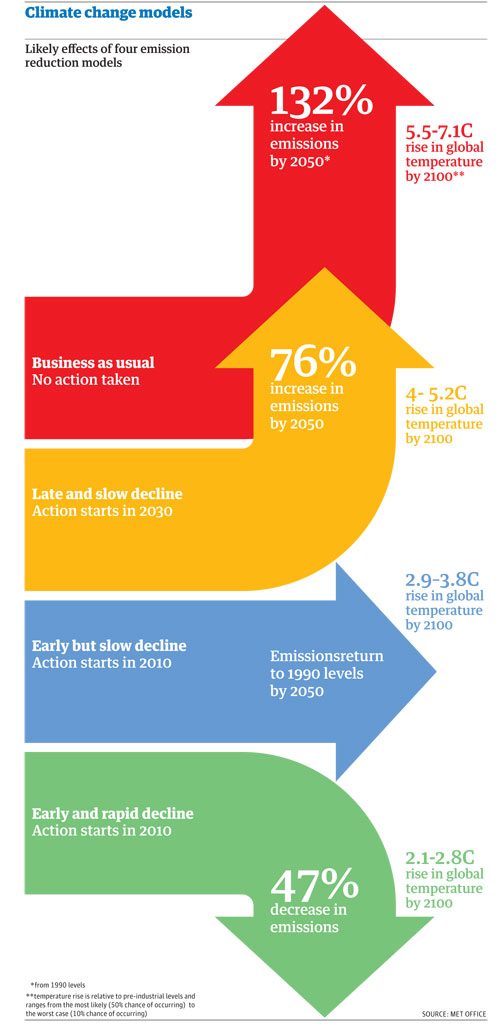
In the context of ClimateGate I would like to say that the 2007 IPCC Assessment, which is the most comprehensive and respected analysis of climate change to date, states clearly that without substantial global reductions of greenhouse gas emissions we can likely expect a world of increasing droughts, floods and species loss, of rising seas and displaced human populations.
However, even since the 2007 IPCC Assessment the evidence for dangerous, long-term and potentially irreversible climate change has strengthened. The scientific evidence which underpins calls for action at Copenhagen is very strong.
December 3, 2009
tablets are coming
This is an example of how tablets-- the "new cool toy" eg., the rumored Apple "iTablet", an expanded, souped-up version of the iPod Touch --- will enable the creation of innovative reading experiences by publishers, media companies, and advertisers:
Tablet devices will play video and music and display text; they will let you navigate by touching your fingers to the screen; and they will be connected to the Internet at all times. Here then, is your new morning newspaper, with videos next to stories and the ability to customize the panes to deliver what you want and leave out what you don't.
These powerful devices with constant Internet access will enable us to rethink media. They will be about about high quality media content, games, music, photo albums and everything with the word “fun” in it.
December 1, 2009
the aesthetic image
At this Undoing the Aesthetic Image conference mentioned in Radical Philosophy Jacques Rancière refers to two recent trends in contemporary photography--the historical tableau of Jeff Wall and the monumental portaits of Rineke Dijk.
He argues that photography is not content to occupy the place of painting Rather it:
presents itself as the rediscovered union between two statuses of the image that the modernist tradition had separated: the image as representation of an individual and as operation of art. How should we think of this new coincidence and tension between the grand pictorial form and simple images of indifferent individuals?
From what I understand, Rancière's aesthetics holds that politics is the struggle of an unrecognized party for equal recognition in the established order. Aesthetics is bound up in this battle because the battle takes place over the image of society -- what it is permissible to say or to show.
On the other hand, we have a politics of aesthetics, which, in the modernist regime, establishes the autonomy of art, the identity of its forms with the forms that life uses to shape itself and liberates art from being shackled to any particular noble content that distinguishes it from everyday life. This artistic egalitarianism is analogous to the breaking down of real social and political hierarchies.