|
December 21, 2009
Sarah Jones had one of her images included in the seminal "Another Girl, Another Planet," curated by Gregory Crewdson and Jeanne Greenberg Rohatyn, at what was then called the Lawrence Rubin Greenberg Van Doren Fine Art in New York City in 1999. I referred to that exhibition in the post on Annika von Hausswolff's photograph that was provided the context for the exhibition.
This image was part of a series of teenage girls with whom Jones has been working for some time, photographing them in and around their comfortable middle-class homes. The girls inhabit an in-between space that bridges childhood and maturity. In pointing to a haunting narrative beyond the frame--a childhood "uncanny" -- Jones denies her work the genre-portrait status to which it might otherwise be consigned.
Jone's previous series was Consulting Room, 1995, which explored the various codes, signals and conventions associated with the sense of ritual and place. The couch series is ongoing and it now represents couches in the analyst rooms:
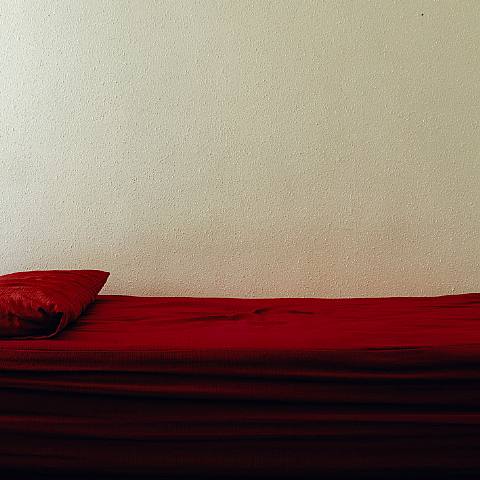 Sarah Jones, Analyst (Couch) (I) circa 1995, Lambda print mounted on aluminium
What is explored is the ‘analytic frame’ that marks off the different kind of reality that is within it from that which is outside it; but a temporal spatial frame also marks off the special kind of reality of a psychoanalytic session. There are many elements of the analytic frame. It is a room — a physical setting. It is a set of conventions about how one behaves. It is a state of mind — a mental space. It is a facilitating environment and a container.
In this interview in Frieze Magazine Jones says that the head of British Institute of Psychoanalysis spoke about:
how patients in the room often imagine the presence of a third person, and he suggested that the camera could be like this third eye; an onlooker, an audience. This then unfolded a whole way of photographing the couches, which developed into photographing the girls and the roses and the trees, and my relationship to photography.
In psychoanalysis it is the existence of the analytic frame that makes possible the full development of that creative illusion that analysts call the transference.
|


