March 30, 2007
Mark Steyn on popular music
I've just come across this review of Martha Bayles 'Hole in Our Soul: The Loss of Beauty and Meaning in American Popular Music by Mark Steyn in New Criterion. Steyn says that Bayles’s subtitle makes her point: “The Loss of Beauty and Meaning in American Popular Music:”
Rap, metal, grunge flaunt their lack of beauty: the ghetto sucks; kids are angry; what is there to be beautiful about? To which Miss Bayles sniffs: “London in a recession produced the Sex Pistols; Kansas City in a depression produced Count Basie.” As for “meaning,” by emphasizing the social context and textual analysis at the expense of the music, rock has diminished its capacity for any meaning whatsoever. To Miss Bayles, “the hardy affirmative spirit of Afro-American music”—by which she means any pop, jazz, country, blues, soul, or rock ’n’ roll tune she happens to dig—has been perverted and brutalized by the influence of European intellectual poseurs.
Steyn is of the popular music is dead school. Rap, metal, and grunge--and I presume punk ---is strictly for losers. It's dead because popular music has become both less popular and less musical.
His argument is that the half-century before Bill Haley in the 1950s were the best that American popular music has ever known, years which saw the rise of jazz, country, and blues, an indigenous musical theater, good commercial film music, and pop songs, a few of which could reasonably claim to be the only true art songs in the English language.
Steyn also has no time for rock criticism. He says that rock critics will write about anything to avoid writing about the melody, the rhythm, the harmonic structure. In many cases, it’s difficult, for the most direct example of pop as a vehicle for social protest is also the most uncomfortable reminder of how little the music matters:
No matter how idiotic the rock biz is, rock criticism will always trump it. Is anything less relevant to Elvis than the respected commentator Greil Marcus? In Mystery Train, Marcus cites a number by the punk band X as “the best song ever written about Elvis” and drools with delight over the lyric: “man in the back says Presley sucked dicks.” Miss Bayles, striving piously to concentrate on the music, sighs wearily: “Of all the distortions found in Marcus, the most glaring is his utter indifference to the fact that 1950s rock ’n’ roll was, above all, a dance craze.” For a moment, she trembles on the brink of great insight into rock ’n’ roll: those who can, dance; those who can’t, figure out some other explanation.
The music did matter in the late 1960s with Dylan's HighWay 61 Revisited, the Band's first two albums, the work of Gram Parsons, Miles Davis' Bitches Brew, The Beach Boys Pet Sounds etc etc.
March 29, 2007
Fleurieu Peninsula Snaps: summer
Autumn has come to Canberra --warmish days and cool nights. It was only a week or so ago that South Australia was still caught up in the summer heat. It was so dry and dusty along the coast when we went to Kings Beach to escape the heat.
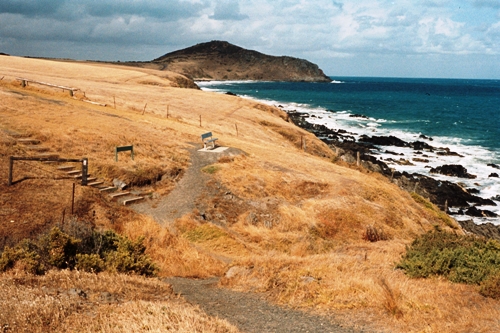
Gary Sauer-Thompson, looking to the Bluff, 2007
I returned to my own images in despair after watching Fox News for several hours courtesy of Foxtel It's effect is to make me feel suicidal: the sound and images hurl themselves at me, overwhelming me. The effect is to pound you into submission, and then to lock you into the Republican mindset and to accept the issues and their framing by Fox News.
There is one world view--the nationalist/imperialist one of the highly politicized Fox News -- and everything else is bad. What is bad is aggressively attacked, denigrated and mocked relentlessly. The nation is Republican. Immigration from Latin America is a threat to the nation's cultural integrity from the perspective of Fox's nativist sentiment. Pound pound, pound goes the anti-immigration discourse.
March 28, 2007
Adelaide Festival of Ideas 2007
I see that Adelaide is hosting another Festival of Ideas. Good on them. They are important events in the cultural life of the South Australia and the nation. Adelaide does this kind of thing very well indeed.
 I remember that the 2003 one raised the ire of Sydney cultural conservatives and the disgust of Tim Blair. It was seen by conservatives as an example of the way that Australian intellectual life is dominated by the left. It became caught up in the cultural wars and the conservatives' discourse that pits an 'ordinary Australian public' against a constructed (left-wing) 'elite'.
I seemed to have taken a low key approach to the 2005 festival here at junk for code. I was more engaged with it in terms of needing to make the shift to a digital world over at public opinion.
The list of speakers for the 2007 Festival is here. The theme is an interesting one: 'Which way to the future? It directly addresses the greenhouse gas emissions associated with our the way we live our current lives. So where is the green in the red and black festival logo?
I understand that some of Adelaide's bloggers (Kerryn Goldsworthy at Pavlov's Cat, Tim Dunlop at Blogocracy and Gary Sauer-Thompson at thoughtfactory) will be involved in 'blogging the festival.'
One possible problem the Festival faces is that dissenting voices are needed debate, not the talking together of amongst friends that mutes differences of opinion. That's the cultural conservative charge.
So how is that avoided that?
Mark Cully, Chair of the Festival’s Program Advisory Committee, has elaborated on what the festival theme, ''Which way to the future?', means. He says:
’Most people agree on the kind of future they want – growing prosperity, a sustainable environment, decent work, a feeling of security, and to bequeath a better world to their children. What we don’t agree on is the best way to get there. The speakers at FOI 07 will map out possible paths, challenge our thinking and debate the alternatives. The future should not be foreboding. It is ours to imagine, then create.’
Does that mean the issue of how Adelaide can become a more ecologically sustainable and people-friendly city will be addressed by the speakers? The big themes need to be linked to place.
From what I can make out from the speakers list Peter Cullen is carrying the flag on environmental issues along with James Lovelock. Are they going to build on the architecture symposium from previous Adelaide of Arts festivals by linking architecture and sustainability. Do not Adelaide's architects--- talk about regionalism in architecture?
Going digital is the next big step for the festival to take. My experience is that the Festival audience is very well informed and knowledgeable, and so what would be creative is to find ways to include the audience in the on-going digital public conversation and debate about the ideas introduced by the speakers. That kind of diversity would help to avoid the conservative charge about a cabal of leftists as it shifts the focus to the conversation sparked by the festival.
March 27, 2007
Velvet Underground + Grateful Dead
Late this afternoon I wandered down from Kingston to Manuka taking some photos of graffiti along the way. I went to pick up a book on order from Paperchain bookstore ---Martha Bayles Hole in our Soul: The Loss of Beauty and Meaning in American Popular Music. The text breaks with the gonzo rock journalist who thinks he is a rock star and considers rock music to be the authentic expression of revolution, and is a declinist account of modern music because it moves away from its Afro-American roots.
A classic example from 1967:
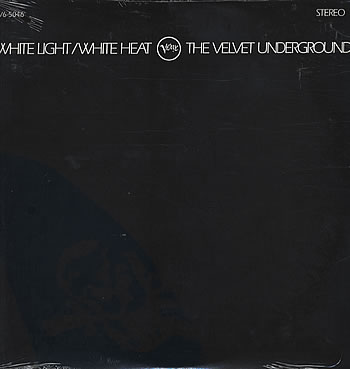 Mayles is poor on both the Grateful Dead ---crowd pleasing stoned music with little musical content ---and the Velvet Underground --Dada happening with amateurish primitive musical accompaniment.
Authenticity is black music (blues and jazz) and it is polluted by an injection of attitudes and approaches imported from the European modernist avant-garde.
The text is less a go at Adorno's ignorance of Afro-American music and more a nativism deeply at odds with artistic modernism. What we have is a cultural conservatism grappling with radical freedom and thes rejection of traditional morality in European modernism.
Bayles writes:
The central argument of Hole in Our Soul is that the anarchistic, nihilistic impulses of perverse modernism have grafted onto popular music where they have not only undermined the Afro-American tradition, but also encouraged today’s cult of obscenity, brutality, and sonic abuse.
By "perverse modernism" Bayles refers to the strain of "anti-art" that has its origins in the poet Rimbaud—who rejected his own poetry as "absurd"—as well as futurism, Marxism, and the early 20th-century dadaist who held artistic standards in contempt. These groups viewed art itself—with the exception of their own negations, of course—as "bourgeois" exercise ripe for parody and deconstruction. They're European intellectual poseurs.
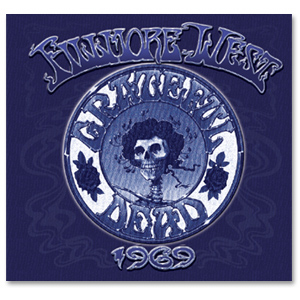 Bayles' nativist account ignores the Grateful Dead's first major flowering as a long-form experimental group.These concerts in 1969 are by rock musics greatest improvisational band at their earliest peak.
In these 1969 concerts the avant gard band developed the template for Grateful Dead concerts for decades to come: a compact set of discrete, relatively short songs, followed, after a break, by a set of longer, free-form jams built around the skeletons of a few select numbers.
The Bobby "Blue" Bland R&B classic "Turn On Your Lovelight," based around Ron "Pigpen" McKernan's vocals and stage charisma, was a two-chord song that the Dead played with an almost bebop-like level of improvisatory complexity.
This review by Mark Grieff in the London Review of Books makes more sense than Bayles, as it links the Velvet Underground and the Grateful Dead as musical groups:
Suppose one connects them, following chronologies rather than personal histories, to a part of the California scene they are held to oppose, but with which they share an uncannily similar history.I’m thinking of the Grateful Dead. In the musical-historical imagination – with its New York v. California, but especially its punk v. hippie oppositions – the Dead ought to be the exact antithesis of the Velvet Underground.
The similarities are not just the tight association between music, and drugs, happening and light shows.
The most striking fact is that, like the Grateful Dead, the Velvet Underground started out as a platform for extremely long, wandering, repetitive, live improvisations, appropriate to multimedia events. It’s eye-opening each time the Velvets’ principals insist in interviews that they were far better as a live band than in anything captured on record. Yet they all do. David Fricke, in his notes accompanying Peel Slowly and See, the Polygram reissue of their four albums with out-takes, quotes Morrison, Reed and Tucker all complaining about the failure to capture their live work, and he alludes to unrecorded work like ‘Sweet Sister Ray’, a sometimes forty-minute-long improvisational prelude to live performances of ‘Sister Ray’. The Dead cultivated a ‘taping’ culture of audiophiles who recorded each and every performance, which got people to imagine that the essence of listening to the Dead lay in ‘being there’ – and, at the far extreme, created a unique audience of people willing to listen to forty performances of ‘Dark Star’ to find the passages of improvisational transcendence in each.
The long jams in Fillimore West disc merge into epic suites; more soloing, less singing. Disc Two is dominated by the Dark Star -> St. Stephen -> The Eleven -> Death Don't Have No Mercy suite, totalling almost 43 minutes. Disc Three is one long suite anchored by "That's It For The Other One," a suite in itself, and which contains the "Drums" and "Space" (here called "Jam") sections that practically every Dead second set was to include thenceforth.
Sure both groups move away from the original bluesy roots of Afro-American music. The 'perverse modernism' of Europe actually gave rise to some very good and groundbreaking experimental music that pulsates with energy and primitivism.
historical apologies
Here's a tough image to decode as there is a lot going on and the image has an historical feel to it.
The background is this reverberation of colonial British history that lifts the veil on an enlightened civilization engaged in the slave trade for over a century. It is the 200 anniversary of the British Parliament's abolition of the slave trade. Human slavery still exists in postmodernity as its current form is human trafficking.

Martin Rowson, apologizing for the slave trade, 2007
Rowson often reworks earlier images --an example ---and I 'm presuming that this is the case again. Can anyone with an art historical background help out? Is it the cartoonist William Hogarth again?
It is possible as slaves were openly bought and sold on markets at London and Liverpool in the early 1700s, and depicted them, but the style looks different. It doesn't look like Georg Grosz:

George Grosz, The Pillars of Society, 1926
This is more collage or montage became his expressive medium and complemented by such Futurist-inspired techniques as the simultaneous portrayal of multiple phases of motion.
March 26, 2007
Black Hawk Down
I watched Ridley Scott's Black Hawk Down last night- about the first Battle of Mogadishu in the early 1990s fought under the UN charter. It represented a turning point in the Clinton Administration's use of military intervention in Third World conflicts. The film focuses on the 18 Americans killed and 73 wounded in the 18-hour battle, even though an estimated 500 to 2,000 Somalis were also killed. The ghosts of Somalia continue to haunt U.S. policy.

I was curious because I thought that Ridley Scott's visually innovative and provocative sci-fi Blade Runner was an excellent movie in the genre. Black Hawk Down links back to the Vietnam movies. It looks great, is emotionally charged, but I got bored with its account of American heroics under fire. The image that made them front page news -- the bloodied bodies of American soldiers being dragged through the streets of Mogadishu is not included in the film. This caused President Clinton to pull Americans out of the country.
The film glorified American actions in the precision mission gone wrong---a deadly ambush---but it does not critically analyze the US government's view of internationalism. Putting the incident into a global context is done by the History Channel presentation on the Deluxe Edition of the DVD. Why are the Americans intervening in a civil war? What began as a successful effort to halt bloodshed and feed starving people somehow evolved into a series of seek-and-destroy missions against the powerful warlords who ran different parts of the country.
What we are offered is a polished, photogenic vision of battle that gets across the blood and guts of it and captures the mood of the soldiers -- abject frustration, dedication to duty, dismay and fear, grief, a desire for retribution, and above all, heroism in the face of impossible odds. What is down played are the military blunders. So it is anti-war but pro-military with sound effects galore. The flow of events is fluid in terms of an unfolding of anarchy.
Watching the film I kept on thinking forward to Iraq and the Americans in Baghdad and postmodern spaces in Representations of post-modern spaces in Ridley Scott’s Black Hawk Down
Scott’s film explores in minute detail how the State’s military is undone when it attempts to use its mobile technological might to penetrate Mogadishu. It is undone because it is unprepared to deal with the spaces of Mogadishu which are neither the space of modernity, the space of nations, nor the tribal spaces the colonialists encountered in their first occupation of Africa. Scott recontextualizes the notion of post-modern war imagined in terms of the U.S.’s advanced technology and information control.
The text states that:
Postmodernity in the Mogadishu represented in Black Hawk Down has its own measure, one whose trajectory is heavily inflected both by its tribal heritage and its influences from Europe, but which is other than both. This Mogadishu is anything but “primitive,” undeveloped, or unordered as the Americans tend to think. The Somalis’ access to technology, markets, and media all tend to level out many of the disparities that once characterized their relationship with the European powers.
Even though the Americans eventually extricate themselves they have lost not just the battle but the “war” because the very measure of what’s winning and what’s losing has shifted into a new modality--one represented by Iraq.
March 25, 2007
pulp mills
They--the powers that be-- say it would create new jobs and new investment opportunities and so benefit Tasmania greatly:

pulp mill, air pollution
There is no need to worry about the air pollution in the Tamar Valley says Gunns. It's all under control says the Lennon Government. What matters is the one, giant industrial project that will secure Tasmania's future, and so put paid to an eternally recurring history of conflict over the environmental consequences of these kind of resource developments. Pulp mills are the future.
It's a cargo cult mentality isn't it, especially when we remember this aspect of Tasmania-- a natural advantage.
urban snaps: city living
The south-east corner of Adelaide city is slowly changing. The old workshops, factories and depots are slowly being replaced by apartments and middle class service industries--lawyers, accountants, economic researchers, bloggers and photographers, hairstylists etc. Even politicians and policy wonks.
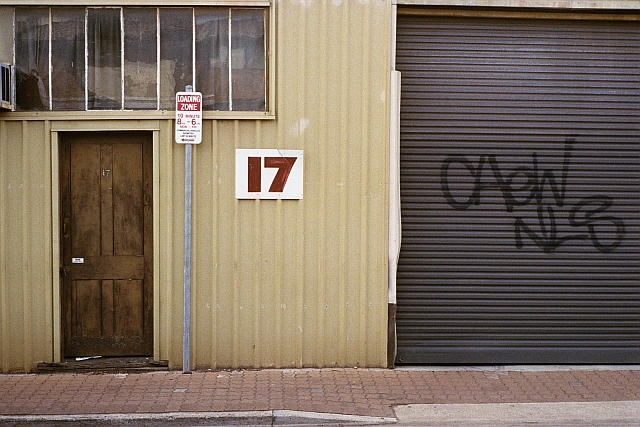
Gary Sauer-Thompson, car workshop shed, Adelaide, 2007
It's the familiar process of gentrification within Adelaide with a difference: more and more people are living in the city inside the parklands perimeter, rather than in the gentrifaction of the suburbs that start outside the parklands. What kind of city will it become as a result?
Nothing like Melbourne or Sydney that is for certain. The global city is not even a possibility for Adelaide, despite the dream time of business people and Liberal politicians. An attractive people-city then? Perhaps. The possibilities are there, but they requiring rolling back the car to make way for people to create their own public spaces. And protecting Light's parklands from the right wing Labor politicians who still dream of the glory days of F1 returning to put Adelaide on the map in a global world.
What we need is a few more innovative architects to create visually interesting buildings that express a critical regionalism (rather than globalism); a critical regionalism in the sense of creating an architectural forms that address the realities of global warming in Adelaide ---hotter weather, less water. Do we have such an architecture? Not really. that's the downside of Adelaide--it has not responded creatively to the environmental realities caused by economic growth in the 20th century.
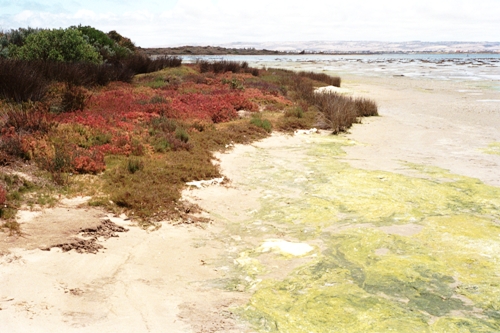
Gary Sauer-Thompson, River Murray, south of Goolwa barrages, 2006
Adelaide could lead the nation in becoming a sustainable or solar city ---but it falters and fears to cross the threshold. It dreads being too different.
March 24, 2007
Hillary '1984'
I'm making the shift to multimedia by making use of YouTube so that junk for code is not soooo 2006. The video is an innovative reworking of Apple's 1984 Superbowl commercial.
This video is a reworking by speech professor of the powerful 'Vote Different ' citizen ad----BIg Sister/1984 video----was posted on YouTube by ParkRidge 47 March 20th 2007.
Is it just another YouTube moment? Or something more?
This effective example of cultural jamming does provide one answer to the questions raised in this post about the potential of YouTube. The "Hillary '1984'", as a user-generated political video, does rupture the power of big money message controllers very effectively. The spin and political message will be much more difficult to contain now.
Does this kind of user generated content represent a watershed moment in 21st century media and political advertising?
Fiona Foley: urban Aboriginal art
I saw this excellent sculpture by Fiona Foley when I visited the postmodern National Museum of Australia:
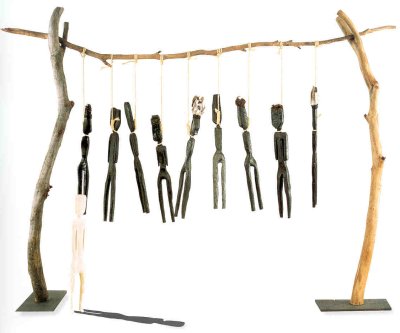
Fiona Foley, Annihilation of the Blacks, 1986
It is a response by Foley, an urban based Aboriginal artist, to her mother’s accounts of massacres of Aboriginal people in the Maryborough and Fraser Island areas during the second half of the 19th century. Specifically, it concerns the massacres on the Susan River, a tributary of the Mary River, the story of which was passed on as Badtjala oral history to Foley's mother as a child.
Foley, like other urban Aboriginal artists, has studied at European-style art schools is aware of current debates in art the workings of the art market, and the modernist discourse in the international art scene, surrounding notions of the 'primitive' and the 'other'. She was part of the movement that in the Australian art world that held art by Aboriginal artists could be part of the wider contemporary scene, and so could move away from art galleries specialising in indigenous art to more mainstream ones.
This challenges a dominant discourse in Australia that has promoted the perspective that ‘authentic’ Aboriginal culture is confined to the relatively undeveloped, under-populated, and isolated, north of the continent. Images of ‘tradition oriented’ Aboriginality have played a central role in the promotion of Australia as a distinctive tourist destination. This discourse consigns Aboriginal people to the past, but not to history’ whilst the term ‘traditional Aboriginal culture’, fixes all ‘authentic’ forms of Aboriginality within precolonial history and views all forms that diverge from this, and the people as a diminishing of traditional culture.
An alternative discourse makes Australia’s history of race relations visible in the culturall landscape, which makes the inclusion of Aboriginal perspectives in the official telling of Australian history highly contested.
March 23, 2007
Gunn's pulp mill: dioxins
Some of the issues around Gunn's proposed Tasmanian pulp mill in the Tamar Valley are discussed over at public opinion. The pulp mill is a project of State significance, yet as a private-sector development, it is a marginal operation, that will come to rely more and more on government subsidy. Already the project has benefited from direct and indirect federal and state government financial support just to get to the planning stage.


Ray Norman, Cut the Crap, 2007
A core issue is the potential effects of pollution as the pulp mill would flush high levels of dioxin into Bass Strait. Dioxins are among the most poisonous and persistent chemicals known----'they are known as persistent organic pollutants' or POPs. Gunns have repeatedly dismissed the possibility of dioxin pollution as non-existent---even less than in red wine!
However, even Gunns says that dioxins will be a part of the mill waste. Dioxins don't disappear, degrade or change; they're persistent and poisonous, they don't go away. Jon Sumby at tasmedia! says:
Dioxins don't like water and tend to stick to particles in the wastewater, so they usually fall to the seabed near the waste pipe. Then they get eaten by animals that live on the seabed, then by other fish and so on, up the food chain. There is a large body of research that shows this process. Dioxins are poisonous and persistent, they will accumulate no matter the amount of dioxin the pulp mill releases.
Seals and other sea mammals are particularly at risk because they feed almost entirely on fish from polluted oceans.

March 22, 2007
Fiona Omeenyo, Hauntology, Derrida
Fiona Omeenyo is part of the Lockhart River Gang, and her work explores family relationships – those who are alive and those who are dead. Is there a haunting by ghosts and a politics of memory in play here in these paintings?
My interpretation of some of Fiona Omeenyo recent paintings is that we have the ghostly echo (or traces) of an ancient "nomadic mode of life 'drifting' through an violent economic flows of modernity. The images can be interpreted as a hauntology that remembers the suffering of the Indigenous people though their stories that are passed down.
This isn't about the return of the past, it is about us living in a time when the past is present, and the present is saturated with the past; and the past shapes future possibilities.
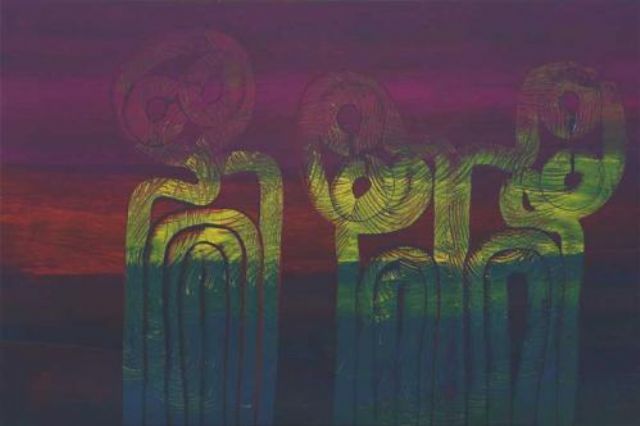
Fiona Omeenyo, My painting, 2001, synthetic polymer paint on canvas
Fiona Omeenyo says:
My works are about country and stories passed onto me by my family. i like to paint about those stories ... good to understand ... so I can tell my kids about those story places and why they are important to our family. Sometimes when I'm bored ... I do my best paintings .. the feeling inside of me ... I don't know how to explain it ... i just let that painting take a hold of my hand ... just put the paintbrush on the canvas and start painting away. And when I'm painting I feel happy ... just like someone's standing next to me watching what I'm doing ... makes me feel strong.
The image speak to a history of Australia beneath the surface, away from the standard 'end of history' narrative we've learned on our mothers knees; speaks to another, alternative history that we struggle to articulate intelligibly how this spectre is haunting Australia.
Omeenyo's 'My painting' is not spooky, but we are not made comfortable either. We sense the presence of spectres on the edges on the art institutions, and we become aware that the image offers an alternative to modernism's linear history, or postmodernism's permanent revival of past styles. This history is about the time being out of joint; there is some temporal disjunction here that we cannot quite put our finger on; we suspect that it is a space where the precondition for our being is the killing, abduction, and rape of your ancestors; or their forcible removal from their own lands? The ghosts always return. In hauntology, we engage with the ghosts, resurrect them, commit ourselves to a response to the many voices of the past.
UIpdate: 24 March
I forgot to mention that hauntology, as K-Punk points out has its roots in Jacques Derrida's Specters of Marx. This update is cross posted from philosophical conversations. The ghosts dealt with in this text pertain to, at the very least, those ghosts of Marx that haunt us (as in chapter 3, “Wears and Tears”), and those that haunted Marx (those he confronted, was obsessed with, and afraid of, as in chapter 4, “In the Name of the Revolution, the Double Barricade”).
In dealing with these different levels of ghosts and hauntings Derrida treats two fundamental questions: 1) whither Marxism?, that is, where is it going? and is it dying?, and 2) how is time out of joint and what kind of response does this call for? These questions come together in an affirmation of a certain type of “learning to live” as seen in the
exordium (xii-xx). Derrida urges the reader to learn to live together-with, together with ghosts, and together with others rather than repress history. In recognizing a debt–a debt to Marx and his specters–Derrida signals a “politics of memory” and the necessity to reckon with, and work with our past, our ghosts, and our inheritance.
March 21, 2007
YouTube as Internet TV?
YouTube is a video start up---a video hosting site. But is it more than that? It has gone from start up to about a year ago to more than 100 million videostreams a day. I mostly use it to watch music videos of musicians I want to find more about--eg., Gillian Welch, whom I came across when watching the Coen Brothers O Brother, Where Art Thou.

Bob Garfeld in YouTube vs. Boob Tube at Wired Magazine reckons so. He says:
When you put together a million humans, a million camcorders, and a million computers, what you get is YouTube....And there they are, in the bedrooms and dorms and cubicles of the world, uploading their asses off, more than 65,000 times a day on YouTube alone....Until about five minutes ago, remember, almost all video-entertainment content was produced and distributed by Hollywood. Period. That time is over. There was a time when advertisers could count on mass audiences for what Hollywood thought we should be watching on TV. That time is all but over. There was a time when broadband penetration was too slight and bandwidth costs too prohibitive for video to be watched online. That time is sooooo over. "
This implies that we are the beginning of a new medium known as internet television. Iinternet TV is not new TV, it is an evolution of TV as we knew it. Does that mean we will see internet talk-show network as a placeholder for Fox Television in Australia?
Is this the future YouTube points to? Or is it more than this?
March 20, 2007
The Story of the Weeping Camel
What a delightful, engaging and complex film about living with animals. Filmakers Byambasuren Davaa (a Mongolian whose grandparents were nomads) and Luigi Falorni weave together fiction and nonfiction elements to tell the story not just of one two-humped Bactrian cmother camel and her abandoned colt, but of the nomadic way of life and its encounters with modernity (motorbikes, television electricity) and the fragility of families.

It reaches back to Robert Flaherty's classic documentaries---such as Nanook of the North and Man of Aran ---in the way that it traverses a narrow line between dramatic staging and the observation of real life that avoids National Geographic kitsch and reruns on the Nature Channel.
Story of the Weeping Camel conveys a sense of an indigenous nomadic culture whose relationship to the earth and to nature is shaped not by conquest but by collaboration, and a caring for animals. It is the strong unity of the family—and the animals are part of the family —that saves the young white camel from certain death. The weeping camel in the Mongolia's Gobi desert refers to a ritual that is performed by the nomadic shepherds any time a camel mother rejects her new-born: through music and singing the nomads find a way into the camel mother’s heart; in the end big tears come to her eyes, as she finally accepts her little white colt.
The compelling subtext of the film is the younger generation's real and inevitable embrace of modernity and a turning away of a nomadic life. Unga, the young boy, will probaby move to town to work in a factory making clothes designed by the fashion industry in Australia.
Coorong snaps: --maleleuca
The Murray-Darling river basin is among the top 10 most endangered river systems in the world. It figures.

Gary Sauer-Thompson, Maleleuca, Coorong, 2006
There is a pressing need to address the overallocation of water through a licence buy-back by the government and to ensure that invasive species are not allowed to enter the river system. Little is being done on these issues or taking out the willows. At least the willows have not invaded the Corrong.
March 19, 2007
Adelaide Graffiti---traditional
The photo below depicts traditional throwup graffiti executed in spraycan enamel. The block letters style is very popular in Adelaide. While many people associate graffiti with tasteless vandalism, the term traditionally refers to writing on walls (eg., in Roman times ). Whilst the term is more loosely used today graffiti still generally denotes artistic writing or drawing--usually with spray paint--on walls, trains, cars or pavements.
Traditional styled graffiti forms a key thread in the street culture of Adelaide that I'm just beginning to discover that responds to the urban decay and poverty around them with a burst of creative self-expression. The graffiti artists generally avoid explicit political statements in their work, which has little connection to the leftist, generational or racial politics of the 60s.

Gary Sauer-Thompson, traditional graffiti, South Terrace Adelaide, 2007
Others have been there before me. The interesting work of some Adelaide street photographers grouped under Church on Fire shows more of Adelaide's alternative street culture that is not recognized as public art by the Adelaide City Council.Yet the former changes the grimy urban wasteland spaces into a gallery of graffiti.
This creating poetic images on walls is an innovative transformation in graffiti and introduces a division between taggers interested in quantity and muralists concerned with developing style. It is unclear whether the latter have a base of support in Adelaide's art gallery world. I presume the indifference of the art scene is the norm. How much work is motivated by an individuals' knowledge of American hip hop culture---or is very regionally based? Can the work understood to be visual expression of hip-hop youth culture.
In Australia, art historians have judged some local graffiti of sufficient creative merit to rank them firmly within visual art. Oxford University Press's art history text Australian Painting 1788-2000 concludes with a long discussion of graffiti's key place within contemporary visual culture, including the work of several Australian practitioners. Discovering Graffiti by Christopher Heathcote in Art Monthly (Australia, September 2000) is good on Melbourne and Sydney graffiti.
March 18, 2007
a mud bath
Even though the public dislikes negative political campaigning that targets the person and not the issue, this type of campaign is effective.
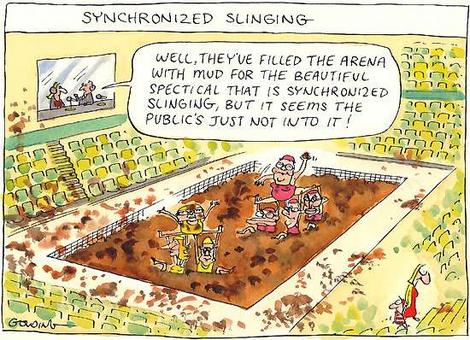
Matt Golding
Sometimes the negative campaign backfires though.
March 17, 2007
Banksy and baddogwhiskas
If public art is to some extent a commentary on present day issue, then commissioned public works, such as monuments, memorials and murals, usually do not produce work that is politically offensive, religiously or morally confronting. It is very difficult to produce art that challenges the public with these ridged constraints.
Some graffiti and stencil art expresses a need for designated spaces in the public domain for free expression.

This conveys a concise message to a broad number of people--just like an advertisement on a billboard. We need to introduce tolerance zones for this kind of public art---street art combining graffiti with a distinctive stencilling technique---on the walls of our cities.
Some of Banksy's work in Australia has been documented by baddogwhiskas, who has an extensive gallery of graffiti and public art in Australia.
March 16, 2007
state of River Murray
Inflows to the River Murray system since June 2006 have been running at record low levels - less than 60 per cent of the previous historical minimum recorded over the last 115 years. Consequently, though SA is entitled to an annual entitlement flow of 1850GL, the Murray-Darling Basin Commission has reduced this entitlement to 1470GL for 2006-07.
At the end of last month, SA only had 174GL remaining until the end of the financial year.

Gary Sauer-Thompson, River Murray, 2006
This is what the River Murray is becoming with reduced flows.
The photo was taken between the Goolwa barrages and the Murray Mouth which has no flows from either the river or the sea end.
March 15, 2007
picturing a heated-up Australia
The notes to the NASA image of Australia in November 2006 say that the high temperatures in the Great Dividing Range and elsewhere were part of an unusually warm and dry spring, which in turn, was an extension of a dry year.

The notes state that:
Some of the dryness may be linked to a weak El Niñno in the Pacific Ocean. El Niñno is a regular climate pattern during which sea surface temperatures in the eastern Pacific Ocean near the equator heat up and trade winds weaken. Though the effects of El Niñno vary, the phenomenon often changes rainfall patterns around the world. In Australia, El Niñno often brings a dry winter and spring. It is also linked to an increase in the number of extreme fire days, during which conditions are hot, dry, and windy.
Climate change is not mentioned. It overlays El Niñno as a long term trend. That means the current drought becomes more akin to the normal than the exception or the anomaly.
Australian country music + politics
Rae Wear has an article in the Brisbane Institute's online journal Brisbane Line entitled Australian Country Music’s Political Message that links into this earlier post. Wear says:
At the broadest level, country music's subject is the pain of loss. It is 'losing and hurting' music, telling stories of lost loves, lost farms, lost identities, lost lives. Its symbolic roots are rural, wherever it is recorded or performed. The values underpinning life on the land are presented as basic and real, untainted by pretension or falseness. Lyrics emphasise the lives of ordinary people and their struggles: against alcoholism, a cheating partner, fate, or their own worst selves.
Unfortunately no musicians are mentioned. Nor are the different strands in country music explored, nor the innovations in the musical tradition spelt out. The politics is developed from the content not from the sedimentated musical form.
Wear goes on to say that:
Like populism, country music presents a black and white world: good women and bad; authentic and fake, city and country. In country music, city and country people are portrayed as inhabiting fundamentally different worlds. While country boys and girls may be seduced by city partners, these romances invariably fail and the prodigals return, with relief, to their country homes. Alternatively, they remain permanent exiles, pining for country homes and family. The Australia of the imagination that they dream of is monocultural, not significantly different from the country described by the bush balladists at the turn of the last century, or the one that Pauline Hanson wanted to retrieve.
For Wear country music's impact comes from its narrative strength as this is what distinguishes it from other commercially popular styles. Its musical form is interpreted in terms of musical predictability allows listeners to focus on the words and makes copying simple for amateur musicians.
Is the musical form as conservative and hidebound as Wear assumes? Surely there has been crossover with rock music? Surely there is innovative country music or alternative country music?
March 14, 2007

colonial topographical sketches
On 13 May 1787 eleven ships, now commonly referred to as The First Fleet, set sail from Portsmouth to establish a colony in New South Wales, Australia. They reached their destination on 18 January 1788. One of the unplanned but long-lasting outcomes of this event was the large number of outstanding drawings of aboriginal people, the environment and wildlife found on arrival as well as of the early foundation of the colony.
Some of these images are held by the Natural History Musem in London, including:
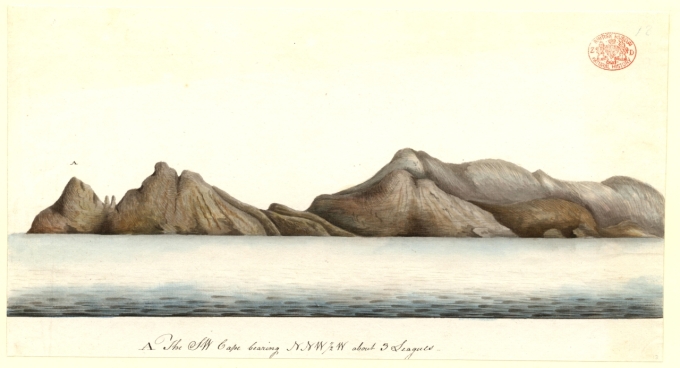
John Hunter (attrib), The SW Cape bearing NNW 1/2 W about 3 Leagues, Tasmania, 1788
Since no professional artists had been assigned to the First Fleet, it fell mainly to the naval men, trained in the art of chart-making and the drawing of coastal profiles, to construct a visual record of their journey.
March 13, 2007
democracy today
We don't have that many images of democracy, or if we do, not many are currently produced in Australia.
Spooner has it pretty spot on--therein lies the source of corruption in Australian politics:
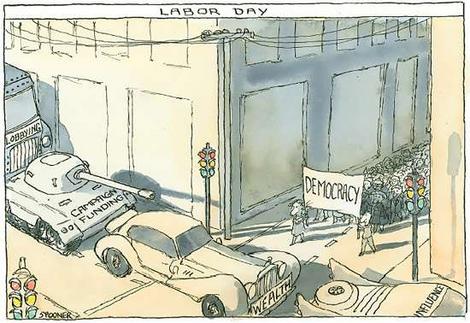
John Spooner, Labour Day, 2007
It's often called money politics, but it is really about the defence of democracy.
March 12, 2007
Lucinda Williams
Annie Leibovitz is one of America's most famous living photographers, and though she is best remembered for her 13 years of work for Rolling Stone, she has produced a great body of work
Courtesy of About Art History and the Detroit Institute of Art:

Annie Leibovitz, Lucinda Williams, from American Music, 2006
I've been listening to Lucinda Williams' 8 year old Car Wheels on a Gravel Road. I've just bought the original CD --I haven't heard William's earlier music, such as 'World Without Tears' nor the later work, such as 'West'.
'Car Wheels' was six years in the making, recorded from scratch twice, and then more guest solos and recut vocals are folded in to make the album sound less produced. It is an album about place---the Deep South---conveyed through images and numerous references to specific towns in what is commonly understood as the 'rootsy' sound of alt-country genre. Williams' lyrics mostly deal with personal love relationships that have gone sour, disappeared or gone on for too long amidst travelling through the Southern America, visiting the cotton fields, broken-down shacks and juke joints of Macon, Lake Charles, Nacogdoches, Greenville, Lafayette, Baton Rouge and Vicksburg.We are on the long, sorrowful road of America’s greatest folk singers.
There's a bitterness that bubbles just beneath the surface of Drunken Angel.
March 11, 2007
Adelaide Graffiti: going political
The style of urban graffiti that most people have seen and know about, is the kind that uses spray cans. It came from New York City in the late 1960s, and was born on the subway trains and basically indicated a writer's presence. However, graffiti became so much more than simple tagging or throw-ups. Graffiti writers, in addition to getting their name around as much as possible, would try to outdo each other in terms of style.
NYC subway graffiti became world famous, and its style and sensibilities were transplanted to other parts of the country and the world, mixing with local traditions and styles in new ways. I remember seeing the grafitti along the walls of Melbourne's suburban train lines in the late 1970s as I travelled from Sandringham to the city.
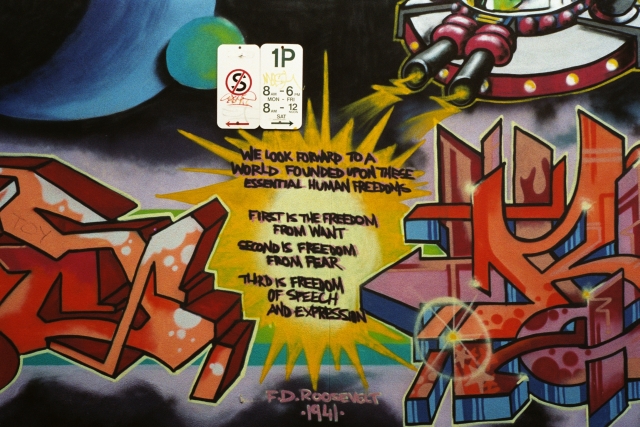
Gary Sauer-Thompson, words+images, Adelaide, 2007
The word graffiti simply means--words or drawings scratched or scribbled on a wall. Since Adelaide has no subway the street walls become the major medium of graffiti art. If the building has no architectural beauty and is a perfect place to display a mural, why not put one up? Why not make some streets into art galleries?
March 10, 2007
Anne Coulter + the conservative political unconscious
Anne Coulter, the heroine of the conservative movement, is well known for her public expressions of the bigotry and hate that circulates in the conservative political unconscious.

darkblack, Liar of the Right Worm, 2007
It's tough image. But then Coulter says that the Democrats are a bunch of fags and dykes who are both too effeminate and too masculine to properly lead the nation out loud.The Republicans see themselves as triumphant masculine heroes and strong leaders who triumph over the weak, effete, humiliated liberal Enemy.
Snaps: Fleurieu Peninsula
The camera business has become the consumer electronics business. Companies like Sony, Panasonic and Samsung, giants of this field, see the camera as being no different than other electronic devices. The shift to digital that has taken place means that few pros are shooting film any more, whilst sales of medium format cameras are in decline, and have been for several years. Bronica is gone, Contax is gone, and if industry rumours are to be believed, Mamiya isn't in the best of shape.
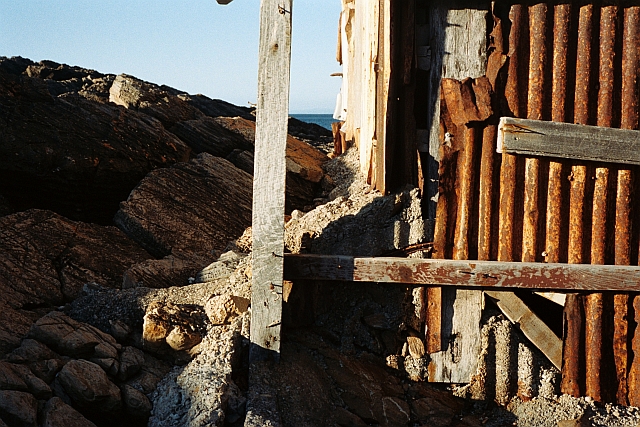
Gary Sauer-Thompson, Boatshed, Second Valley, 2006
I mentioned pros above--- that implies a distinction between amateurs and professional photographers. In the amateur category is everyone who doesn't make their living from photography, and in the professional category includes everyone that does. Simple but effective. I'm an amateur and the economics is a huge problem now that the digital photographic era is now in full swing, given the need to re-tool camera systems and acquire digital backs for medium format cameras.
For example, a decent 35mm SLR film camera cost somewhere between $500 and $1,000. You could pay less and get a plastic toy, or somewhat more and get a Canon 1V or Nikon F5. But lenses aside, about a thousand dollars ($US) was what it took to buy a good quality 35mm camera body. The shift to digital has changed in this equation. Base level DSLRs like the Nikon D100, Canon D60 and Fuji S2 are now between $US 2,000 and $2,500 --- a doubling or more over the price of comparable film-based camera bodies. High-end digital SLRs like the Nikon D1 and the Canon 1D families are priced between $5,000 and $6,000, triple the cost their film-based equivalents. This is way beyond the amateurs budget limits.
March 9, 2007
Richard Thompson: Live in Providence
I watched a DVD of The Richard Thompson Band Live in Providence last night. It was made whilst Thompson was touring in support of his The Old Kit Bag (2003).
I was interested as I have an enormous amount of respect for Thompson's work beginning from the Leige and Leif Fairport Convention days; an attempt to give back to the British people their own culture in a form that they could really dance to and appreciate. In his solo career he produces a particularly English idiom for rock, looking to English and Scottish sources and rejecting the blues-based expressions of many of his contemporaries and near-contemporaries.
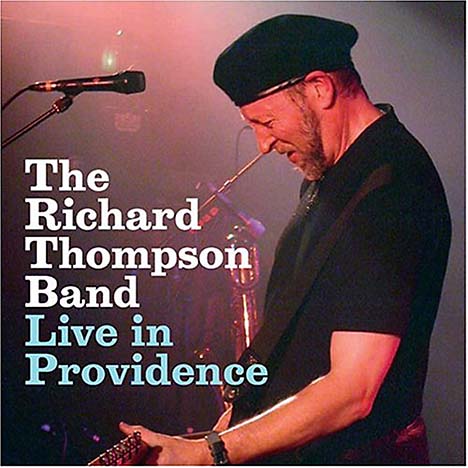
Live in Providence features old friend Pete Zorn on horns, mandolin, guitar and vocals, and relative newcomers Rory McFarlane on electric and upright bass and drummer/percussionist Earl Harvin, and was filmed at Lupo's in Providence, Rhode Island It is a 13-song, 90-minute performance in which Thompson digs back into his extensive repertoire, performing songs from albums including Shoot Out the Lights, Hand of Kindness, Daring Adventures, Amnesia , Rumour and Sigh and Mock Tudor. I only know the excellent Shoot Out the Lights which features Linda Thompson.
The DVD has some archival footage of Thompson from 1981 to 2001:“The Choice Wife” and the ballad “Just the Motion” from '81; a powerful performance of “Man in Need” from '84 with his little big band from the Old Grey Whistle Test(1984); three tunes from the Across a Crowded Room concert video (1985); and performance with his acoustic trio from an 2001 Austin City Limits broadcast.
Live in Providence presents us with boring visuals and minimal performance--it is a conventional film of a live show--- or more accurately, a straightforward performance video as part of Thompson's 2003 US tour. There is no great camera wizardry as the the emphasis is the music: we have biting and darkly intelligent expressive songwriting, innovative and singular guitar-playing, and a good band, with tasty and subtle base lines that lock in with Harvin's creative and solid rhythms to ground the band enough for Thompson and Zorn to take off. Though the instrumental sound was clear the words were difficult to hear.
March 8, 2007
Bertolucci's The Dreamers
I've seen a few of Bernardo Bertolucci’s films--- The Conformist (1970), Last Tango in Paris (1972), The Last Emperor (1987). I was impressed. I haven't seen Before the Revolution (1965), The Spider’s Stratagem (1970), and The Sheltering Sky (1990). 1900 (1976) was too truncated and Luna (1979) left me indifferent. From what I've seen it's an impressive body of work.
I watched The Dreamers (2004) on DVD the other night. It appears to be a nostalgia piece for the glory days of student activism in May 1968, and yet the film focuses on three particular protagonists, committed cinephiles who spend their days watching old films in the Cinémathèque Française; then, after it is closed down by the state, talking and arguing about films, vexing the relative merits of Keaton and Chaplin, and challenging each other to identify re-enactments of memorable scenes from their favorite movies.
It is a film about cinema as well as 1968 and reconciling individual desire with the desire of the people.
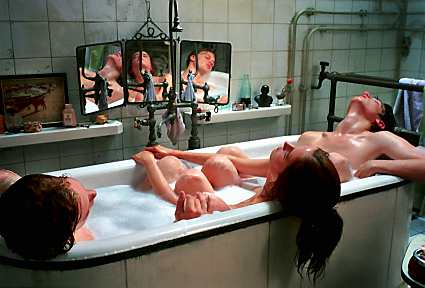
Yet the film also has a perverse and alienated air around the ménage à trois-- a sexual and fraternal frisson of personal middle class rebellion within a regressive cinephilic universe. They rarely leave the house for several weeks, and their isolated personal idyll and suicide attempt ends with a brick thrown through the apartment window during the May riots, and the twins embrace of direct action, street riots and violence.
Is the film is an old man’s exercise in nostalgia, thinking back to his youth in 1968, when idealism, sex, cinema and street protest were all that mattered? It is going back over old ground but it is not nostalgia. It is not '68 but an idea of it; or a dream of it? It is very referential in both a pop cultural (the Hendrix versus Eric Clapton discussion, Marilyn Monro in Delacroix's 'Liberty leading the People ' , The Grateful Dead's Dark Star etc) and cinematic sense.
March 7, 2007
better cities anyone?
Elizabeth Farrelly informs us in the Sydney Morning Herald that the Sydney City Council has appointed Jan Gehl, the Danish architect, to tell the city what it already knows: that there is an overwhelming preferment of car over pedestrian in the city centre, and that every pedestrian-unfriendly gesture - from traffic lights to street furniture to noise to fumes to the fact that the only civilised toilet in coo-ee is David Jones's third-floor powder room - probably hurts the city economy. She comments:
It's all stuff we know. We know that more street trees would be good. That scramble crossings at major intersections help dignify pedestrians; that people sit, talk and eat more happily away from the fume and roar of traffic; that shared zones work better than full pedestrianisation. We know that more, cleaner public transport is required and that chewing gum becomes devil's spawn when it lands on bluestone.
She says that:
We know all this partly because Gehl has been here before, and told us, just like he's told Melbourne, and Adelaide, and London and Copenhagen and New York. We know because we have strategised precisely these things ourselves, in every pedestrian strategy since George Clarke and Don Gazzard's original in 1971.
Geyl was in Adelaide in the 1990s arguing for ways to enhance public life in public spaces, and he pushed the boundaries beyond common uses of the public realm.
Nothing has been done in Adeliade to roll back the car and make the city more people friendly. The opposite has happened. The car's dominance has has been protected by a conservative Adelaide City Council, despite a policy of encouraging people to live in the city.
The car is supreme in Sydney. As it is in Melbourne and Brisbane. None of Australia's cities are learning from Copenhagen.
March 6, 2007
Greil Marcus: punk, dada, lettrists, situationists
Greil Marcus' Lipstick Traces: A Secret History of the 20th Century has a story to tell about music and culture which be summarized thus:
The question of ancestry in culture is spurious. Every new manifestation in culture rewrites the past, changes old maudits into new heroes, old heroes into those who should never have been born. New actors scavenge the past for ancestors because ancestory is legitimacy and novelty is doubt---but in all times forgotten actors emerge from the past not as ancestors but as familiars. I n the 1920s in literary America it was Hermann Melville; in the rock 'n roll 1960s it was Mississippi blues man Robert Johnson of the 1930s; in the entropic Western 1970s it was the carefully absolutist German critic Walter Benjamin of the 1920s and 1930s. In 1976 and 1977, and in the years to follow, as symbolically remade by the Sex Pistols it was, perhaps, dadists, lettrists, situationists, and various medieval heretics. (p.22-23)
It's an interesting story. I'm puzzled by the link to the lettrists and their concern to efface language. I guess punk music effaced the rock music that preceded it. Did it efface Captain Beefheart or the Velvet Underground to make a new culture out of the old chords?
Marcus goes on to say that:
Punk was not a musical genre; it was a moment in time that took shape as a language anticipating its own destruction , and thus sometime seeking it, seeking the statement of what could be said without words or chords. It was not history. It was a chance to create ephemeral events that would serve as judgments on what ever came next, events that would judge all that followed wanting--that too was the meaning of no-future. (p.82)
Words and chords? What has happened to image? Wasn't punk about the image?
March 5, 2007
graffiti-Adelaide: poetics
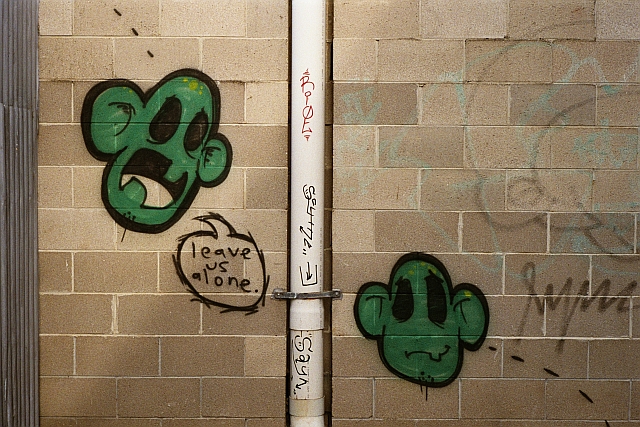
I'm looking for graffiti in Adelaide that moves beyond the lowly tagging and throwups--- for signs that go beyond graffiti writers symbolically taking possession of the space that is denied them, and can be considered to be pieces or some form of artistic expression. An example:
Gary Sauer-Thompson, faces, Adelaide, 2007
Sarah Giller in Graffiti: Inscribing Transgression on the Urban Landscape defends tagging. Her argument is that what is central to graffiti's power to establish identity in an urban space is the predominant role of one's name. This doesn't strike me as very plausible, so we need to look at her argument.
Giller says that:
Espousing self-chosen identities, urban youth use graffiti to reclaim and transform the denied space closest to them, the neighborhoods and communities which surround and shape their lives. Employed by those with few avenues for formal arts training and production open to them, graffiti is a visual means of resisting the privatization of public space. These "parasitic" art forms create "openly contested terrains." In "bombing" as many sites as possible with one's chosen identity, graffiti is art attacking architecture, the marginalized attacking the mainstream. In painting your name on a "public" space, graffiti writers symbolically take possession of that which society has made inaccessible to them. Simply stated, name plus place equal possession. In reappropriating an urban built environment engulfed by skyscrapers and privatized spaces, graffiti is a declaration of identity and an assertion [of] power. In the middle of spaces that have excluded them, graffiti empowers the marginalized to inscribe signs of their own.
Well there are signs and there is art. Giller goes on to argue that graffiti is an art of letters. Letters are symbols of written language. In reinventing the appearance of these symbols, graffiti reinvents written language itself.She says that some writers work to distort the letters as much as possible to ensure non-writers will not understand their internal code. By repeatedly inscribing distorted text on the urban landscape as a means of asserting identity and power, visual slang becomes "a new kind of visual rhetoric."
'Writers' and 'visual rhetoric ' strikes me as odd. Why not see some graffitists as artists creating a visual street language that is a part of public art of the city. I've seen lots of images in the city of Adelaide --not just reworked letters. It's graffiti as images--often poetic images-- that indicates the significance of graffiti as street art. In a city that has forgotten its commitment to contemporary public art in the 1970s, it is an artistically informed graffiti in the south and western parts of the city that is the placeholder for public art in Adelaide that has faded.
March 4, 2007
Visconti: The Damned
The recurring theme of Luchello Visconti's period films was the decadence and decline of upper class milieus in the face of historical upheaval: thus the last months of the Austrian occupation in Senso (1954), the unification of Italy in The Leopard (1963) and of Germany in Ludwig (1972), the rise of the Third Reich in The Damned (1969).
I'm a Visconti fan as I love his aesthetics (framing and colour) his political astuteness and sense of history and tradition, the way that the personal is intersected by the political, and the big canvas to convey the sense of history.
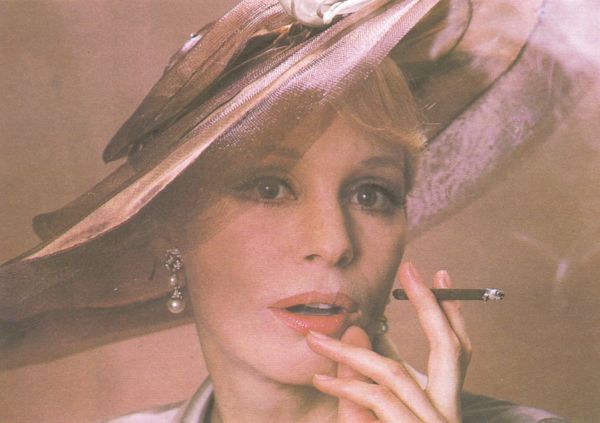
Ingrid Thulin, Visconti, The Damned, 1969
The Damned opens and closes with shots of fire, more precisely shots of the furnace in the von Essenbeck family steel mills, and has the burning of the Reichstag as a pivotal event. This forceful denunciation of the political helllfire of Nazism sweeping through the lives of a powerful industrialist's family (based on the Krupps) boldly embraces the kitsch side of Nazi popular culture. The shots of the furnace suggest a Dante-esque inferno, whilst the film is constructed from a Hammer-horror pop color palette emphasizing the intense contrast between shadow and light (good vs. evil), blues, browns and reds.
What is represented is a series of horrors, including murder, rape, child abuse and incest, as the bourgeois family falls into the clutches of neurotic grandson Helmut Berger who uses his Nazism to play out his monster size Oedipus complex. This is not a world order fading as with the landed aristocracy in Visconti's The Leopard. It is a bourgeois world exploding.
Visconti shows the massive shift in the power-base internal to the Nazi's once in power they were in power . He shows the way its populist Brown-shirt elements who often relied upon anti-capitalist rhetoric were de-decapitated as a political force within Nazism with the infamous ‘Night of the Long Knives’ (June 30th 1934) in which the Black shirted SS loyal only to Hitler massacred the Brown-shirt leadership. Hitler then became Fuhrer after the death of Hindenberg.
In 'Visconti's Cinema of Twilight' in Senses of Cinema Maximilian Le Cain highlights the camera technique. He says that:
The disorientating violence of the zooms in The Damned literally pulls the space out from around the characters, enveloping them in a panicky state of alienation from their surroundings which are changing too fast. This constant spatial disintegration reflects the insecurity of the often ruthless characters' scrabble for power in the crucible of a new and very dangerous society.
On the one hand, we have the bourgeois family struggling to maintain its influence and prosperity in the face of fascism's relentless and brutal ascent, and on the other hand, the way the Nazi's divided the family to control them. The consequence is that blackmail, double-dealing, cynical sexual manipulation and murder become the accepted currency of family members attempting to purchase power and prestige.
I'm unclear to what extent Visconti engages with fascist aesthetics --I presume it was there in the aesthetics of physical perfection in depicting the nude SA as akin to pictures in physique magazines: pinups which are both sanctimoniously asexual and pornographic; and in the transformation of sexual energy into a "spiritual" force, for the benefit of the community.
Is there an an unresolved tension in Visconti's work between his social Marxist perspective and the commitment to sheer cinematic aesthetics and the beauty of the image as a legitimate value in its own right; one that is further complicated by his growing awareness of his homosexuality and its impact on his films? I would have thought that the political and aesthetic import of the film is shown to be a direct consequence of its ability to restructure perception and to revitalize thought, even at the expense of traditional modes of cinematic enunciation.
March 3, 2007
neat
Burke's Backyard was a popular tv magazine style programme in which celebrities and politicians showed off their gardens to the public in a humble sort of way.

Brian Burke's backyard refers to this corruption sleaze and rottenness. Those who venture into Burke's backyard are entangled in the poisonous reach of disgraced former West Australian premier Brian Burke, which continues to rock both the federal Labor and Liberal parties. Entangled because they are interpreted to be seeking favour, support, preferment or patronage.
March 2, 2007
Friday dog blogging
There seems to be a convention of Friday animal blogging--mostly cat, sometimes dogs--that is developing in the bloggosphere. My contribution:
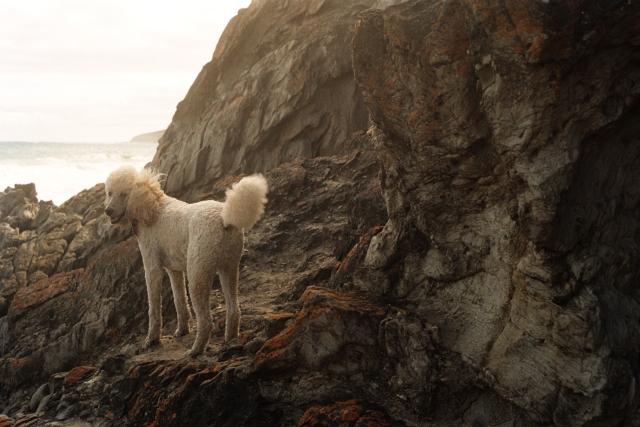
Gary Sauer-Thompson, Ari, Petrel Cove, 2006
These rocks and cliffs at Petrel Cove are close to the weekender at Victor Harbor and they form part of our playground--we wander amongst the rocks one way and walk along the cliff tops the other way. It makes for a good and interesting morning and evening walk. Often I take photos on the walks-- some of these can be seen in this album in my gallery.
March 1, 2007
Fiona Omeenyo meets the Situationists
I've been thinking about the work of the Lockhart River artists and the effect this regional form of Indigenous art has on us living in a wholly commodified, spectacular culture of a modern consumer culture with its street signs, neon lights, shopping centres, the seductive, super-intense colour of advertising and desire as pleasure.
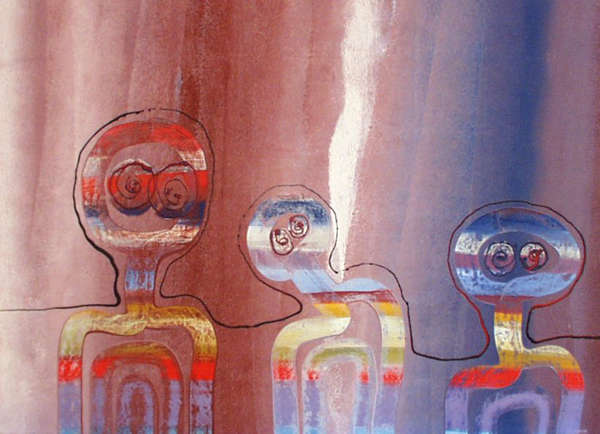
Fiona Omeenyo, Wedding Ceremony, 2001, Acrylic on canvas
I remembered this paragraph from Guy Debord's The Society of the Spectacle, which was published in the late 1960s.
When art becomes independent and paints its world in dazzling colors, a moment of life has grown old. Such a moment cannot be rejuvenated by dazzling colors, it can only be evoked in memory. The greatness of art only emerges at the dusk of life.(para 188)
Debord's remarks are a reworking of Hegel for sure, but they captures a key point--the dazzling colours of a vibrant art emerges at the dusk of the form of traditional Indigenous (hunting and gathering) life grown old.
Of course, Debord, as a good European, was not thinking of a postcolonial Australia. He was thinking of Europe in the 1930s and he had Dada and Surrealism in mind.The National Gallery of Australia incorporates Indigenous works into Dada and Surrealism on stylistic grounds, which I find rather dubious.
In a latter paragraph in the Society of the Spectacle Debord says:
Dadaism and surrealism were the two currents that marked the end of modern art. Though they were only partially conscious of it, they were contemporaries of the last great offensive of the revolutionary proletarian movement, and the defeat of that movement, which left them trapped within the very artistic sphere whose decrepitude they had denounced, was the fundamental reason for their immobilization. Dadaism and surrealism were historically linked yet also opposed to each other. This opposition involved the most important and radical contributions of the two movements, but it also revealed the internal inadequacy of their one-sided critiques. Dadaism sought to abolish art without realizing it; surrealism sought to realize art without abolishing it. The critical position since developed by the situationists has shown that the abolition and realization of art are inseparable aspects of a single transcendence of art.(para 191)
What rose was a spectacular society that buries history in culture and restructures society without community.
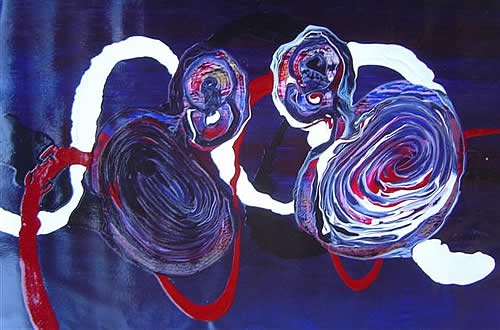
Fiona Omeenyo, Untitled, 2005, Acrylic on canvas
Can Indigenous art be interpreted as having a critical position in relation to modernist art and the spectacular society?