Thought-Factory.net Philosophical Conversations Public Opinion philosophy.com Junk for code

Mandy Martin, Puritjarra 2, 2005. For further information on MANDY MARTIN, refer here: http://www.mandy-martin.com/
If there are diverse kinds of knowledge and ways of knowing place, then we need to learn to value the different ways each of us sees a single place that is significant, but differently so, for each perspective.
RECENT ENTRIES
SEARCH
ARCHIVES
Library
Thinkers/Critics/etc
WEBLOGS
Australian Weblogs
Critical commentary
Visual blogs
CULTURE
ART
PHOTOGRAPHY
DESIGN/STREET ART
ARCHITECTURE/CITY
Film
MUSIC
Sexuality
FOOD & WiNE
Other
www.thought-factory.net
looking for something firm in a world of chaotic flux

graffiti-Adelaide: poetics « Previous | |Next »
March 05, 2007

I'm looking for graffiti in Adelaide that moves beyond the lowly tagging and throwups--- for signs that go beyond graffiti writers symbolically taking possession of the space that is denied them, and can be considered to be pieces or some form of artistic expression. An example:
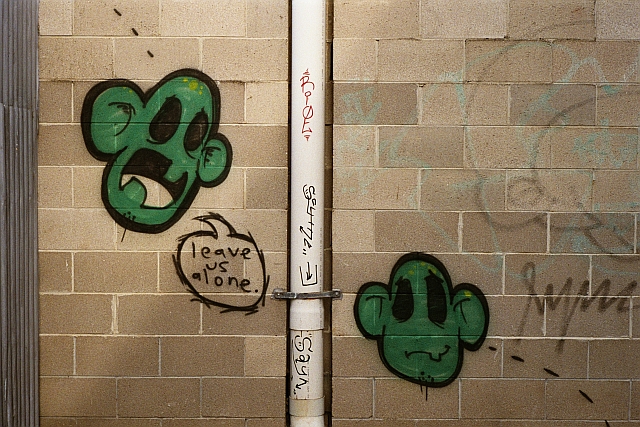
faces.jpg
Gary Sauer-Thompson, faces, Adelaide, 2007

Sarah Giller in Graffiti: Inscribing Transgression on the Urban Landscape defends tagging. Her argument is that what is central to graffiti's power to establish identity in an urban space is the predominant role of one's name. This doesn't strike me as very plausible, so we need to look at her argument.

Giller says that:

Espousing self-chosen identities, urban youth use graffiti to reclaim and transform the denied space closest to them, the neighborhoods and communities which surround and shape their lives. Employed by those with few avenues for formal arts training and production open to them, graffiti is a visual means of resisting the privatization of public space. These "parasitic" art forms create "openly contested terrains." In "bombing" as many sites as possible with one's chosen identity, graffiti is art attacking architecture, the marginalized attacking the mainstream. In painting your name on a "public" space, graffiti writers symbolically take possession of that which society has made inaccessible to them. Simply stated, name plus place equal possession. In reappropriating an urban built environment engulfed by skyscrapers and privatized spaces, graffiti is a declaration of identity and an assertion [of] power. In the middle of spaces that have excluded them, graffiti empowers the marginalized to inscribe signs of their own.

Well there are signs and there is art. Giller goes on to argue that graffiti is an art of letters. Letters are symbols of written language. In reinventing the appearance of these symbols, graffiti reinvents written language itself.She says that some writers work to distort the letters as much as possible to ensure non-writers will not understand their internal code. By repeatedly inscribing distorted text on the urban landscape as a means of asserting identity and power, visual slang becomes "a new kind of visual rhetoric."

'Writers' and 'visual rhetoric ' strikes me as odd. Why not see some graffitists as artists creating a visual street language that is a part of public art of the city. I've seen lots of images in the city of Adelaide --not just reworked letters. It's graffiti as images--often poetic images-- that indicates the significance of graffiti as street art. In a city that has forgotten its commitment to contemporary public art in the 1970s, it is an artistically informed graffiti in the south and western parts of the city that is the placeholder for public art in Adelaide that has faded.

start previous next

| Posted by Gary Sauer-Thompson at 06:06 AM | | Comments (4)
Comments

Comments

Not all bombing is worthy. Some tags are just crap no matter how benign one wans to be.

Funnily I know seem to mentally block out the bad tags and only see the art.

I and many others long for a return to the art trams of melbourne. Seems as if it was something for a street artist to aspire to. And they looked great. Now we just have inspid grey trams or ones with ads all over them.

see; http://www.angelfire.com/ca/austelec/decotram.html

Sadly most of the photos on that site don't show up.

Even more sadly (after a quick and dirty search) there doesn't appear to be a site displaying the Decorated Trams of Melbourne. I can't believe it isn't documented.

Francis,
yes I too find Giller's romantic defence of tagging with its gesture to Foucault rather strange----ie.,graffiti is art attacking architecture, the marginalized attacking the mainstream.

It's strange for two reasons:

Firstly, I agree with you. Not all graffiti is art. Some is marking walls as vandalism. Only some graffiti can be considered to be street art.

Secondly, some graffiti artists also work in the mainstream. Giller goes on to say that

Graffiti's form, stylistic goals, and violation of property prevent its commodification. Graffiti is the wall it decorates.

This is naive. The work is being documented in online galleries, in exhibitions in the art institution, and in books in Australia, the UK and the US. Graffiti is a recognized and commodified art form.

Giller seems to work with mainstream society and subculture as outsider.Yet in Adelaide it is an integral part of the vibrant university precinct in the western part of the city with the new student housing for the University of South Adelaide


Francis,
yes it is a pity that many of the graffiti works have not been documented in Australia; although that is thankfully changing.

It's also a pity that the images of Melbourne's art trams have been lost.When were they done? In the 1980s?Is there seems to be a conservative backlash to this kind of street culture? Or has it moved to Brisbane?

In the light of the above Giller says some problematic things:

In essence, graffiti is simultaneously a salvation and a curse because it is a complete transgression from our social structures. Traditionally excluded from economic and cultural resources, marginalized urban youth are able to use graffiti to access the power of the image. Continuous anti-graffiti laws and activity convey the success of graffiti to give the invisible the power to be seen. The source of this negative response to an empowering social element lies, however, in graffiti's a-hegemonic nature. Graffiti's self-referential approach to aesthetics, language, property, and commodity suggests graffiti exists outside of, rather than in response to, dominant norms. Clearly, in a society where the cultural is political, graffiti's strength lies in the fact that it transgressively declares only itself.

Graffiti is 'a complete transgression from our social structures'? Surely street kids and street culture is part of ourt social structure. There is no outside.

And 'Graffiti's self-referential approach to aesthetics, language, property, and commodity suggests graffiti exists outside of, rather than in response to, dominant norms.
The aesthetic categories of 'art' as a piece as distinct from 'non art'(tagging) and the graffitist as an artists subverting traditional language and creating a new street language shows that graffiti culture is informed by tyhe norms of the art institution.

 
Post a comment

(If you haven't left a comment here before, you may need to be approved by the site owner before your comment will appear. Until then, it won't appear on the entry. Thanks for waiting.)

Name:
Email Address:
URL:
Remember personal info?
Comments: (you may use HTML tags for style)