February 28, 2007
Snaps: Adelaide graffiti
What people often call 'subcultural graffiti'---refers to those scrawled names and brightly coloured murals, which work their way into the urban spaces without permission and without a clear agenda. This has it own subculture, complete with rules, lingo and a social hierarchy. It has a strong internal organization, involves many people, is a-political and had no social or demonstrative purpose for outside consumption.
You can see bits of this work here amidst the tag graffiti---the signature scrawls that upset so many people because it is seen as a defacing:
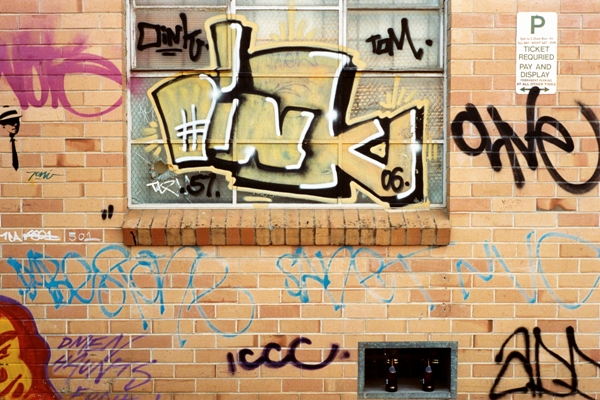
Gary Sauer-Thompson, graffiti. Adelaide, 2007
If graffiti is a sub-culture - (a complex, diverse aspect of youth culture), then tagging, throw ups, slap ups, aerosol art, murals, legal walls, youth art, stencils - is the language or jargon of graffiti!
My crude understanding of tag graffiti from living in the city of Adelaide is a negative one: a young man who is unhappy, lonely, is a serious drug user, and has little concern for his own safety or the consequences of his behaviour. I appreciate that this is deeply flawed account, as some graffitists are visual artists who have a knowledge of modern art and an understanding or urban space. So their work is often self-expressive and loaded with meaning and style.
Little of this kind of work currently exists in Adelaide, or if it does, then I have not come across in my wanderings around the inner city urban spaces. So much of the inner city of Adelaide is an urban wasteland--the walls of abandoned buildings could do with a facelift from good and innovative graffiti that gestures towards the mural of the 1980s.
February 27, 2007
Hockney's, A Bigger Grand Canyon,
I'd mentioned this David Hockney painting in an earlier post As it is seen as an iconic and groundbreaking painting by the National Gallery of Australia. I was suprised, and puzzled, to see it stuck away above some escalators, rather than given pride of place.

David Hockney, A Bigger Grand Canyon, 1998
A Bigger Grand Canyon is a series of 60 paintings of the Grand Canyon in the Arizona desert, that are combined to produce one enormous picture that gestures back to Picasso. It was bought by the National Gallery of Australia for $4.6 million. Hockney is still a working artist. It is the intensity of colour and the blocks of colour that is the immediate impact of A Bigger Grand Canyon, and its the colour which creates the structure and the shape.
The NGA evaluates the painting in terms of the limitations of photography and the ways of looking at landscape.
Hockney, suprisingly, has strong views on photography, as he thinks it is a dying medium because it has gone digital. Though he worked in photography during his photo-collages of the 1980s Hockney now says that photography is inherently inferior to painting as an art form. First the camera sees geometrically. We don't. So paintingg and drawing express the human point of view. Secondly, perspective is built into the photograph and therein lies its limits. The Grand Canyon was deemed to be unphotographable, meaning that its real subject is space and photography can't show you that.
Yet the composition of arrayed smaller canvases emphasize the optical mechanics based on photography, and this underlays the Grand Canyon mural-picture in the form of draft collage assemblies. What we have is a different kind of perspective--a reworking of the cubist one.
Hockney's painting also lets the subjective experience of places and things unfold within a visual space that makes the observer an active party. His organisation of this space involves the observer very directly in the experience of phenomena related to concepts such as tangibility and incomprehensibility, as well as to their psychological parallels: intimacy and distance.
Putting this together we can say that, in contrast to a lot of traditional depictions of the canyon from fixed or singe point of view or perspective with their illusionistic or atmospheric depth, Hockney's flattened panorama enables us to have an impression of being there, of being in the landscape, engaging with it. We are in the landscape rather than looking at through a window or frame. The subject, who has disappeared from view, appears only as viewer, becoming aware of space and time and how they are closely related.
February 26, 2007
carnage and bedlam
When I was working on the paranoia and politics post at public opinion I recalled this image by the Dutch painter Hieronymus Bosch: it is the hell panel of the The Garden of Earthly Delights
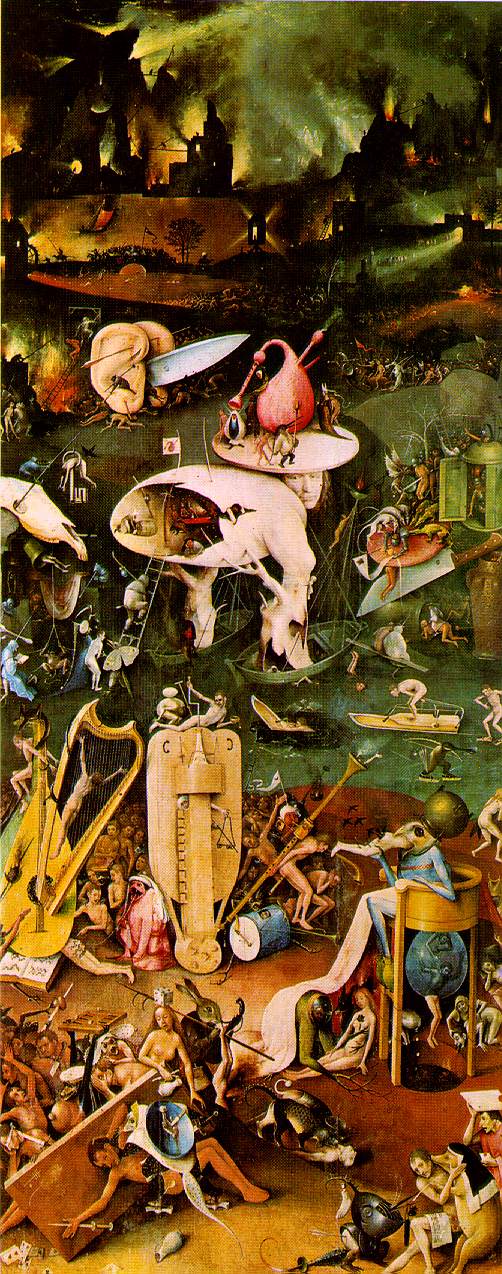
Hieronymus Bosch Hell, from The Garden of Earthly Delights, circa 1504
What we have is a nightmarish landscape of carnage and bedlam ---isn't this the experience of Iraqi's today, caught up as they in bloody civil war between the Shiites and Sunnis?
February 25, 2007
city living, advertising, graffiti
Instrumental reason sees the city as a place to make money--it's a commodified space. Big business in Adelaide continually says that the city should not become a pleasant place to live. If you want a nice place to live, then you go and live in suburbia. The city is about business--making money.

Gary Sauer-Thompson, from my balcony, 2006
Well, people increasingly live in the city and they are encouraged to do so by the City Council. And we want the city to be people friendly and to embody people values. If urban places respond to market pressures, with public dreams defined by private development projects and public pleasures restricted to private entry.
So we have a battle between commodities/billboards and our dreams as citizens on the one hand, and between surveillance/control and our desires for a city life on the other. Cash rules public discourse.
Business, South Australia says that we in Adelaide need to dump the cloak of conservatism, embrace innovation, make a stand and implement bold changes. So let us have resurgence in public transport based on an extension of the tram lines beyond the tourist run to Glenelg. Why not make Adelaide a green city? That would be an innovative bold change. Why not more public art and street culture?
So why is it that the onslaught of outdoor advertising is more acceptable to the general public than graffiti? Why is graffiti seen as a blight to society, but junk advertising, which covers wall and spaces in our city, is accepted as if its "normal"? Is it because, in the words of Jeremiah McNichols:
graffiti is a protest against everything every successful ad agency stands for: the commodification of public space, the standardization of the built environment, and the permission-based, central control of communication in the form of visual display, which dystopians and state planners the world over agree is the most powerful way to communicate with large groups of strangers who are busy doing something else - the definition of a modern city.
Graffiti is a medium of public expression for people who don't have the money or the proclivity to advertise in public spaces. This mode of expression in public contexts, which involves a contesting space for non-corporate, non-governmental significations, is seen as gang-related, sheer vandalism and defacement. The people who do it are anti-human--wild dogs on drugs.
the politics of country music
An interesting article on country music at American Prospect----When Country Went Right by J. Lester Feder. He says that though country music is now married into the conservative movement -- it wasn't born there.
Country music's roots are as much populist as reactionary. Always fiercely allied with working people, the earliest country stars were old enough to have campaigned for populist champions like Tom Watson; FDR was celebrated in songs of the Depression; and Merle Haggard and Johnny Cash were feted by liberals for speaking up for the downtrodden in the '60s. Country music only became synonymous with mainline conservatism -- indeed, only became consistently political -- in the late '60s, a shift that not only helped buoy Richard Nixon into the White House, but reshaped the media landscape. The wars of the Dixie Chicks are the legacy of these years, but so are Rush Limbaugh, Bill O'Reilly, Fox News -- the conservative noise machine itself. The idea of values-based marketing to conservatives began with country music.
Feder misses Woody Guthrie, who was aligned with leftwing populism in the 1930s and 1940s. THe was such a contrast to the the hard-working farmer, love-rich poor folk, patriotic fighting men, and devoted Christians make the music "the voice of your 'Silent Majority'" of the 1970s and 1980s.
February 24, 2007
war as showbiz
It's a bit like this isn't it:

Garland
Trouble is, few are interested in going to have a look at it in a cinema near them. The script is widely held to be a bit of an embarrassment because it's pretty second rate. Rather poorly done in fact. It's all sawdust and tinsel, you might say. Nobody really wants to be associated with it. And its been done before. Sequels are usually terrible, especially the ones that express Hollywood's tawdriness.
Update: 26 February
A review of developments by Seymour Hersh in The New Yorker
the default country
In this review of J. M. Arthur's The Default Country: A Lexical Cartography of Twentieth-Century Australia, (UNSW Press, 2003) Andrew Johnson says that Arthur's key argument is that:
the English language carries within it the image and idea of a particular kind of environment and landscape. That vision was transported to Australia with the language and acts as a screen between the colonists' eyes and the country they view. What the non-indigenous Australian sees, or rather, projects across the actual landscape when they write or speak about it in English, is the country that they all thought or hoped would be there: almost anything but the country that is.
For instance, the use of the word 'drought,' embodies sense of an abnormal ecological event, something outside the normal progress of seasons and rainfall. in Australia 'drought' has political, cultural, economic, and environmental impact. Arthur argues that the language conditions its users to expect rainfall as a right because it is "natural." The word 'drought' suggests to Australians that the country they inhabit is defective, and it encourages them to take steps to "repair" the land through extensive programs of irrigation.
What then is the default country for white settler Australia? Johnson says that:
Australian English affects the settler's attitude to the place in which they live has implications for the relation between humans, language and environment beyond Australia.for non-indigenous Australians the default country, the one against which the actual country is measured and evaluated, is England: a land of plentiful water, green fields and defined, regular seasons. Even for England and for other countries, however, the argument could be made that a different "default country" influences attitudes and responses to the environment: that country is Eden, or arcadia, paradise undivided and unmediated. That is to say, whether one lives in Australia or elsewhere, to describe a place in terms of its absences, loss, defects or failures is to view it through the lens of an imagined exemplar, and to establish a dichotomy of fallen and redeemed with distinctly Judeo-Christian overtones. Ultimately, any further discussion of "default" countries would have to take account of this theological and cultural dimension of the human experience of environment.< /blockquote>
February 23, 2007
Adelaide Graffiti, urban snaps, Adorno
I've finally got around to having some of the urban photos that I have been shooting in the last year or so with my old film camera developed by Atkins Technicolour. I've also started an urban album. My eye has been caught by the graffiti around the city of Adelaide, because these images renegotiate the social significance of our public spaces:

Gary Sauer-Thompson, Graffiti, Adelaide, 2007
I interpret this kind of graffiti as expressing a violent rejection of instrumental reason. Graffiti protests at the hegemony of instrumental reason in our social and economic world, and in the emotional protest against this form of reason we can discern the rationality of graffiti as a 'street art'. This particular image uses a simple wall in a public space (a car park), and the figure of a scary monster to express unconscious emotion.
In Aesthetic Theory Adorno says, in reference to Walter Benjamin's writings on photography, that:
Benjamin's dichotomy between auratic and mass-produced art, for simplicity's sake, neglects the dialectical relation of these two types. For another, he becomes the victim of a perspective on art that hypostatizes photography as a model, which is just as atrocious as the view, say, of the artist as creator" Benjamin's conception as a whole tends towards a kind of copy realism which cannot account for the moment of critical opposition in art--opposition to cult, the ideological surface phenomena of life. (AT, pp. 82-83)
Adorno notes that in his early essay, 'A Short History of Photography' Benjamin was more dialectical as he held that early photography did have something of an aura. This was subsequently lost owing to commercial exploitation by Eugene Atget.
Is this the only way to look at photography? Surely we could say that, even though photography, is one the most mimetic of arts, photography is a way of interposing an image between ourselves and the thing or object, and that it has the effect of extracting the thing (graffiti) from the perspective of the world. We are now looking at an image not a mirror of a thing. And the image suggests that we see the marks on the wall not as vandalism that needs to be wiped off, but as a street art whose shout of outrage should be preserved in some way as a valuable expression of street culture.
critical perspectives on Indigenous works
An interesting paper by Marcia Langton on The Politics of Representation in Aboriginal Art and Film in Rouge magazine. She says that:
Critics find it difficult to discuss Aboriginal works because of an almost complete absence of critical theory, knowledge and sensibility towards Aboriginal film and video production. There are some important exceptions, mostly in specialist literature. It is not widely read...there is no sizeable body of literature that provides an informed anti-colonial critique of the films and videos about Aboriginal people.
What we have is a dense history of racist, distorted and often offensive representation of Aboriginal people. Langton goes on to say that:
I contend that the central problem is not one of racial discrimination, although I do not deny that it might be a factor in specific or general encounters. Rather, the central problem is the need to develop a body of knowledge and critical perspective to do with aesthetics and politics, whether written by Aboriginal or non-Aboriginal people, on representations of Aboriginal people and concerns in art, film, television or other media.
The text is from Michele Grossman (ed.), Blacklines: Contemporary Critical Writing by Indigenous Australians
February 22, 2007
From Hogarth to Rowson
This image portrays a society ruined by drink and in it Hogarth ridicules the English. Hogarth is widely acknowledged as the master of that tradition of English satire that holds up a distorting mirror wherein those depicted see themselves more clearly. What is depicted is the abuse of spirits by the working classes and the poor.
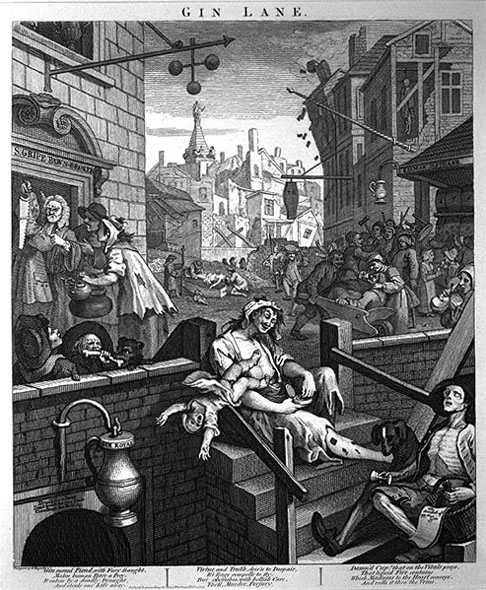
William Hogarth, Gin Lane, 1750
The print was produced as part of a campaign to restrict the sale of gin (and bad taste in art), the effects of which are graphically depicted here: buildings are allowed to go derelict, children die from neglect, the honest businessman hangs himself for lack of trade, the pawnbroker prospers, the gin manufacturer thrives, the coffin maker does excellent business and the general population create mayhem.
The satirical tradition continues:
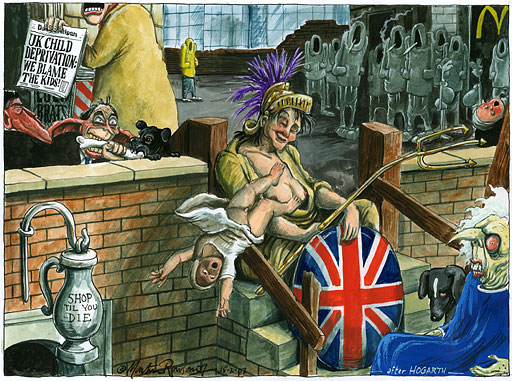
Martin Rowson, child wellbeing, 2007
More here
February 21, 2007
public transport
Melbourne's public transport planning is supposed to be following a well-researched strategy based on sound economic principles. This damming account by Tony Cutcliffe in The Age about public transport in Victoria shows otherwise:
Victoria's chaotic public transport is symptomatic of poor planning, insufficient investment and short-term management. Train tracks and signals groan with neglect, rolling stock is short on back-up and capacity, and efficiencies are lost to network technology as old as the golf-ball typewriter. A motley tram fleet moves at the average speed of a bicycle, bursting at the seams. Buses are overcrowded or empty and AWOL on weekends.
This type of dysfunctionality exists even though the Brack's Government has had seven years and a war chest of money to fix the mess.
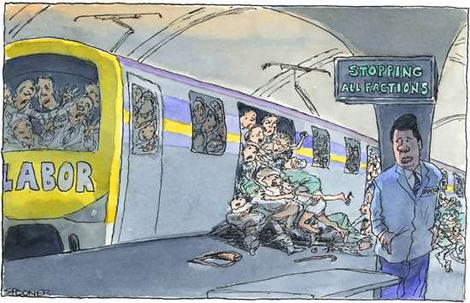
Spooner
John Legge in The Age says that:
On economic grounds it is trams first, trains second, and buses nowhere. On environmental grounds it is again trams first, trains second, and buses behind either. On popularity grounds trains slightly shade trams, while once again buses trail far in the rear. What has our economically rational, environmentally aware Government chosen to do?
Legge goes on to say that:
In spite of the huge success of the Box Hill and South Vermont extensions, the tramway network is to go 15 years without any further "significant" extensions. The rail system is to be the subject of some minor bottleneck reduction and some feasibility studies. Meanwhile, hundreds of millions of dollars is to be spent on running more unpopular, polluting and very expensive buses.
Legge says that if the Government is serious about its greenhouse targets and serious about increasing public transport patronage, it should start progressively replacing buses with trams and using trams and light rail connections to link Melbourne's developing suburbs to the train network and their local shops and schools. At the same time, it should start filling in the gaps in the tram network, especially where a minor extension can create a train/tram interchange, as at Box Hill.
February 20, 2007
February 19, 2007
Samantha Hobson: exploring colour
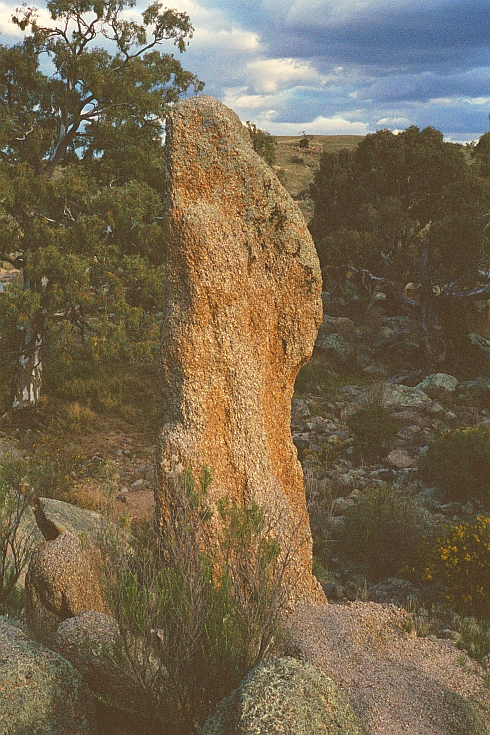
Below is another artist from the Lockhart River, Cape York, and member of the Lockhart River Art Gang. These works highlight the development of Aboriginal art from the adaptation of traditional symbolic to a modern aesthetic that explores colour as part of an indigenous visual language. Presumably, there are regional variations in colour and a historical sense of progression from traditional application of palette to the exploration of colour, and a moving beyond being essentially religious art.
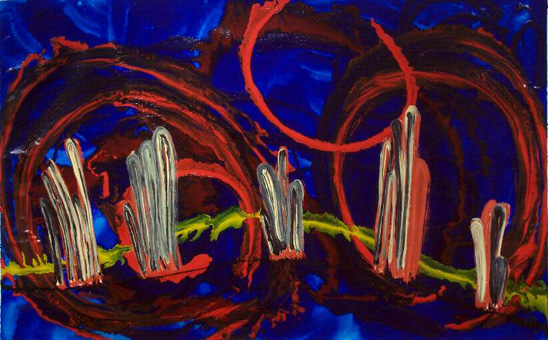
Samantha Hobson, Friday Night, 2006, synthetic polymer paint on canvas
Friday night, specially at the canteen and parties is where man and woman fight.It could refer to the drunken brawling in the small community of about 800 people. The image is splashed with scarlet smears of what could be fresh blood, the crimson of clotted blood and tangles of black, like torn-out hair. It is not mystical or religious: it is you about how some Aboriginal people live today.
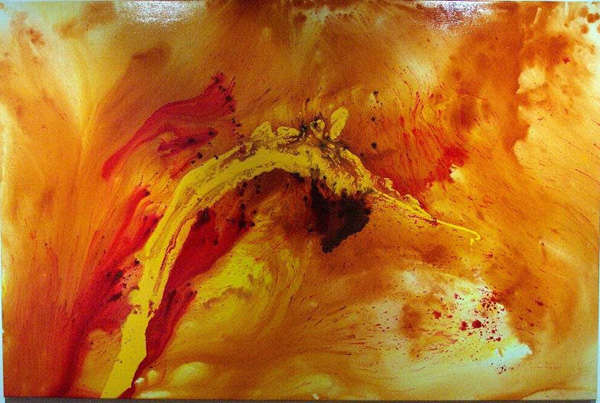
Samantha Hobson, Burning Grass Season - Hot, 2001
Contemporary aboriginal art is becoming the international face of Australian art; a radical change to being a footnote to modernist European Art.
February 18, 2007
William Christenberry: disappearing places
Since the early 1960s, William Christenberry has been photographing the regional identity of the American South, focusing his attention on Hale County, Alabama, from which he hails. His theme is singular: the history, the very story of place, is at the heart of his art project. Place is often explored in terms of time.

William Christenberry, Havana Methodist Church, Havana, Alabama, 1976, Digital pigment print.
The art institution interprets the work in terms of being a poetic documentation of Southern vernacular architecture, signage, and landscape captures moments of quiet beauty in a sometimes rustic terrain that, with its worn iconography and buildings turned ramshackle, evokes the power of the passage of time.
Every year he treks south to the place of his youth, Hale County in rural Alabama. It is the place where he snaps photos and his body of work has spanned decades:

William Christenberry, red brick building in Talladega National Forest in Hale County, Alabama, 1983.
How much of this kind of work about place is being done in regional Australia? Work that explores rural landscapes, its vernacular architecture, and the worn, remote margins of small-town life?

William Christenberry, Wall of Building with 5 Cents--Demopolis, Alabama,1980/printed 1981, type C print on paper
What we need in Australia is a prolonged study of a place, that reconstructs a region’s heritage and shows the stasis and change. These places are disappearing.
living with the heat: snaps
It's hellishly hot in Adelaide--over 40 degrees with a hot north wind blowing. It's bush fire weather. We fled Adelaide and went down to the southeren coast of the Fleurieu Peninsula's on Friday night ---to Victor Harbor and the beach. But it is hot here this Sunday morning. The hot wind dropped late Saturday afternoon, and wee went for a swim.
I longed for a digital camera to take images of everybody cooling off in the sea as the seals dived and swarm around us. It was a lovely moment. I could have then come back to the weekender and posted the images immediately on junk for code. Without that technology I have to make do with an earlier atmospheric image without people from a print camera:

Gary Sauer-Thompson, West Is, Fleurieu Peninsula, 2005
The hot wind returned early this morning. Everything is hot. It is hard to concentrate. We are just sitting it out as best as we can, waiting for the wind to change. There will be no rain, despite the talk on the radio about rain. We long for the cool nights of autumn--and some rain.
I remembered this time last year when we were in Tasmania. It was still hot, the flies were everywhere but the forest was cool.

Gary Sauer-Thompson, trunk leaves light, Franklin-Gordon National Park, 2006
The Franklin River was flowing then and it looked wonderful. So pristine. Tasmania has so much water compared to South Australia. We have to start learning to live in the heat without much water.
Australian Photography: Carl Warner
A photo from the Fortitude: New Art from Queensland exhibition of the Queensland Art Gallery in 2000 mentioned in yesterdays post. It shows the established presence of photography in the mainstream of contemporary art. I'd more or less taken this for granted and so I was rather suprised to find so little photography on display at the National Gallery of Australia.

Carl Warner, Brown, 2000, Type C photograph
Warner often photographs industrial landscapes, although the latter work combines this approach to surfaces with images of nature. In many ways they don't read as photography at all. Warner's work is formal and painterly in its preoccupation with urban and natural surfaces.
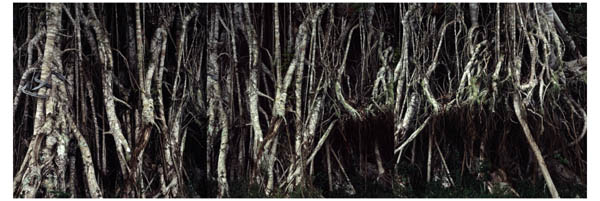
Carl Warner, banyon, from 'nature is' series, 2004, type c photograph
He has produced a substantial body of work over the last decade that works the surfaces of objects, framing a visual language out of the overlooked visual fragments, abstracting the details of industrial environments and transforming what is commonplace space into the formal artistic space of the art institution.
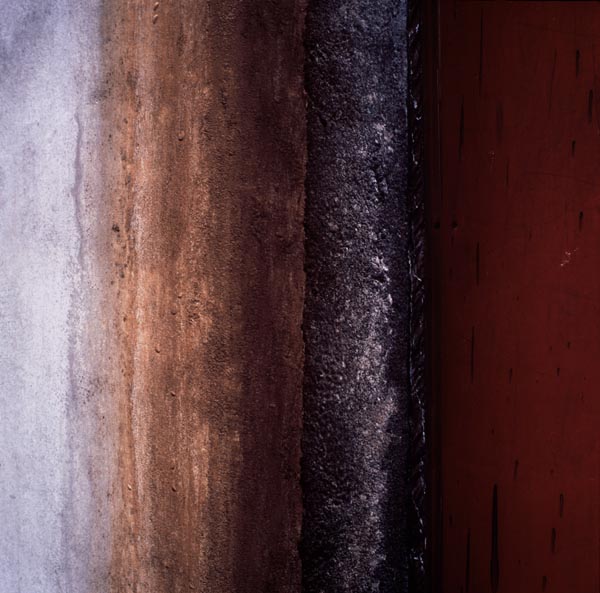
Carl Warner, The Surface 72, 2004, from the series The Surface, Lambda print
Though the photographs of the surface of things are done in straightforward way the aim is not documentary one , since the formal approach to the sign implies that photography has been liberated from its traditional referent to the real object. The reference is to both visual pleasure of the spectator and the aesthetic of minimalist painting.
February 17, 2007
Rosella Namok: breaking new ground?
The three paintings below are from the online archive of the Queensland Art Gallery in Brisbane. I 've turned to the QAG after my visit to the National Gallery in Canberra and saw the paucity of their Indigenous art collection. It was a primitive footnote to the universal (European) avant garde art of the first half of the 20th century. The avant garde works all looked so conservative---it was like stepping back into a modernist time warp: that was how things were way back then.
'Primitivism' is a disgrace in terms of a collection policy. The NGA is still besotted by works, such as David Hockney's A Bigger Grand Canyon, and they are blind to the brilliant and innovative work being done by Indigenous artists in Australia over the last two decades to renew their visual language. It would appear that the NGA is still fighting the Blue Pole high modernist battles of the 1970s, instead of developing a tradition of Indigenous art from the colonial period to show the different strands of Indigneous art, how the artists rework their old visual language to express contemporary concerns, and how they break away from indigenous art being traditionally classified as magico-religious. Shouldn't that be one of the responsibilities of the NGA?
The exhibition at the Queensland Art Gallery is entitled Fortitude: New Art from Queensland 2000 It includes some work by an Indigenous artist Rosella Namok, from Lockhart River in Cape York.

Rosella Namok, Big house, 1999-2000, Acrylic on canvas
Lockhart River is a small community near the sea on the eastern side on the peninsula, and the work produced is often directly related to the isolated community's iconographic traditions and concerns. Namok has the ability to take the traditional visual language of Indigenous art and reshape the old signs to create some contemporary artworks.
Though Rosella Namok often paints with her fingers — a technique that relates to the tradition of sand drawing and body painting---she is not categorized as a primitive artist vis-a-vis the (international) avant garde; nor is she seen as just producing kitschy tourist art. The art institution holds Rosella Namok to be one of the most widely-acclaimed and best known of an emerging group of young Aboriginal artists in Cape York; a group commonly referred to as the Lockhart River Art Gang.
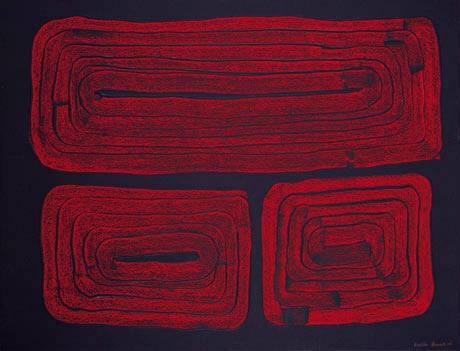
Rosella Namok, Para Way, 2000, Synthetic polymer paint on canvas
To non-Aborigines, much contemporary Aboriginal art is read as abstraction. Even given the story, we never get it, because the magicoreligious bit eludes us. We could begin by accepting the fuzzy spaces of the art institution's old art history styles in a post-colonial society, the diversity of contemporary Indigenous art practice, and look at the way Indigenous artists are breaking new ground whilst working in their traditions.

Rosella Namok, Kaapay and Kuyan today, 1999, Synthetic polymer paint on canvas
The painting depicts the two halves, or moieties, into which Ungkum society is traditionally divided and which one you are . . . ‘kaapay’ or ‘kuyan’ .... depends on your father.
This approach by the QAG in the Fortitude and survey exhibitions is refreshing as it enable us to look at the works of Indigenous artists as contemporary art, rather than being obliged to put Indigenous works into the spiritual/religious/Dreamtime category--- interpreted as non-western magico-religious---because we don't get it. Why not accept that young Indigenous artists such as Rosella Namok are producing contemporary art, just like non-Indigenous artists. That is what the QAG is inviting us to do. in doing so it breaks new ground when compared to the NGA.
the personal and the political
This denuded landscape in Tunbridge, in the Tasmanian Midlands looks like parts of South Australia in summer time. The paddocks are no longer lush and green and the hills are bare of trees. The landscape is all grazed completely out by sheep. Agriculture rules.
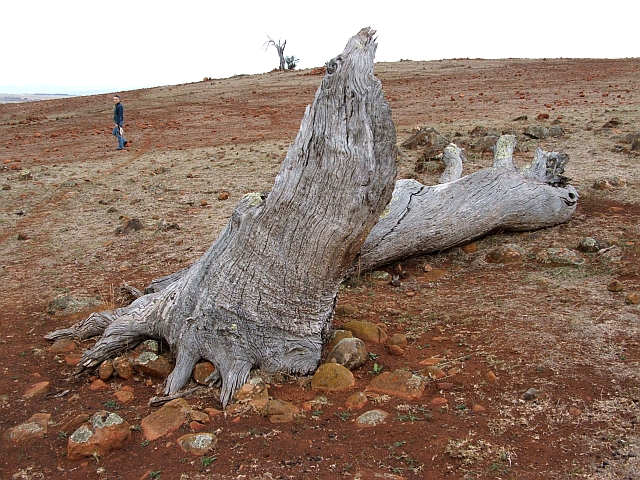
Barbara Health and Malcolm Enright, Suzanne, Tunbridge, 2006
The future is not bright for the Midlands. CSIRO has stated that the drought that is being experienced in Tasmania at the moment is very much shaped by global warming.The impact will vary across Tasmania significantly with agricultural areas to be hit the hardest. With declined rainfall and increased temperatures, some of the native forests in Tasmania will be badly affected. The ecology of Tasmania is changing.
But the damage has already been done to the native grasslands in the salt afflicted Midlands landscape by agricultural practices. Much of Tasmania's native grasslands have been replaced by the bright green of introduced pasture which turns yellow in the drier weather. They began to lose their vigour as hard-hoofed, close-cropping stock were introduced to these areas. Farmers began replacing native grasslands with introduced grasses, but this required improving the soil by ploughing and adding fertilisers. Continuous ploughing removed the long-lived native grasses allowing the introduced species to invade and out-compete them.
This is tragic since native grasslands support a huge variety of native Australian plants and animals. The Tunbridge buttercup is a tiny plant is listed as a threatened species and is restricted to four properties. A large variety of orchids occur in native grasslands.
February 16, 2007
Klein on Bowie
Steven Klein has done something that is rare in the fashion magazine world. He has transformed fashion magazines into his own private gallery spaces. When his collaborative, narrative series appear in publications like American Vogue, L’Uomo Vogue, W, and Arena Hommes+, they are often perceived as ‘signal events’ in the art and fashion world.
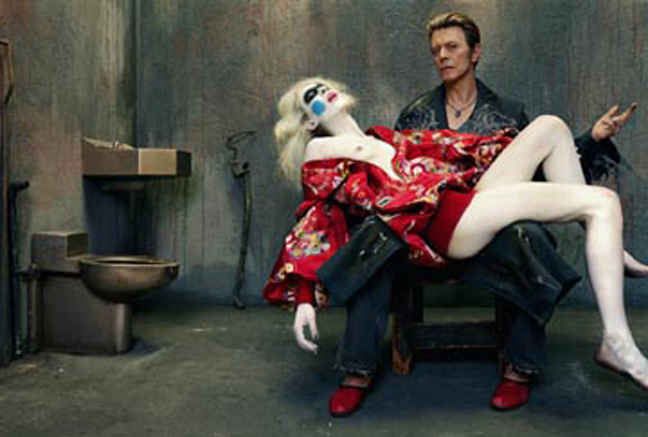
Steven Klein, Bowie 02, L 'Uomo Vogue, 2003, Color C-Print mounted to aluminum.
Fashion has become the highly visible and commercially effective site for picture-making that is every bit as challenging as that being pursued by so many photographers who define themselves as independent artists.
on the road
On their way back from Tunbridge, Tasmania, to Brisbane on the Newell Highway, Barb and Mal stopped off in Goondiwindi. This is a junction of the Cunningham, Newell, Bruxner, Barwon and Leichhardt Highways on the border between New South Wales and Queensland. It is a rambling Queensland Darling Downs settlement that spreads for kilometres around the old Customs House on the banks of the Macintyre River.
This signpost at the old Customs House caught their eye:
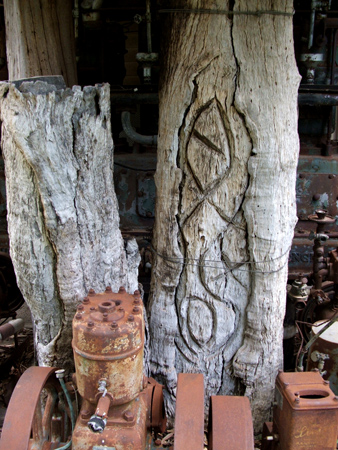
Mal Enright & Barbara Heath, Aboriginal Signing Post, Goondiwindi Customs House, 2007
The old Customs House, which is located on the town side of the main bridge across the Macintyre, has been converted into the Goondiwindi Museum. It is a typical rural folk museum by all accounts.
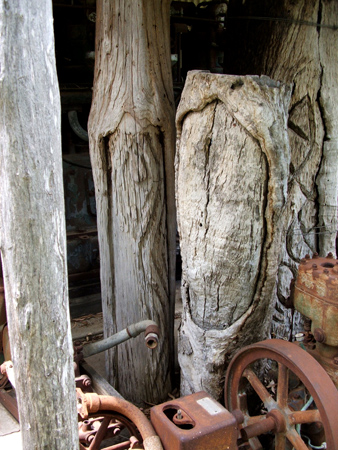
Mal Enright & Barbara Heath, Aboriginal Signing Post, Goondiwindi Customs House, 2007
I'm not sure what a signing post is.
February 15, 2007
Steven Klein & Madonna
Stevin Klein's recent Madonna series---a 50-page portfolio of images in W magazine, that transgress the imitations of the fashion magazine world preoccupation with beauty and glamour. What is offered is a fine-art take on fashion and celebrity and pop culture that re exposes celebrities who have built their careers, in large part, through exhibitionism:
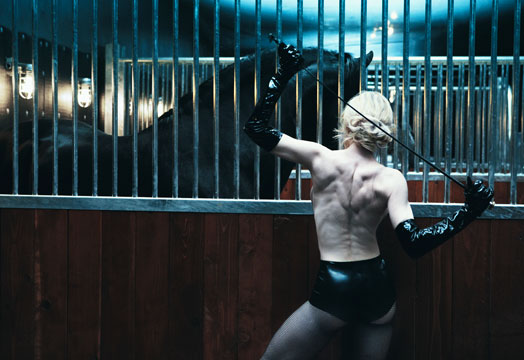
Steven Klein, Madonna, 2006
In this article on Klein it is stated that Klein's photographs become part of the dialogue of who that person is or how they can express themselves.
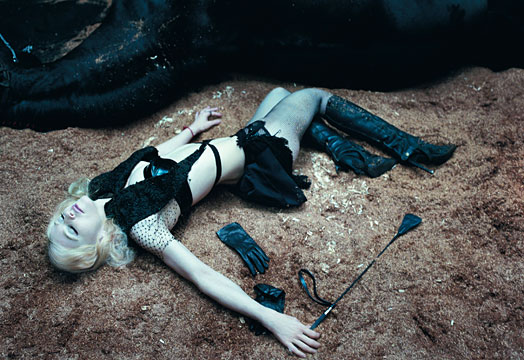
Steven Klein, Madonna, 2006
The narrative sensibility of Klein's still photography suggests a filmic approach that examines the dark side of things: what we have is a straitjacket that emancipates—the S&M subtext commenting on the celebrity’s bondage to image.
February 14, 2007
Art + fashion
Art is art, and fashion is fashion. "But fashion, like art is a visual language with the kind of history and identity that art has. Art and fashion are currently coming together is Susan Bright's argument of this exhibition at the National Portait Gallery. Bright is the author of Art Photography Now

Corinne Day, Kate Moss, 1993, 'Under Exposure', British Vogue, C-Type Print
Day's work is seen as a reaction to the traditional and glamorous image which dominated fashion photography during the late 1980's

Corinne Day, Georgina, Brixton, 1995
Transgression is the theme. What is transgressed is the conventional wisdom is that fashion is the enemy of art. The exhibition does this in terms of the work of Mert Alas & Marcus Piggott, Corinne Day, Steven Klein, Paolo Roversi and Mario Sorrenti. If the exhibition charts how contemporary fashion portraiture has shaped many of today's notions of beauty, sexuality and fame, then it also down the walls between art and fashion photography. Some would say that the boundaries have become so blurry that they’re practically meaningless.
February 13, 2007
Jacques Villeglé: torn posters
The image below is from a section of posters and advertisements stripped from the rue de Tolbiac in Paris.
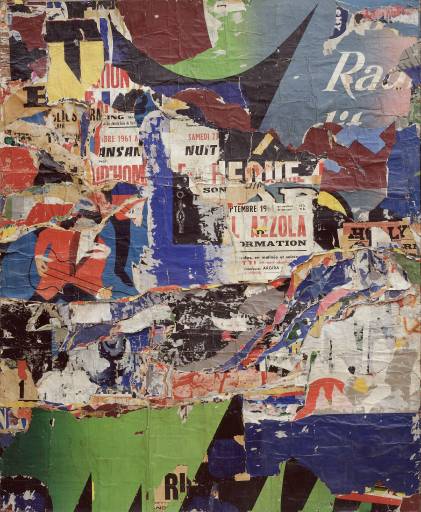
Jacques Mahé de la Villeglé, Les Jazzmen, Jazzmen, 1961
Villeglé started making works using torn posters in the late 1940s and again in the 1960s. He wanted to emphasize the actions of anonymous passers-by who had torn and stripped the posters, a process that he regarded as a spontaneous art of the street.
Villeglé was part of a larger group in the 1960s called Nouveau Réalisme (New Realism), Paris' answer to the American Pop movement. The members of the group saw the world as an image, from which they would take parts and incorporate them into their works.
February 12, 2007
bush fires
It looks as if climate change means that major bush fires will happen more often. There is no single silver bullet to better fire management.

Spooner
Since we cannot eliminate these sorts of fires so we need to know how to lower the risks large fires pose to the things that we value - people, property, and the natural environment.
February 11, 2007
postmodern cities
In David Cox and Molly Hankwitz's Cities of the Future 2000 they say:
Urban space today is a site of unparalelled change, alteration and dynamism. The impact of globalised systems of economic power, mediated by electronics, have lent the contemporary city a mutable aspect. Cities seem to seeth with the potential for self growth, grown organically from the material that is the media age. No-one it would seem has a strong handle on where contemporary cities are going. Gone are the heady days of certainty which thrust skyscrapers out of a landscape of mining and manufacturing. These are the fluid and liquid city days.
February 10, 2007
the new old politics
The change in the climate that we are currently living through is a big change. A historic moment is unfolding.
An account by Martin Flanagan of the changing landscape in Australia due to the effects of drought overlaid by those of climate change.

Tandberg
Maybe we should reread Henry Lawson's short story The Drover's Wife about life in a grim, hard land? And the politics? Well, the political milieu has changed.
The emphasis has been focused on irrigation efficiency as a way of getting water. That may well be about to change, as there are people willing to sell their water entitlements, especially the older farming familiies close to retirement. They may take the money and retire to the Gold Coast.
February 9, 2007
Francois Dufrêne: effacing language
An example of décollage, where an image is created by cutting, tearing away or otherwise removing, pieces of an original image. In this case it is a poster:

Francois Dufrene, Fleur à gaz, 1965
The posters Dufrêne utilized were found objects, like Marcel Duchamp’s ready-mades —banal & anonymous. He was a member of the Lettrism movement. This Parisian movement, which began in the 1940s, focused on the visual dimensions of language. It was based on the concept that conventional language failed to adequately transmit individual energies and desires and should be replaced by “fluctuating letters” disentangled from their usual meanings and contexts, enabling them to retain “suggestions” and “fleeting evocations.
Update: 13 February
According to Jennifer Farrell in her The Effacement of Myth: A Study of the Work of Roland Barthes, Isidore Isou, François Dufrêne and Daniel Buren Lettrism, was also known as hypergraphie, and super-écriture, was a movement based on the plastic use of the letter or sign which was not to signify anything other than itself, thus transcending traditional conventions of meaning by emphasizing the figure or form of the sign of the letter over representation. Farrell says:
The work of the décollage artist and lettriste poet François Dufrêne reflected a similar conception of language as object in his search for a neutral or “colorless” form of language. Dufrêne, however, did not approach his investigation solely as a theoretician, but rather as an artist and a poet who utilized the very forms he deconstructed to structure his art. Central to his visual work was the removal, or the literal effacing of “language,” namely, the texts of the found posters that were the basis for his visual work. The removal and separation of text from meaning in his visual work was paralleled by the aural investigations of his poetry, which explored the liberation of language through the reinterpretation of literary devices, such as alliteration, crirythmes, and other such methods, to ultimately lead to the construction of “a purely phonetic language that would eliminate all semiotic and semantic conventions"... Through the process of extinguishing language, Dufrêne had sought to reinvigorate and reinvent it and to expand the role of the artist beyond art and language to society itself.
The Dufrene image can be contrasted with Picasso's cubism:

Picasso, Still life with Chair Caning,1911/12. Collage of oil, oilcloth, and pasted paper simulating chair caning on canvas.
As Farrell comments collage by the 1950s was no longer a revolutionary form. Collage had become a recycled avant-garde strategy that had long since ceased to be oppositional. However, there was still radical potential in using something from the street, something found in daily life such as the debased fragments of commercial culture that the décollagists used.
February 8, 2007
Tim Storrier: a return to surrealism?
Tim Storrier's work has continually referred to the desert, the Australian outback and fire. He is well known for his Fire Line series, culminating in Point to Point (The Blaze Line), completed in 1992. This more recent image is from Pastoral Domestic at Metro 5 Gallery

Tim Storrier, Pastoral (domestic), 2006, Acrylic on canvas.
The gesture back to surrealism connects up with his photography as in this image:

Tim Storrier, Pastoral Domestic - TV Dinner IV 2005,Type C photograph on metallic photographic paper
Empty tv sets, carcasses, broken bottles, fire, fruit
February 7, 2007
City of God: representing the horrors
Where it once shocked as the new in the early 20th century, cinema now saturates our habitual ways of seeing. The shock of the new has given way to acceptance and naturalism. Yet the experience of cinema has remained intensely ambivalent since film is is neither wholly real, nor simply imaginary (as those terms have been customarily understood). The history of photography and film (and the mass media) has produced an image-world where representation is no longer shaped to fit what is real; but rather the world is called on to live up to its images. So how do you represent the horrors of history?
I watched the Brazilian gangster film The City of God (2002) by Fernando Meirelles on the weekend. This represented the horrors by reworking the modernist concept of history conceived as a narrative series of motivating causes and effects to depict the rise of dystopia within the very heart of modernity.
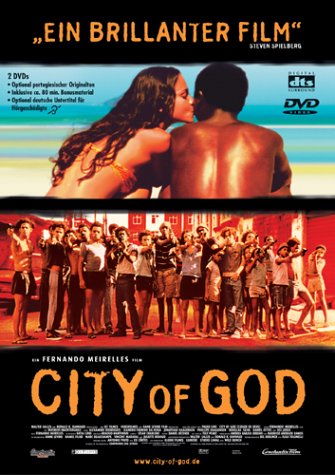
In the filmRocket, a photographer, narrates our journey into the slums of Rio de Janeiro. A child of the 60s, he witnesses two decades of barbarity, greed, rape and revenge which fuel a catastrophic gang war and the rise of Li'l Zé, a ruthless, sociopathic killer, as the ghetto's 'godfather.' The film is trading on something actual: the dirt-poor Brazilian housing project Cidade de Deus, on the outskirts of Rio de Janeiro, which was created in the sixties, and quickly became a highly dangerous fiefdom of teen drug lords and gang chieftains.
The film, which was adapted from a best-selling novel by Paulo Lins who grew up in Cidade de Deus, depicts an amoral slum world without pity, where children casually kill children. Poverty and depravity have stripped these kids of any defining humanity and turned them into a race of grotesques. The experience of the slickly presented violence centred on the pleasure of the look is one of shock; even though it is easy to accept the idea of history as biodegradable ---it is very selective, full of gaps, as it is formed by processes of selective amnesia, illegibility, repression, avoidance, neglect, and loss. That shock does not lessen even though the photographer is redeemed through art for we are left with a nightmare akin to an inferno.
I know very little about Brazilian cinema, let alone the cinema of Latin America. My vague conception is that it is politically orientated. The cinematic experiments and activism of the decades of the 1950s and 1980s is about revolution, dictatorship, and exile constitutes what a Latin American 'cinema' has most generally been identified with both in film exhibitions outside Latin America. I have no knowledge of Latin American cinema studies in English.
What is only implied in the film is the way that a the legacies of hundred years of American and European economic and political imperialism have created unequal development, high rates of urbanization and the concentration of wealth in the hands of the Brazilian elite and international investors, and the socially excluded poor who limited access to education and better jobs. Over 500 shantytowns or slums, (known as favelas,) exist within the confines of Rio de Janeiro, comprising more than a third of the city’s population. The everyday violence of Cidade de Deus is a result of this underlying, historically entrenched, structural and political violence.
Although Rocket photography gets him out of the slums there is little that indicates he'd been able to see something through the lens of his camera that he couldn't as a mere bystander. He doesn't seem to think about the meaning of the violence that he captures --he's a newspaper photographer. There is little reflection on the role of art in representing the horrors of history, or about the eye or visuality, or with light as a metaphor for the desire for truth (Plato and the cave) Is the film part of a truth-system structured around the light metaphor (light in terms of enlightenment)?
'feeling the heat'
The image is a cartoon, and not a work of art, and so it is not caught up in aesthetic illusion that eliminates every reference to reality. As a cartoon it does not need to pose as an autonomous, integral and unified entity that surpasses the world of things but remains locked in the social prison of its own autonomy.Though the cartoon is a product of the culture industry it is not a superficial commodity.
The image's surface refers to the political contest between the major political parties as Parliament opens for 2007. The image's truth content reveals the way that global warming has become a centre stage issue in our national politics and the negative effect on nature.

One way to interpret this truth is the Howard Government's rhetoric: it says that the government has history on its side because it has delivered economic prosperity, and there is no loss of public confidence in its management of the economy and national security. But this smoothness is illusory as the government is at sixes and sevens on climate change.
Ministers saying that they love being climate change sceptics; that Australia cannot do anything but protect its natural advantages in cheap energy; that carbon pricing (by way of a carbon tax or an emissions trading scheme) will damage the long-term interests of the economy; therefore, there is little need for anything to be done in the short term apart from clean coal and going nuclear. There is no other choice et etc. Those who question this are climate change purists, fanatics and zealots.
What is sidelined is that the clean energy technologies are ready for implementation, given appropriate carbon pricing, regulations and standards: efficient energy use, solar hot water, solar space heating, wind power and bioenergy from crop residues, organic wastes and landfills.
So you can see why Howard & Co are feeling the heat and looking the worse for wear.
February 6, 2007
desire, commodities
From David Cox's article Lens of Images
If desire is expressed through the commodity, and the commodity is that which is supposed to stand in for desire, to desire an end to commodity society is the desire to embrace that which consumer society deems no longer useful or valuable. Alongside this is the desire to re-inscribe certain specific things with new and unauthorised types of cult value. The culture hacker collects things which seem to have no value. She makes of the world around her a quilt of emblems of her own desire. She anticipates a world in which control and governance have shifted away from the surrogate mercantile type of economy to an economy of desire itself.
Cox is a film maker and academic at Griffith.
February 5, 2007
Queenstown: snap to artwork
Most of my short time in Queenstown, Tasmania was spent looking around for the right sites to take photographs from. This is a snap of an disused open-cut mine just out of Queenstown. I had intended to go back with a larger camera the next day, but it rained that morning. By the time the rain had cleared the light I required for the image had gone. Then we had to leave Queenstown to begin the journey back to South Australia.
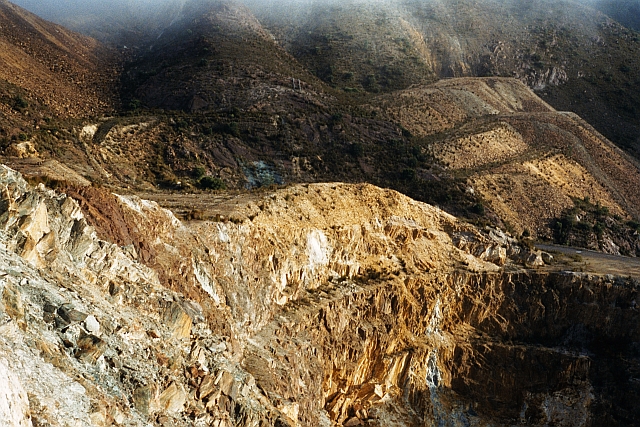
Gary Sauer-Thompson, Queenstown mine, 2006
So I was just left with a sketch, a snap that suggested possibilities. It constitutes the raw material to work from, and it s part of the process to produce the finished product as a photographic image that is an artwork. So we have a polarity between the photograph's character as an entity and its character as a process. The finished product remains incomplete and it's reception as an experienced object is based on a fragment of an art work.
How would I have completed work on the snap to produce the final image? I would included the water at the bottom of the open cut mine to show that it was a mine:
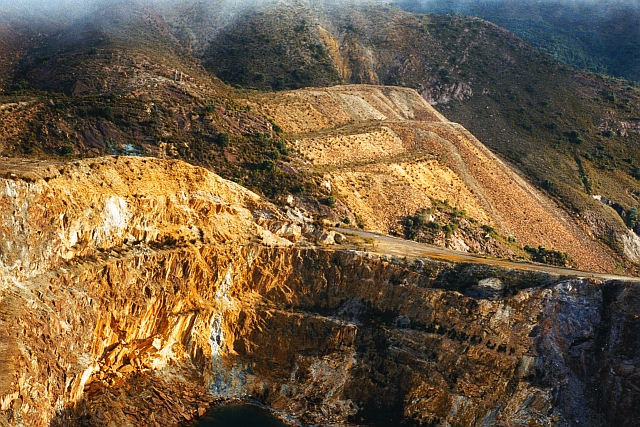
Gary Sauer-Thompson, Queenstown mine, 2006
This is where I would have started work from this image in the early morning light. I would have used the camera movements of the old Linhof 5x4 to square up the diagonals and make them more dynamic. I would also have included more of the water at the bottom of the mine to show why the cliff face was barren of vegetation. The final image would have disguised the work that went into its production and it would need to be reconstructed from the series of snaps.
So one can begin to discern a work's truth content by asking whether the photographers' intentions were actually achieved. Technical failure can signify questions about the intentions. But we also have a material unconscious that lets history crystalize in the artwork.
February 4, 2007
salty rivers
There is a lot of talk about water and climate change these days.What is not mentioned is the level of salt in the river. It is so great that it needs to pumped out of the river and stored in basin.
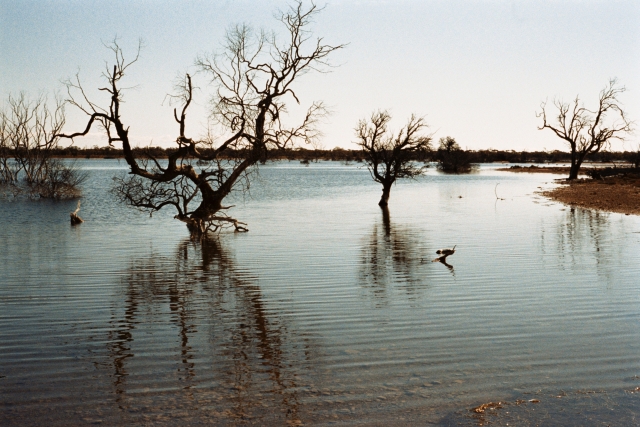
Gary Sauer-Thompson, Saltlake, Stockyard Plains, 2004
It is said that the salt lake at Stockyard Plain is fine and full of life. The blub says that:
Stockyard Plain is an 1870 hectare oasis for kangaroos, emus and reptiles and over 130 other species of birds. It has become a popular destination for bird watchers and environmentalists.Camping is allowed at two sites within the grounds
It looked dead to me.
February 3, 2007
Zappa and Beefheart
I'm reading Frank Zappa, Captain Beefheart and the Secret History of Maximalism by Michel Delville and Andrew Norris. It is an interpretive essay investigating the cultural and historical importance of Zappa and Beefheart, and it offers an alternative interpretation to the cultural studies take on the study of popular music, which generally neglects aesthetics in favor of the merely semiotic and sociological.
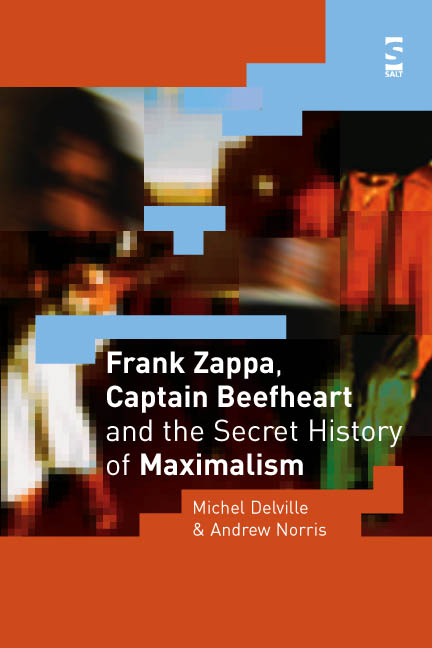
It is a complicated text. An early account says that maximalism is an art that exceeds its own historical context and represents more than the sum of all past and present compositional styles. The the maximalist approach in contemporary music “embraces heterogeneity and allows for complex systems of juxtapositions and collisions, in which all outside influences are viewed as potential raw material.”
In an extract they ccomment about Beefheart:
As a musician, Van Vliet lacked both the formal know–how of technique, and an interest in advanced musical technologies, and this may explain his unwillingness to extend the experiments he was making at the level of the group to the broader plane of conceptual and materialist manipulation, his failure to objectify his moments of transcendent insight into a project/object with a life of its own. Regularly, also, the Captain tried to conform to the norms of popular music, writing songs which seem to labour under a load of assumed sincerity while lending themselves to a perversely melancholic listening experience...This hesitation between modes of creativity, together with his eventual selection of a neo–primitive abstract–expressionist aesthetic for his painting contrasts interestingly with Zappa’s self–consuming commitment to the Big Note and its cosmic ramifications.
The extract notes that in spite of the differences between Zappa and Beefheart, many of Van Vliet’s texts are thematically consistent with Zappa’s concerns, and both hark back in various ways to the anti–art activities of Dada (perhaps the key maximalist movement of the modernist period):
Van Vliet drew on the paradox of ordered disorder exploited by Hugo Ball in his sound poetry, together with the “primitivism” of Tzara, rendered urgently audible in the free jazz of Ornette Coleman; while Zappa fell in love with the materiality of sound, and the theatrical extravagances of burlesque, key components in his self–recharging brand of social satire. While Van Vliet played with the paradox, evolving his own surrealist slant on those odd overdetermined objects so dear to Zappa, the latter branched out and out into parody, satire and beyond.
February 2, 2007
downtime
Thoughtfactory has been experiencing major download problems. A cable was cut in Atlanta, US, yesterday and that was a main route to my Hosting Matters in Florida. So the site was down for most of the day. Hosting Matters says on its Emergency Forum that:
We are currently seeing Level3/WCG timeouts in multiple locations that are preventing requests from reaching the network. This is also affecting the remote monitor, which will show multiple servers down although they are not in fact down....it is indeed confirmed to be dropped routing. Based on the explanations we have received thus far, it appears that an OC3 was taken out by one provider, and with that maintenance, numerous routes were dropped at the same time. Those routes are being rebuilt/readvertised at this time and we hope things will return to normal shortly based on that activity....From Peak10, Telcove has had a major fiber cut in Atlanta, and our Level 3 Circuit is carried over the Telcove line. Telcove technicians are onsite trying to repair the cut right now...the crews are working on it. The word has come down that a couple of other providers also experienced cuts.... the last update we have is that the new fiber has been pulled, is in place, and the splicing process is beginning. They were unable to give us an estimate of how long this will take,
We are back online today but I cannot upload any images.And there you go.
So an event in Atlanta substanially effects people in Adelaide and Florida. That's how internal relations in a network operate; a network in an information economy that is based around diverse digital information flows.
Isn't an information economy the new form of a technologically rationalised world that Horkheimer and Adorno initially mapped in 'The Dialectic of Enlightment'? Shouldn't we be wary of the 'Wired circle', the spokespeople for the wonders of technology, because the intoxication with techology leads to a constructing the realm of a delirious phantasmagoria?
We can accept the totalisation of exchange value and the commodity form in everyday life and history as it is experienced'. So we need to unresolve what has already been violently made 'whole'.
February 1, 2007
apocalyptic dread & sublime
Leunig's light hearted cartoon can be read as a witty comment on what Rough Theory calls the conversational flow around contemporary apocalypticism. The commentary is conveniently summarized here at High Low and in between.

Leunig
This apocalypticism can be linked to Susan Norrie's Undertow, which I have considered under the notion of the sublime. Norrie's work connects apocalyptic dread to the popular unconscious in Australian culture, which finds its everyday expresson in droughts and bushfires. (Floods in Australia are commonly seen as restoring life after a drought).

Eugene von Guerard, Bush fire between Mt Elephant and Timboon, 1859, oil on canvas board
Apocalyptic dread is increasingly being expressed in our concerns about the effects of global warming on our mode of life. The catastrophic scenario is a 6 degree rise in temperature signified by the melting of Arctic ice. The ecological discourse of a passionate environmentalism connects with this dread and fantasy, in the sense of an industrial civilization so harming the Earth that it’s killing our life support systems.
Global warming effectively returns us to Kant, who lodged the sublime in nature, and understood the sublime as an aesthetic quality in nature distinct from beauty.The dynamically sublime is a kind of horror" and we struggle to grasp the enormity of a sublime event such as an bush fire. So we come to the edge of our conceptual grasp of the event (a maelstorm), a realization that nature elides our attempts to control it through instrumental reason, and the growing senation that the subject is
caught between nature and freedom.
In Aesthetic Theory Adorno says:
Deeply etched into the sublime are characteristics like domination, power, and greatness, and yet art protests against domination....With the eclipse of formal beauty it seemed as though sublime was the only idea of traditional aesthetics to survive and live in in modern art.(p.281)