|
February 05, 2006
This map of Tasmania shows my holiday journey. We flew into Hobart from Adelaide across the north-west corner of the island; travelled up, and stayed in the Midlands; moved onto Launceston and Hawley Beach near Devenport, travelled across the top north coast to Rocky Cap and Stanley, moved down through the west to Strahan, onto Queenstown, back to the Midlands, and then down to Hobart. Quick and short.

The Midlands figured strongly in the week's holiday as we stayed with family in Tunbridge. Suzanne's sister, Barbara Heath, and her husband are spending their holidays restoring a Georgian store in Tunbridge. Tis a 10 year project.
The Midlands reminded me of the South Australian landscape: dry, hot, salt scolds, with a golden afternoon light illuminating dead trees across a yellow landscape. Only the Midlands had more trees than SA, which has been pretty much stripped bare.
Alas, the MIdlands do not have enough trees to save the landscape from the rising salty groundwater. Lots more trees need to be replanted, but there was very little evidence of that. Unlike South Australia, Landcare has not taken deep root in the Midlands. It is seen as a failure rather than something to be built upon. So the old farming practices continue.
The Midlands are dotted with some very gracious Georgian houses beside the Heritage Highway running from Hobart to Launceston. These buildings (shops, manisons, windmills, barns etc) are all in the process of being lovingly restored with a very keen heritage eye.
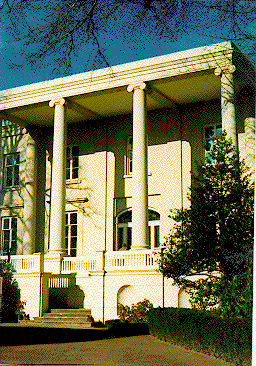
Clarendon House, Nive, 1838
Oatlands, just south of Tunbridge, has the largest collection of sandstone buildings of a village situation in Australia, and is reputed to have the largest collection of pre-1837 buildings in Australia:
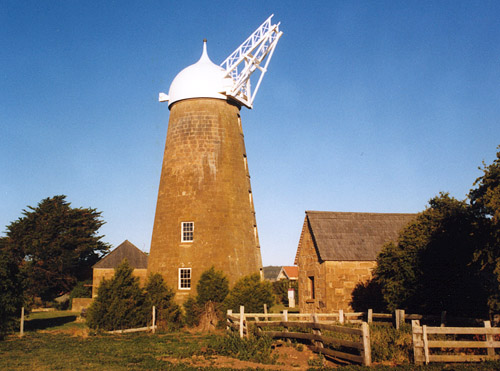
Callington Flour Mill, Oatlands, 1837
As Oatlands was a garrison town I presumed that many of the buildings were convict-built, as is this sandstone bridge over the Macquarie River at Ross, another garrison town, just north of Tunbridge, designed by the Architect- Engineer John Lee Archer.
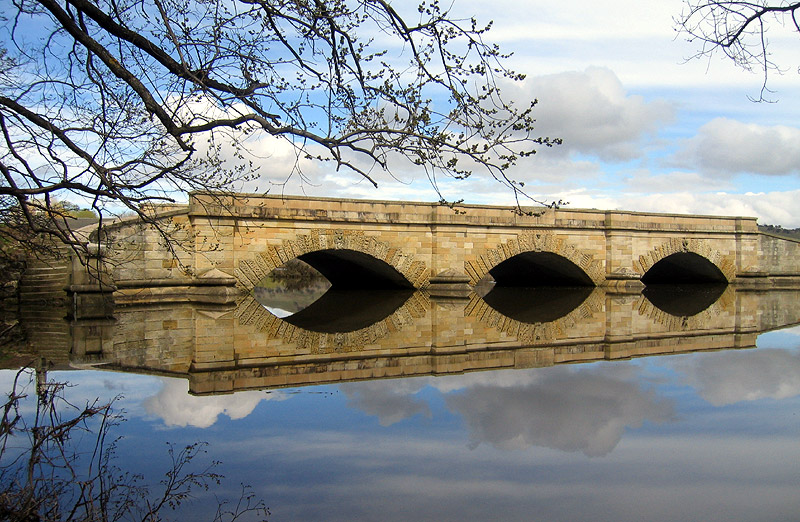
Jennifer Spence, Ross Bridge, built 1832-1836
It's an excellent monument to the artistic convict craftsmanship. The bridge consists of three perfect symmetry arches, all bearing contemporary patterns of colonial sculptured stone.
Tis the beautifully restored architecture in a blighted landscape that stands out. Schizophrenic isn't it. But that's Tasmania. Redneck and cosmopolitan. The old and the new. Traditional resource based economy and the newly forming knowledge economy.
|


