June 30, 2005
snazzy design
Is the goal of jewellery as a contemporary art/craft practice the creation of beauty?
I guess the object below is an example of what many people in Australia mean by contemporary jewellery that has broken away from the old folksy arts and crafts:

Mari Funaki, Ring for one and two fingers.
Funaki is held to be an example of contemporary design where the concept is as important as the craft. The craft here refers to both technique, to a non-industrial, non-capitalist mode of production. Well crafted means good technique and able to withstand decay (solid craftmanship).

Mari Funaki, Bracelet, 2005
This kind of jewellery is the art of making beautiful things. That's beauty as form, as opposed to beauty as sensation (ie., the empiricists idea of of the object evoking clusters of stimulii in the subject). Instead of a piece of jewellery it could be a well designed chair.
So where's the concept in relation to this wearable ornament? How does that conceptual bit fit into jewellery as the creation of beautiful form? Is it the conceptual bit that highlights the step from craft to art?
There is many an artist who clings to their image as craftspeople because they eschew theory and aesthetic self-interpretation and talk about their craft knowledge and skill of how to best construct an object, such as a chair or ring.
June 29, 2005
craft or design?
Sheridan Kennedy, a friend of Suzanne's sister---Barbara Heath is coming to stay with us for several days whilst she organizes her show of jewellery.

The show is at the Jam Factory. From what I can gather the exhibition is called Shades of Gray. It is a celebration of its 20th year as one of Australia's leading jewellery workshops, and it brings together its previous tenants for the first time to show their work.
Sheridan is in Gallery 2 which is a room at the end of the main gallery, which contains a series of linked show cases that exhibit Sheridan Kennedy's Astromancer:
 I'm not really sure what an astromancer is.
'Astro' means star shaped, pertaining to outer space.
'Mancer' means to interpret signs so 'practical' decisions can be made, and it is associated with prophecy.
The image appears to depict some form of navigating instrument
I always been puzzled by the ambiguity surrounding art jewellery. It is mostly seen as craft. Craft understands itself as retaining the vital link to its folk roots whilst art and literature have severed those roots and become autonomous.
Yet contemporary jewellery is about smart and fashionable design that is also very wearable (eg., neckpieces, brooches, rings and bangles).
This kind of work is seen to be craft, and this kind of ornament is to be found under the umbrella of Craft Australia or Craft Victoria.
One thinks of people showing off their wealth and status in conspicuous displays of flesh, fashion, and body adornment. I guess that jewellery, aesthetically pleasing (beauty) and sexy bodily adornment go together.
So we have egetal
Or should we view jewellers as more than designers? People talk about ceramic artists do they not? Why not jewellers?
Some of the jewllery work that I'd seen in the Jam Factory around three years ago when I used go the openings, was often interpreted as a form of art. It is viewed in an art gallery and a some works can be seen as a form of sculpture.
Hence Object Gallery
Can Sheridan's Astromancer exhibition be interpreted as sculpture? The title suggests more.
Why not view jewellers as visual artists using jewellery as their medium? They are more than designers making a beautiful aesthetic object as the work is goes beyond an ornament because it is about meaning aand the interpretation of signs.
June 28, 2005
impenetrability
This image reminds me of reading Hegel's Phenomenology of Spirit:

Gerhard Richter, Mediation,1986
It was the sheer impenetrability of that influential philosophical text that stumped me when I tried to read it.
June 27, 2005
recoiling from tv.
I've gotten sick of the low grade or trash offerings on free-to-air television and so I watch around 30 minutes a night at most. Suzanne watches around to 90 minutes and she enjoys TV. Watching TV makes Suzanne feel good as it helps her to unwind from work. Watching tv makes me feel bad, or dissatisfied, as I feeel that I could be doing other things that are more fruitful.
And I don't take to the limited range of DVD's in the video shops. So I've gone and joined Homescreen. One of the DVD's I selected was Pete Townshend's
Lifehouse
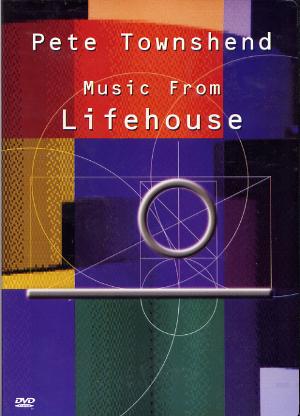 Most of the songs of the Lifehouse project, which s supposed to follow "Tommy", had surfaced on the Who's excellent Who's Next(1971). that album is considered by many to be the group's best work,
Lifehouse is about being wrapped up in a world of virtual reality and computer technology, but the band found the ideas unworkable.The project was originally intended as an album and a multi million dollar film. Townshend was undeterred and pushed on with the project, which included interactive concert performances at the Young Vic Theatre in London.
The live shows failed to give Townshend the response he had hoped for and the film deal fell through. The project as a whole was shelved.
So I'm curious to see what's on offer.
June 26, 2005
heritage/development conflict
I've come down to the shack at Victor Harbor to have a bit of break as my job winds down. The winter rains had come whilst I was in Canberr and Sydenyand the winter grasses are beginning to appear. Tis time to plant more trees and bushes in the reserve and creek beds to restore the biodiversity that had been stripped from the land by the farmers.
As I drove through the town last night I could not help but wonder about the heritage/development conflict that is raging along Australia's coastal townships.
Victor Harbor is in danger of becoming a very ordinary commuter town to Adelaide. The large blocks of the old town with their cottage gardens are being broken up; the new development is a mixture of the Sydney-style McMansions, which take up the whole block and sit jammed up against one another, and the new cheaply built concrete slab beachside apartments.
Victor Harbor is seachange town caught up in the heritage/development conflict.This conflictis being played out between those on the heritage side who want to shut the door and live in a fishbowl, and those on the development side who talk about business and economic growth. This black and white perspective pushes quality development into the background.
June 24, 2005
Bruce Davidson
People in Adelaide have to continually fight to protect their urban park, which rings the inner city, and separates it from the suburbs.
Then I remembered this work:

Bruce Davidson, Central Park
Urban parks are very precious public places for those people whose companions are dogs.
June 23, 2005
a touch of humor
Maybe Australia could bring a case against Japan to the International Court of Justice?

Japan failed to gut the International Whaling Commission’s agenda. According to Humane Society International:
"Japan had planned to wipe out discussions of humane killing, whale sanctuaries, human health concerns, environmental threats and to abolish the Conservation Committee---taking the life blood out of conservation issues at the IWC."
Thank goodness.
Japan's Institute of Cetacean Research has a few pitiful papers published in peer reviewed scientific journals to show for 18 years worth of killing whales for 'scientific research'.
However, Australia is in a difficult position. Ian Campbell, Australia's Environment Minister, challenges Japan's cultural heritage argument on conservationist grounds. Yet he defends the destructive cattle grazing in Victoria's alpine national parks on cultural heritage grounds.
June 22, 2005
cultural conservatism
I've noticed this:

Strange isn't it. The violence is incredible on free-to-air television but all the fuss is about sex not violence.
protecting the whales

Good news from here at this meeting. Japan's motion calling for an end to the almost 20-year ban on commercial whaling has been defeated at the International Whaling Commission meeting in South Korea.
Ian Campbell,Australia's Federal Environment Minister, said Australia and other anti-whaling nations had wanted to send a strong message to Japan, and this had occurred.
"We were seriously on the edge of an abyss, with the chance of seeing the world step over the edge towards commercial whaling. This is a great result for all the Australians who campaigned against it."
This should be celebrated.
Then pressure needs to placed on Japan to abandon its push to resume commercial whaling and increase its scientific cull.From this perspective Japan's failure to swing an early majority vote behind the pro-whaling camp is not a victory for the whales - it is merely another reprieve.
Nicola Beynon, from the Humane Society International, and an adviser to the Australian Government's IWC delegation, said that:
"If Japan's recruiting drive continues to be so successful, they will be able to take us back to the bad old days."
Japan is pushing for the IWC to preserve whale stocks and make possible the orderly development of the whaling industry.
Japan is deeply opposed to Australia's position to keep the IWC as a whale preservation and protection organisation.

However, Japan lost its bid at the International Whaling Commission (IWC) to do away with a decade-old whale sanctuary in the Antarctic that it said was no longer ecologically justified. The International Whaling Commission (IWC) also voted on Wednesday to urge Tokyo to cut its scientific whale hunt.
June 21, 2005
music & noise
Music and noise are generally seen as opposites.
In the new audio culture it has become increasingly difficult to distinquish music from what is seen as its other: silence, noise and non-musical sound. This has expanded the concept of music beyond the narrow and specialized domain that was demarcated in the Western academy in terms of melody, harmony and rhythm.
Is music now the attempt to codify and stratify noise and silence with the composer as an organizer of sound?
Our soundscape is changing from industrial and urban sounds to the sounds (or noises?) of buying and selling. Just think of shopping malls and radio advertisements. Money buys space from noise and the option of silence or solitude.
June 20, 2005
storm
These images of a storm came via email from a colleague in the Senate:

I have no idea when they were taken or who took them. All I know is the location: Bunbury, Western Australia

The storms of nature have a pattern.
noise and city life
I was walking around The Rocks area in inner Sydney yesterday and I heard the noise from this:

The noise was from 600 truckies in a go-slow to protest against the Government's planned industrial relations reforms. The truck drivers crept across the Sydney Harbour bridges blocking traffic for more than an hour in a show of civil disobedience with their hand on the horn.
Urban noise. I fled from the urban noise that assaulted the silence.
Then I started thinking about the new audio culture that represents the auditory turn in contemporary culture. This is based on opening music to the background noise of the industrial city as raw material for the cut and splice development of the new music.
I'm not sure how to chart this new sonic landscape in which there is an incursion of music into everyday life and into the spaces of everyday living.
Does this sound construct us as human subjects and locate us in particular social and cultural contexts?
back on deck
I'm back on deck after spending several days in Darling Harbour Sydney conferencing and networking. I'm trying to catch up with what's been happening whilst I've been out of circulation.
This Bruce Petty cartoon caught my eye.
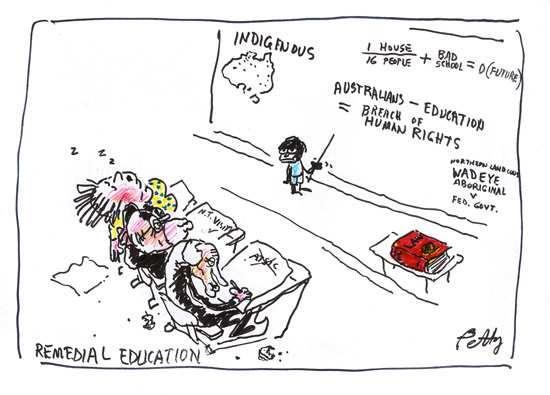
It is a neat reversal don't you think, given this?
They need some education that would enable them to run their own schools and businesses: that would give them an independent source of income and break the whole culture of welfare dependency.
June 15, 2005
It is a quick post as I'm due to catch back on a plane in Canberra to go to Sydney via Adelaide. Basically I'm leaving one world and entering another.
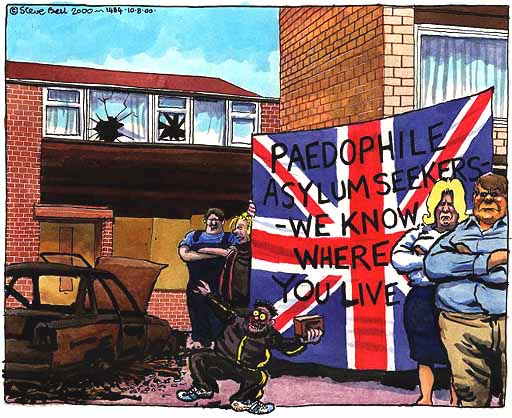
I've always puzzled about the paedophile campaign. It disturbs me. But I cannot put my finger on it.
June 14, 2005
Michael Jackson
I've watched the celebrity trial at a distance but I did not have enough information to make any form of judgement about the whether Michael Jackson was guilty of the charges that were presented in the case. I presume there were too many lingering questions and there was enough reasonable doubt.
What we saw on television was a strange person who did not look in the best of health:

Hell I thought that blck was beautiful.
The one-time King of Pop is in a pretty bad way with respect to creating more music.His career has been in a steep 10-year decline and he seems to retreat more and more into his own private world.
June 13, 2005
Adorno: aesthetics of rock music
Is rock and rock/jazz fusion music best when it apes the standards of European classical music? Should we conceive of musical value in terms of its structural complexity and independence from the market economy?
This is the aesthetic heritage bequeathed to us by Adorno:

Stefan Moses, T. W.Adorno, 1964
A response by Theodore Gracyk:
"Many efforts to dismiss rock music as derivative, primitive, and musically simple will strike us as misguided attempts to grasp rock exclusively as an allographic art form. Those who disdain rock typically respond only to the songs and performances, ignoring relevant properties and values like instrumental mix, stereo placement of various elements, echo on the voice, and even how ragged or nasal the singer's voice was at the time of the recording." Rhythm and Noise: An Aesthetics of Rock (p.36)
What the judgements about the music of the Grateful Dead indicate is that it is the particular performance of Dark Star on the night that is what is musically valued; not the written down musical structure of Dark Star so that any accurate performance is a genuine instantiation of that work.
Maybe the dichotomy between "commercial" music and "artistic" music is a false one. One pathway.
June 12, 2005
Adorno, rock music, language
I often wanted to introduce more of the work of T.W.Adorno into junk for code, but to do so in a way that his aesthetic categories can help us to understand what is happening in our rapidly changing culture. Music may be one way to do this.
 Theodor Adorno is conventionally seen as the ascetic high priest of high culture by many of those who did cultural studies in the 1980s.
They have given us the usual reduction of Adorno's work to a face-off between mass-produced entertainment and the high modernist aesthetics he championed. We even have suggestions that Adorno was politically conservative because he didn't like American mass culture of jazz and Hollywood movies.
Yuk. Another example of the poverty of academe.
When Adorno died in 1969, Western popular music was going through a technological rock mutation----eg., the Grateful Dead's dark acid rock improvisations (including noisy, jarring electronic feedback) which created a feeling of angst enhanced by the jungle of dissonances and percussions.
 No doubt, Adorno would have considered this kind of popular music to be even more "barbaric" than the jazz he so roughly condemned.
This commodity music would have been seen as yet another affirmative nail in the coffin of enlightened humanistic individualism and a dancing on the grave of a critical autonomous modernist art that resists an unfree society.
What would Adorno have thought of Jimi Hendrix, heavy metal or punk? This certainly was not decorative music that made itself pleasant to people to reconcile them to a consumer society. It was more of an aggressive assault on the senses. Adorno's judgement would be that Hendrix or an electric Miles Davis had nothing to do with art of a high quality or aesthetic truth. Was it really music? No doubt the judgement would have been along the lines of musical illiteracy.
So you can see why Adorno is not on the must read lists of the lovers of rock music, and the many and varied fans of the Australian singer-songwriter Nick Cave. Cave and Adorno--now there's an idea.

Adorno gives us something to make sense of the music of 1969--his idea of music resembling a language. This quote is from the opening page of Adorno's text Quasi una Fantasia: Essays on Modern Music:
"Music resembles a language. Expressions such as musical idom, musical notation, are not simply metaphors. But music is not identical with language. The resemblance points to something essential but vague. Anyone who takes it literally will be seriously misled." (p.1)
Great opening huh? The particular piece of writing is called Music and Language: A Fragment
Adorno continues:
"Music resembles language in the sense that it is just a temporal sequence of articulate sounds which are more than just sounds. They say something, often human. The better the music, the more forcefully they say it.The succession of sounds is like logic: it can be right or wrong. But what has been said cannot be detached from the music. Music creates no semiotic system."
So true.
 Of course, Adorno was thinking of modernist classical music, such as that composed by Mahler and the new music of Arnold Schoenberg and Alburn Berg.
Adorno most certainly was not thinking of the Grateful Dead's exploratory Anthem of the Sun, despite its aural montage from divergent performances taken from tapes of live shows and its explicit references to the electronic music of John Cage and Karlheinz Stockhausen, atonality and chance. It is an aural representation of an LSD trip in which strange sounds fade in and fade out whilst moods flow into one another at dizzying speed.
Anthem of the Sun indicates that the Grateful Dead were one of the most musically erudite rock groups. As Piero Scaruffi observes the band was aware of the atonal compositions of the European avantgarde, the modal improvisation of free-jazz, and the rhythms of other cultures as well as transforming guitar feedback and odd meters into the rock equivalent of chamber instruments.
Was not the innovative music of Anthem of the Sun (it was created through studio editing) as hostile to an administered society as that of Berg or Webern? Can we say that popular music sometimes created art works?
If we pick up on Adorno's idea of music resembling language then we can say that interpretation in music means performance. Adorno again:
"To interpret music means: to make music. Musical interpretation is performance, which, as synthesis, retains the similarity to language, while obliterating every specific resemblance. That is why theidea of intereptretion is not an accidental attribute of music, but an integral part of it."
Both the Grateful Dead and electric Miles Davis were deeply involved in interpretation as performance. Their improvisation meant that they were not entertainers.
June 11, 2005
Crikey's bile
This is from a letter written by Gerard Henderson to Crikey after he'd been given the flick from his weekly column in The Age, which Henderson sees as 'The Guardian on the Yarra.'
"I have long held the view that The Age is the most left-wing newspaper in Australia --in a sense, its culture is set by Michael Leunig":

And this is is Crikey's Christian Kerr on Leung:
"...the Leunig metaphor is perfect. Mawkish, self-pitying, saccharine-sentimental pseudo-Christian socialist (don't want to be too Christian though--that's not PC) nonsense dressed up as touching profundity. Complete bollocks, in other words. Worse, it's utterly Melbourne-centric nonsense. Why the Sydney Morning Herald runs Leunig is anyone's guess. Presumably it's a cost saving measure---that other great Fairfax tradition."
What Kerr's criticism misses is the wit.
The above cartoon does express the droll humor of the anti-green agrarian socialists who love state paternalism during a drought. Of course, Crikey is a right wing capitalist outfit in love with the free market and wealth creation, and deeply hostile to the very idea of sustainable living in an ecological sense.
Maybe Kerr does not have a sense of humor? Or is he just stirring to create controversy and put soem bite back into the new marshmellow Crikey?
June 10, 2005
Miles Davis, Isle of Wight concert, Adorno
The photo of Miles Davis is by Jeff Sedlik
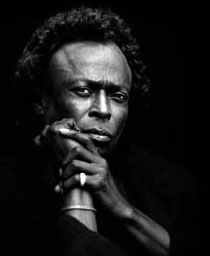 I saw the Miles Davis band at the 1970 Isle of Wight concert documentary on SBS on Tuesday night--Miles Electric: A Different Kind of Blue which had premiered at the 2004 New York Film Festival, and released on DVD by Eagle Eye Media.
I hung in there through the interviews waiting for the uninterrupted 38-minute set, despite having to get up at 4.30 am the next morning to catch the early morning flight to Canberra.
That Isle of Wight concert was a music festival that has achieved an almost mythological status in rock music history. The Who appeared on the same bill as the Doors, Jimi Hendrix, Joni Mitchell and Miles Davis. This is Rolling Stone's review.--Really insightful about live music that was fresh, challenging and engaging.
The music played by Davis was very impressive. It was powerful, innnovative music that blended improvisational rock and jazz into an exciting new style. Hearing this music makes it hard to agree with Adorno that the "eunuch-like sound of the jazz band" represents the slippery slope towards the total elimination of freedom and individuality when hearing this music.
'Tis a pity the documentary did not contextualize this music more in terms of the rejection of Bitches Brew by the jazz community, or the reception of this avant garde music by the rock community. How did it compare to the powerful set by the Who or Hendrix? There was so much space in the music as there were no guitars to fill it. Though it came across as a "jazz" set, yet there were the dominant waves of bass and the drums.
The musicans in the Davis band described the music they played as transitional music--it came across as unsettled and unfinished-- but transitional to where?
The images of the music festival reminded me of the Grateful Dead famous performance in Egypt beside the pyramids, and I imagined creative avant garde music connecting up with traditional aboriginal music being played at Uluru.
If we come back to Adorno we find his hostility to Jazz being based on his understanding of jazz as basically dance or background music. It was not music that would be listened to intensely for its intellectual value.
It would appear that Adorno's main concern was with the heavily-commercialized Tin Pan Alley jazz with its standardized and repetitious forms where all spontaneity was rigorously excluded from the music.In Perennial Fashion-Jazz, Adorno writes:
"Considered as a whole, the perennial sameness of jazz consists not in a basic organization of the material within which the imagination can roam freely and without inhabitation, as within an articulate language, but rather in the utilization of certain well-defined tricks, formulas, and clichés to the exclusion of everything else."
You cannot say that the music of electric Miles is a static music whose deviations were "as standardized as the standards."
Presumably, Adorno's hostility to jazz went deeper than just the style of jazz. The presence of some advanced elements such as montage, shock, and technological production techniques, did not validate jazz for Adorno. For him, "jazz, a phantasmagoria of modernity, is illusory and provided but a "counterfeit freedom."
June 9, 2005
no need for art criticism
The photograph is almost painterly:

Ken Duncan, Snowy River Country, Victoria
This kind of work is outside the modern art institution as it is placed way down in the visual art hierarchy. It is not produced as a self-conscious photograph destined for inclusion in a museum's cabinet of photographic art.
So it avoids being addressed by art criticism of the curatoriat or art-historical professoriate. The photo is what you see. There is no need for art criticism to tell us anything about our experience of the work.
Most art is usually verbiage produced by babblers, anyhow. The critics are the enemy. The philosophers of aesthetics have already disappeared long ago.
Are not art works embodied meanings? Does this art work embody the gap between aesthetic beauty and utility (a paperweight, urinal, sparkplug) as a deep truth?
June 7, 2005
dreaming of green
I'm dreaming of rain.
It is winter in Adelaide. It is warm and there has been no rain. The ground is dry and cracked.

Ken Duncan, Kakadu Dreaming, photograph
The weather forecasters say the rains are on the way. When they arrive up they turn out to be just the odd shower or two.

Ken Duncan, Outback Oasis Northern Territory
Yeah, I know. The style is very conservative--Hans Heysenesque, it is touched with romanticism, and it is about the beauty of wildnerness.
How does this kind of work understand beauty? As symmetry. As God's creation or identical with God? As something timeless? As that which pleases?
I'm dreaming and dreams have their own logic, don't they.
Update: June 8
The rains have arrived, finally. The tarmac at Adelaide airport was wet when I got back from Canberra this evening. It was not much though as it just wet the ground. More rain is expected on Thursday, according to the weather bureau. The promise is that these will be soaking rains.
Miles Davis

This is the image of the Tutu album produced in 1986. It is based on an Irving Penn portrait of Miles Davis
Miles Davis' only Australian tour was in 1988. I didn't see it even though it took in Adelaide. Suzanne reckons she did, though she cannot remember much about the music. She did mention funky.
Was this Miles Davis still electric Miles? The one who made music such as this Or had he moved on yet again?
Miles Beyond is a good site for those wanting to explore electric Miles.
I cannot recall many Australian rock bands being influenced by electric Miles. Are there any? Or was Australian rock pub rock? Raw primitive energy with little innovative musicality. How did these conservative musicans react to electric music that ditched many of the pillars of jazz such as the chord progression, the walking bass line, the swing eighth notes, and replaced them with one-chord vamps, bass riffs, swirling electronic keyboard and synthesiser sounds, hard-line funk and the backbeat of rock.
Or did this music pass them bye?
June 6, 2005
Miles Davis: In a Silent Way
When I was in Sydney recently I bought a copy of In A Silent Way (1969) by Miles Davis.
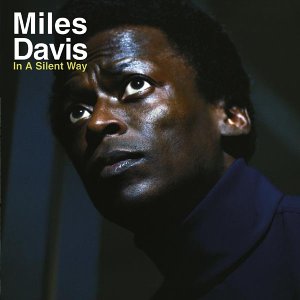 This CD marked the point at which Miles left conventional forms of jazz behind altogether, and moved into completely new ground---ambient jazz. I have not heard the complete sessions, but I understand that this record is final product of elaborate editing and postproduction work by Teo Macero and Miles Davis. Still it is a far cry from the improvisational rock 'n roll of 1970 Grateful Dead.
This music lead to the more aggressive electric rock/jazz fusions of Bitches Brew and A Tribute to Jack Johnson Miles connects with the youth culture of the day, delves into the 'primitive' world of rock music, opens concerts for the Grateful Dead, and influenced the live jams of the Grateful Dead.
Previously (eg., the ambient jazz of Filles De Kilimanjaro) Davis had reinvented old forms, made them his own by painting his lyrical, melancholy trumpet lines over whichever canvas he chose as his basis of expression. Music from earlier albums, such as "Solea" from Sketches of Spain, became a part of the improvisation of the Grateful Dead of 1973/1974. Did Bitches Brew influence the Dead?
In a Silent Way presented a new kind of music:
"The music itself is...free, unfettered and uncontainable, a liquid pool of keys and atmospheres from which originates a series of open-ended vamps and solos, and a rhythm that is sometimes barely present, at other times sinuously, subtly funk-inflected. There are no rules to this music, no boundaries. The players pick up on each other, establish riffs, whispers of melodies, and either leave them to dissolve or else gently breathe life into them. Shorter fills space, floating in and out of audibility, until it is his turn to articulate a moment."
Th emusic makes use of multiple keyboardists--Herbie Hancock and Chick Corea on electric piano and Joe Zawinul on organ--Davis on trumpet Wayne Shorter on soprano saxophone, Tony Williams on drums, and John McLaughlin on guitar. The music dips into rock and R&B, gospel and classical, electronics and creative editing, with Davis providing multiplies tones and melody lines and complicates textures.
In the 1970s Miles moved away from the European approach to music, to a more Afrological, spontaneous, and collective way of creating music. Miles tried to break open the logic of the music and have the rules change completely every night. Oddly enough, it was a way of music-making more akin to the Grateful Dead playing Dark Star than to conventional jazz. Just as the improvisation in Dark Star can differ greatly from night to night, and the tune part is not really that important, the Miles stuff from the mid 70's,(from '72-'75) from start to finish, is pretty much all like the middle of a really open Dark Star completely different each time it occurs.
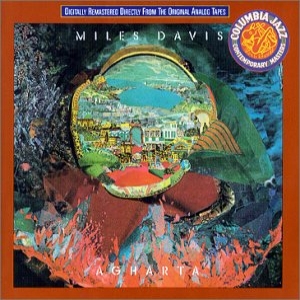
Between Bitches Brew and A Tribute to Jack Johnson Davis was searching for an improvised form of jazz music based on Jimi Hendrix's guitar-bass-drums line-up.
Was Davis trying to play jazz by becoming a rock 'n roll band in the studio, and give the rock 'n roll bands a run for their money?
Was the task then was to create a great live rock and roll, funk ‘n jazz band.
Was that achieved in 73-75 with the Agharta band?
It was during the late 80s and early 90s that the Grateful Dead/Jazz relationship deepened, and took the form of very close encounters between the members of the Dead and some of the practitioners of jazz including Branford Marsalis, Ornette Coleman and David Murray. I haven't heard this music or the Grateful Dead's music of the late 1980s or early 1990s: I've only heard the 1980 Go To Nassau. That music was not a development in the rock jazz fusion.
Now what I am discovering as I dig around is that the band is one of the most critically maligned bands in rock 'n' roll. Radio stations rarely played the band's songs whilst mainstream media and Rolling Stone regularly panned them. The 1982 edition of the New Rolling Stone Record Guide called the Dead "a pox on the face of pop -- nostalgia mongers -- offering facile reminiscence to an audience with no memory of its own."
By 1987 the Grateful Dead had shifted from beign a cult band and quietly assimilated into the mainstream of pop culture with its 1987 In the Dark album, stadium tours and regular rotation on MTV. They had become an acceptable and inescapable part of pop culture. The 1992 edition of the Rolling Stone Album Guide began revising its musical judgements as it gave the early 1970s albums (Workingman's Dead and American Beauty) five-star ratings. However, there is little recognition in Rolling Stone of The Grateful Dead's creativity pulse in the rock jazz fusion.
Miles Davis developed the improvisational music with a backbeat, into a wat of playing that was based on cooperative effort and centralized and focused on rhythm, through Bitches Brew, Live Evil, the twin Agharta, and Pangaea and the live jam record Dark Magus. From the bits I've heard It is dense and bizarre music, but, by and large, the post Bitches Brew music is unknown to me.
From what I can gather Davis's '70s recordings have undergone a fairly radical reassessment and are now seen by many as a significant body of work, with their interesting mixture of ideas gleaned from jazz, funk and rock music as well as from experimental, "process-oriented" European composers.
From what I can make out there was a backlash against all progressive jazz after the 1970s, when musical trends turned conservative and the remnants of jazz-rock mutated into smooth contemporary jazz. The rock jazz fusion falls between stools in terms of music criticism, with hidebound jazz critics dismissing it as too much like rock music, while rock critics think of it as too much like jazz music.
June 5, 2005
The new face of Australia?
This judgement about the crisis of Australian humanism may not be quite right:

The cartoon implies that an Australia that says no to refugees and asylum seekers is a fortress, inward looking, hostile to the outside world, and which sanctions the continuance of the White Australia policy.
Maybe it is the camp (of mandatory detention) that is the political face of Australia these days, not border protection.

The recent deportation of Vivian Alverez Solon to the Philipines indicates not just administative bungling, but the smooth operation of a system of lawful detention and deportation. The heart of that system is the camp, as illustrated by the imprisonment of Cornelia Rau, an Australian citizen.
Recently we had Mirko Bagaric and Julia Clarke, two legal academics from the law school at Deakin University, writing in The Age that torture was a 'permissable' and 'moral' action in certain circumstances. Those circumstances were then justified on utilitarian grounds. Peter Faris, one time head, of the now defunct National Crime Authority, supported the call in the context of the war of terrorism.
Government torture in the camp is back on the agenda after-Auschwitz. Once again we 'stare into the unsayable' engineered by Western rationality (instrumental reason) that gave us Auschwitz and the Gulag in modernity. The camp, then and now, is no irrational aberration.
June 3, 2005
students whoring
The corporate media (The Australian) are carrying stories that many female university students are turning to the sex industry to earn easy cash to pay course fees and support themselves through university.

Joshua Rubin, 4 Girls.Link courtesy of Waking Vixen
Students said they preferred the cash-in-hand wages earned as strippers, escorts or sex workers to the pay and conditions of waitressing or other casual jobs. The shorter working hours and higher pay on offer in the sex industry was the best means for acquiring the finances needed to live, yet also allowing enough time to study.
However, shame is involved as the students felt obliged to keep their sex jobs a secret from friends, thereby leaving themselves isolated and vulnerable.
It appears that the students work as paid employees rather than being independent sex workers running their own business; and that those who completed their degrees have continued to work in the sex industry.
Sarah Lantz, of the University of Melbourne’s Centre for Adolescent Health, said her research exposed one of the unintended consequences of government reforms, with students squeezed to meet living expenses. Presumably though sex work is thriving in Melbourne the sex workers (Educated sluts) don't come 'out' to their family, friends, and other employers.
Over at Catallaxy Andrew Norton says that we "should not see student prostitution as a policy failure, but as a legitimate way a small minority of people choose to finance their lives." The claim that prostitution is a legitimate way to finance your life was not addressed in the comments by the libertarians, who understand themselves to be rational economic agents shaping their lives with cost benefit analysis.So no need to worry about the sex industry being exploitative.
None ventured as far as to explore the assumption of the research that sex is commodity being sought and paid for; or that prostitution is living to please others or what kind of whoring is taking place and by whom. Or that what is paid for is a relationship, and not a series of isolated hook-ups, as they assumed. If relationships are for hire, does that mean that those clients who paying for a relationship with a prostitute, see this as the only sexual relationship they are having?
June 1, 2005
Chowilla
The drought continues to deepen in Australia. Towns, such as Goulborn in NSW, are running out of water as the rains fail to arrive.
The major cities are going onto water restrictions as an emergency which then become the normal. Australians have to live with water restrictions.

It is different with the rivers, such as the Murray-Darling. Too much water has been taken out of them by irigators. So the wetlands die. The big farmers shrug. Few are serious about shifting to sustainable farming.