July 31, 2005
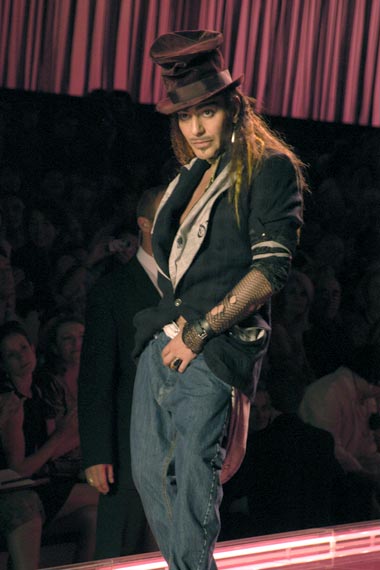
John Galliano
The designer
The dress, from the autumn-winter haute couture collection, for Christian Dior:

It's an art work.
July 29, 2005
designer fashion
Ready to wear from John Galliano, the British designer, who is now chief designer of France's haute couture flagship, Christian Dior, in Paris. He is accepted as one of the great designers of our time.
I love the gear.It offers men up-to-date contemporary clothes, rather than the staid classic pleated trousers and double cuff shirt look of yesteryear.
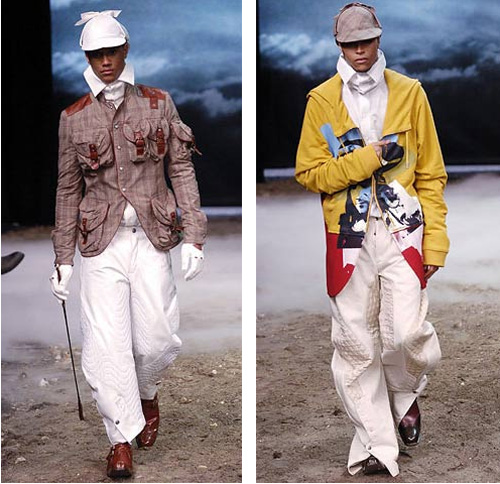
Tis not for the sleepy town of Canberra though, is it.
A brief description of Galliano's autumn-winter 2005 haute couture collection for the Christian Dior label.
July 28, 2005
The Pope on modern music
I'm serious.
I was following links (mosaics of fragments) when cruising the postmodern Experience Music Project's Pop Conference. This is self-described as 'an annual gathering dedicated to music writing in all its limitless forms, with a mixture of academics, journalists, artists, and other aficionados'.
The conference on music writing is held in the participatory museum of music in America's rock temple:
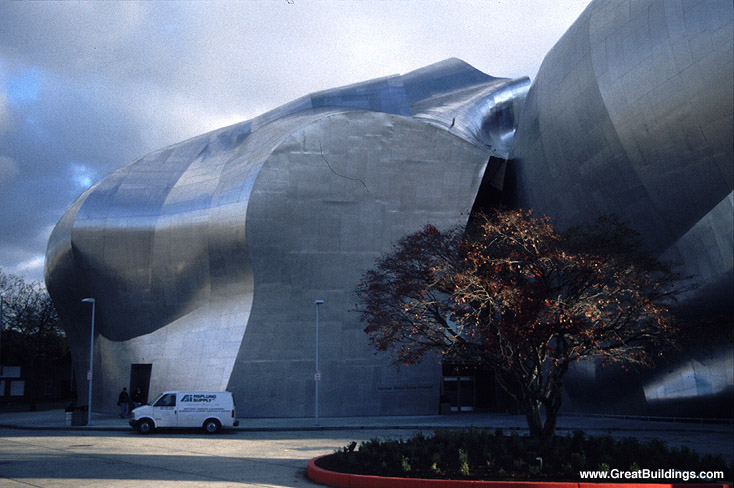
Frank Gehry Experience Music Project, 2000
I was surfing the web. I was intrigued by this found myself reading this; loved this; puzzled about this; wandered through this and with great interest; then, somehow, I came across an intriguing quote.
It was by Pope Benedict XVI when he was a cardinal:
"Then there are two developments in music itself that have their origins primarily in the West but that for a long time have affected the whole of mankind in the world culture that is being formed. Modern so-called "classical" music has maneuvered itself, with some exceptions, into an elitist ghetto, which only specialists may enter -- and even they do so with what may sometimes be mixed feelings. The music of the masses has broken loose from this and treads a very different path.On the one hand, there is pop music, which is certainly no longer supported by the people in the ancient sense (populus). It is aimed at the phenomenon of the masses, is industrially produced, and ultimately has to be described as a cult of the banal. "Rock", on the other hand, is the expression of elemental passions, and at rock festivals it assumes a cultic character, a form of worship, in fact, in opposition to Christian worship. People are, so to speak, released from themselves by the emotional shock of rhythm, noise, and special lighting effects. However, in the ecstasy of having all their defenses torn down, the participants sink, as it were, beneath the elemental force of the universe. The music of the Holy Spirit's sober inebriation seems to have little chance when self has become a prison, the mind is a shackle, and breaking out from both appears as a true promise of redemption that can be tasted at least for a few moments.
What is to be done? Theoretical solutions are perhaps even less helpful here. There has to be renewal from within."
The quote is from this text. It was delivered at Eighth International Church Music Congress in Rome in 1986. Here is my link.
This 'renewal from within' is going to be difficult to achieve, given his stark duality that dividing music into "high serious" and "low commercial" realms with their Appollarian and Dionysian undercurrents. It reminds me of this guy
Maybe it is Cardinal Ratzinger's stark duality is the problem. We can think in terms of an excess of meaning by looking at the excluded middle as unpacking possibilities within the tightly defined duality.
This is an example:
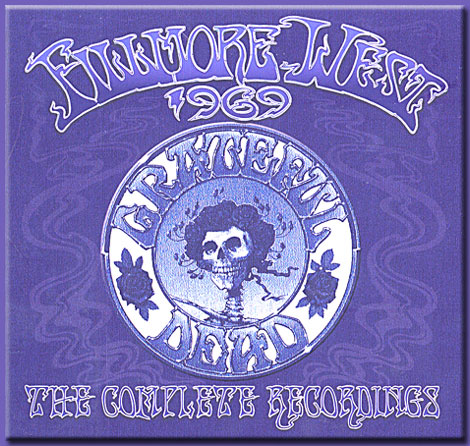
And so is this.
I guess the Pope needs to some Derrida when he was a moment.
July 27, 2005
Frank Miller's Sin City
This the stylish poster of the film of three stories ('The Hard Goodbye,' 'The Big Fat Kill,' and 'That Yellow Bastard') of the seedy underworld explored in Frank Miller's Sin City series:
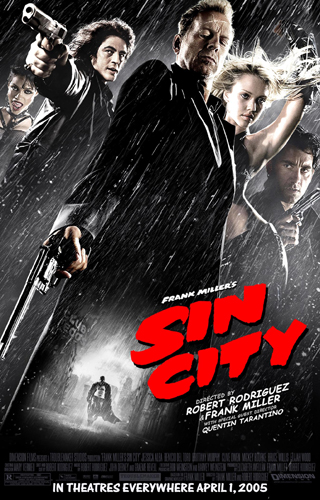 The poster signifies visually dazzling, sexy, cool, violence and deformed and soul destroyed characters.
However, Sin City isn't just the glossy sheen of Rodriguez and Tarantino.
Frank Miller is the cartoonist behind and co-director of the film, which aims to be a movie that captures a comic book panel by panel. Apparently you can cherry-pick scenes throughout the film that are composed exactly as Miller composed them.
I haven't seen, or read, the comic or deleved into the literary canon of graphic novels (comics for adults?), but I gather that there are seven novels in the Sin City series, plus one art book.
The roots of Sin City are in the mean streets depicted in the hard-boiled school of American crime writing. This includes Mickey Spillane, Raymond Chandler's Philip Marlowe, and Dashiell Hammett's 1930's classic The Maltese Falcon, which was turned into a film by John Huston in 1941. Frank Miller is working in one of the basic American literary traditions.
Prior to Miller's Sin City series there was the Dark Knight series.
Sin City works within the dark, shadowy, nihilistic styles of literary/film noir. It is a world of brutal violence; the sex is passionate and rough; criminal activity and prostitution is rampant, commonplace and a way of life; the characters are psychotic.
'Tis modernity as dystopia. It is everything the conservatives fear most: their nightmare of a violent Hobbesian world in a nearly lawless urban landscape is a violent modernity that has become sordid and pathological. Hence the conservative response for more order and discipline to achieve security from fear, and a return to the Judaic-Christian tradition to give social cohesion.
The poster suggests that the film directed by Robert Rodriguez and Frank Miller has turned away from the roughness of Sin City comics. the film. It looks to be glossy, slick and high tech (digitally-rendered backgrounds) and disconnected from the everyday lived emotional reality of a violent pathological modernity.
A Frank Miller graphic:
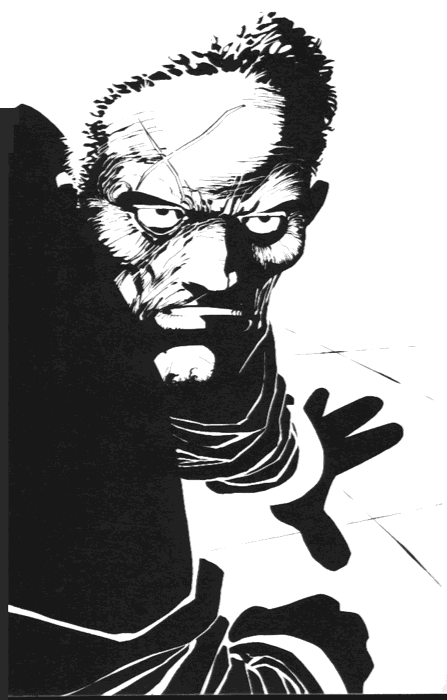
The graphic cuts the poster in terms of form and content. It is far more edgy, dangerous and expressionistic. The form is the sendimented content of the German expressionist artists and filmmakers.
Some reviews
July 26, 2005
smilely smile
This smiley smile post picks up on this post and this one and this.

The quote is from John Hartley's The Politics of Pictures:
"Given that the public, elusive at the best of time, has a historic tendency not to stand still and take impressions that are deemed good for it, but simply to walk away, the media's efforts at popular instruction (whether the object of the exercise is didactic or democratic, disciplinary or disruptive), are strikingly succesful. With drama, entertainment, pictures and pleasure as their stock in trade, the media are the first and greatest of the 'smiling professions', and the public they create out of these raw materials is the envy of education and government." (p.121)
Hartley says that smiling is now the 'dominant ideology' of the 'public domain', the mouthpiece of the politics of pictures apart from the old fashioned 'straight-faced craggy-jawed masculism of law, medicine, science, education and the military.
Philosophy, of course, is a classic no smiler.
July 25, 2005
records, mirrors, performances
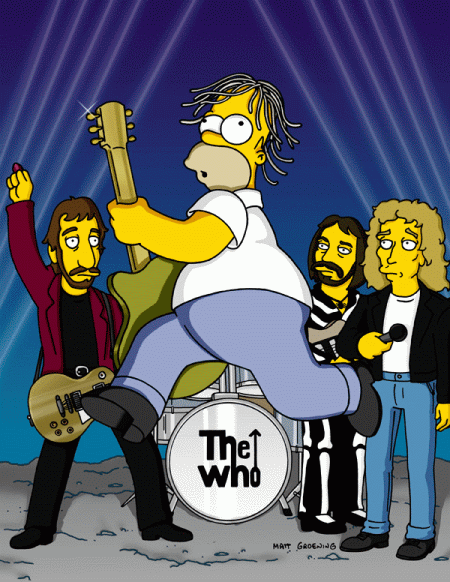
Promo card for A Tale of Two Springfields"
In rock music the performance is usually given a higher priority than recording. This is not just the rock romanticism of the dramatic live show that expresses authenticity and emotion ---eg., the Who Live at the Isle of Wright; with the live performance as the paradigm of musical presentation.
It is the view that the recording is a documentation of the performance. This is a denial that language is present, in that it is held that the Who's studio sound is quite similar to the sound of the stage act, albeit recorded with overdubs and other standard studio tricks. Recordings are mirrors: the CD is the transparent medium for getting at the music. What is downplayed is the way that the recorded sound is manipulated, filtered, edited, crafted and altered--a sculpturing of recording sound; a working of the actual sound to create the overall sound.
This is what we see with the making of the music in the classic rock albums series, which show how the particular classic album was put together, and the considerable time that was spent on the recording of the album.
Who's Next is a good example of this. Much of it derives from Lifehouse, the ambitious sci-fi rock opera concept album that Pete Townshend abandoned, and latter released after nearly three decades. It indicates that the Who were more than Townsend's backup band.
July 24, 2005
Fiona Hall
I went and saw the Fiona Hall exhibtion at the SA Art Gallery this afternoon.

Fiona Hall Leaf Litter, 2002-3
July 23, 2005
Denise Green: image and metonymy
Denise Green is showing at the University of Queensland Art Museum
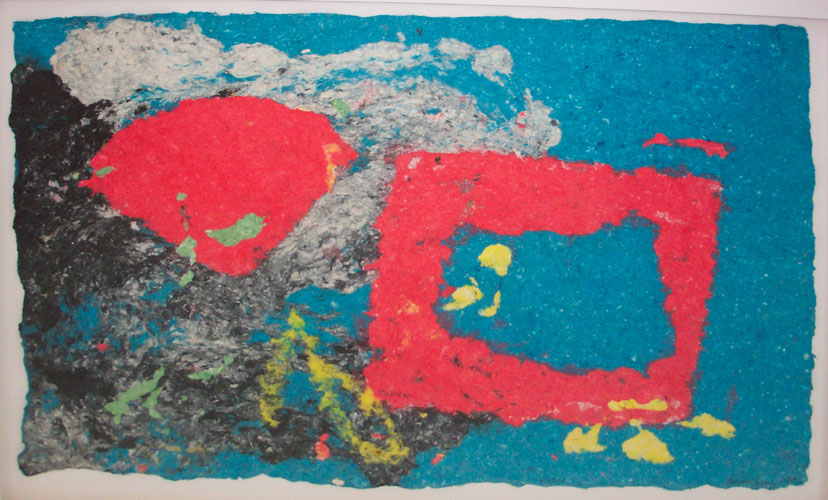
Denis Greene, Modhera
These are richly coloured canvases. Green gave a talk last Saturday on 'Metonymy in contemporary art: a new paradigm'. There is no archive or podcast of this so I have no idea what was said. I understand the talk is based on her book Metonymy in Contemporary Art: A New Paradigm, which has just been published by Macmillan.
One account of metonymy relates to narratives set in linear time. I find Green's canvases richly coloured, and appreciate the sophistication of the formal arrangement of image's elements, but I do not see a linear narrative.
Another account says that metonymy is the use of a single characteristic to identify a more complex entity. For example,'The pen is mightier than the sword' signifies that "pen" denotes publishing and "sword" denotes military force.
July 21, 2005
The Sopranos: Season 1
Thanks to Homescreen I'm watching the first season of the Sopranos Season 1 on DVD, instead of the repeats on free-to-air television, or the one dimensional Law & Order, NYPD and CSI.
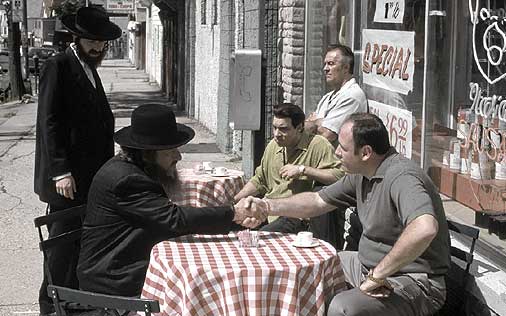
I'm impressed. This is classy, wellcrafted, work. I'd given up on the gangster genre after Martin Scorsese's 1990 excellent Goodfella's. I struggled to watch the third part of Francis Ford Coppola's The Godfather(1990). I've missed the British versions of the genre.
I love the sharp, witty dialogue; a suburban mob boss seeing a pychiatrist due to anxiety attacks; the mob boss is on Prozac whilst the daughter is on ecstasy; the darkness of the dysfunctional suburban family; the chaotic, violent incompetence of the New Jersey mob running their "waste management" business and nightclub; the continual visual and verbal references to the Godfather; the sense of dislocation within 1990s Italian culture and everyday life; the way time is slipping away; their own impending obscurity as their form of life fades away; and the music. The overall sense is one their suburban world coming to a tragic end. Things just don't look good.
The postmodern show is so accessible that it undercuts the need for the literary/film institution, with its high cultural (Leavisite?) assumptions, to filter, order, shape and interpret the work for us by those with highly valued cultural capital to act as academic critics.
What I find interesting is the form. It transgresses the linearity of most TV dramas to give us a complexity of action moving forward in odd lurches without explanation. Things just happen. This refusal to signpost why x happens is what gives rise to a sense of dread.
July 20, 2005
Easy rider revisited
Wasn't there a Byrds song from around the time of Easy Rider, entitled 'Wasn't Born to Follow'?
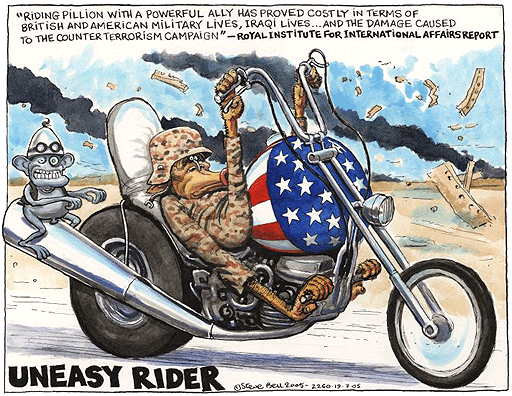
I like the ugliness of the line. It reminds me of some well known US comics whose name I cannot remember.
The Royal Institute of International Affairs (Chatham House) Reportfor those interested in such things. Their report concluded that by riding pillion to the US in the invasion of Iraq, Britain (and the other members of the Coalition) had increased the risk of terrorist attacks on their own soil.
An Australian cartoon on a similar theme.
Easy Rider was a late 1960s "road film" (1969) made around the time of Woodstock. It was about the search for freedom (or the illusion of freedom) in an authoritarian, racist and corrupt America, in the midst of paranoia, bigotry and violence. The two buddies went looking for America but they couldn't find it.
They won't find it in Iraq either. What they will find though, is little by way of credible arguments to defend the occupation of Iraq.
July 19, 2005
overlapping signifiers
Given that all the bombs, bodies and deaths associated with the "war on terrorism" a part of our everyday world, the work of Francis Bacon appears to be of its time, does it not?

Francis Bacon, Painting,1946
'Painting' is a complex image. The description provided is this:
"The scene is an old fashioned butcher's shop with ceramic festoons on the walls and, looming up in the background, a carcass....which is also a headless Crucifixion. In front of this, under an umbrella, is a figure which seems to be that of a politician (or even a Pope) addressing a battery of microphones; on either side of the foreground is a side of meat attached to a tubular structure evocative of gymnastic apparatus."
I reckon we can further than this description in terms of what it means for us today living in a war zone.
I re-interpret the image in terms of being reminded of the standard or routinised mass media image of politicians standing in front of presidential lectures delivering a set speech to the media about how well the war is going. I see the carcasses of the dead bodies hanging behind them as grim reminders of the success.
Yeah, it's crude to the point of vulgarity. But we are talking about raw experience here. What I should say is that this kind of baconian imagery helps us deal with the problem of experience we are living.
constructing a musical listener
Since I've been listening to music I have begun to wonder about the role of the listener in the music heard on the radio of the culture industry. I hear it in shopping malls, taxis, airports, on the street as I walk the dogs.
It seems as if commercial radio constructs me as mindless, as someone who does not have a culture, has little connection to serious music, and does need to be cultivated.
This kind of culture was no longer humanizing me as an individual. In fact, due to the concern with ratings to chase the all important advertising dollar:----this culture did not even bother to try to cultivate me. It is same with free-to-air television. Neither form of media cared about educating me, and both are quite happy to leave me uneducated and stupid.
The effect on me was to leave me anxious, inadequate and speechless. As I hummed along to the old tunes enwrapped in memories and illusions, I could feel myself regressing from all the violence hurled at me.
Where was the music that caused me to have goosebumps or shudder about the brewing disaster?
July 18, 2005
Of course, we are meat
A quote by Francis Bacon that I came across in Gilles Deleuze's, Francis Bacon: the logic of sensation:
"Of course, we are meat, we are potential carcasses If I go into a butcher's shop I always think it's surprising that I wasn't there instead of the animal."
Bacon, however, goes into the butcher's shop as if it were a church.
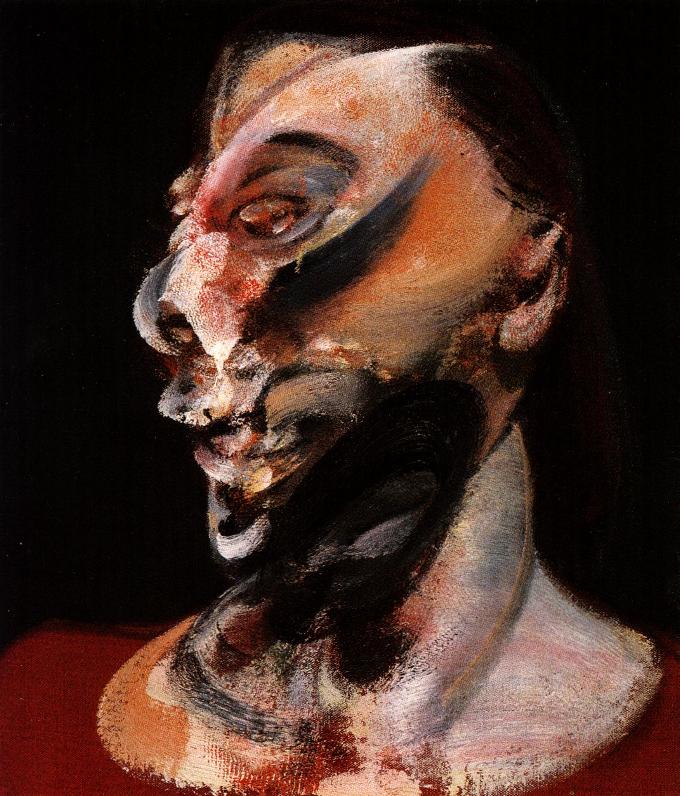
Francis Bacon, Three Studies of Muriel Belcher, 1966, Right Panel
Though Bacon understood planet earth as a slaughterhouse on the verge of annihilation at any moment, he also blurred the divide between humans and animals.
Bacon said:
"Nietzsche forecast our future for us--he was the Cassandra of the nineteenth century---he told us it's all so meaningless we might as well be extraordinary."
If life is so meaningless then suffering cannot be made sense of because it has no meaning.
July 16, 2005
Lifehouse: redemption+rock
I watched a DVD of Pete Townsend's Lifehouse music performed at the Sadler's Wells Theatre, London on February 25th & 26th 2000. I presume the DVD is from these two shows.
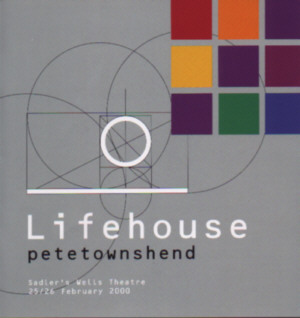 Lifehouse was to be a journey through the scarred wasteland of a futuristic, polluted middle England, where a computerised 'Big Brother' grid imposes virtual reality on the populace and the subversions of rock music offer the only salvation from suffering from a damaged life.
A romantic tale?
The songs in the concert did not offer the listener this kind of narrative. Nor did the narrative come through as we had the music, not the play with music. There was no mention of the film --is it yet to be? How does the film link up to the play and the music? And the idwea of the audience artist interaction featuring improvisation and spontaneity with the music emerging from the community seemed to have been forgotten.
Townsend made brief reference to a BBC play in 1999 of 'Lifehouse' Radio 3 and a 6 CD box set, 'The Lifehouse Chronicles'. Presumably, the two shows at London's Sadler's Wells were to sell the CD set. The set includes the original tracks for the project, which Townsend recorded in 1970 and 1971, as well as new music, orchestral pieces, the radio play and text on the history of the project.
I've found a little background on Lifehouse. There is little by way of online archive of the 1996 BBC Radio 1 documentary on Lifehouse, directed by John Pidgeon, called The One That Got Away'. I found this critical reviews of the Sadler Wells music.
The band was a rock band (keyboards, bass, electric guitar, percussion, and 3 supporting vocalists) plus the London Chamber Orchestra. Townsend fronted as vocalist playing an acoustic guitar. He acted as the tormented, self-conscious creative artist with absolute control over his creation. That elitism is in contradiction to rock as popuar music wuith its roots in thre urban community.
The music was familar, as a lot of it was performed on the Dionysian Who's Next:---Baba O'Riley', 'Won't Get Fooled Again' and 'Song Is Over'. These classic songs were parred down to their musical bones and their melodic strength shone through.
Rock and redemption? That big theme assumes that artistic form liberates society from the prevailing social order. Tonsend's liberating artistic form contained a hint of reconcilation of nature and culture. But, by themselves, an artwork cannot actually transform society.
July 15, 2005
Rock aesthetics: romanticism, Grateful Dead
I heard someone on Radio Breakfast say that music--meaning rock and roll for the masses---was to be listened to, and not written about. The statement was not picked up by the Fran Kelly the presenter. It was if there were no cultural meanings around music, and there was no such thing as a tradition of aesthetics that gives us the categories to make sense of autonomous art and popular culture.
What should have said is that music does need to be written about.
Consider the concept of Animated Architecture, which refers to Candice Brightman's magnificient light shows for the Grateful Dead

Jim Anderson
Consider what Marmaduke Dawson, guitarist of the New Riders of the Purple Sage, who toured with the Dead in 1970-71, says of the Grateful Dead:
"None of them knew where they were going, especially during the long, three- to five-hour sets when, fortified by a good bit of LSD, they were trying for the magic. Garcia would be there playing around with something and Weir would be playing around with something and everybody would be doing five things together on the stage, and people would still be listening and saying, what the hell is going on here? And sometimes they would get it, the magic of all of them seeming to think together. The magic could be worth waiting for, but for the fans, so too was the waiting."
Well that magic--the existential rush of teetering on the edge of chaos, when chaos gives birth to new musical forms---wasn't happening in the 1990s in the large stadiums playing to 60,000 people.
This doodling is usually interpreted in terms of romantic aesthetics: what David Gans calls self-expression, self-indulgence, being in the moment, making it real, being honest about it, and fostering a higher consciousness based on unconscious processes. It is an aesthetic that elevates the artist's orginality, emotion, spontaneity and invention as the measure of aesthetic success as artists rather than entertainers.
However, Candice Brightman's light shows are a long way from a bunch of freakish acid heads and dreamers, who drawing on the authentic tradition of white folk music and African-American blues, to create authentic music. It is high tech, fabricated, and linked to the doodling.

It suggests that rock is not immediate, real or authentic in a way that jazz or classical music is not. It undercuts the romanticism of rock critics, such as Dave Marsh and Greil Marcus, who run the romantic aesthetic of authentic self-expression counterposed to inauthentic estalishment pop.
The Grateful Dead were a corporation whose marketing strategy was premised on a counter cultural (alternative) ethos of authenticity that was positioned against convention, decadence and betrayal. Authenticity was established through the outsider, outlaw Dionysian image of Andrew Oldham marketing of the early demonic Rolling Stones, the Malcolm McLaren marketing of the nihilistic Sex Pistols, and the authentic, blue collar Bruce Springston's spontaneous outflow of genuine emotion.
Why not celebrate style or performance rather than intensity of feeling?
There are lots of meanings around music. Why there is even a rock canon that has been constructed that privileges 1960s music.
Artistic musical expression and experimentation, commerce (product for popular consumption) and advanced electronic technology walked hand in hand in the 1990s. Though rock music in this setting does not seem to be very rebellious, it is not a sellout to the corporation either. Rock is rooted in recording techology and the commerce of the music industry.
Time to drop the romanticism I reckon, since since rock music is a commercial enterprise that has little to do with high art and high culture and more to do with pulp fiction.
However that does not mean we need to accept the postmodern repudiation of aesthetics by cultural studies academics; nor accept the dualism of popular and high culture with the former the negative opposite of the latter.
July 14, 2005
alert and alarmed
A witty Nicholson cartoon published in the popular media (The Australian):
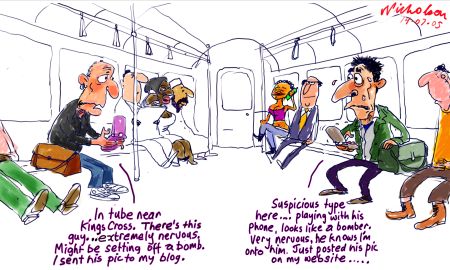
Tis a good example of the politics of pictures. An okay article by Fareed Zakaria in Newsweek. Fareed says:
'The other important difference between the London bombings and 9/11 has been the response of the world of Islam. For months after 9/11, I kept writing that it was sad and disturbing that Muslims were reluctant to condemn the attacks. This time is different. Major Muslim groups in Britain have unambiguously denounced the bombings. Even "fundamentalist" organizations have condemned it. The Muslim Association of Britain, a hard-line group with alleged ties to militants in the Middle East, called the bombings "heinous and repulsive" and urged Muslims to help the emergency services and police.'
Fareed is right when he says that simple slogans that tell us that we fight terrorists in Iraq so that we will not have to fight them here, are just slogans. They are not comprehensive policies.
July 13, 2005
images and democracy
Benjamin R. Barber is uneasy about pictures and the influential effects of images. He understands our world in terms of the conflict between tribalism and globalism, with both posing threats to democracy.
A quote from Benjamin Barber about the internet and democracy:
"There is considerable ambiguity surrounding the use of pictures and text in the new technologies. In its early incarnation, the web has been a word-based technology (scrolling text) that has actually countered the pictorial leanings of television. I have argued elsewhere that by returning us to 'the word' the web is an apt medium for politics, law, deliberation and contracts. Reason and promising are the products of the word and for all its technological progress, this remains a civilization based on the Word. The word-centered character of the technology is good for democratic politics, good for participation and good for deliberation (only plebiscitory democracy benefits from manipulated images). Yet, this focus on the word is but a matter of technological lag-time. The Net is faster and getting faster. Streaming video is the wave of the future, allowing moving pictures to displace text. Moreover, the generation being trained incomputers today is a television educated, picture-inundated generation that prefers 'moving pictures.'"
Barber has a problem with the visual culture in relation to democracy:
"In as much as democracy is the politics of reason and of promising, and reasoning and promising demand the currency of words, democracy will rely on words rather than pictures and streaming video will not be a welcome development. It maybe that the transition from a civilization of the word to a civilization of moving pictures will inaugurate new political institutions rather than eroding democratic institutions. Yet such a civilization may be less able to sustain promising and the social contract, or the kinds of discourse that make democracy possible."
Yet images play a key role in politics. We need to learn how to read and critique images.
July 12, 2005
the politics of pictures
John Hartley in his search for the public in the age of the media in
Politics of Pictures says the following:
"Chapter 2 begins the forensic analysis of the public domain by tracing it to its classical roots, the Greek agora or Roman forum: the physical public sphere at the centre of the city state, wherein the public actually congregated in order to conduct political, legal, religious and market affairs. Now its gone; there is no public space. It hasn't disappeared but gone private and turned into pictures."
You've guessed it. Everybody's at home watching the telly. That implies that the media are the public sphere. Hartley is explict about this:
"Television, popular newspapers, magazines and photography, the popular media of the modern period, are the public domain, the place where and the means by which the public is created and has its being."
We sit at home watching pictures and so contemporary politics is conducted in the private and personal realm. But Hartley goes beyond the obvious media like television and the news to pictures such as record covers, postcards, musems, advertisements, magazines etc What we get is a visual sense-making.
They are waiting there like dead bodies/things to be forensically dissected and interpreted.
July 11, 2005
the best that could be done?
The G8's response to the poverty of Africa have been overwhelmed by the London bombings. That event overwhelms everything.

You have to go Posted by Gary Sauer-Thompson at 10:45 PM | Comments (0) | TrackBack
July 10, 2005
architectural photography

University of Sunshine Coast Library
"Photography has great influence in architecture. Comparatively little knowledge of recent architecture is gained by first-hand experience: most of it is known only through images. Photography is the principal means of communicating new ideas and processes, and architectural photographs continually present new perspectives on buildings and the built environment. Yet despite this influence, relatively few Australian photographers work exclusively in architectural photography. (Two notable exceptions are Peter Hyatt, editor of Steel Profile, and Patrick Bingham-Hall, publisher and editor of Pesaro Publishing.) By the mid-1990s there were around one hundred professional architectural photographers nationally – most of them also accepting a wide range of other kinds of commissions. A generation earlier, when Australian architectural photography was still comparatively young, the leaders were Max Dupain, David Moore,Wolfgang Sievers, Richard Stringer and Fritz Kos. This handful established standards for the photography of Australian architecture for the 1960s and beyond. Their work appeared frequently in Architecture Australia and its predecessors, and thereby became well known to the broad architectural profession. Two generations on, John Gollings, Patrick Bingham-Hall, Anthony Browell, Trevor Mein, Brett Boardman and Jon Linkins are among the country’s most prominent photographers, and their work appears frequently in the pages of the magazine. The link between particular photographers and Architecture Australia and its predecessors is significant. Regular publication and acknowledgment in the journal bears an unofficial but implicit imprimatur of acceptance by the architectural profession".
July 9, 2005
Adelaide Festival of Ideas---2005
I'm just going to link this Visual Culture and National Identity for the moment. I will come back to it given the importance of including, for example, ideas of "Australianess" in the discussion of visual culture(traditionally painting, photography, and cinema) has been historically important.
It is an old and central theme in Australian culture and one that is still particularly relevant to living in particular regions in a global world. It is an issue in which there has been a vigorous public discussion in Australia.
On that note the Adelaide Festival of Ideas is on again in the dirty drug capital of Australia (the drugs are laced with poison) and still caught up in the Randall Ashbourne political corruption affair. Though Adelaide is mocked as a big country town on the way becoming a retirement village, it does do the discussion of ideas in a public space well.

The full programme is oneline. It is very activist orientated--finding ways to make the world a better place. The idea is that we are overwhelmed by information and we have troubling translating that into knowledge and then into action.
The Festival has had a low media profile--unsuprising given the anti-intelllectual populism of the Murdoch rag called The Advertiser and the self-satisfied complacency of its columnists.

However, like most cultural institutions in Australia, the Festival does not have a strong online presence. None of the talks are online. So it has the feel of town meeting prior to the digital age. It is popular because it is that.
I missed the Thursday night forum session in the Adelaide town Hall. Entitled on 'Perils, Real or Imagined', it was about domesday scenarios and apocalypse soon. I don't need help to sort through the chaff of alarmism (a meteorite collison) to understand that global warming is a big threat to our way of life.
The Friday night forum session at the Adelaide Town Hall was on 'How to be Good', which would be the core of the programme. The emphasis is on goodness as an ethical category not an ethical/political one of an ethical life..
I have little interest in Saturday's session, Designing the Universe, as I am evolutionist who does not take creationism seriously and I'm not persuaded by the classic argument from design.
I notice that there is nothing on urban design and make Adelaide a more exciting and sustainable urban place based on a dwelling mode of being-in-the-world?
July 8, 2005
Abstraction
on the shore looking out to sea:
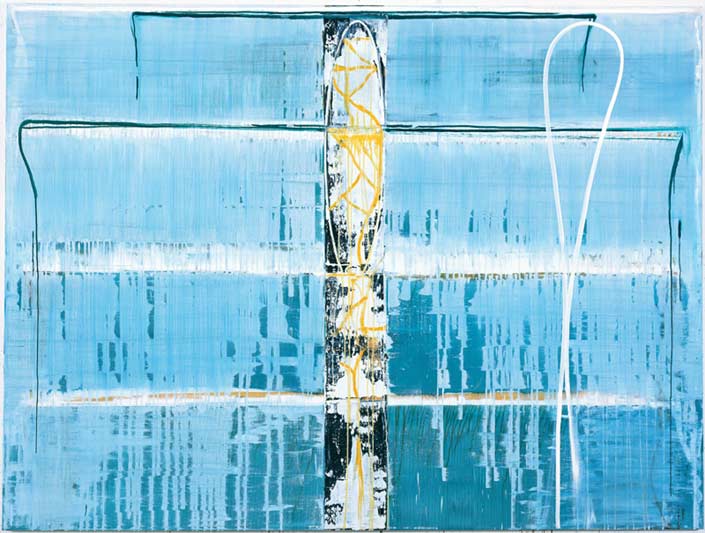
John Firth-Smith
We have both traditions of representation and abstraction here. We are looking out towards the meeting point of sky and sea and seeing the painted surface.
July 7, 2005
the gray sadness
It is raised here in The Age by Greg Barnes as low-level depression. He calls it the grey sadness:
"What colour is the world today? It's never black and hopeless, more grey and dull. You struggle to find blue sky because the sun's rays never seem to penetrate the pall of pale sadness that covers you from head to toe. But you can function like the average Joe. This is not the dramatic depressive episode about which the doctors, mental health advocates and media speak. The one where you can't get out of bed, you spend the day in tears and you are immobilised by the pain."
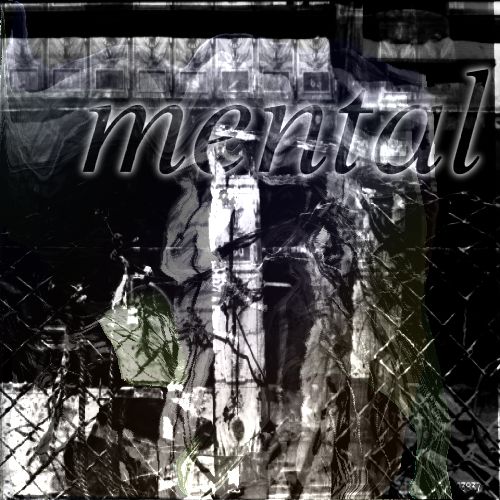
Barne's account of grey sadness is mocked by the libertarians over at Catallaxy. They argue that the grey sadness is personal not public, and so should not be featured in an op.ed in the broadsheet press.
That response ignores the strategy of the world's big, multinational pharmaceutical companies is to sell drugs to healthy people, to aim for "an ill for every pill", and undermine the independence and ethics of medical practice.
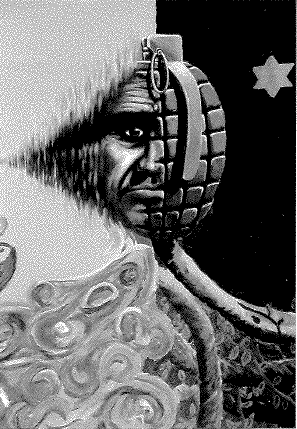 [TPH(Vietnam Vet & Art Group), photo Di Briffa]
Perhaps the libertarian's concern is that what Freud has called "the worried well" has become the worried sick though the medicalisation of some of the ordinary tribulations of human existence?
The impact of the medicalisation of ordinary life has created the culture of depression that is treated by antidepressants.
It is the medicalization of the gray sadness in the form of pills and the drug based cure that is sold by big Pharma, and pushed by GP's, psychiatry and the local pharmacy which is the problem.
It is the language of psychiatry that needs to, and should, be questioned.
July 5, 2005
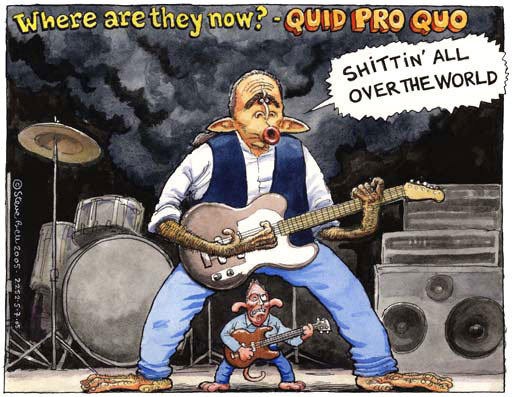
1990s Grateful Dead
I'm on holiday this week as I'm between jobs. So I've started listening to 1990s Grateful Dead. At the moment the music is being accessed through internet files.
My initial judgement is that 1990s Dead is a very different band to the one of circa 1977. This indicates that the sound of the Grateful Dead at different stages of their career is an expression of the personnelas well as the albums.
The image:
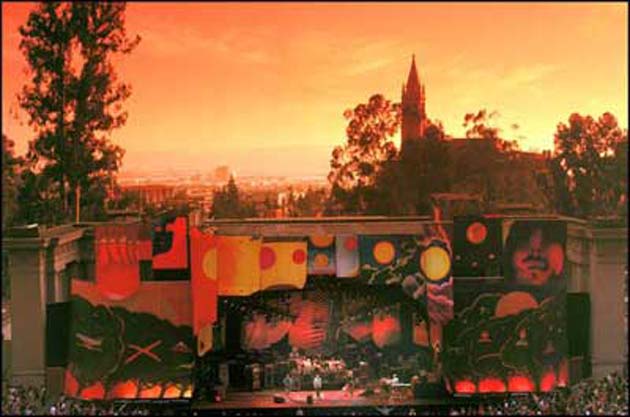
Susana Millman, Grateful Dead, Greek Theatre, Berkeley, Ca - August 18, 1989
The music courtesy of Theodore Grayck.
The populist rock criticism that devalues the musical innovation of this band.
I do not have any DVD's of the 1990s band, but I am considering ordering Without a Net, which is structured around the 1990 tour.
I am curious about the work arising from the guest appearance of Branford Marsalis on saxophone, and the collaborative work with the atonal free-form jazz (harmolodic) of Ornette Coleman in the early 1990s.
Is that kind of music explored on Infrared Roses? This appears to be a compilation taken was taken from the live moments during a portion of their concerts known as "drums and space".
And this sends me back to 1968 "Anthem Of The Sun" Dead, when the original five-piece Dead line-up was expanded with the addition of second drummer/percussionist Mickey Hart and additional keyboardist Tom Constanten, which gave a fuller muscular sound to the entire band. "Anthem Of The Sun" captured the psychedelic Dead in its prime and is a carefully constructed mix of studio and live recordings along with a editing and mixing job and wild studio effects.
July 4, 2005
Graham Sutherland
This reminds me of Francis Bacon:
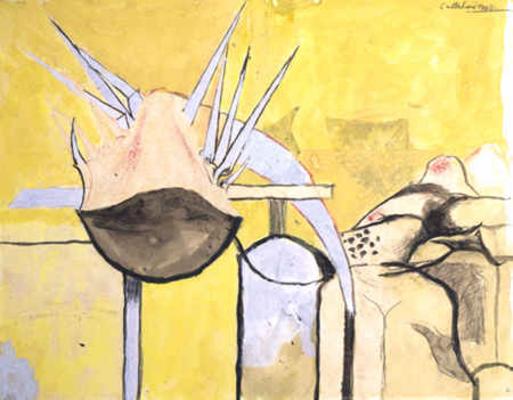
Graham Sutherland
I do not know the title or year of the work.
Live 8: an awesome multimedia event
As one of the 2-3 billion people watching the pop and politics of Live 8, I caught bits and pieces of the Hyde park concert in front of 200,000 people on free-to-air television last night.
I saw Paul McCartney's clever and colourful St Pepper concert opener; was impressed by a professional Sting and an energetic Robbie Williams; was suprised and deeply moved by the warmth and emotional charge of a historically reunited Pink Floyd playing Wish You Were Here, which was dedicated to reclusive ex-Floyd member Syd Barrett; and caught bits of McCartney's final set of The Long and Winding Road and Hey Jude.
I missed Maddona, Coldplay and the Who at Hyde Park, saw nothing of the Berlin, Tokyo or Philadephia concerts, was taken in by the references back to Live Aid and wondered about the non-appearance of the Rolling Stones again.
Where was the black music? Where where the African rhythms and singers? Wasn't Live 8 about Africa? Well, the African musicians were down in Cornwall while the big white superstars were in London. Is that the best way to celebrate Africa's musical talent?
The political signs were everywhere: justice not charity, trade not aid, make African poverty history. The aim of the five free concerts staged around the world featuring the biggest names in music and televised globally was to persuade the G8 leaders to accept a package of reforms on developing world trade, debt and aid.
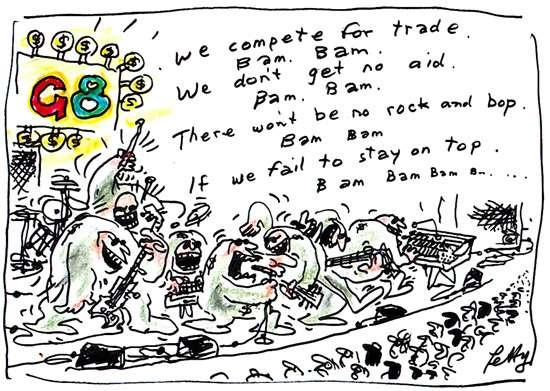
In a week or so leaders of the eight most economically powerful economies in the world will meet at Gleneagles. Will they come to a deal on Africa, poverty and climate change? Will these powerful nations impose neoliberal policies onto Africa?
Could not the rich G8 nations begin to end the obstacles to growth they currently impose on poor African countries - eg., remove the huge subsidies Europe, the US and Japan give to their farmers. Then the nation-states of Africa could begin to be the architect of its own survival. Trade not aid.
Will the G8 this week take up the challenge to mutually end agriculture subsidies? I cannot see Bush or Europe giving much ground here.
Update: Tuesday July 4
The carnival of Live 8 certainly was a spectacular global visual event that made people notice.
I have just come across the Live 8 website, the live feeds of the concert, Danny Wallace's blogging and the Edinbourgh coverage and the Guardian's bloggers
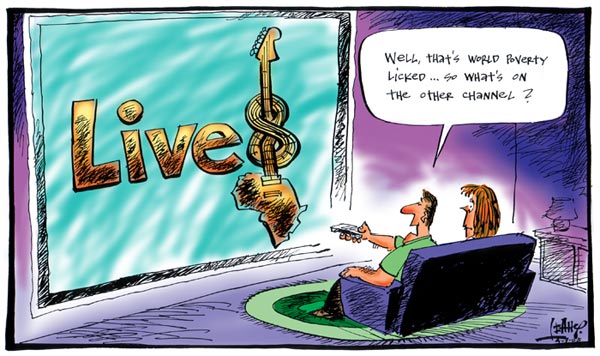
Leahy, After Live8
This does capture a reality beyond the reality of living in a virtual world. President Bush is not likely to give ground on removing subsidies to American farmers. As The Guardian reports:
"Princeton Lyman, an analyst at the Council on Foreign Relations pointed out that the [Bush] administration spends $3.9bn (£2.2bn) a year on subsidising American cotton farmers - more than it spends on African aid.Cutting off such huge subsidies to agro-industry would strike a serious blow to congressional Republicans now fundraising for the 2006 mid-term elections. The president has enough troubles in Congress already without sparking a revolt. The problems the administration is having pushing through the Central American Free Trade Agreement demonstrate the strength of protectionist sentiment on both sides of the aisle."
G8 Gleneagles could be an anticlimax.
July 3, 2005
Architecture: why worry about design
I've noticed this in Australia. Architectural style and design is not important for house buyers. Their concerns are price and cost. If style comes into play it is as a preference for size--the Sydney McMansion--or as heritage.
Design is the variations on the standardized shape offered by the corporate builders. Judging by the Hindmarsh Island Marina Development the emphasis is on lifestyle and not good design.
July 2, 2005
Six Feet Under
The first mail video arrived from Homescreen that I mentioned here.
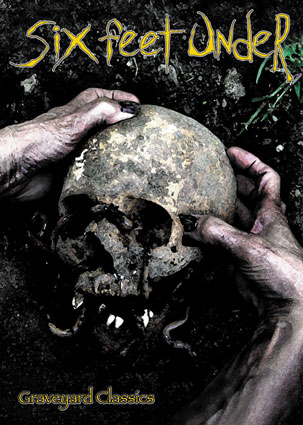 It was Six Feet Under: The First Season, which had been created by Allan Ball. I did not know his TV work, nor have I seen Ball's American Beauty.
I was impressed. It is very David Lynch with its tense balance between the sublime and the banal of people's everyday suburban lives.
Is that link to Lynch that made the strangeness (pulling back the curtain on suburbia) so familiar?
What is revealed is a darkness that is brightly and evenly lit.
I've only watched one episode--4---but from what I can gather it is the lives and loves--and deaths---of a southern California family of undertakers. The messed up Fisher family---owners of an independent funeral home in Los Angeles--- are shown dealing with death on a pretty much daily basis.
July 1, 2005
an easy going cubism
Courtesy of Artrift
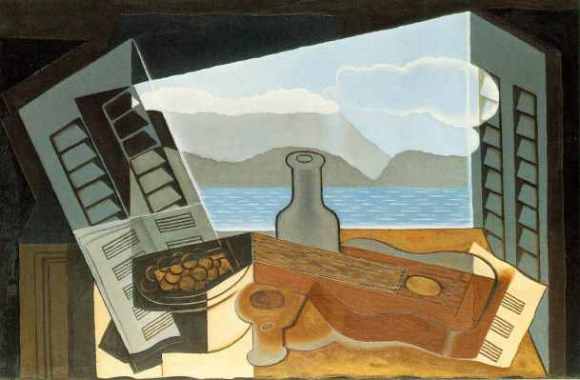
Juan Gris, The Open Window, 1921 Oil on canvas, M. Meyer Collection, Zurich
The painting highlights the way the cubists sought to show everyday objects as from different perspectives at once.
That concept is easy to grasp at an intuitive level is it not? Imagine a cubist painting of the ups and downs of a relationship over time.
That should undercut the traditional view of a modernist art alienated, or separated, from the everyday. What it does indicate is the critical turn made by art in the early 20th century: a negation of both organic synthesis (unity) in art and the mood of a romantically informed impressionism.