|
July 16, 2005
I watched a DVD of Pete Townsend's Lifehouse music performed at the Sadler's Wells Theatre, London on February 25th & 26th 2000. I presume the DVD is from these two shows.
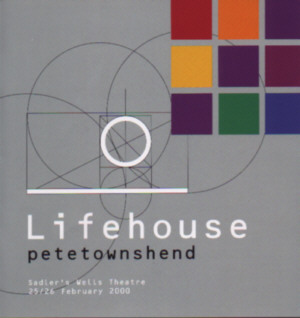 Lifehouse was to be a journey through the scarred wasteland of a futuristic, polluted middle England, where a computerised 'Big Brother' grid imposes virtual reality on the populace and the subversions of rock music offer the only salvation from suffering from a damaged life. Lifehouse was to be a journey through the scarred wasteland of a futuristic, polluted middle England, where a computerised 'Big Brother' grid imposes virtual reality on the populace and the subversions of rock music offer the only salvation from suffering from a damaged life.
A romantic tale?
The songs in the concert did not offer the listener this kind of narrative. Nor did the narrative come through as we had the music, not the play with music. There was no mention of the film --is it yet to be? How does the film link up to the play and the music? And the idwea of the audience artist interaction featuring improvisation and spontaneity with the music emerging from the community seemed to have been forgotten.
Townsend made brief reference to a BBC play in 1999 of 'Lifehouse' Radio 3 and a 6 CD box set, 'The Lifehouse Chronicles'. Presumably, the two shows at London's Sadler's Wells were to sell the CD set. The set includes the original tracks for the project, which Townsend recorded in 1970 and 1971, as well as new music, orchestral pieces, the radio play and text on the history of the project.
I've found a little background on Lifehouse. There is little by way of online archive of the 1996 BBC Radio 1 documentary on Lifehouse, directed by John Pidgeon, called The One That Got Away'. I found this critical reviews of the Sadler Wells music.
The band was a rock band (keyboards, bass, electric guitar, percussion, and 3 supporting vocalists) plus the London Chamber Orchestra. Townsend fronted as vocalist playing an acoustic guitar. He acted as the tormented, self-conscious creative artist with absolute control over his creation. That elitism is in contradiction to rock as popuar music wuith its roots in thre urban community.
The music was familar, as a lot of it was performed on the Dionysian Who's Next:---Baba O'Riley', 'Won't Get Fooled Again' and 'Song Is Over'. These classic songs were parred down to their musical bones and their melodic strength shone through.
Rock and redemption? That big theme assumes that artistic form liberates society from the prevailing social order. Tonsend's liberating artistic form contained a hint of reconcilation of nature and culture. But, by themselves, an artwork cannot actually transform society.
|


