July 31, 2012
SALA 2012
SALA is happening in South Australia. The photography is here. One person not mentioned here is David Hume's la città perfetta Hume is an abstract topographic painter and la città perfetta returns to an early 1995 subject matter--Venice but there is a switch from water colours to photography.
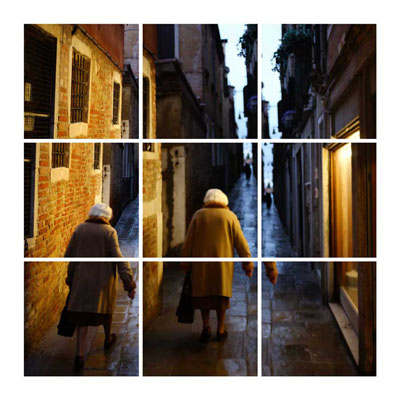 David Hume, propina Gicleé print from la città perfetta
What we see here is the cross over and mixture of mediums. The modernist demand for the purity of medium has gone.
July 26, 2012
Ampersand magazine: Capture the Fade
I stumbled upon this ---Capture the Fade--- a photography competition in which the winning and highly commended works were shown at an exhibition at the Paper Mill, Sydney on November 2010. It was run by the Sydney based Ampersand Magazine, which was mentioned in The Australian in a survey of magazines by Christopher Bantick.
The exhibition was then published on Tumblr.
July 22, 2012
faux-vintage mobile photography
Stuart Murdoch has collected a series of links about Instagram on Delicious that place the Instagram is destroying real photography complaints about faux-vintage mobile photography in perspective.
The best of these links is the essay by Nathan Jurgenson in which he argues that faux-vintage photography, while seemingly banal, helps illustrate larger trends about social media in general. He says that the faux-vintage photo is merely an illustrative example of a larger trend whereby social media increasingly force us to view our present as always a potential documented past:
the Hipstamatic photo places yourself and your present into the context of the past, the authentic, the important and the real.But, of course, unlike urban grit or the rarity of an expensive antique, the vintage-ness of a Hipstamatic or Instagram photo is simulated (the faux in faux-vintage). We all know quite well that these photos are not really aged with time but instead by an app. These are self-aware simulations (perhaps the self-awareness is the hipster in Hipstamatic)....These are all simulations attempting to make people nostalgic for a time past.
The very thing that a faux-vintage photo provides, authenticity, is thus negated by the fact that it is a simulation. However, this fact does preclude these photos conjuring feelings of nostalgia and authenticity because what is being referenced is not “the vintage” but “the idea of the vintage,”
The faux-vintage photo asks the viewer to suspend disbelief about the authenticity of the simulated nostalgia and to see the photo–and who and whatever is in it–as being authentic and important by referencing at least the idea of the past.....The rise of faux-vintage photographs, snapped on smartphones and shared via social media, is centrally an existential move that is deployed because conjuring the past creates a sense of nostalgia and authenticity.This reference to nostalgia goes deeper than the connection between Instagram and the generalized hipster/bohemian sensibility, which places a premium value on the old, the artisanal, and the idiosyncratic.
Instagram photos emphasize photography as an elegiac or twilight art, one that fakes the emotion of old photographs by cutting out the wait for history entirely. In On Photography Sontag writes:
It is a nostalgic time right now, and photographs actively promote nostalgia. Photography is an elegiac art, a twilight art. Most subjects photographed are, just by virtue of being photographed, touched with pathos. An ugly or grotesque subject may be moving because it has been dignified by the attention of the photographer. A beautiful subject can be the object of rueful feelings, because it has aged or decayed or no longer exists.
July 20, 2012
Australian photography: Katrina Koenning
German-born photographer Katrin Koenning currently lives and works in Melbourne, Australia. Much of her work investigates intricacies of the ordinary and everyday, and is concerned with questions of place and belonging.
 Katrina Koenning, Dry Creek near Globe Derby Drive, Adelaide, from Encounters with an Outer Land
The Encounters project is a work in progress, documenting regional and remote Australia in a globalised 21st Century. It was submitted to the Leica Oskar Barnack Award 2012
July 19, 2012
the impact of digital on photography
I joined the University of South Australia's library as a community member this afternoon. I was tired of trying to access books on photography online. There is not that much.
I was wanting to read Hilde Van Gelder and Helen W. Westgeest Photography Theory in Historical Perspective after reading Representation in Photography The Competition with Painting online some time ago.
The text was not on the shelves. I didn't have much time to explore the library but I noticed that there were lots books on individual photographers but few on critical writing about photographic culture. Maybe I wasn't looking in the right place.
 Jeff Wall, The Stumbling Block,1991. Transparency in lightbox.
In that first chapter Van Gelder and Westgeest explored both the extent to which photography and painting are capable of representing reality and the differences in character and origin of the two modes of representation. In the first section of the chapter they introduce the question of whether photography represents reality in a more objective and truthful way than painting, and, if so, how this is played out in particular contexts.
In the second section of the chapter they develop a comparative analysis of straight and composed photographs, emphasizing the importance of staging and perspective choices made by the artists discussed and the relationship with these characteristics of paintings. In this section they are exploring the impact of digital against he background of modernist photography.
They refer to this as straight photography by which they mean a specific aesthetic, which was:
was typified by higher contrast, sharper focus, aversion to cropping, and emphasis on the underlying abstract geometric structure of subjects. Combination prints were eschewed as much as staging pictures. This emphasis on the non-manipulated silver print dominated modernist photographic aesthetics well into the 1970s...the aesthetics of straight photography introduced aspects of formalist photography to America...In order for a photograph to obtain artistic acclaim, it had to stay true to a “straight approach to life”
This is in contrast to the work of Jeff Wall, which are “reenactments,” multi-layered combinations of an extensive range of shots, taken over a certain period of time “with a single camera position and with the camera set almost the same for every shot.
Some have argued that digital interventions undermine photography’s supposed inherently truthful status, and have thus come to herald the death of analog photography’s most specific hallmark As there are no original negatives to verify the truth of the image, the challenging idea of a photographic copy that has no original has circulated widely over the past decades.
July 18, 2012
London: paying the price
The Olympics have changed. They've become a global extravaganza. A sporting event ---a festival of bodies--- has become overlaid with commercialism, heavy-handed security, ostentatious plutocracy and phoney patriotism. The people of London have been sacrificed for the London Olympics that will cost the host city close to $20 billion.

This overlay when coupled with the International Olympic Committee( I.O.C.) history of corruption tarnishes the Olympic brand. The image that surfaces from the media hype is not a city city clogging up and grinding to a halt. It is the armed drones being deployed in the skies above his city and the blue fence around Olympic Park. It is the image of surveillance ---cameras, the blue fence surrounding the stadium, armed soldiers on rooftop buildings, brand protection teams” roaming the city.
The London Olympics is an example of civic enhancement that acclaim themselves as "regenerative" and find their expression most charismatically in architectural "grand projects": domes, stadiums, mega-sculptures and super-cities. It is a grand project as a firm of corporate futurism premised on the privatisation of public space whose stadiums may well become modern ruins in a global city
It is an example of what Ian Sinclair calls Grand Projects that are abandoned and useless and suck up lots of money. The Olympics, for Sinclair, London's heart of darkness.
July 17, 2012
Auckland Festival of Photography: Mary Macpherson
Mary Macpherson has an exhibition in the The Auckland Festival of Photography is a 7 year project about change in New Zealand society as seen in small towns throughout the country.
It is entitled Old New World and its narrative is one of a shift from the remains of the traditional New Zealand of the 1950s and 60s to places of boom and prosperity.
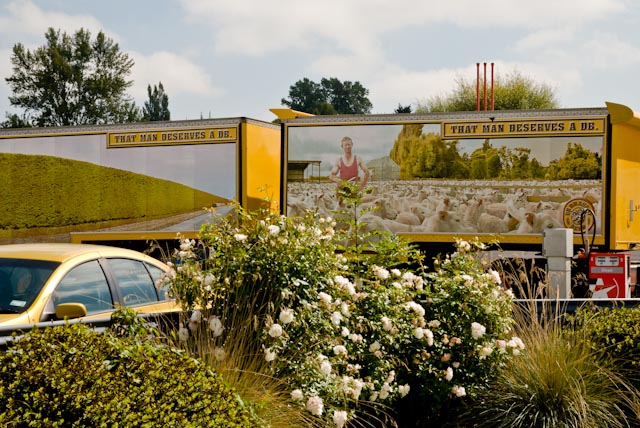 Mary MacPherson, DB advertisement, truckstop, Canterbury, 2008 from Old New World
MacPherson is interested in finding ways to get a sense of how people perceive their world. In Old New World this surfaces in the photographs of statues, murals and public artworks which show how people were representing regional and national history and regional identity.
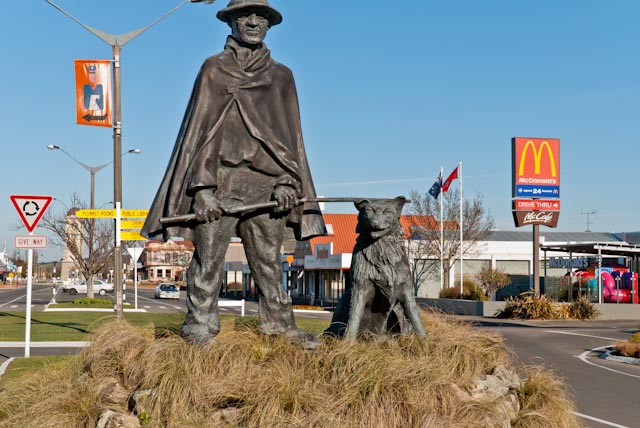 Mary MacPherson, statue, Manawatu, Whanganui, Old New World
Many of the small townspainted up the main street to attract custom and celebrate their identity. These were places that remained resolutely themselves in contrast to those that were heading into decline.
July 10, 2012
Colberg on digital photography
In his The digital revolution has not happened (yet?) on his Concientous Extended blog Joerg Colberg argues that:
digital photography has not really been used much at all to push the boundaries of the medium in ways other than getting maybe slightly improved versions of what you could do with analog cameras. Regardless of where you look, digital photography essentially has made life easier for people. There’s nothing wrong with that. But where are the artists who use the inherent properties of digital photography, all those things that are different from what you find in the world of analog photography?
The digital revolution has made things easier for me---I'm able to scan the old large format negatives that I'd taken in the 1990s when I had a studio in Bowden. These are ones that I processed but never printed but, thanks to digital technology, I can now publish on the internet and incorporate them into a DIY book.
Colberg is interested aesthetic not technical issues. He says:
Let’s be very clear here: Manipulating images on the computer is not new. It’s not revolutionary.Photographers have manipulated photographs in the darkroom for hundreds of years, and the first composites of sets of negatives date from the 1800s. Digital makes it easier, but it’s nothing new..what has actually happened is that while digital photography entered the scene, the world of photography has turned backwards, to increasingly focus on the past.
My turn to photographing with a a digital camera is to use it just like a analogue camera (eg., an old film Leica), rather than exploring the medium of digital photography.
Colberg adds that we have not even started to assess what digital photography could do once we stop treating it as a slightly improved version of analog photography:
Digital photography essentially is not well understood at all. Our thinking of digital photography conforms to our thinking of analog photography, even though in actuality the inherent properties of the two often are very different.
Digital photography is not an extension of analog photography or something that’s more convenient than analog photography. It is something that can do things that analog photography cannot do.
July 7, 2012
Lauren Marsolier: transition
Lauren Marsolier's body of work entitled Transition part 3. Transition refers to being in a place we know but can’t quite identify” and then as having a gestalt change, that is, a shift in how the world is seen.
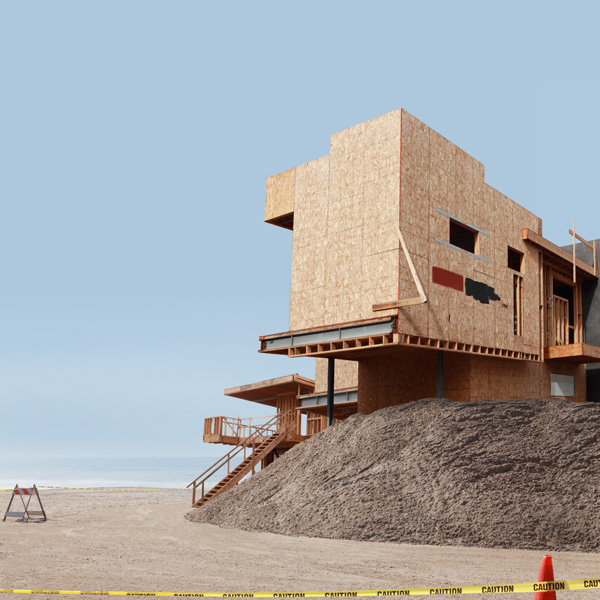 Lauren Marsolier, untitled, from Transition 3
The images of the built environment represent a place of disconnection and loneliness. They are constructed from real photographs that are then digitally altered and combined to create a new landscape. Is this replicated fragments of the world blended together an example of digital photography coming into its own?
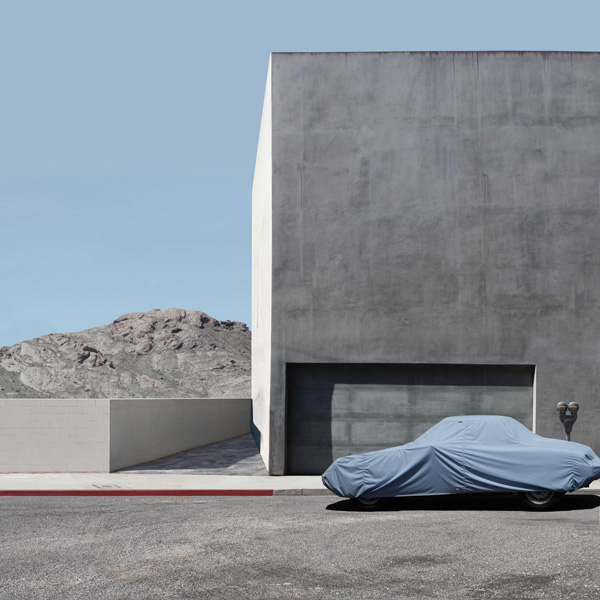 Lauren Marsolier, untitled, from Transition 3
Would this kind of work be an example of what Joerg Colberg is calling for a digital photography that can do things that analog photography cannot do. Or is it still an example of manipulating images on the computer, which is is not new, since photographers have manipulated photographs in the darkroom for hundreds of years.
July 5, 2012
Carl De Keyzer: Moments Before the Flood
It is widely accepted by climate change scientists that the sea level will rise dramatically before the end of the century. Carl De Keyzer's book Moments Before the Flood is a photographic investigation into how Europe is coping with this difficult to gauge threat. The coasts of Europe are the areas which will bear the impact of the rising sea levels and the project poses the question: is Europe prepared for this sea level rise and to what extent will its efforts prove to be futile.
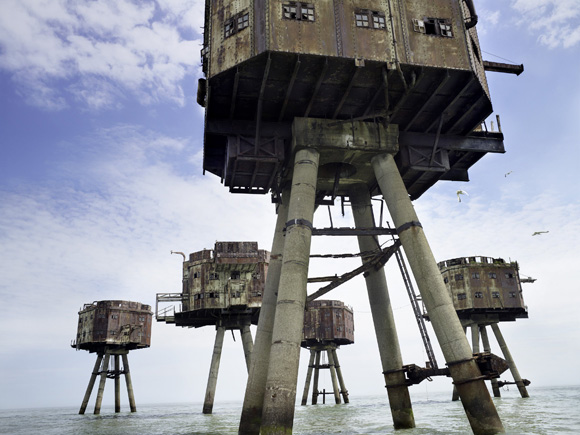 Carl De Keyzer, Thames Estuary. Great Britain, 2009, from Moments Before the Flood
The Maunsell forts were built during the second world war to protect London from the attacks of the German planes. The work focuses on empty landscapes, desolate beaches, deserted hotels, wintry piers, bleak harbor cranes and disconsolate cliffs, in an attempt to depict images of doom in David Lynch fashion. The images depict the absence of catastrophe-- they allude to the disaster waiting to happen.
July 4, 2012
Rena Effendi: Chernobyl, Still Life In The Zone
Twenty-five years since the disaster of the nuclear accident at Chernobyl, Ukraine and the subsequent radioactive fallout the entire access to the area around Chernobyl Nuclear Reactor is still restricted with barbed wire and police checkpoints.
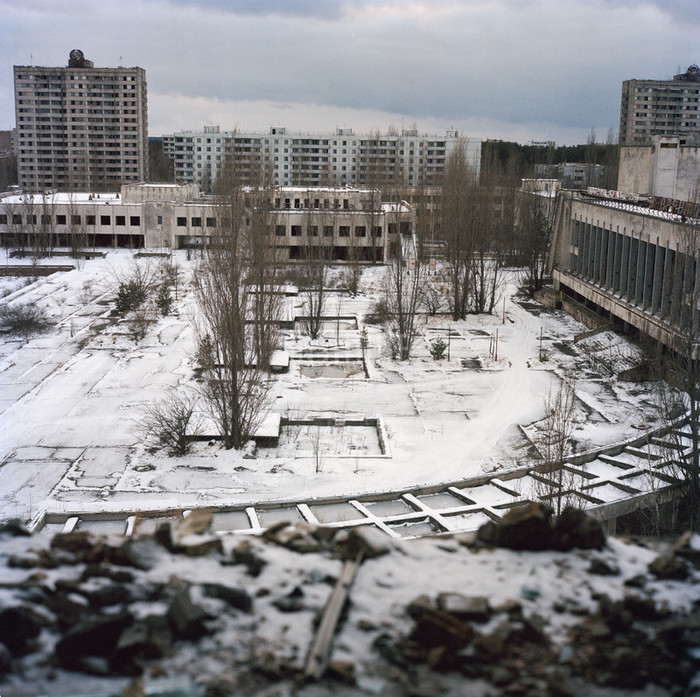 Rena Effendi, View over the abandoned city of Prypiats, December 2010
About 230 people inhabit the area of 30 km in radius, now named the Zone of Alienation. Inside the Zone, as well as in some sparsely populated villages adjacent to it, the inhabitants are mostly elderly women. They survived the great famine of Stalin’s blockade, Nazi occupation in WWII and even only days after the worst nuclear accident in the world’s history, they chose to return home.
 Rena Effendi, chicken for broth, 2010
The women live alone, on meager pensions, sustaining on their small orchards, harvesting radioactive food, burning contaminated logs and sneaking into the forests of the Zone to collect mushrooms and berries that are known to absorb radiation. The food chain has been contaminated with radiation, especially animals that consume local food, such as grain and vegetation from the zone.
July 3, 2012
English photography: Guy Sargent
Guy Sargent photographs both landscape and architecture using a large format camera--an Ebony 5x4. He used to be a full-time carpenter. But after buying a camera and securing six weeks off work to tour around Ireland taking photographs, he never returned to carpentry. He runs a blog.
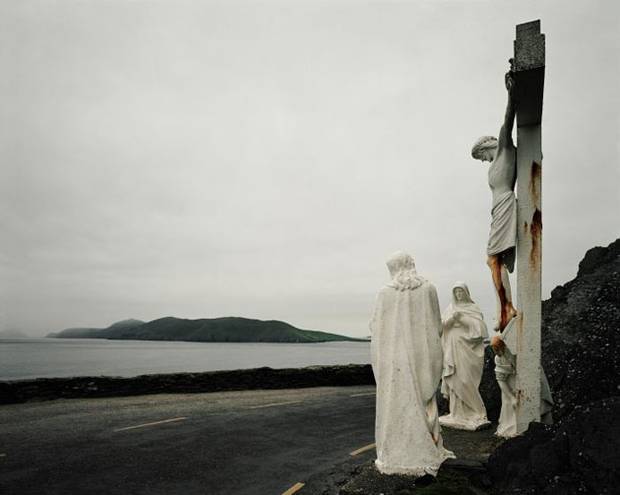 Guy Sargent, 'Slea Head', Blasket Islands, Ireland, from "What Lies Beneath the Surface"
Sargent says that 'Ireland is full of grottos - niches in rock walls filled with Jesus figures - and I would pass this one every day, on my way to shoot a beach. He adds that:
My holidays have always been to coastal areas, so the series started with coastal photographs. Initially it was just an emotional response to what I was seeing, but after a while I realised there's quite a deep meaning, a theme to it all; time passes, but with landscapes, nothing really changes except the man-made monuments we put on them.
The landscapes are generally about wilderness or the wild places and are within the Romantic tradition.
The other part of the What Lies Beneath the Surface is architectural:
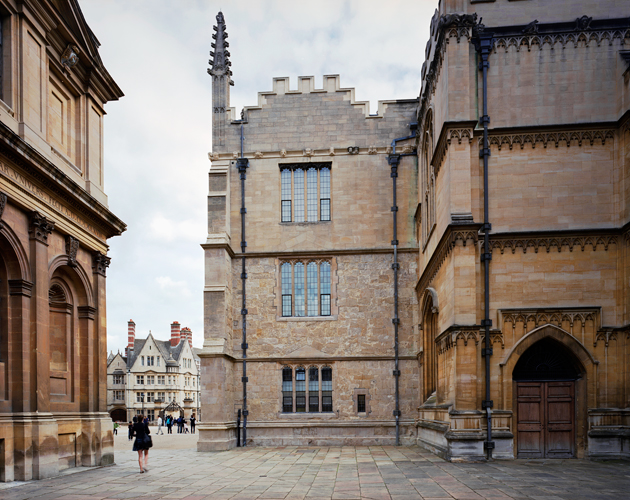 Guy Sargent, The Sheldonian Theatre, Hertford College and The Bodleian Library, Oxford 2011
Much of Guy Sargent’s architectural work is inspired by European history and it has a time line over the centuries, from the Gothic architecture of the 13th century to contemporary architecture such as the Mercedes-Benz museum in Stuttgart.
I am much taken by Sargent's view of London, given my work on the Adelaide book. This is a personal view that emerges out of walking around this global city and enjoying the architecture and history that London is so rich in.
July 2, 2012
graphic political imagery
A visual representation of the doom and gloom campaign that has surrounded the introduction of carbon pricing that ensures some of Australia's largest greenhouse gas emitters finally starting to take responsibility and pay for their carbon pollution.

Carbon pricing is the first step. From 2015-16, the carbon price becomes effectively a carbon trading scheme with a flexible price linked to the international market. Australia has taken the plunge to begin the shift to a low carbon economy.
July 1, 2012
photographers as artist researchers
Landscape photography is still very strong in Australia, even though the social landscape has become the center of the focus whilst the natural landscape has retreated to the background in contemporary photography. It is generally accepted in critical discourse that there are two main styles of landscape photography, which are often termed aesthetic (meaning a focus on natural beauty ) and documentary (meaning evidential).
Liz Wells, in her essay Landscape, Geography and Topographic Photography, (2006) which was presented the University of Plymouth’s, “The Rural Citizen: Governance, Culture and Wellbeing in the 21st Century” conference, explores the ground of the credibility of contemporary topographic practice. The paper is part of a larger book project entitled Land Matters: Landscape Photography, Culture and Identity in which she argues that visual interpretations of land reinforce social, political and environmental attitudes.
Wells argues in her paper that the credibility of contemporary topographic practice rests not on photo technologies (chemical or digital), nor on the expressive abilities of photographers as artists who frame their work in terms of pure photographic seeing (it is unmediated). Instead it relies on the integrity of photographers as artist researchers, especially when they adopt a systematic approach to image making as a form of research and by careful consideration evident in the presentation of results. This highlights the methodology of the photographer.
Wells argues that there has been a historical cultural tendency to view photographs as unmediated in both the nineteenth (naturalism) and twentieth century(modernism). Photography has lost its early reputation as an objective “memory machine”, and that in turn its claims to fact, truth and objective memory have been found wanting.
She says that today we longer believe that pictures of ‘landscapes’ are fit only for benign consumption, flavoured perhaps by fantasies of ownership or escape. Since the 1970s, at least, the genre has been the subject of searching and fruitful interrogation by postmodernist and feminist scholars and practitioners as well as the environmental movement. This is part of a long and intricate history of the mistrust of the mechanism of representation.
Thus contemporary photography in Australia can be seen as a rhetorical art practice that engages with land, landscape and place with its imagery contributing to inflecting our understanding of ‘Australianness’; contribute to in the sense that they either enhance or displace previous understandings of space, history and place.
The emphasis on methodology (systematic and research) would take the form of developing a knowledge of the way that history has transformed space into place, and an analysis of the subject matter under investigation. Taking the picture represents only the starting point around which the construction of meaning revolves.