November 30, 2010
Swedish photography: Jan Tove
Jan Tove is a Swedish photographer (b. 1958) who was originally trained as a portrait photographer and educated as a film photographer but ended up working as a reporter for Borås Tidning, Sweden’s main daily newspaper. He worked there from the age of 28 to 34, became a full time professional photographer a few years latter, then started using a large format camera in the 1990s.
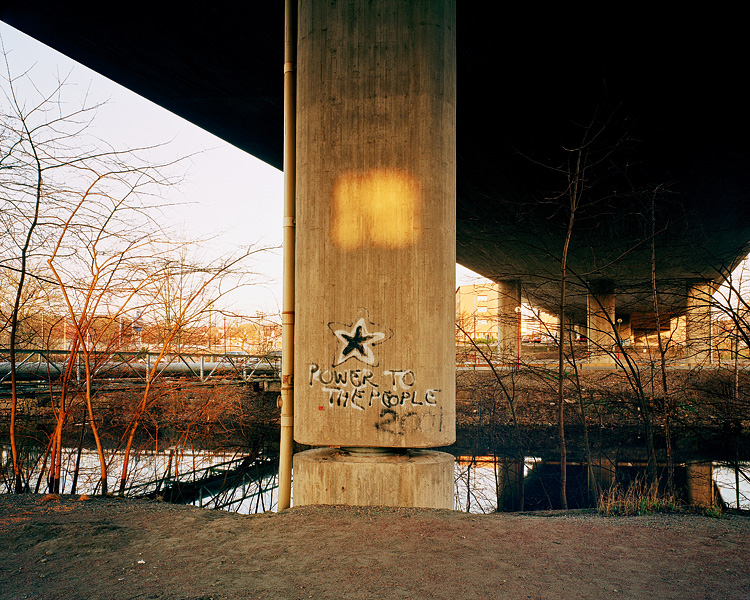 Jan Tove, Boras 2003, C-print, from the Riverside series
I know very little about Jan Tove or Swedish photography. There is not much on the web either. Tove's photography has moved from a concern with the natural beauty of the landscape to the social landscape.
Contemporary art is still impacted by a sense of the loss of aesthetic dominance in the wake of conceptualism, yet at the same time, its so-called anti- aesthetic dimension contains no independent dimension outside of the sphere of aesthetics. Aesthetics here usually means beauty--and we find it in landscape photography.
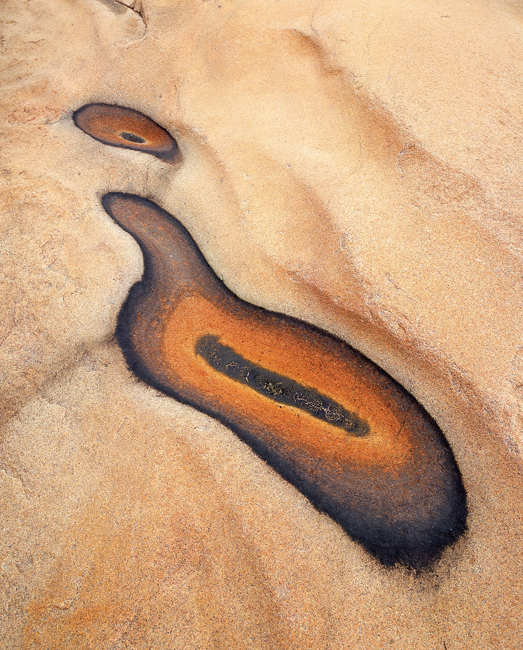 Jamn Tove, granite ponds, Archival Pigment Print, from Beyond order
Some argue that it is also important to retrieve some of that which was lost within conceptualism and postmodernism’s assault upon modernism; and that this retrieval presents us with the task of balancing the history of modernist aesthetics with the cultural theories that defined poststructuralist discourse. Though it is not possible to occupy the past with any authenticity, we can return to unfinished projects or reapply old ideas to new contexts.
Is this what are finding with the new topographics movement?
November 29, 2010
Unnerved: The New Zealand Project
Unnerved: The New Zealand Project, which was curated by Maud Page, is on tour in Australia. It claims to be neither “representative nor comprehensive of contemporary New Zealand art. There has been no major exhibition of contemporary New Zealand art in Australia since Headlands: Thinking through New Zealand art at Sydney’s Museum of Contemporary Art in 1992.
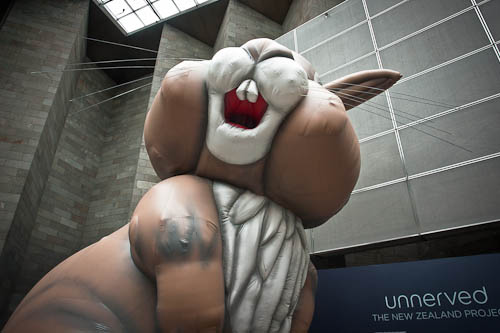 Gary Sauer-Thompson Michael Parekowhai's inflatable McMurty rabbit, NGV, 2010
Unnerved features more than 120 contemporary New Zealand works by more than 30 artists, dating from the late 1960s to the present, including paintings, drawings, photographs, sculptures, installations, film and video art. It shows some of the Queensland art Gallery’s diverse trans-Tasman holdings acquired through the acquisition of works from the Asia Pacific Triennales. What we are presented with is the plurality of contemporary cultural production in which photography has a central place.
David Broker in stirred not shaken in Contemporary Art Centre of South Australia's (CACSA) Broadsheet rejects Allen's approach and argues that:
Much more interesting and productive is a focus on some of the factors that have driven the production of art in the dynamic and turbulent bicultural environment of Aotearoa.
Broker fails to analyze what this might be other than to mention the presence of religion. What was obvious to me was the ongoing influence of post-Duchampian conceptualism, in which the relative weight of any one discipline, style and genre, has for the most part been flattened.
Most advanced art practices now requires an knowledge of both art history and the specific idea being articulated. Art theory enables us to comprehend the philosophical transformation that occurs in which anything can potentially become art if it occupies the structural place of art. Since conceptualism, art has become increasingly accustomed to playing host to its own critique. Following the impact of a critique of canonical art history that has been underway for half a century the social function of art is that of identifying aesthetic conventions and artifice that are inherently political and then opening them up. The nostalgic lament for the loss of traditional skills does not acknowledge the contemporary realities of a pluralist cultural landscape.
November 27, 2010
in Melbourne
I'm in Melbourne for a few days. It is mostly a holiday ---Suzanne is taking a break from work-- but I will be doing some photography and taking in some of the photographic exhibitions in the various galleries in the city.
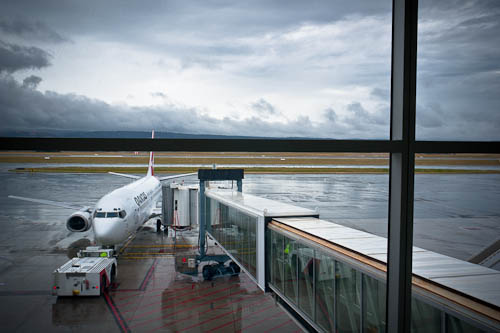 Gary Sauer-Thompson, Adelaide airport, 2010
I'm hoping to see the Luminous Cities exhibition, which has been selected from NGV’s permanent collection and curated by Susan Van Wyk. What sort of Australian work is there? What is being done now?
November 25, 2010
Hart's Mill
I have been done to Port Adelaide twice this week to shoot Hart's Mill with the 8x10. I failed on Monday morning because the wind was too strong for an 8x10 and the rain swept in.
Today was another failure because the cloud cover broke up and the light was against me. I'd got down there too late, due to taking Ari to the vet to get a grass seed out of his ear.
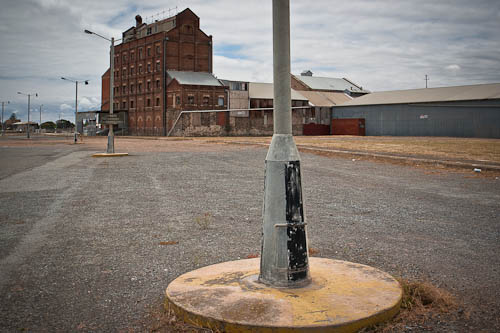 Gary Sauer-Thompson, Adelaide Milling Co building, Port Adelaide, SA, 2010
I'm a bit annoyed as the dense cloud cover and soft light were the conditions that I'd wanted for the black and white shot. These kind of conditions are very infrequent in summer in Adelaide. I'll just have to rethink the image.
I hung around hoping that the cloud cover might return but the increasingly cleared and the light became brighter, and there was little shade.
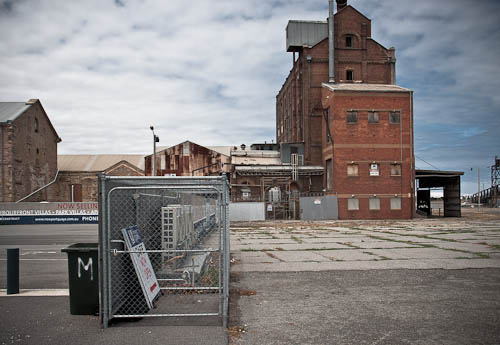 Gary Sauer-Thompson, Adelaide Milling Co building, Port Adelaide, SA, 2010
So I took some digital snaps, explored a bit around the river for future photographic possibilities then packed it in for the day.
November 24, 2010
Deep Sleep: Fabio Barile
Deep Sleep is a quarterly online photography magazine founded by and featuring work from a small group of contributors who share the same office space in Shoreditch, East London. They say:
The rationale was simple: in the internet age, where anyone with a simple website can make their images instantly available to half the planet, why rely solely on the whims, tastes, judgements and budgets of the few mainstream publications still taking an interest in photography? A web-based magazine could provide a showcase for work that was not necessarily commercial or the kind of thing we might do to earn money; it would be an opportunity to try and produce good work for the sake of producing good work...
The latest issue is entitled The Sea. it was the work of Fabio Barile that caught my eye---his studies of the effects of erosion due to overdevelopment along the Italian coastline.
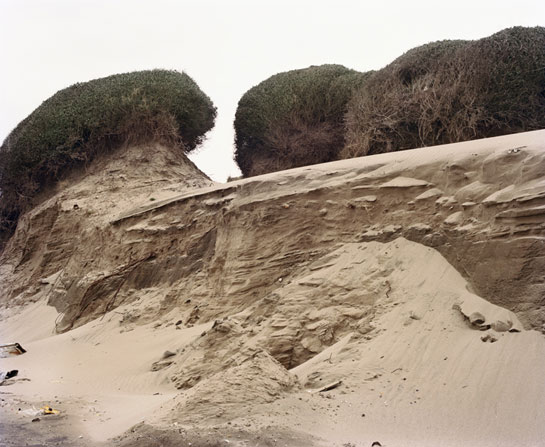 Fabio Barile, Untitled, Among
1200 km of Italian shore are affected by the erosion of the sea.
November 23, 2010
Piece of Cake
via Sherri Cuttler's excellent Photographs Do Not Bend ----Justin James Read in his Photography Collectives in the 21st Century in Ahorn Magazine says that the explosive nature of photo blogging between 2005 and 2009, with it’s interconnected dialogue and enthusiastic spirit, functioned much like a collective as unorganized and seemingly disparate as it was.
This period was an exciting time and helped to connect many young photographers to each other in profound and new ways. For a certain time, almost anyone could start a blog and enter into dialogue with a world of ‘emerging,’ and ‘emerged,’ photographers. While many of these blogs still remain, they have mostly trended towards an insular nature, primarily offering individual views and self-promotion.
It seemed that much of the online discourse, while vital and sincere, also lacked a certain depth and follow through. It appeared to be a critical moment to take the interaction off the web and work toward more tangible connections--to developing a strong community and network of artists and comrades.
One example is Piece of Cake with its European and American branches.
One photographic collective that I know in Australia is the Sydney based Oculi group. Another is the film-based Flickr group known as Melbourne Silver Mine. They have their own website and they have annual exhibitions. I've just become a member.
November 22, 2010
the alleyway
The alley is a marker for what is not meant to be seen aesthetically. It is a designated space for the discarded, for refuse; a non-place. It is a place of decay of the residue of what is used and then discarded.
If this urban space of refuse is a space of dissonance for us, then it is space of the obscene; a space for the unwanted, such as needles, street art and graffiti. They are places where not even drunks lie down to sleep the booze off.
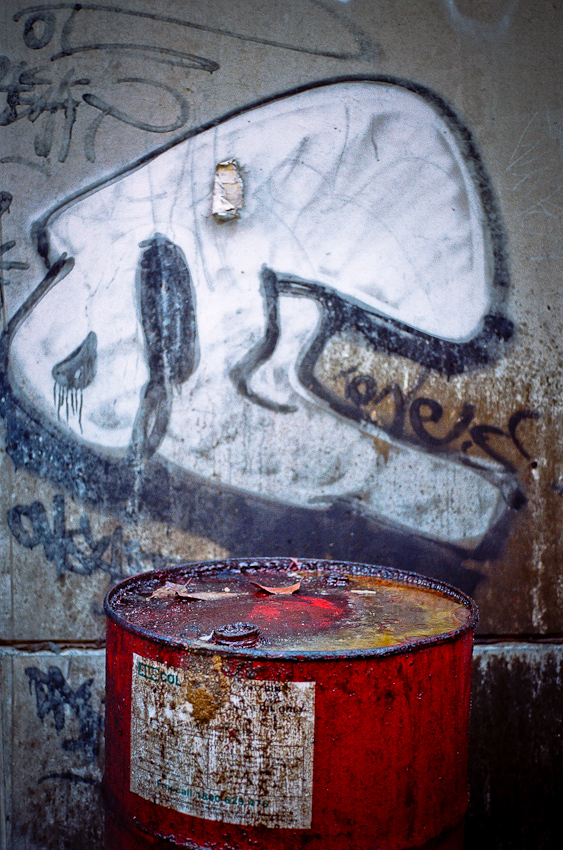 Gary Sauer-Thompson, red drum, Adelaide CBD, 2010
The alleyway is a place where the body recoils from the grime and dirt, as well as the stench of human vomit and urine amidst the decaying refuse. It is here that we have an acute sense of our body in space that provides such a different perspective to that of instrumental reason in our everyday life in the marketplace.
We realize the body is in the world, that this embodiment is a given of experience, and that it is the body that is the bearer of all our sensations that feels its way through the alleyway.
November 21, 2010
British Photography: Jem Southam
I have been digging around the current of Neo-Romaticism in post-1945 British photography with its emphasis on the British landscape place, nature reclaiming ruins, history-in-landscape and environmental concerns. This current can be interpreted as continuing the 19th century romantics critique of the ugly' modern world of machines and industrial capitalism, new cities, and the market place.
These figures include Fay Goodwin, James Ravilious, Raymond Moore, Andy Goldsworthy Jem Southam and John Davies. The body of work that appealed to me the most was that of Jem Southam, who lectures in photography at the Exeter school of Art and Design, and who uses a Wista 8x10 field camera.
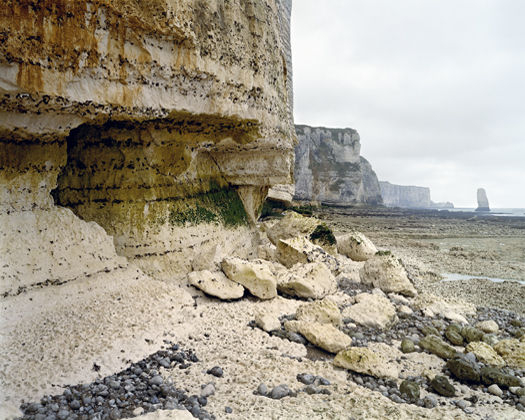 Jem Southam, Valleuse de Cure, April 2006, from Rockfalls of Normandy
Southam's Rockfalls of Normandy continue his project of representing the landscape in a continual state of flux--- the effects of time, climate and human beings on some twenty rural, urban and industrial locations, principally in the South and South West of England.
Southam's photographs bear witness to the physical transformations the sites are subjected to, from coastline erosion to the growth of a pond, thereby highlighting the natural forces at play whilst simultaneously emphasising the changing world in which we live.
According to this interview in SeeSaw magazine Southam's photographs y are structured in a series that are built up over time, through returning to the same site again and again over several years.
emerging
Finally, I've got my old 5x7 Cambo monorail view camera working. The new bellows has arrived, the dark slides have been cleaned and loaded with Kodak's Portra colour film, and the Linhof tripod is now functioning as it should. Now I'm ready to re-shoot the rock forms near Kings Beach, Victor Harbor.
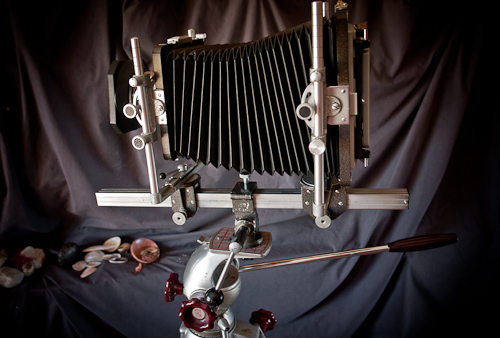 Gary Sauer-Thompson, Cambo 5x7, Encounter Studio, 2010
I'm ready to do the rock studies in the late afternoon, which I had lined up, but were too difficult to access carrying the 8x10 Cambo monorail. Hopefully I will be able to walk along the path to Kings Beach, and then double back under the cliffs by clambering over the rocks whilst carrying the gear. The 5x7 is much lighter.
Update
This afternoon was useless for photography The sun was high in the sky even though it was after 5pm, the temperature was high, the light was bright, the sun was still shining on the cliffs and the sticky flies were crawling around eyes . It would be a couple of hours before the cliffs were in open shadow. So it became a dog walk. The joys of landscape photography.
I'll have another go early tomorrow morning just after dawn.
Update 2
No such luck.The early morning sun was shining brightly on the rocks and there was no cloud cover to speak of. It promises to be a hot day--bright and sunny. So the photographic shoot will have to be around 7pm tonight.
November 19, 2010
British photography: Eric de Maré
Eric de Maré was a British architectural photographer who worked in the mid 20th century and specialised in the qualities of early and late industrial structures. De Mare was a pioneer in recovering architectural merit (of a kind that nobody now denies) in the then-overlooked industrial buildings of the past.
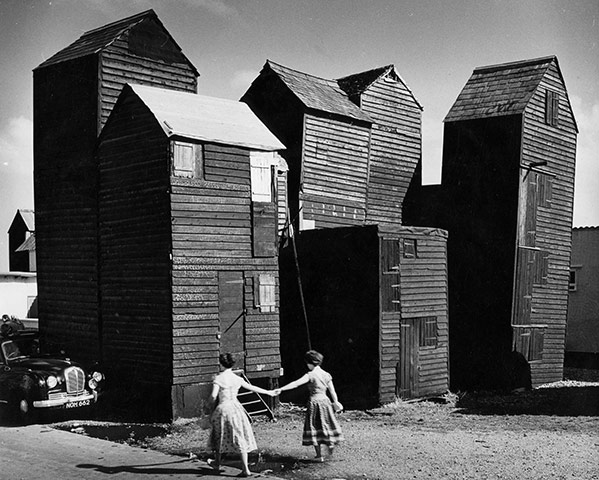 Eric de Maré, St Edward's, 'Skyscraper' fishermen's sheds, the Stade, Hastings, Sussex 1956
As well as exploring England's neglected industrial heritage de Maré became a champion of a humanised modernism, less austere than the machine aesthetic of such as Le Corbusier. In 1931, de Mare published The Functional Tradition. In this he urged admiration for the qualities of design arrived at in the early industrial period by high-quality but simple solutions to mechanical and manufacturing problems.
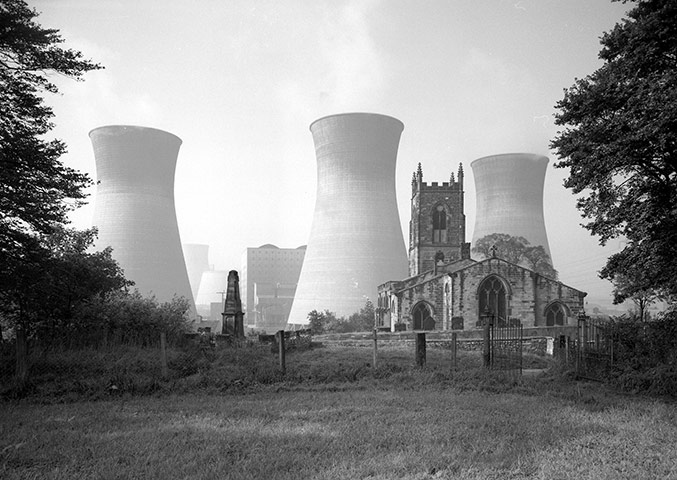 Eric de Maré, St Edward's, Brotherton, with Ferrybridge B power station behind, 1960s
In the above image St Edwards church in Brotherton, North Yorkshire, stands before Ferrybridge power station. It is a surreal image which captures the odd juxtaposition of rural and urban architecture, of the church and factory, an image suggestive of the shifting tides of post-war British culture.
This kind of photography was influential: one can see a line that runs through the imagery of Fay Godwin and John Davies starting somewhere from here.
Update
I've just stumbled across a collection of de Maré's photographs of English heritage architecture:
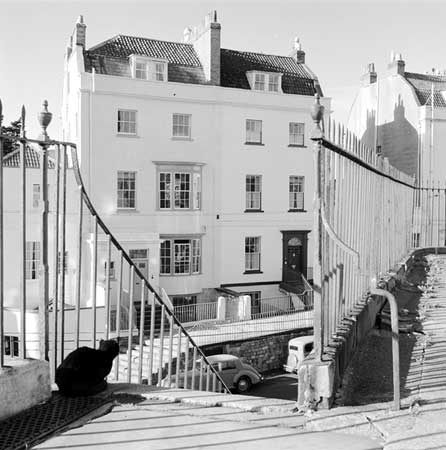 Eric de Maré, Prince's Buildings, Wellington Terrace, Clifton, Bristol
This body of work, whose ostensible purpose was to document heritage architecture reminds me of the work of Eugene Atget. ed Maré, however, was also concerned to stress that the anonymous, vernacular industrial structures (eg. , the canals of England) with their simple, forthright and unadorned functional forms provided a casebook of precedents for Modernist architects to rebuild post-war Britain.
November 18, 2010
New Zealand photography: Eva Polak
Eva Polak is a New Zealand photographer who was formerly a graphic designer in her homeland of Poland. Her work explores the possibilities of representing the impressions of a sense of time and motion in which the soft, poetic look is often achieved with the use of vaseline.
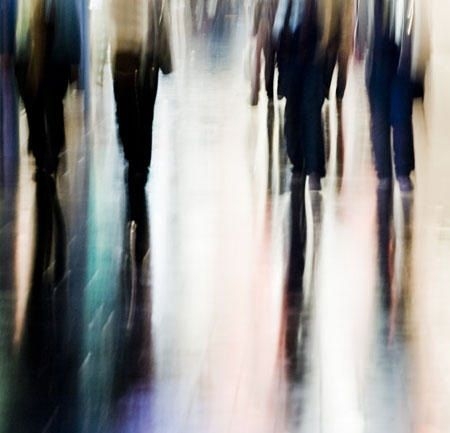 Eva Polak, human paths,
Polak has published a book of At the Beach --impressions of the atmospherics at Wattle Bay, one of Auckland's wild west coast beaches. I find that the abstractions work the best--though I haven't seen the ballerina work. There is a genuine play in movement, light and colour in this body of work.
I have tentatively explored the abstraction/movement in nature but my results have been disappointing to date. There was very little drama in the image and the images looked drab. I wasn't trying to break all the rules---the image being out of focus and using vaseline.
November 17, 2010
American photography: Charles Grogg
Charles Grogg says that the title of his portfolio, After Ascension and Descent,” is taken from a phrase by Pierre Joris in A Nomad Poetics in which he calls for an approach to writing that accounts for what Gilles Deleuze refers to as “rhizomatic,” allowing for varieties of discourse, idioms, syntax, even languages.
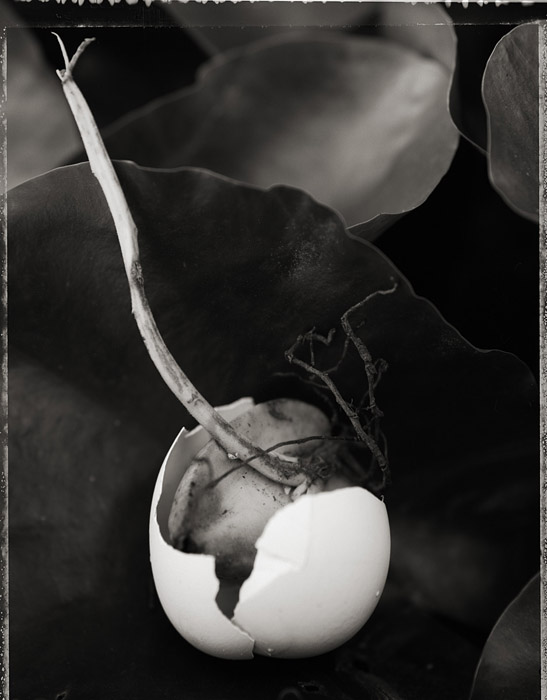
Charles Grogg, Sudden & Unexpected, gelatin silver print from 'After Ascension and Descent'.
Grogg adds:
I gave the work this title because I am at a loss when it comes to speaking of knowing one’s roots. My family, with its adopted members, silence about its past, reverence for the absolute at the expense of the profane, has taught me to speak one language only. To be monolingual is to be foreshortened, and like so many Americans I know I speak a provincial, not a global, language. The advent of “wireless” living does nothing to allay this. If anything, we are almost hopelessly tethered—to each other, to the world. It’s when we forget this, when we think we are free beyond complicity, that we encounter trouble looking for meaning.
Grogg will often alter the surface of the physical photographic print--eg., the dark, white and red treads and strings that he has sewed onto the print’s surface.
More drastically this selection of images is produced as gelatin silver prints, toned in selenium, then painted with mud in alkyd, smeared with dirt and compost in encaustic, pierced with copper wire or sewn.
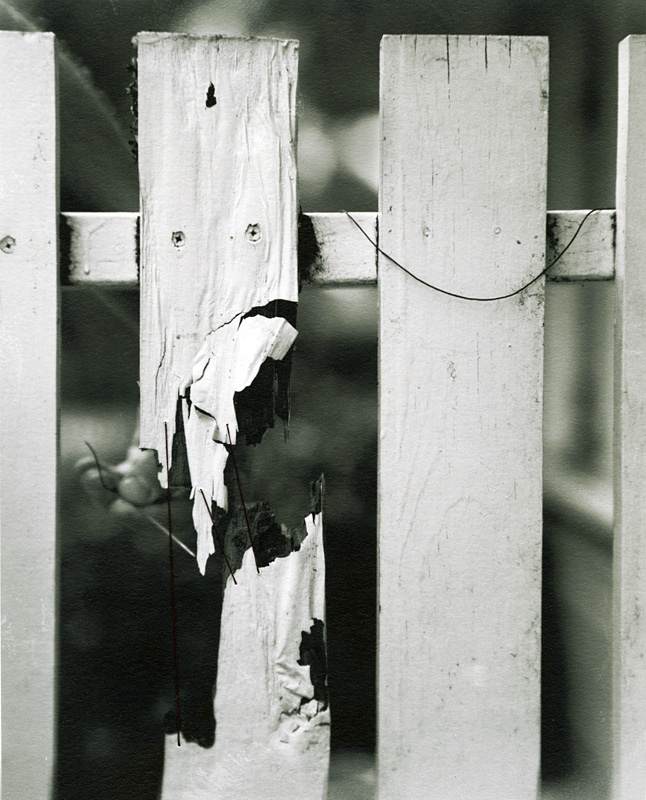 Charles Grogg, Mending Fences, cotton thread, gelatin silver print from 'After Ascension and Descent'.
I find the idea of allowing for varieties of discourse, idioms, syntax, even languages in photography to be very appealing. I concur with Joris that the days of static—form, content, state—are over and that anything not involved in continuous transformation hardens and dies. This suggests to me a photography that is ongoing & open-ended.
November 16, 2010
my beast of burden
This is the 8x10 Cambo view camera with the new bellows that I've mentioned on earlier posts that I've started using in the field shooting black and white film.
The camera sits on a Linhof heavy duty pro tripod, with its large geared post and Prof3 pan/tilt tripod head. This is the only tripod that I have that has the load capacity to carry the weight of the camera.
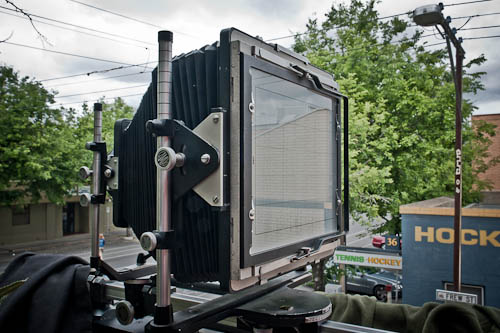 Gary Sauer-Thompson, Cambo 8x10 view camera, Adelaide 2010
This camera is one reason (my health + fitness are the others) why I have been going to the gym 4-5 times a week to do weights and cardio. I need to build up the strength in my arms, shoulders and legs so that I can carry the gear---- the camera is in one hand, the tripod in the other-- from the car to a location. The cardio is for stamina.
The 8x10 is a beast of burden as carrying the camera and tripod to a location more than half a kilometre away from the car is a two person task. Sometimes Suzanne is not willing to be a beast of burden and I struggle along on my own. Sometimes it is just too difficult.
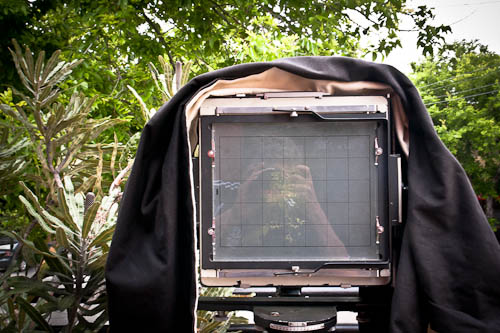 Gary Sauer-Thompson, Cambo 8x10 view camera, Adelaide 2010
If I shoot with black and white film --as I am currently doing because it is available in Australia ---then the film has to go to Sydney to be processed and scanned. Though 8x10 colour film has to be imported from the US, it can however be processed in Adelaide. That eases the burden.
Gary Sauer-Thompson, Cambo 8x10 view camera, Adelaide 2010
If I shoot with black and white film --as I am currently doing because it is available in Australia ---then the film has to go to Sydney to be processed and scanned. Though 8x10 colour film has to be imported from the US, it can however be processed in Adelaide. That eases the burden.
You can understand from this experience why people will switch to medium format digital--especially when Pentax have been able to come up with a digital medium format for the masses.
Update
I played around with the Pentax 645D today in my local camera shot. At around $14,000 with a new lens and 40 Megapixels, it does with the top end end digital DSLR's (a NIkon D3x or a Canon 1Ds MKIV) and price wise it undercuts the lower end of Phase One cameras (eg.,Phase One P40+), Hasselblads (H4D-40 or H4D-31) or the Leica S2. The Pentax is definitely a game changer and it deepens the industry shift from film to digital.
November 15, 2010
American photography: Jan Groover
Jan Groover was mentioned in this post by Stephen B Smith in this interview.
Groover abandoned painting for photography and puts a painter’s sense of composition into her series of photographic Kitchen Still Lifes. These were done when black and white still ruled and colour had to establish itself as serious art photography.
 Jan Groover, Untitled, circa 1978, Chromogenic print, from the Kitchen Still Lives series
Groover is working with the classical still life tradition, where the artist arranges and composes the forms and then captures elements of this arrangement. Groover uses the reflection off the metals of her cutlery and steel bowls to give off painterly effects of light and dark, and shadow. The photos are cropped close-ups of a mix of utensils and produce, often larger than life. Groover sometimes incorporates mirrored elements to further increase the depth of the usually simple objects.
Kitchen Still Lifes were precisionist abstract color photography from the late 70s. As formalism feel out of favor and William Eggleston's lyrical documentary style has taken hold,. Groover's analytic studies in muted tones of kitchen utensils feels isolated from today's colour photography.
 Jan Groover, Untitled, circa 1978, Chromogenic print, from the Kitchen Still Lives series
Groover is often included in discussions about the "new" color photographers of the early 1970s because of her preference and proficiency with emerging color technologies. Although readings of Groover's work have been largely formalist, her images also reveal a witty understanding and appreciation of the history of photography. With a subtle humor, she makes reference to such celebrated 20th-century artists as Edward Steichen, Alfred Stieglitz, Paul Strand, and Edward Weston and to the history of painting.
Groover's sophisticated formalism often features the leaves of several houseplants, two forks, and a mixing bowl. Although these objects are pedestrian, the artist coerces magical formal dialogues from their contrasting shapes, colors, and textures, and ultimately creates a Technicolor cubist collage.
November 14, 2010
American photography: Steven B. Smith
Steven B. Smith's photography represents the transition of the American Western landscape into suburbia, and the work references back to Robert Adams, Lewis Baltz and Richard Misrach:
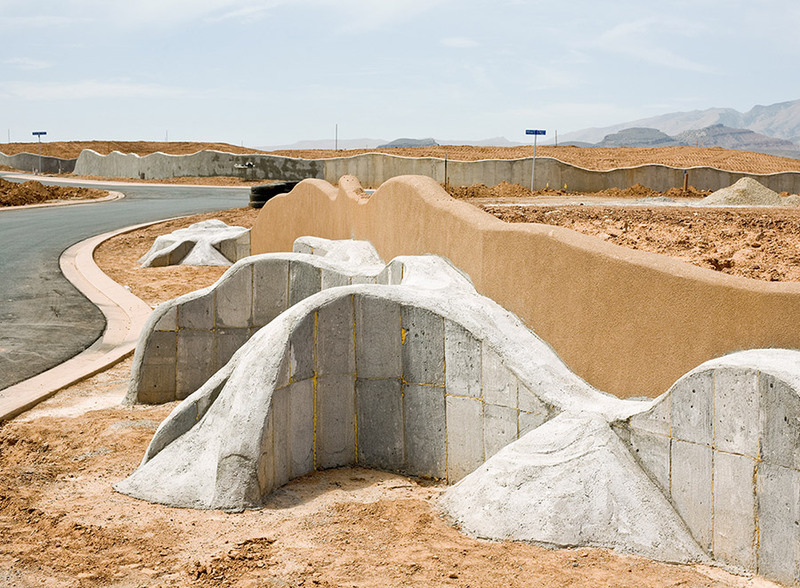 Steven B. Smith, Sculpted Fence # 6, Ivins, Utah, 2007, from the Close to Nature series
In this interview Smith, who teaches in the photography department at Rhode Island School of Desig, . says:
I trying to make a portrait of the culture, of the values of certain middle- and upper-middle-class people in the West. I wanted to do that by showing the process of how they changed the land, making it into something they thought was valuable. Specifically, these developments where the land is dramatically changed but in a way that supposedly takes the local environment into consideration—you know, the manmade reflecting and paying homage to the existing landscape. I was mostly interested in the systems that people use to restrain the land and route water, these elaborate systems of short-term control.
He adds that he started 1993 or ‘94, and he wanted to make black-and-white straight landscape photos.
I thought, why don’t you just kill yourself? Why do you insist on doing something that will never sell or be popular? And then the Germans started becoming popular. All of a sudden it was okay to do landscape, landscape was really hot. And then it was okay to do black and white. Photographers like Toshio Shibata were doing great. It was weird. I started out thinking that I was out in the wilderness, and then slowly it became okay to do what I was doing; I lucked into it.One of his influences was Jan Groover’s work. She uses the large-format view camera to extend and play with the way the lens draws, as well as the way that film acts as a canvas. She used the view camera on tabletops, and Smith took some of the ideas, rules, or limitations of the tabletop and transferred them to landscape.
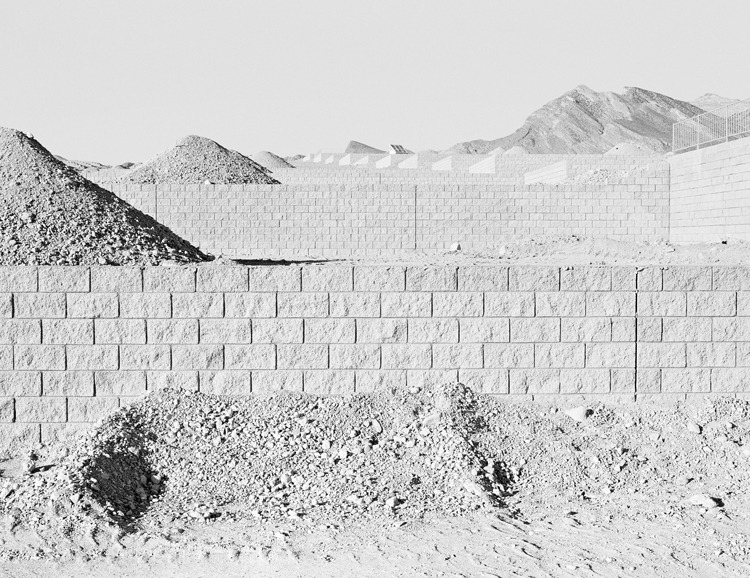 Steven B. Smith, Homesites, Las Vegas, Nevada, 1996, from the series The Weather and a Place to Live
Smith talks about his equipment, technique and work flow. He says that:
I shoot with 4x5 film and develop it myself. Occasionally I’ll make a few silver prints, to make sure that I’m processing things correctly. But I scan my images on an Imacon scanner, which is a high-quality film scanner or a drum scanner, and then I work on the files in Photoshop. I print the photographs digitally using quadtone ink on archival cotton-rag paper.
The printer is an Epson 7600, and he uses John Cohen’s Piezography quadtone inks, selenium color, printed on Hahnemühle photo rag and Roy Harrington’s quadtone RIP.
This kind of equipment is way beyond what I can afford. An Imacon scanner is around $15000. The scanning and printing would have to be outsourced.
November 13, 2010
the camera as sketch pad
This is a study for a large format camera shot that I did this afternoon. I'm basically using my digital camera as a sketch pad for a future large format shoot. I take several digital shots then look at them on the computer.
 Gary Sauer-Thompson, Adelaide, study for large format, 2010
It's a slow way of working, but it is the only way I know to figure out whether what I'm doing works or not photographically. Does the idea work photographically? Does the image say anything? Is it worth working on the idea with a large format camera? The cost and hassle of sheet film is such that the one shot that I take has to count.
November 12, 2010
I want to buy a rangefinder
This animation by Robert Jag is pretty funny, especially for Lecia fans such as myself
Alas, I have a Canadian built M4-P
Annie Leibovitz: A Photographer's Life 1990–2005
The Annie Leibovitz's book A Photographer's Life 1990–2005, is also and exhibition that is showing at Sydney's Museum of Contemporary Art.
It draws together for the first time the well-known assignments and rarely-seen personal work of one of the world’s celebrity portrait photographers. With approximately 200 photographs, the exhibition shows iconic images of famous public figures together with personal photographs of her family and close friends.
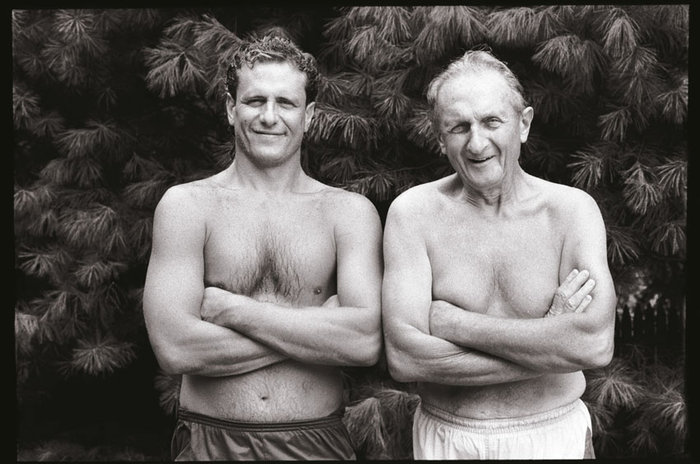 Annie Leibovitz, Brother Philip and My Father, 1988
In some ways the book seems like it confirms closure following the death of her father and Sontag in 2004. I much prefer the private portraits and snapshots, which show a lot of power that I hadn’t expected from a studio photographer who meticulously sets up her setting, lighting and props.
We can see the latter with Nicole Kidman, 2003, Leibovitz’s over-the-top, golden-hued portrait of the actress standing tall in a beaded fishtail gown while the bright lights of a theater glare behind her.
 Annie Leibovitz, Nicole Kidman, Vogue 2003
In this studio portrait Leibovitz pushed movie star glamour beyond extravagance: Leibovitz and Kidman created an archetypal image of the actress majestic in her solitude and oozing sexual power. Behind this kind of studio work lies Richard Avedon, who provided the tools and style.
November 11, 2010
American photography: Anna Collette
Anna Collette says that her representation of the contemporary landscape ie., urban and suburban environments-- focused on how the natural world—and human expectations of it—is being redefined, both visually and metaphorically, by the failed idealism of increasing development. An economic development that rejects the conservative views of America as a rural, agrarian society.
 Anna Collette, Untitled, urban series, 2002-5, C-print.
There is little urban nature in this image. What is striking is the high rise apartments in the universal international rising above the regional vernacular style of the wooden houses in a specific locality. Vernacular here refers to J.B. Jackson's conception of urbanscapes or5 cultural landscapes made by ordinary people, without professional input and without much conscious motivation.
This body of work, which refers back to the “New Topographics” tradition consists of numerous large scale color photographs that represent the pluralization of housing styles in the New York/New Jersey area. They represent the intrusion of high-rise apartment buildings into areas already populated by hamlets of shingle roofed, cozy two family styled houses.
 Anna Collette, Untitled, urban series, 2002-5, C-print
In the US his kind of apartment architecture is now an antiquated mid-century international style that failed to fulfill the promise of a successful urban utopia. The fact that the apartment buildings stand isolated and singular suggests the death as a rational modernist solution to a spatial, urban problem. They are monuments to their own failure.
November 10, 2010
Renew Adelaide
As an old industrial city with a declining manufacturing base Adelaide has lots of empty shops, buildings and building sites. This increased due to the economic fallout from the global financial crisis. Hence the Adelaide is crumbling argument.
This has given rise to the Renew Adelaide an urban renewal movement which matches creative entrepreneurs with city landlords, aims to foster the city’s cultural industries to bring foot traffic and life back into the city of Adelaide as it faces the rapidly changing environmental and economic conditions.
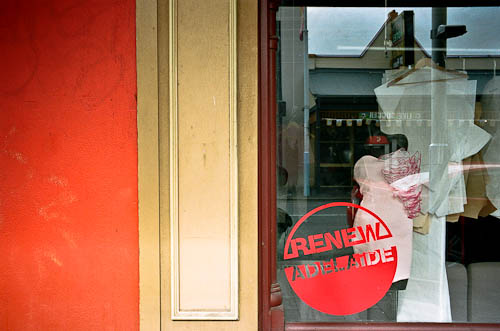 Gary Sauer-Thompson Renew Adelaide, 2010
Adelaide needs renewal. There are more empty shops to come according to Clay Shirkey's analysis of the effects of the shift to a digital economy.
Referring to the decline of bookstores in the US Shirkey says:
Internet use is as widespread as cable TV, and an internet user in rural Utah has access to more books than a citizen of Greenwich Village had before the web. Millions more books. Like record stores and video rental places, physical bookstores simply can’t compete for breadth of offering and, also like the social changes around music and moving images, the internet is strengthening rather than weakening the ability of niches and sub-cultures to see themselves reflected in long-form writing.
He adds that:
the spread of electronic commerce for everything from music to groceries is part of the increase in empty store fronts on shopping streets, leaving a series of Citi branches, ATT outlets, and Starbucks that repeat at regular intervals, like scenery in a Hanna-Barbera cartoon. Even when the current recession ends, it’s hard to imagine vibrant re-population of most of the empty commercial spaces, and it’s easy to imagine scenarios in which commercial districts suffer more: consolidation among pharmacy chains, an uptick in electronic banking, the end of our love affair with frozen yogurt, any of these could keep many street level spaces empty, whatever happens to the larger economy.
He argues that it is clear what those bookstores will have to do if the profits or revenues of the core transaction fall too far: collect revenue for the side-effects:
The core idea is to appeal to that small subset of customers who think of bookstores as their “third place”, alongside home and work. These people care about the store’s existence in physical (and therefore social) space; the goal would be to generate enough revenue from them to make the difference between red and black ink, and to make the new bargain not just acceptable but desirable for all parties.
However, any change from a commercial to a cooperative model of support would also probably have to be accompanied by a renegotiation of commercial leases--which is what the Renew Adelaide movement is doing.
November 9, 2010
The Hijacked series
The Hijacked series are published by Big City Press, an independent publishing house, specialising in progressive and contemporary photography books, within the realms of art, design, documentary and experimental. The Big City Press is based in Perth Western Australia and is run by Mark McPherson, an artist, art-photography entrepreneur, a contemporary photography book publisher and an Adjunct Lecturer, School of Communications and Arts at Edith Cowan University, Western Australia.
The Hijacked series pairs Australia with another country. They can be seen as exploring the movement of international cultural exchange as well as a survey of up-and-coming photographers. Two books have appeared so far in the series Hijacked 1: Australia/America appeared in 2008. Hijacked 2: Australia/Germany appeared in 2010. I mentioned them in this earlier post.
 Anne Lass, Untitled, Chicago, 2006, from Hijacked 2: Australia/Germany
In Hijacked 2: Perth-based curator Mark McPherson has collaborated with German curator Ute Noll and book publisher Markus Schaden. The works of German and Australian photographers are juxtaposed to stimulate conversation and to suggest connections and so we have a look at the emerging Australian photo scene. Although Hijacked 2 groups photographers together based on nationality, it also questions the notion of a coherent national photography.
An exhibition of Hijacked 2: Australia/Germany is now touring Australia. It will be at the Monash Gallery of Art Melbourne from 29 October 2010 to 16 January 2011
Now we have Hijacked 3: Australia / UK. Submissions officially opened on 1 October 2010. are now active with the deadline being July 31st, 2011.
November 8, 2010
Richard Misrach + the colour photo movement
Richard Misrach, the American photographer, is associated with the first period of colour photography:
 Richard Misrach Lake Meed #1 (1986)
In this interview with Aron Schuman at See Saw magazine in 2006 Misrach says that it was John Szarkowski, at MOMA in the 1970s, who engendered the colour revolution in photography.
Misrach says:
Clearly, John Szarkowski's bold embrace of William Eggleston's work was a salvo heard around the photographic world, and eventually the broader world. However, I think it was Szarkowski's preeminence, rather than Eggleston's work, that explains why everyone is working in colour today. Once Szarkowski argued that colour was a viable language, we lunged at the new medium...The explosion of colour activity from then on has had a huge impact on the whole field of art , not just photography. I think that , in the future, some serious art historical criticism will be focused on the 1970s colour photo movement as a powerful and pivotal period of practice, with the same importance of other historical art-world movements like minimalism, conceptual art, performance art, and so on.
Misrach adds that the early colour period paved the way for another rich level of practice, including digital colour photography. Both the early period of colour and digital colour photography are at the heart of art world practice today.
Misrach’s lifetime project, the Desert Cantos series, with its individual segments divided up between the terrain, events (the landing of a space shuttle, military testing), floods, and fires, has as much to do with social issues as with man’s presence within nature. Begun in 1979, the Desert Cantos series takes its name from its location and the structural term for a subsection of a long song or poem. The cantos vary in subject matter, the amount of time they span, and the number of works in the final grouping.
Misrach thinks of all his desert pictures as part of a single great work, divided into cantos by smaller themes, each canto numbered as it is completed. The first fourteen cantos, in order, are: The Terrain, The Event, The Flood, The Fires, The War (Bravo 20), The Pit, Desert Seas, The Event II, Project W-47 (The Secret), The Test Site, The Playboys, Clouds, The Inhabitants, and The Visitors. Stranded Rowboat, Salton Sea is from the third canto, The Flood.
November 7, 2010
too difficult
I've decided after today's experience that using the Cambo 8x10 monorail to take photographs of rocks along the coastline west of Victor Harbor is just too dam difficult.
The idea was simple. I'd do a variety of rock studies with a digital camera, then reshoot those that work in black and white with a large format camera. The reason for black and white was that this film was cheaper in colour. Hence renovating the 8x10.
 Gary Sauer-Thompson, rock study #2
However, it takes two of us to carry the camera, tripod and dark slides if we have to walk more than half a kilometre. That is the distance I can carry all the equipment on my own, in spite of all the sessions on weights at the gym.
What I've since discovered is that I'm limited in what I can do. The above shot, for instance, was done with a digital camera as a rock study. It would look good in black and white. It is, however, shot close to the ground. This cannot be done with the Linhof tripod that supports the weight of the 8x10, as the tripod can only work at waist level and above, whilst the rock study was done from ground level.
I need a lighter and smaller camera for this sort of work:--one that is easy carried in a back pack and which can work on a tripod that has the capacity to spread its legs so that can nearly lie flat on the ground. That is the 5x4. Maybe I could carry the 5x7 and tripod over my shoulder when the new 5x7 bellows arrives from the UK?
November 6, 2010
German photography: Michael Schmidt revisited
Michael Schmidt first gained attention in 1973 with Berlin-Kreuzberg, a series of photographs of the quarter where he still lives. In Berlin Stadtbilder (Images of the City) (1976-80), Schmidt explored the architecture of the city, depicting the apartment blocks and office buildings in an austere, documentary style.
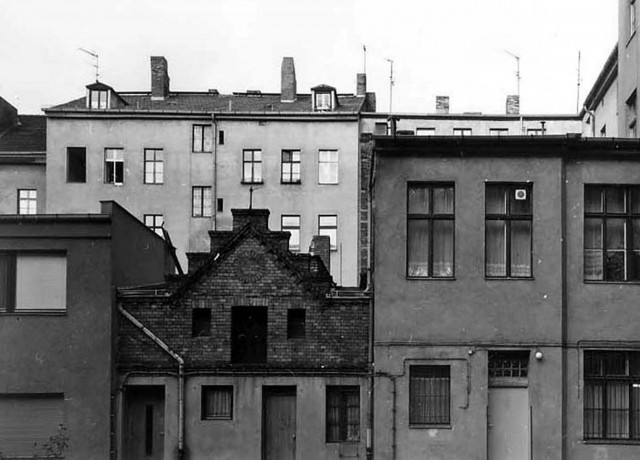 Michael Schmit, Berlin architecture
Schmidt says of his work:
I prefer black and white photography because it guarantees the viewer a maximum amount of neutrality within the limits of the medium. It reduces and neutralizes the coloured world to a finely nuanced range of greys, thus precluding an individual way of seeing (personal colour tastes) by the viewer. This means that the viewer is able to form an objective opinion about the image from a neutral standpoint independent of his subjective colour perception. He is thus not emotionally distracted.
Schmidt’s images lack all superficial attraction; they are without incident and as far removed from the photographic concept of the decisive moment as possible; they are neither striking nor narrative.
 Michael Schmidt, Stadtbilder4 (Custom), Berlin, 1976-80.
His understanding of photography is that it enables us to portray reality with complete precision to the last detail. There is no other medium - apart from media which derive from the invention of photography (e.g. film and television) - which is in a position to document reality exactly as it is by means of technical process.
In book projects like “Berlin - Kreuzberg” (1973) and “Stadtlandschaften 1981” (1981) Schmidt repeatedly approached the city and time and time again made it look like a landscape. Schmidt ́s Berlin photographs, whi show the no man ́s land that came into existence during the separation of East- and West-Berlin, its wild grass and ruin-like buildings – subjects that appear to be suspended in a transhistorical state.
November 5, 2010
Visions and Images: Joel Meyerowitz, 1981
This Barbaralee Diamonstein interview with Joel Meyerowitz is from a video series in which photographers talk about photography. Or more accurately, it is American photographers on photography
It is an interesting interview.
November 4, 2010
black rock study
This is a study using a medium format camera for a proposed black and white image shot using the Cambo 8x10 monorail:

It is just a matter of carrying the dam camera and the tripod down to the rocks. That is the most difficult part. I'm planning to have a go this weekend.
Kodak is reporting an resurgence in film including 8x10. So I'm walking backwards to the future.
In contrast, the new style of digital studio photography:
Michael Schmidt - Hasselblad H4D - Julia from Michael Schmidt on Vimeo.
November 3, 2010
US landscape photography
In Reviewing American Landscape Photography Back West refers to Crossing the Frontier: Photographs of the Developing West, 1849 to the Present.
This catalogue of an exhibition curated by Sandra S. Phillips at the San Francisco Museum of Modern Art explores the tradition of landscape photography. The subject of landscape photography is the land, and the dramatic, quite possibly tragic, reshaping of the West by Americans in the last century.
The West has remained a favorite, though not exclusive, subject for landscape photographers in part because its skeletal deserts retain the scars of land use more clearly than other landscapes and also because of their interest, in deflating the grand style of western landscape photography that they inherited). Then there is this remark:
The idealization of individualism and of corporate enterprise, so vividly optimistic in nineteenth-century photographs and so important even to the work of Ansel Adams, has become despairing, and reveals a flawed and damaged landscape that is only occasionally brightened by an appreciation of the fragile beauty of what remains. The optimism that energized Dorothea Lange and her colleagues to rally for change has been transformed into a weary acceptance of what exists and what we have done
It is both an acceptance and a critique of the effects of industrialization and urban expansion on the land.
There is not a similar critical landscape tradition in Australia. That landscape tradition has been preoccupied with celebrating the beauty of wilderness.
November 2, 2010
German photography: Michael Wolf
Michael Wolf’s Architecture of Density refers back to the work that emerged from the Düsseldorf school of Bernd and Hilla Becher and to the contemporary minimalist work of Andreas Gursky or Thomas Struth. Wolf is German born, grew up in the USA and studied at UC Berkley and at the University of Essen in Germany, and resides in Hong Kong.
His 'Architecture of Density' series, which is a portrait of Hong Kong with no people in it at all, was initially shot with a 6x7 cm Makina Plaubel, then a 4x5 view camera.
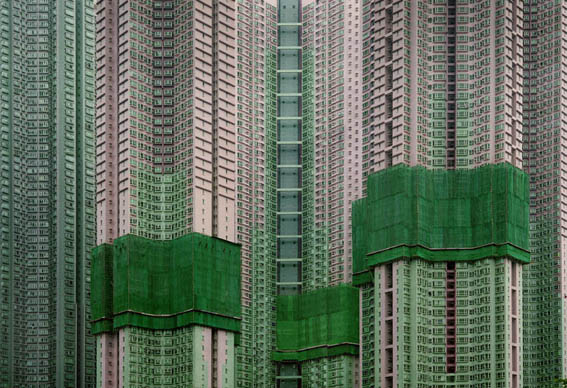 Michael Wolf, Architecture of Density #12, from Architecture of Density, 2003, Chromogenic Print
This is high rise urban living in Hong Kong is dense, and Wolf's camera represents the facades of monstrously tall and repetitive residential high- rise buildings, so as to give the impression that these high rise apartments appear as if they might extend indefinitely, upwards and down.
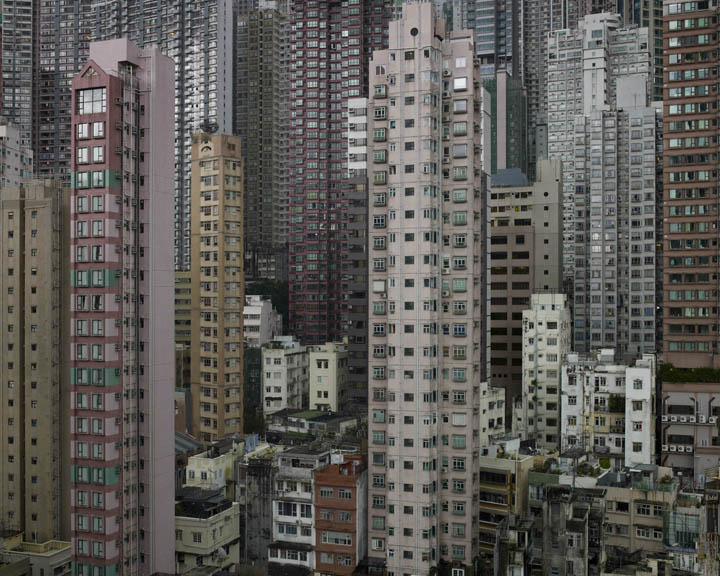 Michael Wolf, Architecture of Density #116, from Architecture of Density, 2008, Chromogenic Print
In these Hong Kong pictures, Wolf purges high-rise architecture of the romance and celebration of the 20th century modernists in New York and Chicago.
In his previous projects, Wolf described the vernacular culture of the street. His early vision of the region dwelt on personal aesthetic gestures left in back doors and alleyways, such as makeshift seating in the streets.In these photographs, small tokens of human presence took precedence over monumental architecture.
November 1, 2010
American photography: Zoe Strauss
Philadelphia based photographer Zoe Strauss is interviewed by Will Steacy in the interesting "photo-eye magazine.
One of her projects was America: We Love Having You Here:
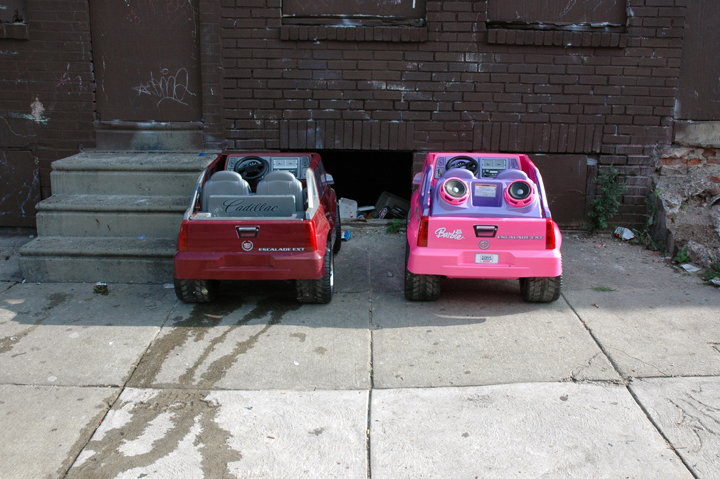 Zoe Strauss, Parked toy Escalade, 2008, Archival pigment print
Another project is Under I-95”. The project was conceived not just as the taking of photographs of her neighborhood and places that she has known in Philadelphia, but includes a yearly exhibition of more than a hundred of them on the support columns of I-95, the elevated highway that cuts through South Philadelphia. The vast space is accessible on all sides to the surrounding neighborhood, and the photographs are available for $5. The project is meant to continue over the course of 10 years, with the body of photographs refined and added to annually.
The I-95 project began as a documentary, echoing the street photography style of Diane Arbus and Garry Winogrand. Strauss’s photos of shuttered buildings, empty parking lots and vacant meeting halls illuminate her South Philly neighborhood’s grim character.
 Zoe Strauss, Marine's Billboard, 2001-06
This is the other “America,” one where people have to deal with a society that provides freedom and nothing else while lavishing its wealth elsewhere. Struass' Flickr stream is here.
Another project is On the Beach about the the Deepwater Horizon oil spill.