|
November 10, 2010
As an old industrial city with a declining manufacturing base Adelaide has lots of empty shops, buildings and building sites. This increased due to the economic fallout from the global financial crisis. Hence the Adelaide is crumbling argument.
This has given rise to the Renew Adelaide an urban renewal movement which matches creative entrepreneurs with city landlords, aims to foster the city’s cultural industries to bring foot traffic and life back into the city of Adelaide as it faces the rapidly changing environmental and economic conditions.
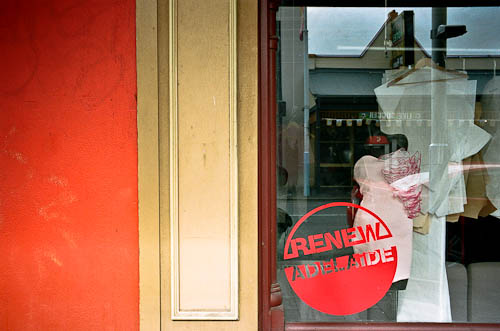 Gary Sauer-Thompson Renew Adelaide, 2010
Adelaide needs renewal. There are more empty shops to come according to Clay Shirkey's analysis of the effects of the shift to a digital economy.
Referring to the decline of bookstores in the US Shirkey says:
Internet use is as widespread as cable TV, and an internet user in rural Utah has access to more books than a citizen of Greenwich Village had before the web. Millions more books. Like record stores and video rental places, physical bookstores simply can’t compete for breadth of offering and, also like the social changes around music and moving images, the internet is strengthening rather than weakening the ability of niches and sub-cultures to see themselves reflected in long-form writing.
He adds that:
the spread of electronic commerce for everything from music to groceries is part of the increase in empty store fronts on shopping streets, leaving a series of Citi branches, ATT outlets, and Starbucks that repeat at regular intervals, like scenery in a Hanna-Barbera cartoon. Even when the current recession ends, it’s hard to imagine vibrant re-population of most of the empty commercial spaces, and it’s easy to imagine scenarios in which commercial districts suffer more: consolidation among pharmacy chains, an uptick in electronic banking, the end of our love affair with frozen yogurt, any of these could keep many street level spaces empty, whatever happens to the larger economy .
He argues that it is clear what those bookstores will have to do if the profits or revenues of the core transaction fall too far: collect revenue for the side-effects:
The core idea is to appeal to that small subset of customers who think of bookstores as their “third place”, alongside home and work. These people care about the store’s existence in physical (and therefore social) space; the goal would be to generate enough revenue from them to make the difference between red and black ink, and to make the new bargain not just acceptable but desirable for all parties.
However, any change from a commercial to a cooperative model of support would also probably have to be accompanied by a renegotiation of commercial leases--which is what the Renew Adelaide movement is doing.
|


First the record stores died, then the video rental places, and logically the bookstores are next. Bricks-and-mortar bookstores look increasingly out-dated, except as venues for leisurely coffee and book signings.
Amazon has boasted that it is selling more e-books than hardbacks on its web site,