April 30, 2004
Music, Olympics & politics
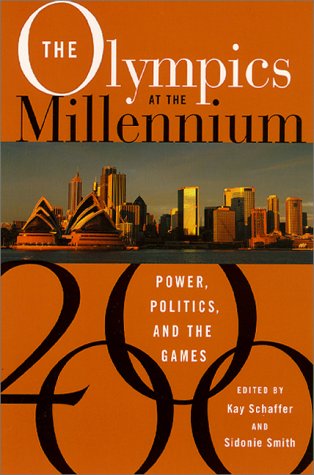
The Sydney Olympics were politicised to a degree around the issue of reconciliation between whites and blacks. There was a positive public response to the symbolic political statements by Midnight Oil--a dissent to Howard's refusal to say sorry for past wrongs. The Prime Minister himself was ambushed when Midnight Oil wore their sorry hearts on their sleeves. The "SORRY" icons on Midnight Oil's tee-shirts were flashed across the screen during the concert at the Closing performance.
And Yothu Yindi put the treaty on the closing agenda for the Games.
April 29, 2004
it was a time
I'm reading Lester Bangs. Re-reading the material in Psychotic Reactions and Carburetor Dung (1987), and Mainlines, Blood Feasts, And Bad Taste because I'd read a lot of this emotional thinking aloud before. I'm reconnecting with it. The narrative is one of keeping the faith as rock music sank pretty low during the 1970s.
Lester's material takes me back, since it is about capturing the mood or feel of a place.

It's a memory of a place where I once lived, walked the streets hearing the sounds of the unruly guitar-based energy of Midnight Oil being played everywhere.
It was a time when I listened to Astral Weeks, read Lester Bangs on rock and roll on the balcony overlooking main street, wondered about what had ever happened to Bo Diddley during nerve-torn nights. I used to devour Rolling Stone for insights into the gems of our popular culture that were buried in all the rubbish and the muck put out by our cultural heroes.
That was the time people were into pastoral nostalgias and assassinations and and struggled with the whole Miles Davis thing. It was long after Andy Warhol had been killled and I'd stopped reading Allan Ginsberg or listening to Bob Dylan.
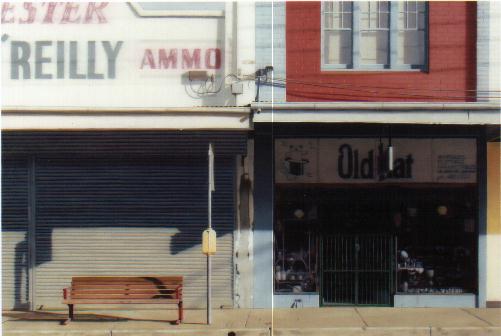
I never did connect to Lester Bangs Detroit rock and roll bands. I could no hear the inner pain turned into deep poetry there. I did with punk though. Were Lester's Detroit bands good hard rock bands playing for the working class? Maybe the hard rock and fiery, pulsating sounds of Midnight Oil---before they went 'artsy' and experimental with '10, 9, 8, 7, 6, 5, 4, 3, 2, 1' --- was the Australian equivalent?
Artsy? Well, it became more political, as with 'Beds are Burning' from (Diesel and Dust) with slide into blandness with Garrett's predictable nasal growl, the same guitar chuggin, the lack of musical variety. The 'alternative music' becomes dull and formulaic. However, some of the songs become iconic in our culture:--'The Dead Heart', 'Blue Sky Mining', the 'Forgotten Years'. Musically Midnight Oil pettered out in the 90s. Yet when I saw them performing on television at the Sydney 2000 Olympics I was taken back by the intensity of the performance and its political criticism of our conservative national culture. It was all over in late 2002 when Garrett left the band.
Lester Bangs. He's full of the emotions of place even though his "gonzo" style is dismissed as "...a Beat-derived spew of words that aims for Kerouac and occasionally rises to the level of the execrable Charles Bukowski." His writings on rock music and Miles Davies' 'urban environment music' brings back memories of the urban landscape around inner Melbourne: that soft focus of the light playing across the shop facades of urbanscapes.

William Breen, Goes Further Tastes Better, 2003
Bangs was a partisan of rock at its noisiest-- he saw rock music as the ecstatic disruption of culture. He actually tried to put down what the music meant in the context of our world: what it said about who we are, what we do, how we choose to live, where we’re at and where we’re going.
April 28, 2004
Paint
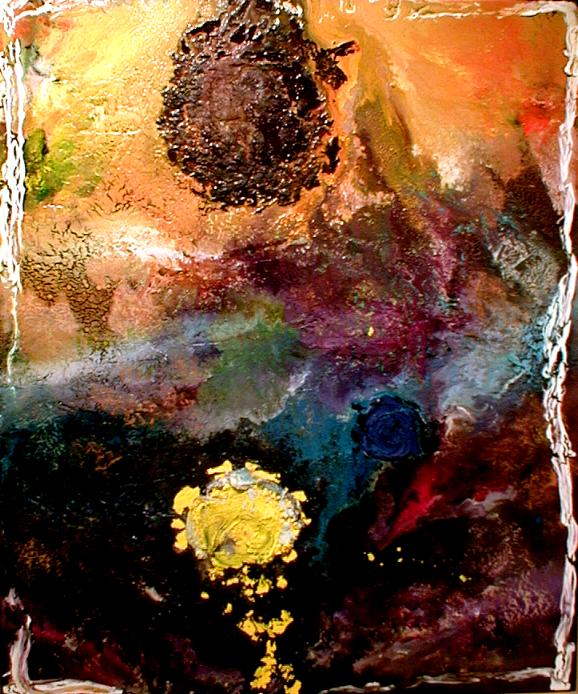
Jules Olitski,Bathsheba Reverie - Blue, 2001
You can almost feel the pain in your hands. The temptation is to play with the one's bare hands. Treat it like mud. Playing with paint.
Paint. It makes a difference from the flow of digital images in our media culture and a haven from the television's steady colonization of everyday life.
Paint. It keeps at bay the thought that philosophy is at its end and television is replacing it ands that we live amidst a world of images. Paint. It is the craft of yesterday to tomorrow's digitial/technological image crafted by the commercial machine.
Paint. It is the equivalent to the poet walking in the woods and loses herself in the rapture of its presence whilst the bulldozers level it the rainforest on the other side of the hill.
April 27, 2004
Wilderness#3
The world's last pristine wilderness continent

Jan Senbergs, Admiralty Hut, Heard Island
Antartica. The great white south continent. A world of stunning seascapes, astonishing icescapes and sublime landscapes that few of us will visit to experience.

Maria Buchner, Ice Tree Sculpture, East Bay of Mawson, Antarctica
April 26, 2004
Anzacs, regionalism and national identity
I've been arguing for a critical regionalism that would be in opposition to those glinty-eyed, hard-hearted punishers who love to place life in a straitjacket.
An example of critical regionalism:

Sidney Nolan, Bathers, 1943
My argument is that such a regionalism offers possibilities for a good positive response to the negative effects of global economic flows on our ways of life, and the way the neo-liberal market is constructing our national identity:

Hou Leong,An Australian (Crocodile Dundee) 1994
Of course, that critical regionalsim is not how Canberra sees culture. There has been an ongoing refashioning of our national identity by the Canberra politicians. Despite all the talk about economics being the main game, Canberra has been deeply interested in culture thoughout the 1990s. Canberra has searched for something to hold the nation together to counter the way their engineered economic reforms of the 1980s ripped the guts out of our social democratic way of life. The country was fracturing under the growing inequality from the global economic flows. It became a divided nation.
So we have the cultural/history wars about national identity, which have been waged about the republic, an apology to Aboriginal Australia for past wrongs, refugees, and the affirmation of the US-Australian alliance. Coupled to this has been a sidelining of multicultural diversity in favour of a conservative mainstream monoculture that is defined as commonsense Australian, with its disdain and contempt for the innercity cultural elites who tell us what our cultural identity is.
This conservative political shift---by both political parties (eg.,the Coalition and the ALP)---is a response to globalization. It redefines our national culture in terms of national unity and social cohesion, and it attacks that which divides us. "Us" is always left unclear because citizenship is never mentioned. "Us" is about what binds and unifies the nation.
What binds the nation in a global world?
Fraternity as mateship. What is mateship? It is our dominant values that underpin and constitute Australian nationalism. These are the ones that are part of a long tradition founded on the beaches of Gallipoli in 1915. It is that enduring legacy that acts as a unifying link in our chain of identity and memory.

William Longstaff, Menin Gate at midnight, 1927
This cultural conservatism excludes those who do not fight in the name of social cohesion and unity, and it has little time for surrealism's expression of the horrors of war:

James Gleeson, The sower, 1944
In the face of this retrenched and defensive cultural conservatism we can affirm our regional diversity:

Tracey Moffat, The movie star: David Gulpillil on Bondi Beach, 1985
A critical regionalism show how diversity constitutes national identity.
April 25, 2004
Regionalism & music
This guy keeps on moving from Sydney up to Byron Bay, then back to Sydney. Recently, he went to hear the music played by these musicians. Whilst cruising the endless highway back to Sydney from Byron, CS listens to Eric Clapton. CS and Eric share a metaphysical fix with Robert Johnson, the King of the Delta blues. He is in heaven.
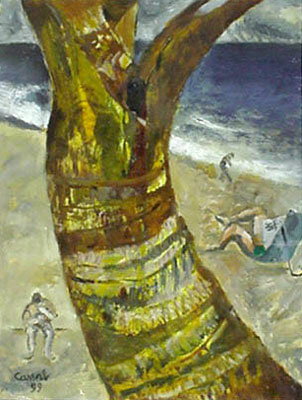
Now CS just loves Byron Bay, that is so lovingly depicted by Judy Cassab
 CS says:
"Byron Bay is my favourite place on the whole earth. Forget all that crap about counter-cultures, celebs, trendies, property prices and the rest. This is just flotsam and jetsam on the big scheme of things. I’ve been stopping over to surf Byron since the 60s, when the only other people who knew or cared we were in the place were the local cops. I've long since stopped staying in Byron itself, but the surrounds remain my heaven on a stick. With the surfing breaks of your wildest dreams, with water those few delicious degrees warmer and cleaner and more dolphin filled than Sydney, with rolling Irish-green hills trimmed by blissed out cows, with that semi-tropical air, and with that crucial psychic gap from the big metropolis and … well, the place is a complete aesthetic spirit, mind and body bath … a stark reminder that the protestant work ethic is the most grievous mortal sin ever committed by humankind against everything that's truly meaningful in and about life."
That love of place which celebrates a Dionysian life is an affirmation of regionalism in a global world. CS expresses a critical regionalism, as he affirms and respects the specific quality of a region and its cultural identity.
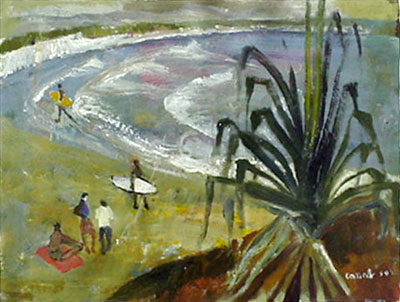
Judy Cassab, Surfers, Byron Bay,
If the love of place is an affirmation of regionalism in a global world, then CS says nothing about the architecture of this regional place in northern NSW. Is there an environmentally sensitive regional architecture developing in and around Byron Bay? Or is the same standardized two story glass rectangle/square that you see everywhere along the coast?
To be fair, CS is more a budding music critic than an architectural one. That is to be welcomed, given the lack of critical music reviews in Australia. There is a nascent music criticism going on in Australian weblogs, but it is more concerned with classic rock albums or the greatest Rolling Stone song, rather than exploring the contribution of rock music to our sense of place; or its relationship to our broader culture.
What lies outside the horizons of this type of music criticism is whether this music have a critical edge in relation to the world of utilityand instrumental reason? Was is its relationship to our changing mode of existence? CS does not tell us how the country blues can affirm critical regionalism in a global world; or why this music has a critical edge in a world of utility.
Maybe these are not the right questions to ask about rock music. Rock music is all about the guitar licks and lines? The questions about regional identity in a global world are questions that can be properly addressed by the visuals arts and architecture.
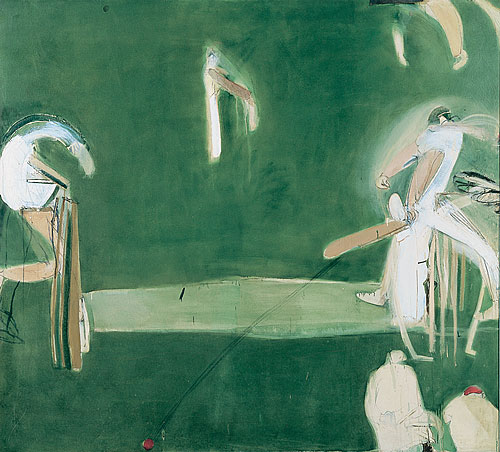
Brett Whiteley, The cricket match, 1964
Music should be judged on its own terms as music. CS places the emphasis on aesthetic experience.
I do not accept this this line of argument. Greil Marcus' Music Train: Images of America in Rock 'n' Roll Music, says otherwise. If the Americans are exploring this, why not the Australians? In a global world it is critical regionalism, not Luddism, that is the way to go.
April 24, 2004
Critical regionalism in Architecture

Marco Frascari, Drawing table
One of the innovations at the 2004 Adelaide Festival of Arts was the inclusion of Architecture Symposium.
I did not attend. The symposium appeared to be appeared about themes of concern to junk for code; namely regionalism and architecture. The symposium asks the question: How could regional identity be explored in architecture, as it is in food and gastonomy?
Or as it is in regionalism in painting for that matter?
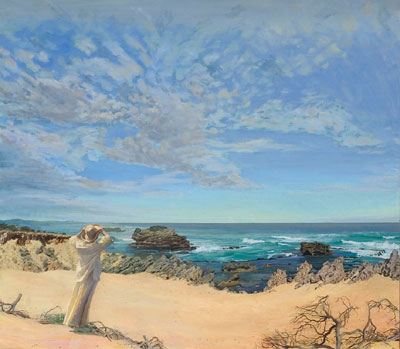
Brian Dunlop, Penelope at the Crags, 2003
There is little regional architecture around Adelaide. Take the southern coast of the Fleurieu Peninsula where the seachange phenomenon is giving rising to a massive boom in new holiday and retirement homes. The homes are project homes that has little connection to the climate or the seaside tradition. It is a housing type that makes no attempt to engage with people, environment or place.
Yet we do have a tradition of a critical regionalism in Australian Architecture. The more the effects of globalization impact on us, and on architecture and town construction, the clearer the critical regionalism becomes as an alternative strategy. This emphasizes and respects the specific quality of a region and its cultural identity.
One way of doing this is to take the pathway to sustainable cities. Billions are spent adding to the network of freeways, tunnels and toll roads to subsidize the developers without a hint of concern about the sustainability of what is being built in suburbia; or the consequences of a car-dependent city. What has been created by the market are classic urban-sprawl, car-based cities in Australia.
In Adelaide the development boom is taking place on the coastal strip of the southern Fleurieu Peninsula, about an hours drive from the city. The transport corridor is car-based---motorways and passing lanes without even a hint for a new southern light rail network. So Adelaide becomes even a more car-based city. Sustainability means dealing with our car dependent cities.
April 22, 2004
having lost my way
When I've lost my way from living in an airconditioned space for too long I return to the desert paintings for nourishment.

Eunice Napangardi, Bush Banana, 1996
They centre me.
I lose myself in the brillant, evocative colours of what many people often see as the drab bush of the outback that has no life.
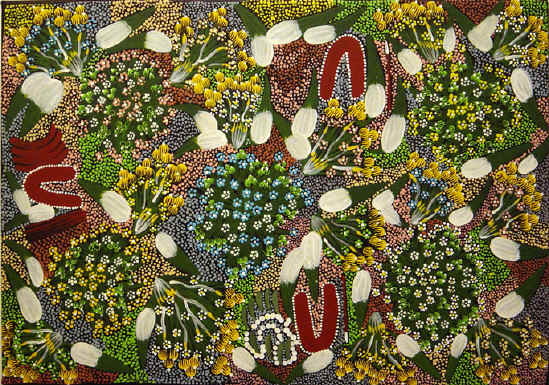
Eunice Napangardi, Bush Banana, 2000
I do not understand the stories embodied in the desert paintings. Nor can I work them out on my own.
I do relate to the country they express. I know that some postmodernists say that we have no roots only ariels that pick up the global media flows. But the desert paintings are my roots for I live on the southern edges of the desert country.
From film & televisual culture
This post will not get very far. It is little more than random jottings that have little direciton.
It's initial impetus is a sense that something has happened to film. I reckon it is because it has gone digital.
Now we see computer generated images rather than acting, and these images have changed the relationship of film's representations to social and physical reality. It is possible to have a film that has no referents to the history and the physical world but exist solely in the digital domain of the computer.
That is a big shift. Does it open up screen culture to different kinds of film? Does it mean that the modern history of the cinema is no longer oriented solely according to movements and aesthetic schools? Does the replacement of film's photo-chemical base for an electro-magnetic base have little bearing on film as a cultural practice? Does it threaten the very ontological underpinnings of film culture?
Dunno. I'm not sure that I care.
Hell, I'm still coming to grips with television:---the fleeting images that catch your eye in the corners in airport lounges and shops; the shows that mark Suzanne's daily transition from work to relaxation, the non-stop flow of images when in Canberra. Television is such an integral part of our daily experience that it is now now taken-for-granted. It is cultural/visual form of everyday life.
Remember the bodies of four charred, dead Americans being brutalized and dragged through the streets of Fallujah, Iraq on broadcast television?
The burned corpse chopped and beaten with a pole and pikes and shovels;
a charred side of human flesh dragged through the street by its roasted leg; young teenaged boys laughing and cheering in front of scorched and broken bodies strung from the rafters of a green iron bridge.
That was global television. Television is the primary global medium. What does it mean? Dunno.
Well, we seem to accept that the prolonged feeds from CNN and the BBC mean that television is the only real source of knowledge of waht is happening around the globe. It forms the basis of our common knowledge?
I only know about 9/11 from watching the flow of images and commentary live on a television feed. Like everyone else. but what is the flow? How is it different from programming?
In academia there was a disdain, if not contempt, for the superficial depthlessness of television as a medium, compared to, say, the academic validity of cinema. Film was space aroudn which the serious theorizing took place. Few talked about the forbidden pleasure of watching television. It is hard to miss the television 'chat' as a form of commentary that assumes we are all wealthy, healthy bourgeoisie. It's naturalist tropes across genres, offer us a form of heightened reality.
We do have a televisual culture. That much I can say and do know. Yet I yearn to watch television as distinct from watching a program on television. I yearn to depart from the rhythms of broadcast transmissions of both the public and commercial television systems.
My sense is that the media landscape has been in constant upheaval. Most attention has been focused on the Internet but the old media are being transformed. Digital television now seems inevitable depsite the defence of free-to air-- television systems, and there is lots of talk of the convergence between computer technology, the internet, and television.
I dunno what all that means. I cannot even imagine it.
April 21, 2004
Wynne Prize
The Wynne Prize in Australia is awarded to what the judges consider to be the best landscape painting of Australian scenery in oils or watercolours, or for the best example of figure sculpture by an Australian artist. That is what the blurb says anyhow.
The winner of the 2004 prize was this painting from the Western Desert:

George Ward Tjungurrayi, Untitled
For the record here are the finalists for the Archibald portrait prize and the finalists of the photographic portrait prize.
Nicolas Rothwell visited George Ward Tjungurrayi. His account of the visit is here. Rothwell describes the austere formalesque paintings as:
"...depict the ancestral desert narratives, relating to the country west of Kintore – above all, the snake-rich landscapes around Lake MacDonald. But they are not maps, as much as expressions of a world, a logic, a sense of how space is enlivened by spirit.
Just as the creation journeys they refer to operate on many levels, so do the paintings: to the outside eye, they possess an austere beauty; when explained in detail, they can serve as visual cues to a complex story-system; but all the while their air of coherent depth comes from the underlying mental architecture of the desert world."
It is a world that is outside the horizons of we white Australians in the city and we--those in the art institution--re-interpret them largely in formal terms.
I'm uncomfortable with that reading. Though the painting is very formal--geometric even --- it also expresses story and country as do these. Many whites refer to this as spirit (of the desert) which has its ancenstry in Hegel's conception of Geist. Spirit with its roots in Geist is tacitly given a religious, rather than a cultural interpretation, and so implies that reality is ultimately spiritual. Spirit means dreaming.
There is no way around Geist or spirit. I prefer to give it a minimal interpretation (what Hegelians call a non-metaphysical interpretation) of a strong attachment to land, a strong sense of territory, a very strong attachment to country as the traditional lands. From the attachment to country as a heritage to be cared for comes the cultural values of a sharing of the land and resources, co-existence and a collective conception of society. This takes us to the threshold of Aboriginal culture.
April 19, 2004
That Eye, the Sky
I saw a film of this Tim Winton book tonight by John Ruane.
This director has made Death in Brunswick in 1991 and Dead Letter Office in 1998. Both are quirky films.
That Eye, the Sky (1994) does not appear to have been widely reviewed, even though it is a part of an Australian national cinema. That puzzles me. Is there a concern for an Australian national cinema? Or has that fallen away as nostalgia in the new media age? Has film gone out of fashion?
What does that say about our film or screen culture? Do we have an informed critical edge concerned with Australian cinema? Is there a space for a critical film culture that engages with our public culture? What has happened to critical writing with its cultural commentary function in Australia?
I canot seem to find anything on the critically looking at--questioning--the reviewing of films. Was not this kind of reviewing a going concern in the 1980s with Meaghan Morris and Adrian Martin looking at the Australian film revivial? That is my memory. Did they not mark out a genuinely critical space?
Has everything now given way to the commercialism and standard business practice embodied in the global Fox Studios in Sydney?
I know I'm being crude here. But something is troubling me with film culture in Australia, and I cannot quite put my finger on it.
That Eye, the Sky as a film explores family problems that lead to breakdown, violence as a result and then renewal. The father of two children has a car accident and ends up in a coma. His son is traumatised, his daughter gives in to anger and his wife gives up on him. A mysterious stranger turns up, and helps them deal with what has happened. Its a healing process.
It links eroticism and religion as aspects of our inner experience. It also links the erotic impulses and death. The focus is on the inner life. This inner experiences is related to eroticism and religion in that instinct and raw animality is transformed by the transcending aspect of inner experience.
This is the world of Bataille
April 18, 2004
Film Culture
This post picks up from an earlier one here.
The post is a question: Could not the oppositional independent film scene in Australia during the 1980s be an example of an avant garde that has taken a path that has lead to a deadend. It did so through a resistance to being coopted into the mainstream mass market. It became a narrow enclave market that resists the mainstream film industry's preoccupation with audiences as box office dollars. The rise of economic rationalism results in a pressure to press a critical film culture into a commercial straitjacket.
Okay. So what happens then? We get 1980s style postmodernism with its central dynamic of the breakdown of the modernist divide between high art and low mass culture. This new discourse is structured around depthlessness, the simulacrum, the death of the subject, and the non-differentiation of "art" and popular culture. This breaks down the old modernist divide between film culture and film industry.
This is the new mode of critical thinking. It quickly enters the class room in this form:
"Postmodernism is about language. About how it controls, how it determines meaning, and how we try to exert control through language. About how language restricts, closes down, insists that it stands for some thing. Postmodernism is about how 'we' are defined within that language, and within specific historical, social, cultural matrices. It's about race, class, gender, erotic identity and practice, nationality, age, ethnicity. It's about difference. It's about power and powerlessness, about empowerment, and about all the stages in between and beyond and unthought of.... It's about those threads that we trace, and trace, and trace. But not to a conclusion. To increased knowledge, yes. But never to innocent knowledge. To better understanding, yes. But never to pure insight. Postmodernism is about history. But not the kind of 'History' that lets us think we can know the past.... It's about chance. It's about power. It's about information. And more information. And more. And. And that's just a little bit of what postmodernism [is]."
Brenda K. Marshall', Teaching the Postmodern, (Routledge, 1992, p. 4)
That produces a flattening of our cultural contours.
April 17, 2004
Representation & power
There is a danger in the critique of representation. It comes when representation is linked to power. Power subjugates others.
The move here is to make a political analysis of modernism that focused on the relations of power. So domination and subjugation are inscribed within the representational systems of the West, such as the institution of art. It is a cultural and political institution. So representation is not neutral; it is an act of power in our culture. We can then go onto specify particular harmful effects of powerful representations, and the groups most likely to suffer those harms in our culture.

K Weston
The original modernist avant-garde endeavoured to stand outside the art institutions and the market to avoid being incorporated into the networks of power. The response to this fear by the oppositional avant garde was purity and integrity. They tried to produce an art work that did not become a commodity and did not become art.
The modernist obsession with purity ends in a deadend: the dead end of silence as the only pure act, and the dead end of isolation from every audience. To appeal to anyone outside the self is to become implicated in social forms of exchange that are repudiated.
The response is to dump the individuals, accept the enframing and shaping by the power networks of our visual culture, and then critically engage with them.
April 16, 2004
Porn & popular culture
Jenna Jameson is a porn star who is marketed as a goddess of the adult entertainment industry, and a pop pinup. She markets her image with references to Hollywood cinematic aesthetics:

jenna jameson
Like the characters in your standard Hollywood dreamfactory movie, this image is a projection surface for the perceptions and desires of the consumer. It is an image that one encounters in the transit points and temporary abodes of the non-places, such as airport lounges, train stations, hotel/motel rooms, supermarkets, and conveyor belts.
It is argued here that the Jameson image:
"...continuously transforms in order to sustain a commodified existence within the pornographic world and beyond. The image has become economically autonomous to the extent that there is no longer any resemblance to the signified, if there ever was a signified. The image is real only in its ability to generate capital and accommodate the sexual desires of its consumers. These desires exist indefinitely as they are never really fulfilled, and therefore generate a self perpetuating Lacanian cycle of unfulfilled plentitude – ideal for the capitalistic appetite. The Jameson image is a sexual simulacrum."
Consumer culture--and the Jameson images are a part of consumer culture---is now full of images of public sexual-posturing, erotica, sex toys, and fetishes. Porn has become a popular culture genre.
There is a deterritoralization process taking place.
April 15, 2004
Deleuze & simulacrum
More on the category of simulacrum. It is an important category as it provides a way to counter the conservative attack on postmodernism that says doing away with representation and truth leads to a nihilistic world.
This conservative account holds that when images are no longer anchored by representation then we have the the substitution of the signs of the real for the real. The center of meaning is empty. Images now float weightless in cyberspace. We we are satellites in lost orbit in a world where images run together, become interchangeable and slip chaotically over each other.
Is this necessarily the case? Is Baudrillard the only option. Is either images that truthfully depict reality or free floating images? Consider this image:

Gerhard Richter, Administrative Building, 1964.
In this article on Richter and SimulacrumAndrew Ottwell says that in his photo paintings Richter took a found image, (news photo, documentary still, amateur snapshot, and at times his own photographs) then enlarged and reproduced the image on canvas. Richter's blurred and distorted pictures are simulacra in that the works make reference to "originals"--the source photographs--but do not duplicate them in the sense of being copies.
The Platonic account holds that simulacrum is a reproduction with the greatest degree of discernible difference from the original, but which is still recognizable as a derivation from a model. The copy makes you aware of the resemblances.
Deleuze's rethinking the simulacrum was concerned to overturn the system of values inherent in the Platonic hierarchy of original-copy as simulacrum. For Deleuze the simulacrum is not a "degraded copy,"---a poor copy of the original photograph. It is a literally different thing from the original. Deleuze's conception of the simulacrum makes you aware of the differences. The direction of evaluation is reversed: you become conscious of differences rather than samenesses.
Hence Richter's photo painting is a different thing from the photograph. It is not a representation of reality in the same way many consider photographs to be. The photo paintings are more about opposing and actively denying the historical "culture of painting" and the ability of the painting to represent a reality or to communicate meaningful content. This late modernist process is turns against representation as a model of reality in order to open a new space that affirms art's own difference from painting. Hence the process of differentiation is about ceding art mimetic function to photography and a conscious re-evaluation of representation.
The process is one of a deterritorialization involving a dissolution of old identities and territorialities and the unleashing of new images and meanings.
How does the simulacrum apply to our visual culture rather than individual painters or filmmakers? What kind of deterrorialization is taking place with the plethora of sexual images that now surround us? What is being deterrorialization by the entry of porn into consumer culture?
A suggestion. The image world of porn:
"... is a fictional, fantastical, even allegorical realm; it neither reflects the real world, nor is it some hypnotizing call to action. The world of pornography is mythological and hyperbolic, peopled by fictional characters. It doesn't and never will exist. But what it does do is to insist on a sanctioned space for fantasy."
Is this a process of dissolution of old sexual identities and territorialities and the unleashing of new images and meanings?
beyond copies & models
A common definition of the simulacrum is that it is a copy of a copy whose relation to the model has become so attenuated that it can no longer properly be said to be a copy. It stands on its own as a copy without a model. An example is photorealism.

Hilo Chen, Beach 137, 1997
The above painting is a copy not of reality, but of a photograph, which is already a representation of the original. Some interpret that as a copy of a copy.
Deleuze, in his article "Plato and the Simulacrum," argues that the simulacrum is less a copy twice removed than a phenomenon of a different nature altogether. It undermines the very distinction between copy and model. That means a simulacrum is an image that does not resemble; the image is maintained whereas the resemblance is lost.
According to Brian Massumi for Deleuze that means the:
"...the production and function of a photograph has no relation to that of the object photographed; and the photorealist painting in turn envelops an essential difference. It is that masked difference, not the manifest resemblance, that produces the effect of uncanniness so often associated with the simulacrum. A copy is made in order to stand in for its model. A simulacrum has a different agenda, it enters different circuits. Pop Art is the example Deleuze uses for simulacra that have successfully broken out of the copy mold: the multiplied, stylized images take on a life of their own."
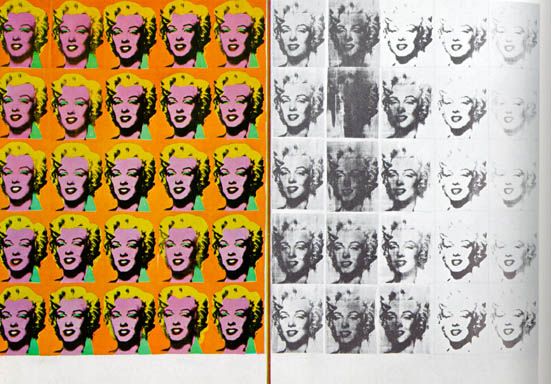
Andy Warhol, Marilyn Monroe, 1962
The thrust of the process is to turn against the model and its world in order to open a new space for the simulacrum's own mad proliferation. The simulacrum affirms its own difference. It is process of differentiation.
With pop art (and Italian neo-Realism and the French New Wave in film) there is is the beginning of a dissolution of old identities and territorialities and the unleashing of objects, images and information having far more mobility and combinatory potential than ever before.
April 14, 2004
simulacrum
I stumbled across this via this and this. My starting point was the always excellent Things Magazine.
What attracted me with Modern Painters was photography as part of the broader visual culture.
Alas, not much is online. The odd article and the occasional image:
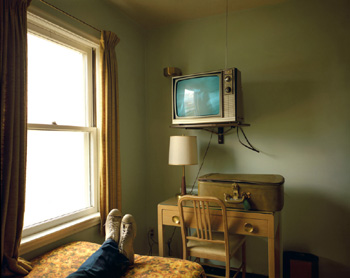
Stephen Shore, Room 125, Westbank Motel, Idaho Falls, Idaho, July 18, 1973
Frustrated and disappointed I went looking for an image to remind me where I'd been over the Easter break:

Richard Misrach, Untitled
Continuing my search I came across this passage that describes the visual culture of the late twentieth century and the impact it has has had on us:
"The European image of the United States in my generation, born in the 1950s, was molded by a reality already shaped by its media presentation. American magazines, comics, movies, and TV - the mass media, in short have, as German director Wim Wenders has remarked, "colonialized our subconscious." Our perceptions of the country and its inhabitants are shaped by the cliches of a secondary reality, cliches that suggest familiarity, but which in reality do not exist."
That is also the Australian image of the United States.
That passage marks a shift from the conception of the visual world as a system of representations (identity) to, one of a simulcra which reproduces the appearance of the original but only as a copy which differs. We live within a world of floating images whose connection or relation to reality has been fractured. What we have are visual signs that no longer primarily represent or refer to an external model. They now primarily stand for themselves and they refer only to other signs.
That is our condition within the world of consumer capitalism.
April 12, 2004
It's a tragedy
I've posted this image because it captures the religious (messianic) fervour of the whole US enterprise in the Middle East.

Spooner
When you listen to President Bush and the US military you hear resonances of the mediaeval Christian crusaders attacking the infidels. (subhumans).
So what are the Iraqi's seeing?
Baghdad Burning says:
"They say around 600 Iraqis were killed in Falloojeh- 120 children and 200 women... it's an atrocity and horribly sad. They have let one or two convoys in and the rest were sent back. The refugees from the area are flowing into Baghdad and it's horrible to see them. Women and children with tear-stained faces, mostly in black, carrying bundles of clothes and bottles of water. The mosques are gathering food and clothes for them... one of the storage areas for the refugee stuff was hit by an American tank today in A'adhamiya and the scene is chaotic... scattered food, medication, bandages, blankets, etc."
What a mess. Dead kids. See the picture file on the Falluja seige at Aljazerra net. It is what we don't see in our media. We see this
April 11, 2004
rhizome
I'm down on the South Coast, near here, the mouth of the River Murray:

John Olsen, Lake Alexandrina, 1996
Whilst everyone appears to be wandering around looking at seaside property I'm relaxing. I had tried to access the music Bryan Bay music Festival as an live download this weekend. It should be a live download, but it is not. So much for the use of the Internet in Australia. It is not breaking away from the beaten path of a music festival.
So I'm trying to get my head around Deleuze and Guattari's concept of the rhizome. I like the idea of something that grows in all directions, or is a network of concepts that are in a state of flux from being modified or transformed as they are applied to one problem and the next. It loosens things up, allows some room for creativity, provides space for the emergence of new thinking.
April 10, 2004
a nomadic existence
It seems as if the temporary life of being single between leaving the parental home and getting married is becoming a permanent mode of urban existence.
In the 1970s and 1980s this single living used to be temporary. It was a period where those in their 20s and early 30s acquired a good university education, lived off crates and second-hand furniture in a rented cottage in the inner city, and enjoyed being unattached, and celebrated sexual freedom and being childless. After that romantic period of liberty one shuffled off the suburbs to raise kids, forever yearning for the time when the kids had left home. They consoled themselves about the loss of their nomadic life by playing the Rolling Stones Exile on Main Street; and imagining they were on the road listening to a world weary juke-joint band playing their rough material at a seedy and dirty highway bar.
When the kids had left home to live their own lives, the suburban home was sold. The aged couple either returned to the inner city for an experiment in apartment living; or they went to the place of the endless summer on the coast, played Captain Beefheart's Trout Mask Replica. They visited regional galleries full of comfortable abstract expressionism and marvelled at works of John Olsen

John Olsen,
that they were not able to make sense of 40 years earlier. They could now converse easily about the landscape and Australian identity, the imagined space somewhere between dream and reality and a rich aesthetic vocabulary.
Being a 20's something single today is quiet different. It is a mode of living in the postmodern city where kinship ties fracture and fray whilst friendship ties strengthen.
It is a nomadic mode of life or existence in which the economic pressures bite hard. The urban wandering does not appear to be a live of creative transformation, in which free floating individuals are transformed into something different to what they were before through a patchwork life of creative mutation and change. There is little whimsical fantasy of 'exotic primitivism' here; little nomadic ethics apart from self-interest; little to the nomadic mobile existence than the journey between two points in an open-ended social space.
What we do have with this social nomadism is a deviation from then majority or standard that is the bearer of the dominant social code and the possibility for a deterritorializing of the dominant social code of family. Within this process there may be new forms of subjectivity and new forms of connection in an open social space.
They intuitively understood the Deleuze and Guattari's phrase in Anti-Oedipus that 'Capitalism...decodes and deterritorializes with all its might.' It would appear that the capitalist assemblage pierces the nomadic body from any direction it desires, and that the nomadic defense against the massive plateau of global capital, which constantly constitutes and colonizes new territory, are few and far between.
April 9, 2004
surrealism in Australia#2
I re-read this earlier post on Australian surrealism this morning whilst I was reading Bataille. I was reminded how surrealism was seen as historical and dead in Australia yet Bataille's ideas are alive and well.
Bataille's criticism of Andre Breton's form of surrealism can be applied to Australian surrealism. Bataille argued that for all Breton's talk about fusing life and art in the 1924 "Manifesto of Surrealism," the Surrealists never abandoned the affirmative ideals of aestheticism. As Richard Wolin says, Bataille's criticism was that:
'Despite their vaunted and prodigious bohemianism—their fascination with ruins and shock effects, with the forlorn and abandoned quarters of modern cities; their celebration of the unconscious and the spontaneity of "automatic writing"—the Surrealists never renounced the conformist ideal of the presentable, well-wrought work of art. Turning their backs on the Dadaist notion of "anti-art," the Surrealists, under Breton's austere tutelage, committed the unpardonable: They squandered their initial avant-garde élan in order to become merely another "art movement." '
My judgement is that surrealism in Australia has been interpreted as just another art movement; one that has been more or less linked to the personal vision of James Gleeson:

James Gleeson, Landscape with Anthropomorphic Ambitions, 1985
In these works the psychological mythical concerns are to the fore, whilst the earler emphasis of art addressing social/political concerns---an anti war stance---has disappeared:

James Gleeson, Surreal Landscape with Figures c.1943
The presence of the world's horror disappears in Gleeson's latter works. There is little about filfth and corruption associated with desire and pleasure.This is not a dissident surrealism
As an avant garde art movement that began in the 1930s surrealsim was violently rejected by conservatives as an expression of modernism. It was seen to be too much an expression of the unconscious to be a part of a noble high culture.
Why was that a problem?
Because surrealism rejected rational thought in the creativity process. Thus it was irrational and could not function as a shield of high culture against the commercialism and utilitarianism of the market. Surrealism smelt of vandalism, the break down of values and standards and sexual desire.
Let's not forget the base materialsim of bodies and sexual desire, feces, menstrual blood and cadavers. Bataille in 1930's Australia would have been banned out right.
So surrealism in Australia never filfilled its Bataillian promise of a cannibalised bestiary in which severed limbs and unspeakable horrors were born from the promise of great joy and desire. It avoided tarrying with the negative:--the dark forces of sacrifice, myth, cruelty and violence.
April 8, 2004
give them a drink
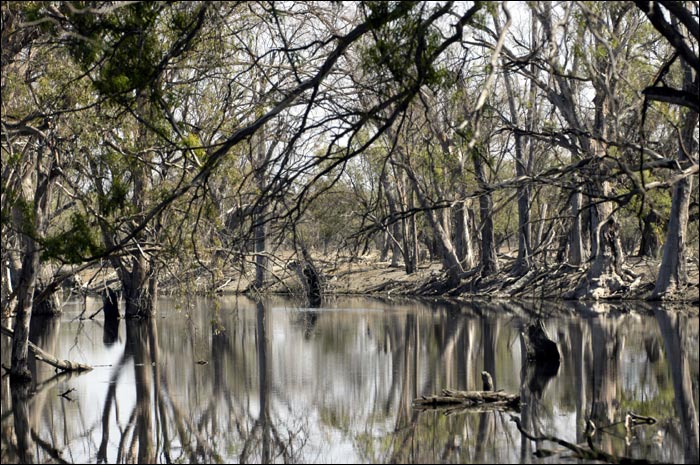
David Mariuz, River red gums get a long, life-saving drink of water on the Chowilla flood plain, near Renmark.
The trees in the Chowilla floodplain near Renmark in South Australia are close to dead.
Some have already died:

Andrew Tatnell, dying River red gums in the ‘Garden of Eden’, Chowilla
Attempts are being made to give them a drink. Others resist. Irrigators must come first always.
April 6, 2004
postmodern markets
This post over at John Quiggin's blog is interesting. It find faults with this article in The Age, which I blogged about here.
What I found interesting is how, in picking holes in the argument (about postmodernism, generational explanations, all-round-stupidity and apologies for the exploitation of workers), Quiggin and the various commentators miss the wood for the trees. These hardboiled econs and politicos, in generally condemning The Age article, missed the postmodern consumer culture they inhabit. The sexualised nature of this market culture and our contradictory responses to it is what the The Age article was talking about.
Little fire power was directed at this culture or the male pornogaze this sexualized culture presupposes.
To put the point at issue in more philosophical terms for the moment. This market culture represents a fusion of what was once separate in modernity: the instrumental system of money and politics with its concerns of profit and power; and the lifeworld with its concerns of meaning, communication, personal identity and integration. This newly formed market culture in postmodernity is about making money and aesthetic hedonistic lifestyle, and it is all about marketing, creativity, advertising and design:

G.Bourdin, Beer.
Missing the wood makes you wonder. How do men do it? Are the hardboiled realist econs and politicos, who often talk amongst themselves about being rational maximizers of a utility function, aware of how their desires are daily shaped as consumers? Do they walk around with eyes closed to everything but numbers? Do they just drink the beer without seeing the world created by Bourdin?
I don't know the answers to these questions.
To put it in philosophical terms once again. Bourdin and the advertisers are wearing the mask of the artist to sell their sophistry to producers to persuade (seduce) consumers to buy their beer. And the consumer exercise their choice and buy a particular brand of beer. It's a clever strategy and it works. These artists deploy aesthetics to socially construct reality through deploying the beautiful to further the interests of the big producers.
Or more rarely, by deploying the sublime:

G. Bourdin
He seduces the consumer with a powerful image rather than the product it promotes.
April 5, 2004
Urban life: isolation & gloom
It is the 1950s account of urban life updated is it not?
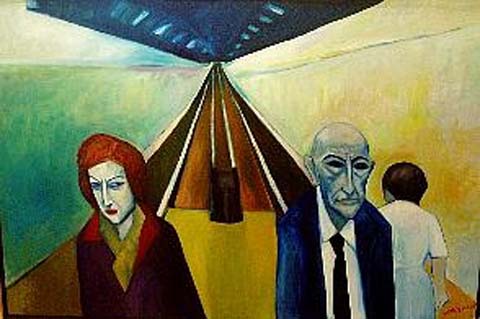
R. Dickerson, Frequent Fliers, 2003
Suppressed irritation? I've been on the shuttle service a fair bit this last month. The people commuting are a little more joyous than this.
It is the dark side of the Sydney sun:
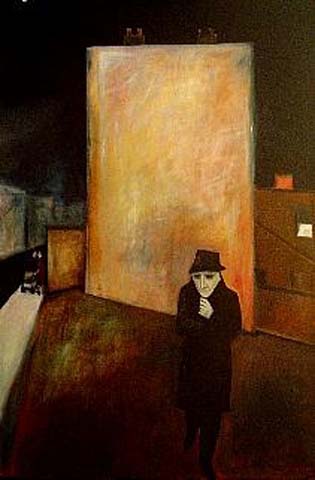
R. Dickerson, Winter in Sydney, 2003
There is little connection between people.
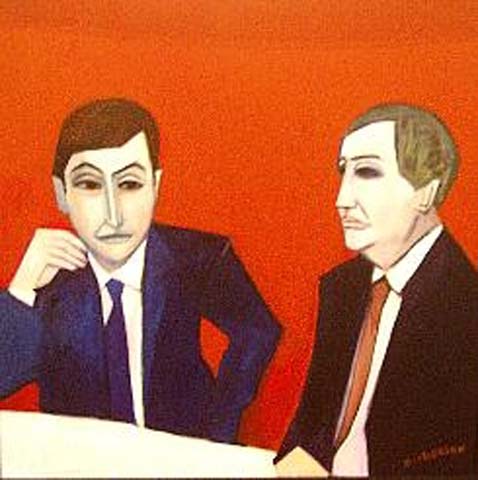
Robert Dickerson, Securing the mortgage, 2003
We are sealed in our inner worlds in an alienating city:
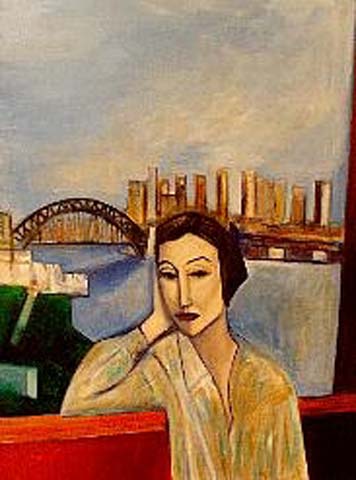
Robert Dickerson, North-shore woman, 2003
Australia in 2004 is a lot better off in terms of material of goods that the Australia of the 1950s. But it is emotionally bleak.
What does this work say about our cultural identity? John Howard considers the deabte closed. Apparently we are over all that national identity stuff.
The Australians in Dickerson's work do not seem to be proud of their history or heritage. Maybe the work is a form of cultural jamming.
April 4, 2004
Guy Bourdin: postmodern surfaces
On the surface advertising images are often fashion shots of classy goods (shoes) for fashion magazines, such as French Vogue during the 1960s and 1970s.

Bourdin's images are seen as breaking new ground in fashion photography. Bourdin was avant garde in the 1960s-70s. Consequently, Bourdin's work is influential within fashion photography
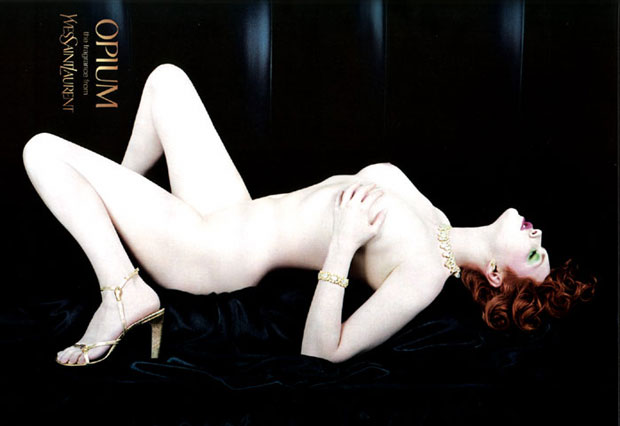
Steven Meisel, Yves Saint Laurent Opium (Nipple), model Sophie Dahl
Thus we have a consumer culture that is self-referential as well as intertextual and ironic. So we edge increasingly towards a postmodern market. This is a world (postmodernity) where aesthetics and economics dance hand in hand.
Yet there is more than surface with Bourdin. When we look at the Bourdin image we wonder if something else is happening around sexual desire.Somethign other. Is the women dead perhaps? Or are we looking at a mannequin? There is just a suggestion or a hint of something not quite right. It is hard to put one's finger on what is off-putting.
Sometimes what is off-putting is made a tad more explict:
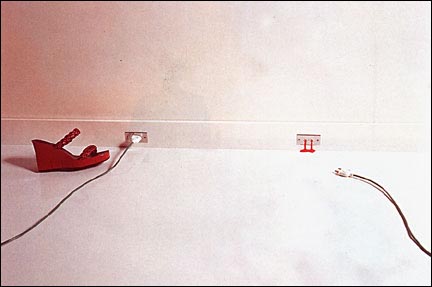
G. Bourdin, shoes and plugs, 1975
It is death. Sex and death.
The self-destruction of sexual desire is very Bataillean, is it not?
So the critical edge has not entirely disappeared from consumer culture.
April 3, 2004
Guy Bourdin & re-enchantment
In an earlier post I briefly mentioned the rhetoric of visual culture. Here is a master of visual rhetoric:
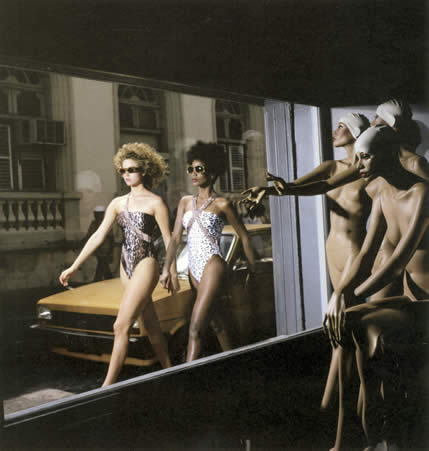
Guy Bourdin, No title (Fashion illustration) 1975, French VOGUE May 1975 pp180-81
If there was a process of the disenchantment of the world (along the lines described by Max Weber) in modern industrial society then Bourdin suggests a process of re-enchantment in postmodernity. He suggests a magic, morality and narrative being allowed to enter the marketplace. This re-enchantment indicates the evolution of post-modern markets, as we exit from industrial society.
Guy Bourdin was one of France’s leading avant-garde fashion photographers. Critical to his work was his ability to subvert images of fashion and beauty by his knowledge that it is not just fashion but its representation that seduces and fascinates us.
This major retrospective shows a selection of his intense and dramatic photographs from the peak of his career, rarely seen films and hundreds of his unpublished private images. The Guy Bourdin exhibition at the National Gallery of Victoria is sponsored by L’Oréal Paris and the L’Oréal Melbourne Fashion Festival in association with Vogue.

Guy Bourdin, Dummy legs
A touch of surrealism to re-enchant the world?
Bourdin's narrative is darker than the standard account of fashion photography as art. We do have the standard objectification of women through the male gaze:
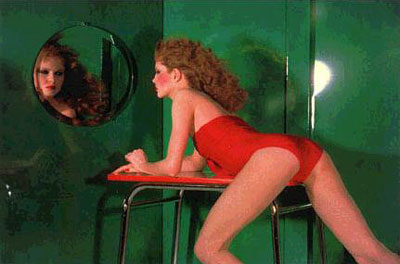
No title, French Vogue, May 1977, pp. 94-5.
We are dealing with markets here; with advertising images used to persuade. Markets work on persuading consumers to buy the tantalizing commodities. Consumer culture is crucial to markets working properly ---ensuring the linkages between supply and demand are not hit and miss. Yet the visual culture of competitive markets is overlooked by economists.
These often lead into images of death that remind us of how destructive desire can be:
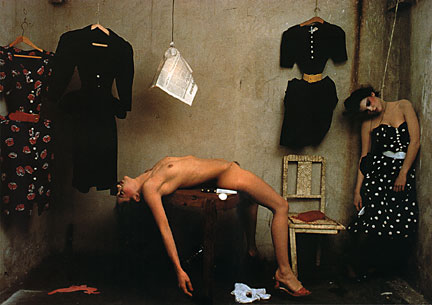
G Bourdin, Hanging woman
April 2, 2004
Sex: it's everywhere
This captures the double standard about sexuality in contemporary culture. It states the obvious:
"We live in an age where the use of imagery in the media and advertising is highly sexualised....What drives the fashion industry and labels such as Westco is profit. And what the gen X audience knows is that sex sells fashion. That certain politicians and government officials don't understand this is almost quaint and reflects how out of touch with contemporary attitudes on sex and advertising many of them are."
Fashion has been playing around with sex all the time, as can be seen from a cursory glance at the edgy 70’s fashion photography of Guy Bourdin at the National Gallery of Victoria.
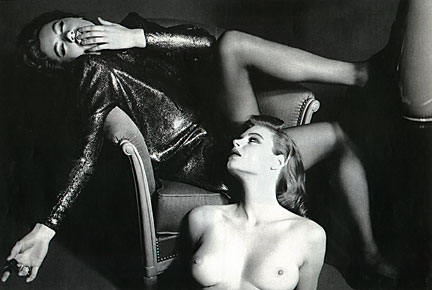
Guy Bourdin, Topless
It is certainly true that some politicians in Victoria decry the use of sex in a fashion campaign---a T-shirt slogan that says "stop pretending you don't want me", yet turn a blind eye to the Victorian Government supporting the recent Melbourne Fashion Week with its events and media coverage filled with images of half-naked male and female models. Others ignore the State Government-promotion of the Formula 1 Grand Prix, which plays on the sex-sells message with its mix of grid girls, fast cars and drivers.
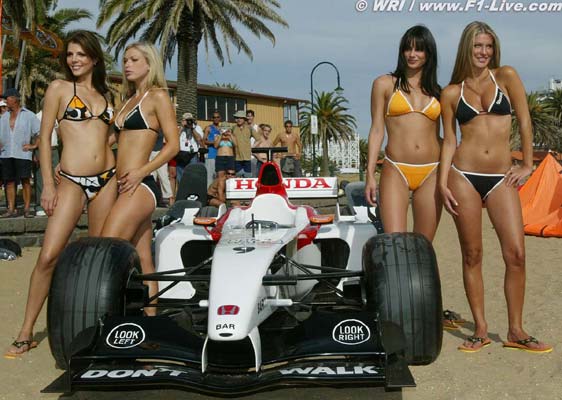
Formula 1 Melbourne 2004 supporting move to ban various films and television programs they happen to consider to inappropriate for public consumption. Others point the finger at the sexual behaviour of teenagers whilst ignoring the sexual imagery in the mediascape all around them.
Update
Meanwhile the old style academic modernists who decry the "postmodernist irony" of popular culture, rightfully reminds us about the important of class. But they ignore the visual culture that enframes us. Their tone of hostility indicates something more: the old science versus the humanities divide/war surfacing? This time around it is the queen of the social sciences (not the natural sciences) versus the humanities (rhetoric).
Only rarely do the economists acknowledge the rhetoric embodied in their science, or acknowledge that markets work in terms of rhetoric (persuasion).
