|
April 15, 2004
A common definition of the simulacrum is that it is a copy of a copy whose relation to the model has become so attenuated that it can no longer properly be said to be a copy. It stands on its own as a copy without a model. An example is photorealism.

Hilo Chen, Beach 137, 1997
The above painting is a copy not of reality, but of a photograph, which is already a representation of the original. Some interpret that as a copy of a copy.
Deleuze, in his article "Plato and the Simulacrum," argues that the simulacrum is less a copy twice removed than a phenomenon of a different nature altogether. It undermines the very distinction between copy and model. That means a simulacrum is an image that does not resemble; the image is maintained whereas the resemblance is lost.
According to Brian Massumi for Deleuze that means the:
"...the production and function of a photograph has no relation to that of the object photographed; and the photorealist painting in turn envelops an essential difference. It is that masked difference, not the manifest resemblance, that produces the effect of uncanniness so often associated with the simulacrum. A copy is made in order to stand in for its model. A simulacrum has a different agenda, it enters different circuits. Pop Art is the example Deleuze uses for simulacra that have successfully broken out of the copy mold: the multiplied, stylized images take on a life of their own."
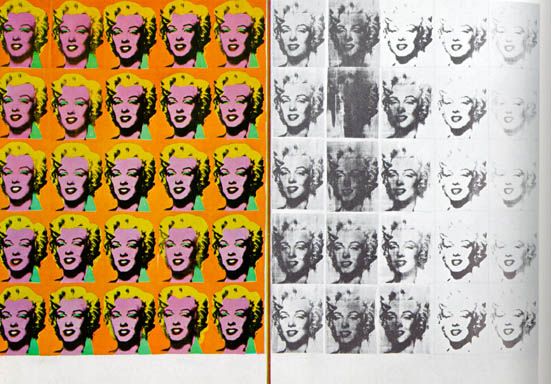
Andy Warhol, Marilyn Monroe, 1962
The thrust of the process is to turn against the model and its world in order to open a new space for the simulacrum's own mad proliferation. The simulacrum affirms its own difference. It is process of differentiation.
With pop art (and Italian neo-Realism and the French New Wave in film) there is is the beginning of a dissolution of old identities and territorialities and the unleashing of objects, images and information having far more mobility and combinatory potential than ever before.
|


this is a really good post. maybe I'm wrong -- Deluze's stuff might really work for your project.
The question I have, though, is how does this mad proliferation root itself in the common? Warhol is cool, but I hope you're looking for a better kind of new space than what he induced. His one seems to have only offered a new horison for exploitation and visual starvation -- all the best Factory artworks are locked up in the Warhol estate!
That's the flip side of the new combinatory potentials, of the new collaborations pop art created. if the simulacrum is also the axis on which exploitation operates, how does this new space avoid re-territorialization? or is our best hope to just try to out-run it?
P.S. did you notice my comment on "Guy Bourdain & re-enchantment?