|
April 14, 2004
I stumbled across this via this and this. My starting point was the always excellent Things Magazine.
What attracted me with Modern Painters was photography as part of the broader visual culture.
Alas, not much is online. The odd article and the occasional image:
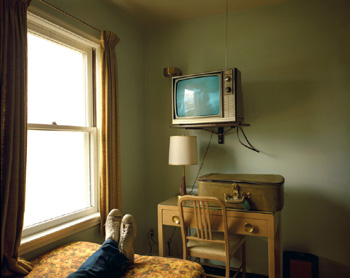
Stephen Shore, Room 125, Westbank Motel, Idaho Falls, Idaho, July 18, 1973
Frustrated and disappointed I went looking for an image to remind me where I'd been over the Easter break:

Richard Misrach, Untitled
Continuing my search I came across this passage that describes the visual culture of the late twentieth century and the impact it has has had on us:
"The European image of the United States in my generation, born in the 1950s, was molded by a reality already shaped by its media presentation. American magazines, comics, movies, and TV - the mass media, in short have, as German director Wim Wenders has remarked, "colonialized our subconscious." Our perceptions of the country and its inhabitants are shaped by the cliches of a secondary reality, cliches that suggest familiarity, but which in reality do not exist."
That is also the Australian image of the United States.
That passage marks a shift from the conception of the visual world as a system of representations (identity) to, one of a simulcra which reproduces the appearance of the original but only as a copy which differs. We live within a world of floating images whose connection or relation to reality has been fractured. What we have are visual signs that no longer primarily represent or refer to an external model. They now primarily stand for themselves and they refer only to other signs.
That is our condition within the world of consumer capitalism.
|


