October 31, 2009
it's odd, isn't it
It is odd how people have a dislike of wind generators on aesthetic grounds---they are ugly as well as noisy --so we don't want them defacing our beautiful landscape. And yet they are perfectly happy with the giant transmission lines criss-crossing the landscape to power the machinery of industrial capitalism.
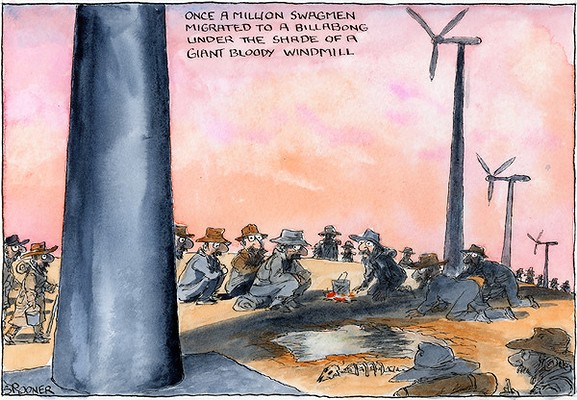 John Spooner,
This objection from those opposed to renewable energy in regional Australia is sometimes made by those who also say that they are conservationists and greenies. And yet, in trying to stop, wind farms they remain with power generated from coal -fired power stations. What gives?
October 30, 2009
Art of Nature
The Department of Environment and Heritage in South Australia is hosting a photographic competition entitled Art of Nature, in which members of the photographic community can enter their photos that celebrate South Australian natural landscapes, seascapes and native plants and animals over the next fortnight.
Those photos that are posted in an online gallery are voted on by registered members of the public. It's a nice idea in terms of Web 2.0 user generated content and is proving to be very popular in terms of uploads.
I initially submitted this image under thoughtfactory, which looks better on the DEH online gallery than it does here:
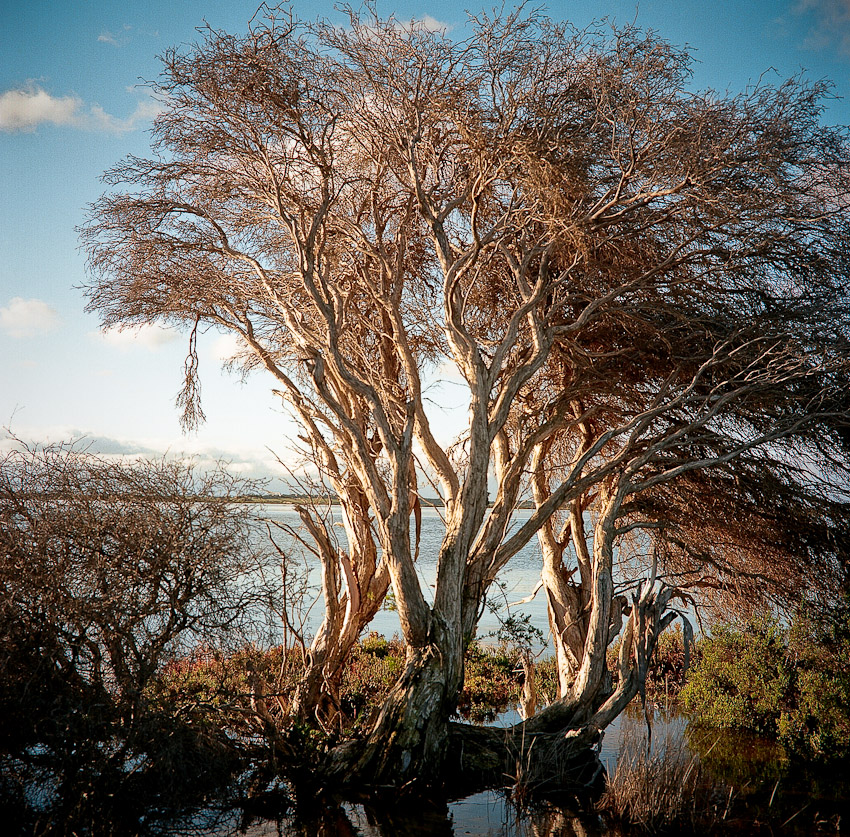 Gary Sauer-Thompson, Melaleuca, Murray-Mouth estuary, 2008
The image is languishing around 200 in the most popular and has received no comments. Oh well.
The results of the top ranked photos so far are what you'd expect: sunsets, moody landscapes, cute animals, with the emphasis on content not form. It confirms the views of those who argue that there still is a big divide between art photography and popular photography. They have different aesthetics.
Joel Coberg's point is about the distortions and misinterpretations in internet debates around this divide and across this divide. He says:
The “rather straightforward” point that “there is this tendency to stereotype Flickr as nothing but kittens, sunsets, and chipmunks” of course never happened in the three articles that caused all of this. In fact, it was the exact opposite (but apparently, artists like Penelope Umbrico or Joachim Schmid are not worthwhile talking about - well, if that isn’t just the same form of elitism that is usually leveled at the “fine art” community I don’t know what it is).
Internet debates are not conducted like academic seminars, as they are far more freewheeling. Colberg goes on to say that this distortion, and what he sees as an attack by "Flickerites":
is a “wonderful” example of how so many “debates” on the internet evolve, and as someone who is interested in talking about photography online, it’s actually pretty disheartening. Why should anyone bother trying to engage with Flickr, if regardless of what is written it is automatically taken as stereotyping “Flickr as nothing but kittens, sunsets, and chipmunks” - even if in reality the exact opposite is happening?
Trouble is, as Bryan Formhals points out, since 'Flickr' is a social networking platform with diverse uses and voices, it cannot be seen as a unified whole, one group, or as Flickrites. Colberg refers to engaging with Flickr --with mass culture in the old terms --rather than with the specific voices or groups using Flickr.
October 29, 2009
New Topographics restaged in the US
The exhibition New Topographics: Photographs of a Man-altered Landscape, held in 1975 at the International Museum of Photography George Eastman House, (Rochester, NY) and the show brought together nine photographers—Robert Adams, Lewis Baltz, Bernd and Hilla Becher, Joe Deal, Frank Gohlke, Nicholas Nixon, John Schott, Stephen Shore, and Henry Wessel, Jr.
 John Schott, John, El Nido Motel, 1973, gelatin silver print
This signaled the emergence of a new approach to landscape, effectively giving a name to a movement or style and has since come to be understood as marking a paradigm shift. The Exposure Project describes this shift as a rejection of the the photography of an Ansel Adams and Edward Weston who depicted the landscape as an entity of unscathed and organic beauty. It also rejected the gauzy theatrics and feel-good humanity of Alfred Stieglitz and Edward Steichen.
The photographers of the "New Topographics" movement strove to show the rapidly increasing imprint of human beings on the landscape by an industrial culture. They turned their cameras towards newly built tract houses, industrial parks, expansive highways and commercial strip malls as proof of man's impetuous development.
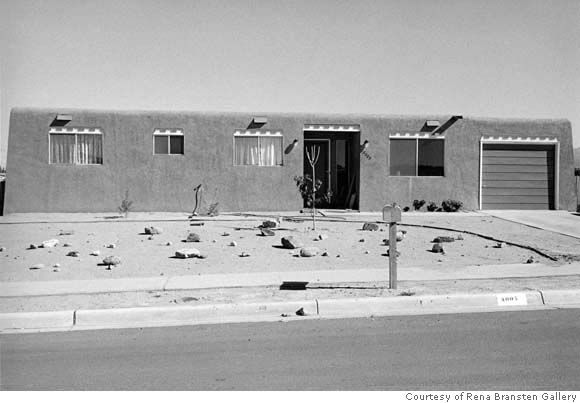 Henry Wessel, "New Mexico" 1969, silver gelatin print
The New Topographics focused on what everybody in America during the 1950s, 60s and 70s actually saw in front of their noses, through their windshields or across their backyard fences.These were run-of-the-mill subjects: highways, strip malls, used car lots and other seemingly nowhere places. They created a poetics of the American everyday life.
The exhibition has influenced a whole generation of photographers. In Australia and in Japan photographers worked by questioning the notion of wilderness and the celebration of an untouched nature. So we can talk about a New Topographics movement.
A new version, restaging or recreation of this exhibition has been organized by organized by the George Eastman House with the Center for Creative Photography at the University of Arizona. More than two-thirds of the photographs by the original ten participants—Robert Adams, Lewis Baltz, Bernd and Hilla Becher, Joe Deal, Frank Gohlke, Nicholas Nixon, John Schott, Stephen Shore, and Henry Wessel, Jr.—are displayed.
An accompanying presentation of works by influential photographers and thinkers offers historic context, including Timothy O’Sullivan, Walker Evans, Ed Ruscha, Robert Smithson, and Dan Graham, as well as architect team Robert Venturi and Denise Scott Brown, with their publication Learning from Las Vegas (1972).
The issues that contemporary photographers could explore to build on what the "New Topographics" artists started would be the effects of consumerism, the over-development of the landscape, the accelerated use of our natural resources and climate change.
October 28, 2009
Hans Aarsmann: urban nature
Hans Aarsman is a Dutch photographer, author, and lecturer at the Rijksakademie in Amsterdam and is known as a significant figure in the New Topography movement. He started his career as a photojournalist for the Dutch newspaper Trouw In 1989 he published the book Hollandse Taferelen which consisted of landscapes photographed from the roof of a camper which he pulled through the Netherlands for a year.
 Hans Aarsman, Kattensloot (from Hollandse Taferelen), 1995, C-Print
He gave up photography for a decade or so because he felt it was an unsatisfactory representation of his visual reality. The image is now less dependable than ever with its unfixed and contested meanings, its immateriality, erasability and throwaway nature. The gulf between object and image becomes ever wider with the image becoming the thing.
 Hans Aarsman, Waterhuizen (from Hollandse Taferelen), c-print, circa
He returned to photography with Photography as Antidote to Consumerism. In an accompanying essay he said:
Let us provide some resistance. Let art stop acting as a vehicle for commercial interests. And if art is incapable of doing so, because its interests are too closely tied to those of commerce, then we’ll do it ourselves. After all, everybody has a camera in their phone these days.
Aarsman currently works as a writer, in particular on photography, and is co-founder of the magazine Useful Photography.
What intrigues me about the earlier urban landscape work is its new topographic ethos. This is a modern image of the Dutch landscape that is in contrast to that of the old Dutch Landscape that is familiar chiefly from 17th century Dutch painting. Today the Netherlands is known for its planned, manipulated landscape as the agrarian function of the Dutch landscape is replaced by suburbanization, recreation, industrial and business parks and infrastructure for transportation.
October 27, 2009
a revitalised and rejuvenated Adelaide CBD
Adelaide has had a long string of visiting urban planners, social planners, environmentalists, scientists and other eminent experts thinking hard about Adelaide on our behalf. There has been a history of good urban thinking, but no actual doing in to ensure city living and active use of the city in a people friendly city.
There has been a pessimism and anxiety about the future, a lack of clarity about where the state is going, that has lead to a retreat from constructive thinking about the future in order to dig oneself into the trenches of the past/present. The dead hand of Treasury weighs heavily on the Adelaide, and this has resulted in a state of paralysis about the city reinventing itself for the 21st century.
 Gary Sauer-Thompson, mural, Adelaide City Council, 2009
There is no sense of Adelaide becoming a design friendly city; a city based on good urban design and innovative buildings; a city that is people friendly.
So the Property Council of Australia (South Australian Division) call for a revitalised and rejuvenated central business district in Adelaide in its report, Adelaide 2036: Building on Light's Vision, is to be welcomed. This builds on the earlier Adelaide: The Way Forward (2000) which outlined more than 80 projects, initiatives and actions designed to boost the city across a wide range of sectors. The response has been favourable.
The Report rightfully returns to Colonel Light's urban design and Jan Gehl's Public Spaces and Public Life: City of Adelaide (2002) Consequently, many of its proposals to make Adelaide more liveable and people-friendly are sensible. These include:
upgrading laneways across the central city, modelled on the Melbourne City initiative; improving public spaces including reducing the heat island effect through more trees, creating a linked, people-friendly city; an incentives scheme to increase investment in public art and the public realm; the central city should be easy to move around in, with frequent and free trams and buses, safe pedestrian and cycle networks and good visual connections; extended tram routes( to the airport)
They are designed to make changes from a car dominated city to a people-friendly city; one in which walking is the key to liveable city.
October 26, 2009
Ed Ruscha + everyday objects
Ed Ruscha is the visual artist of the cityscapes of his native Los Angeles which he represents in terms of a bristling thicket of billboards and signs. The work has connections with pop art, minimalism and conceptualism, without ever fitting neatly into any of these stylistic categories.
The image below looks like a logo for an as yet unincorporated Hollywood studio financed by an oil company as well as referring to standardisation in industrial capitalism:
 Ed Ruscha, Standard Station, Amarillo, Texas, 1966
His latest work transposes the language of the city --- popular culture, word depictions, and commercial graphics---to the Californian countryside--and it continues to explore and play with pop culture and commercial imagery, type and typography. Words are objects --a formation of cut-out coloured shapes. Often the relationships and juxtapositions between word and image are puzzling and the meanings elusive.
Though Ruscha sees his work as simply a collection of facts about words, gasoline stations, street frontages these were not seen as interesting. Now, because of him, we see gasoline stations as having angles, colours and shapes as we look at the long, sign-filled streets spewing out words, images, screens---we are immersed in a mediascape.
I'm attracted to Ruscha's little books with their witty cataloguing of the everyday world. As Adrian Searle observes in The Guardian their understated style and design - are a kind of precise visual poetry of the unspectacular or the everyday. Searle says that
In the 1960s, Ruscha picked up a camera and started to make small books featuring peculiar and mundane series of photographs. These include Twenty Six Gasoline Stations (1962), shot on a journey through California, Texas and Oklahoma; Thirty Four Parking Lots, with overhead shots of the layouts and markings of, well, almost empty parking lots; books of apartment buildings, records (album sleeves on the left page, the vinyl discs on the right), vacant real estate lots. A Few Palm Trees is a 64-page book with only 14 illustrations.
he adds that these photographic works as cousins to the relentless projects of Düsseldorf photographers Berndt and Hilla Becher, with their records of half-timbered houses on the Ruhr, of cooling towers, pit-heads and water holding tanks. In both cases, this is art-as-list, detailing sameness and particularity, formal regularity and difference. These images encourage you to look, too.
October 25, 2009
Edmund Capon: the end of art
In the print edition of the October issue of The Monthly Sebastian Smee reviews Edmund Capon's I Blame Duchamp: My life's Adventures in Art
In one of the chapters Capon lines up Marcel Duchamp for the current state of contemporary art, especially conceptual art. Duchamp and his Fountain--- a ready-made sculpture as a ordinary manufactured objects designated by the artist as works of art--- are fingered for the second-rate in art today, which is devoid of beauty and sometimes a concept.

The reason given is that this ready made does not meet Capon's definition of art and so it is a version of the end of art thesis. I'm reading contemporary art as different from modern art in the sense that much contemporary art is no longer modern art in a stylistic sense. The non art--in Capon's sense--is an anti art in that these reject prior definitions of art and question art in general.
The end of art thesis, in the form of Arthur Danto's argument, Warhol’s discovery that anything, including a commonplace Brillo Box for Danto could become art is described by Danto as the end point but also as the high point of that revolutionary period. After this discovery, there were no boundaries anymore to cross and hence no further steps to take towards greater artistic self-understanding.
Artworks continued to be made, but the history of art came to a definitive halt---ie., the developmental history of art is over.Danto welcomes the unlimited diversity of art since the art world is a model of a pluralistic society, in which all disfiguringbarriers and boundaries have been thrown down.
The end of art then is where the word “art” ceases to be a meaningful term because it refers to nothing or everything.
October 24, 2009
Ballarat International Foto Biennale: Drex Brooks
One of the core exhibitions at the Ballarat International Foto Biennale was Drex Brooks, currently Professor of Art at Weber State University. Some of his work forms part of the Legacy Project, which builds a global exchange on the enduring consequences of the many historical tragedies of the 20th century.
 Drex Brooks, Pyramid Lake Battlefield, Pyramid Lake Reservation, Nevada, 1988, From the project Sweet Medicine Gelatin silver print
In his Sweet Medicine project, Drex Brooks photographed historical sites where conflict between Native Americans and white settlers occurred.
What we see are the photographs of sites as they appear today—landscapes extraordinary at times, ordinary or desolate at others, but always beautiful as photographs—we are aware of the tumultuous skirmishes, battles, massacres, and atrocities that real people went through a hundred or two hundred years ago before treaties were struck on these sites.
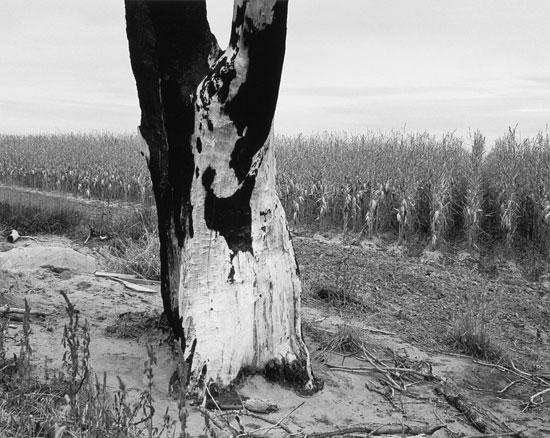 Drex Brooks, Council Grounds at the Great Treaty of Horse Creek, Scott's Bluff County, Nebraska, 1987 From the project Sweet Medicine, Gelatin silver print
The text accompanying each photograph was patiently researched and excerpted by the author/photographer from historic documents of treaties, speeches, and other records. The melding of the photographs and texts causes an emotional response for most viewers/readers.
The Biennial exhibition showed some of Brooks more recent work:
 Drex Brooks, Yard Sale, Astoria, Oregon, date unknown,Color photograph; archival inkjet print edition of 8
I'm not sure whether the recent work is part of a project, and, if so, what sort of project that is.
October 23, 2009
from yesteryear
More nostalgia:
It's an advert for the SX-70 instant camera, but it does show how far photography has changed from film to digital. The failure to adapt meant going out of business. It nearly happened to Leica--interest is growing --- and to Hasselblad. Franke & Heidecke, the makers of Rolleiflex were sideswipped by digital. Even though Phase One did make a back for the Rollei 6008 for a time, the Rollei brand languished.
Despite eventually making the Hy6 for Sinar and Leaf-- the Rollei/Sinar Hy6/Leaf Afi!--- have gone bankrupt and closed down their factory. The Hy6 appears to be the case of too little too late, as it was basically a retrofitting of the old film camera (a Rollei 6008 based MF body with Jenoptik digital back), rather than a 100% digital from the start. Sinar has said that it is negotiating a possible continuation of the medium-format Hy6 camera production.
The digital revolution has definitely cut a destructive path through the medium format camera market, even though they saw the technological revolution happening in the 1990s and an entire industry for digital backs for medium format cameras emerged in the 1990s.
Christian Sandström observes:
the rise of digital imaging put an end to the camera industry as we knew it. Many established players have gone out of business or balanced at the brink of bankruptcy for several years. The main reasons for this seem to be the explosive nature of digital technology, along with the fact that many firms had a position and a competence base that was rendered obsolete. While digital imaging has both popularized photography and taken it to new heights, this has been accomplished through the destruction of thousands of jobs and entire companies.
The market for the $50,000+ digital medium format camera such as Hasselblad and Phrase One is very small, and it probably now rests almost entirely in the rental houses. What is needed is medium format cameras starting to become more affordable,
Meanwhile, the digital revolution continues with the convergence of still photography and video, whilst the latest DSLRs, feature HDMI connectors which allow them to plug directly into home entertainment systems. We are a long way from the classic film cameras of yesteryear.
October 22, 2009
looking backwards
Photographic culture is currently marked by nostalgia as well as archiving archiving photographic criticism and scholarship.
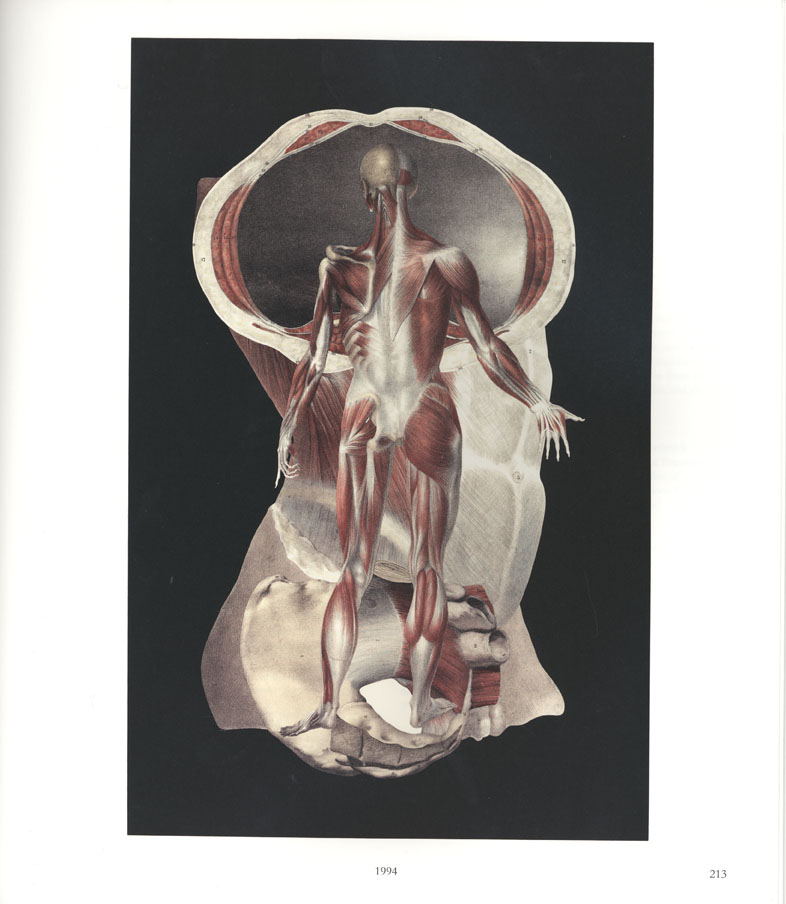 Friedrick Sommer, date unknown
The photo-historical literature that developed around analogue photography trace photography's path as originating in the context of industry and ending up somewhere near, but not within, the fine-arts in the art institution. 'Fine-arts' is such an old fashioned world. Why not pictorial arts?
If photography is the primary craft there is no reason to stop practicing painting and drawing at the same time. An example is Friedrick Sommer, who integrated the use of so many media and expanded the traditional boundaries of photography in the process.
Photography's traditional path shifted from an emphasis on the "making" to the "maker" of photographs giving rise to the emergence of the photographer as artist. Art is about "expression" rather than imitation in that the poet through his sentiment transformed simple language into an individual expression. Thirdly, we have the conscious recognition and propagation of photography's inherent qualities that was made explicit in the modernist idea of the concept of straight photography, whose ethos of purity rejected both manual alterations (ie., Pictorialism) and the commercial aspects of photography industrial photography).
The digital revolution provides us with spaces to allow us to us to try to break out of this discourse of photo-historical literature.
October 21, 2009
Vivian Maier: street photography in Chicago
Over at Flickr's Hardcore Street Photography (HCSP) site John Maloof says that he has purchased:
a giant lot of negatives from a small auction house here in Chicago. It is the work of Vivian Maier, a French born photographer who recently past away in April of 2009 in Chicago, where she resided. I opened a blog with her work....I have a ton of her work (about 30-40,000 negatives) which ranges in dates from the 1950's-1970's.
Vivian Maier was a Jewish refugee from wartime France a displaced Jewish photographer, who first settled in New York, then lived, worked as a nanny and photographed in Chicago.
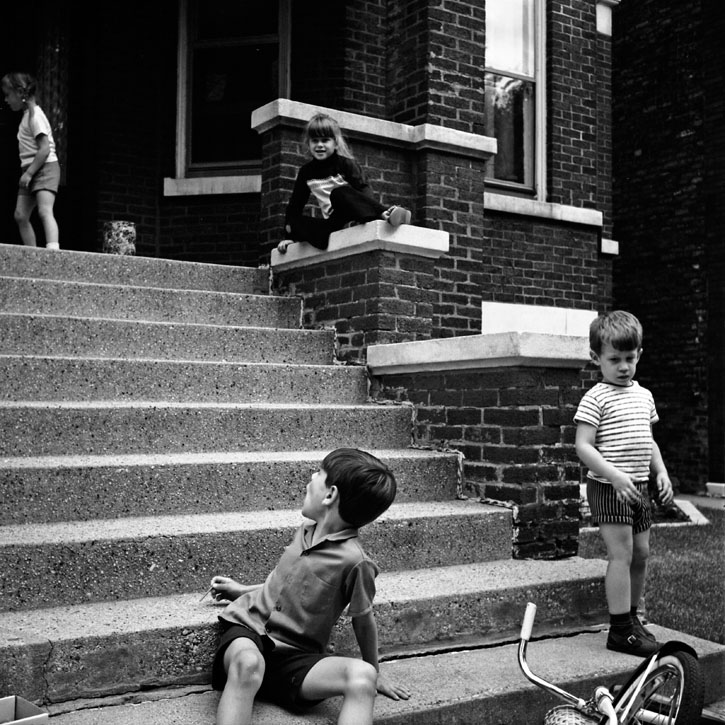 Vivian Maier, untitled, circa 1950-1970
The work was done with a twin lens reflex camera (a 1940's Rolleiflex TLR?) and it reminds me a lot of the work produced by both Lisette Model and Helen Levitt.
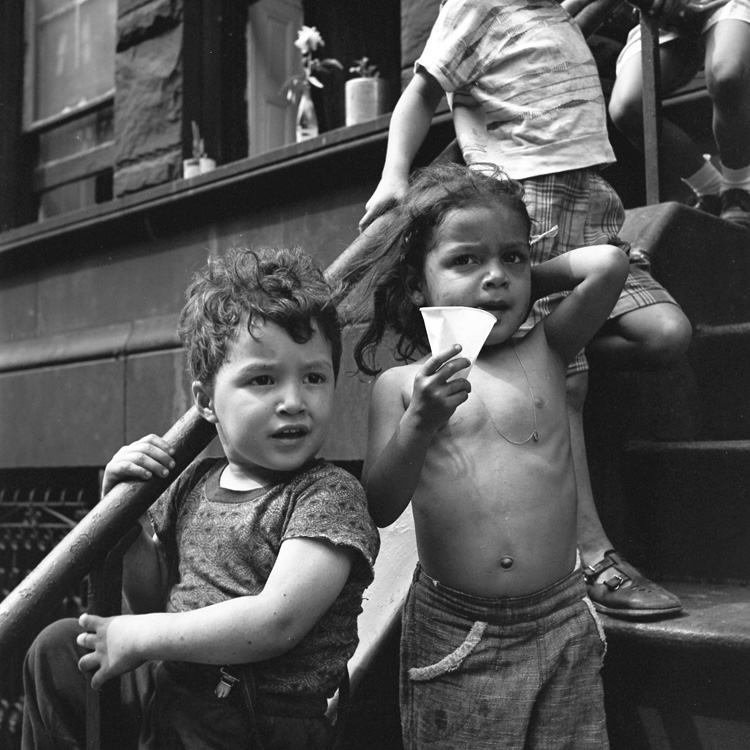 Vivian Maier, untitled, circa 1950-1970
Some of the work moves away from this classical humanist street photography approach to the odd landscape:
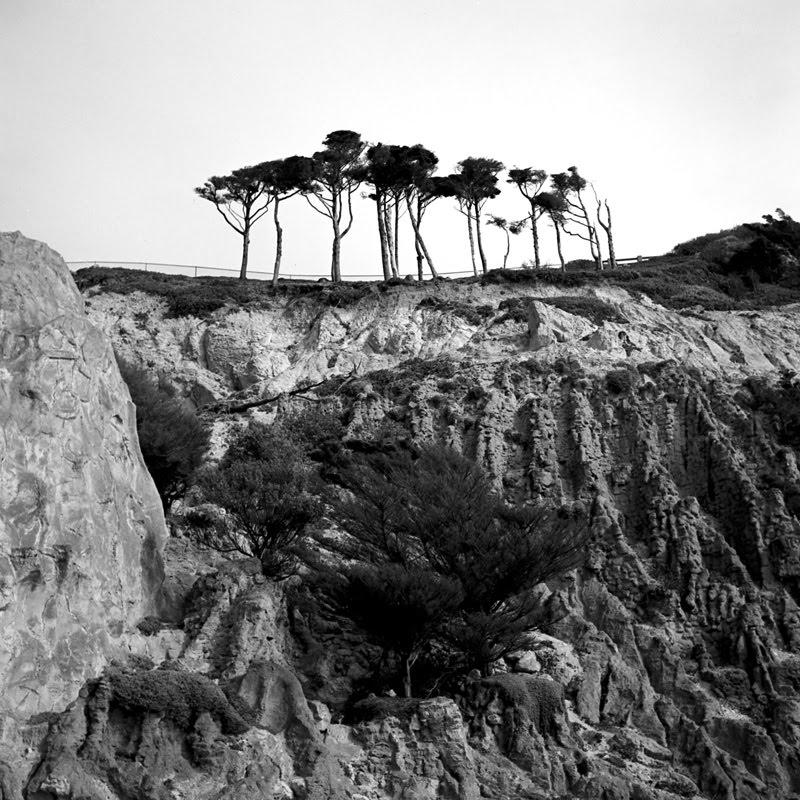 Vivian Maier, untitled, circa 1950-1970
And to architectural work:
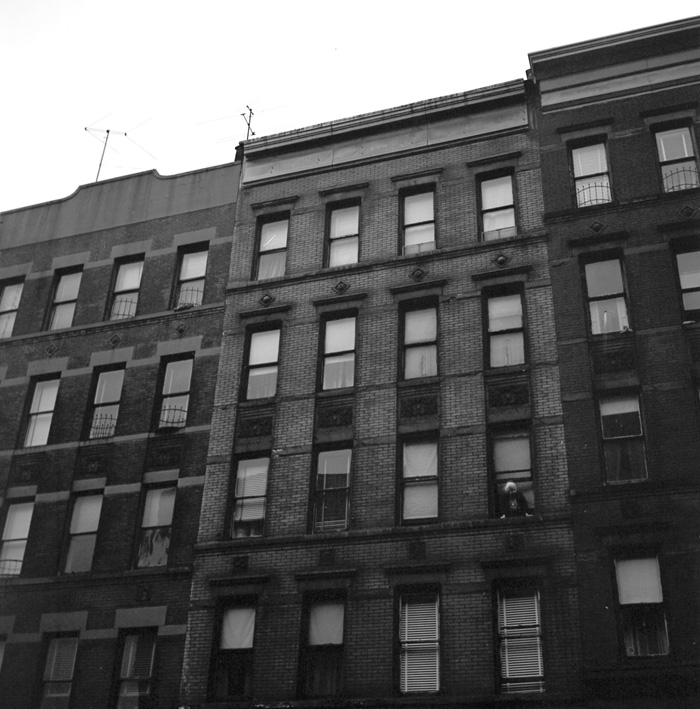 Vivian Maier, untitled, circa 1950-1970
Maloof wonders what he is going to do with this body of work he has acquired. The best suggestion I've seen in the comments thread at Hardcore Street Photography is to use Flickr Commons and make it a public digital collection.
October 20, 2009
shifting from Microsoft to Apple
The computer shop has informed me that the hard drive on my Windows XP desktop PC at Victor Harbor died. It is decision time. Should I dump the Windows PC and Microsoft and move over to an Apple desktop, as so many others are doing?
I have no desire to upgrade to Windows 7 after my experiences with Vista on a Toshiba laptop. Windows XP, though an old operating system, is perfectly adequate for the mechanics of making email, word processing and web surfing. I decided to get a new hard disc and stay with the PC and Microsoft, rather than buy a new Windows-based PC.
The simple reason for staying with the old is that old tedious issue — the incompatibility of the Mac with the Windows PC for text based documents. That's a big problem for income orientated policy work, even if I find Windows Mobile so cumbersome to use.

I was a Mac user in the late 80s when at university, then I switched over to the PC for the policy work. I starting the process of making the transition top Apple with the MacBook (I acquired the first modern Intel Mac in 2008) The decision is to keep the old PC/Windows computer going while I save the money to continue the transition to Apple for my photography.
When the Windows based PC dies I will replace it with a Dell, hoping that Microsoft's Windows 7 works smoothly. Microsoft may have a vision about computing in a digital age, but its implementation is shoddy and second rate. So my next step is acquiring a desktop for my photography-- for scanning film negatives and post production in Adelaide.
This will probably be the updated iMac, rather than the bigger and more expensive Mac Pro. That will come latter.
October 18, 2009
disliking photography
Issue 5 of Proximity Magazine's is on photography. The editors say that they had battles on whether or not “Fine Art” photographers were more interesting than “documentary style” photographers. Then fashion photographers were maligned from one corner, while in another quarter they were celebrated as one of the reasons photography is so well accepted as an art form to the public.
Unbelievably, fists flew while championing the rise of the “amateurs” and chairs were kicked around while the editors argued about either the irrelevance or the significance of Flickr, Myspace and Facebook.
 Gary Sauer-Thompson, erosion, Victor Harbor, 2009
In this issue there is an article by Bert Stabler on why he doesn't like photography. I struggle to follow some of the reasoning.
Stabler says:
in the case of photography, the key anxiety of the medium is its own transparency, the sense of constantly being an undressed emperor. The anxiety is narcissistic, the uncanny otherworldly familiarity of the mirror. Fine art is so hard to distinguish from anything else these days, and fine art photographs are so hard to sift out of the ocean of photography, that the signifiers are, by necessity, highly rigid – a rigidity the market richly rewards. So, what are these signifiers of “photography as art?”
His answer is that art photography is hemmed in 'by three ‘P’s: painting, poverty, and Pentax (technology). Fair enough.
On the first 'p' he says that from its inception, photography established itself as art by trying to move into the space abandoned by painting. Painting went on to its own tightrope walk on the thin line of cultural relevance, and photography seemingly stuck around to lap up painting’s sloppy seconds. Okay, that is probably true in a historical sense. However, photography had little problem in gaining cultural relevance in the 20th century, even if it struggled to be accepted as a "fine art" in the art institution.
By the poverty signifier Stabler means that we are treated to an endless minstrel parade of homeless veterans, junkie drag queens, sideshow refugees, depressed suburban loners, trailer-park residents, and various other contemporary mutants deemed undeserving of dignity." Fair enough. That's documentary photography.
Stabler then adds that:
Photography is unique. It is not like other art, because there is no step away from mimesis. The image is not made of something clearly artificial, like paint, clay, or even collage. There is no embodiment. The print or screen quality is merely a certain kind of window. And, unlike the analogous media of film and video, there is no time, and thus no sense of the third party – the camera and the subjects being part of a distinct event, whether explicitly contrived or not...What photography then offers is a pure presence, a mirror that shows us what Lacan contends is at stake when we develop in early childhood a sense of our own objective existence, by not just (mis)recognizing oneself in the mirror, but wanting oneself.
Hence the idea of photography as a narcissistic medium.
However, I'm puzzled by "wanting oneself". What does that mean? The reference to Lacan's mirror stage refers to a phase in which the subject is permanently caught and captivated by his own image, whilst the Imaginary refers to the field of images and imagination, and deception.Stabler adds that in a sense we are infantilized by photography – we are seeing something like a waking dream, a scene as both a memory and an object of desire, but not an event or a thing unto itself. Should photography enable us to see an event or thing unto itself?
Mimesis is not equivalent to a mirror since what stands between is representation and expression. Maybe pure presence is an illusion of contemporary photography--but not fine art photography?
October 15, 2009
photography: a note
Remember in the late 1970s when contemporary photography, moving away from its journalistic functions, and increasingly conscious of its size and subject matter, began to be made to hang in art galleries and on museum walls. More often that not these large-format canvases were usually ascribed to "artists using photography" rather than photographers (making art).
Did the dynamics of contemporary picture-making changed through the medium of photography's admission to the space of the gallery, and the photographer’s incorporation of that destination into their work?
The photographic “ghetto” no longer exists. Once photography had freed itself from the printed page, where it was accessible to an audience of only one or two people at a time, and was enlarged and elevated---eg., the work of a Jeff Wall and Andreas Gursky, who are known for their elaborately constructed or digitally manipulated photographs--- then issues concerning the relationship between the photograph and the viewer standing before it became crucial for photography as they had never previously been".
Most viewers look at a large photograph on a gallery wall differently than they would look at it in a book, or as a small print. They prepare themselves for a lengthy, meditative relationship with the image. Photography is making people look closely again.
So argues Michael Fried in Why Photography Matters as Art as Never Before. He reads art photography's critical value issues as arising from its resistance to the observational, documentary impulse --photography's indexical cohort with reality made explicit in the “observe and record” model of photography.
We can however, locate contemporary art photography in Gerhard Richter and Ed Ruscha, and in artists like Marco Breuer who experiment with photography’s basic materials—and to locate contemporary photography as a whole not only by reference to art, but to the many kinds of scientific, technological, and utilitarian images and their digital and philosophic possibilities.
October 13, 2009
the turn to beauty
Is aesthetics making a return through the backdoor in the form of the return of beauty in reaction to the 1980s theoretical turn to Marxism, semiotics and postmodernism?
 Gary Sauer-Thompson, red rose, Adelaide parklands, 2009
That turn to theory in the 1980s (reading Art Forum and October in the art school?) was seen as an embrace of the anti aesthetic.This did not imply a negation of aesthetics as such. Rather, it was intended to refer to an aesthetics of opposition to modernism. It offered a critical account of both modernist art and formalist art-criticism.
In a postindustrial society, in which aesthetics has been reintegrated into economic production, and art has become little more than "commodity production, investment portfolio and entertainment, conventional aesthetics has remained conservative. It is concerned with the autonomous art object and beauty.
The anti-aesthetic can be seen as a form of critique of the general strain of aesthetics popularly known as “art for art’s sake,” and more specifically the brand of formalism practiced by the critic Clement Greenberg, derived in turn from the 18th century philosophy of Immanuel Kant.
The impulse of modern art is the desire to destroy beauty. Beauty was considered charming, pleasurable, or ornamental. Beauty after all, remains the official ethos of the fashion world. However, beauty remained. Modernist design movements began by stripping away the purely ornamental aspects of their designs to lay bare the functional essentials. Their perception of beauty was found in grids, in unity, and in mathematical symmetry. There is real beauty in order.
Modernism uses the technique of art to draw attention to its status as art. Instead of seeing a picture as the things it depicts, the proper way to view a painting is as a painted surface. Simplicity, flatness, the denial of illusion and the importance of the picture plane as what is important to seeing a photography as a picture. To see a picture first “as a picture” is to see it formally and to hold that art is an end in itself and, secondly, that the aesthetic is an autonomous value.
While Greenberg insisted that his framework was merely descriptive rather than prescriptive, its teleology was inescapable: to the extent that it was modernist, each medium tended to divest itself of all traits or characteristics not “proper” to it (that is, not belonging to some other medium). In the case of painting (his preferred medium), its “proper” characteristics were flatness, (two-dimensional) shape, and “opticality.” Other traits formerly common to painting, such as narrative, three-dimensional illusionism, or even texture, were more “proper” to other media and therefore to be avoided in painting (or, at least, in “modernist” painting).
The “anti-aesthetic” and “postmodernist” critics objected to both a conception of art as an autonomous sphere of human activity, detached from material, social, and political concerns and to Greenberg's modernism. The turn back to aesthetics and beauty is a return to a broader, Kantian aesthetics of autonomy, rather than to Greenberg; and a turn back to the idealist conception of the work of art as spaceless and timeless, a conception famously embodied by the modernist “white cube” gallery space.
Thus Hilton Kramer employs a clear-cut either/or aesthetic equation: modernism good, postmodernism bad.Art, they believe, has become little more than "commodity production, investment portfolio and entertainment."
October 12, 2009
The Jackson Jive
The Jackson Jive on the recycled, nostalgic ridden Hey Hey Its Saturday show -- a Channel 9 TV show--- was meant to be a humorous tribute to Michael Jackson. The show had a very long run – on for 28 years which in TV time is as long as it gets. They then had a 10 year break and were brought back for 2 “reunion” shows – bringing back all the key performers from 28 years into the one show including the Jackson Jive crew.
What made this skit offensive was that the people involved had black paint on their faces. In America "making black" means making looking black people look like buffoons. The skit reinforces negative racist stereotypes associated with blacking up:
In Australia the routine is interpreted as good fun and "taking the piss" out of people and it expresses a better ability to laugh at themselves. Yet it was about black musicians in America. The cultural context is that blackface was a traditional trope of minstrel shows in the U.S. that dates to the 19th century. Whites playing stock black characters — usually offensive stereotypes meant to demean — rubbed coal, grease or shoe polish on their faces. Blackface is stepped in history and considered offensive.
In the reunion show, a group of 6 performers reprised their “act” from about 20 years previously where they did a Jacksons tribute with what is termed “black face” – wearing dark makeup to make them appear as African American. They won with the skit the last time they performed.
The show “chose the ‘Jackson Jive’ revival act in full knowledge of what it represented: a relic of the past (classic blackfaced minstrels) in which black people were mocked. The performers would not have dared perform that skit on American television. They knew that there had been a cultural change. Hence the apology after the show and the damage control.
October 11, 2009
revival of aesthetics
Open Humanities Press has broken new ground with its translations of Filozokski Vestnik International. My interest here is with the 2007 issue-- The Revival of Aesthetics, which addresses the quest for the answer to the question – aesthetics: transformed, revived and renewed, or obsolete and passéist? – lingers on and is being posed and asked over and over again. It lives on as a minor academic discipline in philosophy departments where it is understood as a philosophy of art.
 Gary Sauer-Thompson, Salt Creek, Coorong, 2009
I am interested in this revival of aesthetics because over the weekend I've been selecting images from the altfotonet .org archive for the third online exhibition that is contemporary topographics and I need some text that goes beyond the cliched truth versus falsity that continues to dominate commentary about photography.
Photography is an invidious position after Duchamp, whose ready-made signaled the demise of traditional art whilst the emergence of postindustrial society and the decline of modernism, has meant that art has lost its previous “overvaluation”.
Modernists claimed to rejected beauty yet they continued to produce formally beautiful pictures.The New topographic movement in the 1970s rejected beauty for truth, whilst those contemporary photographers who reject truth embrace beauty--the essence of photography as art for them is beauty. Their assumption is to normatively constrain art photography to be beautiful even though the sublime or the ugly has little to do with beauty.
October 10, 2009
Renew Newcastle project
Renew Newcastle is associated with Marcus Westbury and it addresses the urban decline and decay manifested in closed shops and empty space in the CBD by offering the spaces rent free for artists musicians, film makers and designers. The disused spaces are done up, occupied and used and have access to free wireless internet.
Westbury has argued that Adelaide is the least interesting cultural place in Australia because it lacks this kind of urban renewal or revitalization.
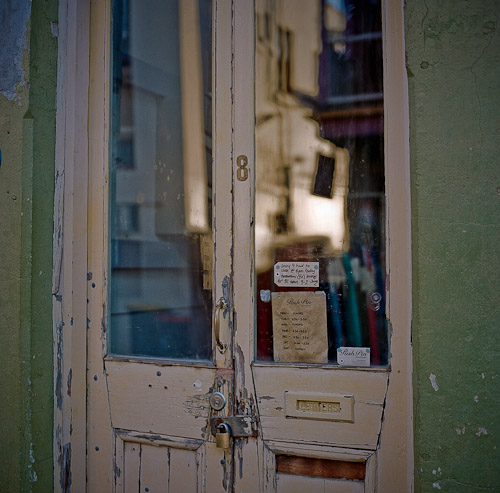 Gary Sauer-Thompson, doorway, Adelaide CBD, 2009
Renew Newcastle is on Flickr. An ABC NSW Stateline video on Renew Newcastle gives an overview of the process of renewal and it mentions some of the many projects. It is a model to bring life to the Adelaide CBD, which constantly defers its future through a failure to re-imagine the city.
A number of photographers are involved in the Renew Newcastle project --such as Shannon Hartigan who produces panoramic landscape images and is on Flickr. Another photographer involved in the project is Alexandra Thompson's Surfhouse Photography; a space that is a retail outlet for her surf photography. A photography Gallery is another project---Gallery Raw Newcastle House of Photography which has its roots in Flickr.
Westbury in his Creative Initiative: 2009 Hunter Valley Research Foundation Lecture states that:
The cultural world is has become a very “top heavy” place. It is heavily bureaucratised – it is full of people whose job as curators, directors, bureaucrats and administrators is to essentially pick winners. That’s how we think about culture when we don’t actually stop to think about it.A cheaper and far more effective strategy is to ensure that our cities, particularly those with abundant empty spaces can become cost effective places of creation and distribution of living culture. It is far cheaper to intersect with and animate the passions and motivations of people who actively seek to create.
Small scale, small impact can only happen in an environment of low capital and that has to mean with a low regulatory cost.
The aim of Renew Newcastle is to treat all the empty space as an asset and a opportunity---to allow people to access those spaces while they sit empty. It brokers access for people who want to access spaces and helps them get started. It is based around short-dated leases, often just 30 days long, which roll over so long as the landlord hasn't found a permanent tenant.
October 8, 2009
Ballarat International Foto Biennale: Tim Griffith
One of the core exhibitions at the Ballarat International Foto Biennale was called Immediate Future by Tim Griffith. He is a foremost architectural commercial photographer whose parallel art practice comments on the disquiet about the present states of both architecture and photography.
The disquiet in architectural photography refers to the fact that the majority of commercial architectural photography is commissioned by developers with a vested interest in portraying the built form in a good light, and so the images are cleaned up by photographers to produce the sleek, manipulated, politicized images made for commercial or marketing purposes. It has been like this for zonks.
 Tim Griffith, Sentinel, from Immediate Future exhibition
On the other hand, we have the constructed architecture photography in the fine art world where the architecture itself --ie., the built form--- is of much less importance than the artist making use of it as their subject.
Both kinds of architectural photography take us a long way from the truth ethos of photojournalism (the concept of photography as a “documentary piece of evidence) that is opposed to digital manipulation, which is seen as akin to fakery. This ethos has limits as it does not apply to architectural photography.
As Tim Griffith points out in the blurb to his Immediate Future exhibition:
With the recent rise in popularity of architecture around the world , many new buildings, especially those in the public domain, have been pressed into the service of focal and national authorities as drawcards for political and financial gain. A building in this service no longer has the opportunity to gracefully embed itself into the general consciousness of the society that surrounds it. It can no longer wait to be cherished. It must be loved now.
The recent monumental architecture in modern China would be an example of this.
October 7, 2009
The Wire: Season 2
In season two of The Wire Season one's drug war narrative---a Baltimore police unit hunting a gang of drug dealers and the utter failure of traditional policing and incarceration in the face of poverty and the drug trade---is displaced. The account of the drug war in America continues in the background.
The focus has shifted to Baltimore’s decrepit industrial waterfront, where the struggling longshoremen’s union has used the last of its financial resources to lobbying politicians to revitalize projects at the docks. As part of the effort, the union’s checkers, who monitor the comings and goings of ships’ cargo, have begun cooperating with a crime syndicate importing contraband (and illegals) run by The Greek.

The death of working-class America is explored through examination of the city ports. Faced with ever-shrinking work opportunities after decades of soft complacency, white dockworkers and their kids, like their inner-city black counterparts, turn to crime and the allure of easy drug money when presented with no ready options.
Is the argument that unencumbered capitalism is not a substitute for social policy and that on its own, without a social compact, raw capitalism is destined to serve the few at the expense of the man?
The beginning of the exploration of the crumbling of a city is where David Simon broadly shifts "The Wire" away from being merely a good cop show about the drug wars. Season 2 indicates that the theme of institutional dysfunction will be expanded across different areas of the city as the show progressed. What sits on the horizon is the decline of Rust Belt inner cities.
This is a drama crafted not as a television entertainment, but as the visual equivalent of a modern novel that represents what is happening in American cities and what is at stake.It is such a contrast to the crime television about sexually perverse serial killers or psychotic mass murderers or child rapists.
October 6, 2009
Ballarat International Foto Biennale: Tim Burder
I missed Tim Burder's work at the Ballarat International Foto Biennale. A former accountant, he lives in Daylesford in Victoria, where he has been trying to make a go of photography as a living for the last seven years. His show at The Eureka Center, Ballarat was entitled Deserted Works:
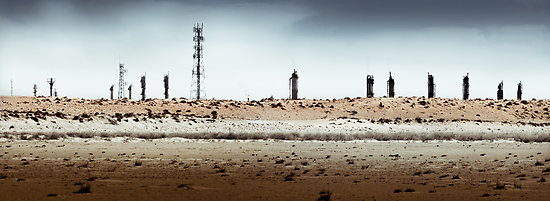 Tim Burder, Strzlecki Track 3, South Australia
This consisted of large panoramas from the outback of South Australia and Western NSW. My preference is for the more abstract or austere images as opposed to the more dramatic ones with their sweeping cloud formations.
 Tim Burder, Lake Eyre, South Australia
I suspect that this image of Lake Eyre is not in the 'Deserted Works' exhibition since it is not a panorama. I appreciate that the vastness of the Australian desert with dramatic clouds, can refer to the sublime, and Burder does link this work back to the Kantian sublime:
The desert gives us many awe-inspiring sights and quite often the beauty is just in the sheer “bigness” of the place. There is nothing like the night sky seen from the desert to give the sense of how insignificant we are and, by extension, how pointless our pettiness is.
Somehow a more minimalist approach appears to be more appropriate given the pervasiveness of the tourist and HDR aesthetic on Flickr.
October 5, 2009
back from Ballarat
We've just got just back from the International Photo Biennale in Ballarat via Penola and the Coorong. The long drive back has left us exhausted in spite of the breaks at the Grampians, Robe and the Coorong.

The picture is of Lake Windouree in Ballarat. The lake has seen better days. After a decade's worth of below-average rainfalls the lake went dry, and the water currently there comes from diverted storm water. The Lake is now a swamp of mudflats, reeds and stagnating and evaporating puddles of water. Yet another indication of climate change.
A weekend was not enough to take in the Biennale's various exhibitions or to take photos. The Biennale's core in Ballarat was okay, but the fringe was spread out around the outlying towns of Creswick, Trentham, Daylesford and it was impossible to get to see them all in a day.
October 2, 2009
Ballarat International Foto Biennale: alternative photographic processes
I'm off to see the Ballarat International Foto Biennale this weekend. We decided early this morning to go. We are driving from Adelaide, leaving early this afternoon, staying at a pet friendly accommodation just passed Horsham tonight. We found some pet friendly accommodation in Ballarat, and so we can spend two days in Ballarat looking at the photographic exhibitions--both core and fringe--- n the company of Stuart Murdoch --s2art--- who is coming up from Melbourne.
We plan to return to Adelaide on Monday via the Gampians, Penola and the Coorong as I will be looking for possible future photographic trips. The Coorong is what I have my eye on with large format in mind.
Whilst in Ballarat I hope to see some of the images produced by those working in the historical or alternative photographic processes, such as Silvi Glattauer or Wendy Currie.
 Wendy Currie, Lobster Pots, cyanotype
This work is very different and it highlights how much photography is a part of the hand crafted printmaking tradition.
There is an extensive body of work being shown in the Trentham Fringe
October 1, 2009
nailing the photographer
An example of the attack on photographers in the name of national security that I have mentioned before.
A photographer is arrested by AmTrack security for taking pictures of Amtrack trains whilst taking part in an Amtrak photography contest. It's a witty report from Stephen Colbert (The Colbert Report) at Comedy Central in the US:
| The Colbert Report | Mon - Thurs 11:30pm / 10:30c | |||
| Nailed 'Em - Amtrak Photographer | ||||
| ||||
This ndicates that photographers are now identified as the terrorists within who are clearly part of sleeper cells that threaten national security. Increased surveillance is required to meet the threats on our street.
Julius Shulman: modernist architectural photographer
By Design on the ABC recently had a programme on Julius Shulman, the American photographer of (Californian) modernist architecture of the 1950s that incorporated the sleek lines, broad expanses of glass, and steel frame construction popularized by European architects in the 1930s.
 Julius Shulman, Beach House, Uruguay
He shot glossy, stylized images of California cool, which in turn promoted the architecture of Richard Neutra, and John Lautner, and their colleagues. His iconic photographs symbolized the polished freedom of LA living, evoked by shots like that of models lounging in Pierre Koenig’s Case Study House No. 22.
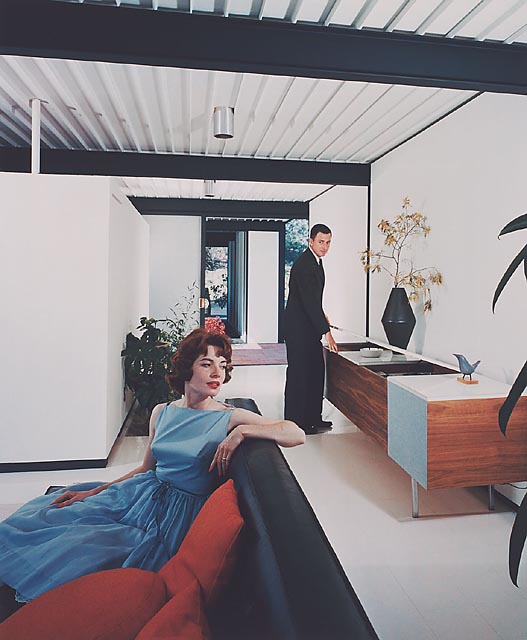 Julius Shulman, Case Study House No. 21 in Los Angeles by Pierre Koenig (1958), J. Paul Getty Trust.
His images were dramatic and clean, like the lines of the modern buildings he shot, but also playful, redolent of the easygoing California lifestyle that he helped to define. His specialty was domestic architecture, and in his later years, with the rediscovery of mid-century modernism and the helpful promotion of the publisher Taschen, he became something of a minor celebrity.
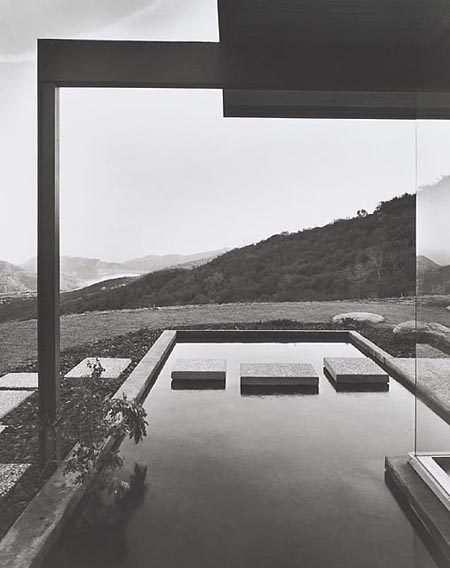 Julius Shulman, Singleton House, Los Angeles
Giselle Arteaga-Johnson in Narrating Modern Space:The Interior View says of Shulman's architectural work that:
He frames his images as narratives by photographing interrelated compositions of space and Modern furniture that serve as guides, allowing the viewer to imagine walking through the room. In this way, Shulman depicts homes as stage sets, using furniture and architecture to suggest a modern living style unique to California....Shulman achieve[s] the unique effect of blurring the lines between what is inside and what is outside
These glamorizing of Los Angeles depicts a fantasy portrayal of Southern California's relaxed and very influential lifestyle characteristic of the post World War II era.