|
May 19, 2009
I read somewhere that Naoya Hatakeyama had been influenced by the American New Topographics movement of the 1970s. The New Topographics was a part of the tradition of documentary rather than formalist photography, and it was related to the idea of 'social landscape', which explores how human beings affect and shape their natural environment. How have their ideas travelled and reworked?
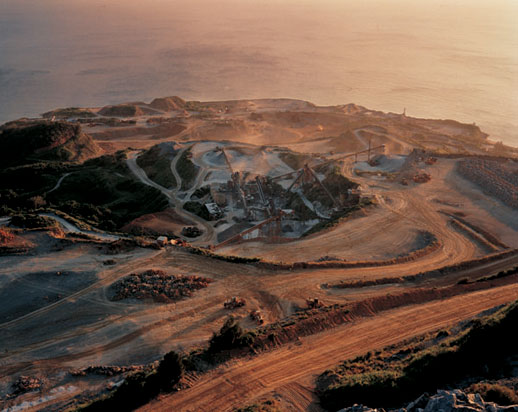 Naoya Hatakeyama, 'Lime Hills (Quarry Series)' (1986-91), Lime Works
The claims by New Topographics (eg., by Baltz, Adams, and Jenkins) to scientific objectivity and neutrality were an attempt to disassociate this body of work from the emotionalism and sentimentality of American popular photography. It was also a reaction to what many perceived as the overheated expressionism of the fifties-as represented, for instance, by Minor White-and to the pictorial excesses of the sixties-as represented by Jerry Uelsmann.
The statements were also tacit protests against the contemporary production of images that depicted a traditionally sublime landscape. They chose to underscore the formalist precedents for the work and they pointed to precedents in the aestheticization of the American industrial form in the landscapes in the Precisionist paintings of Demuth and Sheeler, the ironic machine aesthetic of Duchamp and Picabia, the functional stylizations of the Bauhaus, and the conceptual art of the sixties and seventies.
If they allied their work with precedents in art rather than in photography, they were traditionalists in that they recognized the beautiful in the disdained, and they endowed the vulgar and the ordinary with a new pastoralism. They were interpreting the social landscape but from what perspective? The work of Edward Burtnsky 20-30 years latter is fromt the perspective of sustainable living.
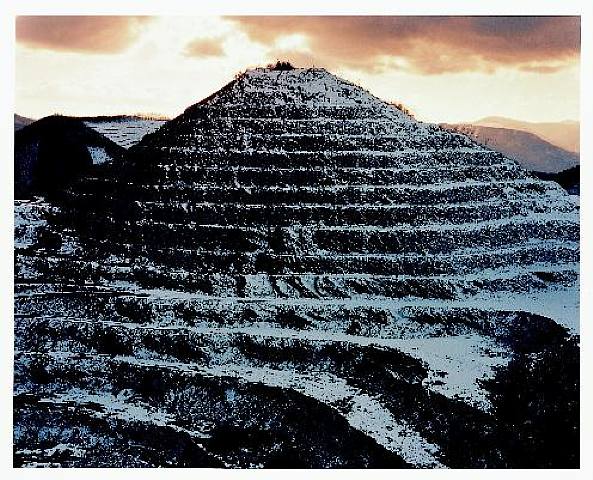 Naoya Hatakeyama, 'Lime Hills (Quarry Series)' (1986-91), Lime Works
Another reworking of this tradition is that by Naoya Hatakeyama, who is is one of the most important Japanese photographers of his generation. He says in this interview that he is not interested in a photography that takes pictures to document interior space, where interior space” refers to a concept of the self and connotes a sense of this warm, fuzzy feeling of beauty inside. He prefers to pay more attention to the exterior world and his photographs are a form of visual poetry. He has a major following in Germany because of the influence of the Bechers, with whom has thematic affinity.
Lime Hill (Quarry Series) (1986-1991) and Lime Works (Factory Series) (1991-1994) are landscape photos of Japanese limestone quarries and of the mining industry. The Lime Works series represents the transformation of the landscape through limestone extraction for the production of concrete, the material Japan’s fast-growing cities are built of. The limestone is removed on roads concentrically paved around the mountains; the quarries forge ahead further and further into the mountains; the landscape changes. For Hatakeyama this rough landscape, from whence the raw material for cement is dug, is the first phase of urbanism. The holes that are gouged in the earth reflect the buildings in the cities.
|


Here is what Naoya Hatakeyama writes as an introduction to the "Lime Works" chapter of his book Naoya Hatakeyama: