October 29, 2011
Lisette Model
Though Lisette Model is known through her pupils Dianne Erbus, her the roots were European roots and they reach back to German expressionism and to Eugène Atget. Her 1940s pictures of Midtown skyscrapers, for instance, are layered with reflections from store windows à la Eugène Atget
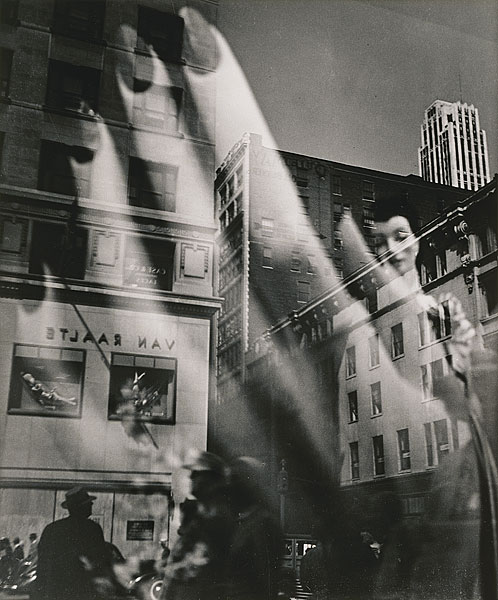 Lisette Model, Reflection with hand 1939-45, gelatin silver photograph
Eventually she devoted herself fully to teaching New School for Social Research at Columbia University. Model's teachings have influenced three generations of photographers---Dianne Arbus, Bruce Cratsley, Lynn Davis, Elaine Ellman, Larry Fink, Peter Hujar, Raymond Jacobs, Ruth Kaplan, Leon Levinstein, Eva Rubinstein, Gary Schneider, Rosalind Solomon, and Bruce Weber.
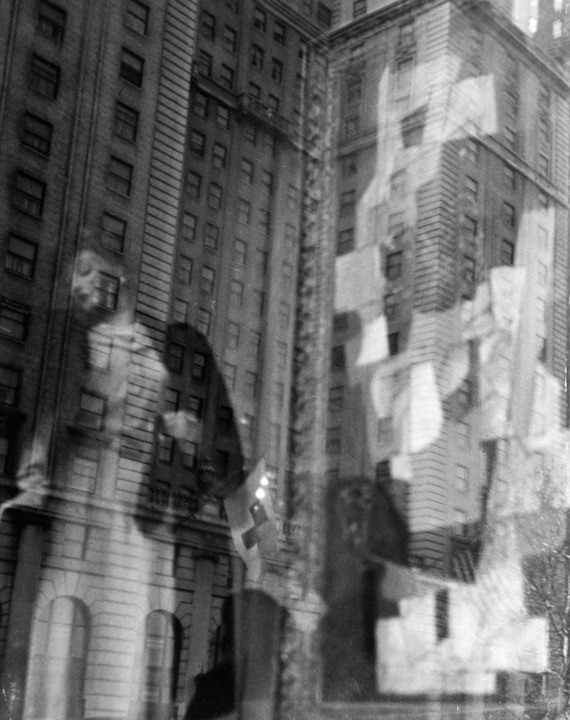 Lisette Model, Reflections, New York, Red Cross, 1939-45, Gelatin silver print
Model used to tell her students to “photograph from your guts.”focusing on the object of passionate interest rather than worrying about how the image would be perceived; about getting close to the subject andtaking an interest in the world around us, breaking with the conventions and routine that keep us from seeing what is around us; about living in the present and reacting spontaneously to the freshness of the moment.
October 27, 2011
Australian photography: Mark Strizic
Mark Strizic is renowned for his his collaboration with Robin Boyd on the book Living in Australia. His photographs are part of the collections of the National Gallery of Australia, the National Gallery of Victoria and the Monash Gallery of Art.
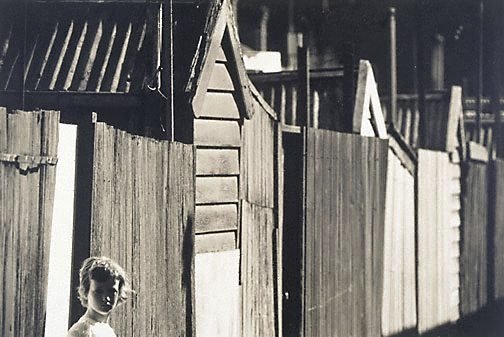 Mark Strizic, Off Francis Street, Richmond Vic. 1961, gelatin silver photograph, sepia toned
In his photographs from the early 1950s Strizic represented Melbourne as a cosmopolitan centre bustling with sophisticated and urbane people. Strizic’s view of the city changed. The city centre is increasingly shown in as a place of business and commerce, with individuals negotiating the city streets with an air of isolation and loneliness.
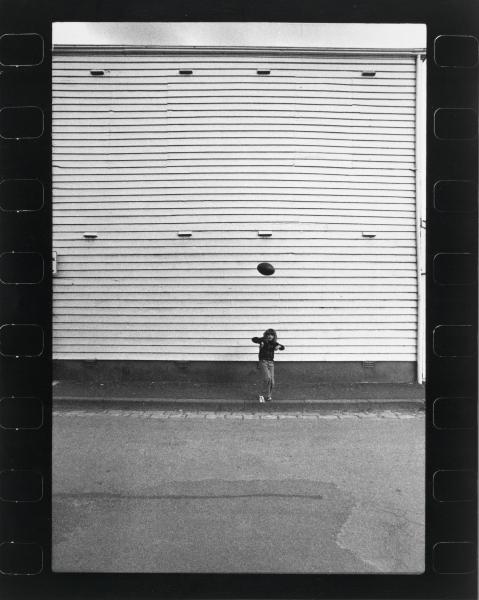 Martk Strizic, untitled, (Girl and football) from the Children of the streets series (c. 1970), gelatin silver photograph
Strizic's pre-modernist Melbourne would be viewed with nostalgia today --ie. marvellous Melbourne---judging from the reaction to the work of Angus O'Callaghan.
October 26, 2011
Angus O’Callaghan: yesterday's Melbourne
Whilst walking the streets of Melbourne's CBD and trying to photos in the rain I popped into the Kozminsky Gallery in Bourke Street. I'd seen some images of Melbourne circa 1970 in the gallery's window when Suzanne and I had been walking by in Hardware Lane.
Angus O'Callaghan, was a school teacher in Brighton, who used to roam the city's streets with his Yashika twin lens cameras (one for black and white film and one for colour at night and on weekends from 1968 to 1971.
 Angus O'Callaghan, Milk Bar, circa 1971
This was the picture in the window that caught my eye. O'Callaghan's exhibition was entitled "Marvellous Melbourne" and a heap of work had been sold --around $200, 000. Judging by that Melbournians love their city of yesterday.
An example is this late-60s shot looking north along Swanston Street from Princes Bridge during a storm:

I understand that some of Angus O'Callaghan's images of Melbourne have been published in Stephen Banham's new book "Characters" which investigates typography in advertising in Victoria;
October 25, 2011
postwar Melbourne photography
It rained so constantly in Melbourne on Monday that I gave up photography and retreated to the State Library of Victoria to check out the exhibition of "modernist" Melbourne Photographers.
Entitled As modern as tomorrow it explored post war photography in Melbourne created by immigrant photographers from abroad, who became active in commercial fields as varied as fashion, advertising, architectural and industrial photography:
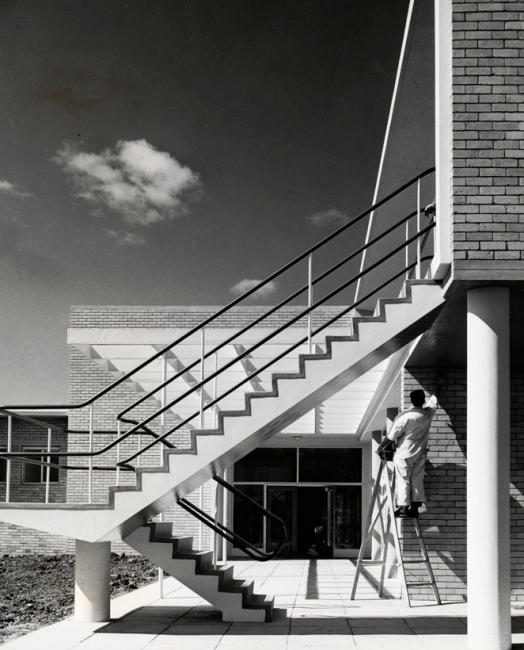 Helmut Newton, amenities block, circa 1951-54
It is largely Melbourne in black and white with some (early) colour work that looked dated. I thought that the architectural work was the strongest in a modernist celebration of Australian modernity; a modernism that largely excluded everything else around the building, eg., the work of Max Dupain and Harry Seidler.
Wolfgang Sievers not only understood the ambitions of modern architecture but he was in command of a modernist photographic vocabulary that aimed to reveal facts about the constructed world, it left behind the aesthetic of the pictorialists who tried to achieve painterly effects in their work. Modernist photography’s hallmarks were sharp focus, purposeful lighting, emphatic viewpoints and detailed close-ups.
It's not surprising that the work is a celebration because it was commissioned so as to become the iconic image of the building.
October 20, 2011
in Melbourne on a photo shoot
I'm off to Melbourne for four days on a phototrip. As I won't be taking my computer with me I will not be blogging. The emphasis, when I'm not with Suzanne, will primarily be on photography. Though there will also be a lot of digital snap shots taken my energies will be concentrated on the large format style, and I will be focusing on this kind of urban work.
I'll be back on deck on Tuesday.
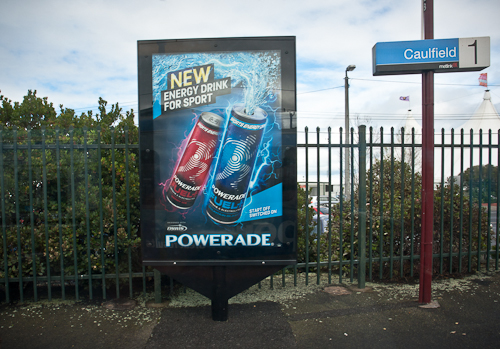 Gary Sauer-Thompson, Powerade, Caulfield, Melbourne, 2011
This was from an earlier trip when I was taking photos through the window of the Frankston line train.
October 19, 2011
Photography Festival: Ways of Looking
Ways of Looking is a new festival of photography in Bradford, England. It runs throughout October 2011, has its own Flickr group, and explores the theme EVIDENCE---that record and document different ways of looking.
Some of these are quite unusual--eg., Red Saunders' meticulous recreations of the 'hidden history' of revolutionaries and radicals in England. These are akin to cinematic stills which recreate events in the long struggle for parliamentary representation and democracy in Britain. These events are the 'hidden' neglected scenes of working class history.
This is the first in a series of Hidden History tableaux:
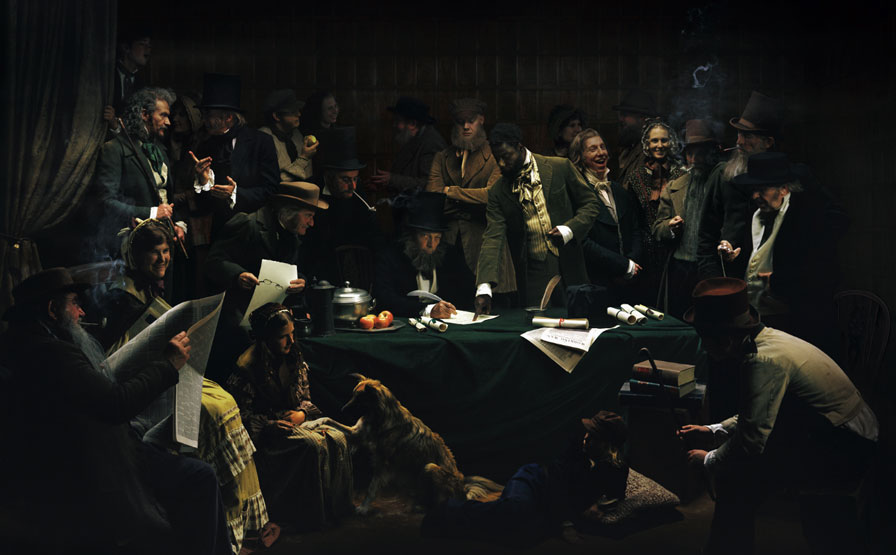 Red Saunders, "William Cuffay and the London Chartists 1848", 2010
The image was shot over two days using a traditional large format camera, later composited. It uses volunteers ( themselves workers and trade unionists ) as Chartists and every costume is accurate - staff and students from the London College of Fashion donated their time to help.
The method refers back to those Victorian photographers who made a composite of several different negatives, cutting out and merging the images to produce the finished result. Today, digital photography and retouching extend and re-invent the tableau tradition giving it greater meaning and more relevance to our times.
October 18, 2011
Docklands: a wasteland?
In previous posts on the Docklands in Melbourne I mentioned that the public spaces where one could relax and escape the noise and traffic of the city were few and far between.
My view from my experience of walking around this urban space was that, rather than the Docklands precinct being on the cusp of becoming a vital and dynamic urban space, it appeared that it---basically a successful business park-- is becoming a giant lifeless wasteland.
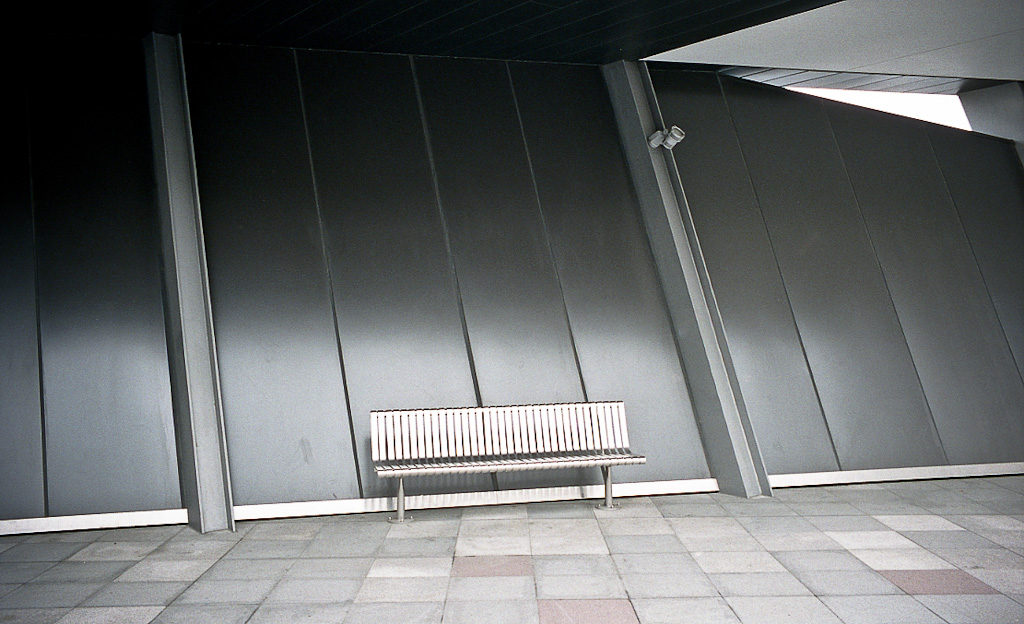 Gary Sauer-Thompson, seat, Docklands
In Locals ignored as Docklands development treads a familiar path in The Age Heike Rahmann refers to the design or development tradition of the First Decade:
massive scale, disconnection from the water, and general disregard of the local context. In other words: quantity, not quality; a form of development in which public access to the water, the acknowledgement of local qualities and community needs have been neglected and utterly compromised by corporate developments.
The development of Docklands means that Melbourne's traditional CBD has been expanded. There is a lot of banal corporate tinted glass tower architecture.
Rahmann adds:
Melbourne claims to be the "design capital of Australia" but paradoxically there is little discussion about urban design. So far, discussion of urban design seems completely absent in the Docklands. We could blame developers for this lack of vision but complaints will most likely remain unheard. Real action and positive change only occurs where policy embraces design as a strategy for urban revitalisation.
She says that what has been missing in the discussion about transformation strategies for Docklands is urban design. I would add urban design about public spaces. What design there has been is that of the developers constructing their high rise office and apartment buildings in isolation.
Update
The Melbourne Urbanist comments:
the development process was conceived like a mine – extract as much value as possible from the sale phase and get out. It’s as if each development was set up as a self-contained project with no one having any incentive to think about what they meant as a whole or to care about the quality of the public space that connects them. I don’t blame any individuals or even the responsible agency. I think it goes right back to what the State Government of the day wanted from the project – revenue. They set up the management arrangements for the development to reflect that goal.
It's a giant business park. It's bike friendly due to the lack of cars.
October 16, 2011
British photography: Dougie Wallace
London based photographer Dougie Wallace has been working on a series of wonderful images made through the windows of city trams at the moment of departure in Portugal, Egypt and Eastern Europe, in cities including, Lisbon, Alexandria, Sarajevo, Ukraine and Albania.
His technique juxtaposes the interior life of the tram with the architecture and life of the city reflected in the windows:
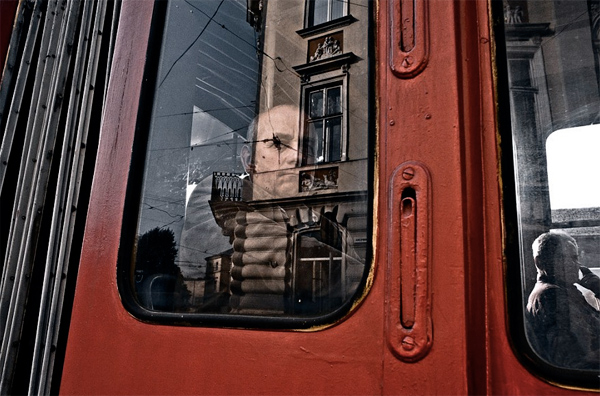 Dougie Wallace, untitled, from Reflections On Life
The work was shown at the Format Festival 11 in March- April in Derby, England was entitled Right Here, Right Now': Exposures from the public realm, and it was curated around the theme of street photography. It explores the resurgence of street photography understood in terms of Cartier-Bresson’s idea of ‘the decisive moment’ --to observe and record candid moments on our everyday streets.
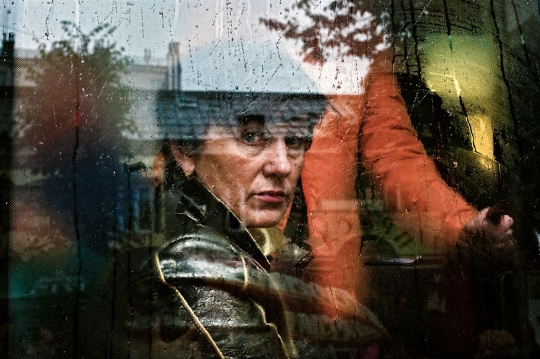 Dougie Wallace, untitled, from Reflections On Life
The images are multi-layered fractured scenes that are built around reflections in the windows of the trams and which often have a disorienting and surreal affect. There is a gesture here towards the work of Bruce Gilden in that there is a focus on 'characters' and in the closeness to the subject.
The Format photography festival, which was established in 2004, by Louise Clements and Mike Brown, is now one of the UK’s leading non-profit international contemporary festivals of photography and related media, is biennale.
October 13, 2011
Foam Festival
The Foam Festival is one of the UK's leading international contemporary festivals of photography and related media, with this year's programme being curated around the theme of street photography.
I guess that it is only fitting that there is an exhibition of Garry Winogrand's colour work, most if not all shot on archival Kodachrome slide film.
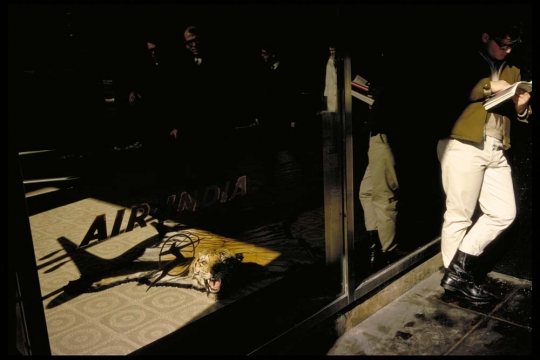 Garry Winogrand, untitled, circa 1958-1964
If there ever was an exponent of street photography it is Winogrand's work from the early 1960s to the 1980s. His photographic persona is one of roaming the streets of New York with his 35mm Leica M4 camera rapidly taking photographs--almost an obsessive picture-taking machine. Winogrand left behind nearly 300,000 unedited images, and more than 2,500 undeveloped rolls of film, mostly (mostly Tri-X),
He was a self-proclaimed modernist, given his remarks that "Photography is not about the thing photographed. It is about how that thing looks photographed", and that "A photograph is the illusion of a literal description of how the camera saw a piece of time and space." However I am sure that some of Winogrand's stuff was shot on the fly, with scant regard for composition, only for content.
October 12, 2011
Melbourne's Docklands
A classic example of urban renewal is Melbourne's Docklands. I spent several days walking around when last in Melbourne. I thought that it was a bad example of contemporary urban planning because of its lack of public spaces where people can gather and spend time amongst the high-cost residential/office/commercial mix.
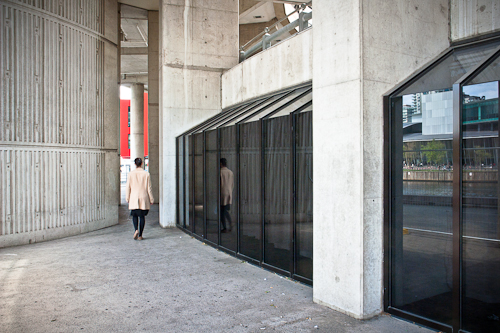 Gary Sauer-Thompson, Crown Casino, Docklands, Melbourne, 2011
In The Age Kate Shaw goes much further than my initial impressions. She says:
The much-publicised problems at Docklands, Melbourne's signature urban renewal project, are not a failure of planning; there was no planning, only the division of publicly owned land for handover to private developers to do what they wanted, with a substantial gift of state-funded infrastructure. The developers responded as developers do: focused on maximising returns, they had little regard for the public realm and no regard for what other developers were doing on neighbouring sites.
The outcome was predictable: enormous buildings on massive podiums, arbitrarily varying form with no attention to the spaces between the buildings, and large residential, office and commercial spaces demanding maximum possible rents.
At the Docklands the developers rule. The "highest and best use'' of its property for commercial return is what drives the urban renewal. That is the way of doing business.
October 10, 2011
Walker Evans - Subway Photographs
American Suburb X has an album of Walker Evans' Subway Photographs that were taken between 1938-1941 on their Facebook page.
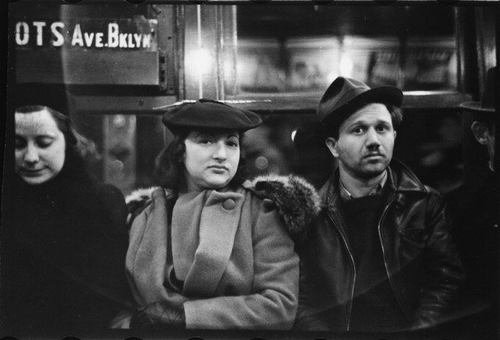 Walker Evans, Subway, from Many are Called 1966
These were taken between 1938-1941. Evans travelled on the subway with a miniature Contax camera concealed inside his coat connected by a long lead to a shutter release that nestled just inside his sleeve. Daily he snapped the people who sat opposite him on the subway, waiting patiently for a revealing moment of reverie or boredom or, on one or two occasions, the onset of sleep.
Evans was able to capture his subjects totally unawares.Many appear to in transit between work and home, on their way to the movies, reading the paper in their hands (always a tabloid, never a brodasheet — fitting, for the the tabloid was invented to accommodate the confines of the packed subway carriage.
October 7, 2011
Le Mois de la Photo à Montréal
The 12th presentation of Le Mois de la Photo à Montréal is resonating with the theme proposed by guest curator Anne-Marie Ninacs: Lucidity. Inward Views. The exhibitions, the publication, the colloquium, the special events and the educational activities are all organized around this theme.
The blurb says that Le Mois de la Photo à Montréal features:
artists who, in a certain way, turn their cameras towards themselves and conceive of photography as an introspective process, an opportunity for meditation, a mode of consciousness, even a means of revealing the unconscious. In doing so, they draw our attention to forces that we find it difficult to recognize but that nevertheless govern our actions – the illusion of identity, fear, death, anger, not knowing – and provide us with opportunities to reflect on acceptance, compassion, creativity, and the freedom to act.
Lucidity means inner clarity, a “transparency of mind,” and so is the psychological meaning given to the term lucidity. An example:
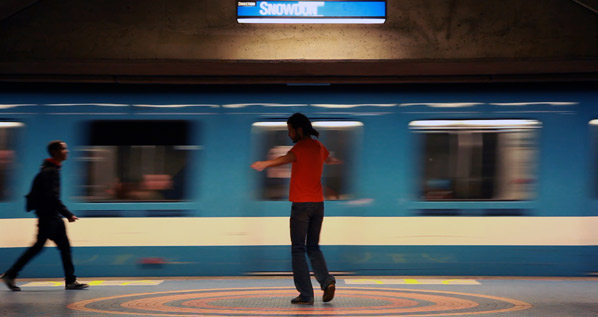 Alfonso Arzapalo, Compositions silencieuses, from the series horizons sensibles.
Whereas human interventions in the public space--such as railway stations--- often “make noise” and “move air around,” Arzapalo's photographic interventions deliberately mediates in such spaces. Arzapalo, an artist (video, photography, text, performance) and architect, poetizes the relationship that the body has within urban space.
October 6, 2011
Steve Jobs: a tribute
This morning whilst working on one of Apple's superb computers--a Mac Pro with its big cinema screen--- I heard the news that Steve Jobs, the man behind these well designed products, had died.
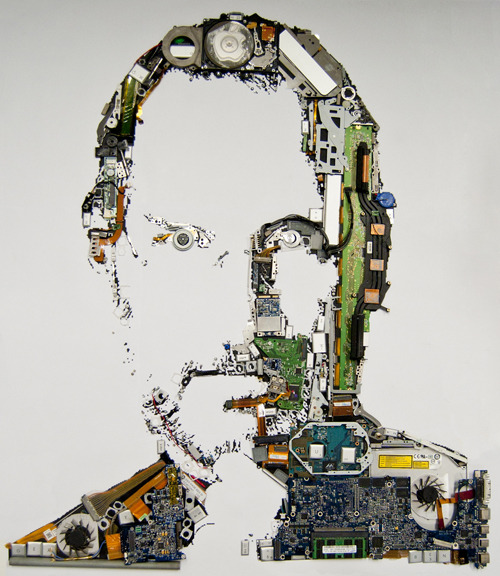 A tribute, made from the parts of a MacBook Pro.
Mint Foundry, A tribute, made from the parts of a MacBook Pro.
A tribute, made from the parts of a MacBook Pro.
Mint Foundry, A tribute, made from the parts of a MacBook Pro.
Jobs was a quintessential Silicon Valley hero, following on from HP's Bill Hewlett and David Packard and preceding Google's Larry Page and Sergey Brin.
I switched back to Macintosh computers around 2005 for two reasons. Firstly, I became sick of the incessant interruptions on the Windows PC - the endless updates of both the OS and antivirus software. The constant crashes. The viruses. The regular need to wipe the whole OS clean and start again. Secondly, Apple machines were seen as the 'professional's choice' in the graphics industry in that they deemed to be reliable and do the job.
So the decision was easy, in spite of the cost.
October 5, 2011
reCollections: hybridity, Aboriginal art
reCollections is journal published by the National Museum of Australia. It consists of contributions relating to the role of museums in society, museum practice, and the history, collection, interpretation and display of museum collections relating specifically to Australia and the Asia-Pacific region.
In 'We have survived': South-east Australian Aboriginal art exhibitions since 1988 Fran Edmonds uses the Homi Bhabha's concept of hybridity to provide a lens through which to view the progressions and adaptations south-east Australian Aboriginal people have made in their art practices and in the staging of art exhibitions, as they intersect with developing ideas about their own identity and their place in the world.
It is also used to opposed constricting and essentialist representations, where purity of culture is equated with authenticity, namely colonialist assumptions about south-east Australian Aboriginal culture as inauthentic.The emphasis is on the complex history of colonial encounters.
October 3, 2011
modernism in Australia
Modern Times: The Untold Story of Modernism in Australia. (eds. Ann Stephen, Philip Goad, and Andrew McNamara; Miegunyah Press, Carlton, Vic.) follows an earlier collection of primary sources by the same editors and publisher, Modernism and Australia: Documents on Art, Design and Architecture, 1917–1967 (2006). In Australia it was accompanied by an eponymous travelling exhibition that opened at the Powerhouse Museum, Sydney, in August 2008.
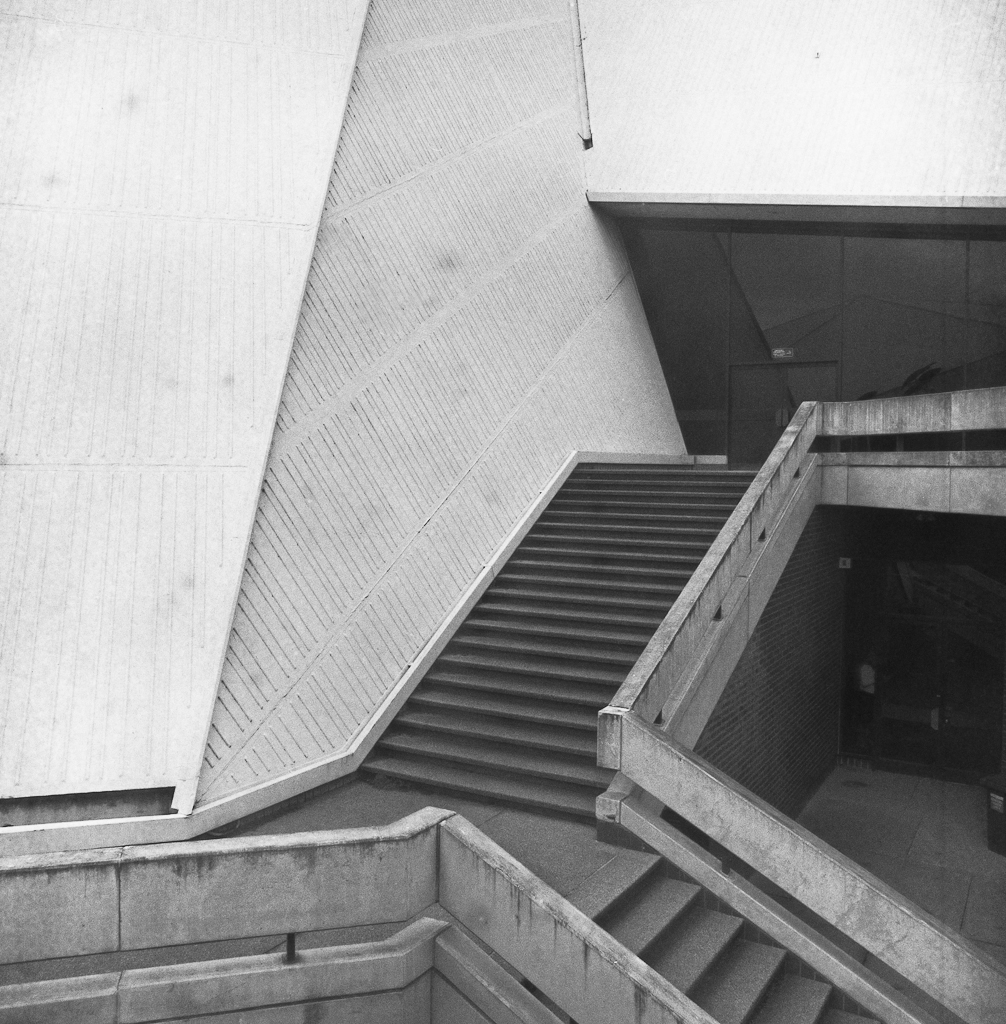 Gary Sauer-Thompson, Adelaide Festival Theatre, 2011
Modern Times is a collection of twenty-five essays that deal with the popular reception of "modernism" in Australia——in a range of media, including painting, architecture, design, fashion, photography, and advertising; and a range of sites, such as skyscrapers, exhibitions, factories, milkbars, and suburban swimming pools. It provides an interdisciplinary overview, but what are the connections? What is the central argument?
Dixon mentions the "untold" history of Australia's informed engagement with modernism as an international, interdisciplinary project spanning five decades, from 1917 to 1967 and he refers to the editors' initial arguments about modernism and social modernity, cultural nationalism and internationalism, and the belatedness or otherwise of provincial cultures. These arguments, he says, tend to drop in and out of their contributors' essays, varying as they do in content, length, and approach.
So what is the argument? It rejects Bernard Smith's received account of the Australian reception of modernism in Australian Painting (1962) as a series of belated, style-based shifts occurring discretely within painting, sculpture, design, and architecture. Belated refers to Smith's time-lag' notion, the idea that modernism in Australia was a late arrival, that it 'arrived in a suitcase' and that 'modernist influences were worked through long after the initial inventive moment had been eclipsed at its source'.
Their revision of art-historical orthodoxy led Stephen, Goad, and McNamara to make the following argument:
'we assert that there is no straightforward aesthetic narrative thread — whether realist, nationalist, social realist, surrealist, abstractionist or anti-modernist — that can cut through this tenuous and complex reception and shed light on one single, coherent explanation of the reception of modern art in Australia'.
In ReCollections Jill Julius Matthews highlights the conceptual shift:
In the first half, the modern is a specific moment in time (the inter-war period); a moment when then became now for a distant and probably foreign people; a time with its own acknowledged aesthetic (modernism), which we today recognise as historic. In the second half, the modern is our modern. The focus is on representing the process whereby our now came into existence from a proximate past.
I would accept that modernism cannot be limited to the inter-war period and that it was in the 1960s that modernist art came to a slow end.
October 2, 2011
ANZANG Nature Photography
The SA Museum has announced the winners in its 2011 ANZANG Nature Photography competition It is one of Australia's main photo competitions.
The competition aims to highlight the stunning biodiversity of the Australasian bioregion (Australia, New Zealand, Antarctica and the New Guinea region) and to encourage the conservation and protection of its flora and fauna species.
My interest is in both the "Our Impact" category, in which the image must depict human impact (negative or positive) on the natural environment, be it terrestrial, marine or atmospheric; and the wilderness category, in which the landscape or seascape must have minimal evidence of human interference. The latter was won by Rob Blakers, the Tasmanian photographer:
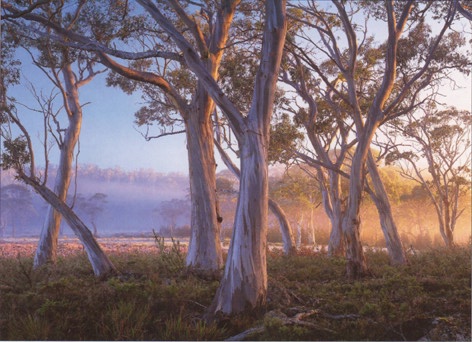 Rob Blakers, Navarre Plains, near Lake St Clair, Tasmania
Tasmania is the place to do wilderness photography and to do it properly you have to live there.
Blakers also won the "Our Impact" category with his forestry regeneration burn in the Weld Valley--the image is not in the public domain.
October 1, 2011
history + photography
The photo below is an aerial photograph of the Sydney Harbour Bridge on the morning of the opening day celebrations in 1932:
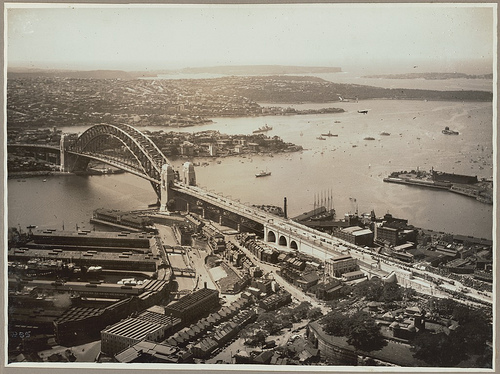 Searle, E. W. (Edward William), Sydney Harbour Bridge from Dawes Point, 19 March, 1932, NLA
This highlights the importance of photography's relationship to history --it enables us to visualize our history. In this case the Searle's photograph reminds us how much the Sydney Harbor Bridge signified Australia becoming modern. This was the moment when Australia became modern---ie. industrialized--by which it was understood that Australia became more like America. It was leaving behind the Australia of settler capitalism and heading in the direction of globalism.
It stood for the future not the past.