|
September 6, 2011
I have mentioned Wolfgang Sievers in an earlier post. One of his strengths was architectural photography --modernist architecture done in a modernist style. He is part of the early canon of architectural photography in Australia---- Max Dupain, David Moore, Wolfgang Sievers, Richard Stringer and Fritz Kos-- that established the standards for the photography of Australian architecture for the 1960s and beyond.
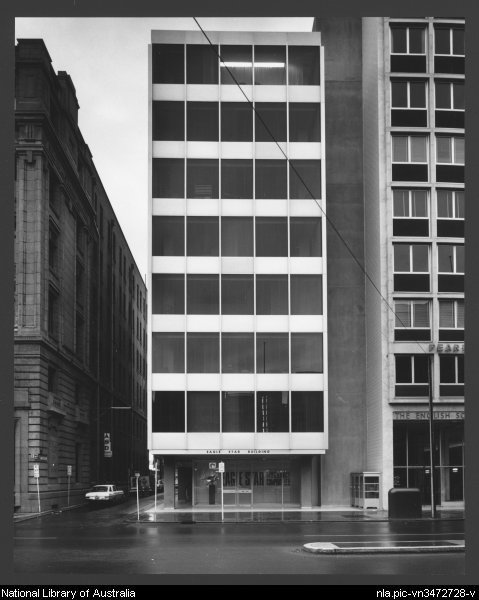 \Wolfgang Sievers, Eagle Star Insurance Building, Adelaide, 1969, architect Yuncken Freeman. NLA
Siever's industrial and architectural photographs ranged from from mining, office buildings, scientific processes, light and heavy industries, Olympic stadia and schools. On the surface he was hired by the Australian Government and private companies to help change the image of Australia from rural and agricultural, to industrial and manufacturing nation.
The modernist approach generally focused on the meticulously staged full facade shots where people, cars and other uncontrollable objects are excluded.They showed buildings as a series of isolated monuments as distinct from recreating the experience of a building. What the modernist architectural photographers ignored were the beaten-up buildings of early Australia that endure as a nineteenth-century version of Critical Regionalism.
|


