February 29, 2008
urban gardens
Another city, another hotel, another view.
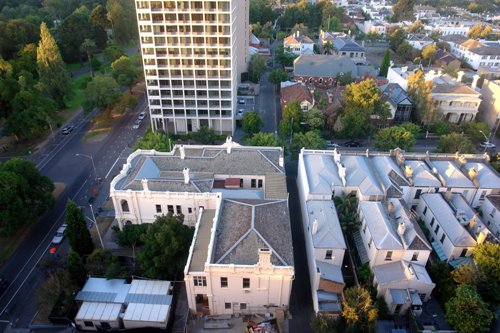 Gary Sauer-Thompson, from the window of the Hilton on the Park, 2008
I'm in Sydney, in the Stamford hotel next to the airport. I'm here for meetings on Saturday afternoon, and in the morning to pick up the repaired Toshiba laptop, and to discuss ways to improve the technological functioning of thought-factory.net by setting up remote access.
The view from the window is poor----its all airplane sheds.There are a few trees, but its mostly concrete and tin. The area outside the hotel is all roaring traffic flows. On Sunday I plan to explore Newton with my camera before returning to Adelaide.
February 28, 2008
urban nature
Since the industrial revolution there has been a trend in Australia greater urbanisation. Today the majority of the population live and / or work in ever expanding towns and cities along the seaboard. As both urban areas and their populations have grown so has the significance of urban landscapes.
The city is less an urban jungle from which to flee, than a dynamic living system, an ever changing landscape of diverse patches of concrete and greenery. It is a network of human and non-human habitats full of complex ecological interactions, environmental hazards and opportunities. The urban jungle includes nature.
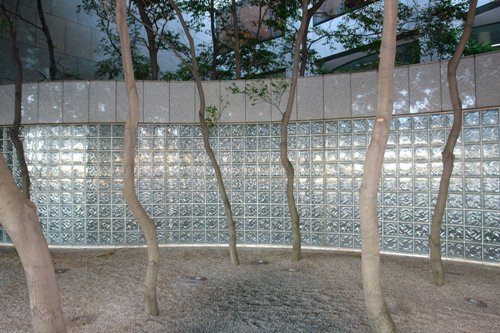 Gary Sauer-Thompson, urban trees, Melbourne, 2008
If 'jungle' refers to, and includes, green spaces in our cities, then urban nature exists in different varieties in our cities and towns.
February 27, 2008
Seidler's Riverside
When I was in Brisbane I returned to Harry Seidler's heritage listed Riverside Centre (1987), which I'd explored on an earlier visit, and interpreted in terms of developing a critical regionalism. This is the building that gave Brisbane a sense of growing up, a sense of confidence. Just like Australia Square in Sydney, it was a symbol of an emerging new Australia, a clever country unfettered by colonial restraints.
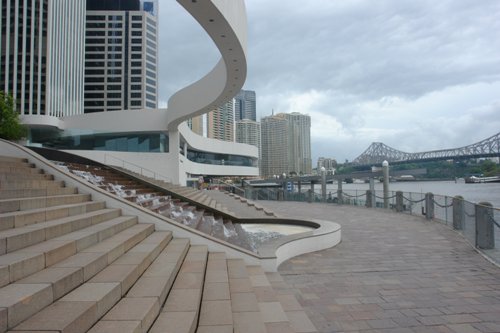 Gary Sauer-Thompson, Riverside Centre, 2008
This time I was more interested in the Riverside Centre's public space, and the link of the plaza to the river and the walkway of Brisbane's first flagship CBD building. It is held that Seidler was
constantly engaged in three interrelated operations: first, in an effort to render the tall office building as an integrated urban landmark; second, in a parallel endeavour to treat the landscape at grade in such a way as to create a civic arena ... without those public institutions that are essential to the public realm; and finally, Seidler continually tries to create enclaves within the chaos of the modern city and to augment those enclaves where possible
This is certainly the case with the Riverside Centre. It provides the space for the urban outdoor lifestyle that gained momentum in the late 1980s, and so enabled people to sit outside and display themselves. It's Brtisbane's equivalent of the Roman promenade.
February 26, 2008
same old
Sometimes being on the road is seeing the familiar in a habitual way. There is the 4am rise to catch the cab to the airport, and the same breakfast at the Qantas Club. Then there is the view from plane window:
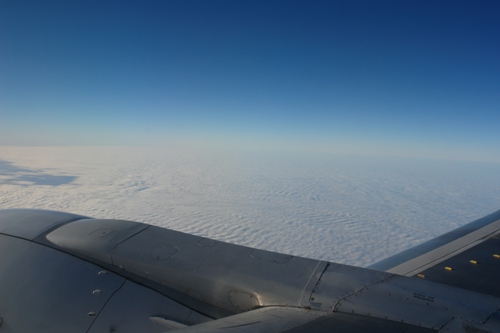 Gary Sauer-Thompson, leaving Adelaide, 2008
Though this kind of travel is different from traveling on public transport in a major city, there is the feeling that you've seen this view a hundred times before.
Then there is the familiar view from the same hotel window:
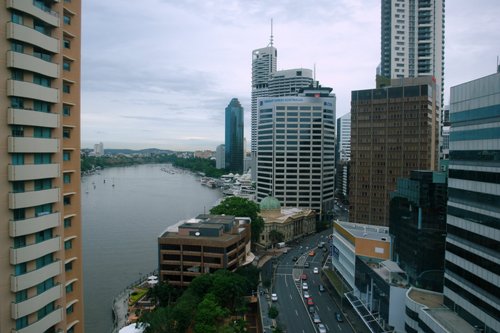 Gary Sauer-Thompson, Brisbane from the Marriott Hotel, 2008
Then the meetings, the rush to make the evening plane through the gridlocked city traffic, a quick drink at the Qantas club, catch the last plane back home, arriving around 10pm, exhausted. All that is remembered is one notable difference: the rain on the east coast compared to a bone dry, dust ladened Adelaide.
This kind of travel for work is more than transport. It's a culture with its own conventions, fashion, food and commentary about hotels, frequent flyer points and travel deals.
February 25, 2008
Adelaide Festival of Arts: Lawrence Daws
There is an exhibition of the work of Lawrence Daws at the Adelaide Festival of Arts. The work is being shown at the Greenhill Gallery.
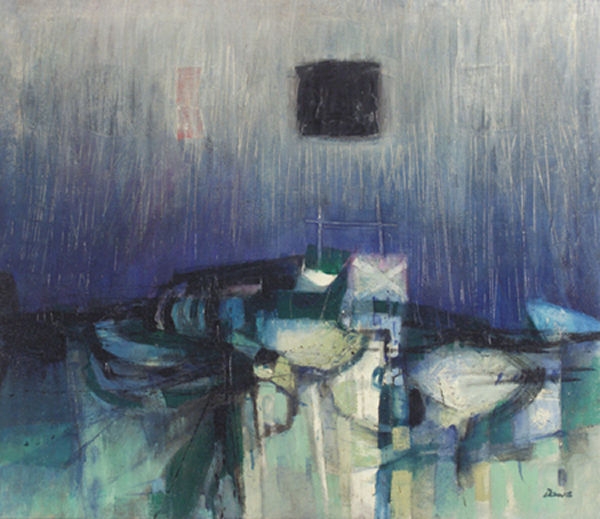 Lawrence Daws, Manes Stone 1
Greenhill Galleries have embrace the internet and so the Daws survery exhibition is online. As would be expected, given my interest in the Fleurieu Peninsula, I am interested in Daws' recent paintings of the Fleurieu Peninsula. None of these are online in the public domain as far as I can discover.
What I have seen is that these works emphasis the barreness, yellowness and the form of the eastern Mt Lofty Ranges.
February 24, 2008
Sidney Nolan
Sidney Nolan at the National Gallery of Victoria is the first retrospective exhibition to be mounted since the artist’s death in 1992 and it includes a selection of his most important works. I didn't see it when I was in Melbourne, which is a pity.
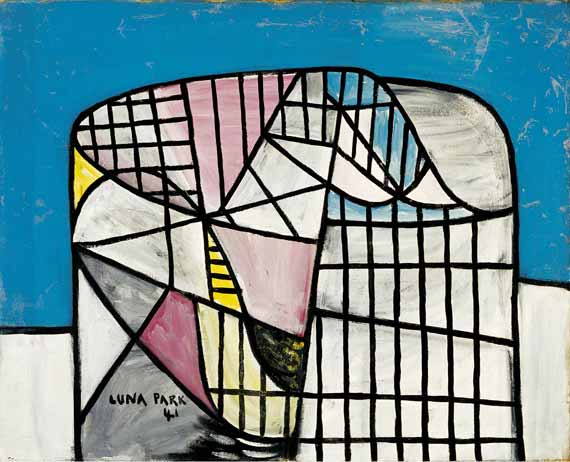 Sidney Nolan, Luna Park, 1941, ripolin enamel on canvas.
The exhibition brings together 117 pieces from all over the world, it is hung chronologically, and represents the different phases of his life. So we get more than the twin series of paintings of the Ned Kelly myth that supposedly created an idea of the entire continent of Australia. What was that idea? Tragedy?
 Sidney Nolan, Self portrait in youth, 1986, spray enamel on canvas,
The argument is that when Nolan began painting in 1932 there was no accepted pictorial language for rendering Australia and that Nolan forged the pictorial language of white Australian painting. Without Nolan there would have been no Fred Williams, no Brett Whiteley.
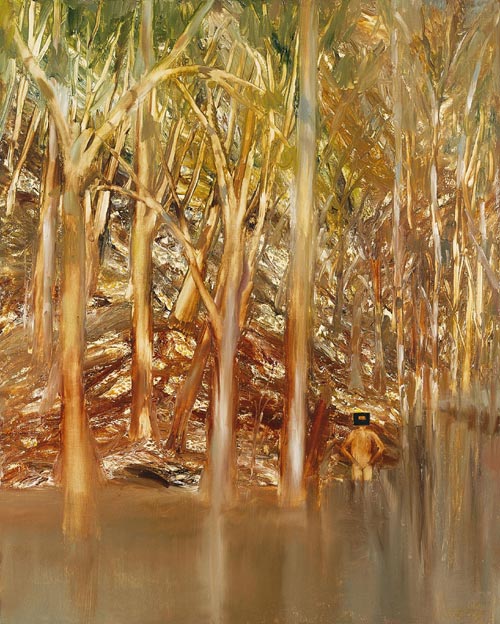 Sidney Nolan, Riverbend 11, 1965–1966, (one of nine panels), Oil on canvas
Riverbend was the first of several panoramic murals Nolan produced between 1964 and 1967, and it was drawn from the Goulburn Valley landscape he used to walk with his father. It proved to be pivotal in his career for integrating his Australian themes of the nineteenth-century outlaw Ned Kelly (now given overtones, among other things, of the explorers Burke and Wills), and the primeval Australian scene. The landscape-----the sunlight filtering through pendant leaves flickered disturbingly on the muddy flanks of the river---dwarfs the human action within it.
February 23, 2008
avoiding the broadband pirates
I may have solved the problem of broadband access when I'm traveling, which avoids the $25 days a day charged by hotels in the CBD of the capital cities. This is piracy. I've signed up to 3 Mobile broadband for two years.
The coverage is limited to capital cities, the speeds are slow and I do not know about the congestion. I simply ignored the sales hype, street buzz, and catchy visuals as the deal gives me the broadband mobility I need. I'll put up with the limitations.
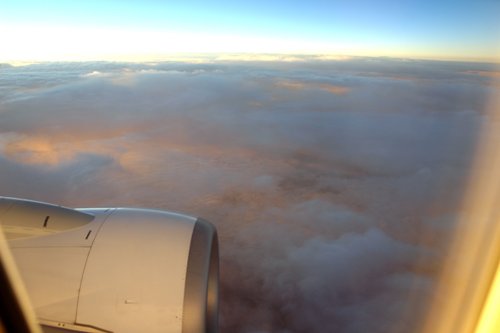 Gary Sauer-Thompson, from a Qantas window, 2008
The buzz us all about the appreciation of street life, the loft or boho lifestyle of the inner city and everything being in walking distance. The surface image in the 3 shop is all about being young and funky. The future is mobile.
Update: 26 February
Well, I'm in Brisbane testing running the 3 mobile network at the Marriot Hotel. It took some setting up----I eventually had to go to the oh so busy 3 shop in Queens Street mall to get them to run some checks and then to access tech support in India. The shop was packed. How come 3 is so fashionable with the inner city young?
The mobile network is working a treat. So I can bypass the hotel pirates and their $25 a day internet charge. One day a month in a hotel covers what I would have otherwise paid. I can shift the modem from one computer to another.
February 22, 2008
fat + hot
More Friday humour:
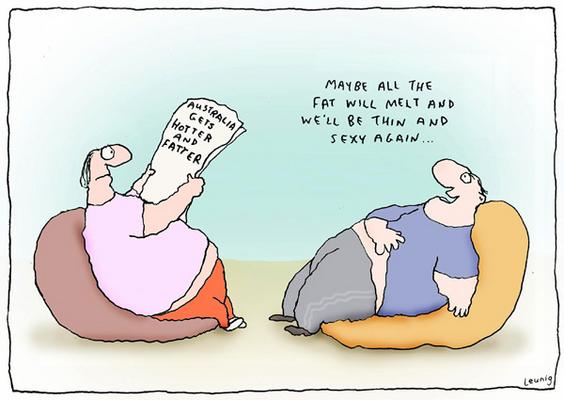 Leunig
The solution is a good diet and frequent exercise. Of course, the libertarians view this as the do-gooders of the Left regulating our pleasures out of existence by the Nanny state interfering in what happens in the kitchen. Food fascism.
For the libertarians this is not much different from the conservatives desire to filter internet porn and to regulate what happens in the bedroom. Both Left and Right deny individual responsibility and crush the choice of individuals to smoke, eat junk food and drink alcohol and take heroin when pregnant.
February 21, 2008
dawn
I was up at 4am this morning so that I could fly to Adelaide on the 6am Qantas flight out of Canberra. I was returning home after ten days on the road. Thankfully, the cab arrived. It's always fingers crossed in Canberra. Whilst waiting for the plane in the Qantas Club, I explored Framelines, which I had come across through Dogmatic, and listened to PJ Harvey.
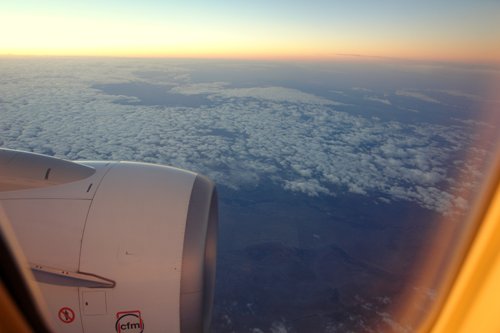 Gary Sauer-Thompson, from a Qantas window, 2008
I kept on thinking about the work of Bronwen Hyde that I'd briefly seen in the second edition of Framelines. It was so different to my own. More grounded. A large portion of Bronwen's photographic the work centres around self-portraiture, urban landscapes, graveyards and dolls and is located in the world of an exhibition, a book and art photography.
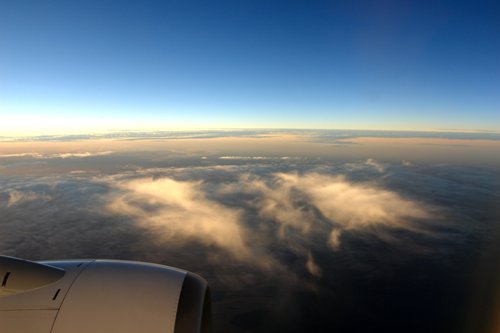 Gary Sauer-Thompson, from a Qantas window, 2008
I am impressed by the online art magazines, such as Phirebrush or f-stop magazine or File magazine. They are the next step on from a photography site or archives and photo-sharing, such as Flickr, or a photoblog. Their offers to submit work for publication is a way of finding more outlets for one's own work.
February 20, 2008
Nicholas Building: Cathedral Arcade
When I was in Melbourne last week I made sure that I had a quick look through the Nicholas Building in Melbourne's CBD. This building, designed by Harry Norris, and built in 1925-26 is an example of the Beaux-Arts style of architecture in Melbourne and is a Swanston Street landmark.
The Nicholas Building is important as it has the only remaining vaulted leadlight arcade (called Cathedral Arcade) in Melbourne, which is surprisingly intact.
 Gary Sauer-Thompson, Cathedral Arcade, Nicholas Building, Melbourne, 2008
Most of the ground floor shops retain their original fronts with the exception of a bookshop.
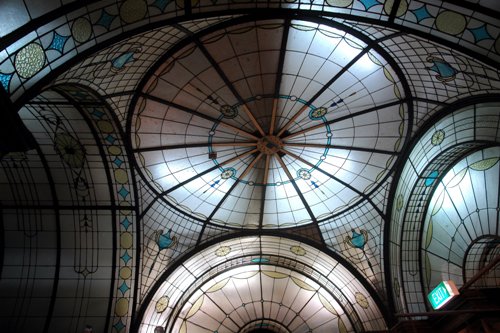 Gary Sauer-Thompson, Cathedral Arcade, Nicholas Building, Melbourne, 2008
The retail shops on the first floor are also extremely well preserved and according to the National Trust are an important example of 1920's office design. The building was originally only 8 storeys tall, but was extended in 1939.
February 19, 2008
Meet the New Boss
Same as the old boss. And the old, old boss. I picked the car up in Tucson on Saturday. The trip between Tucson and Phoenix is best known for its 75 mph (140 kmh) speed limit. The car handled those constant speeds with ease.

The rusted wall in the picture above is from a local library on Thomas Peak Rd. Arizona, and especially Phoenix, has a very modern streak in its architecture. I was hiking on the Scottsdale side of Camelback on Sunday and a residential house was done over in a mix of the rusted metal style and heavy log barn. I like Phoenix' adventurism in this area.
February 18, 2008
De Facto Geographies of Captivity
Bryon Finoki documents the human movement across a fallen boundaryl after Palestinian militants blew the wall at Rafah between Gaza and Egypt.

This is a reclamation of public space from the arbitrary divisions of nationalism.
Finoki writes:
I mean, there is such a fine line between walls that are meant to keep people 'in' and walls that are meant to keep people 'out', if you think about it. Despite any stated intention, either way, a border wall will produce both consequences. For instance, while the US-Mexico border fence’s formal purpose is to keep unwanted immigrants out, its ultimate effect is to keep them inside Mexico. This is made even more paradoxical when you think about the border fence’s impact on those undocumented immigrants who are already within the U.S. and now probably feel trapped there because the risk of exiting the country and not being able to return has become too great.So, again, the wall achieves both inside and outside conditions.
The title of the post if from Finoki's page.
brutalist public spaces
Under a post WW2 modernism in the 20th century the public culture, which had characterised an earlier modernism, had been displaced by a pervasive withdrawal into a private sphere. In architectural or urban planning terms terms, the rise of the (good) garden suburbs was positioned as the nemesis to the (bad) public space of the modern city.
So there was the displacement of traditional public spaces such as city squares, plazas, streets and boulevards into the background and the rise of public spaces that were hostile to a gathering and mixing of people as moving subjects.
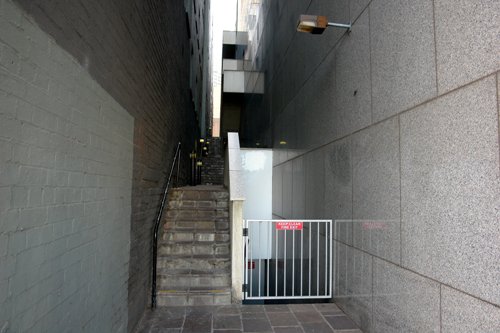 Gary Sauer-Thompson, walkway, Flinders Street/Spring Street cnr, Melbourne, 2008
Such brutalist spaces are not conducive to public civility amongst diverse people who are strangers. They foster fear and apprehension amongst strangers rather than facilitating strangers engaging with each other in public. So we are left with the assumption that Australians feel uncomfortable sitting in a square, and that they are comfortable working at the office, home with the family looking at television, or the productive’ practice of shopping in the department store or arcade.
This decline of the public space--- a turning away from the street and towards controllable domesticity---gave rise to a culture in which strangers had no right to speak to each other, that each mobile subject possessed as a public right an invisible shield, a right to be left alone:
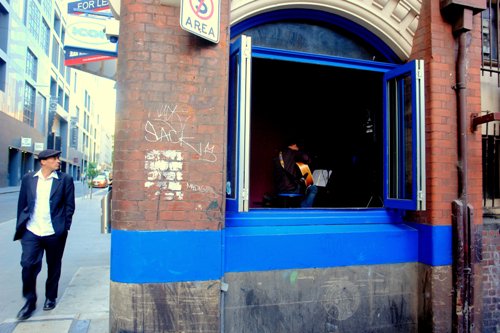 Gary Sauer-Thompson, Flinders Lane, Melbourne, 2008
So we have a modernist public culture that privileged looking over talking, detachment over engagement.
February 17, 2008
AC/DC Lane, Melbourne: revisiting
I had been disappointed in the lack of visual culture in AC/DC Lane when I explored it last year. Afterwards, I realized that I had only seen one part of it. The lane curves in a semi-circle off and then back to Flinders Lane. In my hurry I had failed to walk the curve. I was still caught in the mentality of the Hoddle grid.
I walked through the Fitzroy Gardens and worked my way down the corporate looking Flinders Lane to the AC/DC Laneway.
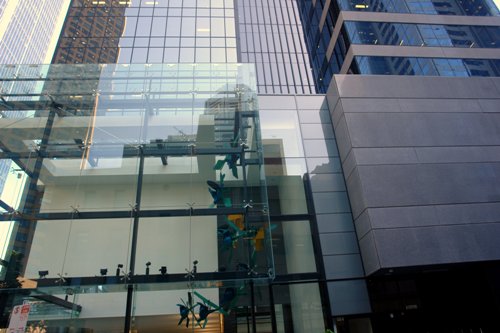 Garry Sauer-Thompson, Flinders Lane/Exhibition Street cnr, Melbourne CBD, 2008
The back doors of the Flinders Lane restaurants opened onto the laneway, whilst other doorways opened up into clubs or upstairs restaurants. There were a few people around in the laneway, mainly restaurant staff. The visual musical culture of the laneway was mainly based on posters, and it expressed, 1970's punk:
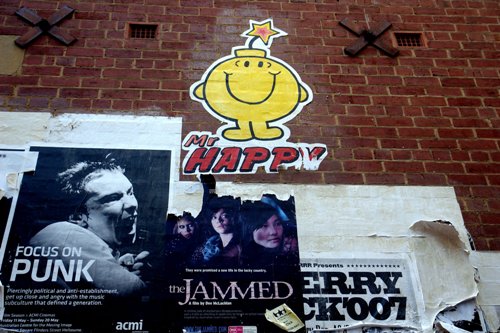 Gary Sauer-Thompson, AC/DC Lane, Melbourne, CBD, 2008
This stood in stark contrast to the rapid renovation of the 19th century warehouses and rag trade buildings happening all along Flinders Lane. Two worlds. But they weren't colliding.
What was surprising was the lack of music being played. It was in the afternoon, but I thought that music would be coming from some of the clubs/venues/ bars as the doors were open. I'd been listening to David Bowie's best music from the 80's period on the plane to Melbourne, and I 'd found it disappointing after the innovative work of the Berlin trilogy period in the 1970s. The 1980s work did not sound fresh, hip, or contemporary. Classic Bowie is both tuneful and adventurous and this was the hallmarks of his '70s work.
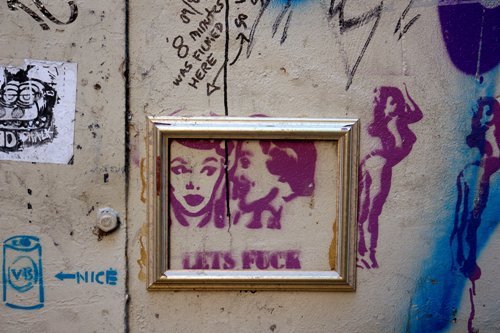 Gary Sauer-Thompson, AC/DC Lane, Melbourne CBD, 2008
Presumably, it is all very different at night. The place comes alive. That's when the music photographers turn up to do their work.
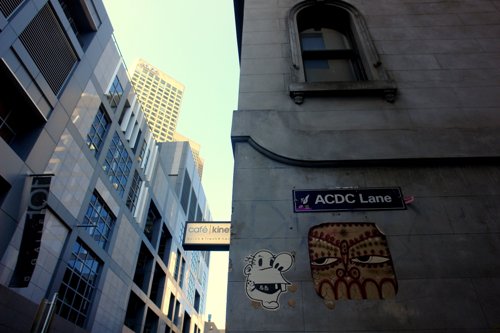 Gary Sauer-Thompson, AC/DC Lane,/Flinders Lane cnr, Melbourne CBD, 2008
I was thinking of Bowie as he seems to be a kitschmeister, and habitue, of a prematurely abandoned modernist space; post-punk minimalist, ironic, electronic pop-as-sound.
February 15, 2008
Melbourne street art: plus
I'm in Melbourne for a couple of days, staying at the Hilton on the Park. I had some time to do some photography in the latter part of the afternoon. My aim was to explore the city along, and around, Flinders Lane in Melbourne's CBD.
so I wandered from the hotel through the ever so green Fitzroy and Treasury Gardens. It was like returning home, as I had once lived in East Melbourne and I'd spent a lot of time in these Gardens. Melbourne looked so green compared to Adelaide. I took some shots of begonias in the Conservatory in the Fitzroy Gardens, then moved on to look at Ian Macrae's exhibition of Italian photos at the always interesting fortyfivedownstairs gallery in Flinders Lane.
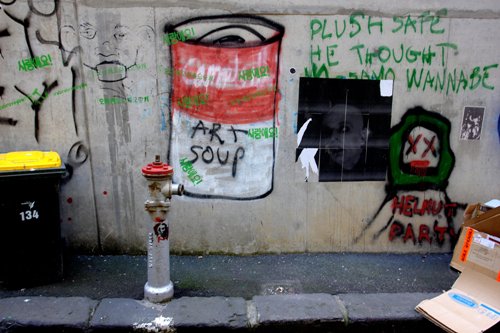 Gary Sauer-Thompson, street art near Flinders Lane, Melbourne, 2008
This image was in a laneway just east of AC/DC Lane. I wanted to explore Flinders Lane more thoroughly this time, as it had only been a cursory glance of AC/DC last time.
I even managed to do a bit of the old style documentary street photography:
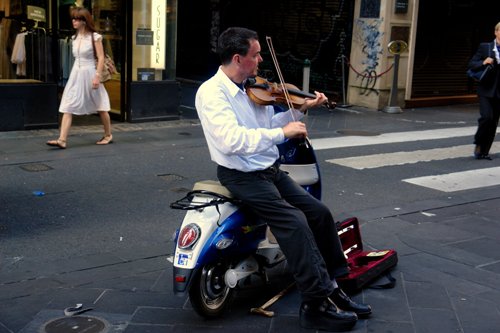 Gary Sauer-Thompson, busking, Flinders Lane, Melbourne, 2008
This was near Campbell Arcade/ Degraves Lane, where I had a quick bite to eat. I then explored more of the city before making my way back to the hotel.
Soul Deep, television culture, academia
I watched Soul Deep: The Story of Black Popular Music last night on ABC1, even though I had to catch an early flight to Melbourne. I was hoping that I'd learn something about this popular form of black American music and whilst watching it I wondered how music and image and history would come together to inform a television culture. Do we have a television culture? Of sorts
The quote below is from an interview with Jane Roscoe conducted by Henk Huijse in M/C Dialogue. Roscoe says:
in Australia we don't seem to take television very seriously. We're not culturally very interested in it. We don't write a lot about television in the public sphere. You know we have movie shows, but you're lucky if you get a column on television. We don't talk about or write about television in sophisticated ways. We don't feel it's an art form. We don't take it seriously. I mean even the people who make television; often they don't watch it, and they feel they're making television because they can't make a film. And so it's always considered that kind of second rate medium, domestic and confined to the living room, and not to be publicly celebrated and enjoyed, and debated over.
I see television as the culture industry and so unworthy of critical refection or consideration unless it is about the trash or junk. I know that not all the product on the different free-to-air channels and Foxtel is trash, but I 'm not really interested in it apart from the programme here and there (eg., Soul Deep Soul Deep), despite the centrality of this media in our visual culture.
Roscoe goes on to say:
I think academics have a great opportunity to kind of make it more of a public celebration. Now, not everything on television is worth talking about. But I think academics can share their knowledge to enrich the experience of viewing, because that's what television culture is about. Viewing can be enhanced when you know something more about processes or ideas; it doesn't have to be like a lecture, and again, you know, not that idea of: if you knew more about what these representations mean, you would know more. But more: how would your viewing be enhanced if you knew more about the processes, or what the program makers were trying to achieve? How would program making itself be enhanced if producers knew more about how audiences relate to their material? And so, academics can play a really important role in exciting people about television, in making links where perhaps a viewer might not already see those. Enhancement rather than education though, I think is what I'm getting at. I like sharing those ideas with people, and I think it's important. Academics are publicly funded and should give back what they take, that's the bottom line. And I think that's an enjoyable way to do it.
It's an excellent point-----Academics are publicly funded and should give back what they take, that's the bottom line.
February 14, 2008
facing the past
A nation confronts its racist past:
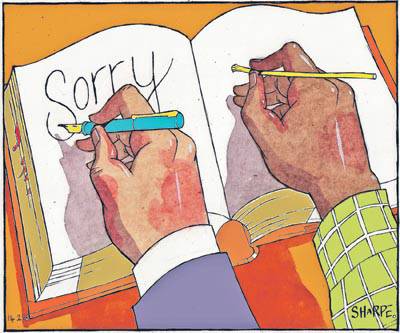 Sharpe
Kevin Rudd, the Australian Prime Minister, said in his speech to Parliament:
There comes a time in the history of nations when their peoples must become fully reconciled to their past if they are to go forward with confidence to embrace their future. Our nation, Australia, has reached such a time. That is why the Parliament is today here assembled: to deal with this unfinished business of the nation, to remove a great stain from the nation's soul and, in a true spirit of reconciliation, to open a new chapter in the history of this great land, Australia.
Rudd, to his credit then mentions the way that race contributed to the "great stain on the nation's soul" through the forced separation of Aboriginal and Torres Strait Islander children from their parents over the better part of a century.
He says:
But should there still be doubts as to why we must now act, let the Parliament reflect for a moment on the following facts: that, between 1910 and 1970, between 10 and 30 per cent of indigenous children were forcibly taken from their mothers and fathers; that, as a result, up to 50,000 children were forcibly taken from their families; that this was the product of the deliberate, calculated policies of the state as reflected in the explicit powers given to them under statute; that this policy was taken to such extremes by some in administrative authority that the forced extractions of children of so-called mixed lineage were seen as part of a broader policy of dealing with the problem of the Aboriginal population.
There in the phrase "forced extractions of children of so-called mixed lineage were seen as part of a broader policy of dealing with the problem of the Aboriginal population" is the reference to the state policy of eugenics.
February 12, 2008
Canberra
I'm in Canberra. The day has been spent setting up a new PC lap laptop running Vista with automatic backup and in transferring the old data from my portable Lacie backup from the old Toshiba with a dud hard disc. It was a tech day at work.
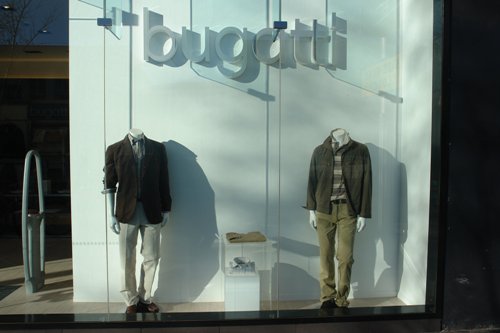 Gary Sauer Thompson, shop window, Canberra CBD, 2007
I missed the opening of Parliament but I saw the 'Welcome to Country' on the ABC 's evening news. That symbolism finally spells the end to the conservative ascendancy of the last decade. 'Welcome to Country' is going to be a part of the opening of Parliament from now on. That is a big cultural shift, and a much welcome one.
February 11, 2008
opening up to photography projects
I have yet to set up a photoblog feeder or aggregator to keep in contact with the work of photographers. I still rely on my contacts in Flickr for this as I know very little about the world of photographers working now. I realized that when I started exploring the work of Amy Stein, that Cam had linked to in this recent post.
What Cam's post disclosed is the world of those photographers who had spent several years working on different photographic projects have shows in galleries and run blogs.
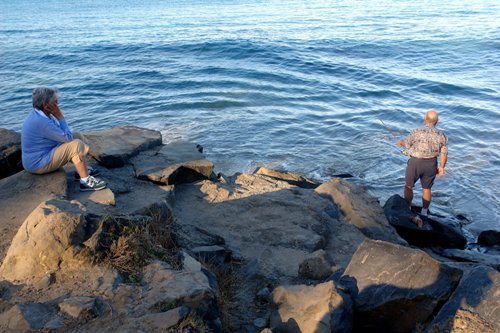 Gary Sauer-Thompson, Rossetta Head, Victor Harbor, 2008
I'm still at the stage of working with Flickriver--that lists my most interesting images according to Flickr's criteria---until the photoblog is up and running. I need to start thinking in terms of my photography as a specific project, despite the constraints on my time. What better place to start than Victor Harbor where I spent much of my leisure time?
This is place undergoing a seachange and it still remains a resort town for the Adelaide daytrippers.
February 10, 2008
fading roses
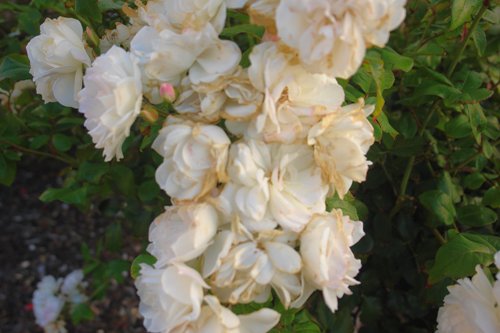
I've reached the limits of my Zeiss lens on the point and shoot Sony R1. I cannot get in too close to a subject, as you can see here, with this shot:
 Gary Sauer-Thompson, fading roses, Victor Harbor, 2008
Pity about the out of focus, as I loved this shot. You can see the difference with Murfomurf's rose or tulip or coffee rose. She is able to get up close to flowers and stay in focus.
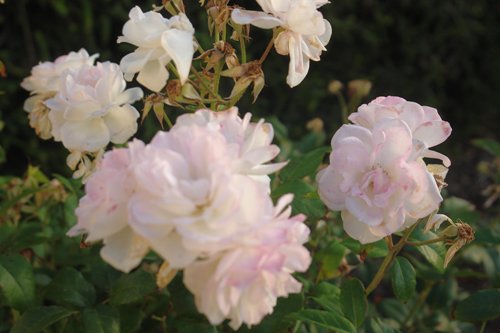
Another example of the limitations of the Zeiss lens:
 Gary Sauer-Thompson, pink rose, Victor Harbor, 2008
Overcoming that limitation means shifting from a point and shoot to a DSLR and a macro lens if want to do close ups of flowers as Murfomurf is able to do. I'll just live with the limitations in the short-term.
I need to put the money into developing Thought-factory-net, improving my computers, backup storage, and remote access, and acquiring some decent photographic software to process my photographs. That will gobble up the money in no time.
February 9, 2008
Keating: try to imagine the Aboriginal view
A quote from Paul Keating's Redfern speech:
I said we non-indigenous Australians should try to imagine the Aboriginal view. It can't be too hard. Someone imagined this event today, and it is now a marvellous reality and a great reason for hope. There is one thing today we cannot imagine. We cannot imagine that the descendants of people whose genius and resilience maintained a culture here through 50 000 years or more, through cataclysmic changes to the climate and environment, and who then survived two centuries of dispossession and abuse, will be denied their place in the modern Australian nation. We cannot imagine that.
That phrase "we non-indigenous Australians should try to imagine the Aboriginal view" is apt, given the way Indigenous artists have painted the landscape or the country. We have great difficulty in learning to read the country from their traditional perspective. We could imagine that point of view though.
going European
I'm having great difficulty posting this weekend. The hard drive on my Toshiba laptop has died, as has the old desktop computer at the weekender in Victor Harbor. So I'm writing this post from the public library at Victor Harbor, and not much that I'm writing is getting through for some reason.
I've wasted the hour of my community access on posts that never went public for some reason. I rewrote them and they appeared in double. My attempts to clean things up achieved little. So this post is a test.
 Martin Rowson
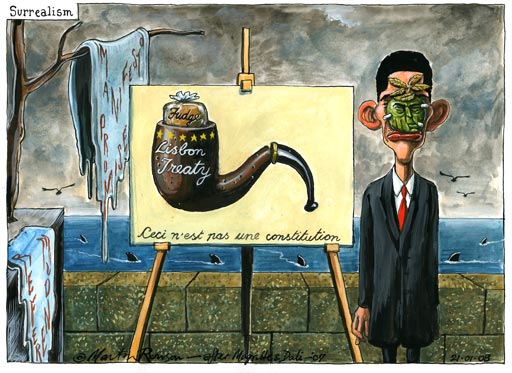
It's a great image about European federalism is it not?
I'm going to have to go and find an internet cafe in the town centre on Sunday to clean things up since the public library is closed on Saturday afternoon and Sunday. From what I've been told the commercial rates are around $6 an hour.
February 8, 2008
Stranded
Amy Stein explores the space on America's highways; "Stranded is a meditation on the tension and desolation found on the shoulders of America's highways and interstates. My photos challenge the viewer to slow down and witness scenes of futility playing out in an uneasy and alien space."

a rose, the baroque, the fold
"The baroque" is a term traditionally associated with the seventeenth century, though it was not a label used by individuals of the period itself to describe the art, economics, or culture of the period. During the eighteenth century "baroque" implied an art or music of extravagance, impetuousness, and virtuosity, all of which were concerned with stirring the affections and senses of the individual. The baroque was believed to lack the reason and discipline that came to be associated with neoclassicism and the era of the Enlightenment.
 Gary Sauer-Thompson, my desktop, (decaying rose), 2008
For the eighteenth and the nineteenth century, the baroque was increasingly understood as possessing traits that were unusual, vulgar, exuberant, and beyond the norm. Indeed, even into the nineteenth century, critics and historians perceived the baroque as a degeneration or decline of the classical and harmonious ideal epitomized by the Renaissance era. The baroque was generally considered a chaotic and exuberant form that lacked the order and reason of neoclassicism, the transcendent wonder of romanticism, or the social awareness of realism.
It is within the context of the postmodern that the neo-baroque has regained an aesthetic presence.
In her Introduction to her Neo-Baroque Aesthetics and Contemporary Entertainment Angela Ndalianis says:
As was the case with the seventeenth-century baroque, the current expression of the neo-baroque has literally emerged as a result of systemic and cultural transformations, which are the result of the rise of conglomeration, multimedia interests, and new digital technology. Cultural transformation has given birth to neo-baroque form. The neo-baroque articulates the spatial, the visual, and the sensorial in ways that parallel the dynamism of seventeenth-century baroque form, but that dynamism is expressed in guises that are technologically different from those of the seventeenth-century form. In the last three decades in particular, our culture has been seduced by visual forms that are, reliant on baroque perceptual systems: systems that sensorially engage the spectator in ways that suggest a more complete and complex parallel between our own era and the seventeenth-century baroque.
The argument is that the neo-baroque offers a productive formal model with which to characterize the transformations of cultural objects of our epoch; that many of the important cultural phenomena of our time are distinguished by a specific internal `form' that recalls the baroque" in the shape of rhythmic, dynamic structures that have no respect for rigid, closed, or static boundaries; and that neo-baroque forms display a loss of entirety, totality, and system in favour of instability, polydimensionality, and change.
 Gary Sauer-Thompson, folding rocks, Victor Harbor, 2007
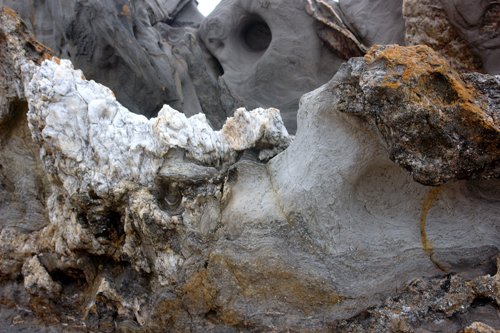
In The Fold Gilles Deleuze argues that Leibniz's writings constitute the grounding elements of a Baroque philosophy and of theories for analyzing contemporary arts and science. A model for expression in contemporary aesthetics, the concept of the monad is viewed in terms of folds of space, movement, and time. Similarly, the world is interpreted as a body of infinite folds and surfaces that twist and weave through compressed time and space.
February 7, 2008
Architecture: brutalism + modernism
Brutalism in modernist architecture has a presence in Australia, though it is often softened with a slab of colour as distinct from the singular, iconic concrete monoliths that are favoured by Telstra to signify its dominant gorilla like presence in Australia's telecommunications industry.
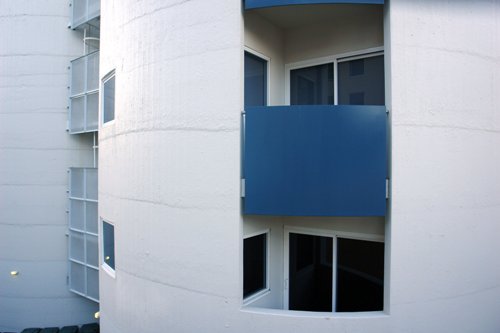 Gary Sauer-Thompson, flats (back detail), Salamanca Place, Hobart, 2007
This building, as self-contained monolithic form, is probably better seen as an updated Brutalist style. It still continues the tradition of architects thinking of cities as collections of buildings with spaces in between them.
It belongs to the modernist tradition, as it both utilizes advances in technology to produce a better quality of life for all, and repudiates the 19th century tradition and heritage. In doing so modernism radically changed,. and is changing, the urbanscape in Australia.
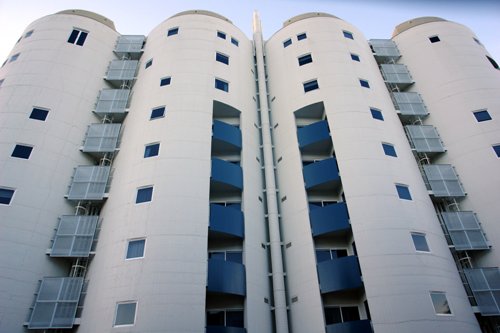 Gary Sauer-Thompson, Modernist flats (back facade), Salamanca Place, Hobart, 2007
I do not have a working knowledge of the history of modernist architecture in Australia with its concept of architecture as a monumental, autonomous, constructed space, in Australia, its fierce opposition to historicism and taste for superfluous ornamentation, and its dream of a rationalized machine world where life would approach the perfection of an assembly line.
Mauro F. Guillén in his The Taylorized Beauty of the Mechanical: Scientific Management and the Rise of Modernist Architecture says the modernists architects:
They yearned to create houses, public buildings, factories, artifacts, and durable consumer goods combining beauty with technical, economic, and social efficiency. They became technicians organizers, and social reformers as well as artists, adding the stopwatch, the motion picture camera, the slide rule, and the psycho-physiological test to their toolkit. Architecture and our experience of the built environment changed in ways still discernible today. Technology merged with style, science with history, efficiency with creativity, and functionality with aesthetics.
I don't know the effect of the Bauhaus or Le Corbusier's concepts of the “machine for living,” the standardized “dwelling unit,” and the “mass produced house” in Australia after WW2. Modernism includes several “discontinuous movements” not always fully compatible with each other; but there is an overall unity in the aesthetic qualities of the institutionalized modernist architecture, such as classical trinity of “unity, order, purity”.
February 6, 2008
urban nature in Adelaide
As the old building sites from the days of rustbelt Adelaide slowly gives rise to new modernist glass towers the urban trees are cut down. Despite the city sweltering during the long months of summer heat there are little moves to plant trees to provide shade for people as they walk the city. So we have images like this in the south west corner of the city:
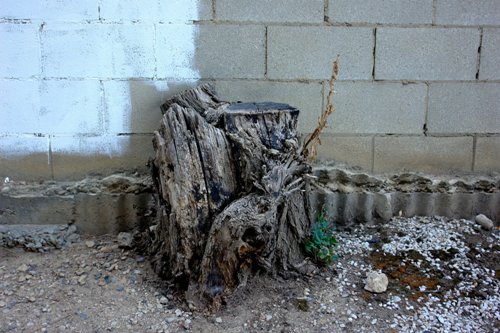 Gary Sauer-Thompson, tree stump, Adelaide CBD, 2008
Urban design is still modernist--how to pack lots of people in a small ordered space with little thought being given to the quality of the public spaces in a warming world. Trees represent disorder, mess, uncleanness. Only decorative street trees and trees in parks are allowed. Le Corbusier’s key text, The City of Tomorrow and its Planning, is central to understanding our urban life.
It is premised on “the exodus of city dwellers” from the centers of the city and the “replacement by business.” Le Corbusier take this as evidence that people prefer to live in suburbs rather than in cities, and therefore bases his theory of urban planning on the idea that the center should be for commerce (and some public services), and that it should be surrounded by two belts of residential areas – one with “blocks of dwellings on the ‘cellular’ system”, and one outer garden city. The center of a great city should consist mainly of skyscrapers – exclusively for commercial use.
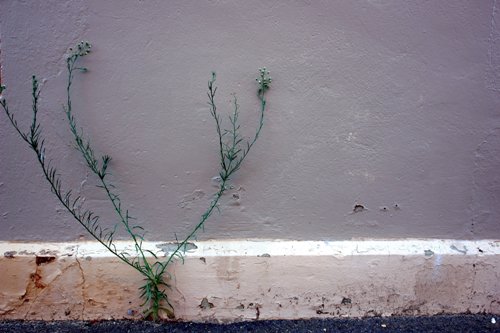 Gary Sauer-Thompson, green weed, Adelaide CBD, 2008
That's how urban planning in Adelaide traditionally understand itself, with on modification---trying to bring people back to the live in the CBD to create some life,diversity and creativity in a CBD that was dead and empty after working hours. The New Urbanism of Jane Jacobs, with its stress on the importance of diversity in neighborhoods in the inner city is not embraced.
Like Le Corbusier it is assumed that order = peace and happiness. Adelaide as an ordered garden city is of a purely geometrical kind; its rectilinear is clear and well-arranged, easy to police and to clean, a place in which you could find your way about and stroll with comfort.
What was rejected is what Le Corbusier calls the Pack-Donkey’s Way--or the curvilinear type of city that allows the meandering along, meditate a little, becoming lost, and ending up is strange and different spaces.
February 5, 2008
Leunig: humour
bad theory--the joyless wordsmiths that beat the image, nay art, to death with their verbosity, as they grimly dissect its corpse. That's the cultural Left, say the cultural conservatives as they gird their loins for yet another battle in the eternal cultural wars.
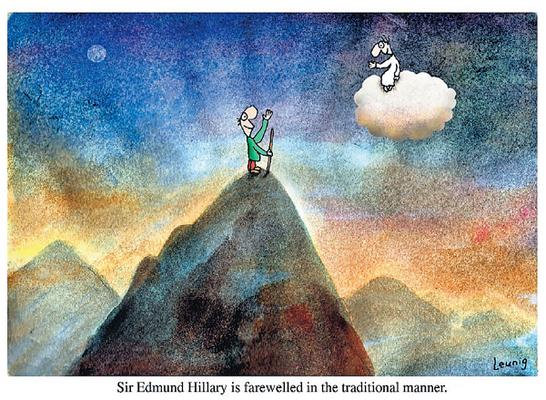
Some humour from Leunig, an old leftie.
Joseph Cornell assemblages
Joseph Cornell constructs his boxes as constellations or, perhaps, as nodal points of private associations of collected objects, which are in ‘infinite combination’ and rearrangement. These works sometimes involve stargazing’ from the perspective of the fan.
 Joseph Cornell Untitled (Penny Arcade Portrait of Lauren Bacall),1945-46, Construction
So we have an example of collector's cabinets of curiosity as portals within a single frame. These works are assemblages:
 Joseph Cornell, Untitled (Paul and Virginia), c. 1946-48 (150 Kb); Construction
They can be read in terms of multiple perspectives within a frame--just like a computer screen.
 Joseph Cornell, Verso of Cassiopeia 1, 1960
They can be interpreted as multiple virtual portals within a frame.
February 4, 2008
modernism + heritage
According to Nathan Glazer in his From a Cause to a Style: Modernist Architecture's Encounter with the American City modernism in architecture and urban design, proposed one big and all-embracing ideal for buildings and cities: building should be functional, rational, directly accommodating specific needs, and should eschew the forms and elements that had dominated architecture in the West since the Greeks.
It rejected the sculpted, ornamented architecture of major public buildings, and the use of the details and conventions of some past epochs, best expressed in the buildings designed for princes and potentates, secular and sacred. Modernism rejected any use of the styles of building of the past.
 Gary Sauer-Thompson, heritage, Adelaide CBD, 2008
Modernism called for "the machine for living." And the city was also to be a machine. The architecture and urban design of modernism—in particular, the publicly subsidized high-rise housing projects on large cleared sites that became, along with the flat-topped glass and steel skyscrapers of the city center, are the very emblems of modernism—in Australia.
Glazer's From a Cause to a Style collects his intriguing and accessible essays on urban architecture and public space, some of which originally appeared in City Journal and The Public Interest. He says that in an effort both to break with the past and to provide the working classes with better living conditions the modernists insisted that buildings should be relentlessly functional and rational, accommodating specific needs. Architects should make no concessions to public taste—the public would need to learn what to like. He adds:
that the greatest successes of the critics of modernism had less to do with building something new and counter to modernism than with preserving what existed, what had been created in the ages before modernism, when historical styles were innocently copied, revived, revised, adapted to different uses, used even for factories and office buildings, and were allowed to cluster together messily and incongruously in the city.
This is certainly the case in Australia. Heritage was the battle ground from the 1970s and it still is. Despite public rejection of modernism the style survives—and even thrives in some settings such as the CBD of the capital cities. Virtually all new office buildings arise in the bland textures and boring modernist style that repudiates the life the street.
February 3, 2008
multiple perspectives
This painting below is called Nomad. A nomad is someone who travels around from place to place and doesn't have a permanent home. Paintings usually have one part that stands out from all the others; this is called the "focal point." James Rosenquist's painting doesn't have a focal point. Our eyes just keep moving around, like a nomad.There is no single perspective:
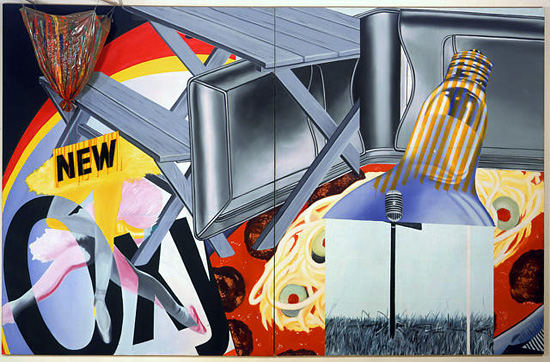 James Rosenquist, Nomad, 1963, Oil on canvas, plastic, and wood,
There are a number of his works that have multiple perspectives within a single frame and which look remarkably like photos of street art:
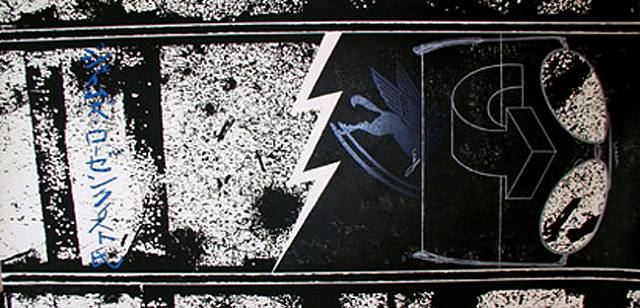 James Rosenquist, Rails, 1975-6, Lithograph
We could now read the history of art, cinema, photography in terms of a fracturing of perspective and the way that the collectors cabinets of curiosity, art objects and collectables functioned less as a literal ‘window’ and more as portals to its user by housing the flotsam and jetsam of a natural/artifical world through an enframed display.
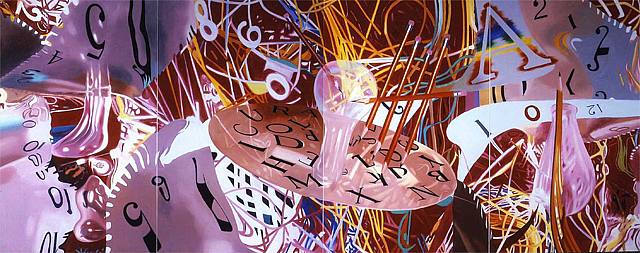 James Rosenquist, Time Blades-Learning Curves, 2007, oil on canvas
What needs to be emphasized is the frame of viewing, not a natural or mimetic view. So the turn is to imaginative narrative mappings rather than to the production of a “window on the world”.
Manufacturing Town Squares
Developers in Northern Virginia built out large suburbs of mixed high, medium and low density housing. Suburbs with broad streets and trendy, new shopping centres and malls. However they found young educated professionals were choosing the old city centres like Alexandria and Arlington over their new developments. This was a wealthy market that the developers did not like missing out on. A new development in Northern Virginia is Lansdowne. It contains the normal spiralling suburb but with sections that have artificially constructed town centres.

Parking is off the side of the town centre so the restaurants and shops are pedestrian friendly. There is a tall clock tower, a small atrium for music, and central park area. Surrounding the town square is high density housing and light commercial buildings. This is being designed for the single young professionals. I like it.
The goal is to give it a European feel, but like Las Vegas, the buildings are new, clean and air conditioned. Plus there are touches of modern American landscaping.

One of the most successful upscale big stores is Wegmans. This is a Dutch company but is run out of Rochestor, NY. The stores are slowly making their way south from the US NE and one recently opened in Ashburn, VA near the AOL Headquarters. These are heavily trafficked by the working professionals of North Virginia.
Where Wegmans differs from other big box stores is that they design them inside like a town square. It looks like a cross between the Montreal fishmarkets and a European town centre. Both Lansdowne and Wegmans are probably aimed directly at people like me. I like them. They are well designed and executed.
February 2, 2008
beyond a single point perspective?
If we reject photography as a window onto the world and as a form of personal expression, then what do we have left? Where do we go? Well, it means that we have left, or are in the process of leaving the cultural formation of positivism and romanticism---the dualist and conflicting twins of modernity as it were ---behind. But what have stepped into? A vacuum? A black hole? Possibly not.
We could interpret this photo as multiple spaces coexist and overlapping like a computer screen--as if it were a customized igoogle desktop-- rather than as a picture:
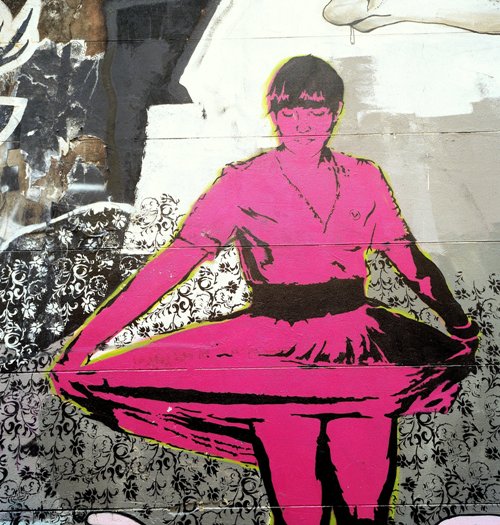
Gary Sauer-Thompson, Hosier Lane, Melbourne, 2007
What if windows were actually translucent and not transparent? One that lends itself to imaginative narrative mappings rather than to the production of a “window on the world? This excellent image----Once Upon Time --- on Myla Kent's blog is a better example of a translucent window. It is different to this kind of historical image making. It is possible to read/interpret Kent's image as if it were a computer screen, rather than the single point perspective that reaches back to Leon Battista Alberti De pictura (1435).
I'm not sure where this leads----to the flows of multiple perspectives within a single computer frame? To virtual windows, as understood in Anne Friedberg's interesting The Virtual Window: From Alberti to Microsoft. That text charts a pathway.
Update
Some of my photography takes its bearings from pop artists such as Robert Rauschenberg and James Rosenquist.
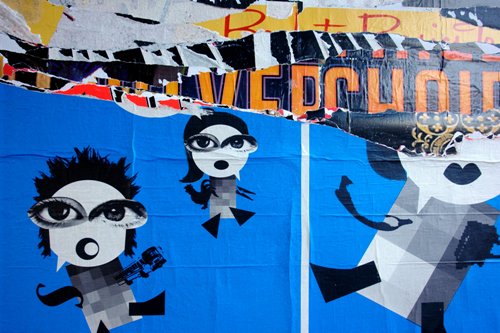 Gary Sauer-Thompson, street art, King Street, Melbourne CBD
The way we produce and interpret both the moving and still image seems to be undergoing a series of profound shifts. We have come to inhabit a pervasive screen-scape in which our “position is no longer fixed in relation to the virtual elsewheres and elsewhens seen on a screen… the virtual window is mobile and pervasive.
What does seem to have gone--in contemporary work such as this ---is the strong linkage of the linear or single-point perspective with the “Cartesian subject: centered and stable, anonymous and thinking, standing outside the world. The computer-based virtualities do not adhere to a fixed, perspectival positioning, as we have multiple-screen display or multiple-screen composition within the single frame.
Daniel Walbidi + Bidyadanga art movement
Daniel Walbidi, a key figure in the Bidyadanga art movement, blends Aboriginal artistic techniques, the vocabulary of modern art. This work is born of the collision between tradition and modernity.
 Daniel Walbidi, Winpa, Synthetic polymer paint on linen
The Bidyadanga tribe lived in an area in the Great Sandy Desert identified as being around Well 33 on the Canning Stock Route. It is Yulparija country. After a decade of devastating drought, the tribe was forced to move away in the 1950s, and they went to the coast, which they now call home and have "learned to eat fish"
The tribal land is intensely important to Aboriginal people and the artists of the Bidyadanga community have been painting it ever since. The transition from desert subsistence to coastal living introduced many rich greens and ocean blues into their art as well as the pinks and yellows of coastal flora. The mix and variation of this vibrant palette, combined with a memory of hot reds and yellow spinifex of the harsh desert landscape, has produced a different kind of art.
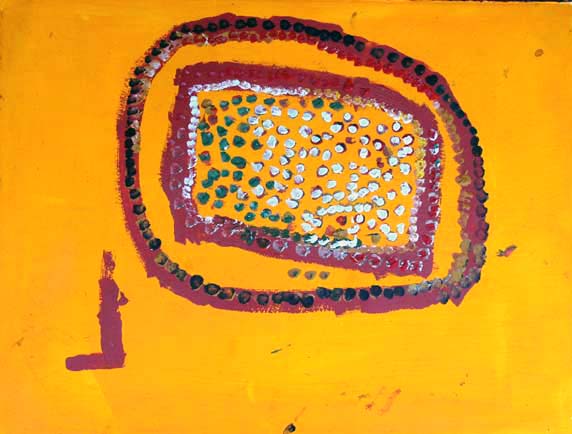 Alma Webou (Kalaju), Untitled, 2002, acrylic on paper
Last year the old people took Walbidi back to the sacred land that they had left half a century ago and for the first time he saw the landscape he had been painting for eight years, imagined only from songs and stories passed down from older generations. Of particular significance is Wimpa,a freshwater spring in the dune surrounding Percival salt lakes.
If Aboriginal art is proving to be one of the most distinctive creative currents of our time, then it is best evaluated in the terms of two contending realms in the collision between tradition and modernity.
February 1, 2008
Library of Congress on Flickr #1
Another historical image--one that is relevant to contemporary Australia whose current prosperity depends on mining rocks in the ground. The image is from the Library of Congress' 1930s-40s in Color collection.
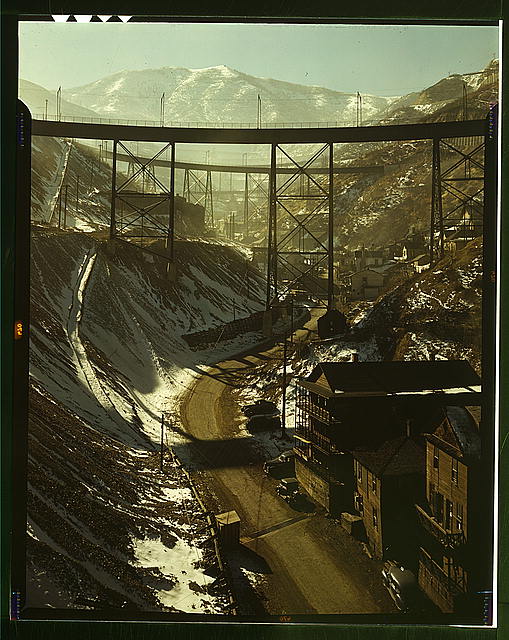 Andreas Feininger (1906-1999), Carr Fork Canyon as seen from "G" bridge, Bingham Copper Mine, Utah, colour transparency, 1942, (Library of Congress)
It is part of a series of color photographs that depict life in the United States, (including Puerto Rico and the Virgin Islands), and which focus on rural areas and farm labor, as well as aspects of World War II mobilization, including factories, railroads, aviation training, and women working.
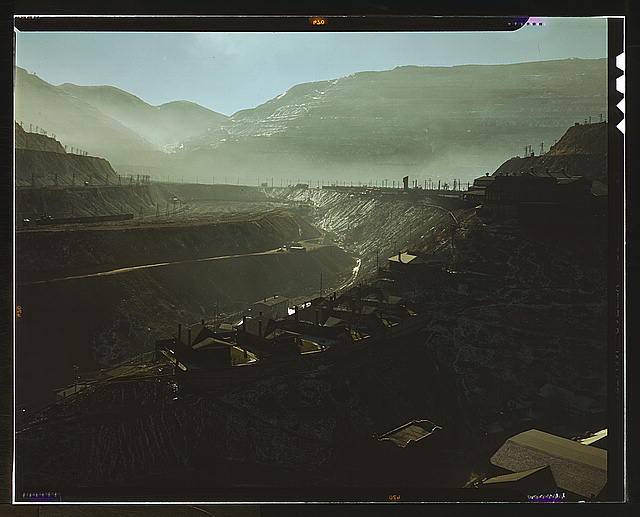 AndreasFeininger (1906-1999), American Smelting and Refining, Garfield, Utah,1942, colour transparency, (Library of Congress)
Is there a similar Web 2.0 documenting going in WA today? Or Queensland? Or SA? Is some of the vast wealth being generated from selling minerals to China being ploughed back into a visual culture commons pilot project structured around the public domain and user communities so as to help people better acquire information, knowledge and—understanding of our lived history?